What Is a Half Cousin? (Chart + How It Happens)
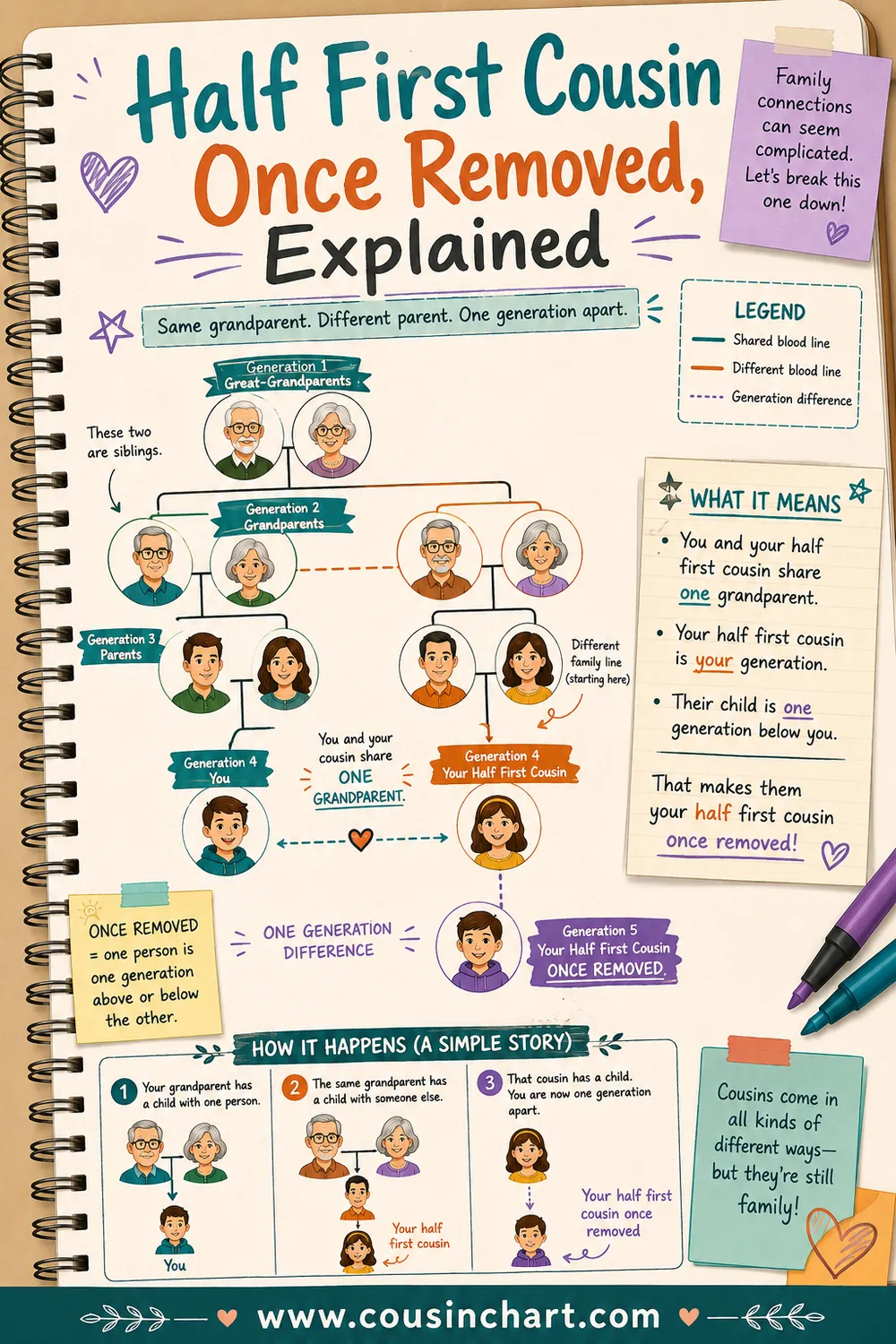
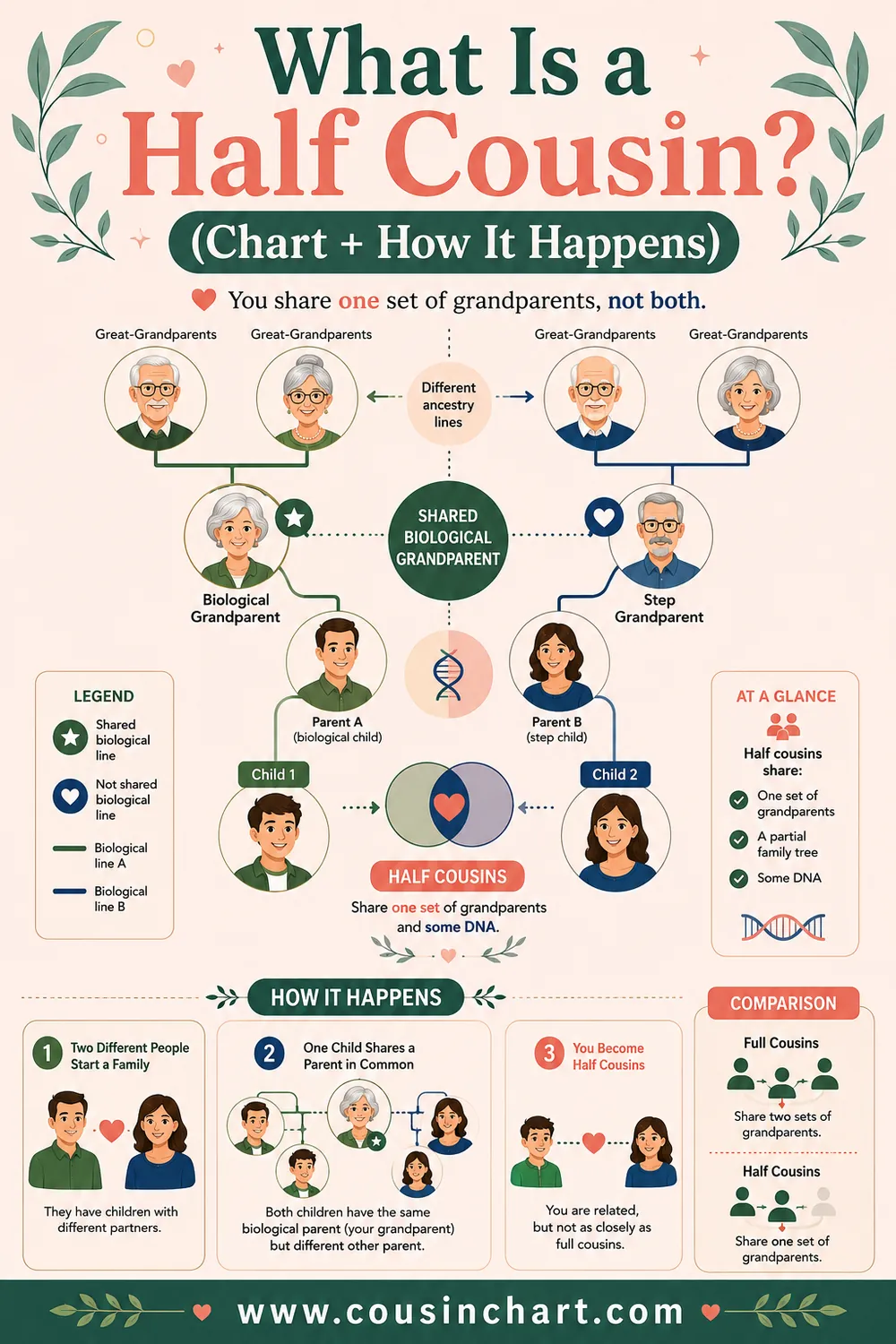
A half cousin is the child of your parent's half-sibling — which means the two of you share one grandparent instead of two. Where full first cousins descend from the same grandparent couple, half cousins descend from the same single grandparent through different partners.
Half cousins are completely real cousins — same generation, same branch structure, half the shared ancestry. This guide covers how the relationship happens, the chart, the DNA numbers (including the one that confuses every match list), and how "half" ripples down the generations. For any specific pair, the free relationship calculator on our homepage sorts it in seconds.
Relationship quick-check. Tap a phrase to see the correct term:
The answer will appear here.
How a Half Cousin Happens
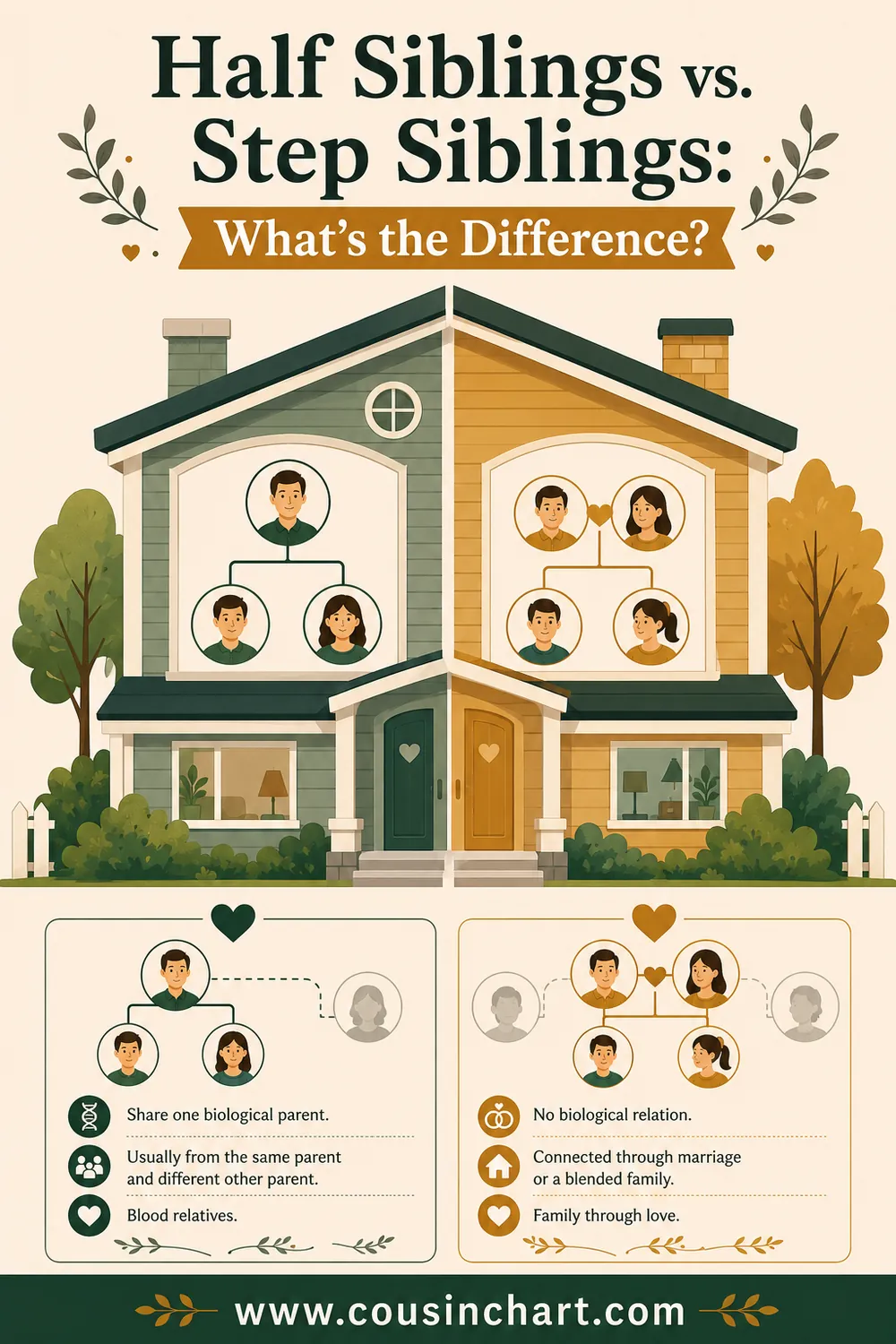
Half cousins start one generation up, with half-siblings. Say your grandfather had a son (your dad) with your grandmother, and later another son with a second wife. Those two sons are half-brothers — they share a father but not a mother. (More on that distinction in half siblings vs step siblings.)
Now both sons have kids:
- Your dad has you.
- His half-brother has a daughter, Nora.
You and Nora are half first cousins. You each have one line running back to your shared grandfather — but where full cousins also share a grandmother, your grandmothers are two different women.
Common routes to half cousins: a grandparent who remarried after divorce or widowhood, a grandparent with children from more than one relationship, or a blended family a generation back that nobody drew on the tree. It's ordinary family history, and far more common than the tidy textbook trees suggest.
Half Cousin Chart: One Grandparent vs Two
| Full first cousins | Half first cousins | Step-cousins | |
|---|---|---|---|
| Parents are... | Full siblings | Half-siblings | Step-siblings (or step-aunt/uncle situations) |
| Shared grandparents | Two (a couple) | One | None |
| Blood relation? | Yes | Yes | No |
| Average shared DNA | ~12.5% (~865 cM) | ~6.25% (~430 cM) | 0% |
| Same generation as you | Yes | Yes | Usually |
The "half" prefix carries down every degree, always meaning "one ancestor instead of the couple":
- Half second cousins share one great-grandparent — their parents are half first cousins because the grandparents were half-siblings.
- Half third cousins share one great-great-grandparent.
- Removals attach normally: your half cousin's child is your half first cousin once removed.
The DNA Numbers — and the Classic Mix-Up
Half cousins share about 6.25% of their DNA on average — roughly 430 centimorgans. That's exactly half the full-first-cousin average, which makes sense: one shared ancestor contributes instead of two.
Here's the wrinkle that confuses every DNA match list: 6.25% is also the average for a first cousin once removed. The two relationships are indistinguishable by DNA amount:
| Relationship | Average shared DNA |
|---|---|
| First cousin | ~12.5% |
| Half first cousin | ~6.25% |
| First cousin once removed | ~6.25% |
| Second cousin | ~3.1% |
| Half second cousin | ~1.6% |
So when a testing site labels a match "1st cousin once removed," a half first cousin fits the same numbers. Clues that break the tie:
- Age and generation. Half first cousins are usually your rough contemporaries; a 1C1R is typically a generation older or younger.
- Which grandparent lines match. Shared matches clustering around one single grandparent — not a couple — point to a half relationship.
- X-DNA and family records. Marriage dates, remarriages, and obituaries usually reveal the half-sibling generation quickly.
This is one of the most common "surprise" discoveries in consumer DNA testing, and it's worth handling gently — a half relationship in the tree sometimes surfaces family history someone kept private.
Are Half Cousins "Real" Cousins?
Yes — fully. Socially and legally, nobody meaningfully distinguishes half cousins from full ones:
- Socially, almost every family just says "cousin." Many half cousins never learn about the "half" until someone builds the tree or takes a DNA test.
- Legally, where cousin relationships matter (inheritance, marriage law), half-blood relatives of a degree are generally treated like whole-blood relatives of that degree, though specifics vary by jurisdiction. On marriage: US states regulate first cousin marriage in varying ways, and a few explicitly address half cousins — laws vary by state, so check current law if it's a live question.
- Genealogically, the "half" matters and should go on the chart, because it changes which ancestor lines you research and how much DNA you expect.
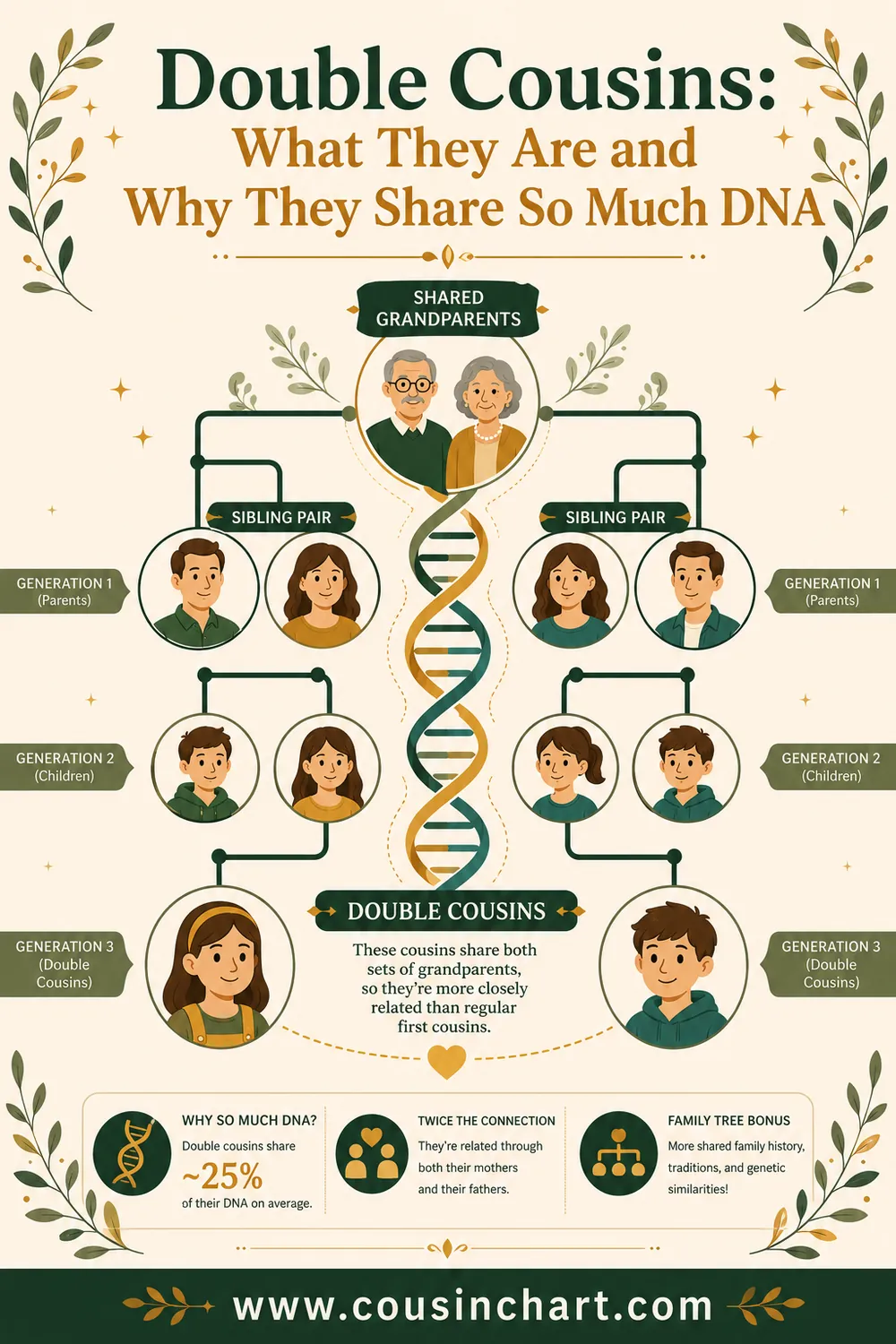
The prefix isn't a demotion. It's a precision tool — the same way double cousins sit at the other end of the scale, sharing both sets of grandparents and roughly double the usual DNA.
How "Half" Ripples Down the Tree
Once a half relationship enters the tree, everything downstream inherits it. From you and your half first cousin Nora:
- Your kids and Nora's kids → half second cousins (one shared great-grandparent).
- Nora's child to you → half first cousin once removed.
- Your grandkids and Nora's grandkids → half third cousins.
The degree-and-removal math is untouched — count generations to the shared ancestor exactly as usual. The "half" simply tags along, meaning "one person at the top of this line, not a couple." Our free cousin calculator handles half relationships too: pick the half-sibling link where it occurs, and the term comes out with the right prefix attached.
A Match-List Walkthrough: Finding the Hidden Half
Here's how a half cousin typically surfaces in real life. Jess gets a DNA match named Dana at 440 cM — labeled "1st cousin once removed" by the site. But Dana is Jess's age, and a 1C1R should usually be a generation off. That mismatch is the first clue.
Jess works the problem:
- Check the shared matches. Everyone Jess and Dana both match clusters on Jess's grandfather Ray's side — and none of them match Jess's grandmother's relatives. DNA flowing through one person rather than a couple is the signature of a half relationship.
- Look for the second family. Ray's obituary mentions being "preceded in death by his first wife." A quick marriage-index search turns up Ray's earlier marriage in 1946 — and a son from it.
- Connect the lines. That son is Dana's father: Jess's dad's half-brother. Jess and Dana are half first cousins, sharing Ray and only Ray.
Notice that the DNA number never changed — 440 cM fit both explanations from the start. What solved it was age logic, the one-sided match cluster, and fifteen minutes of records. That's the reusable recipe whenever a match's label feels one generation off: suspect the half.
Putting Half Cousins on Paper (Without Breaking the Tree)
Family tree software doesn't have a "half cousin" button — and it doesn't need one. The half relationship falls out automatically if you record the grandparent generation correctly:
- Enter both unions. Give the shared grandparent two partnerships, each with its own spouse and children. The most common charting error is merging two wives into one person, which quietly upgrades every half cousin to a full one.
- Attach each child to the right couple. Census households, marriage records, and obituaries ("survived by his sons Ray Jr. and Tom, and stepdaughter Alice") sort out which children belong to which marriage.
- Let the software do the labeling. With the two unions recorded, decent genealogy programs — and the CousinChart calculator — will report "half first cousin" on their own.
One documentation tip: the records proving a half relationship are the remarriage records. A widowed or divorced grandparent's second marriage license, the census that shows a blended household, and the two sets of birth records are the paper skeleton of every half-cousin line. File them with both branches, because researchers on each side will eventually come looking.
If the "Half" Is News to the Family
Sometimes drawing the chart accurately means surfacing a first marriage, an out-of-wedlock birth, or an adoption nobody talked about. A little care goes a long way:
- Verify before you share. Be sure the paper trail and the DNA agree before telling anyone their grandfather had another family.
- Start with the oldest generation, privately. They often already know — and can add the context that turns a scandal into an ordinary, human story.
- Lead with connection, not correction. "I found cousins we didn't know" lands better than "your dad hid a marriage."
Most families absorb a new half branch quickly. The cousins were always real; the chart just caught up.
FAQ
What is a half cousin in simple terms?
The child of your parent's half-sibling. You share one grandparent instead of the usual two, making you half first cousins.
How much DNA do half cousins share?
About 6.25% on average (~430 cM) — half of what full first cousins share, and the same average as a first cousin once removed, which is why DNA sites can't tell those two apart by numbers alone.
Is a half cousin still a real cousin?
Completely. Half cousins are blood relatives on the same generation; most families call them simply "cousins" and never mention the half.
What's the difference between a half cousin and a step-cousin?
A half cousin shares a grandparent with you (blood relation). A step-cousin is connected only through a remarriage — no shared ancestor and no shared DNA.
What is my half cousin's child to me?
Your half first cousin once removed — the half version of the ordinary removed relationship, one generation below your half cousin.
What are my half cousin's parents to me?
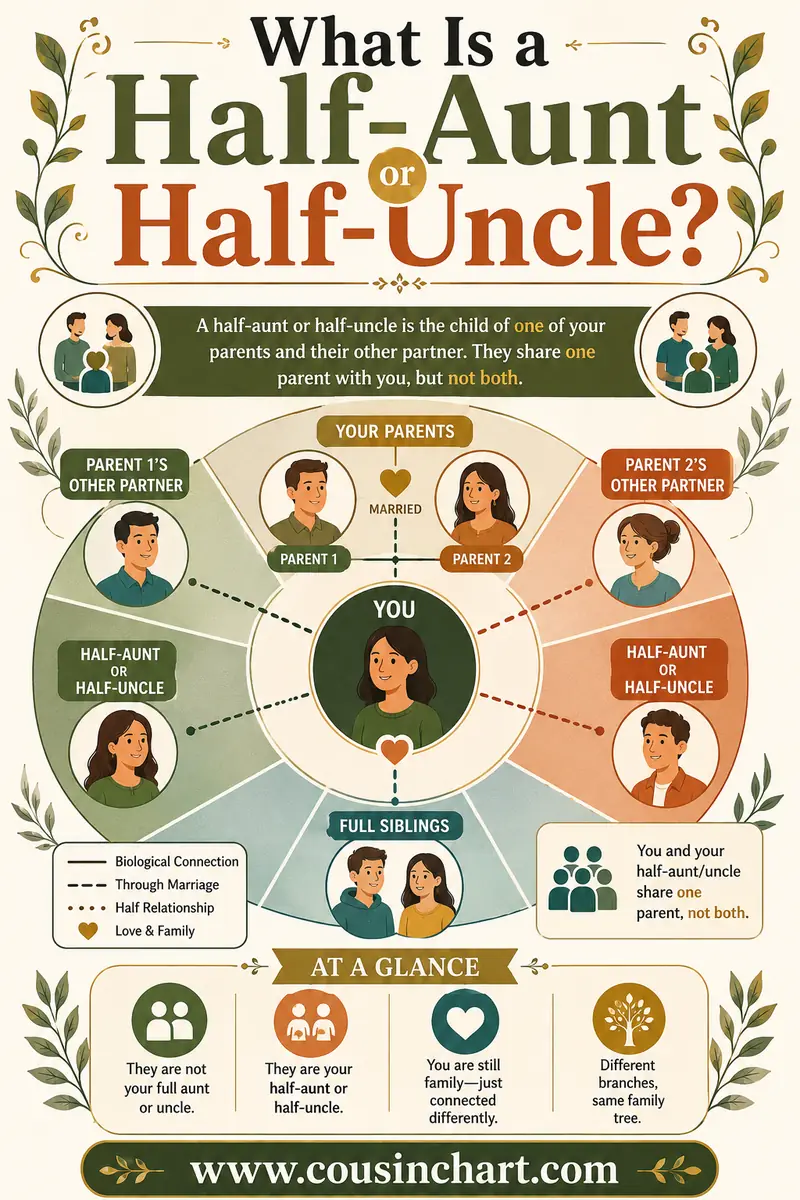
One of them is your parent's half-sibling — your half-aunt or half-uncle — and a blood relative through your shared grandparent. The other parent married in, so they're simply your aunt or uncle by marriage, with no blood connection.
Can half cousins be closer than full cousins in practice?
Absolutely. The "half" describes ancestry, not affection — plenty of half cousins grow up on the same street while full cousins live an ocean apart. DNA ranges overlap too: an unlucky full cousin pair can share less DNA than a lucky half cousin pair, which is one more reason the label alone never tells the whole story.
Do half cousins count the same in inheritance law?
In many jurisdictions half-blood relatives inherit like whole-blood relatives of the same degree, but rules differ by state and country. Check the law that applies to your situation.
The Short Version
Half cousin = one shared grandparent instead of two, courtesy of a half-sibling connection in the parents' generation. Same generation as a full cousin, half the shared DNA, full membership in the family.
Untangling a blended tree with halves, steps, and removeds in every direction? The free family relationship calculator names each connection precisely — and settles the reunion debate before dessert.