Half First Cousin Once Removed, Explained
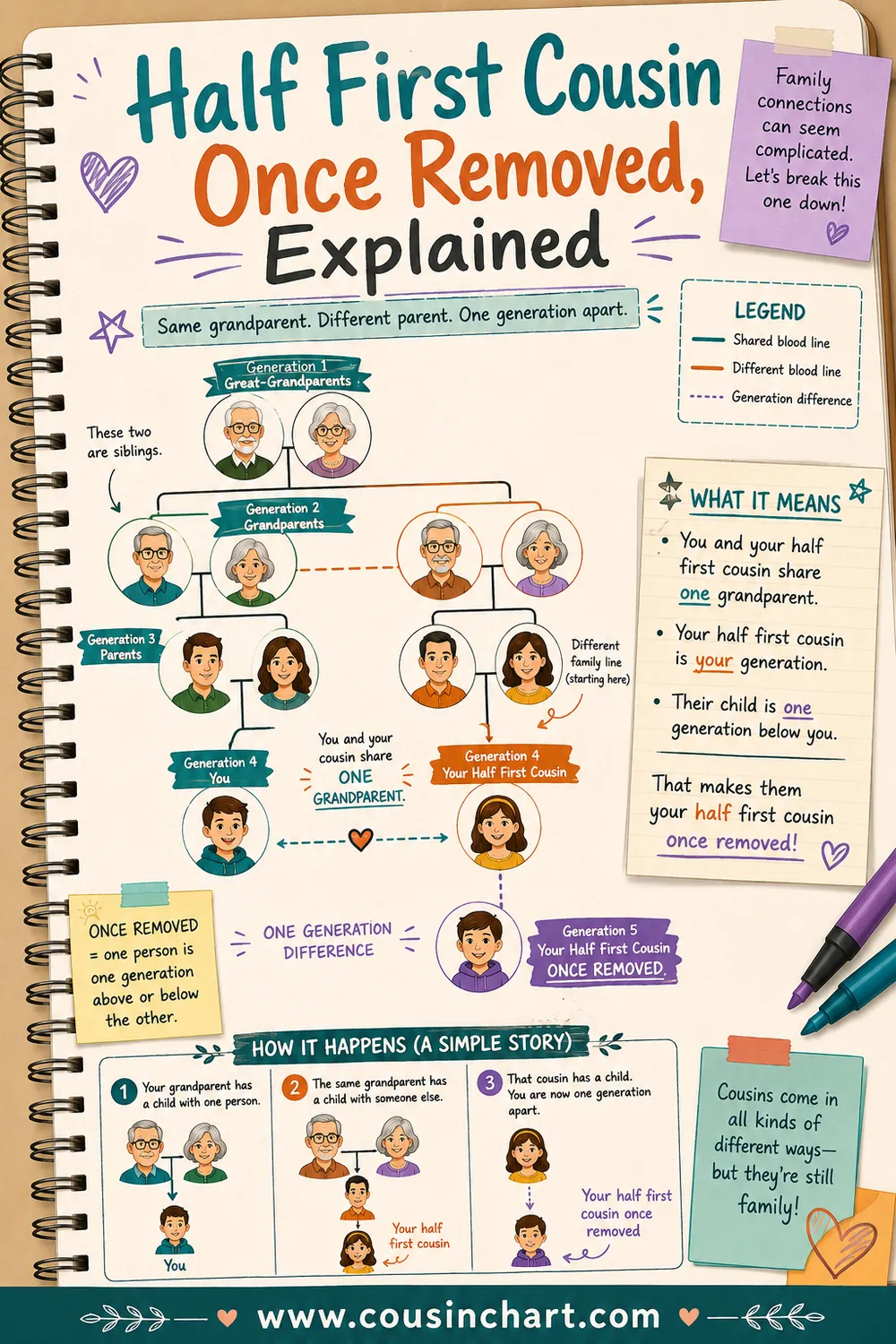
A half first cousin once removed is your half first cousin's child or your parent's half first cousin. Break the phrase apart and it reads cleanly: half (the cousin link runs through one shared ancestor instead of a couple) + first cousin (the closest cousin line) + once removed (a one-generation gap between you).
It's the kind of term that only shows up when a family tree has a remarriage in it and a DNA test gets involved — which is exactly when people need it most. This guide unpacks each piece, shows the chart, and explains why this relationship is a famous DNA look-alike for the ordinary second cousin. For any specific pair of relatives, the free relationship calculator on our homepage names the term in seconds.
Relationship quick-check. Tap a phrase to see the correct term:
The answer will appear here.
Reading the Term, Piece by Piece
Long relationship names are just stacked modifiers. This one has three:
- First cousin — the base line. Full first cousins share a grandparent couple; their parents are siblings.
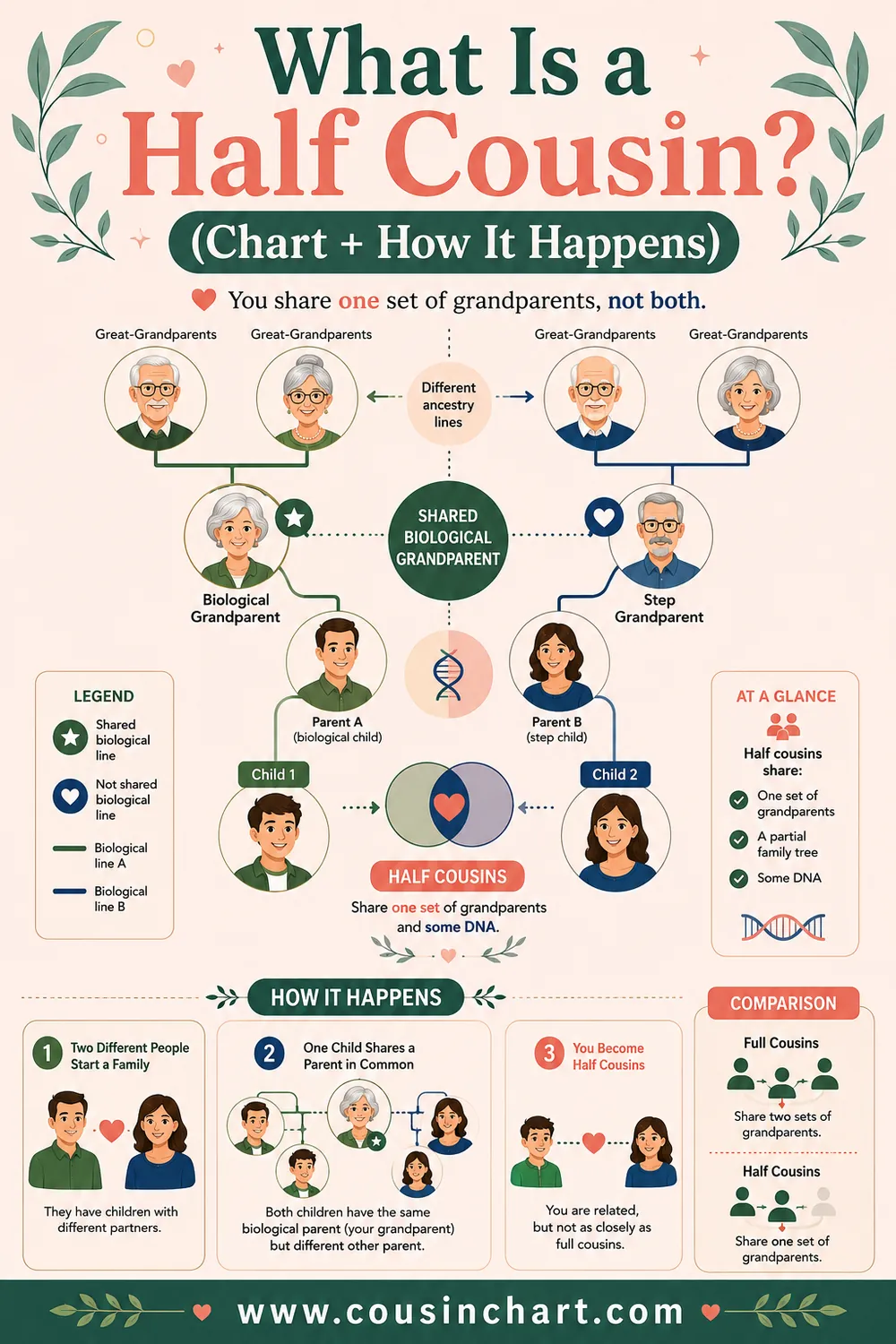
- Half — the sibling link at the top was a half-sibling link. Your parent and their parent shared one parent, not two — so the cousins share one grandparent. (Full backstory in what is a half cousin.)
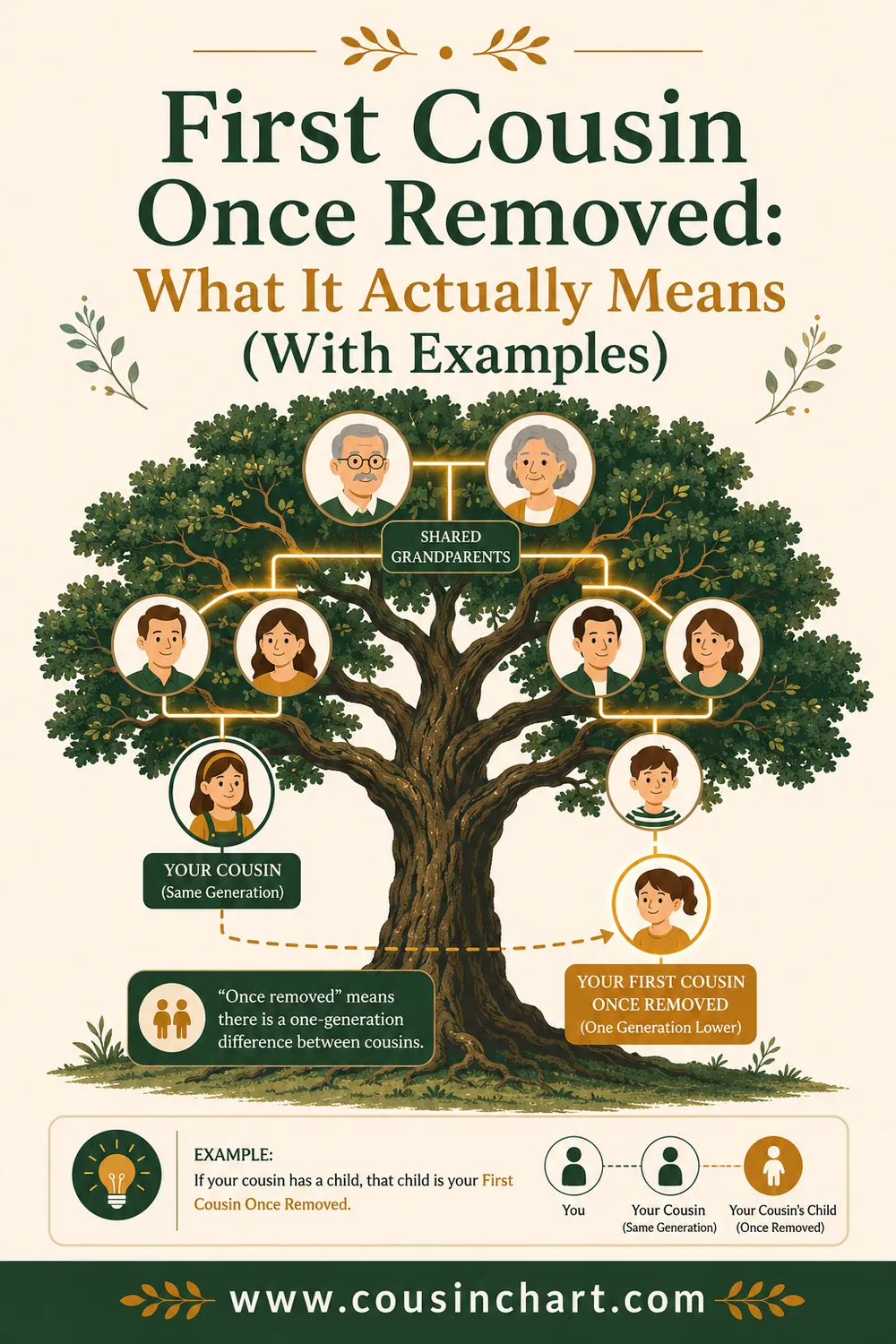
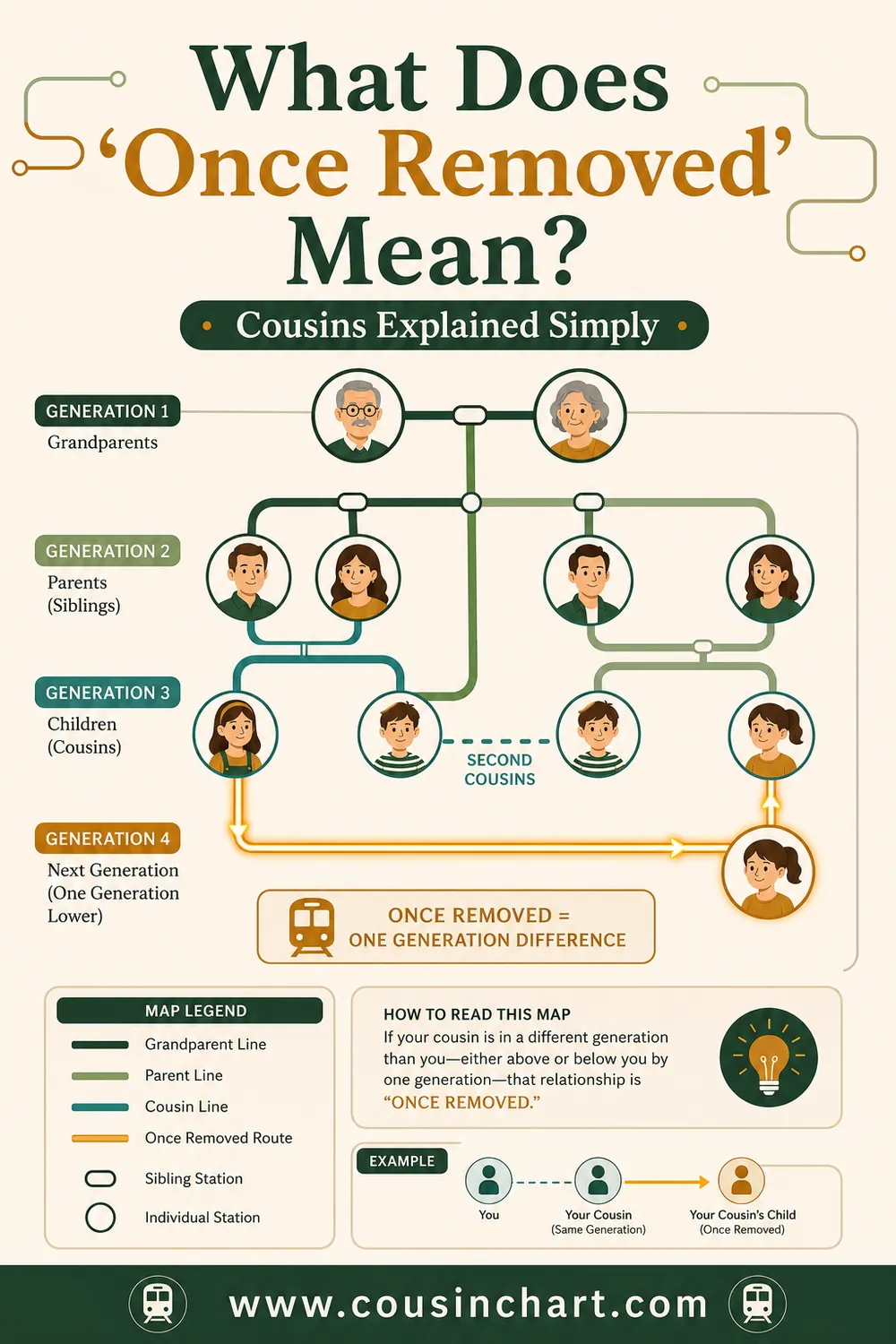
- Once removed — the two people are one generation apart, exactly as in the ordinary first cousin once removed.
Stack them and you get: one shared grandparent at the top, one generation of offset between the two people.
The Two People This Term Covers
Like every removed relationship, it points in two directions:
- One generation down: your half first cousin's child. You and your half cousin share a single grandparent; their child sits one row below you.
- One generation up: your parent's half first cousin. Your parent shares a single grandparent with this person; you stand one row below your parent. The shared ancestor is your single great-grandparent.
Symmetry holds, as always: if Vera is your dad's half cousin, you are Vera's half first cousin once removed, and she is yours.
Chart: The Half-First-Cousin Line
| Who they are | Term | Shared ancestor(s) |
|---|---|---|
| Your half-aunt or half-uncle's child | Half first cousin | One grandparent |
| Your half cousin's child | Half first cousin once removed | One grandparent (theirs: great-grandparent) |
| Your parent's half cousin | Half first cousin once removed | One great-grandparent |
| Your half cousin's grandchild | Half first cousin twice removed | One grandparent, two-row gap |
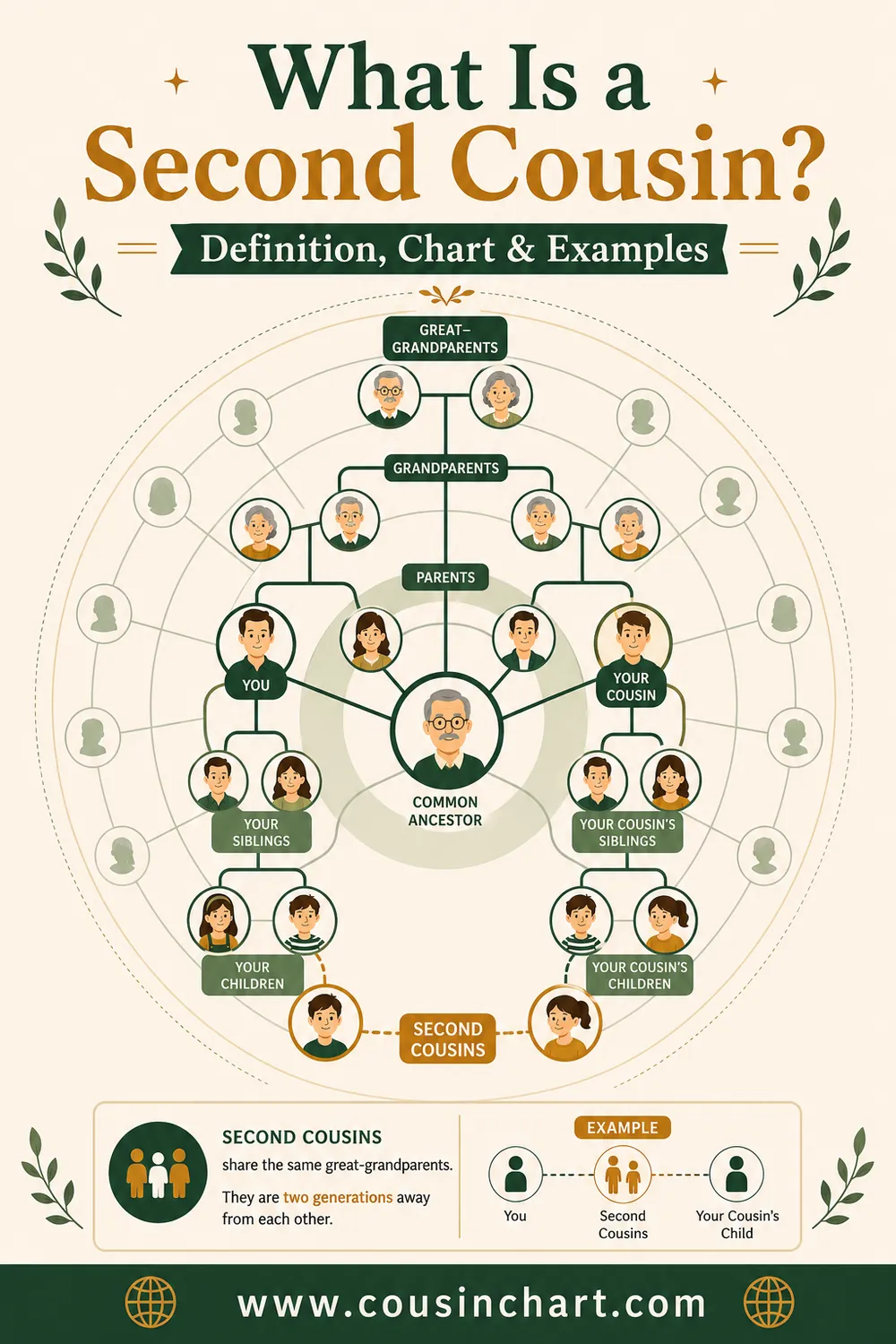
| Your half cousin's child × your child | Half second cousins (to each other) | One great-grandparent |
Compare the full versions: everywhere a full first cousin line says "grandparents," the half line says "one grandparent." The degrees and removals behave identically — the half only halves the ancestry (and, as you'll see, the DNA).
The DNA Twist: A Second-Cousin Impersonator
Here's why this obscure-sounding relationship earns its own article. A half first cousin once removed shares about 3.1% DNA on average — roughly 220–230 centimorgans. That is exactly the average for a full second cousin.
| Relationship | Average shared DNA | Approx. cM |
|---|---|---|
| First cousin once removed | ~6.25% | ~430 |
| Half first cousin | ~6.25% | ~430 |
| Half first cousin once removed | ~3.1% | ~220–230 |
| Second cousin | ~3.1% | ~230 |
| Half second cousin | ~1.6% | ~120 |
The halving logic makes it inevitable: half cuts the expectation in two, and once removed cuts it in two again — landing precisely on the second cousin's number, which got there by a different route (one extra generation on both sides).
Practical fallout for DNA match lists:
- A match labeled "2nd cousin" might actually be a half first cousin once removed — typically an older or younger match, since a generation gap is built in.
- Age is your best first clue. Second cousins are usually rough contemporaries; a half 1C1R is a generation off.
- Shared-match clustering helps. A half relationship clusters around one single ancestor, not an ancestral couple.
- Records finish the job. A remarriage, a second family, or a half-sibling in the 1940 census usually explains the half link within an evening of digging.
If you like having these numbers handy, our shared DNA chart lays out averages and ranges for every relationship on one page.
A Worked Example
Your grandmother Pilar had a half-brother, Luis — same father, different mothers. Luis has a daughter, Carmen, and Carmen has a son, Mateo.
- Pilar and Luis: half-siblings (one shared parent — your single great-grandfather).
- Your mother and Carmen: half first cousins (one shared grandparent).
- You and Carmen: she's your mother's half cousin → your half first cousin once removed (ascending).
- You and Mateo: count to the shared ancestor. You're three generations below your great-grandfather (Pilar, your mother, you); Mateo is three as well (Luis, Carmen, Mateo). Same generation, one shared great-grandparent: you and Mateo are half second cousins.
That last line shows the system working: once both branches step down, the removal disappears and the degree ticks up, with "half" riding along untouched. If tracking it in your head is miserable — it is for everyone — the cousin calculator exists precisely for trees like this.
Where Half Lines Come From
If your tree has a half first cousin once removed in it, somewhere upstream an ancestor had children with two different partners. Knowing how that usually happened tells you where to look for the paper trail.
- Widowhood and remarriage. This is the big one in older trees. Before antibiotics and modern obstetrics, losing a spouse young was common, and remarrying quickly was practical — someone had to run the farm and raise the kids. A man widowed at 35 who remarried and had five more children created half-sibling links that ripple down as half cousins, half 1C1Rs, and half second cousins for generations.
- Divorce and remarriage. The modern version of the same story. Blended families from the mid-1900s onward produce exactly the same tree shape.
- Children outside a marriage. Sometimes the second family was never recorded alongside the first, which is why these lines so often surface as DNA surprises rather than family lore.
For research purposes, the half link is actually a gift: it points you at one specific ancestor and says "this person had another family." Marriage records, census households a decade apart, and probate files that name children from both marriages will usually reconstruct the second family quickly. A widow remarrying often shows up in the census with children under two different surnames in the same household — that's the half line announcing itself.
What the Next Generation Becomes
Removed relationships don't stay still — every new baby shifts the labels. Here's how the half-first-cousin line plays out over time, assuming Y is your half cousin's child (your half 1C1R):
| Pair | Relationship | Avg shared DNA |
|---|---|---|
| You ↔ Y | Half first cousin once removed | ~220–230 cM |
| Your child ↔ Y | Half second cousins | ~120 cM |
| You ↔ Y's child | Half first cousin twice removed | ~110 cM |
| Your child ↔ Y's child | Half second cousins once removed | ~60 cM |
| Your grandchild ↔ Y's grandchild | Half third cousins once removed | ~25 cM |
Two patterns worth noticing. First, the removal disappears when the shallower branch catches up: your child sits level with Y, so they're plain half second cousins, and their children level up again to half third cousins. Second, the DNA keeps halving with every step, which means the "second-cousin impersonator" problem from earlier repeats itself down the line — a half second cousin once removed (~60 cM) looks just like a full third cousin (~75 cM average, wide range) on a match list. The deeper the half line runs, the more you need the tree, not the centimorgans, to tell you what's going on.
Does the "Half" Even Matter?
Socially, almost never — "cousin" covers everything and no one blinks. But the precise term earns its keep in three places:
- DNA interpretation. Expecting ~230 cM instead of ~430 cM is the difference between confirming a tree and chasing a phantom.
- Genealogy records. A half relationship tells you to research one ancestor's other family, not a couple's.
- Inheritance questions. Some jurisdictions treat half-blood and whole-blood kin identically; others distinguish. Laws vary — check the current rules where you live if money or guardianship rides on it.
FAQ
What is a half first cousin once removed in plain English?
Your half cousin's child, or your parent's half cousin. You're connected through one shared ancestor (instead of a couple) with a one-generation gap.
How much DNA does a half first cousin once removed share?
About 3.1% on average (~220–230 cM) — the same as a full second cousin. The two relationships can't be separated by DNA amount alone.
How is it different from a regular first cousin once removed?
The "half": the sibling link at the top of the cousin line involved half-siblings, so there's one shared grandparent rather than two, and the expected DNA is halved (~3.1% vs ~6.25%).
What is my half cousin's child to me?
Your half first cousin once removed. And your children and your half cousin's children are half second cousins to each other.
Why does my DNA site think my half 1C1R is my second cousin?
Because the shared-DNA averages are identical (~230 cM). Testing sites label by amount, not by tree shape. Age gaps and single-ancestor match clusters are the clues that reveal the half relationship.
Is a half first cousin once removed a blood relative?
Yes — you descend from the same person (one shared grandparent/great-grandparent, depending on direction). It's a genuine, traceable blood relationship.
What do I actually call a half first cousin once removed in person?
"Cousin," honestly. The full term is for charts, DNA results, and probate lawyers. In everyday life nobody introduces someone as their half first cousin once removed — save the mouthful for when precision genuinely matters, and use their name the rest of the time.
The Short Version
Half first cousin once removed = one shared ancestor at the grandparent level + a one-generation gap. It shares its DNA signature with the second cousin, its structure with the ordinary once-removed, and its origin story with whichever ancestor of yours had two families.
When your tree throws one of these at you, don't reverse-engineer the phrase — open the free family relationship calculator, click the path, and get the exact term with the why attached.