Aunt, Uncle, Grandparent or Half-Sibling? How to Tell From DNA
If your DNA match shares somewhere around 1,300 to 2,300 centimorgans with you, the test itself cannot tell you which relationship it is. A half-sibling, a grandparent, a grandchild, an aunt, an uncle, a niece, a nephew — and at the lower end, a double first cousin — all sit in that same band, because they're all "25% relationships." The DNA is genuinely identical in size. What separates them is everything around the DNA: age difference, which side your shared matches fall on, whether the match also shows up in your parent's results, X-chromosome patterns in a few specific configurations, and plain old paperwork.
That's the honest answer, and it's worth sitting with for a second, because a lot of people burn weeks trying to squeeze a verdict out of the centimorgan number alone. It isn't there. Run your number through the DNA match calculator to see every relationship that fits it, then use the clues below to knock the impossible ones off the list.
Which clue do you have? Tap one to see what it rules in — and what it rules out:
Tap a clue above and the reading will appear here.
Why Can't DNA Tell These Relationships Apart?
Because they're all built from the same amount of shared ancestry, just arranged differently.
You share roughly 25% of your DNA with a grandparent because you got 50% from your parent, and your parent got 50% from theirs. You share roughly 25% with a half-sibling because you each got 50% from the one parent you have in common, and you each got a different random half. You share roughly 25% with an aunt because she and your parent share about 50%, and you got half of your parent. Different paths, same arithmetic.
A testing company measures shared DNA in centimorgans (cM) — a unit of genetic distance, not physical length. (If that term is new, our centimorgan explainer unpacks it properly.) Your whole tested genome comes to roughly 6,800 cM across the companies, so a quarter of that lands near 1,700 cM. That's why the 25% relationships all cluster in the same place on a chart.
Random recombination then spreads each relationship out into a range, and those ranges overlap almost perfectly. The Shared cM Project — the crowdsourced database of real, documented relationships behind the DNA Painter tools — shows half-siblings, grandparents, and aunts/uncles occupying essentially the same territory. There's no gap to exploit. Nobody has found a hidden signal in the raw numbers that separates them, and if a site claims otherwise, be skeptical.
What Do the Shared cM Numbers Actually Look Like?
Here's the neighborhood, so you can see exactly where your number falls and what's genuinely in play.
| Relationship | Typical shared DNA | Approximate cM range | Can DNA alone confirm it? |
|---|---|---|---|
| Parent / child | 50% | ~3,400–3,700 cM | Yes — it's unmistakable |
| Full sibling | ~50% | ~2,300–3,400 cM | Usually yes |
| Half-sibling | ~25% | ~1,300–2,300 cM | No |
| Grandparent / grandchild | ~25% | ~1,300–2,300 cM | No |
| Aunt or uncle / niece or nephew | ~25% | ~1,300–2,300 cM | No |
| Double first cousin | ~25% | overlaps the lower part of that band | No |
| Half-aunt / half-uncle | ~12.5% | ~500–1,450 cM | Sometimes, with context |
| First cousin | ~12.5% | ~550–1,300 cM | Sometimes, with context |
Two things jump out. First, the four bolded rows are the problem set — they're not "similar," they're interchangeable. Second, the boundaries are soft. A very high first cousin and a very low half-sibling can both land near 1,300 cM, which is why you shouldn't treat the edges of any published range as a wall.
Companies also differ slightly in what they measure and how they filter small segments, so the same two people can get a number that varies by 30 or 40 cM between AncestryDNA, 23andMe and MyHeritage. That variation is normal and doesn't change your analysis.
How Much Does Age Difference Really Tell You?
Age is the single most useful clue you have, and it costs nothing.
A grandparent is two generations up. In practice that means a gap of roughly 40 to 70 years, and it essentially never means a gap of five. A half-sibling shares a parent with you, so the gap is bounded by one person's reproductive lifespan — usually under 25 years, occasionally 30 or more when a parent starts a second family late. An aunt or uncle sits between the two, and here's the trap: in a large family with children spread over 20 years, the youngest sibling can be younger than the eldest sibling's child. Your aunt can be your age.
So use age as a filter, not a verdict:
- Gap over 35 years, match is older — grandparent moves to the front, aunt/uncle stays possible, half-sibling drops back.
- Gap of 10 to 30 years — all three stay live. This is the genuinely ambiguous zone.
- Gap under 10 years — grandparent is out. It's half-sibling or a young aunt/uncle.
- Match is younger than you by a lot — you may be looking at a grandchild, a niece or nephew, or a much younger half-sibling. Same logic, mirrored.
A birth year is often available even when the match hasn't shared one: a public tree, an obituary for a shared relative, a profile photo, a first name that peaked in a specific decade. Don't guess when you can look it up.
Which Side Is the Match On?
This is the second big lever, and on most platforms it's a few clicks.
Open your shared matches (AncestryDNA calls them Shared Matches, 23andMe calls it Relatives in Common, MyHeritage shows shared matches on each match's page). Look at the people who appear on both your list and theirs. If you can already identify a handful of your own cousins, you'll usually see the shared matches pile up on one side of your family.
- Shared matches are all maternal → the connection runs through your mother. That leaves a maternal grandparent, a maternal aunt or uncle, or a half-sibling who shares your mother with you.
- Shared matches are all paternal → same logic on your father's side.
- Shared matches land on both sides → that's unusual and meaningful. It can point to a double relationship, a full sibling you'd misjudged, or endogamy in the background (see what endogamy is if your family comes from a historically intermarried community).
- Almost no shared matches at all → the match may sit on a branch nobody else in your family has tested. Frustrating, but not evidence of anything.
AncestryDNA's SideView feature (which labels many of your matches as "Parent 1" or "Parent 2" without either parent testing) does a lot of this work for you. It's not perfect and it doesn't tell you which parent is which, but it splits the list, and a split list is half the battle.
Does the Match Share DNA With Your Parent?
If either of your parents has tested — or will test — this clue is close to decisive, and it's the one most people overlook.
Say your mystery match shares 1,750 cM with you. Now check what they share with your mother:
- About 3,500 cM (parent/child level) — this person is your mother's parent or your mother's child. So: your maternal grandparent, or your half-sibling through your mother. Age tells you which in about two seconds.
- About 2,600 cM (full-sibling level) — this person is your mother's full sibling. Your aunt or uncle. Done.
- Around 1,700 cM — your mother is a half-sibling, grandchild, or niece to them, which reshuffles the whole question one generation up.
- Nothing at all — the connection isn't on your mother's side. Look to your father.
That single comparison collapses four possibilities into one or two. If a parent is living and willing, testing them is the highest-value thing you can do for any unknown match, not just this one. If a parent isn't available, an aunt, uncle or a known first cousin on each side gives you a weaker but still useful version of the same test.
What Can X-DNA Rule Out?
X-DNA is a specialist tool. It only helps in particular configurations, but when it applies it's clean.
Two rules do most of the work:
- A man inherits his single X chromosome from his mother only. So if you're male and you share any X-DNA with a match, that connection is on your mother's side. Your entire paternal line is eliminated in one stroke.
- A father passes his one X chromosome to every daughter, unchanged. So two half-sisters who share a father inherit the identical X from him — a full-length, unbroken X match. Two half-sisters who share a mother get recombined, patchier X segments instead. A complete X match between two women is a strong paternal-half-sister signal.
There are further patterns — a woman shares a substantial chunk of X with her maternal grandfather, for example, because her mother received his X intact — but they get fiddly fast, and X inheritance is chunky enough that absence of sharing proves very little. Treat X as a tiebreaker, never a foundation.
One practical catch: AncestryDNA doesn't give you a chromosome browser or X-DNA data at all. 23andMe, FamilyTreeDNA and GEDmatch do. If your match is on Ancestry and you both want X information, you'd each need to download your raw data and upload it somewhere that reports it. That's free at GEDmatch and FamilyTreeDNA, and it costs you nothing but time.
Where Do Double First Cousins Fit In?
Double first cousins happen when two siblings from one family marry two siblings from another — so the children share both sets of grandparents instead of one. That doubles the shared DNA, landing them around 25% and dropping them right into this same band.
They're rarer than the other options, but not exotic. Double-cousin marriages were common in small rural communities, in immigrant enclaves, and anywhere the pool of eligible partners was small. If your family has that history, keep it on the list.
The giveaway is usually the shared-match pattern: double first cousins share matches on two ancestral lines that both look like your side, and their own family tree will show the two sibling pairs if anyone has built it. Age is unhelpful here — double first cousins are typically the same generation, so an age gap near zero fits both "double first cousin" and "half-sibling."
The Decision Table: Which Clue Points Where?
Work down this table with whatever evidence you have. Each row is independent — you don't need all of them.
| What you observe | Half-sibling | Grandparent | Aunt / uncle | Double 1st cousin |
|---|---|---|---|---|
| Match is 40+ years older | Unlikely | Very likely | Possible | Unlikely |
| Match is within 5 years of you | Likely | Ruled out | Possible | Likely |
| Your parent shares ~3,500 cM with them | Yes | Yes | No | No |
| Your parent shares ~2,600 cM with them | No | No | Yes | No |
| Your parent shares ~1,300–2,300 cM with them | No | No | No | Possible |
| Shared matches on one side only | Possible | Likely | Likely | Unlikely |
| Shared matches on two of your lines | No | No | No | Likely |
| You're male and share X-DNA | Maternal only | Maternal only | Maternal only | Depends |
| Two women, full unbroken X match | Paternal half-sisters | Unlikely | Unlikely | Unlikely |
| Match's tree shows your grandparents as their parents | No | No | Yes | No |
Notice that no single row settles it. Two or three rows together almost always do.
How Do You Work a Real Case, Step by Step?
Here's the order that wastes the least time.
- Write down the number. Shared cM, plus the number of segments if your company shows it. Run it through the DNA match calculator to get the full list of candidate relationships.
- Find an age. Birth year, approximate age, a photo, a graduation year. Cross off whatever becomes impossible.
- Split the sides. Open shared matches and label them maternal or paternal using cousins you already recognize.
- Pull in a parent, if you can. One parent's cM number with this match is worth a month of theorising.
- Look at their tree. Even a three-person tree gives you surnames and a location. A shared surname on the right side is often the whole answer.
- Check X-DNA if the configuration fits. Male tester, or two women, and a platform that reports it.
- Go to records. Census entries, obituaries, marriage records, school yearbooks. Genetic genealogy ends in a document, not a percentage.
One more habit worth building: write your reasoning down as you go, including what you ruled out and why. When a new match appears in six months, past-you will have left present-you a map.
What If the Answer Is Not the One You Wanted?
Sometimes this analysis lands on a half-sibling nobody mentioned, or a grandparent who isn't the grandparent on the birth certificate. That happens more often than the tidy version of genealogy admits, and it's worth naming plainly.
A few things that genuinely help:
- Slow down before you contact anyone. The match on the other end may know nothing at all, or may have spent decades keeping something private. There's no deadline.
- Separate the fact from the story. DNA can establish a biological relationship. It can't tell you what happened, who knew, or why. Those answers only come from people and records, and sometimes they don't come.
- Keep the language neutral in first contact. "We share a significant amount of DNA and I'm trying to work out how we connect" gets replies. A confident accusation usually doesn't.
- Consider who else is affected. Living relatives have their own stake in what you found. Deciding whether to tell someone is separate from working out what's true.
- Get support if you need it. Organizations and communities exist specifically for people processing unexpected DNA results. You're not the first person here.
None of that is legal advice, and consumer DNA results aren't legal proof of parentage in any case — courts use their own chain-of-custody testing. What a consumer test gives you is a strong biological signal and a starting point.
What About Relationships That Look Close But Aren't?
A quick sanity check before you commit to a theory: make sure you're actually in the 25% band and not adjacent to it.
- Above ~2,300 cM, you've moved into full sibling territory, which is a different question entirely.
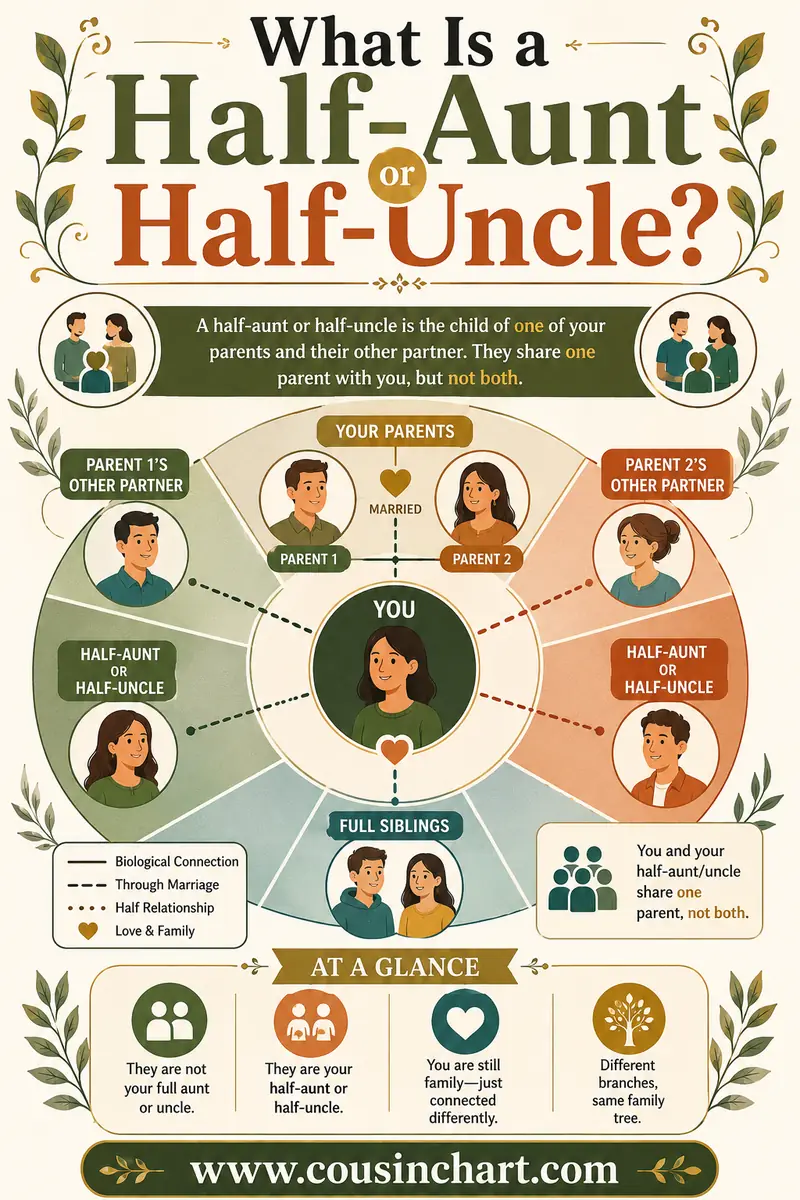
- Below ~1,300 cM, you're sliding toward first cousins, half-aunts and half-uncles. A half-aunt — your parent's half-sibling — averages around 12.5%, half of what a full aunt shares. That's usually distinguishable, though the top of the half-aunt range and the bottom of the aunt range do brush against each other.
- If you come from an endogamous population, every one of these ranges shifts upward, because distant cousins share extra DNA through many small connections. Standard charts under-read the relationship distance in that case, and clustering tools get noisy.
When the relationship names themselves start blurring — half-nephew, grand-aunt, first cousin twice removed — the plain family relationship calculator will name any path you can describe, which saves a lot of arguing.
FAQ
Can a DNA test tell the difference between a half-sibling and a grandparent?
No, not on shared centimorgans alone. Both relationships share about 25% of your DNA and occupy the same range, roughly 1,300 to 2,300 cM. Age difference usually separates them instantly, and if the parent who connects you has tested, their cM number with the match settles it completely.
How many cM do you share with a half-sibling?
Typically somewhere between about 1,300 and 2,300 cM, averaging near 1,700. That's roughly a quarter of your DNA. The exact figure varies with random recombination and slightly between testing companies, so treat any single number as a point inside a range rather than a precise measurement.
What is the difference between an aunt and a half-sibling in DNA results?
Genetically, there isn't a reliable one — both share about 25%. The difference shows up in context: an aunt is your parent's full sibling, so your parent shares roughly 2,600 cM with her, while a half-sibling shares roughly 3,500 cM with the parent you have in common. Comparing the match against your parent is the cleanest test.
Can X-DNA prove a half-sibling relationship?
Only in specific configurations. Two women who share a father inherit his single X chromosome unchanged, so a full unbroken X match is strong evidence of paternal half-sisters. In most other setups, X-DNA narrows possibilities rather than proving them, and a lack of X sharing rarely rules anything out on its own.
Why do shared matches matter more than the cM number?
Because the cM number stops being informative once you're inside an overlapping band, while shared matches tell you which side of your family the connection sits on. Splitting your tree in half eliminates roughly half the candidate relationships in one step, no extra testing required.
Should I test another relative to solve a 25% match?
Yes, if one is available and willing — it's the fastest route by a wide margin. A parent is ideal. Failing that, an aunt, uncle, or a first cousin on each side gives you a reference point for sorting matches by side. Consider our notes on test accuracy before choosing which company to use.
Put a Name to Your Match
A number in the 1,300 to 2,300 cM range is not a dead end — it's a shortlist. The DNA has done its job by narrowing the field to four or five relationships. The rest of the work is ordinary detective work: ages, sides, one more test, a census page.
Start by seeing the full shortlist your number produces. Drop your shared cM into the DNA match calculator, then work the clues in this guide from cheapest to most expensive. Most people solve it in an afternoon once they stop staring at the number and start looking around it.