What Is a Half-Aunt or Half-Uncle?
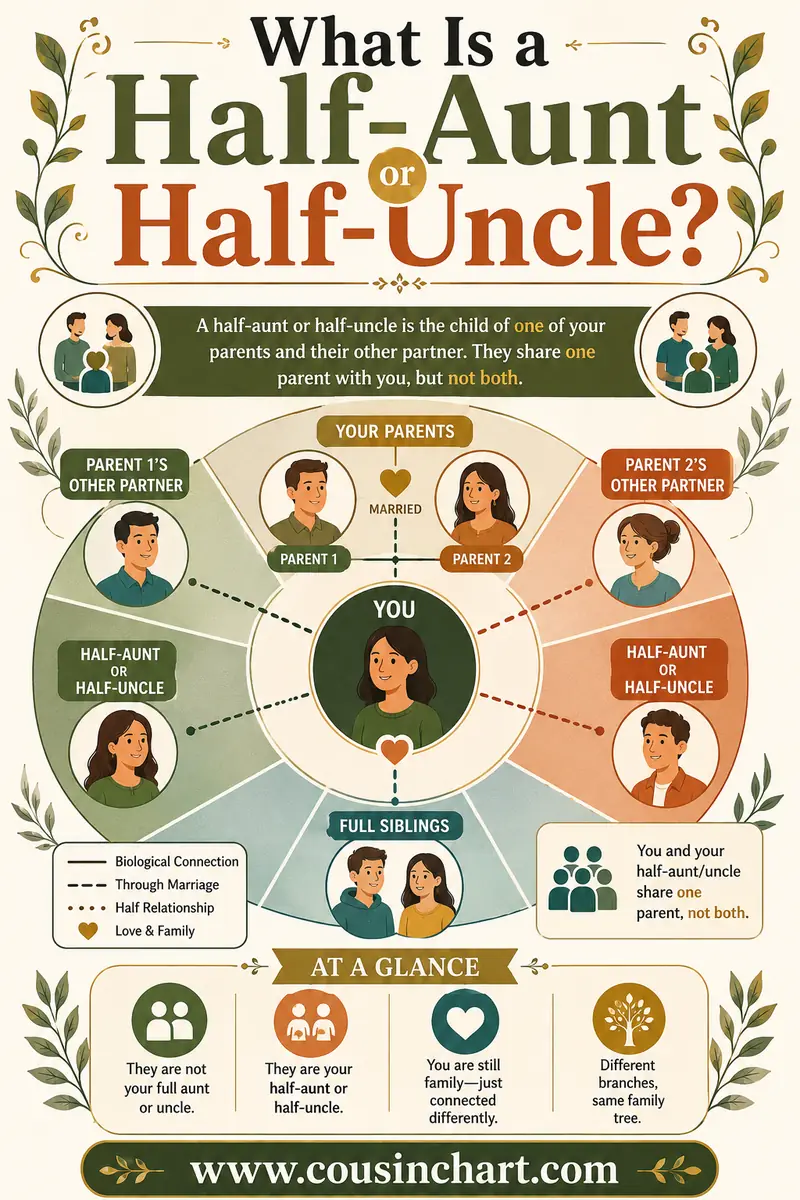
A half-aunt is your parent's half-sister; a half-uncle is your parent's half-brother. They're real blood relatives — you share one grandparent through them instead of two, which works out to about 12.5% shared DNA, half of a full aunt or uncle's ~25%. You are their half-niece or half-nephew.
In conversation, almost every family drops the prefix and simply says aunt or uncle. This guide covers when the "half" actually matters (DNA tests, family trees, medical history), what a half-aunt's kids are to you, and the surprisingly common DNA mix-ups this relationship causes. For any relative you can't place, the free family relationship calculator on our homepage names the connection in seconds.
Relationship quick-check. Tap a phrase to see the correct term:
The answer will appear here.
The Definition, Drawn Out
Aunts and uncles are your parents' siblings. When one of those siblings is a half-sibling — sharing one parent with your mom or dad instead of two — the "half" rides up a generation to you:
- Your dad and Elena share a father but have different mothers → they're half-siblings (~25% shared DNA).
- Elena is therefore your half-aunt (~12.5% with you).
- You are her half-niece or half-nephew — the term is mutual.
The tree-level way to see it: a full aunt connects you to two grandparents' lines; a half-aunt connects you to one. That single shared grandparent is why every number on this branch is half the full-relationship figure. And the halving only exists between the half-relatives — the shared grandparent is 100% your grandparent, no prefix, no asterisk.
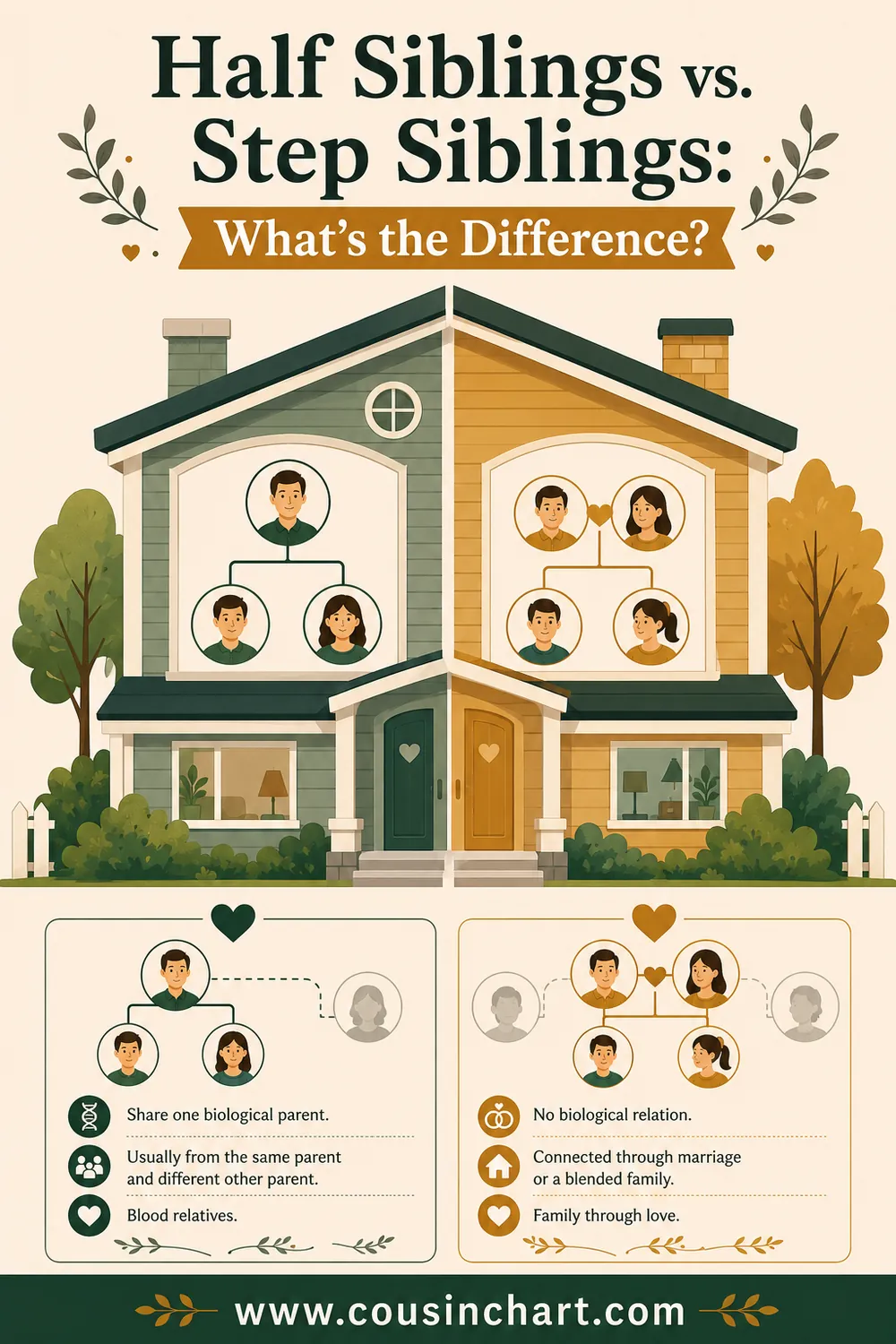
If half-sibling mechanics are the fuzzy part, our half vs step siblings guide covers that foundation.
Half-Aunt vs Step-Aunt vs Aunt-in-Law
Three different "not-quite-classic aunts" get merged constantly. They're genuinely different animals:
| Term | Who she is | Blood? | Avg shared DNA |
|---|---|---|---|
| Aunt (full) | Parent's full sister | Yes | ~25% |
| Half-aunt | Parent's half-sister | Yes | ~12.5% |
| Step-aunt | Step-parent's sister, or grandparent's stepdaughter | No | 0% |
| Aunt by marriage | Uncle's wife | No | 0% |
The half-aunt is the only one of the bottom three who's a blood relative. Step-aunts and aunts by marriage are family through remarriage and marriage respectively — real family socially, invisible genetically. If you're recording a tree or a medical history, these distinctions do real work: a half-aunt's health history is relevant to yours; a step-aunt's isn't.
The DNA Numbers — and the Classic Mix-Up
Here's this branch as a DNA test sees it:
| Relationship | Avg shared DNA | Rough cM range |
|---|---|---|
| Aunt/uncle (full) | ~25% | 1,200–2,300 |
| Half-aunt/uncle | ~12.5% | 500–1,400 |
| First cousin | ~12.5% | 400–1,400 |
| Grandparent | ~25% | 1,200–2,300 |
| Half first cousin | ~6.25% | 150–850 |
Spot the trap: half-aunts and first cousins average the same 12.5%. DNA sites group them under one label ("first cousin" or "close family–first cousin"), and this exact ambiguity is behind a huge share of "who IS this match?" mysteries — especially in families with a grandparent who had children with more than one partner.
How to tell them apart when the percentage can't:
- Age and generation clues. A half-aunt is your parent's generation; a first cousin is yours. Not foolproof, but a strong hint.
- X-DNA and shared-match patterns. Which known relatives the mystery match also matches usually points to the right grandparent line.
- Tree logic. Map the candidate paths with the relationship calculator and see which one fits the facts you know.
What Do You Call Her in Real Life?
"Aunt." Nearly universally. The half prefix is bookkeeping vocabulary, not address vocabulary — nobody says "Good morning, Half-Aunt Elena."
Where the prefix should appear:
- Family tree software — enter both of her parents and the software will compute the half relationship correctly.
- DNA match notes — "half-aunt, via grandpa's first marriage" will save future-you real confusion.
- Medical family history — half-relatives carry half the usual predictive weight, and doctors' intake forms increasingly ask.
Some people worry the word "half" sounds cold. It isn't a ranking — it's a route description. Plenty of people are closer to a half-aunt than to any full relative; the tree doesn't measure that, and doesn't try.
Her Kids, Your Kids, and the Rest of the Branch
Once a half relationship enters a branch, the prefix flows downhill predictably:
| Person | Relationship to you | Avg shared DNA |
|---|---|---|
| Your half-aunt | Half-aunt | ~12.5% |
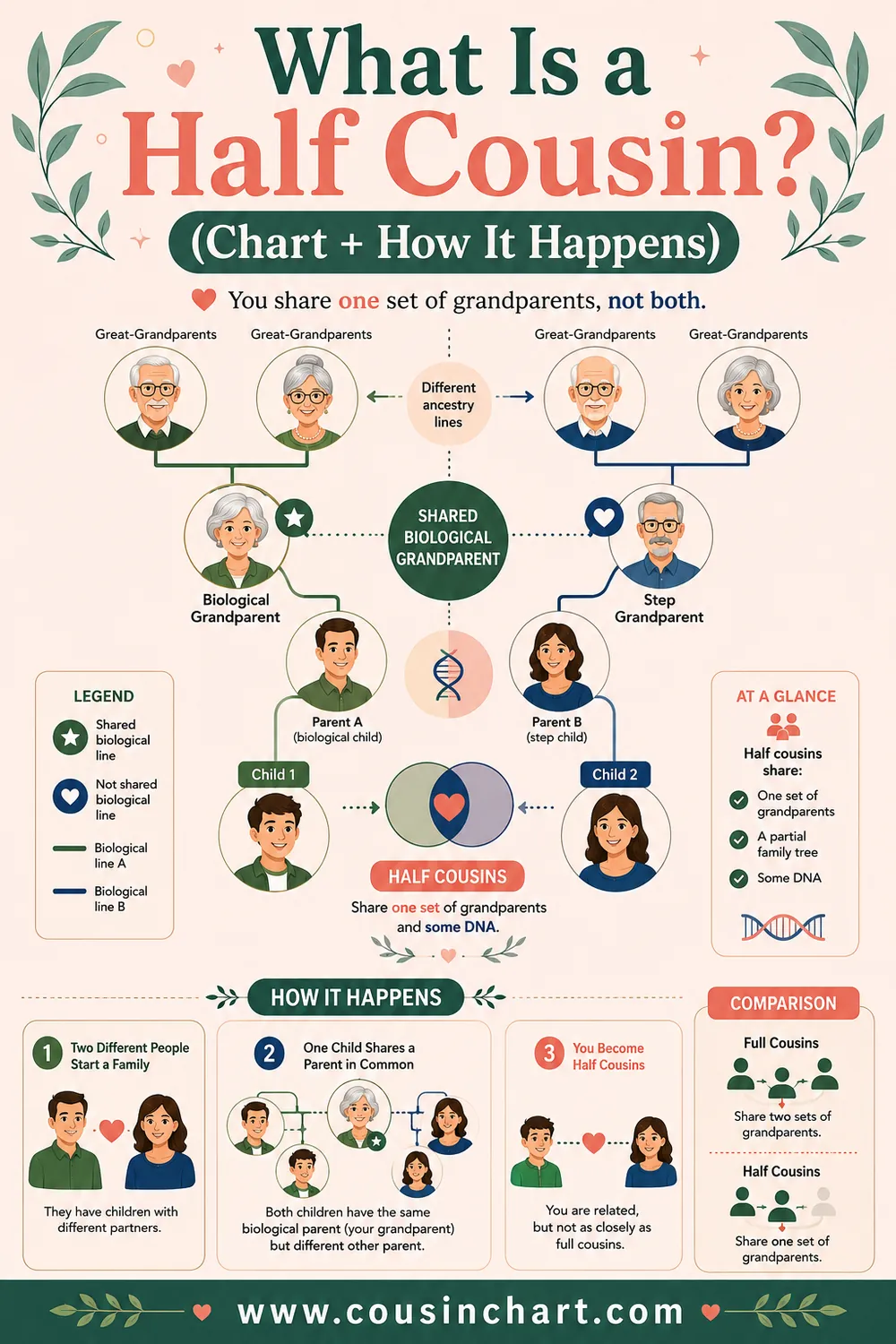
| Her children | Half first cousins | ~6.25% |
| Her grandchildren | Half first cousins once removed | ~3.125% |
| Your kids + her kids | Half first cousins once removed (to each other) | ~3.125% |
| Your kids + her grandkids | Half second cousins (to each other) | ~1.5% |
Wait — check that fourth row against your instincts. Your kids and your half-aunt's kids are not in the same generation-relationship as you and her kids: you and her kids are half first cousins (same generation), so your kids are one step below that pairing — half first cousins once removed to her kids — and your kids and her grandkids line up as half second cousins. Same ladder as any full branch, everything halved. The half cousin explainer walks the lower rungs.
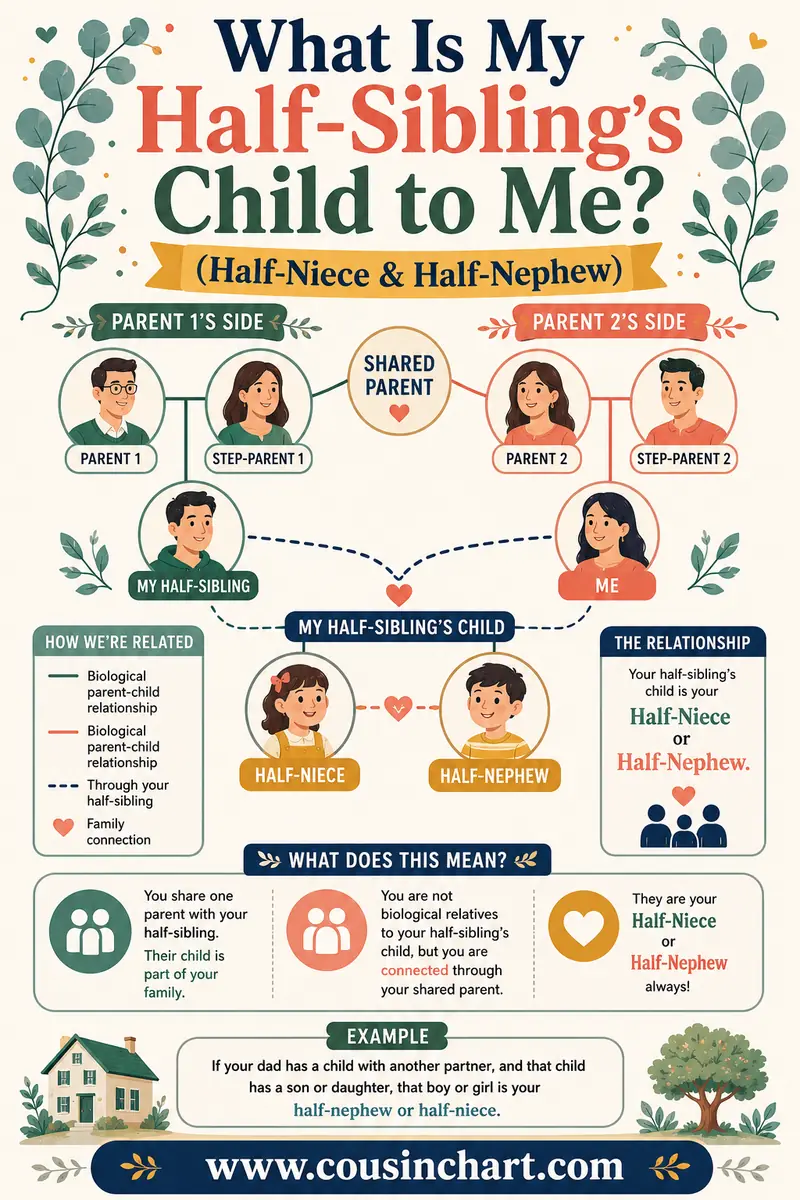
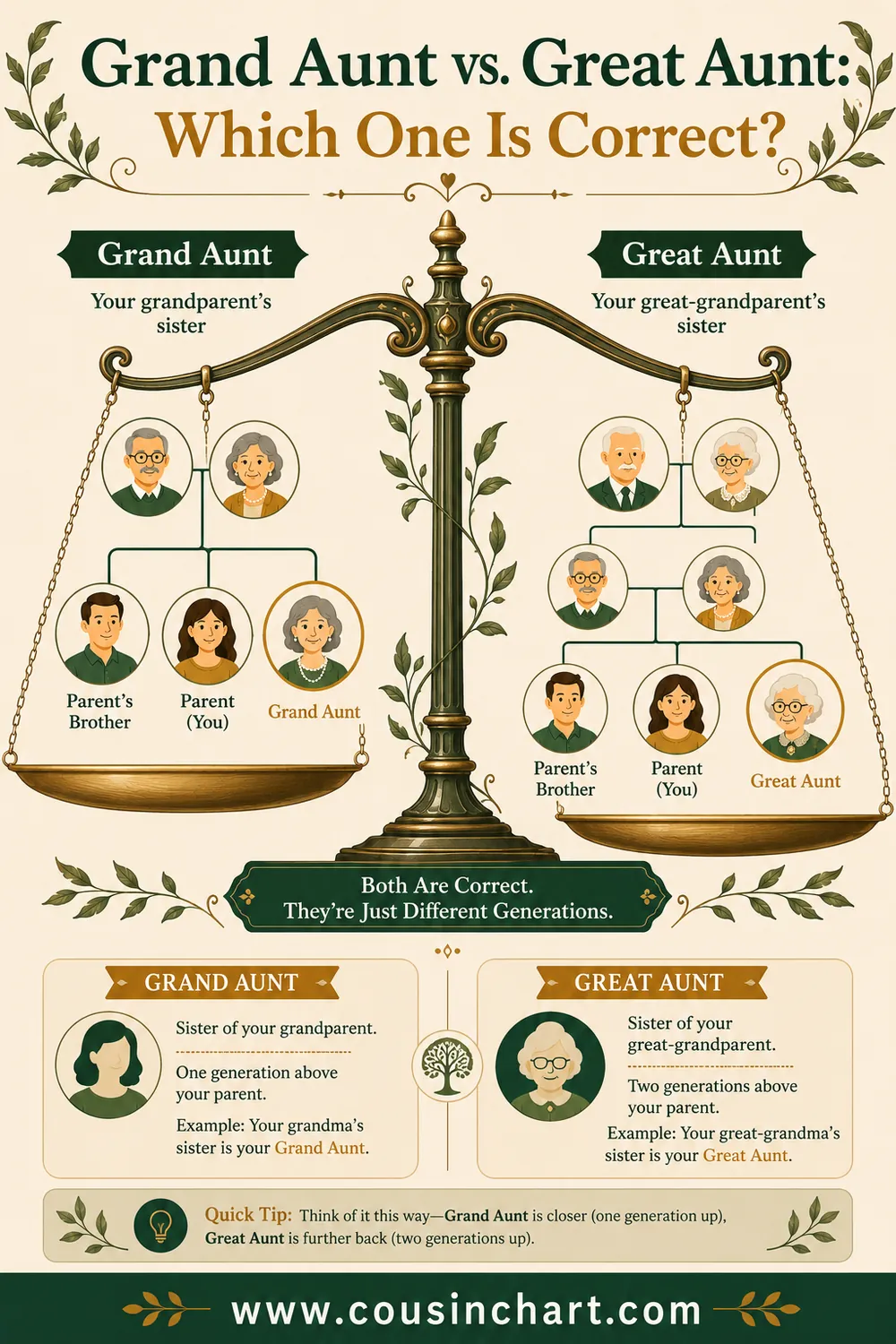
Going up instead: your grandparent's half-sister is your half-grand-aunt (~6.25%) — the half version of the grand-aunt/great-aunt rung. And the mirror of this whole article, seen from the older generation's side, is covered in what is my half-sibling's child to me.
Where Half-Aunts Come From (More Often Than You'd Think)
Half-aunts and half-uncles are among the most common "surprise" relatives in genealogy, because they're produced by completely ordinary family history:
- A grandparent remarried — after divorce or widowhood — and had more children.
- A grandparent had a child before the marriage everyone remembers.
- Large age gaps. A half-aunt can easily be younger than you if your grandfather's second family started late — generations are about tree position, never birthdays.
- DNA-test discoveries. Many people meet a half-aunt or half-uncle for the first time as an unexplained 900 cM match.
If a DNA surprise is how you got here: the relationship is real, the percentage is normal for it, and the label — half-aunt, half-uncle, half-niece, half-nephew — is the standard, respectful term genealogy uses for exactly this.
A Worked Example: One Grandfather, Two Families
Abstract rules stick better with names attached, so here's a complete half-aunt scenario from top to bottom.
Your grandfather, Frank, married twice. With his first wife he had your mother, Rosa, in 1958. After being widowed, he remarried and had a daughter, Elena, in 1979.
Now walk the labels:
- Rosa and Elena share Frank but have different mothers → half-sisters, ~25% shared DNA.
- Elena and you: she's your mother's half-sister → your half-aunt, ~12.5%. Note the age math — Elena is only a few years older than you might be. Perfectly normal for this branch.
- Elena's son Marco and you: you each descend from Frank through different daughters, sharing only Frank at the grandparent level → half first cousins, ~6.25%.
- Frank, to you: your grandfather, full stop. He's on both sides of the split, so no half prefix ever attaches to him.
- Elena's mother, to you: nothing, genealogically. She's your half-aunt's mother — sometimes warmly called a "step-grandmother" if she helped raise your parent, but there's no blood or standard kinship term.
One more generation for good measure: Marco's daughter is your half first cousin once removed (~3.125%), and to your kids she's a half second cousin (~1.5%). Every label in this family follows from one fact — Frank is the only shared ancestor on that side — which is exactly the kind of single-anchor logic the calculator applies to any pair you give it.
Confirming a Suspected Half-Aunt with DNA, Step by Step
Suppose a ~1,000 cM match appears and you suspect "half-aunt" over "first cousin." Percentages alone can't settle it, but this sequence usually can:
- Compare generations first. Ask (or infer from profiles) the match's age relative to your parents. A half-aunt sits in your parent's generation. A 70-year-old match to a 30-year-old tester leans aunt; a same-age match leans cousin. Treat this as a hint, not proof — big age gaps happen on both labels.
- Check shared matches. On Ancestry or 23andMe, look at who you both match. A half-aunt through your paternal grandfather will share matches with your paternal side only — and specifically with that grandfather's line, not your paternal grandmother's. If she matches your paternal grandmother's known relatives too, she's likely a full-side relative like a regular first cousin.
- Use a parent's test if you have one. This is the cleanest tiebreaker. Your half-aunt will match your parent at half-sibling level (~1,700 cM average) — dramatically higher than she matches you. A first cousin of yours would match your parent as a niece/nephew instead, a similar number but through a sibling, which the shared-match pattern from step 2 distinguishes.
- Look at X-DNA and mitochondrial hints where available. They won't name the relationship, but they can rule out certain grandparent paths — for instance, a paternal half-aunt shares no X-DNA with a male tester through the paternal line.
- Write down the conclusion. Whichever way it lands, note the reasoning on the match. Six months later, the next mystery match on that line resolves in minutes because this one is documented.
If steps 1–3 disagree with each other, that's usually a sign of an unexpected branch — a half relationship one generation off from where you assumed, or an unknown parent event. Slow down and map every candidate path before concluding anything.
Half-Aunts in Wills, Guardianship, and Official Forms
The half prefix mostly lives in trees and DNA notes, but a few official contexts give it real weight:
- Intestate inheritance. If a half-aunt dies without a will and the estate reaches the aunt/uncle–niece/nephew tier, most U.S. states count half-blood relatives equally with full-blood. A minority of jurisdictions reduce half-blood shares in some situations, so the distinction is worth stating plainly to an estate lawyer rather than rounding off.
- Guardianship and kinship care. Family courts placing a child prioritize relatives, and a half-aunt qualifies as kin — the "half" doesn't demote her. What matters to the court is the documented relationship path, so a tree that records both of her parents helps rather than hurts.
- Immigration and records. Petitions and lineage-based applications (dual citizenship, tribal enrollment, lineage societies) trace specific parent-child links. A half-aunt shares only one of your grandparents, so she's only evidence for that grandparent's line — useful, but for exactly half the ancestry a full aunt would document.
- Medical intake forms. When a form asks about "aunts/uncles" with a condition, mention the half status. A half-aunt's diagnosis coming from her other parent's side — the grandparent you don't share — carries no predictive weight for you, and your doctor can only weigh that correctly if the "half" is on the form.
None of this should change how anyone treats Aunt Elena at dinner. It's simply the short list of rooms where the prefix earns its keep — quiet paperwork precision, deployed only when a form, a court, or a doctor actually asks.
FAQ
What exactly is a half-aunt?
Your parent's half-sister — she and your parent share one parent (one of your grandparents) rather than two. She's a blood relative, sharing about 12.5% of your DNA on average.
How much DNA do I share with a half-uncle?
About 12.5%, typically in the 500–1,400 cM range. That's the same average as a first cousin, which is why DNA sites often can't distinguish the two from the number alone.
What are my half-aunt's children to me?
Half first cousins — you share one grandparent instead of two, for about 6.25% shared DNA on average.
Is a half-aunt the same as a step-aunt?
No. A half-aunt is a blood relative (parent's half-sibling). A step-aunt is connected by remarriage — a step-parent's sister or a grandparent's stepdaughter — with no shared DNA.
Do I call her "half-aunt" to her face?
Almost nobody does — "Aunt" plus her name is the norm. Save the prefix for family trees, DNA notes, and medical history, where the precision genuinely matters.
Can a half-aunt be younger than her niece or nephew?
Easily. If a grandparent had children across two marriages spread over decades, a half-aunt may be born after her half-siblings' kids. Tree position defines the relationship; age never does.
How do I tell a half-aunt from a first cousin on a DNA test?
You can't from the percentage — both average ~12.5%. Use generation clues (a half-aunt is your parent's generation), shared-match patterns (she should match only one grandparent's line), and ideally a parent's test, where a half-aunt shows up at half-sibling level (~1,700 cM).
Does a half-aunt count as next of kin?
She's genuine kin, yes — courts and kinship-care programs treat a half-aunt as a qualifying relative, and most inheritance laws count half-blood aunts equally with full. She just sits behind closer relatives (spouse, children, parents, siblings) in priority order.
Place Every Half-Relative Correctly
So: half-aunt = parent's half-sister, ~12.5% shared DNA, "Aunt" out loud and "half-aunt" on paper — with half first cousins one rung down and a classic first-cousin DNA mix-up waiting for the unwary. However your family's branches split and re-split, the free family relationship calculator traces the exact path and gives you the correct term, halves included, instantly.