What Is My Half-Sibling's Child to Me? (Half-Niece & Half-Nephew)
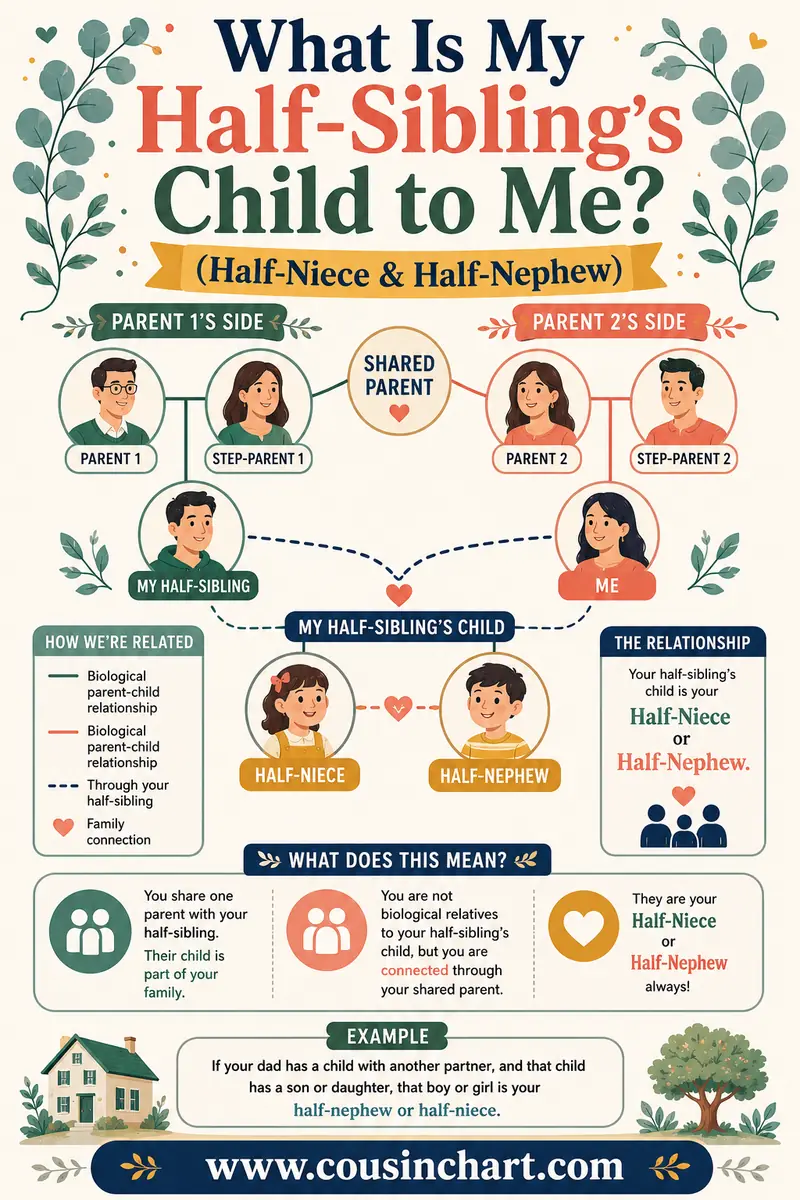
Your half-sibling's child is your half-niece or half-nephew — a genuine blood relative who shares about 12.5% of your DNA, half the amount a full niece or nephew would. You, in turn, are their half-aunt or half-uncle. In everyday life, most families drop the "half" entirely and just say niece, nephew, aunt, and uncle.
Both instincts are right: "half" is the genetically and genealogically accurate prefix, and skipping it is the socially normal choice. This guide covers where the term comes from, what the DNA numbers look like on a testing site, and how the "half" travels down to cousins and beyond. For any branch you can't name, the free family relationship calculator on our homepage sorts it instantly.
Relationship quick-check. Tap a phrase to see the correct term:
The answer will appear here.
Why "Half" — and What It Actually Measures
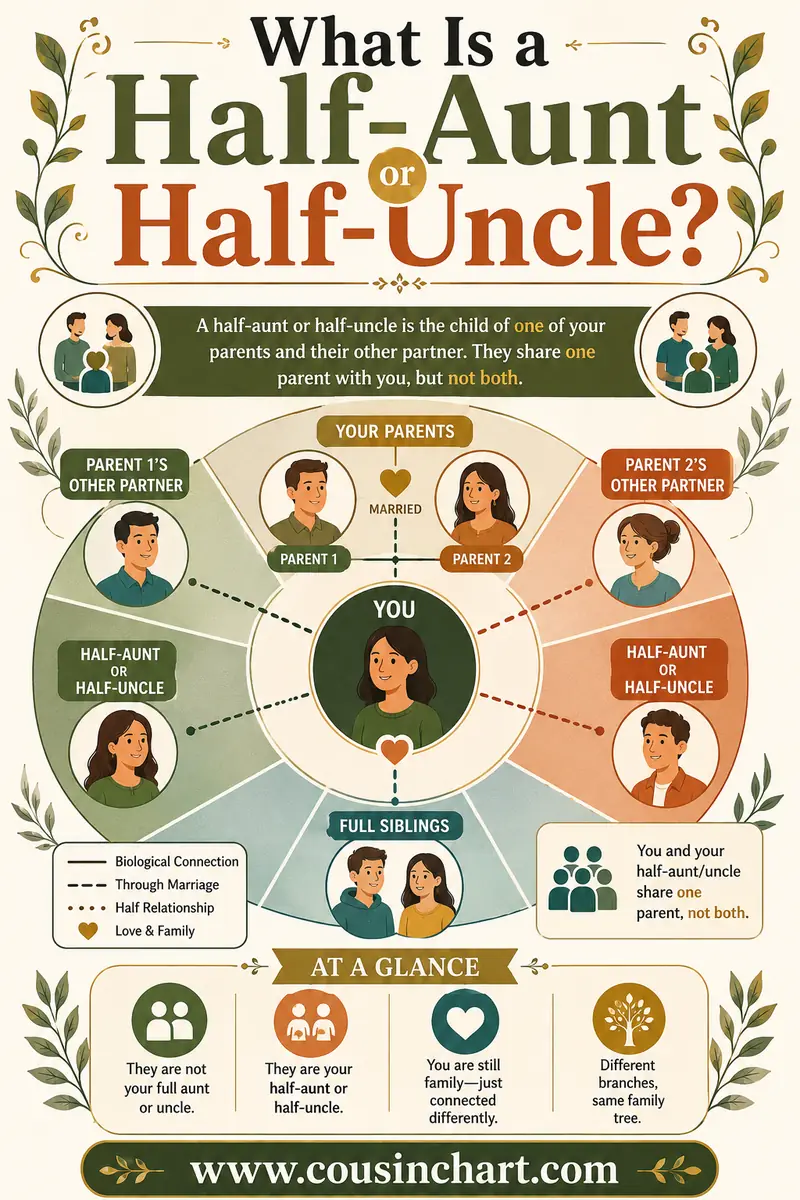
A half-sibling is a brother or sister who shares exactly one parent with you instead of two. That single word "half" isn't about the relationship being lesser — it's bookkeeping. Every blood relationship through that sibling flows through one parental line instead of two, so the expected shared DNA is halved at every step.
Your half-sibling shares about 25% of your DNA (a full sibling averages 50%). Their child inherits half of that connection: about 12.5% shared with you. Hence half-niece, half-nephew — the "half" simply rides along from the sibling relationship that created it.
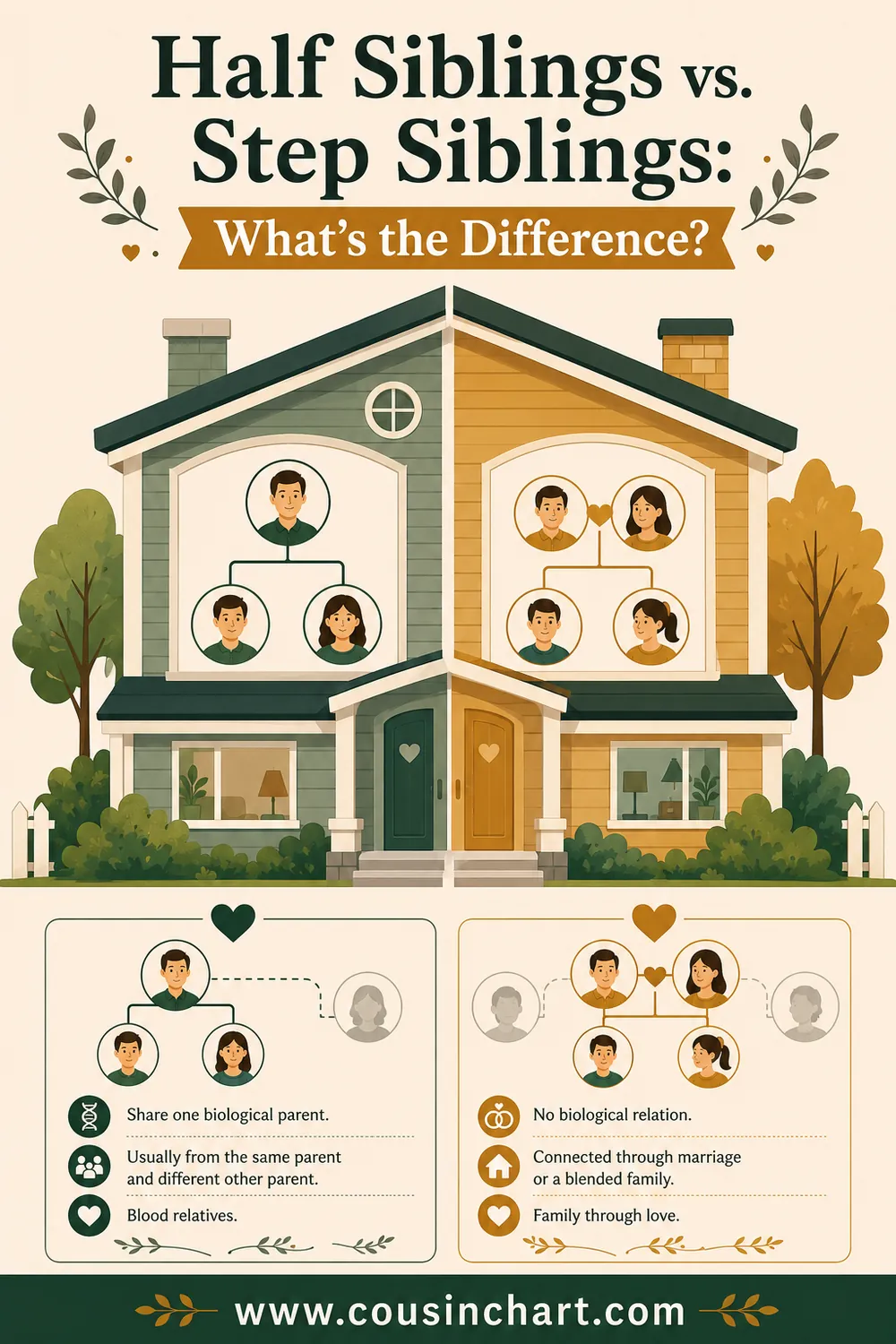
One important boundary: half-relatives are blood relatives, full stop. The half prefix distinguishes them from full relatives, not from real ones. The relatives who aren't blood are step-relatives — a distinction our half vs step siblings guide unpacks in detail.
The DNA Numbers, Side by Side
If you've taken a DNA test, here's how this branch shows up, in averages:
| Relationship | Avg shared DNA | Rough cM range |
|---|---|---|
| Full sibling | ~50% | 2,200–3,400 |
| Half-sibling | ~25% | 1,160–2,400 |
| Full niece/nephew | ~25% | 1,200–2,300 |
| Half-niece/nephew | ~12.5% | 500–1,400 |
| Half-great-niece/nephew | ~6.25% | 200–850 |
| First cousin | ~12.5% | 400–1,400 |
Notice the awkward twin in that table: a half-niece and a first cousin both average ~12.5%. DNA sites can't tell those apart from percentages alone — both may appear under one umbrella label like "first cousin." If a match's number says 12.5% but the ages feel one generation off, "half-niece/nephew" belongs on your shortlist. Tree logic, not centimorgans, makes the final call — which is where the relationship calculator earns its keep.
What Do You Call Each Other in Real Life?
Genealogy says half-aunt and half-niece. The living room almost always says aunt and niece.
- Most families never use "half" in speech — the child says "Aunt Priya," and everyone moves on.
- The prefix surfaces when precision matters: family-tree software, DNA-match notes, medical family history, and legal documents.
- Some families avoid "half" deliberately because it can sound diminishing; others embrace it as a neutral fact. Both are fine — the term describes a genetic path, not a level of love.
A good rule: say what your family says; write what the tree needs. If you're recording genealogy, keep the half prefix — future researchers (and DNA-match detectives) will thank you for the accuracy.
How the "Half" Travels Down the Tree
The half prefix is sticky: once a branch starts with a half-sibling, everything downstream carries it.
| Person | Relationship to you | Avg shared DNA |
|---|---|---|
| Your half-sibling | Half-sibling | ~25% |
| Their child | Half-niece / half-nephew | ~12.5% |
| Their grandchild | Half-great-niece / -nephew | ~6.25% |
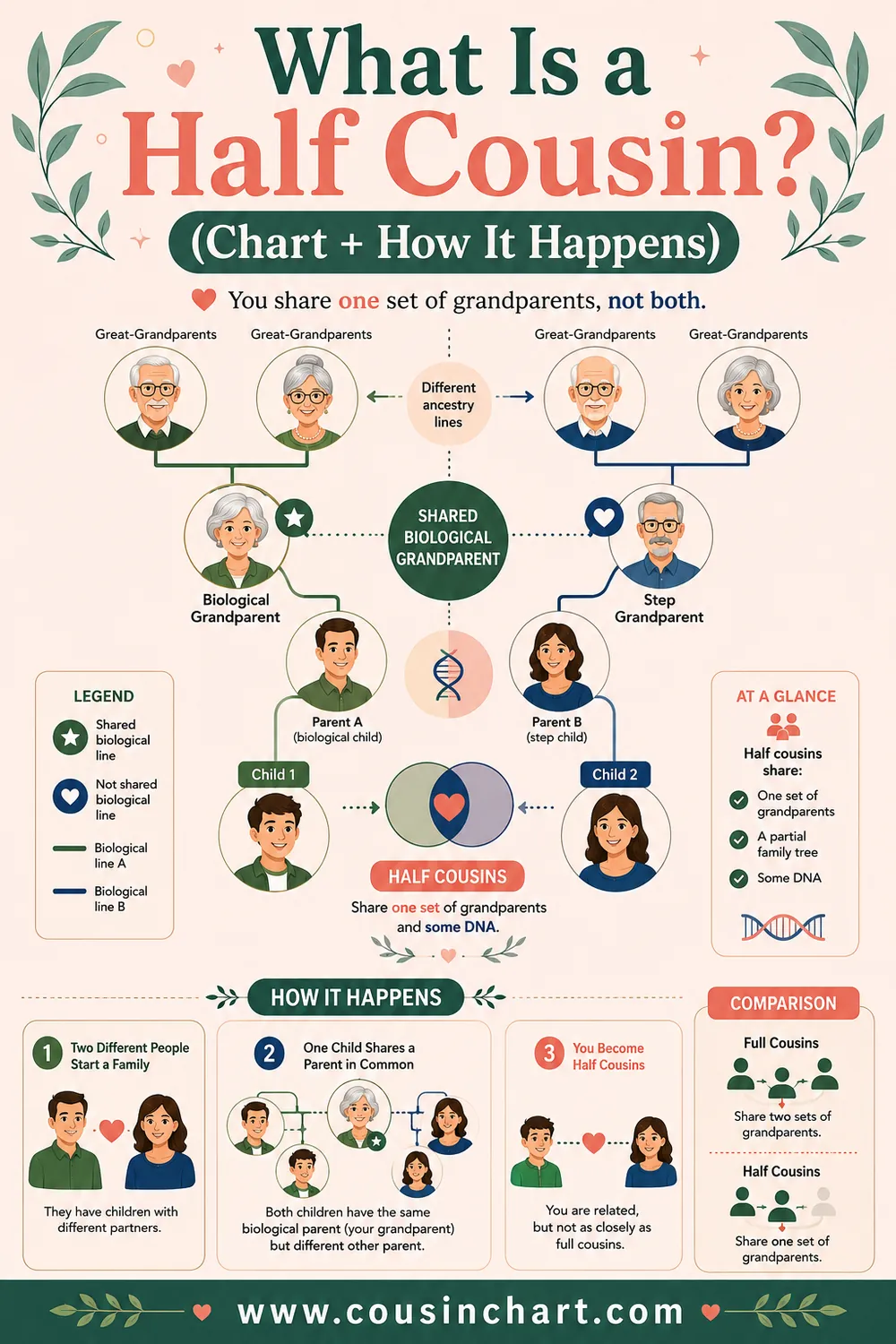
| Your kids + their kids | Half first cousins (to each other) | ~6.25% |
| Your grandkids + their grandkids | Half second cousins (to each other) | ~1.5% |
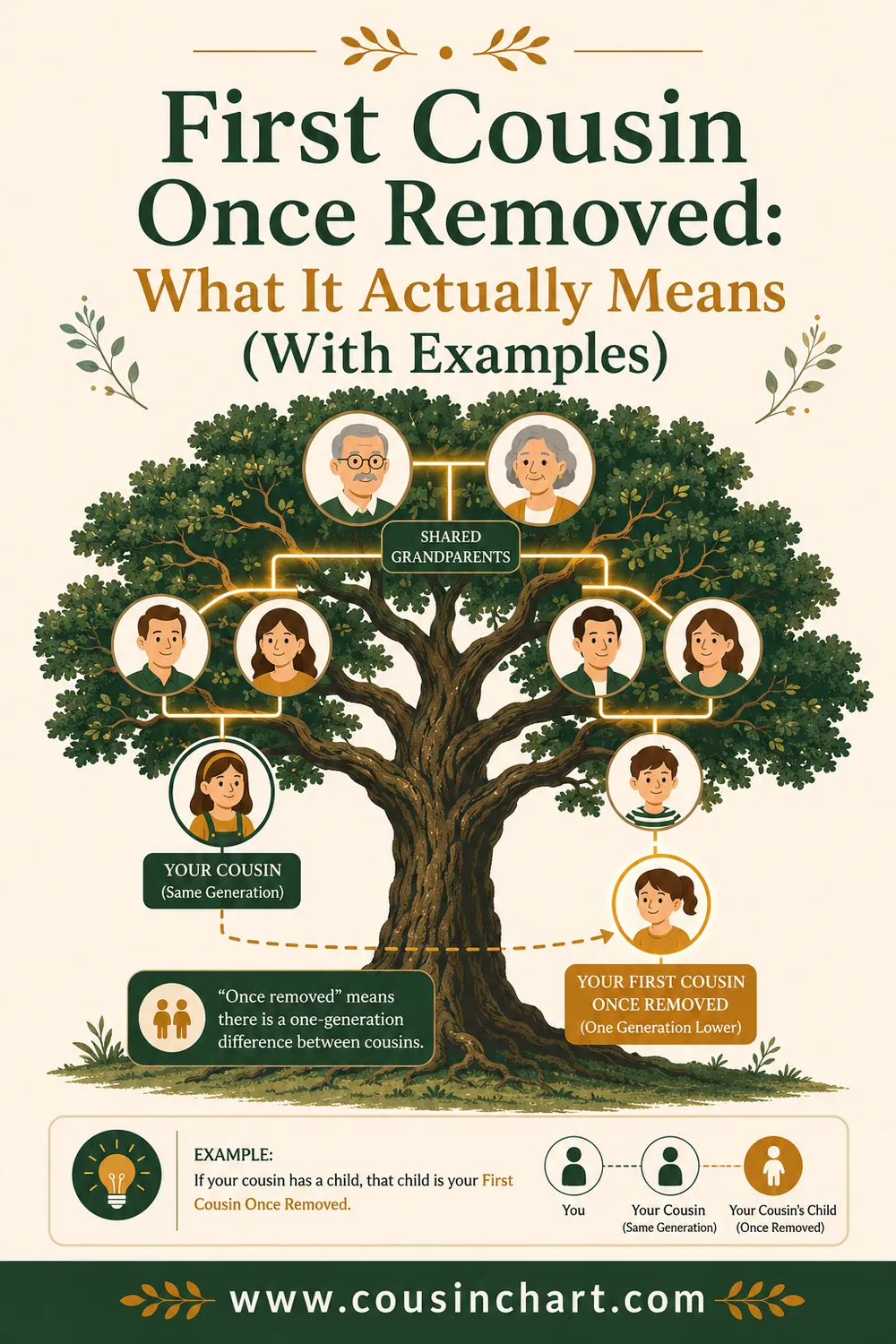
Two patterns stack neatly here, just like on full branches: your relationship to each generation down adds a "great," while the same-generation pairs climb the cousin ladder — with "half" prefixed the whole way. Our half cousin explainer follows that lower branch further.
And one relationship where the halves vanish entirely: to your shared parent, your half-sibling's child is simply a grandchild. Half labels only exist between people whose connection runs through one parent of a pair — the parent themselves is on every path.
Half vs Step vs Full: The Three-Way Test
These three get tangled constantly, and the child in question deserves the right label:
- Full niece/nephew — child of a sibling who shares both your parents. Blood, ~25%.
- Half-niece/nephew — child of a sibling who shares one parent. Blood, ~12.5%.
- Step-niece/nephew — child of a step-sibling (your parent married their parent; no shared parent at all). No blood, 0% expected DNA.
The quick test: trace up from the child to their parent, then ask how that parent connects to you. Shared two parents → full. Shared one → half. Shared none, linked by remarriage → step. Adoption, as always, overrides biology: a child legally adopted by your half-sibling takes the half-niece/nephew slot with full genealogical standing (a DNA test just won't show it).
What This Looks Like on a Family Tree
On paper, half-relationships are where tidy tree diagrams earn their complexity. Your shared parent appears once, with two partner lines branching from them — one to your other parent, one to your half-sibling's other parent. Your half-niece hangs from the second branch.
Practical tree tips:
- Record both of your half-sibling's parents if you can. The whole meaning of "half" lives in that second partner line.
- Use your software's half-relationship support. Ancestry, FamilySearch, and most desktop tools calculate half labels automatically once both parent couples are entered.
- Expect the label to matter for DNA matching. When a 700 cM match appears, knowing which branches are half-branches is often the difference between solving the puzzle in minutes and chasing the wrong grandparent for a week.
Age Gaps: When Your Half-Niece Is Older Than You
Here's a wrinkle full-sibling branches rarely produce: half-nieces and half-nephews who are your age — or older.
Half-siblings often come from different chapters of a parent's life. If your dad had your half-brother at 22 and you at 45, your half-brother is 23 years your senior. By the time you're in high school, his kids — your half-nieces and half-nephews — might be learning to drive. It's entirely possible to be a half-uncle at birth.
This matters for two practical reasons:
- DNA matching gets weirder. Testing sites lean on shared centimorgans and implied generations, but they can't see birthdays. A 900 cM match who's three years older than you reads like a first cousin on paper. If your family has a big-gap half-sibling anywhere, keep "half-niece/nephew" on the candidate list even when the ages scream "cousin."
- The social labels bend. Nobody expects a 10-year-old to be called "Uncle" by a 30-year-old. Families in this situation usually default to first names and let the tree paperwork carry the formal titles. That's not sloppiness — the genealogical relationship and the social script are just two different things, and both can be right at once.
The reverse gap happens too: a half-sibling much younger than you can make you a half-aunt whose half-niece is younger than your own grandchildren. The tree doesn't care about calendars — only about which lines run through which parents.
If you're sketching this out for a confused relative, one sentence usually does it: "Titles come from generations, not birthdays." A half-nephew sits one generation below you on the tree no matter what year he was born, the same way a great-aunt can theoretically be younger than her great-niece. Once people separate the two ideas, the odd-looking age gaps stop feeling like errors and start feeling like ordinary family history.
Where the Half Label Actually Matters: Money, Medicine, and Law
Most days, "half" is a word you can happily ignore. A few situations pull it back out of the drawer:
Inheritance. If your half-sibling dies without a will, most U.S. states treat half-siblings identically to full siblings for intestate succession — and the same logic usually extends down to their children if they inherit by representation. A handful of jurisdictions historically gave half-blood relatives a reduced share, so if an estate is actually in play, the prefix is worth mentioning to the lawyer rather than smoothing it over.
Medical family history. Doctors asking about hereditary conditions genuinely need the half/full distinction. A condition on your half-nephew's other grandparent's side — the one you don't share — tells your doctor nothing about your own risk. Saying "my nephew has X" when he's a half-nephew through your mother can send a risk assessment down the wrong branch entirely.
Life insurance and benefits paperwork. Forms that ask you to list nieces and nephews as beneficiaries or next of kin generally don't distinguish half from full — a half-niece is a niece for these purposes. But if a form asks for the relationship path (through which parent), accuracy avoids probate headaches later.
DNA-match note-keeping. If you manage a match list on Ancestry or 23andMe, tag half-branches explicitly. Six months from now, when a mystery 650 cM match appears, a tree where every half-relationship is labeled will hand you the answer; a tree where they're all flattened to "niece" and "cousin" will hand you a week of confusion.
None of this changes the day-to-day. It just means the half prefix isn't trivia — it's dormant information that switches on in exactly the moments precision counts.
Donor Conception and Other Modern Twists
Blended families aren't the only source of half-relationships anymore. A few modern paths land in the same genetic territory:
- Donor-conceived half-siblings. If you discover a sperm-donor half-sibling through a DNA test, their children are — genetically — your half-nieces and half-nephews, at the usual ~12.5%. Whether anyone uses those titles is a personal and family decision, but the DNA math and the tree logic are identical to any other half-branch.
- A parent's child placed for adoption. If your mother placed a child for adoption before you were born and that child later finds you, they're your half-sibling (or full sibling, if both parents match), and their kids slot in as half-nieces and half-nephews exactly as this article describes. Legally, their adoption created a second, equally valid family tree — genealogists often record both.
- Two half-connections at once. Rarely, families produce a "three-quarter" relationship — for example, if your half-brother's other parent is also related to you. These are unusual enough that DNA percentages stop matching any standard label, and a tool or a careful hand-drawn chart beats guesswork. When in doubt, map every parent couple and let the calculator do the arithmetic.
The common thread: the half-niece label follows biology and legal parenthood, not household history. Whoever the parents on the path are — married, remarried, donors, or birth parents — one shared parent between you and the sibling means "half" everywhere downstream.
Practice: Place These Three
Cover the answers first:
- Your half-brother's daughter's son. Two generations below your half-brother: your half-great-nephew (~6.25% DNA).
- Your half-sister's stepson. No blood path — he's connected by your half-sister's marriage: no formal relation to you.
- Your daughter and your half-brother's daughter. Same generation, one shared grandparent (your mutual parent): half first cousins (~6.25%).
If number 3 clicked, you've got the whole system: halves halve the DNA but follow the exact same ladder as everything else.
FAQ
What do I call my half-sister's daughter?
Formally, your half-niece. In everyday speech, nearly everyone just says niece — the "half" is for family trees, DNA notes, and precise contexts.
Is a half-niece a real blood relative?
Yes. You share about 12.5% of your DNA on average through your one common parent. "Half" distinguishes the relationship from a full niece (25%) — it doesn't make it less real.
What am I to my half-brother's kids?
Their half-aunt or half-uncle. The relationship is mutual: they're your half-niece/nephew, and socially you're almost certainly just "Aunt" or "Uncle."
How much DNA do I share with a half-niece or half-nephew?
About 12.5% on average — typically somewhere around 500–1,400 cM. That overlaps heavily with the first-cousin range, so DNA sites may group the two under one label.
What are my kids to my half-sibling's kids?
Half first cousins — same generation, one shared grandparent instead of two, about 6.25% shared DNA on average.
Is my step-brother's child my half-nephew?
No — that's a step-nephew. Half means one shared biological (or adoptive) parent between you and the sibling; step means the connection is through a parent's remarriage, with no shared parent at all.
Can a half-nephew be older than his half-uncle?
Absolutely. Half-siblings often span decades of a parent's life, so a much-older half-sibling can easily have children before you're born. The titles don't budge — but most families in that situation stick to first names in daily life.
Do half-nieces and half-nephews count for inheritance?
Generally yes. Most U.S. states treat half-blood relatives the same as full-blood for intestate succession, so a half-niece typically inherits like a full niece would. A few jurisdictions have half-blood quirks, so name the exact relationship if an estate is involved.
Get Every Half, Step, and Full Right
So: half-sibling's child = half-niece or half-nephew, ~12.5% shared DNA, "aunt" and "uncle" out loud, and the half prefix rides quietly down the tree into half cousins and beyond. Blended families generate these puzzles faster than anyone can sketch them — and the free family relationship calculator untangles any of them, halves and steps included, in seconds.