Donor Siblings: What They Are, How Related You Are, and How Families Connect
Donor siblings are people who were conceived using the same sperm donor or the same egg donor but were raised in different families. Most donor siblings are genetic half-siblings, so they share about 25% of their DNA on average, which works out to roughly 1,759 centimorgans (cM) in the Shared cM Project. Families connect through donor registries, clinic and regulator services, and consumer DNA tests, and those first contacts can be joyful, awkward, or both.
This guide walks through what the term means, how related donor siblings really are (with real numbers you can check against your own DNA results), the ways families find each other, the vocabulary you'll run into, and the emotional and practical things worth thinking about before you reach out. If you're a parent of a donor-conceived child, a donor-conceived adult, or a donor, there's something here for you.
What are donor siblings?
A donor sibling is a person who shares a gamete donor with you. A gamete is a reproductive cell, meaning a sperm or an egg. If two children were conceived with sperm from the same donor, they have the same biological father, even though neither of them was raised by him and they may live in different states or countries. That makes them genetic half-siblings.
The same logic works for egg donation. If one egg donor's eggs were used by several families, the children born to those families share a biological mother and are half-siblings to each other.
You'll also hear the word "dibling," a casual blend of "donor" and "sibling." Some families like it because it's short and friendly. Others prefer plain "sibling" or "half-sibling" because they don't want a special word that sets the relationship apart. Neither choice is wrong. It's worth asking the people involved what they'd like to be called.
Donor siblings vs. the siblings you grew up with
A donor-conceived child may also have siblings at home. Those could be:
- Full siblings raised in the same home, if the parents used the same donor for more than one child (and, for sperm donation, the same birth mother provided the eggs).
- Half-siblings raised in the same home, if the parents used different donors for each child, or if one child was conceived with a donor and another wasn't.
- Siblings with no genetic link, such as a child conceived with an egg donor and a sibling conceived with a different egg donor in a two-mom family where neither mom's eggs were used.
"Donor sibling" usually refers to the brothers and sisters in other families, the ones you didn't grow up with. That's the meaning this article uses. If you want a refresher on the general difference between half and full siblings, see our guide to half-siblings vs. full siblings.
Who counts as a donor sibling?
Here's a quick way to think about it. Ask two questions:
- Did the two people come from the same sperm donor, the same egg donor, or both?
- Do they share their other genetic parent too?
If they share one genetic parent (the donor) and not the other, they're half-siblings. If they share both genetic parents, they're full siblings, even if they were born years apart into different homes. The table below sorts out the common situations.
| Situation | Shared genetic parents | Genetic relationship |
|---|---|---|
| Two families used the same sperm donor, with different egg sources | 1 (the donor) | Half-siblings |
| Two families used the same egg donor, with different sperm sources | 1 (the donor) | Half-siblings |
| Embryos made from one egg donor and one sperm donor were split between two families | 2 | Full siblings |
| One family used the same sperm donor and the same egg source for two children | 2 | Full siblings raised together |
| A donor's own children (raised by the donor) and a donor-conceived person | 1 (the donor) | Half-siblings |
| Two children of the same family conceived with two different donors and different egg sources | 0 | Siblings by family, not by DNA |
That fourth-to-last row surprises people. When a family donates leftover embryos and another family uses them, the children in both homes can be full genetic siblings. The same thing happens when a clinic creates several embryos from one egg donor and one sperm donor and they go to more than one family.
The donor's own children count too. A sperm or egg donor may go on to have kids of their own, and those kids are genetic half-siblings of every donor-conceived person from that donor.
How related are donor siblings? The genetics
This is where the numbers come in. Everyone gets half of their DNA from each genetic parent. The half you get is a random mix, so two children of the same parent don't get the same half.
For two half-siblings who share one parent, here's the simple math:
- Each child gets 50% of their DNA from the shared parent (the donor).
- On average, any given piece of the donor's DNA has a 50% chance of being passed to a particular child.
- So, on average, half of what child A got from the donor also went to child B: 50% x 50% = 25%.
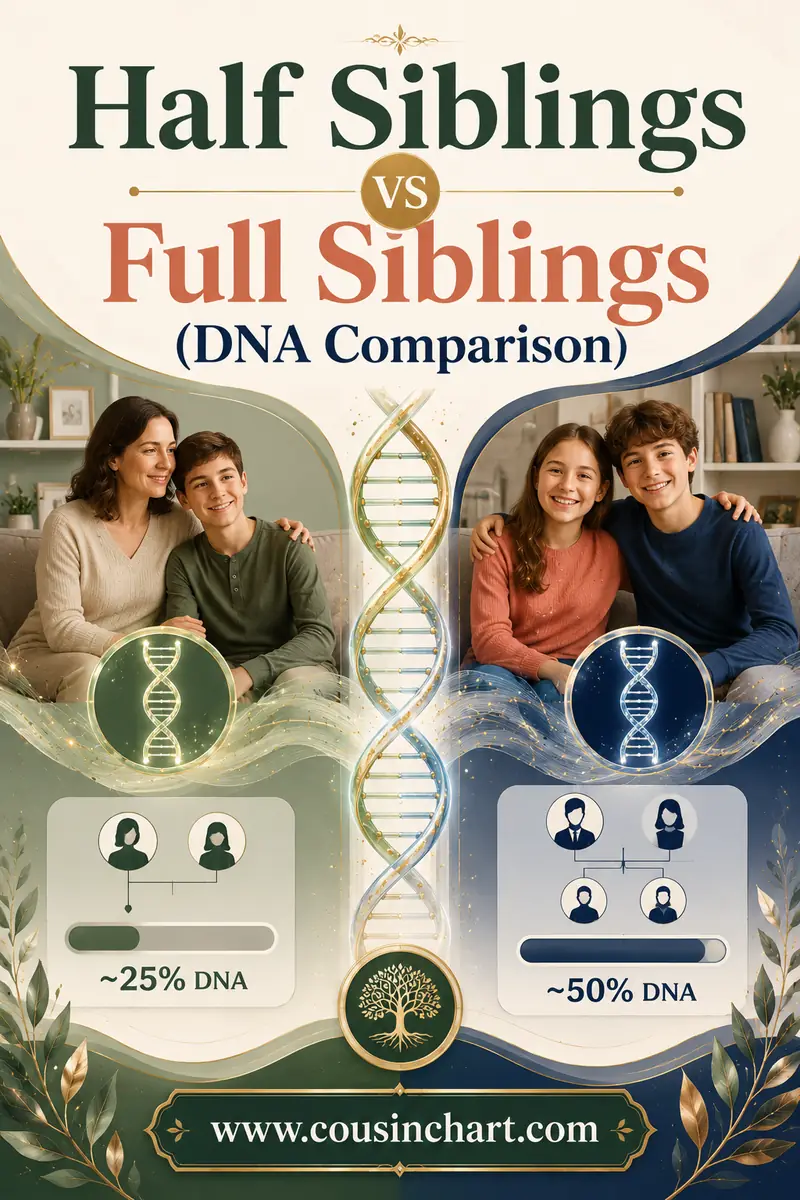
For full siblings, you add up the overlap from both parents: 25% from one plus 25% from the other = about 50%. That's the expected value. Real pairs land above or below it, because inheritance is random.
Shared cM Project numbers for donor siblings
Consumer DNA tests don't usually report a straight percentage. They report centimorgans (cM), a unit that measures the length of matching DNA segments. The bigger the total, the closer the relationship. If you're new to this unit, our explainer on centimorgans covers it in plain language.
The best public reference for how many cM real relatives share is the Shared cM Project 4.0, a crowdsourced data set created by genetic genealogist Blaine T. Bettinger and presented as an interactive tool by Jonny Perl at DNA Painter. Here's what it reports for the relationships donor-conceived people most often see:
| Relationship | Average shared cM | Observed range (cM) |
|---|---|---|
| Full sibling | 2,613 | 1,613 to 3,488 |
| Half sibling (typical donor sibling) | 1,759 | 1,160 to 2,436 |
| Grandparent or grandchild | 1,754 | 984 to 2,462 |
| Aunt or uncle | 1,741 | 1,201 to 2,282 |
| Niece or nephew | 1,740 | 1,201 to 2,282 |
| Half niece or nephew | 871 | 492 to 1,315 |
| First cousin | 866 | 396 to 1,397 |
| Half first cousin | 449 | 156 to 979 |
The DNA Painter tool converts cM to percentages using a total of 7,440 cM. Using that figure, the half-sibling average works out to 1,759 ÷ 7,440 ≈ 23.6%, which sits close to the textbook 25%. The full-sibling average is 2,613 ÷ 7,440 ≈ 35.1%. That looks lower than 50%, and the reason is technical: full siblings share some stretches on both copies of a chromosome, and many testing companies count those stretches only once in the cM total. Don't let the gap worry you. The cM ranges in the table are what you should compare your results against.
The half-sibling look-alike problem
Look at the table again. Half-siblings, grandparents, aunts and uncles all average about 1,740 to 1,760 cM. A DNA test can't tell these apart from the cM number alone. If a stranger shows up as a 1,800 cM match, they could be:
- A donor sibling (half-sibling)
- The donor's parent (your genetic grandparent)
- The donor's brother or sister (your genetic aunt or uncle)
The way to sort this out is to look at other clues:
- Age. A match born within a few years of you is far more likely to be a half-sibling than a grandparent.
- Which side they match on. If the match shares DNA with relatives on your known (non-donor) side, they're not a donor sibling.
- Shared matches. If you both match the same cluster of cousins on the donor side, you're on the same branch. Our guide to shared DNA matches explains how to read this list.
- X-DNA and the testing company's own prediction. Some companies show more detail, such as whether you share fully identical regions, which full siblings have and half-siblings mostly don't.
- Donor number and clinic. If both families have paperwork with the same donor ID from the same bank, that's strong supporting evidence.
If you're trying to tell half from full siblings specifically, our page on DNA tests for half-siblings goes deeper.
Try it yourself: three example matches
Here are three made-up but realistic matches a donor-conceived 22-year-old named Maya might see. Try to place each one before reading the answer.
- Match 1: 1,690 cM, age 19, no shared matches with Maya's mom's side. This fits a half-sibling well. The cM is near the 1,759 average, the age is close, and the match is on the donor side. Most likely a donor sibling.
- Match 2: 1,720 cM, age 71, shares matches with the same donor-side cousins. The cM fits half-sibling, grandparent or aunt/uncle. At 71, a grandparent (the donor's parent) or an older aunt or uncle is much more likely than a half-sibling.
- Match 3: 2,480 cM, age 24. That's above the top of the half-sibling range (2,436 cM) and well inside the full-sibling range. If Maya's parents used donated embryos, this could be a full genetic sibling. If they used only donor sperm with Maya's mom's eggs, the team should double-check, because a full-sibling match would mean sharing the egg source too.
Special cases that change the numbers
A few situations shift the expected amount of shared DNA:
- Related donors. If a family used two donors who happen to be brothers, their children are half-first cousins plus whatever else they share, not unrelated.
- Endogamy. In communities where people have married within a small population for generations, everyone shares extra DNA, which can push numbers up. DNA match tools can overestimate closeness in these families.
- Donor's child with a known parent. The donor's own children are still half-siblings to donor-conceived people, with the same expected 25%.
- Identical twin donors. This is rare, but children from two identical-twin donors would share DNA like half-siblings even though their donors were different people.
How donor sibling families connect
There's no single system that links all donor siblings. Families usually piece together connections through a mix of the methods below. The right mix depends on where the donation happened, when it happened, and whether the donor agreed to be identified.
Regulator and clinic registers
Some countries run an official register. The UK is a good example. Its fertility regulator, the Human Fertilisation and Embryology Authority (HFEA), keeps records of licensed treatments involving a donor since August 1, 1991. According to the HFEA's guide to finding out about your donor and genetic siblings:
- From age 16, a donor-conceived person can ask how many donor-conceived siblings they have, their sex and their year of birth.
- Donors who donated from April 1, 2005 onward couldn't donate anonymously, so their donor-conceived offspring can request the donor's name, date of birth and last known address at 18.
- Someone over 16 who's considering a physical relationship can make a joint application with that person to check whether they're genetically related.
The HFEA also runs the Donor Sibling Link, which lets donor-conceived adults over 18 who were conceived after August 1, 1991 exchange contact details with genetic siblings who've also joined. It only works when both siblings sign up, so a lack of matches doesn't mean you have no siblings. The HFEA notes that a donor-conceived person in the UK could have genetic siblings in up to nine other families, or none at all.
The US doesn't have a national register like this. Records sit with individual sperm banks, egg banks and clinics, and what they'll share depends on the contract the donor signed and the bank's own policy. Many banks run their own sibling contact lists for families who used the same donor.
Independent donor sibling registries
Independent registries let families and donors post a donor ID number and bank name and see who else has posted the same one. One well-known example is the Donor Sibling Registry, which researchers describe as a US-based international registry that connects families sharing a donor. Researchers have used its members to study how families search. In one study of 791 parents recruited through the Donor Sibling Registry, published in Human Reproduction in 2009, parents who searched for donor siblings were mainly driven by curiosity, while those who searched for the donor mainly wanted to strengthen their child's sense of identity. Some families found large numbers of donor siblings, with a maximum of 55, and most reported positive experiences of contact.
Registries depend on what people post. If a family never signs up, they won't appear. Donor ID numbers can also be reused across banks, so it's important to match the bank name as well as the number.
Consumer DNA tests
Consumer DNA tests have changed the picture more than anything else. An autosomal DNA test reads hundreds of thousands of markers across your 22 non-sex chromosomes and compares them with everyone else in the company's database. According to MedlinePlus, the National Library of Medicine's genetics guide, people who are related tend to share more of these variations, and sharing results can lead to unexpected findings about existing relationships.
For donor-conceived people, that means a test can turn up donor siblings, the donor, or the donor's relatives, whether or not anyone signed up for a registry. The American Society for Reproductive Medicine (ASRM) said as much in its 2018 ethics opinion on informing offspring of their donor conception: the growth of genetic testing and DNA databases makes unplanned disclosure more likely, and providers can no longer guarantee donor anonymity.
If you're using a DNA test to search, our guide to searching for an unknown parent with DNA shows how to work from matches back to a donor, and the same steps help confirm a possible donor sibling.
Comparing the ways to connect
| Method | What you need | Strengths | Limits |
|---|---|---|---|
| Official regulator register (for example, the HFEA in the UK) | Proof of identity; treatment at a licensed clinic in that country within the covered dates | Verified records; set age rules; can confirm sibling numbers | Only covers that country and period; contact needs both sides to opt in |
| Sperm bank or clinic sibling list | Donor ID and the bank's account | Easy to join; limited to families who used that bank | Policies vary; not every family joins |
| Independent registry | Donor ID and bank name | Covers many banks and countries; donors can join too | Depends on self-reporting; needs the exact bank and ID |
| Consumer DNA test | A saliva or cheek-swab sample | Finds relatives even without paperwork; confirms biology | Only finds people who tested with the same company; can reveal surprises for other relatives |
| Word of mouth and parent groups | Time and willingness to share | Personal support and advice | Unverified; privacy needs care |
How many donor siblings can one person have?
It depends on the country, the bank and the donor. Some donor-conceived people have no donor siblings at all. Others have dozens.
In the UK, the HFEA tells donor-conceived people they could have genetic siblings in "up to nine other families," which reflects the UK's cap on how many families can use one donor. A family can still have several children with the same donor, so the number of donor siblings can be more than nine.
In the US, there's no single federal cap. Professional guidance is voluntary. ASRM's 2020 committee opinion on repetitive oocyte donation notes that earlier ASRM documents advised no more than 25 pregnancies per sperm donor in a population area of 800,000, to lower the chance that half-siblings might unknowingly meet and form a relationship. For egg donors, it suggests limiting the number of donation cycles, to no more than six, rather than counting pregnancies, because frozen eggs and embryos can lead to pregnancies years later in many places.
Because guidance is voluntary and banks may ship internationally, families in registries sometimes find much bigger groups than they expected. The 2009 study above reported one group as large as 55.
Why the number matters
- Emotional load. Meeting two half-siblings is very different from learning you have forty.
- Medical updates. When one family learns about a genetic condition linked to the donor, the news may matter to many other families.
- Accidental relationships. The more siblings there are, the more it matters to know who your relatives are. That's one reason the HFEA lets two people check whether they're related.
Donor sibling terms you'll come across
Donor conception has its own vocabulary. Here's what the common terms mean.
- Donor-conceived person (DCP): anyone conceived with donated sperm, eggs or embryos.
- Donor sibling or dibling: a person who shares a donor with you, usually a half-sibling raised in a different family.
- Recipient parent: the parent or parents who used the donation to have a child.
- Donor ID or donor number: the code a bank or clinic uses for a donor. It's the main key families use to find each other on registries.
- Anonymous or nonidentified donor: a donor whose identity isn't shared with the family.
- Identity-release or open-ID donor: a donor who agrees that the child can learn their identity, usually at 18.
- Known or directed donor: a donor the family already knows, such as a friend or relative.
- Embryo donation: when embryos created for one family are given to another. Children in both families can be full genetic siblings.
- Donor family or donor group: an informal name for all the families who used the same donor.
- Late discovery: learning you're donor-conceived as a teen or adult, often through a DNA test.
- Misattributed parentage: when the person believed to be someone's biological parent isn't. It's a broader genealogy term that includes undisclosed donor conception.
What do you call a donor sibling's relatives?
Once you find a donor sibling, family trees grow quickly. Your donor sibling's children are your half-nieces and half-nephews. The donor's siblings are your genetic aunts and uncles, and their children are your first cousins by DNA. If the labels get confusing, our guide to half cousins lays out the half-relative labels.
Telling children they have donor siblings
Everything about donor siblings depends on one earlier step: the child knowing they're donor-conceived. The ASRM ethics committee strongly encourages parents to tell children about their donor conception, while leaving the final decision to the parents. It notes that disclosure may serve the child's interest in knowing their genetic heritage and medical history.
When and how families often share
Many parents find it easier to tell the story early and often, so it's simply part of what the child has always known. A few ideas families use:
- Start with a simple story when they're little. "We wanted you so much, and a kind person called a donor helped us have you."
- Add details as they grow. Older kids can understand that the donor helped other families too, and that some of those kids are their half-siblings.
- Use real words. Saying "donor" and "half-sibling" out loud makes the topic feel normal, not secret.
- Let them lead. Some children ask lots of questions, others none for years. Both are normal.
- Talk about DNA tests before a teen takes one. A surprise match is easier to handle when the child already knows the background.
Late discovery
Some people learn they're donor-conceived as adults, often from a DNA test that shows a half-sibling match they can't explain. The ASRM opinion notes that providers should counsel parents and donors about this possibility. Late discovery can bring a lot at once: a new identity question, new relatives, and sometimes hard feelings toward the people who didn't tell. Talking with a counselor who knows donor conception, and connecting with other donor-conceived adults, can help.
Emotional considerations when meeting donor siblings
There's no right way to feel about donor siblings. People describe everything from instant closeness to polite indifference. A few common experiences are worth knowing about ahead of time.
Common feelings for donor-conceived people
- Curiosity. Do we look alike? Do we laugh the same way? Many people love spotting shared traits.
- Belonging. Some find that meeting donor siblings fills in a missing piece of their story.
- Overwhelm. Large donor groups can feel like too much, too fast.
- Uncertainty. "Are they my family? My friends? Strangers?" The answer can change over time.
- Grief or anger, especially after a late discovery or if the donor doesn't want contact.
Common feelings for parents
Parents often feel excited for their child and also protective. Some worry that contact means they're "not enough." Research on searching families, including the 2009 study above, found most parents reported positive experiences, but every family is different. It helps to remember that a child gaining relatives doesn't take anything away from the family that raised them.
Feelings for donors and their families
A donor's spouse and children may not have known about the donation, or may not have pictured actual people. Contact can raise questions for them too. A slow, respectful approach gives everyone time.
Practical steps for reaching out to donor siblings
If you've found a possible donor sibling, here's a step-by-step way to approach it.
- Confirm the relationship. Check the cM against the Shared cM Project ranges, compare donor IDs and bank names, and look at shared matches. Don't assume a 1,700 cM match is a sibling until age and other clues agree.
- Decide what you want. A one-time message? Medical information? An ongoing friendship? Knowing your own goal helps you write a clear first note.
- Write a short, low-pressure first message. Say who you are, how you think you're connected, and that there's no rush to reply.
- Protect privacy. Share a first name and a contact method you control. Hold back home addresses and school names until you've built some trust.
- Respect the answer. Some people reply quickly. Some take months. Some say no. A "no" today isn't always a "no" forever.
- Go slowly with meeting. Messages, then video calls, then a public meetup is a common path. For minors, parents usually handle early contact.
- Agree on boundaries in groups. Big donor groups often set ground rules about sharing photos, posting on social media, and adding new members.
A sample first message
Hi Sam, my name is Jordan. I think we may be donor siblings: we share about 1,750 cM on our DNA test, and my parents used a donor from the same bank. I'd love to say hello and maybe swap a few stories, but there's no pressure at all. If you'd rather not be in touch, I completely understand.
Sharing medical information
One of the most practical reasons to connect is health. If a genetic condition shows up in one donor-conceived child, other families may want to know. The ASRM opinion recommends that programs gather and permanently store donors' medical and genetic information. Some donor groups also share updates among themselves. If you get news like this, talk to a doctor or genetic counselor before acting on it, since a condition in one half-sibling doesn't mean another child has it.
Keeping a record in your family tree
Many families like to record donor siblings in their family tree so the information isn't lost. You can show the donor as the genetic parent, note the donor ID, and draw each donor sibling with a half-sibling line. Our blended family tree template handles relationships like these neatly.
Common mix-ups about donor siblings
These misunderstandings come up again and again.
- "Donor siblings share 50% of their DNA." Only if they're full genetic siblings, such as children from the same donated embryo batch. Most share about 25%.
- "A 1,750 cM match must be my half-sibling." It could also be the donor's parent or sibling. Age and shared matches settle it.
- "No matches on a registry means no siblings." It means no one has posted yet, or they posted elsewhere.
- "An anonymous donor can't be found." As ASRM notes, DNA databases mean anonymity can no longer be guaranteed.
- "The rules are the same everywhere." They aren't. Donor limits, anonymity rules and sibling registers vary by country, and in the US by bank and clinic.
- "Donor siblings are cousins." They're half-siblings, genetically one step closer than first cousins. First cousins average 866 cM versus 1,759 cM for half-siblings.
Why knowing your donor siblings matters for future relationships
It's not a comfortable topic, but it's a real one: two donor siblings who don't know about each other could meet as adults and become romantically interested without realizing they're half-siblings. Donor limits exist largely to make this unlikely. ASRM's 2020 opinion describes the risk of "inadvertent consanguinity," meaning an unknowing relationship between close blood relatives, when one donor helps several unrelated families whose children don't know their genetic background.
Some systems build in a safeguard. The HFEA, for example, lets two people over 16 who are thinking about a relationship apply together to find out whether they share a donor. In places without a service like that, knowing your donor ID, staying in touch with your donor group, and taking a DNA test are the practical ways to be sure.
This is one more reason many families prefer openness. A child who knows they're donor-conceived, and knows roughly how many donor siblings they have, is in a much better position to check than one who has no idea. If you want to understand how close blood relatives are legally and genetically, our explainer on consanguinity covers the basics.
Worked example: mapping one donor group
Picture a donor known only as Donor 4417 at one bank. Here's how one donor group might look once families have connected:
- Family A (two moms) has two children with Donor 4417 and eggs from the same mom. Those two kids are full siblings to each other and half-siblings to everyone else in the group.
- Family B (single mom) has one child with Donor 4417. That child is a half-sibling to all the others.
- Family C (a mom and dad) used Donor 4417 for one child and a different donor for a second child. Their first child is in the donor group; their second child isn't genetically related to the group at all, but is still a half-sibling to their own older brother or sister through their mom.
- The donor later had two children of his own. Both are half-siblings to every donor-conceived child above.
Count it up and Family B's child has five genetic half-siblings: two in Family A, one in Family C, and two who are the donor's own children. If each pair tested, you'd expect each half-sibling pair to land somewhere between 1,160 and 2,436 cM, and the two Family A children to share far more with each other.
A note on health and legal questions
This article is general information, not medical or legal advice. Rules about donor anonymity, donor limits, record access and parentage vary by state and country and can change. For questions about your own family, talk to a genetic counselor, a doctor, or a lawyer who works in assisted reproduction or family law.
Wrapping up: understanding your donor sibling connections
Donor siblings are usually half-siblings who share one genetic parent, about 25% of their DNA, and an average of 1,759 cM. They can find each other through regulator registers, bank lists, independent registries and DNA tests, and what happens next is up to the people involved. Go slowly, confirm the relationship, respect each person's choices, and lean on support when you need it.
If you're trying to work out what to call a new relative, like a donor sibling's child or the donor's brother, try our free family relationship calculator. It names the relationship for you in seconds.
Keep reading: Children of Identical Twins: Cousins on Paper, Half-Siblings in DNA.
Frequently Asked Questions
Are donor siblings considered real siblings?
Genetically, yes. Most donor siblings are half-siblings because they share one biological parent, the donor. Whether they feel like real siblings is a different question, and the answer is personal. Some donor siblings become very close, talk every week and spend holidays together. Others exchange a few messages and stay friendly acquaintances. Both outcomes are normal. The relationship is shaped by age, distance, personality and how much each family wants contact, not just by DNA. It's fine to let the relationship find its own level over time.
How much DNA do donor siblings share?
Most donor siblings are half-siblings and share about 25% of their DNA on average. In centimorgans, the Shared cM Project 4.0 reports an average of 1,759 cM for half-siblings, with an observed range of 1,160 to 2,436 cM. If two donor-conceived people came from the same egg donor and the same sperm donor, for example through embryo donation, they're full siblings and usually share far more, averaging 2,613 cM with a range of 1,613 to 3,488 cM. Always compare your actual cM number with these ranges rather than relying on a percentage alone.
Can a DNA test tell the difference between a donor sibling and the donor's parent?
Not from the cM number alone. Half-siblings, grandparents, and aunts or uncles all average roughly 1,740 to 1,760 cM in the Shared cM Project, so their ranges overlap heavily. You need other clues. Age is the biggest one: a match born a few years from you is much more likely to be a half-sibling than a grandparent. Shared matches, which side of your family the match connects to, and donor paperwork such as the bank name and donor ID all help confirm the relationship.
How do I find my donor siblings?
Start with the information you have. If you know the sperm bank or clinic and the donor ID, check whether the bank runs a sibling contact list and look at independent registries where families post donor numbers. If you were conceived at a licensed UK clinic after August 1991, the HFEA can tell you how many donor siblings you have from age 16 and offers its Donor Sibling Link from 18. Taking a consumer DNA test can also reveal donor siblings who never joined a registry, as long as they tested with the same company.
What is a dibling?
Dibling is an informal word that blends donor and sibling. It refers to a person who was conceived with the same sperm or egg donor as you but raised in a different family. Some families like the term because it's short and makes the relationship easy to explain to kids. Others prefer to say sibling or half-sibling, because they feel a special word makes the relationship seem less real. There's no official rule, so it's kind to ask the people involved which word they're comfortable with.
Can donor siblings be full siblings?
Yes, in some situations. If two children share both the same egg source and the same sperm donor, they're full genetic siblings. This happens most often with embryo donation, when embryos created for one family are given to another, or when embryos made from one egg donor and one sperm donor are shared among families. It also happens within a single family that uses the same donor and the same egg source for more than one child. Full siblings average about 2,613 cM in the Shared cM Project, well above the typical half-sibling average.
How many donor siblings can one person have?
It varies a lot. Some donor-conceived people have none, and some have dozens. In the UK, the HFEA says a donor-conceived person could have genetic siblings in up to nine other families. In the US, there's no single federal limit, and professional guidance is voluntary. ASRM has noted earlier advice of no more than 25 pregnancies per sperm donor in a population of 800,000. A 2009 study of families using the Donor Sibling Registry found one group as large as 55 donor siblings, so very large groups do happen.
Should I tell my child they have donor siblings?
Many experts encourage openness. The American Society for Reproductive Medicine's ethics committee strongly encourages parents to tell children they were donor-conceived, while leaving the final decision to the parents. Learning early tends to be easier than finding out through a surprise DNA match as a teen or adult. Once a child knows they're donor-conceived, explaining donor siblings is a natural next step: other families were helped by the same donor, and some of those children are their half-siblings. Let your child's questions guide how much detail you share.
Is it safe for donor siblings to meet in person?
Meeting can be a lovely experience, and a careful approach keeps it comfortable. Confirm the relationship first with DNA and donor paperwork. Start with messages, then a video call, and meet in a public place when everyone feels ready. Share personal details like home addresses gradually. For children and teens, parents usually handle the first contacts and attend early meetings. If you're part of a large donor group, agree on ground rules about photos and social media. Going slowly gives everyone room to decide what kind of relationship they want.
Sources
We checked every source below while writing this guide. Last reviewed October 30, 2026, by Joan Ramos.
- Shared cM Project 4.0 tool v4 (DNA Painter (data by Blaine T. Bettinger))
- Finding out about your donor and genetic siblings (Human Fertilisation and Embryology Authority (HFEA))
- Donor Sibling Link (DSL) (Human Fertilisation and Embryology Authority (HFEA))
- Gamete donation: parents' experiences of searching for their child's donor siblings and donor (Human Reproduction, 2009) (PubMed, National Library of Medicine)
- Informing offspring of their conception by gamete or embryo donation: an Ethics Committee opinion (2018) (American Society for Reproductive Medicine)
- Repetitive oocyte donation: a committee opinion (2020) (American Society for Reproductive Medicine)
- What is genetic ancestry testing? (MedlinePlus Genetics, National Library of Medicine)