Half-Siblings vs Full Siblings: What Your DNA Actually Shows
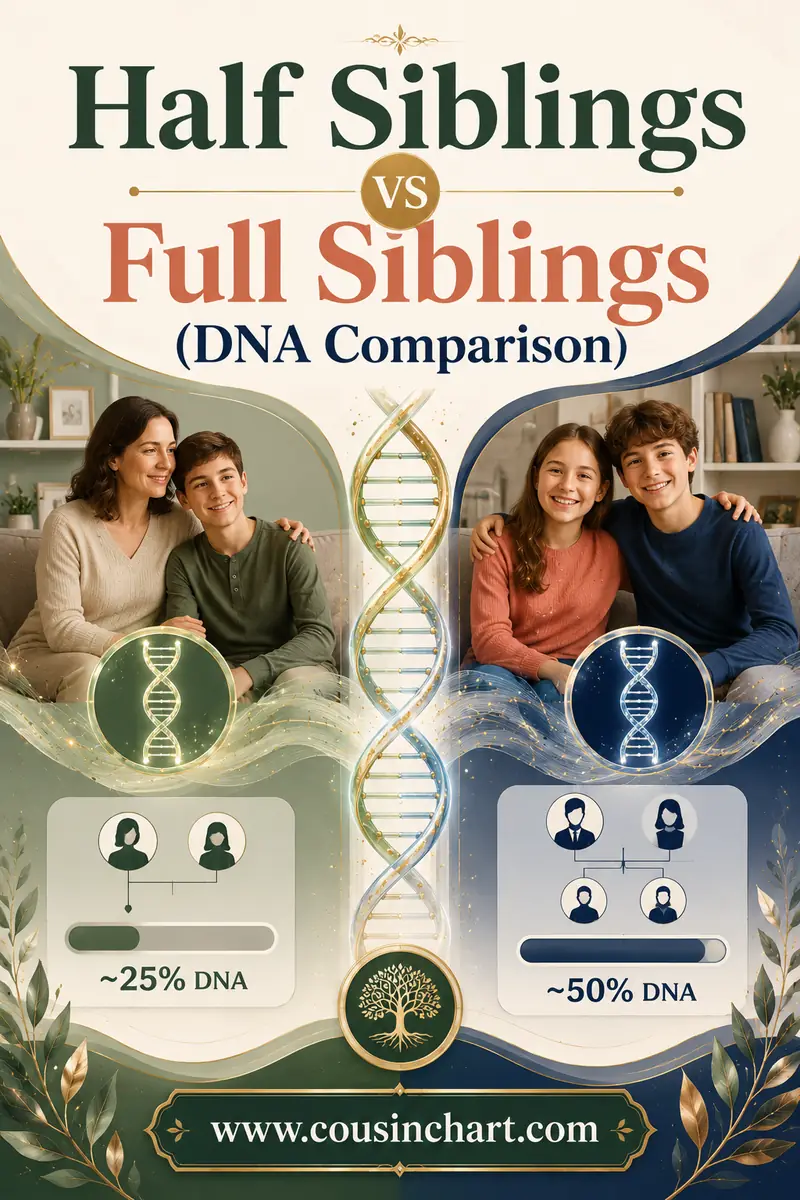
Full siblings share about 50% of their DNA — roughly 2,300 to 3,400 centimorgans. Half-siblings share about 25% — roughly 1,300 to 2,300 cM. Unlike most DNA comparisons, this one usually gives you a clean answer, because the two ranges barely touch. If your number sits comfortably above 2,400 cM you're looking at full siblings; comfortably below 2,200 cM and you're looking at a half relationship (or a grandparent, aunt or uncle — more on that below).
The wrinkle is the narrow overlap at the top of the half range and the bottom of the full range, plus one genuinely useful technical test that most people have never heard of. Drop your number into the DNA match calculator first, then read on for how to firm up the answer.
Where does your number land? Tap the band that matches your shared cM:
Tap a band and the reading will appear here.
What Makes Someone a Half-Sibling Instead of a Full Sibling?
Full siblings share both biological parents. Half-siblings share exactly one.
That single difference halves the expected DNA. With two shared parents, you're drawing from the same two genetic pools your sibling drew from — so on average you match on about half your genome. With one shared parent, only that parent's contribution can overlap, and since each of you got a random half of it, the expected overlap drops to about a quarter.
Worth saying clearly: half-sibling is a biological description, not a comment on the relationship. Plenty of half-siblings were raised in the same house and don't think of themselves as anything but siblings. The genetics don't care what you call each other, and neither do we — the terminology is only here because it changes what the numbers mean.
Step-siblings are a separate thing entirely. They're connected by a marriage, not by ancestry, so they share no DNA at all beyond the trace background everyone shares.
How Much DNA Do Full Siblings Share?
Full siblings average around 2,600 cM, with a real-world range of roughly 2,300 to 3,400 cM. That's the picture from the Shared cM Project, the crowdsourced collection of thousands of documented relationships that underpins the shared cM charts at DNA Painter.
Notice that the average isn't 50% of the ~6,800 cM total. That's not an error — it's a quirk of how sharing gets counted. Full siblings have stretches where both copies of a chromosome match (inherited the same segment from both parents), and companies count those once rather than twice. So the reported cM figure lands below a naive 50% calculation while the underlying relationship is still a full 50% one.
The spread matters too. Two brothers might share 2,400 cM; another pair might share 3,100 cM. Both are perfectly normal full-sibling results. Random recombination decides how much overlap you get, and it varies a lot between sibling pairs.
That spread is also why company relationship labels look inconsistent between families. A pair at 3,100 cM may get a confident "Full Sibling" tag, while a pair at 2,350 cM gets something vaguer like "Close Family" or "Sibling / Grandparent." The label is the company's guess wrapped around a range; the cM number underneath it is the actual measurement. Always work from the number, and if two companies give you slightly different figures for the same pair, that's a difference in how each one filters small segments, not a disagreement about who you are.
How Much DNA Do Half-Siblings Share?
Half-siblings average around 1,700 cM, ranging roughly 1,300 to 2,300 cM. That's about a quarter of your DNA.
The important caveat: that range isn't exclusive to half-siblings. A grandparent, a grandchild, an aunt, an uncle, a niece and a nephew all occupy the same band, because they're all 25% relationships built from different paths through the tree. If your match sits at 1,750 cM, "half-sibling" is one of five or six equally valid readings until you bring in outside evidence.
The clues that break that tie are:
- Age difference. A grandparent is two generations up, typically 40 to 70 years older. A half-sibling is usually within 25 years of you.
- Which side the shared matches fall on. If everyone in common is on your mother's side, the link runs through your mother.
- What a parent shares with them. If your mother shares ~3,500 cM with the match, it's her parent or her child. If she shares ~2,600 cM, it's her full sibling — your aunt or uncle.
None of that changes the half-versus-full question, though. Everything in the 25% band is not a full sibling, and that's the distinction this article is really about.
Half-Sibling vs Full Sibling: The Numbers Side by Side
| Full siblings | Half-siblings | |
|---|---|---|
| Shared parents | Both | One |
| Expected DNA shared | ~50% | ~25% |
| Typical shared cM | ~2,600 average | ~1,700 average |
| Usual range | ~2,300–3,400 cM | ~1,300–2,300 cM |
| Fully identical regions | ~25% of the genome | Essentially none |
| Other relationships in the same range | Rarely confused | Grandparent, aunt/uncle, niece/nephew |
| Can DNA alone confirm it? | Usually yes | Only as "a 25% relationship" |
The row that does the quiet heavy lifting is fully identical regions, and it deserves its own section.
What Are Fully Identical Regions, and Why Do They Settle It?
You have two copies of each chromosome — one from each parent. When two people are compared, a segment can match on one copy (half-identical) or on both copies at once (fully identical).
Full siblings get fully identical regions because they can inherit the same segment from their mother and the same segment from their father in the same place. On average that happens across about a quarter of the genome.
Half-siblings share only one parent, so there's no second line for a segment to match on. They have effectively zero fully identical regions. Occasional tiny flickers show up in "pile-up" regions where the algorithms get noisy, but nothing structural.
That makes it a genuine yes/no test rather than a range comparison — and it's the one place where the DNA really can tell you the answer outright.
Where to look:
- 23andMe shows fully identical segments in its DNA comparison tool, marked distinctly from half-identical ones.
- GEDmatch displays them in a one-to-one autosomal comparison, with fully identical regions highlighted in green on the chromosome graphic.
- FamilyTreeDNA gives you a chromosome browser, though reading fully identical regions from it takes more interpretation.
- AncestryDNA doesn't offer a chromosome browser at all. To use this test with an Ancestry match, you'd both need to download raw data and upload it to GEDmatch — which is free.
If your number is stuck in the 2,200 to 2,400 cM gray zone, this is the check that ends the argument.
Why Do Full Siblings Get Different Results From Each Other?
This surprises people constantly: two full siblings test at the same company and come back with noticeably different ethnicity estimates. One gets 18% Scandinavian, the other gets 4%. Neither test is wrong.
The reason is recombination. You inherit exactly half your autosomal DNA from each parent, but which half is random. Your parents each carry a mix of what their own ancestors passed down, and each child gets a different draw from that mix. Two siblings share about half their DNA — which means about half of what each has, the other doesn't.
Consequences worth knowing:
- Ethnicity percentages differ between siblings, sometimes by double digits. Our guide to how accurate ethnicity estimates are covers why those numbers move around in general.
- Match lists differ. Your sibling may match a fourth cousin you don't match at all. Beyond about the third-cousin level, DNA sharing gets patchy, and real relatives can share nothing detectable.
- A distant ancestor can vanish from one sibling's results and appear in the other's. Nobody inherits a measurable piece of every ancestor.
- Testing a sibling is genuinely useful research, not duplication. Between the two of you, you cover more of your parents' DNA than either does alone.
The one thing that doesn't vary much is the total amount you share with each other. Ethnicity estimates wobble; shared cM between two documented full siblings is stable and reliable.
What If the Number Says Half but the Family Says Full?
Sometimes two people who grew up as full siblings test at 1,750 cM. That's not a testing error — that number means one shared parent, not two.
Before you conclude anything, run three checks:
- Confirm you're reading the right figure. Use total shared cM, not a percentage, not "shared segments," and not a company's relationship label. Labels are estimates; the cM number is the measurement.
- Check for fully identical regions if either of you is on 23andMe or GEDmatch. Full siblings have them; half-siblings don't. This is the decisive check.
- Rule out the other 25% relationships. A match at 1,750 cM could be an aunt or a grandparent rather than a half-sibling. Age and shared matches sort this out quickly.
If it holds up, the result is real, and how you handle it is a human question rather than a genetic one. A few things that help: take your time before contacting anyone; separate the biological fact from the story behind it, because DNA can establish the first and never the second; and remember that other living people have a stake in what you found. Consumer DNA results also aren't legal proof of parentage — courts use their own chain-of-custody testing — so treat what you have as a strong biological finding, not a document.
Does It Matter Practically Whether Someone Is a Half-Sibling?
Genetically, yes. Socially and legally, often much less than people assume.
Medical family history is the place it genuinely counts. A full sibling shares about twice the DNA of a half-sibling, so a hereditary condition in a full sibling carries roughly twice the statistical weight when a doctor is assessing your risk. If you've just discovered a sibling relationship you didn't know about, that's worth mentioning at your next appointment — and it's a question for a clinician, not a genealogy chart.
Inheritance varies by jurisdiction and it's genuinely worth checking rather than assuming. Most modern intestacy statutes treat half-siblings as full siblings, but a minority of places still reduce a half-blood relative's share. That's a question for a lawyer where you live, not something a cM number settles.
Everyday family life rarely cares at all. Half-siblings raised together are siblings in every way that matters day to day, and half-siblings who meet as adults through a DNA test often build a relationship on the same footing. The word "half" describes an ancestral path, not the strength of a bond.
The one place the distinction really earns its keep is research. Knowing whether you share one parent or two tells you which branch of the tree your shared matches belong to — and that shapes every search you run afterwards.
What About Half-Relationships Further Out in the Tree?
The same halving logic runs through the whole family tree, and it's where a lot of confusion lives.
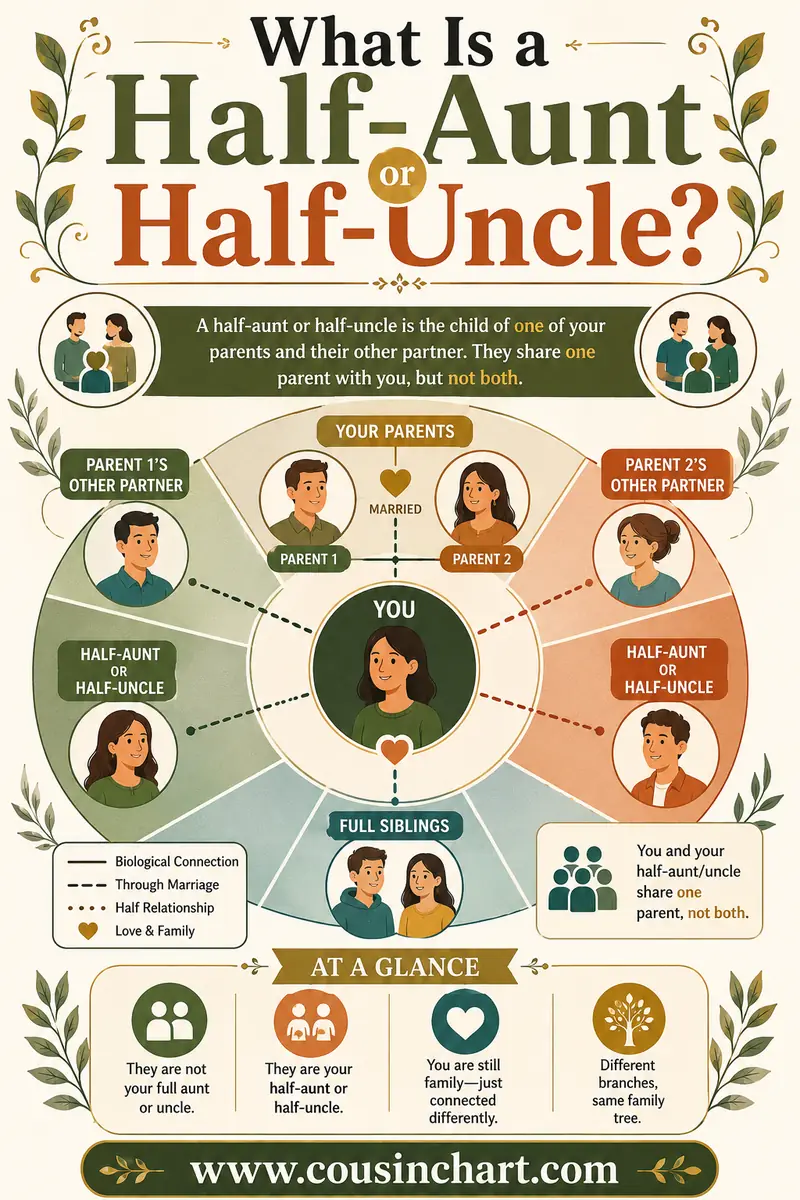
- A half-aunt is your parent's half-sibling. She shares about 12.5% with you instead of a full aunt's 25%. Our half-aunt guide walks through the naming and the numbers.
- A half-first cousin is the child of your parent's half-sibling — about 6.25%, half a normal first cousin.
- A half-nephew or half-niece is your half-sibling's child, sharing about 12.5% with you.
The pattern is simple: any "half" version of a relationship shares about half the DNA of the full version, because there's one shared ancestor at the top instead of two. What trips people up is the naming, not the math — English is vague about half-relationships, and most families just drop the "half" in conversation.
When the labels get tangled, the family relationship calculator will name any connection you can describe, half-relationships included.
How Do You Confirm the Answer Confidently?
A short checklist that covers almost every case.
- Get the total shared cM from your match page. Write it down.
- Compare it to the ranges: above ~2,400 cM means full; 1,300–2,300 cM means a 25% relationship; above ~3,400 cM means parent and child.
- If you're in the 2,200–2,400 gray zone, check fully identical regions on 23andMe or GEDmatch. That's the tiebreaker.
- If you're in the 25% band, use age difference and shared matches to work out which 25% relationship it is.
- Test a parent if one is available. One parent's cM figure with the match resolves nearly every ambiguity in a single step.
- Back it with records. Birth certificates, census entries, obituaries. DNA points; documents confirm.
- Remember what centimorgans are. They're a measure of genetic distance along a chromosome, not a count of matching letters — our centimorgan explainer covers the unit properly.
FAQ
How many cM do full siblings share?
Roughly 2,300 to 3,400 cM, averaging around 2,600. That represents about 50% shared DNA. The number varies between sibling pairs because recombination decides how much of each parent's contribution happens to overlap, so a pair at 2,400 cM and a pair at 3,200 cM are both entirely normal.
How many cM do half-siblings share?
Roughly 1,300 to 2,300 cM, averaging near 1,700 — about 25% of your DNA. Be aware that grandparents, grandchildren, aunts, uncles, nieces and nephews all fall in that same range, so the number confirms "a 25% relationship" rather than "half-sibling" specifically.
Can a DNA test tell half-siblings from full siblings?
Usually yes. The two ranges barely overlap, so most cases are clear from the shared cM alone. In the narrow 2,200 to 2,400 cM gray zone, checking fully identical regions on 23andMe or GEDmatch settles it — full siblings have substantial fully identical regions, half-siblings have essentially none.
Why do my sibling and I have different ethnicity results?
Because you each inherited a different random half of each parent's DNA. Siblings share about 50% of their DNA, which means about half of what one of you carries, the other doesn't. Ethnicity estimates are also built on reference panels that get updated over time, so percentages shift for reasons unrelated to your actual ancestry.
Do half-siblings show up as "close family" on Ancestry?
Yes. AncestryDNA groups half-siblings, grandparents, aunts, uncles, nieces and nephews together under "Close Family," precisely because it can't distinguish them from shared DNA alone. Treat that label as a category, not a conclusion, and work from the cM number underneath it.
Can two full siblings share only 25% of their DNA?
Essentially no. Documented full siblings don't drop to the 25% level — the lower edge of the full-sibling range sits around 2,300 cM, well above where 25% relationships live. A result near 1,700 cM between two people raised as full siblings points to one shared parent rather than two, and the fully-identical-region check will confirm it.
Check Your Number in Seconds
Half or full comes down to one measurement and, occasionally, one follow-up check. Above roughly 2,400 cM, you're full siblings. Between 1,300 and 2,300 cM, you're in the 25% band, and half-sibling is one of several relationships that fit. In the narrow gap between, fully identical regions give you a clean yes or no.
Put your shared cM into the DNA match calculator to see the full list of relationships your number allows, then use the checks above to narrow it to one. It's usually a five-minute job, not a five-week one.