Family Health History: How to Gather It and Build a Health Family Tree
A family health history is a record of the illnesses and health conditions in your blood relatives, along with the ages when they started and, for relatives who have died, the cause and age of death. To build one, you talk with relatives, check documents like death certificates, and lay everything out on a simple family tree that covers about three generations. Then you bring it to your doctor, who can use it to decide which screenings you need and when to start them.
That's the short version. The longer version, which is what this guide is for, covers who counts, what exactly to ask, how to handle gaps and awkward conversations, how to draw a health family tree that a clinician can read in thirty seconds, and what to do with it once it's done. We'll also walk through two complete worked examples so you can see what a finished history looks like.
Most people already know this matters. In a 2004 CDC survey, 96.3% of adults said knowing their family health history was important, but only 29.8% had actually collected it. The gap isn't motivation. It's that nobody tells you how to start. Let's fix that.
What a Family Health History Is and Why It Matters
Relatives share genes, and they often share habits, diets, neighborhoods and environments too. That mix is why some conditions cluster in families. MedlinePlus explains that a family history can show whether you have a higher risk for conditions such as heart disease, stroke and cancer. It also makes an important point that's easy to miss: having a relative with a disease raises your risk, but it doesn't mean you'll definitely get it.
The reverse is true as well. MedlinePlus Genetics notes that having no family history of a condition doesn't rule out your own risk. A family health history is one useful input, not a crystal ball.
What your doctor does with it
According to the CDC's family health history overview, your provider can use this information to decide which screening tests you need and when to start them, even if what you bring is incomplete. The CDC gives concrete examples:
- If your mother or sister had breast cancer before age 50, ask your doctor whether genetic counseling and testing make sense for you.
- If a parent or sibling had colorectal cancer before age 50, ask whether you should start colonoscopies earlier or have them more often.
- If a parent or sibling has diabetes, ask how early you should be screened.
Notice the pattern. None of these examples says "you will get this disease." Each one says "ask a question." That's the right mindset for this whole project.
Why it beats a DNA test for most people
A consumer DNA test reads a sample of your genes. A family health history captures what actually happened to people who share your genes, your kitchen table and often your zip code. The CDC's page on hereditary breast and ovarian cancer points out that a direct-to-consumer genetic test may not fully explain your cancer risk. Family history fills in context that a test alone can't, and it's free to collect.
Who to Include: Close Relatives First
You don't need your entire genealogy. You need your blood relatives, the people you share DNA with by descent. Relatives by marriage, like your aunt's husband or your sister-in-law, don't affect your inherited risk, though their information matters for their own children. If that distinction feels fuzzy, our guide to blood relatives vs. relatives by marriage sorts it out.
The CDC lists parents, siblings, half-siblings, children, grandparents, aunts, uncles, nieces and nephews. MedlinePlus Genetics adds cousins and says a complete record covers three generations.
First-, second- and third-degree relatives
Doctors often group relatives by "degree," which roughly tracks how much DNA you share. Each step away from you on the tree halves the expected share. That's simple math: you get half your DNA from each parent, so a parent shares about 50% with you, a grandparent about 25%, and so on.
| Degree | Who's in this group | Expected DNA shared (average) | Priority for your history |
|---|---|---|---|
| First-degree | Parents, full siblings, children | About 50% | Highest. Get as much detail as you can. |
| Second-degree | Grandparents, aunts and uncles, half-siblings, nieces and nephews, grandchildren | About 25% | High. These complete the three-generation picture. |
| Third-degree | First cousins, great-grandparents, great-aunts and great-uncles | About 12.5% | Helpful, especially if a pattern shows up. |
Half-siblings land in the second-degree group because you share only one parent. If you're not sure how half and full siblings differ genetically, our page on half-siblings vs. full siblings explains it with numbers.
Both sides of the family
Collect your mother's side and your father's side separately and label them. A condition that shows up in three people on your mother's side tells a different story than the same three cases split across both sides. Doctors will ask "which side?" almost every time.
What to Collect for Each Relative
The CDC recommends gathering major medical conditions, causes of death, age at diagnosis, age at death, and ethnic background. Here's how that translates into a practical checklist, with notes on why each item helps.
| Item to record | Example entry | Why it matters |
|---|---|---|
| Name and relationship | Rosa, maternal grandmother | Shows which side and how close the relative is. |
| Year of birth or current age | Born 1941 | Lets your doctor judge whether a diagnosis came early. |
| Each major condition | Type 2 diabetes; breast cancer | The core of the history. |
| Age at each diagnosis | Diabetes at 58; breast cancer at 46 | Early onset is one of the strongest signals. |
| Living or deceased | Deceased | Needed to read the tree correctly. |
| Age and cause of death | Age 74, stroke | Causes of death often reveal conditions nobody talked about. |
| Ethnic or ancestral background | Ashkenazi Jewish; Puerto Rican | Some conditions are more common in certain groups. |
| Relevant habits or exposures | Smoked 30 years | Helps separate inherited risk from lifestyle factors. |
| Pregnancy history, if known | Two miscarriages | Can matter for family planning conversations. |
| Genetic test results, if any | Tested for a known family variant | A known result in a relative can change everyone's next steps. |
Conditions worth asking about by name
People rarely volunteer a full medical list. They answer specific questions. It helps to ask about these by name, since they're among the conditions that sources like MedlinePlus Genetics and the CDC flag as running in families:
- Heart and blood vessels: heart attack, heart disease, high blood pressure, high cholesterol, stroke, irregular heartbeat, sudden unexplained death
- Cancer: which kind (breast, ovarian, colon, prostate, pancreatic and so on), and whether one person had more than one kind
- Metabolic: type 1 or type 2 diabetes
- Single-gene conditions: cystic fibrosis, sickle cell disease, and others a family may already know about
- Mental health and neurological: depression, bipolar disorder, dementia, seizures
- Other: asthma, kidney disease, blood clots, birth defects, learning differences, hearing or vision loss at a young age
Why "age at diagnosis" is the item people forget
If you record only one extra detail, make it age at diagnosis. The CDC notes that your risk may be higher when a close relative has a chronic disease, when more than one close relative has it, or when a relative was diagnosed younger than usual. "Grandpa had heart trouble" is vague. "Grandpa had a heart attack at 47" is something a doctor can act on.
For heart disease specifically, the CDC's page on heart disease and family health history says that heart disease in relatives at age 50 or younger can point to familial hypercholesterolemia, an inherited condition that causes high cholesterol. You don't need to diagnose anything. Just write down the age.
How to Gather Your Family Health History, Step by Step
This is the method that works for most families. It takes a few weeks of on-and-off effort, not one marathon weekend.
- Start with yourself. Write your own conditions, surgeries, and ages at diagnosis. It's the easiest entry and gives you a template.
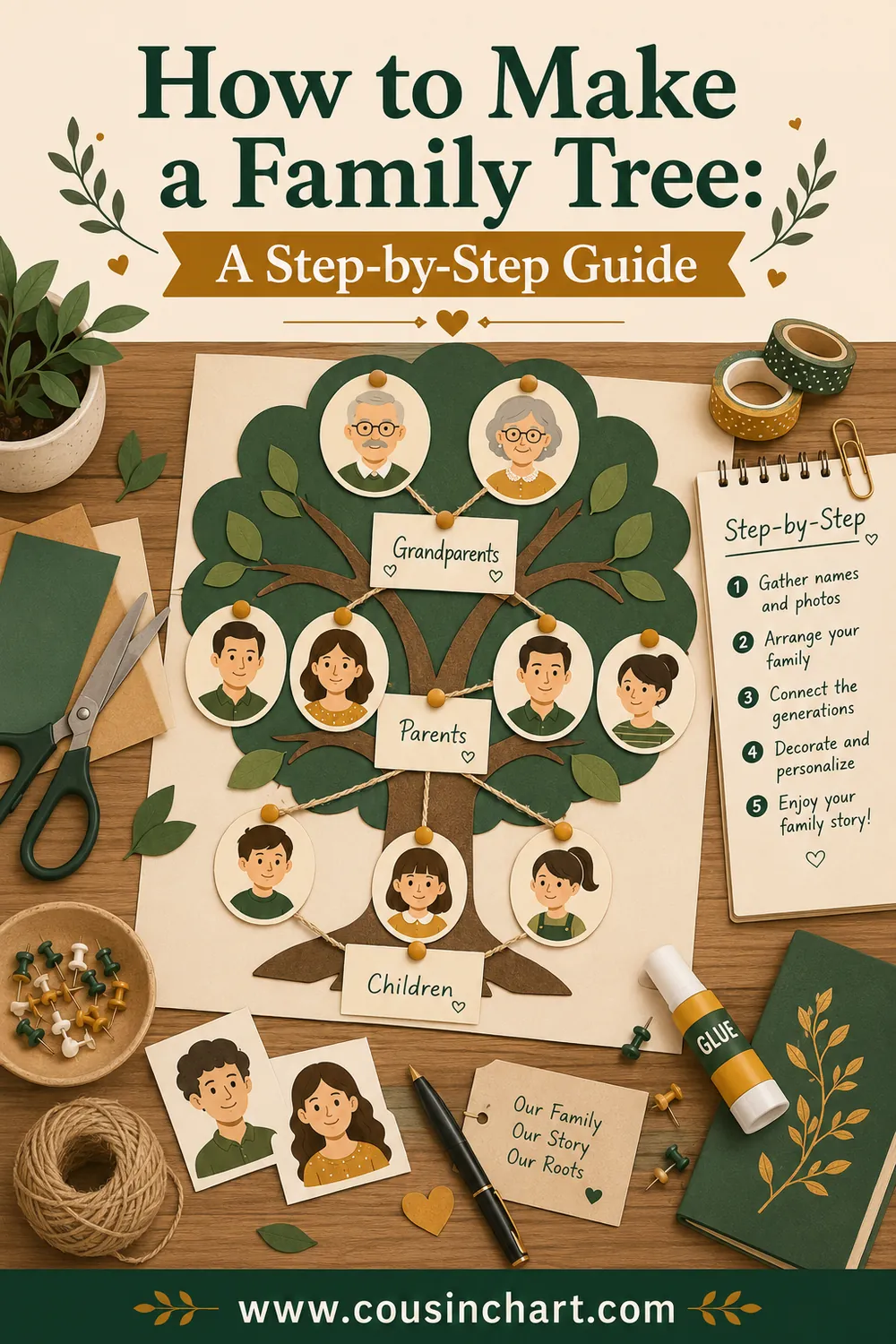
- Sketch the people before the health facts. Draw a quick three-generation tree: you, your siblings, your parents and their siblings, and your four grandparents. If you've never drawn one, our guide on how to make a family tree walks through the layout.
- Pick your best informant on each side. Usually that's the relative who keeps in touch with everyone, often an aunt or a grandparent. Start there.
- Ask specific questions. Use the condition list above. "Did anyone on Dad's side have cancer? Which kind? How old were they?" gets far better answers than "Any health problems in the family?"
- Check documents. MedlinePlus suggests medical records and death certificates. Obituaries can help too, and MedlinePlus Genetics mentions them as a way to fill gaps.
- Write it down in one place. A notebook, a spreadsheet, or a free tool. One place matters more than which place.
- Mark what you're unsure of. "Uterine or ovarian cancer, unsure, age about 60" is still useful. Just flag it.
- Share it with your doctor and your relatives. Bring it to your next appointment, and offer copies to siblings and cousins, who share much of the same history.
- Update it. The CDC recommends updating it regularly. New diagnoses change the picture.
Good times to ask
Family gatherings are the classic moment. MedlinePlus Genetics suggests talking with relatives at events like reunions or holidays. A few other natural openings:
- When someone gets a new diagnosis and is already talking about it
- When you're expecting a baby or planning a pregnancy
- When you're filling out a new-patient form and realize you can't answer the family section
- When you're working on a genealogy project anyway and already have the tree drawn
Questions you can copy
- "Has anyone in our family had heart problems or a stroke? How old were they?"
- "Do you know what Grandma's sister died of, and roughly how old she was?"
- "Has anyone had cancer more than once, or two different kinds?"
- "Did anyone have diabetes? Did they need insulin from a young age?"
- "Has anyone in the family had a genetic test, or been told a condition runs in the family?"
- "Is there anything you've been told by a doctor that you think the rest of us should know?"
How to Draw a Family Health History Tree
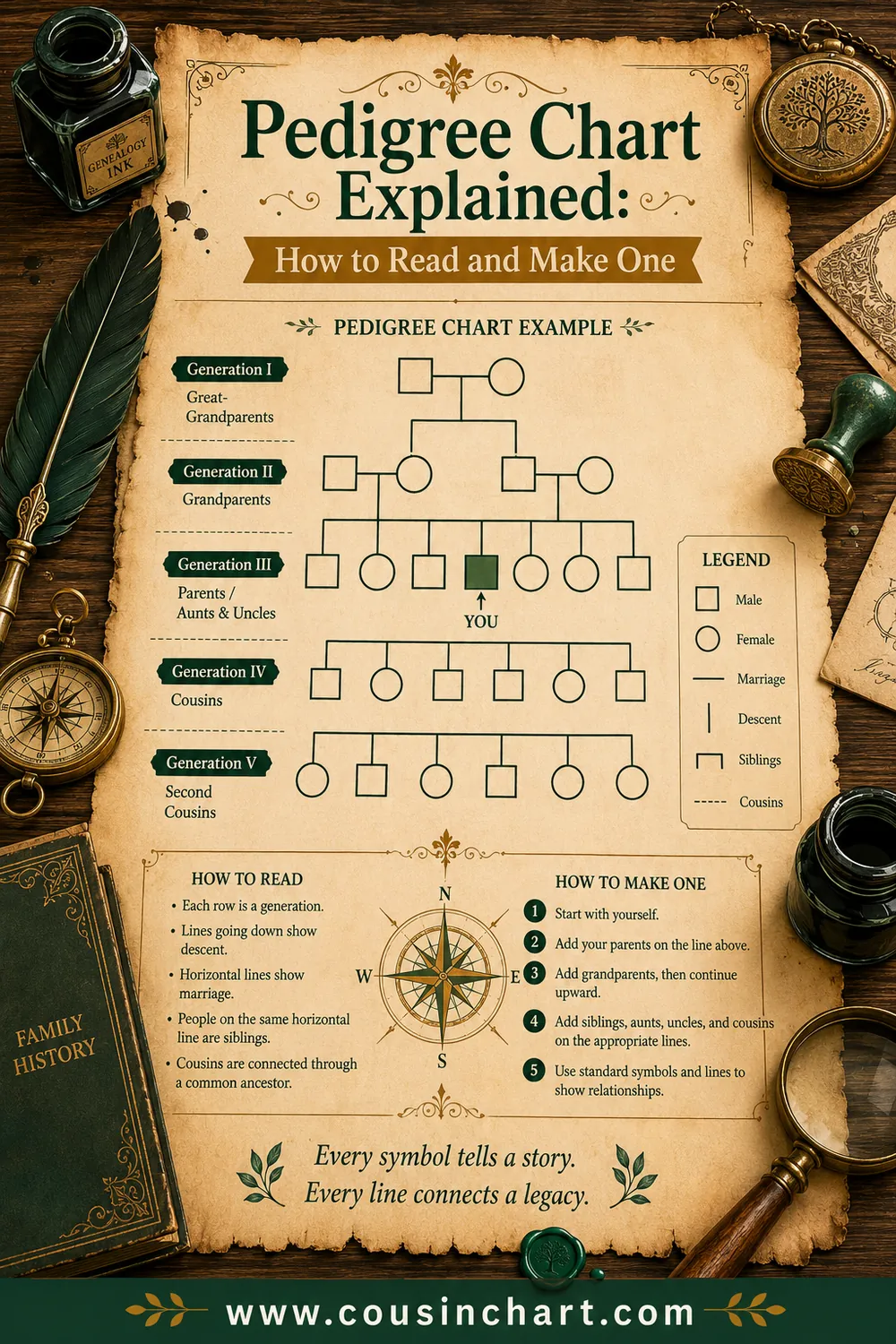
A health family tree looks like a regular family tree with medical notes attached. Clinicians use a standardized version called a pedigree, which uses squares for males, circles for females, filled-in shapes for people who have a condition, and a slash for people who have died. You don't have to draw a formal pedigree, but borrowing a few of its rules makes your tree much easier for a doctor to read. Our explainer on pedigree charts covers the genealogy version, and our article on pedigree analysis covers the genetics-class version.
Simple layout rules
- Put each generation on its own row, oldest at the top.
- Keep your mother's side on one half of the page and your father's side on the other.
- Under each person, write the condition and the age at diagnosis, like "Breast ca, 46."
- For deceased relatives, add "d. 74, stroke."
- Draw an arrow pointing to yourself so it's clear whose history this is.
- Include a short legend at the bottom if you use any abbreviations.
A worked example: the Morales family
Here's a fictional three-generation history written out the way you might jot it down, followed by what it shows. This is an illustration of how to organize information, not a risk assessment for any real person.
You: Ana, 38. No major conditions.
Mother's side:
- Mother, Elena, 64: high blood pressure diagnosed at 50; breast cancer at 44, treated, living.
- Maternal aunt, Lucia, 61: breast cancer at 48, living.
- Maternal uncle, Tomas, 66: high cholesterol at 45.
- Maternal grandmother, Rosa: died at 52, ovarian cancer.
- Maternal grandfather, Jorge: died at 80, pneumonia; type 2 diabetes from age 60.
Father's side:
- Father, Daniel, 67: type 2 diabetes at 55; heart attack at 63.
- Paternal uncle, Marco, 70: type 2 diabetes at 58.
- Paternal grandmother, Carmen: died at 88, dementia.
- Paternal grandfather, Luis: died at 79, heart failure.
What stands out: On the mother's side, there are two relatives with breast cancer before age 50 and a grandmother with ovarian cancer at a young age. Using the CDC's own example, a mother or sister with breast cancer before 50 is a reason to ask about genetic counseling. In a real family, that's the conversation Ana would want to have with her doctor. On the father's side, type 2 diabetes in a parent and an uncle is the kind of history the CDC says to mention when asking how early to be screened.
What doesn't stand out as much: Grandma Carmen's dementia at 88 and Grandpa Jorge's pneumonia at 80 are still worth writing down, but late-life conditions in a single relative usually carry less weight than early ones in several. Your doctor will sort that out. Your job is just to capture it.
Turning the notes into a tree
Drawn as a tree, Ana's maternal side would show Rosa (circle, filled, with a slash, "ovarian ca 52, d. 52") and Jorge (square, slash, "T2D 60, d. 80 pneumonia") at the top. Below them, Elena and Lucia as filled circles with "breast ca 44" and "breast ca 48," and Tomas as a square with "high chol 45." Below Elena, Ana as a circle with an arrow. The cluster jumps out visually in a way it doesn't in a list.
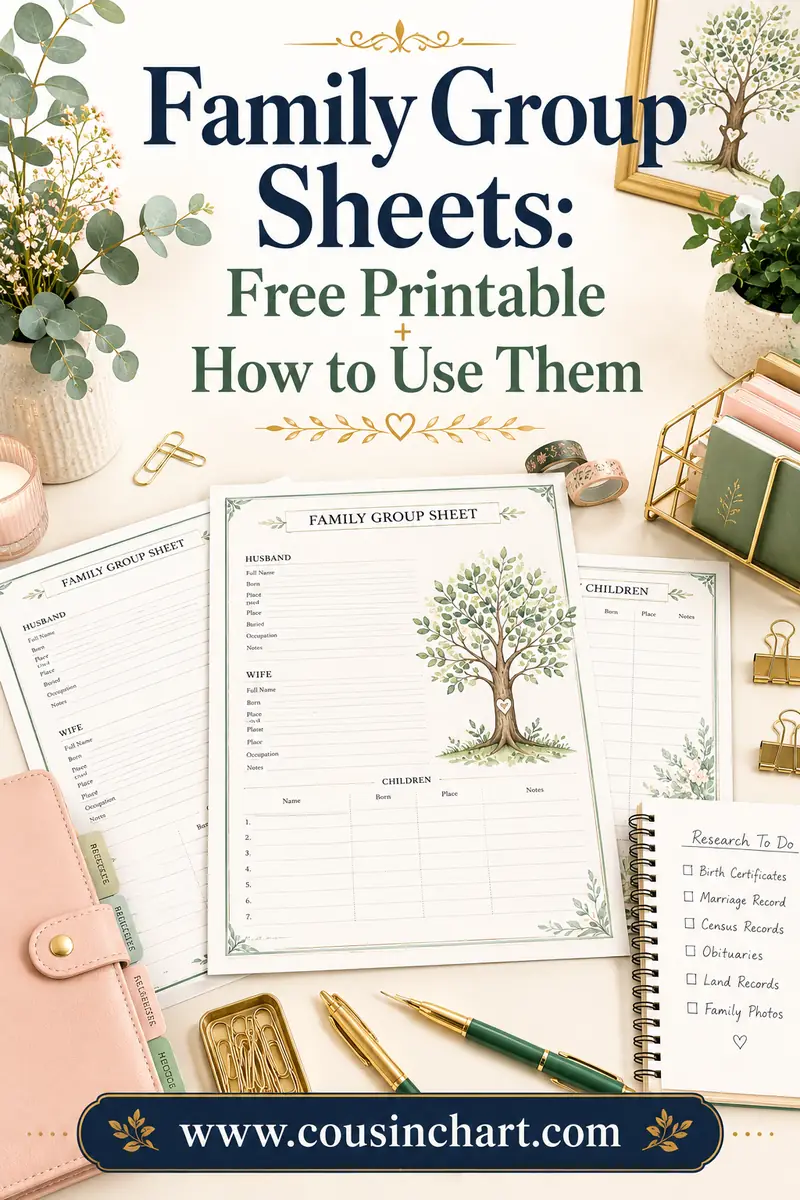
If you'd like a template that also tracks relationships and family dynamics, a genogram template works well. Genograms come from family therapy and medicine and have room for health notes. For a one-family-at-a-time worksheet, try a family group sheet and add a health column.
Free Tools for Recording a Family Health History
You can do all of this on paper. If you'd rather use software, these are the free options that the CDC points to on its family health history tools and resources page.
My Family Health Portrait: is it still available?
My Family Health Portrait is the free tool that started with the US Surgeon General's Family History Initiative. NHGRI explains that the initiative launched in November 2004 and that a web-based version followed in November 2005. The tool builds both a family tree drawing and a health history chart that you can print and share.
Here's the status update, since old links still float around. The original Surgeon General address (familyhistory.hhs.gov) no longer loads when we checked in October 2026. The tool itself still exists at a new home: My Family Health Portrait, managed by the National Cancer Institute's Center for Biomedical Informatics and Information Technology. The CDC's resources page links to that current address. Its page says your data isn't sent to government servers and is available only to you unless you choose to share it, and it lets you save a file to reopen and update later.
Other free options
| Tool or method | Best for | Things to know |
|---|---|---|
| My Family Health Portrait (web) | A full health history with a printable tree | Free. Save the file it creates, since it isn't stored for you online. |
| MFHP Cancer app (CDC) | Families focused on cancer history | The CDC describes it as a mobile app for collecting family cancer history and assessing risk for breast, ovarian and colorectal cancer. |
| Paper tree plus checklist | Older relatives, quick visits, no tech | Easy to bring to appointments. Photograph it as a backup. |
| Spreadsheet | Large families, frequent updates | Use one row per person and columns for each item in the checklist above. |
| Genealogy software notes field | People already building a family tree | Convenient, but check privacy settings before sharing or publishing the tree. |
The CDC's resource list also includes "Let's Talk," a practice tool for having conversations about family cancer risk, and an educational site called "Does It Run in the Family?" Both focus on the talking part, which many people find harder than the recording part.
When Your Family Health History Has Gaps
Almost every family health history has holes. Relatives died young, families lost touch, or people simply didn't talk about illness. An incomplete history is still useful. The CDC is clear that even incomplete information can help your provider.
If you were adopted or donor-conceived
You may have little or no information about your biological relatives. Tell your doctor that, plainly. "I was adopted and don't know my biological family history" is a real and useful answer, because it tells your provider not to assume there's no risk. Some adoptees later get medical information through adoption agencies, reunion registries, or contact with birth relatives. If you're exploring DNA testing to find biological relatives, our guide to an unknown parent DNA search covers how that process works. Health information you learn through reunion can be added to your history at any time.
If relatives died young or of unknown causes
Write down what you do know: approximate age, and anything said at the time ("they said it was his heart"). Death certificates often list a cause. Obituaries sometimes mention an illness or suggest memorial donations to a particular disease charity, which can be a clue. Mark these entries as uncertain.
If your family is small
Few relatives means less information to see patterns in. That's not a reason to skip it. Record what you have, include more distant relatives if you can, and let your doctor know the family is small.
If people won't talk
Some relatives are private about health, and that's their right. Explain why you're asking: you want to help your doctor and your kids. Offer to keep details private. Ask for only the basics (condition and approximate age). If someone still says no, respect it and move on. A partial history is better than a damaged relationship.
Common Mistakes With a Family Health History
These come up again and again. Each one has an easy fix.
| Mistake | Why it's a problem | Fix |
|---|---|---|
| Recording "cancer" without the type | Different cancers have very different family patterns. | Ask "what kind?" and note the body part if the name is unknown. |
| Leaving out ages | Early onset is one of the most important clues. | Even "about 40" or "before she retired" helps. |
| Including in-laws as if they were blood relatives | Spouses of your blood relatives don't affect your inherited risk. | Note them only as the other parent of your cousins, nieces or nephews. |
| Mixing up the two sides | Patterns on one side mean something different from scattered cases. | Label everything "maternal" or "paternal." |
| Forgetting half-siblings | They're second-degree relatives and count. | Note which parent you share. |
| Treating a "skin cancer" spot as the same as melanoma | Common skin cancers and melanoma are often discussed differently. | Ask whether it was melanoma, if possible. |
| Writing it once and never updating it | Family health changes every year. | Set a yearly reminder, or update after any new diagnosis. |
| Assuming no history means no risk | MedlinePlus Genetics notes that's not the case. | Keep up with routine screening your doctor recommends. |
Mix-up: "it skipped me, so I'm safe"
Families sometimes say a condition "skips a generation." Some inherited patterns can look that way on a tree, but it's not a reliable rule, and many common conditions don't follow simple patterns at all. Common diseases like heart disease and type 2 diabetes are shaped by many genes plus environment and lifestyle, as MedlinePlus Genetics explains. Don't use the tree to rule yourself in or out. Use it to start a conversation.
Mix-up: "Dad's side doesn't count for breast cancer"
People sometimes leave out breast or ovarian cancer on their father's side, thinking it only passes through mothers. Inherited cancer risk can come through either parent, so record cancers on both sides, including in men.
Using Your Family Health History With Your Doctor
Collecting the history is only half the job. The CDC recommends writing it down before your appointment and bringing it with you. Here's how to make that visit count.
Before the appointment
- Print a one-page summary or bring your tree.
- Circle anything that seems like a pattern: several relatives with the same condition, early diagnoses, or one person with more than one cancer.
- Write down two or three questions.
Questions you might ask
- "Based on my family history, should any of my screening tests start earlier or happen more often?"
- "Is there anything in my family history that suggests I should see a genetic counselor?"
- "Are there lifestyle changes that would matter most for me, given this history?"
- "Should my siblings or children be doing anything differently?"
What a genetic counselor does
If your doctor suggests it, you might see a genetic counselor. The National Society of Genetic Counselors describes them as professionals with advanced training in medical genetics and counseling who help people understand genetic risk based on family history, decide whether testing makes sense, and interpret results. Many offer telehealth visits. NSGC runs a directory to find one.
Things you can change
Your genes are fixed, but plenty else isn't. The CDC points out that you can change behaviors like smoking, inactivity and poor eating habits, and that screenings can find some diseases early. MedlinePlus makes the same point: knowing your risk lets you take steps to lower it. That's the most hopeful part of collecting a family health history. It turns "this runs in my family" into a plan.
Family Health History Across Life Stages
The CDC's page on family health history and you notes that family history matters throughout life, and it describes three stages where it's especially useful.
Planning a pregnancy
A family history of certain conditions can raise the chance that a baby will have them. Both partners should collect their histories. If either family has a known genetic condition, or if partners share ancestry where certain recessive conditions are more common, a prenatal visit is a good time to raise it. If partners are related to each other, mention that too. Our article on consanguinity explains what being related means genetically.
Children
If a relative has a health condition, a child may be more likely to develop it. Pediatricians ask about family history for this reason. Keeping a written record means you'll have answers ready instead of guessing in the exam room.
Adults
For adults, the history mainly guides screening: what, when and how often. As you and your relatives age, new diagnoses appear, so the history you made at 30 will need updates at 40 and 50.
Privacy and Sharing Your Family Health History
Health information is personal, and a family history includes information about other people. A few sensible habits:
- Ask before sharing widely. Sharing with your doctor is expected. Posting a relative's diagnoses on a public family tree site is a different matter. Ask first.
- Check settings on online trees. Many genealogy sites let you keep living people private. Use that for anyone still alive.
- Store files safely. If you use My Family Health Portrait, its page says the data stays with you. That also means backing up the saved file is your job.
- Share back with relatives. Siblings and cousins share much of your history. Offering them a copy is one of the most useful things you can do, and the CDC's colorectal and breast cancer pages both encourage telling family members about inherited findings.
Try It Yourself: A 20-Minute Starter Family Health History
Short on time? Here's a quick exercise that gets you most of the value in one sitting.
- Draw 11 boxes: you, your siblings (one box each), your two parents, their siblings (one box per side to start), and your four grandparents.
- In each box, write what you already know: any condition and approximate age.
- Circle every box with a question mark.
- Text or call one relative per side with three questions: any heart problems, any cancer (what kind and at what age), any diabetes.
- Fill in the answers and date the page.
Example: a starter history for Sam
Sam, 29, does the exercise. Before calling anyone, Sam knows that Dad has high blood pressure and that a grandparent had "some kind of cancer." After one call to Aunt Kim (Dad's sister) and one to Grandma June (Mom's mother), Sam's page looks like this:
- Dad, 58: high blood pressure at 45; high cholesterol at 48.
- Aunt Kim, 55: high cholesterol at 40.
- Paternal grandfather: died at 49, heart attack.
- Paternal grandmother, 81: osteoporosis.
- Mom, 57: hypothyroidism at 35.
- Grandma June, 79: colon cancer at 72, treated.
- Maternal grandfather: died at 76, lung cancer, former smoker.
In twenty minutes, Sam went from "some kind of cancer" to a page with specific conditions and ages. The paternal side shows high cholesterol at young ages and a grandfather's heart attack before 50. Given the CDC's note that heart disease at 50 or younger in relatives can point to familial hypercholesterolemia, that's a clear topic for Sam's next checkup. Again, the point isn't for Sam to diagnose anything. It's to walk in with the right question.
A Note on Medical Advice
This article is general information to help you gather and organize your family health history. It isn't medical advice and it can't assess anyone's personal risk. Talk to your doctor or a genetic counselor about what your family history means for you, which screenings fit your situation, and whether genetic testing makes sense. Screening guidelines and recommendations differ by country and change over time, so your own clinician is the best guide.
Wrapping Up: Start Your Health Family Tree Today
A family health history doesn't need to be perfect to be useful. Start with your parents, siblings and grandparents, write down conditions and the ages they started, label both sides, and bring it to your next appointment. Then keep it updated and share it with relatives who share your history.
If you're not sure how a particular relative is connected to you, or whether someone is a first-, second- or third-degree relative, our free family relationship calculator can tell you in a few clicks. It's a handy way to label your health family tree accurately before you hand it to your doctor.
Frequently Asked Questions
How far back should a family health history go?
Aim for three generations: your own generation (you, your siblings and cousins), your parents and their siblings, and your grandparents. MedlinePlus Genetics describes a complete record as covering three generations. Going further back can be interesting for genealogy, but older information is often vague and less useful medically. If you only have time for part of it, focus on first-degree relatives (parents, siblings and children) first, then grandparents, aunts and uncles. Those closer relatives share the most DNA with you and usually give your doctor the clearest picture.
What is the most important information to include in a family health history?
For each blood relative, the most useful details are the specific condition, the age when it was diagnosed, and, for relatives who have died, the age and cause of death. The CDC also lists ethnic background as worth recording. Age at diagnosis is the item people most often forget, yet it matters a lot, because conditions that appear younger than usual can be an important signal for your doctor. If you only know an approximate age, write that down and mark it as an estimate rather than leaving it blank.
Do in-laws or step-relatives belong on a family health history?
Not as part of your own inherited risk. Your family health history is about blood relatives, the people you share DNA with by descent. Spouses of your blood relatives, step-parents, step-siblings and in-laws don't pass genes to you. That said, if you're making a history for your children, your partner's family becomes their blood relatives, so your partner should make their own history too. Half-siblings do belong on yours, because you share one parent and about a quarter of your DNA on average.
Is My Family Health Portrait still available?
Yes, but at a new address. The original US Surgeon General website for the tool no longer loads. When we checked in October 2026, the CDC's family health history resources page linked to My Family Health Portrait at a GitHub Pages address managed by the National Cancer Institute's informatics center. The tool's page says your data isn't sent to government servers and is available only to you, so save the file it creates and back it up. The CDC also lists a cancer-focused mobile app version called MFHP Cancer.
What if I was adopted and don't know my family health history?
Tell your doctor directly that you were adopted and don't know your biological family's history. That's useful information, because it tells your provider not to assume you have no risk. Your doctor may rely more on routine screening guidelines and your own health. Some adoptees later learn medical history through adoption agencies, registries, or contact with birth relatives found through DNA testing. Whatever you learn later can be added to your history at any time. An incomplete or unknown history is common and nothing to feel bad about.
Does having a family history of a disease mean I will get it?
No. MedlinePlus explains that a relative having a disease can raise your risk, but it doesn't mean you'll definitely get it. Many conditions that run in families, like heart disease and type 2 diabetes, are shaped by many genes plus lifestyle and environment. On the other hand, having no family history doesn't rule out risk either. Think of your family health history as a tool that helps your doctor decide which screenings and conversations make sense for you, not as a prediction. A doctor or genetic counselor can explain what it means for you.
How do I ask relatives about their health without being awkward?
Explain why you're asking, keep questions specific, and respect boundaries. Saying you want to help your doctor and your kids often opens people up. Specific questions work better than general ones, for example asking whether anyone had heart problems and at what age. Family gatherings, a new diagnosis in the family, or a pregnancy are natural times to bring it up. The CDC lists a free practice tool called Let's Talk for conversations about family cancer history. If a relative prefers not to share, accept that and move on.
How often should I update my family health history?
The CDC recommends updating it regularly. A good habit is to review it once a year, perhaps before an annual checkup, and to add new information whenever a relative gets a significant diagnosis or passes away. Your family's health changes over time as people age, so a history made in your twenties will look different by your forties. Date each update so your doctor knows how current it is, and share the new version with siblings and cousins who have the same relatives.
Should I see a genetic counselor because of my family health history?
That's a question to raise with your doctor, who can look at your full history. The CDC gives examples where it's worth asking, such as a mother or sister with breast cancer before age 50. The National Society of Genetic Counselors explains that genetic counselors help people understand genetic risk based on family history, decide whether genetic testing makes sense, and interpret results. Many offer telehealth visits, and NSGC runs an online directory to help you find one. This is general information, not advice for your situation.
Sources
We checked every source below while writing this guide. Last reviewed October 30, 2026, by Joan Ramos.
- About Family Health History (Centers for Disease Control and Prevention (CDC))
- Family Health History Tools and Resources (Centers for Disease Control and Prevention (CDC))
- Family Health History and You (Centers for Disease Control and Prevention (CDC))
- About Heart Disease, Family Health History, and Familial Hypercholesterolemia (Centers for Disease Control and Prevention (CDC))
- Awareness of Family Health History as a Risk Factor for Disease, United States, 2004 (MMWR) (Centers for Disease Control and Prevention (CDC))
- Family Health History for Patients and Families (National Human Genome Research Institute (NHGRI))
- Family History (MedlinePlus, National Library of Medicine)
- Why is it important to know my family health history? (MedlinePlus Genetics, National Library of Medicine)
- My Family Health Portrait (National Cancer Institute CBIIT / National Human Genome Research Institute)
- About Genetic Counselors (National Society of Genetic Counselors (NSGC))