Pedigree Analysis: How to Read Inheritance Patterns in a Family Pedigree
Pedigree analysis is the process of reading a family chart, called a pedigree, to work out how a trait or condition is passed down. You look at who is affected, which sex they are, whether the trait shows up in every generation, and whether it passes from father to son, and from those clues you decide whether the pattern fits autosomal dominant, autosomal recessive, X-linked or mitochondrial inheritance. It's a mix of logic and elimination: you rule patterns out until only the ones that fit are left.
This guide is written for students in a genetics or biology class and for anyone curious about how inherited traits show up in families. It covers the standard symbols, a step-by-step method, the clues for each inheritance pattern, the probability math, and a set of worked practice pedigrees with full answers. If you came here from genealogy, note that a genetics pedigree is a bit different from a genealogy pedigree chart. We'll explain the difference first.
What a Pedigree Is (and How It Differs From a Family Tree)
The National Human Genome Research Institute (NHGRI) defines a pedigree as a chart that diagrams the inheritance of a trait or health condition through generations of a family. It shows how family members are related and, where the information is known, marks who has the trait.
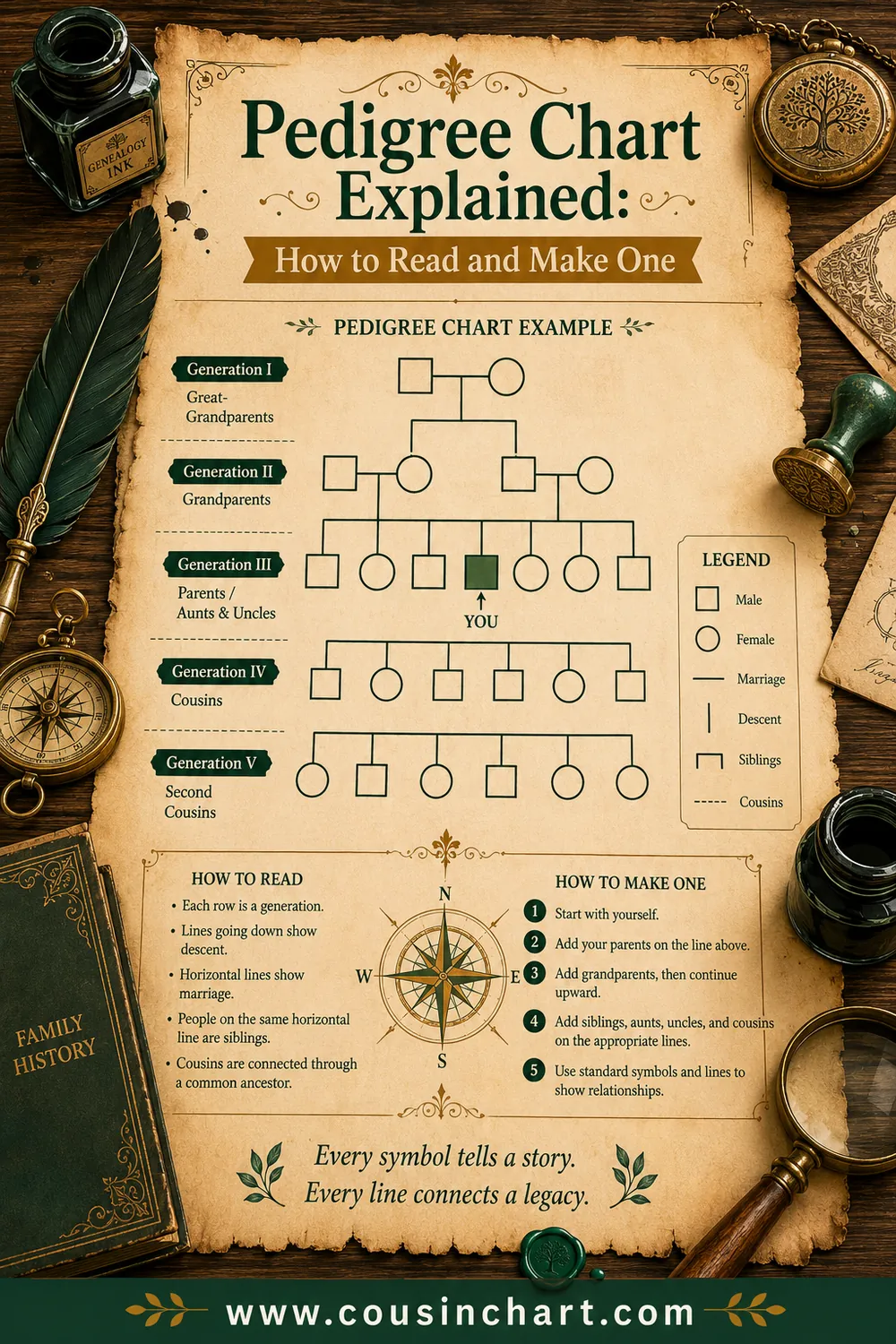
In genealogy, "pedigree chart" usually means something else: a chart of your direct ancestors only, your parents, grandparents, great-grandparents and so on. Our guide to pedigree charts in genealogy covers that kind. A genetics pedigree includes siblings, children, spouses and anyone else relevant to the trait, and it uses a standard set of symbols so any clinician or student can read it.
A related tool, the genogram, adds relationships and family dynamics on top of health information. If you're curious, our genogram template shows how those differ.
Standard Pedigree Symbols
The symbols used in medical genetics come from the National Society of Genetic Counselors (NSGC). Its Pedigree Standardization Task Force published recommendations in 1995, which were reviewed and updated in 2008. The 2008 review found that journals that specify pedigree standards cite the NSGC system and that there were no significant objections or alternatives, so only a few minor stylistic changes were made.
A 2022 NSGC revision kept most symbols but clarified how to show sex and gender separately, so pedigrees are accurate and respectful for transgender and gender-diverse people. It also recommended changes to how carrier status is shown. In practice, that means you should always check a pedigree's key, because older textbooks and newer clinical charts may draw carriers a little differently.
| Symbol | What it means |
|---|---|
| Square | Male |
| Circle | Female |
| Diamond | Sex or gender unknown or not specified |
| Filled (shaded) shape | Affected: the person has the trait or condition being studied |
| Empty shape | Unaffected |
| Half-filled shape, or a dot in the center | Carrier in many textbooks: one copy of a recessive variant, no condition (check the key) |
| Diagonal line through a shape | Deceased |
| Arrow pointing to a person | The proband, the family member who brought the family to medical attention |
| Horizontal line between two people | A couple (partners who have children together) |
| Double horizontal line between two people | A consanguineous couple: partners who are related by blood |
| Vertical line down from a couple, then a horizontal sibship line | Their children, listed left to right, usually oldest first |
| Two diagonal lines from one point | Twins (a bar between them marks identical twins) |
| Brackets around a symbol | Adopted |
| Roman numerals at the left (I, II, III) | Generations, oldest at the top |
| Arabic numerals under symbols (1, 2, 3) | Individuals within a generation, numbered left to right |
The LibreTexts genetics course on pedigrees summarizes the same basics: circles for females, squares for males, filled for affected, half-filled for known carriers, and two lines for a consanguineous couple.
The proband
NHGRI defines the proband as an individual who is affected by a genetic condition or who is concerned they are at risk. Usually that's the first person in the family to bring the concern to medical professionals. In class problems, the proband is often marked with an arrow, and questions are framed around that person.
How to name people in a pedigree
Combine the generation numeral and the person number: II-3 means the third person from the left in generation II. Every worked example below uses this format, so you can sketch the pedigree on paper as you read.
How to Do Pedigree Analysis Step by Step
Most genetics courses teach a method based on ruling things out. Memorial University's Steven Carr frames his six-modes pedigree guide around naming which modes can be ruled out and which individuals let you rule them out. Here's a version you can apply to any problem.
- Read the key. Confirm what filled, half-filled and dotted symbols mean in this pedigree.
- Count affected males and females. Roughly equal suggests autosomal. Mostly males suggests X-linked recessive.
- Check every generation. If the trait appears in each generation, think dominant. If it skips, think recessive.
- Look for two unaffected parents with an affected child. That rules out a fully penetrant dominant trait and points to recessive.
- Look for father-to-son transmission. An affected father with an affected son rules out X-linked inheritance, since a father gives his son a Y, not an X. It also rules out mitochondrial inheritance.
- Check the daughters of affected fathers. If an affected father has an unaffected daughter, X-linked dominant is ruled out.
- Check the mothers. If every child of an affected mother is affected and no affected father passes it on, think mitochondrial.
- List what's left. Often more than one pattern fits. Say which is most likely and why.
- Write genotypes. Assign a genotype to each person, using a dash or "?" where it can't be determined.
"Rule out" vs. "consistent with"
This is where students lose the most points. A pedigree can rule out a pattern with a single individual. It can only ever be consistent with a pattern. Five generations of a trait passing down every generation is consistent with autosomal dominant, but that doesn't prove it. Use the words "ruled out" and "consistent with" in your answers.
Autosomal Dominant Pedigree Analysis
"Autosomal" means the gene is on one of the numbered chromosomes, not the X or Y. "Dominant" means one altered copy is enough to cause the trait. NHGRI notes that a child of a person affected by an autosomal dominant condition has a 50% chance of being affected. MedlinePlus Genetics gives Huntington's disease and Marfan syndrome as examples.
Clues to look for
- The trait appears in every generation, a "vertical" pattern.
- Every affected person has at least one affected parent (with exceptions covered below).
- Males and females are affected in roughly equal numbers.
- Affected fathers can pass it to sons, and affected mothers can pass it to daughters and sons.
- Two unaffected parents don't have affected children, assuming full penetrance.
The probability math
Use "A" for the dominant allele and "a" for the typical allele. Because these conditions are usually rare, an affected person is usually a heterozygote, Aa, as the LibreTexts chapter notes. Cross Aa with aa:
| a (from unaffected parent) | a (from unaffected parent) | |
|---|---|---|
| A (from affected parent) | Aa, affected | Aa, affected |
| a (from affected parent) | aa, unaffected | aa, unaffected |
Two of four boxes are affected, so each child has a 1 in 2 (50%) chance. Each pregnancy is independent. A family with three children who are all unaffected hasn't "used up" its odds. The chance of that happening is 1/2 × 1/2 × 1/2 = 1/8, which is uncommon but certainly possible, especially in small families.
Worked example 1: a dominant family
Generation I: I-1 (affected male) and I-2 (unaffected female). Their children in generation II: II-1 (affected female), II-2 (unaffected male), II-3 (affected male). II-1 has children with an unaffected partner: III-1 (affected male) and III-2 (unaffected female). II-3 has children with an unaffected partner: III-3 (affected male) and III-4 (affected female).
Analysis:
- The trait appears in all three generations. That's consistent with dominant.
- Both sexes are affected about equally. That's consistent with autosomal.
- II-3 (affected male) has an affected son, III-3. Father-to-son transmission rules out X-linked inheritance.
- Affected fathers (I-1, II-3) pass it on, which rules out mitochondrial inheritance.
- II-2 is unaffected with an affected father, which fits a heterozygous Aa father.
Answer: Most consistent with autosomal dominant. Autosomal recessive can't be fully ruled out unless the problem says the trait is rare, because unrelated partners would all need to be carriers. With a rare trait, recessive is very unlikely here.
When a dominant trait seems to skip
Sometimes a dominant trait shows up in a child whose parents are both unaffected. Two common reasons:
- A new variant. MedlinePlus Genetics notes that an autosomal dominant condition can result from a new gene variant in a person with no history of the disorder in their family.
- Reduced penetrance. MedlinePlus Genetics explains that some people who carry a variant never develop the condition's features. A parent might carry the variant without showing it, making the trait look like it skipped a generation.
Textbook problems usually assume full penetrance unless they say otherwise. Real families often don't follow the textbook.
Autosomal Recessive Pedigree Analysis
"Recessive" means a person needs two altered copies, one from each parent, to be affected. NHGRI explains that when both parents are unaffected carriers, roughly a quarter of their children will inherit two disease-causing alleles and have the disorder. MedlinePlus Genetics lists cystic fibrosis and sickle cell disease as examples.
Clues to look for
- The trait often skips generations.
- Two unaffected parents can have an affected child. This is the single strongest clue.
- Males and females are affected in roughly equal numbers.
- Affected people are often found among siblings in one generation, a "horizontal" pattern.
- It shows up more often when parents are related. Carr's guide notes recessive traits often appear in consanguineous matings.
Why related parents matter
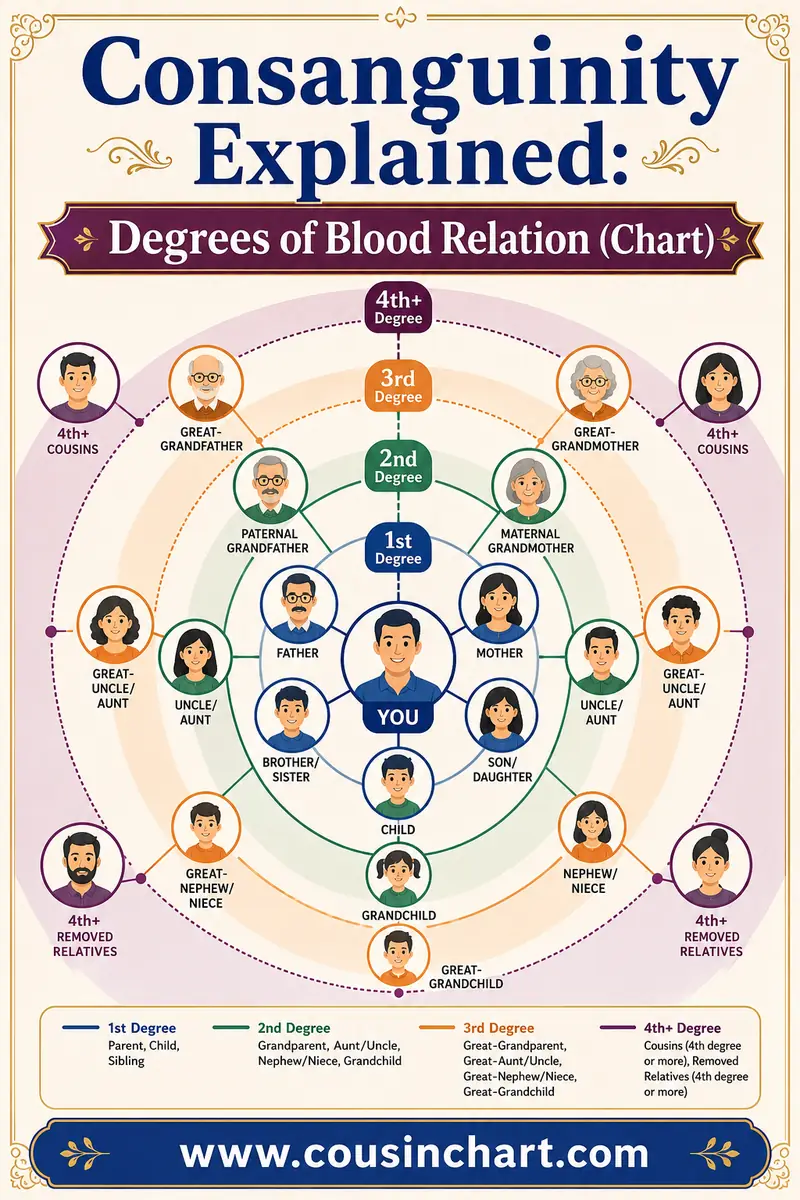
Relatives share ancestors, so they're more likely to carry the same rare variant inherited from a common ancestor. That's why the double line for a consanguineous couple is such a strong hint in class problems. It's a statistical point about probability, not a judgment about any family. Our article on consanguinity explains the degrees of relatedness, and how much DNA cousins share shows the numbers behind it.
The probability math
Two carriers, Aa × Aa:
| A (from parent 2) | a (from parent 2) | |
|---|---|---|
| A (from parent 1) | AA, unaffected, not a carrier | Aa, unaffected carrier |
| a (from parent 1) | Aa, unaffected carrier | aa, affected |
For each child: 1/4 affected, 1/2 carrier, 1/4 neither. That's the 25% NHGRI describes.
The two-thirds rule
Here's the calculation that trips up nearly every genetics student. Suppose two carrier parents have an affected child and an unaffected child. What's the chance the unaffected child is a carrier?
It's not 1/2. We already know the unaffected child isn't aa, so cross out that box. Three boxes remain: AA, Aa, Aa. Two of three are carriers, so the answer is 2/3.
Worked example 2: a recessive family with a cousin couple
Generation I: I-1 and I-2, both unaffected. Children in generation II: II-1 (unaffected male), II-2 (unaffected female). II-1 has a son, III-1 (unaffected). II-2 has a daughter, III-2 (unaffected). III-1 and III-2 are first cousins, and they're joined by a double line. Their children in generation IV: IV-1 (affected female), IV-2 (unaffected male), IV-3 (unaffected female).
Analysis:
- IV-1 is affected, but both parents are unaffected. That rules out a fully penetrant dominant trait.
- An affected female with an unaffected father rules out X-linked recessive, because her father would have to be affected.
- The parents are cousins. That's a classic hint for recessive inheritance.
Answer: Autosomal recessive. III-1 and III-2 must both be carriers (Aa). IV-1 is aa. IV-2 and IV-3 each have a 2/3 chance of being carriers.
Try it yourself
IV-2 from the example above has children with a partner who is known to be a carrier. What's the chance their first child is affected?
Solution: IV-2 is a carrier with probability 2/3. If he's a carrier, two carriers have a 1/4 chance of an affected child. Multiply: 2/3 × 1/4 = 2/12 = 1/6.
Now a harder version: IV-2 has children with a partner whose carrier status is unknown but who also has an affected sibling. Each of them has a 2/3 chance of being a carrier. The chance their first child is affected is 2/3 × 2/3 × 1/4 = 4/36 = 1/9.
X-Linked Recessive Pedigree Analysis
X-linked genes sit on the X chromosome. MedlinePlus Genetics explains that in X-linked recessive inheritance, males need only one altered copy to be affected because they have one X, while females would need altered copies on both X chromosomes, which is uncommon. That's why males are affected far more often. Its examples include hemophilia and Fabry disease. If you want background on how the X chromosome passes between generations, our article on X-DNA inheritance walks through it from a genealogy angle.
Clues to look for
- Mostly males are affected.
- No father-to-son transmission. A father gives his son a Y chromosome.
- Affected males usually have unaffected parents. The mother is typically a carrier.
- The trait can pass from an affected grandfather, through his carrier daughter, to his grandson. Carr calls this the "criss-cross" pattern.
- An affected female must have an affected father (and a carrier or affected mother).
The probability math
Write X-linked genotypes with the allele attached to the X. Textbooks use superscripts, such as a capital H for the typical allele and a lowercase h for the altered one. Here we'll keep it plain: X for an X carrying the typical allele and Xa for an X carrying the altered allele.
Carrier mother (X Xa) × unaffected father (X Y):
- Sons: 1/2 affected (Xa Y), 1/2 unaffected (X Y)
- Daughters: 1/2 carriers (X Xa), 1/2 non-carriers (X X)
Unaffected mother (X X) × affected father (Xa Y):
- Sons: all unaffected, since they get Dad's Y
- Daughters: all carriers, since they all get Dad's Xa
Worked example 3: an X-linked recessive family
Generation I: I-1 (affected male), I-2 (unaffected female). Children: II-1 (unaffected male), II-2 (unaffected female), II-3 (unaffected female). II-2 has children with an unaffected male: III-1 (affected male), III-2 (unaffected female), III-3 (unaffected male). II-1 has children with an unaffected female: III-4 (unaffected male), III-5 (unaffected female).
Analysis:
- Only males are affected.
- The trait skips generation II and reappears in a grandson through a daughter. That's the criss-cross pattern.
- II-1, a son of the affected grandfather, is unaffected and has no affected children. That fits, since he got a Y from his father.
- No father-to-son transmission anywhere.
Answer: Consistent with X-linked recessive. Autosomal recessive is possible but would require II-2's partner to be a carrier, which is less likely for a rare trait. Under X-linked recessive, II-2 and II-3 are obligate carriers, since every daughter of an affected father gets his X. III-2 has a 1/2 chance of being a carrier.
X-Linked Dominant and Y-Linked Patterns
X-linked dominant
Here one altered X is enough in both sexes. MedlinePlus Genetics notes that females with one altered copy are affected, often with milder symptoms than males, and that fathers can't pass X-linked traits to sons. It lists fragile X syndrome as an example.
The key clue is what affected fathers do:
- An affected father passes the trait to all his daughters and none of his sons.
- An affected heterozygous mother passes it to about half her children, sons and daughters alike.
- Affected females tend to outnumber affected males, since females have two chances to inherit an X.
If you find an affected father with even one unaffected daughter, X-linked dominant is ruled out (assuming full penetrance).
Y-linked
Y-linked traits pass only from father to son. MedlinePlus Genetics explains that Y-linked variants can only be passed from father to son and gives Y chromosome infertility as an example. In a pedigree, every son of an affected father is affected, and no females are. Few health conditions follow this pattern, so it shows up mainly in textbook problems and in genealogy, where Y-DNA tracks a direct paternal line.
Mitochondrial Inheritance in a Pedigree
Mitochondria are the cell's energy producers, and they have their own small, circular DNA. MedlinePlus Genetics explains that only egg cells contribute mitochondria to an embryo, so only females pass mitochondrial variants to their children. Both sons and daughters can be affected, but fathers don't pass these variants on. It gives Leber hereditary optic neuropathy (LHON) as an example.
Clues to look for
- Affected mothers pass the trait to their children, both sons and daughters.
- Affected fathers never pass it on.
- The trait can appear in every generation, traced only through the maternal line.
- Carr's guide summarizes it simply: the trait appears in all descendants of an affected female, and affected males don't transmit it.
Worked example 4: a mitochondrial family
Generation I: I-1 (unaffected male), I-2 (affected female). Children: II-1 (affected male), II-2 (affected female). II-1 has children with an unaffected female: III-1 (unaffected female), III-2 (unaffected male). II-2 has children with an unaffected male: III-3 (affected male), III-4 (affected female).
Analysis:
- Every child of an affected female (I-2, II-2) is affected.
- No child of an affected male (II-1) is affected.
- Both sexes are affected.
- Autosomal dominant would predict about half of II-1's children affected. Zero of two isn't impossible for a small family, but combined with all of II-2's children being affected, the maternal-only pattern fits best.
Answer: Most consistent with mitochondrial inheritance. In real families, mitochondrial conditions can vary in severity even among siblings, so "all children affected" is the textbook version. Real pedigrees may look messier, which is one reason genetic counselors don't rely on a pedigree alone.
Pedigree Analysis Cheat Sheet: Clues by Pattern
Here are all the patterns side by side. Use this table to check your answer after you've worked through a problem, not instead of working through it.
| Pattern | Sexes affected | Skips generations? | Father to son? | Key clue | Risk per child (typical cross) |
|---|---|---|---|---|---|
| Autosomal dominant | Equal | Usually not | Yes | Every affected person has an affected parent | 1/2 if one parent is affected (Aa × aa) |
| Autosomal recessive | Equal | Often | Possible | Unaffected parents with an affected child | 1/4 if both parents are carriers |
| X-linked recessive | Mostly males | Often | Never | Passes through carrier daughters to grandsons | 1/2 of sons if mother is a carrier |
| X-linked dominant | Both, more females | Usually not | Never | Affected father, all daughters affected | All daughters, no sons of an affected father |
| Y-linked | Males only | No | Always | Every son of an affected father | All sons of an affected father |
| Mitochondrial | Equal | Usually not | Never | Only affected mothers pass it on | Children of an affected mother (severity can vary) |
Fastest rule-outs
| If you see this | You can rule out |
|---|---|
| Two unaffected parents with an affected child | Dominant patterns (with full penetrance) |
| Affected father with an affected son | X-linked (both kinds) and mitochondrial |
| Affected father with an unaffected daughter | X-linked dominant |
| Affected daughter with an unaffected father | X-linked recessive |
| Affected mother with an unaffected son | X-linked recessive (with full penetrance) and mitochondrial (textbook version) |
| Any affected female | Y-linked |
| Affected father passing it to any child | Mitochondrial |
Practice Pedigree Analysis Problems With Answers
Sketch each one before reading the answer. Assume rare traits and full penetrance unless noted.
Problem A
I-1 (unaffected male) × I-2 (unaffected female). Children: II-1 (affected male), II-2 (unaffected female), II-3 (affected female), II-4 (unaffected male). Which patterns are possible?
Answer: Unaffected parents with affected children rule out dominant patterns. An affected daughter (II-3) with an unaffected father rules out X-linked recessive. An affected female rules out Y-linked. Mitochondrial is ruled out because I-2 is unaffected yet has affected children. Only autosomal recessive fits. Both parents are carriers.
Problem B
I-1 (affected male) × I-2 (unaffected female). Children: II-1 (affected female), II-2 (unaffected male), II-3 (affected female), II-4 (unaffected male). II-3 has children with an unaffected male: III-1 (affected male), III-2 (unaffected female).
Answer: The affected father has all affected daughters and all unaffected sons. That's the signature of X-linked dominant. II-3 (heterozygous) passes it to about half her children, and here she has one affected son and one unaffected daughter, which fits. Autosomal dominant is also consistent, though the perfect daughters-yes, sons-no split from I-1 would be a coincidence (the chance with four children is 1/16, from 1/2 multiplied four times). Mitochondrial is ruled out because an affected father passed it on.
Problem C
I-1 (unaffected male) × I-2 (unaffected female). Children: II-1 (affected male), II-2 (unaffected female), II-3 (unaffected male). II-2 has children with an unaffected male: III-1 (affected male), III-2 (unaffected male), III-3 (unaffected female).
Answer: Unaffected parents with affected children rule out dominant patterns. Only males are affected, the trait passes from I-2 through her daughter II-2 to a grandson, and there's no father-to-son transmission. That's most consistent with X-linked recessive, with I-2 and II-2 as carriers. Autosomal recessive is possible but would require II-2's unrelated partner to also be a carrier, which is unlikely for a rare trait.
Problem D
I-1 (affected male) × I-2 (unaffected female). Children: II-1 (affected male), II-2 (unaffected female). II-1 has children with an unaffected female: III-1 (affected male), III-2 (affected female), III-3 (unaffected male).
Answer: Father-to-son transmission (I-1 to II-1, and II-1 to III-1) rules out X-linked and mitochondrial. An affected female (III-2) rules out Y-linked. The trait appears in every generation with both sexes affected. Most consistent with autosomal dominant.
Things That Make Real Pedigrees Harder
Class problems are tidy on purpose. Real families raise complications that a good analysis keeps in mind.
Reduced penetrance and variable expressivity
MedlinePlus Genetics explains both. Reduced penetrance means some people with a variant never show the condition. Variable expressivity means people with the same condition can have different symptoms, from mild to severe. MedlinePlus uses BRCA1 and BRCA2 variants as an example of reduced penetrance and Marfan syndrome as an example of variable expressivity. Both make inheritance harder to read from a chart.
Age of onset
Some conditions don't show up until adulthood. A 20-year-old shown as unaffected might develop the condition later. When a problem mentions ages, take them into account.
Small families
Ratios like 1/2 and 1/4 are averages. A couple with two children can easily have zero or two affected children by chance. Small sibships make it hard to tell patterns apart, which is why many textbook answers say "most likely" rather than "definitely."
Complex and multifactorial traits
Many common conditions, such as heart disease and type 2 diabetes, are shaped by many genes plus environment and lifestyle. They don't follow single-gene patterns, so pedigree analysis using the rules above won't give a clean answer. That's not a failure of the method. It's just outside what the method was built for.
Incomplete or uncertain information
People may not know a relative's diagnosis, relatives may be adopted or donor-conceived, and records can be missing. Genetic counselors work with these gaps every day, which is part of why the NSGC symbols include ways to mark uncertainty and adoption.
Common Pedigree Analysis Mistakes
- Proving instead of ruling out. You can only say a pedigree is consistent with a pattern. Look for the individual who rules each pattern out.
- Using 1/2 instead of 2/3. For an unaffected sibling of an affected person in a recessive family, the carrier chance is 2/3.
- Forgetting the partner. In recessive problems, unrelated partners who marry in are usually assumed to be non-carriers for a rare trait unless the problem says otherwise.
- Missing father-to-son transmission. It's the quickest way to eliminate X-linked patterns. Scan for it first.
- Misreading carrier symbols. A half-filled shape usually means carrier, not "partly affected." Check the key, since the 2022 NSGC update changed recommendations for showing carriers.
- Confusing a genetics pedigree with a genealogy pedigree chart. The genealogy kind shows only direct ancestors. A genetics pedigree shows siblings and children too.
- Treating ratios as guarantees. "One in four" doesn't mean one of every four children. Each pregnancy is independent.
Mix-up: half-siblings in pedigrees
Half-siblings share one parent, so they're drawn with lines down from that shared parent and their separate other parents. In recessive problems this matters: half-siblings share one parent's alleles but not the other's. Our explainer on half-siblings vs. full siblings covers how much DNA each type shares.
A Note on Medical Information
This article explains pedigree analysis as it's taught in genetics and biology classes. It's general information, not medical advice, and real family histories are more complex than textbook problems. If you're worried about a condition in your own family, talk to your doctor or a genetic counselor, who can draw a full pedigree, consider testing where appropriate, and explain what it means for you and your relatives.
Wrapping Up: Reading Any Pedigree With Confidence
Pedigree analysis comes down to a short list of questions. Who's affected, and which sex? Does it skip generations? Is there father-to-son transmission? Do affected mothers or fathers pass it on? Answer those, rule patterns out one by one, and do the probability math with a quick Punnett square, remembering the 2/3 rule for unaffected siblings in recessive families.
If a problem, or your own family chart, leaves you unsure how two people are related, our free family relationship calculator can name the relationship for you. Knowing whether two people are first cousins or second cousins once removed is the first step in working out how much DNA, and how many alleles, they might share.
Keep reading: Family Health History: How to Gather It and Build a Health Family Tree.
Frequently Asked Questions
How do you tell if a pedigree is dominant or recessive?
Look for two unaffected parents who have an affected child. If you find that, the trait can't be a fully penetrant dominant trait, so it's recessive. Dominant traits usually appear in every generation, and every affected person tends to have an affected parent. Recessive traits often skip generations and can appear suddenly among siblings whose parents are both unaffected carriers. Related parents, shown with a double line, are another hint toward recessive inheritance. Remember that a pedigree can rule a pattern out, but it can only be consistent with a pattern, not prove it.
How can you tell if a trait is X-linked from a pedigree?
Check three things. First, are most affected people male? That points to X-linked recessive. Second, is there any father-to-son transmission? If an affected father has an affected son, the trait can't be X-linked, because fathers pass a Y chromosome, not an X, to their sons. Third, look at the daughters of affected fathers. In X-linked dominant inheritance, every daughter of an affected father is affected. In X-linked recessive inheritance, every daughter of an affected father is a carrier, and the trait often reappears in her sons.
What do the shaded and half-shaded shapes mean in a pedigree?
A fully shaded square or circle means the person is affected, meaning they have the trait or condition being studied. An empty shape means unaffected. In many textbooks, a half-shaded shape or a shape with a dot in the center marks a carrier, someone with one copy of a recessive variant who doesn't have the condition. Always check the pedigree's key, though. The National Society of Genetic Counselors' 2022 update recommended changes to how carrier status is shown, so newer clinical charts may differ from older textbooks.
Why is the carrier probability 2/3 instead of 1/2?
This applies to an unaffected sibling of someone with an autosomal recessive condition whose parents are both carriers. A carrier-by-carrier Punnett square has four equally likely outcomes: one non-carrier, two carriers and one affected. Since you already know the sibling is unaffected, you remove the affected box. That leaves three possibilities, two of which are carriers. So the chance the unaffected sibling is a carrier is 2 out of 3. Using 1/2 here is one of the most common mistakes in genetics homework.
What does the arrow mean on a pedigree chart?
The arrow marks the proband. The National Human Genome Research Institute defines the proband as a person who is affected by a genetic condition or who is concerned they are at risk. Usually, this is the first person in the family who brought the concern to medical professionals, so the pedigree is drawn around them. In genetics class problems, questions are often framed around the proband, for example asking the chance that the proband's future child will be affected.
What does a double line between two people mean in a pedigree?
A double horizontal line joining two partners means they're consanguineous, which is the technical term for being related by blood, such as first cousins. In pedigree analysis, it's a hint toward autosomal recessive inheritance, because relatives are more likely to carry the same rare variant inherited from a shared ancestor. It's a point about probability, not a judgment about the family. Many children of related parents are healthy, and laws and customs about cousin marriage vary by state and country.
How do you recognize mitochondrial inheritance in a pedigree?
Only mothers pass it on. MedlinePlus Genetics explains that only egg cells contribute mitochondria to an embryo, so an affected mother can pass a mitochondrial variant to both sons and daughters, but an affected father doesn't pass it to any of his children. In a pedigree, you'll see the trait running down the maternal line, with affected men whose children are all unaffected. In real families, severity can vary widely among relatives, so the pattern may look less tidy than in a textbook.
Can a dominant trait skip a generation?
In textbook problems with full penetrance, no. In real families, it can look that way. MedlinePlus Genetics explains reduced penetrance, where some people who carry a variant never develop the condition. A parent could carry the variant without symptoms and pass it to a child who does show it. A dominant condition can also start with a new variant in someone with no family history. That's why genetic counselors look at the whole family and other information, not just one chart, before drawing conclusions.
Is a genetics pedigree the same as a genealogy pedigree chart?
Not quite. In genealogy, a pedigree chart usually shows only your direct ancestors: parents, grandparents, great-grandparents and so on, branching backward. A genetics pedigree, as defined by the National Human Genome Research Institute, diagrams how a trait or condition passes through a family. It includes siblings, children, partners and other relatives, and it uses standard symbols for sex, affected status, carriers, deaths and twins. The two share a name and a family-tree shape, but they answer different questions.
Sources
We checked every source below while writing this guide. Last reviewed October 30, 2026, by Joan Ramos.
- Pedigree (Talking Glossary of Genomic and Genetic Terms) (National Human Genome Research Institute (NHGRI))
- Autosomal Dominant Disorder (Talking Glossary of Genomic and Genetic Terms) (National Human Genome Research Institute (NHGRI))
- Autosomal Recessive Disorder (Talking Glossary of Genomic and Genetic Terms) (National Human Genome Research Institute (NHGRI))
- Proband (Talking Glossary of Genomic and Genetic Terms) (National Human Genome Research Institute (NHGRI))
- What are the different ways a genetic condition can be inherited? (MedlinePlus Genetics, National Library of Medicine)
- What are reduced penetrance and variable expressivity? (MedlinePlus Genetics, National Library of Medicine)
- Standardized human pedigree nomenclature: update and assessment of the recommendations of the National Society of Genetic Counselors (Bennett et al., J Genet Couns 2008) (National Society of Genetic Counselors / PubMed, National Library of Medicine)
- Practice resource-focused revision: Standardized pedigree nomenclature update centered on sex and gender inclusivity (Bennett et al., J Genet Couns 2022) (National Society of Genetic Counselors / PubMed, National Library of Medicine)
- Pedigree Analysis: Six Modes of Inheritance (Memorial University of Newfoundland, Department of Biology (Steven M. Carr))
- Pedigrees (BIO 300: Introduction to Genetics) (LibreTexts Biology, Clinton College course)