Do Cousins Share DNA?
Close cousins always do; distant cousins often don't. First cousins share roughly 12.5% of their DNA and will match on any test without exception. Second cousins share around 3% and virtually always match. But from third cousins outward the picture changes fast — about 10% of third cousins share nothing detectable, rising to half of fourth cousins and around 85% of fifth cousins. Two people can be genuinely, documentably related and show no genetic connection whatsoever, which surprises almost everyone who takes a test. This page explains how much cousins share, why the variation is so large, and what a match does and doesn't prove. To identify a relationship from a name rather than a number, use the what do I call them tool.
How Much DNA Do Cousins Share?
| Relationship | Approx. % shared | Average cM | Chance of no match |
|---|---|---|---|
| Full siblings | 50% | 2,613 | 0% |
| First cousins | 12.5% | 866 | 0% |
| First cousins once removed | 6.25% | 433 | Under 1% |
| Second cousins | 3.1% | 229 | Under 1% |
| Second cousins once removed | 1.5% | 122 | About 2% |
| Third cousins | 0.78% | 73 | About 10% |
| Third cousins once removed | 0.39% | 48 | About 30% |
| Fourth cousins | 0.20% | 35 | About 50% |
| Fifth cousins | 0.05% | 25 | About 85% |
| Sixth cousins | 0.01% | 18 | Over 95% |
The percentage halves with each step, roughly, and the probability of no match climbs steeply once you pass second cousins.
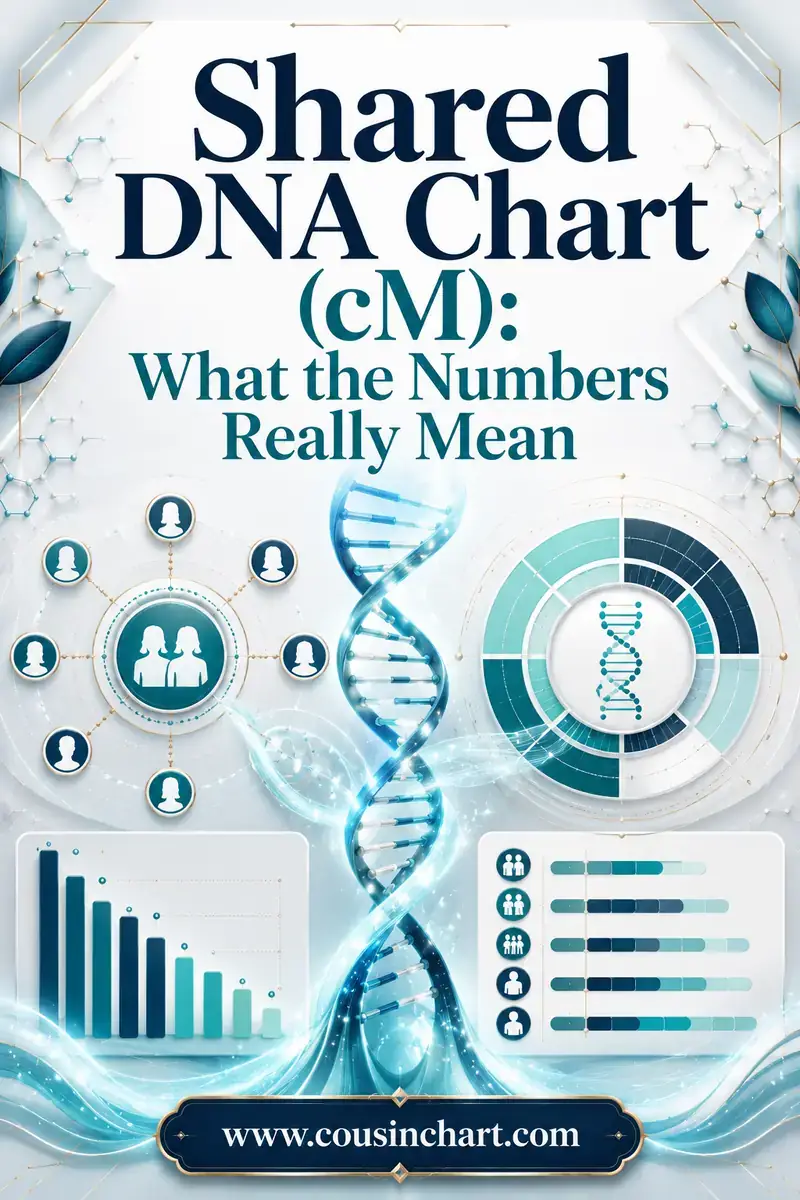
Centimorgans are the better measure. Percentages are intuitive but imprecise; the cM figure is what testing companies report and what relationship charts use. The unit is explained in centimorgans explained, and the full reference version of this table is the shared cM chart.
The ranges are wide. First cousins average 866 cM but range from about 396 to 1,397. Two pairs of first cousins can share very different amounts, and that variation is normal rather than a sign of anything unusual.
Why Do Close Cousins Always Match?
Because there simply hasn't been enough shuffling yet.
You inherit exactly 50% from each parent. That part is fixed and not subject to chance.
Beyond that, it's random. Each generation, chromosomes recombine — your parents' pairs shuffle before being passed on — and only about 30 to 40 crossover points occur across the whole genome. With so few shuffles, chunks of DNA travel intact.
At first-cousin distance, there are only two shuffling events between you and your shared grandparents. That's not enough randomness to eliminate any ancestor's contribution, so 12.5% arrives essentially guaranteed.
At third-cousin distance, there are four, and the contributions have been divided so many times that some ancestral lines drop out of a given descendant entirely. You and your third cousin might have inherited non-overlapping pieces of your shared great-great-grandparents.
By fifth cousin, six shuffles have happened, and most of your fourth-great-grandparents' DNA isn't in you at all. Roughly 85% of fifth cousins therefore share nothing detectable — covered in more detail in what is a fifth cousin.
The crucial consequence: a non-match at third cousin or beyond carries no information. It doesn't suggest the paper trail is wrong, and it doesn't suggest anything about parentage. It's the expected outcome a large fraction of the time.
Why Do Two Cousins of the Same Degree Share Different Amounts?
Randomness, compounded.
Full siblings share 50% on average but range from about 38% to 61%. Which means two brothers can have noticeably different amounts of DNA in common with the same cousin — one might match a third cousin strongly while the other doesn't match at all.
That's why testing siblings is useful. Each sibling inherited a somewhat different sample of the parental genome, so between them they cover more of it. A match invisible to you may be clearly present for your sister.
And why testing older relatives is even better. A parent, aunt or uncle is a generation closer to the ancestors you're researching, and carries DNA that didn't reach you. Testing an aunt effectively pushes your reach back a generation, which no analysis of your own results can do.
Half relationships share roughly half. Half first cousins average around 449 cM against 866 for full ones, because they descend from one shared grandparent rather than a couple.
Double relationships share roughly twice. Double first cousins — where two siblings married two siblings — share about 1,300 cM, which reads on a chart like a much closer relationship.
And endogamy inflates everything. In populations that intermarried across generations, people share DNA through many distant paths simultaneously, so totals overstate closeness substantially and the standard charts don't apply cleanly.
What Can Shared DNA Actually Prove?
Less than people assume, and more than nothing.
A close match is near-conclusive. Above about 1,300 cM, the number of possible relationships is small and ages usually settle which one it is. A parent-child pair at 3,485 cM is unmistakable.
A mid-range match narrows the field. At 200 cM you have perhaps six candidate relationships — second cousin, first cousin twice removed, half first cousin once removed and others. The number rules out most possibilities and identifies none.
A small match proves very little. Below about 20 cM, matches are frequently coincidental rather than genealogical. Below 10 cM, a substantial proportion don't reflect any recent common ancestor at all, and treating them as evidence is one of the most common errors in genetic genealogy.
A non-match proves almost nothing past second cousin, for the reasons above. Within second cousin and closer it does mean something — a documented first cousin who shows no match at all points to either a testing problem, different companies, or a relationship that isn't biological. That's the narrow window where absence is genuinely informative.
What DNA is genuinely good at:
- Confirming or refuting close relationships, within about three generations
- Identifying which branch of a family an unknown match belongs to, via shared matches
- Providing supporting evidence for a documented line when several matches cluster consistently
- Solving unknown parentage, where a single strong match transforms the problem
What it can't do: prove a specific distant relationship on its own, replace documentary research, or tell you the direction of a relationship without ages and trees. The labels themselves — degree and removal — still have to be worked out from the tree, which is what what is my cousin's grandchild to me and first cousin three times removed cover.
What About Half, Double and Step Cousins?
Three variations that behave differently, and the third isn't genetic at all.
Half cousins descend from one shared ancestor rather than a couple — typically where a grandparent remarried and had children by two partners. They share roughly half the usual amount: half first cousins average about 449 cM against 866 for full ones, and half second cousins about 120 against 229.
The awkward part is that a half relationship of one degree overlaps almost exactly with a full relationship one step further out. A half first cousin at 449 cM and a first cousin once removed at 433 cM are statistically indistinguishable. Only ages and trees separate them.
Double cousins are related through both sides — most commonly when two siblings from one family married two siblings from another. Double first cousins share about 1,300 cM, roughly what you'd expect from an aunt or a half sibling, which makes the relationship easy to misread from the number alone.
Double relationships are far more common than people expect in communities that were small, rural or isolated, where the pool of potential spouses was limited. If your ancestors stayed in one parish for two centuries, some doubling is almost certain.
Step cousins share no DNA at all. A step-cousin is the child of a step-aunt or step-uncle — family by marriage, with no genetic connection whatsoever. They won't appear in a match list, and that's expected rather than surprising.
Cousins by adoption, similarly, are family in every sense that matters socially and share no DNA. Worth noting explicitly in a tree, because a missing expected match otherwise looks like a mystery.
What Should You Do With a Cousin Match?
A workable sequence.
1. Note the amount and the date. Match lists change as companies adjust algorithms and people delete kits, so record what you saw and when.
2. Look at the candidate relationships for that cM figure rather than accepting the single label the site displays. Testing companies show one prediction; several are usually plausible.
3. Check the ages. A generation gap eliminates candidates faster than anything else.
4. Look at shared matches. Which cluster do they fall into? That identifies the branch, which is usually more valuable than the relationship label itself.
5. Look at their tree, if there is one. A shared surname in the right county at the right time is often all it takes.
6. Build their tree forward from the ancestral couple your cluster points to, if they haven't. This is where most identifications actually happen.
7. Write down your reasoning, not just the conclusion. DNA arguments are chains of inference and they're easy to misremember.
8. Get in touch, briefly. A short specific message — the shared amount, the surnames, an offer to share what you have — gets far more replies than a long one, and mentioning a specific ancestral couple gives the other person something concrete to react to.
And keep the expectations honest. Most matches never reply, most distant matches can't be identified, and both of those are the normal experience rather than a sign that you're doing something wrong. The value is concentrated in the handful of matches that do connect, and those are usually the closer ones.
Frequently Asked Questions
Do first cousins share DNA?
Always. First cousins share around 12.5% of their DNA, roughly 866 centimorgans, with a typical range of about 396 to 1,397. No first-cousin pair fails to show up as a match on a DNA test.
Can cousins share no DNA at all?
Yes, from third cousins outward. About 10% of third cousins share nothing detectable, rising to roughly half of fourth cousins and around 85% of fifth cousins. A non-match at that distance carries no information about whether people are related.
How much DNA do second cousins share?
About 3% of their DNA, or roughly 229 centimorgans on average, with a range of about 41 to 592. Fewer than 1% of second cousins share nothing, so a match is effectively guaranteed.
Why do I share more DNA with one cousin than another?
Because inheritance beyond your parents is random. You get exactly half your DNA from each parent, but which half is chance, so the amount you share with different cousins of the same degree varies considerably.
Does no DNA match mean we aren't related?
No — not past second cousin. Recombination is random, so some ancestral lines simply aren't passed to a given descendant. Absence of shared DNA is not evidence against a documented relationship at third-cousin distance or beyond.
Can DNA prove exactly how two people are related?
Only for close relationships. Beyond about second cousin, several relationships share near-identical amounts, so the number narrows the field without identifying one. Ages, shared matches and documented trees are what settle it.
A final reframe that helps most people. A DNA match list isn't a list of your relatives — it's a list of the relatives who happened to test, at the same company as you, with matching switched on, and who happened to inherit overlapping pieces of the same ancestors. Four filters, each of which removes a great many genuine cousins. What you see is a sample, and a fairly arbitrary one, which is exactly why records still do most of the work.
Close cousins always share DNA, distant cousins often don't, and the amount varies widely even within the same relationship. Use the number to narrow the possibilities, ages and clusters to choose between them, and documents to confirm — and treat a missing distant match as the ordinary outcome it is. Work out any relationship name in seconds with the what do I call them tool.