Cousin Three Times Removed: A Plain-English Guide
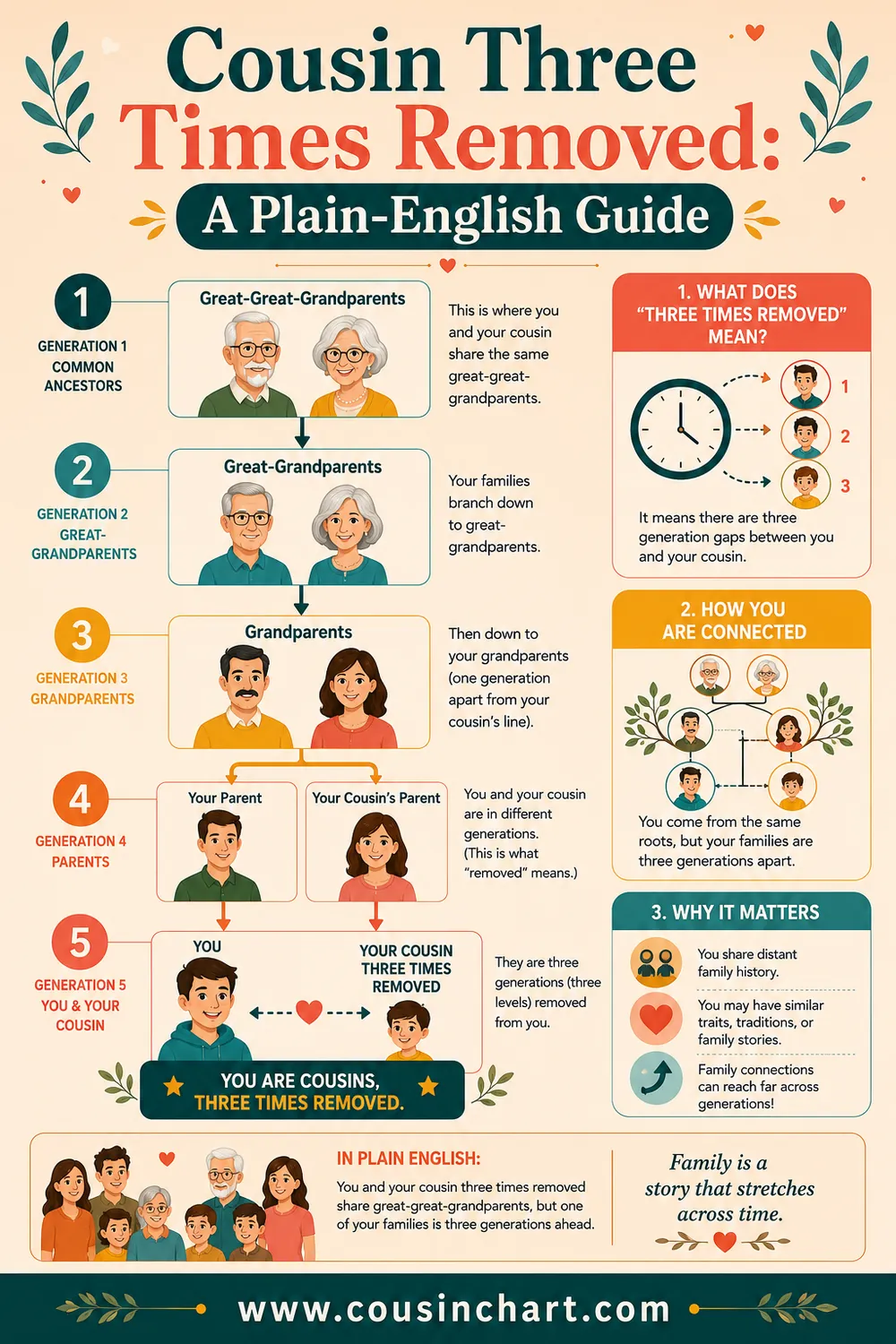
A first cousin three times removed is either your first cousin's great-grandchild or your great-grandparent's first cousin. "First cousin" names the family line; "three times removed" (written 3x removed on DNA sites) means the two of you sit three generations apart.
Three removals sounds baroque, but the logic is the same one that powers "once removed" — it just runs three steps. This guide walks the plain-English version: who these people are, the chart, the DNA numbers, and how "removed" scales to any distance. When counting fails you, the free relationship calculator on our homepage names any relationship instantly.
Relationship quick-check. Tap a phrase to see the correct term:
The answer will appear here.
"Removed" in One Minute
Every cousin relationship carries two numbers:
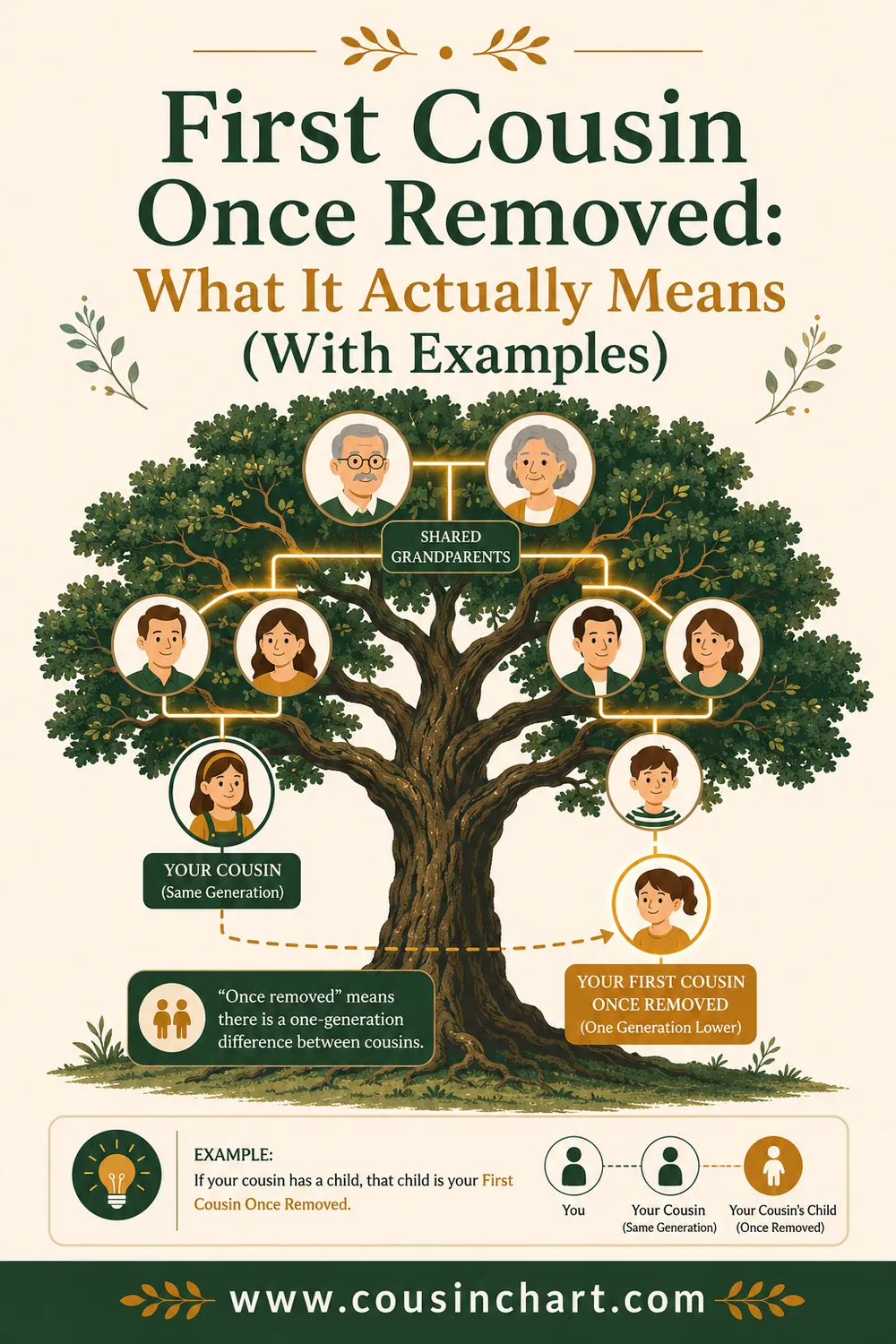
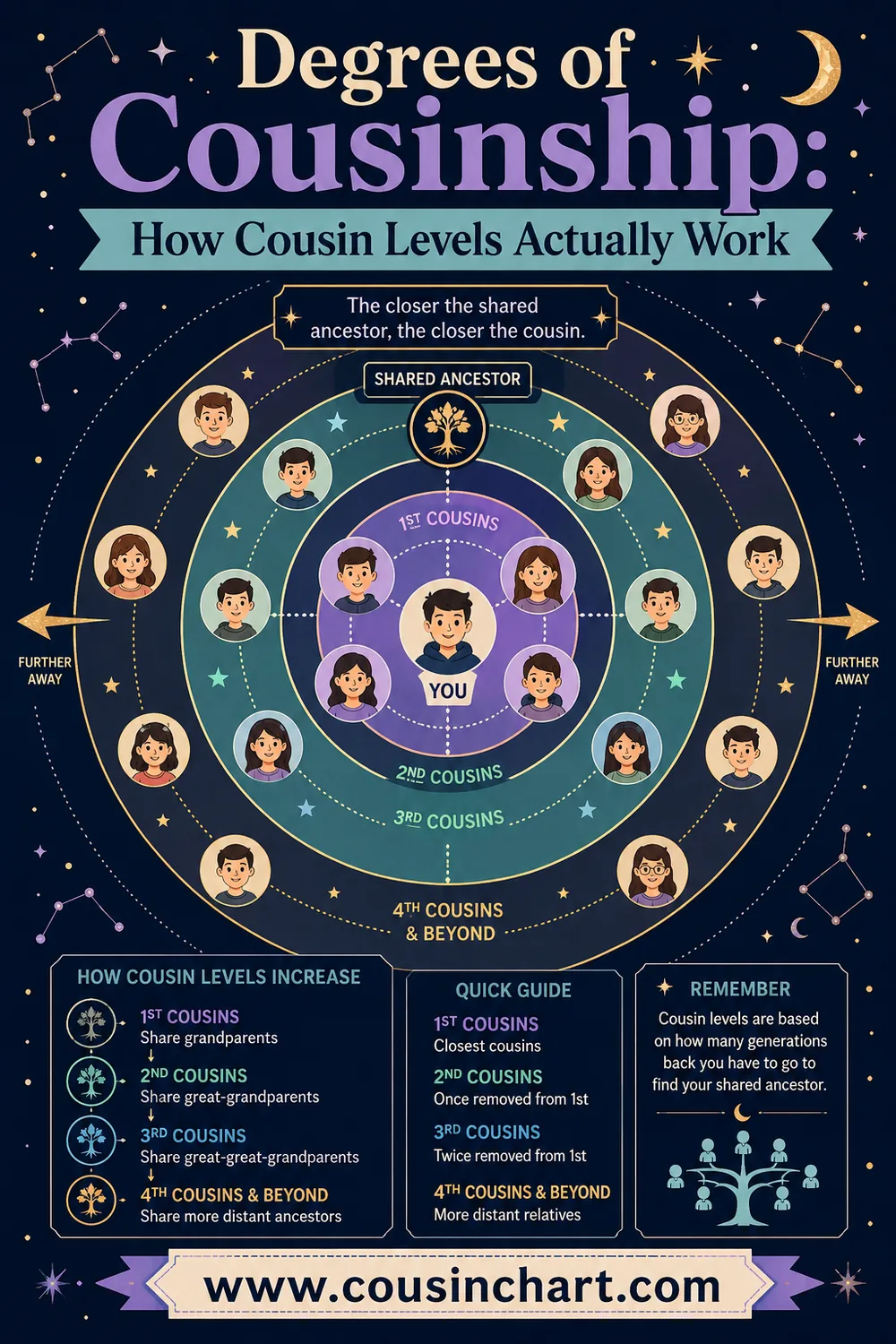
- The degree — first, second, third — set by how far up the tree the shared ancestors sit. First cousins share grandparents.
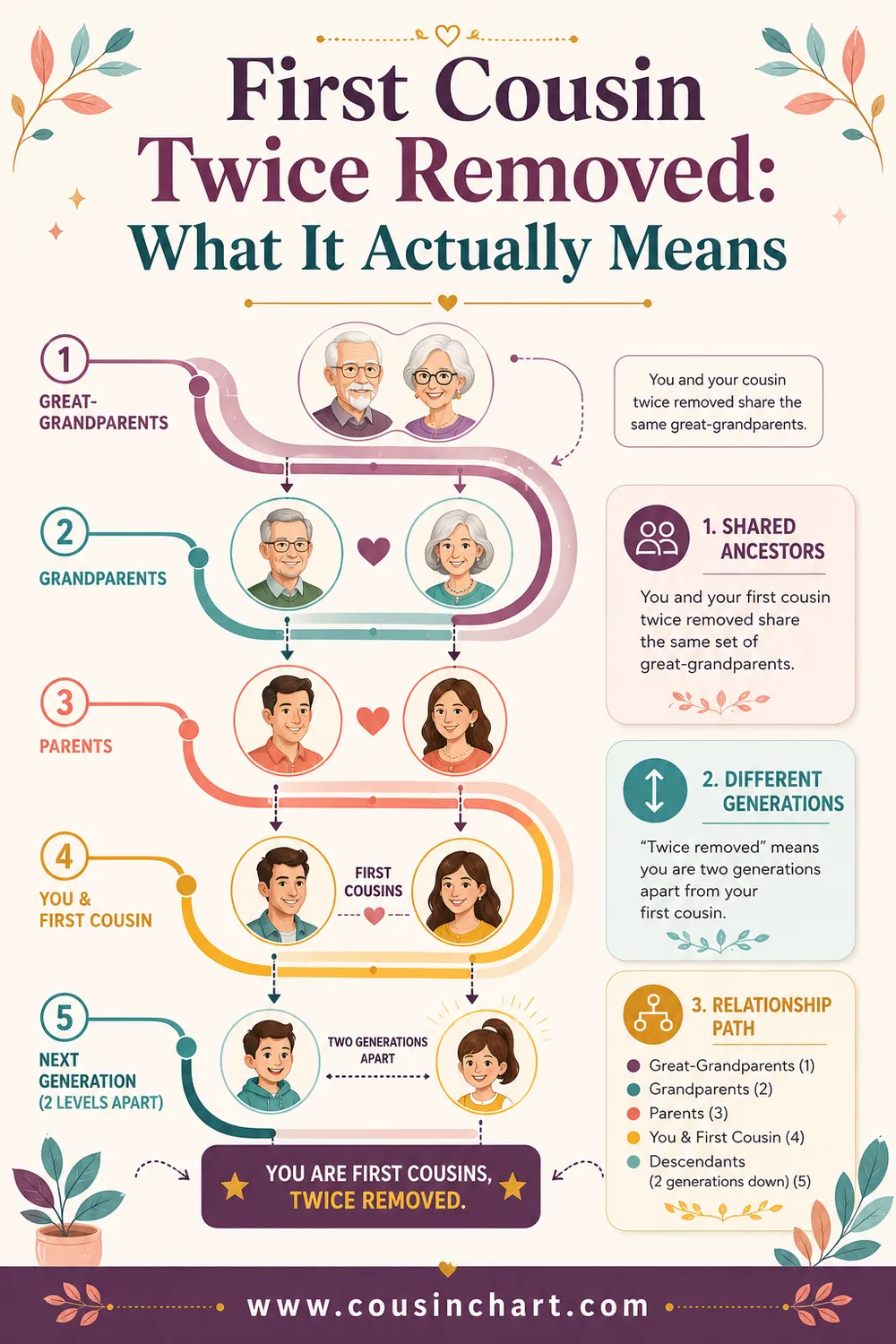
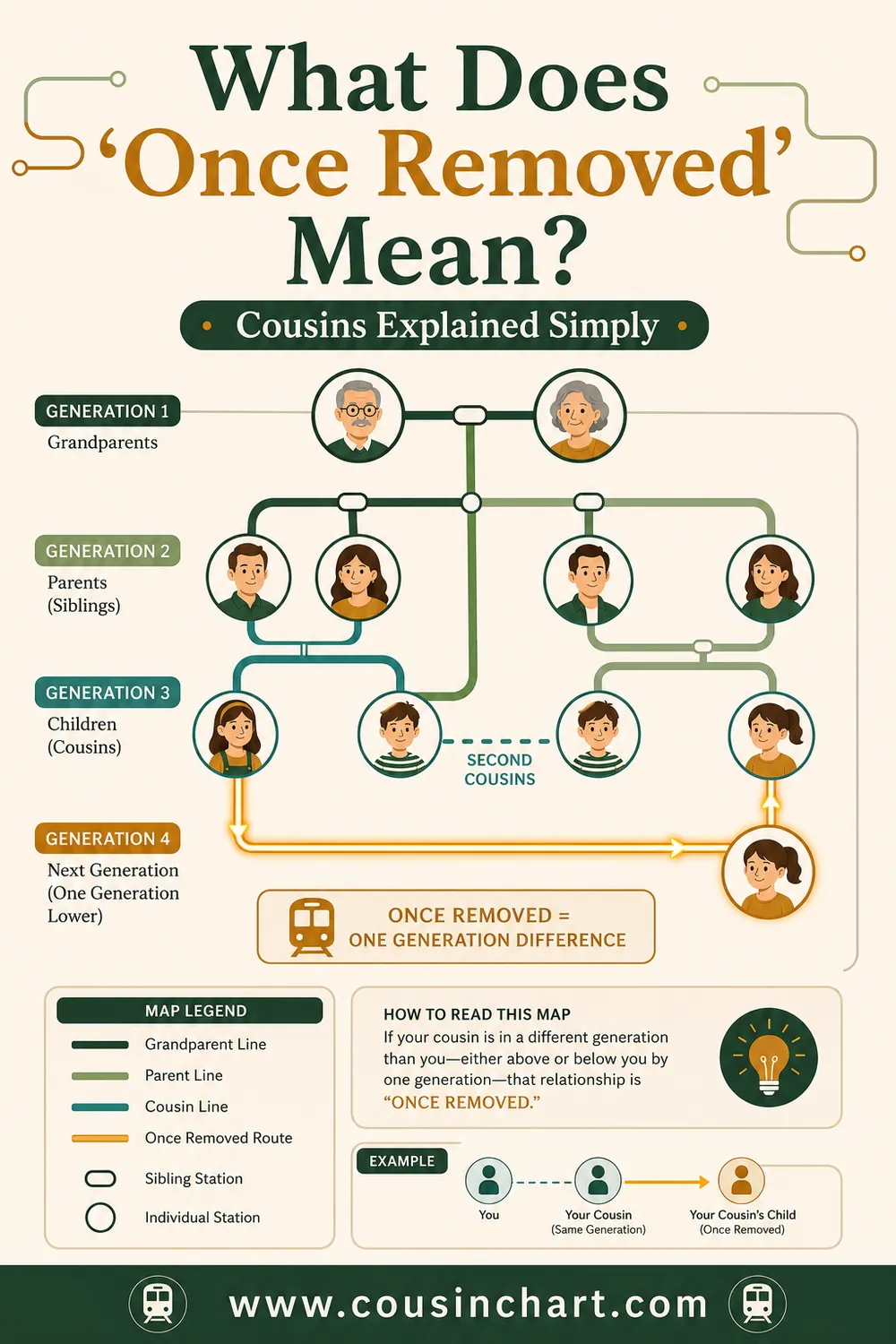
- The removal — once, twice, three times — set by the generation gap between the two people. Same generation, no removal. Three rows apart, three times removed.
So "first cousin three times removed" decodes as: the first-cousin line (shared grandparents somewhere up the chain), with three generations between us. If the basic idea is new to you, our what does once removed mean guide starts from zero; this article is that idea at full stretch.
The Two People Who Get This Label
As with every removed relationship, the term points both up and down the tree:
- Three generations up: your great-grandparent's first cousin. They and your great-grandparent shared grandparents — your 3×great-grandparents. In living memory this person is rare (they'd be very old), but in records they're everywhere: the cousin listed on your great-grandmother's ship manifest, the "cousin Jan" in a 1920s letter.
- Three generations down: your first cousin's great-grandchild. If you're long-lived and your cousin's family moves fast, you might actually meet this one — the baby at the reunion four rows down the tree from you.
Symmetric as always: you are their first cousin three times removed too, whether you're the elder or the baby.
Chart: The First-Cousin Line at Every Removal
| Who they are | Term | Generation gap |
|---|---|---|
| Your first cousin | First cousin | 0 |
| Your cousin's child / your parent's cousin | First cousin once removed | 1 |
| Your cousin's grandchild / your grandparent's cousin | First cousin twice removed | 2 |
| Your cousin's great-grandchild / your great-grandparent's cousin | First cousin three times removed | 3 |
| Your cousin's 2×great-grandchild / your 2×great-grandparent's cousin | First cousin four times removed | 4 |
The degree never moves — it's "first" all the way down the column, because the line itself (shared grandparents at the top) never changes. Only the gap grows. The same table works for the second-cousin line, the third, and so on; swap the degree, keep the removals.
A Worked Example You Can Reuse
Your great-grandfather Tomás had a first cousin, Alma — their fathers were brothers, so Tomás and Alma shared grandparents (your 3×great-grandparents).
Count each person's distance below those shared grandparents:
- Alma: 2 generations (grandchild).
- You: Tomás is 2 down, your grandparent 3, your parent 4, you 5.
Now apply the two rules. Degree: the smaller count minus one → 2 − 1 = 1, a first cousin. Removal: the difference → 5 − 2 = 3, three times removed.
That two-step count — smaller number minus one for the degree, difference for the removal — resolves any cousin relationship in existence. It's the entire degrees of cousinship system, and it's what the cousin calculator automates when the counting makes your eyes cross.
The DNA Numbers (And a Look-Alike Warning)
Each removal halves the expected shared DNA. Down the first-cousin line:
| Relationship | Average shared DNA | Approx. cM |
|---|---|---|
| First cousin | ~12.5% | ~865 |
| First cousin once removed | ~6.25% | ~430 |
| First cousin twice removed | ~3.1% | ~225 |
| First cousin three times removed | ~1.6% | ~110–120 |
| Second cousin once removed | ~1.5% | ~120 |
Spot the trap in the last two rows: a first cousin three times removed and a second cousin once removed share essentially identical DNA averages. On a match list, a ~115 cM match with a big age gap could be either. DNA gives you the ballpark; the family tree gives you the name.
This ambiguity is normal, not a flaw — several relationship shapes always share each cM neighborhood. Genealogists resolve it with ages, known generations, and records.
Remember, too, that averages hide wide ranges. Real first cousins three times removed have been recorded sharing anywhere from roughly 30 to over 250 cM — the shuffle of inheritance is that noisy. And the range points to a practical move: if the elder half of a 1C3R pair is still living, get their DNA tested. Every generation you go up doubles the expected match strength, so the same connection that shows as a faint 100 cM for you shows as a robust first-cousin-once-removed match for your parent, and stronger still for a grandparent. Test the oldest generation while you can — it sharpens every distant-cousin puzzle in the family, not just this one.
Where You'll Actually Meet This Relationship
Three-times-removed relationships live in two places:
- Genealogy research. When you trace your great-grandparents' generation, every first cousin of theirs you document is your 1C3R. Their descendants fan out into your third and fourth cousins — which makes 1C3Rs the gateway ancestors for building out the wide tree.
- Old-fashioned longevity. A 95-year-old at a family gathering meeting her cousin's great-granddaughter: that's a live first cousin three times removed handshake. Rare, but it happens — and now you know what to call it.
In conversation, nobody says the full phrase; "my cousin's great-granddaughter" or just "cousin" does the job. The precise term earns its keep in trees, DNA notes, and inheritance paperwork, where "cousin" alone is uselessly vague.
The Sibling Trap: Great-Great-Aunt vs. 1C3R
The most common mislabel at this depth confuses your ancestor's sibling with your ancestor's cousin. They're different lines with different naming systems:
| Ancestor | Their sibling is your... | Their first cousin is your... |
|---|---|---|
| Parent | Aunt or uncle | First cousin once removed |
| Grandparent | Great-aunt or great-uncle | First cousin twice removed |
| Great-grandparent | Great-great-aunt or great-great-uncle | First cousin three times removed |
The rule: siblings of your direct ancestors take aunt and uncle terms; cousins of your direct ancestors take cousin-plus-removal terms. So your great-grandmother's sister is your great-great-aunt — no removals involved — while your great-grandmother's cousin is your first cousin three times removed. Mixing these up matters more than it seems, because the two point at different shared couples: the great-great-aunt descends from your 2×great-grandparents, the 1C3R from your 3×great-grandparents. Put someone on the wrong line and every relationship you calculate downstream of them inherits the error.
Going Down the Tree: The Baby at the Reunion
The descending version deserves its own walkthrough, because this is the one you might actually meet. Say you and your first cousin Rita share grandparents:
- Rita's son Marcus is your first cousin once removed.
- Marcus's daughter Lily is your first cousin twice removed.
- Lily's new baby is your first cousin three times removed — four generations of one branch, all in your lifetime if the generations run short.
Now watch what happens to your descendants, because their labels are different from yours:
- Your daughter and Marcus are second cousins — each sits three generations below the original couple, and 3 − 1 = 2.
- Your daughter and Lily are second cousins once removed.
- Your daughter and the baby are second cousins twice removed.
Same baby, one row of the family — but she's your 1C3R and your daughter's 2C2R simultaneously. Relationships are between pairs of people, not properties of a person, which is why one newborn can collect a dozen different labels at a single reunion and every one of them is correct.
The Other Three-Times-Removed Cousins
"Three times removed" attaches to every cousin degree, not just the first. The removal stays fixed at a three-generation gap; the degree changes which couple sits at the top and how much DNA survives the distance:
| Relationship | Who they are (going up) | Shared ancestors | Avg DNA |
|---|---|---|---|
| First cousin three times removed | Your great-grandparent's first cousin | Your 3×great-grandparents | ~1.6% (~115 cM) |
| Second cousin three times removed | Your great-grandparent's second cousin | Your 4×great-grandparents | ~0.4% (~30 cM) |
| Third cousin three times removed | Your great-grandparent's third cousin | Your 5×great-grandparents | ~0.1% (often undetectable) |
Same staircase as always: each degree pushes the shared couple one generation deeper and quarters-to-halves the expected DNA. By third cousin three times removed, most true relatives share nothing a test can see — the relationship lives entirely in the records.
The table also shows why the degree deserves your attention more than the removal. A first cousin three times removed is a solid, usually detectable DNA relative; a third cousin three times removed is a name in a parish register. Both are three generations away from you, but they're worlds apart genetically.
Where Your 1C3R Shows Up in the Records
Your great-grandparents' first cousins were their contemporaries — same towns, same churches, same migrations — so they surface constantly once you know to look:
- Census pages. Extended families lived close, so scan the neighboring households on your great-grandparents' census sheets. That same-surname farmer two doors down is very often a first cousin — your 1C3R.
- Ship manifests. Early-1900s passenger lists asked immigrants who they were joining. "Going to cousin, Josef Kovac, 214 Mill St." is a 1C3R handing you his address.
- Marriage records. Witnesses and bondsmen were usually kin. A cousin who witnessed your great-grandmother's wedding gets a name, a date, and a place in one line.
- Obituaries. Old obituaries listed surviving cousins by name and town — a ready-made map of the cousin network in your great-grandparents' generation.
- Wills and probate. Childless great-great-uncles left property "to my beloved cousin" — and probate files spell out exactly who that was.
Each of these people is a branch of your own 3×great-grandparents' tree that your family may have lost track of. Documenting them isn't collecting strangers; it's restoring the cast of characters your great-grandparents actually lived among.
Why This Generation Is the Key to Your DNA Matches
Here's the payoff that makes 1C3Rs more than trivia. Run the descendants forward: your great-grandparent's first cousin sits two generations below your shared 3×great-grandparents, and their great-grandchildren sit five below — the same level as you. Count it out: both of you five below the couple, 5 − 1 = 4, no gap. Those great-grandchildren are your fourth cousins — living, testable, match-list fourth cousins.
That means every 1C3R you document converts directly into a cluster of predictable DNA matches:
- List your great-grandparents' first cousins from censuses, obituaries, and family letters.
- Trace each cousin's line forward two or three generations — marriage and census records make this quick for the 1900s.
- Match the endpoints against your DNA list. When a mystery 25–40 cM match carries one of those descendant surnames, you've likely just named the match — and confirmed your paper trail into the bargain.
Genealogists call this descendancy research, and the three-times-removed generation is its sweet spot: recent enough that records are rich, far enough back that the descendants have spread into the hundreds. Your 1C3Rs are the hinge between the ancestors you know and the cousins you haven't met yet.
FAQ
What does "1st cousin 3x removed" mean on a DNA site?
It means the first-cousin line with a three-generation gap: your first cousin's great-grandchild, or your great-grandparent's first cousin. DNA sites list it as one possible explanation for matches around 1.6% shared DNA.
What is my great-grandmother's cousin to me?
Your first cousin three times removed. She shared grandparents with your great-grandmother, and you sit three generations below your great-grandmother.
Is my cousin's great-grandchild my second cousin?
No — second cousins are same-generation relatives sharing great-grandparents. Your cousin's great-grandchild is your first cousin three times removed: same line as your cousin, three rows down.
How much DNA do first cousins three times removed share?
About 1.6% on average, roughly 110–120 cM — almost the same as a second cousin once removed. The two are indistinguishable by DNA amount alone.
Does "three times removed" mean the relationship is basically gone?
No. Removal measures generation gap, not closeness of the bloodline. A 1C3R descends from your own 3×great-grandparents through your great-grandparents' generation — genealogically that's close family history.
What is my great-grandmother's cousin's grandchild to me?
Your third cousin once removed. That grandchild sits four generations below the shared 3×great-grandparents; you sit five. Smaller count minus one gives the degree (4 − 1 = 3), and the one-step difference gives the removal.
How do genealogists abbreviate these terms?
The standard shorthand is degree, "C," then the removal: 1C3R for first cousin three times removed, 2C1R for second cousin once removed, and so on. DNA sites write the same thing as "1st cousin 3x removed." The shorthand is worth adopting in your own notes — it's unambiguous, sortable, and much shorter than the phrase it replaces.
Can the term go higher — four, five times removed?
Yes, indefinitely. Your 2×great-grandparent's first cousin is your first cousin four times removed, and so on. The degree stays put; the removal counts the gap.
The Short Version
First cousin three times removed = the first-cousin line with a three-generation gap: your cousin's great-grandchild, or your great-grandparent's cousin. Count to the shared ancestor for the degree, count the gap for the removal, and even the scariest-sounding terms unpack themselves.
Or skip the counting entirely: the free family relationship calculator turns "my great-grandma's cousin's grandson" into the correct term — both directions — before the reunion argument gets going.