First Cousin Twice Removed: What It Actually Means
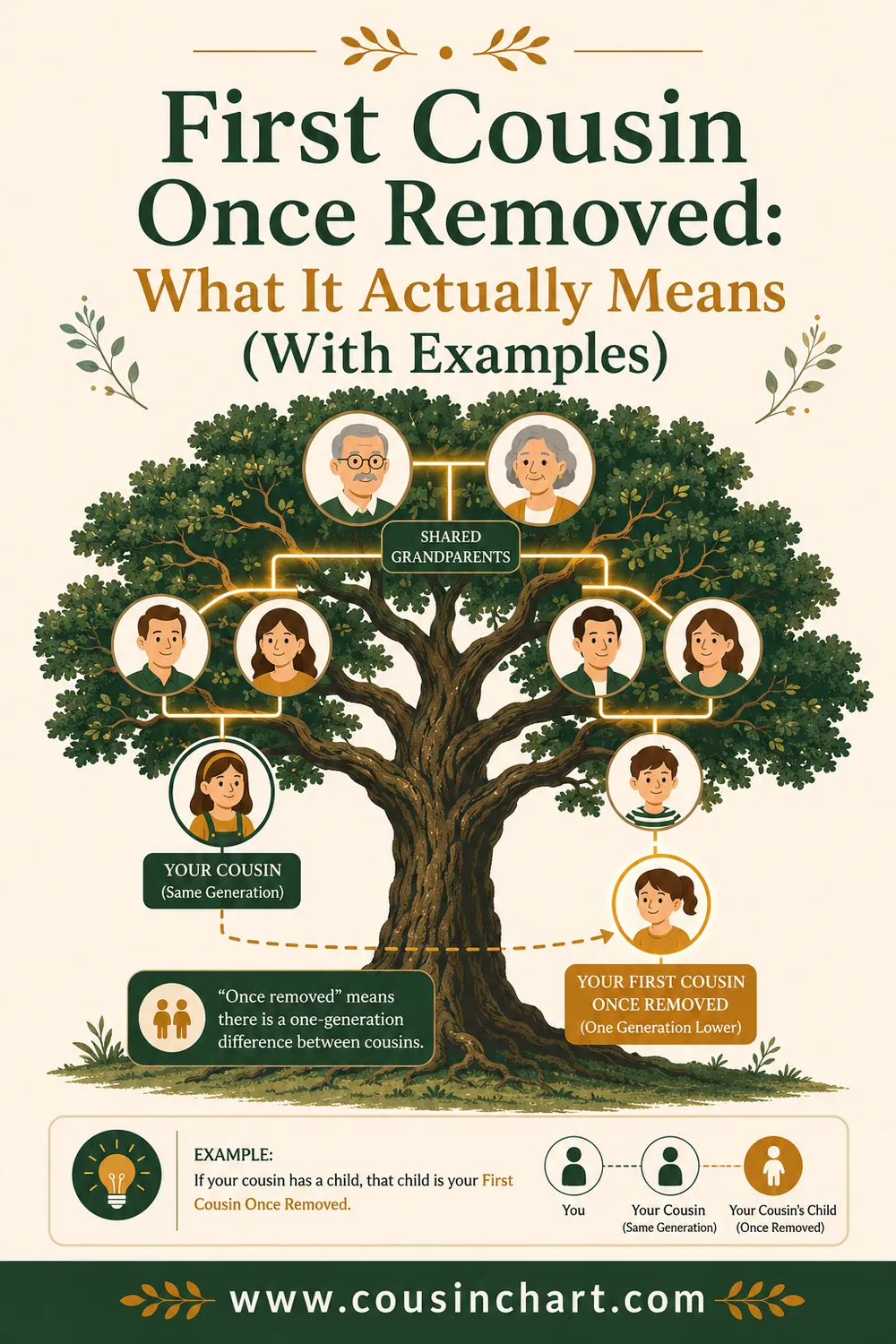
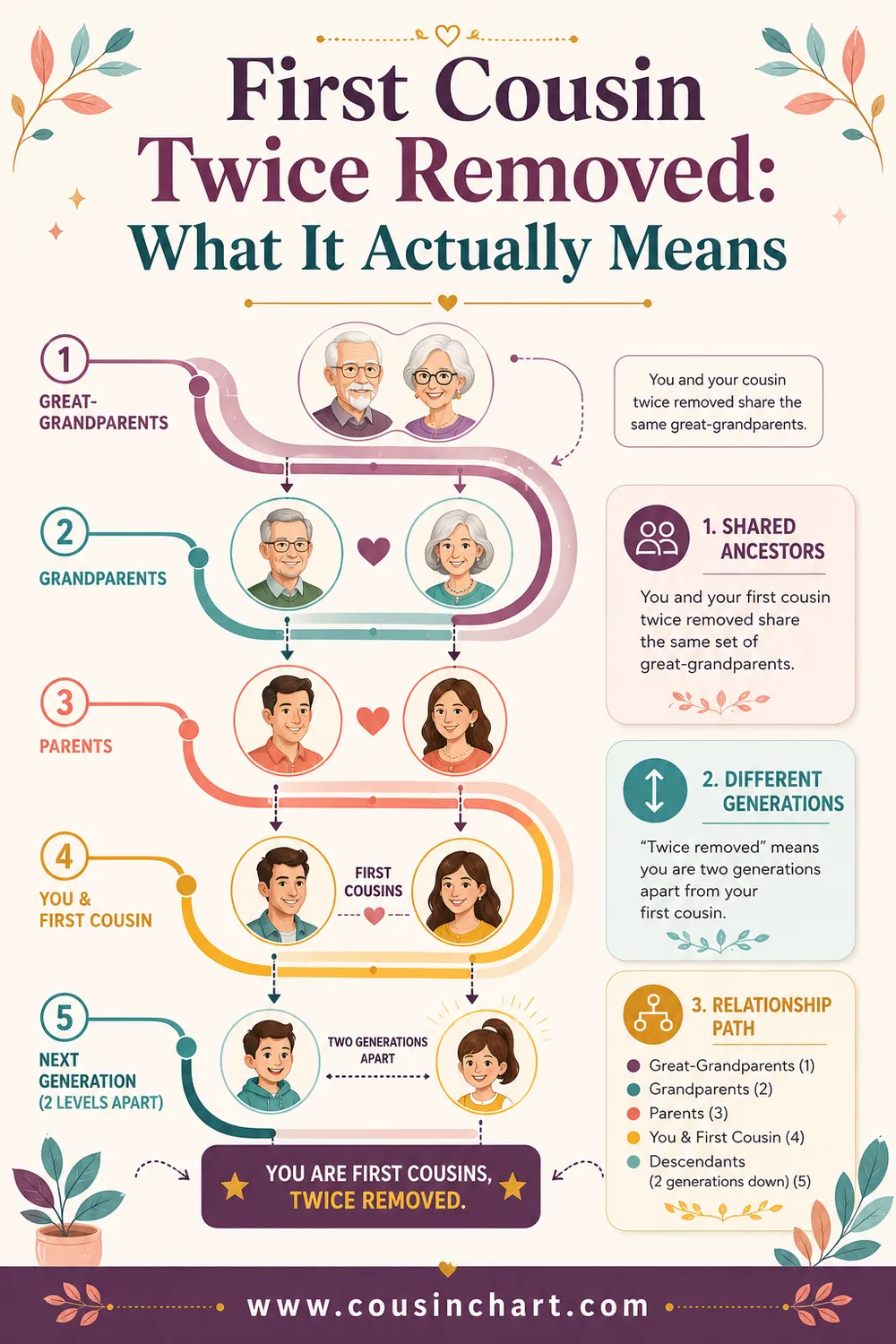
A first cousin twice removed is either your first cousin's grandchild or your grandparent's first cousin. The cousin line is "first" — the closest kind — and "twice removed" means the two of you sit two generations apart on the family tree.
That's the entire definition. Below you'll find the chart, a family story that makes it stick, the surprising DNA overlap with second cousins, and the fastest way to settle it when relatives start debating. (Spoiler on that last one: the free relationship calculator on our homepage answers it in seconds.)
Relationship quick-check. Tap a phrase to see the correct term:
The answer will appear here.
Two People, One Term
Every "removed" cousin term covers two people — one above you, one below:
- Two generations up: your grandparent's first cousin. They and your grandparent share grandparents, which makes those shared ancestors your great-great-grandparents.
- Two generations down: your first cousin's grandchild. You and your cousin share grandparents, and the grandchild sits two rows beneath you.
And it's symmetric. If Frank is your grandfather's first cousin, then you are Frank's first cousin twice removed too. One term, both directions, regardless of who's older.
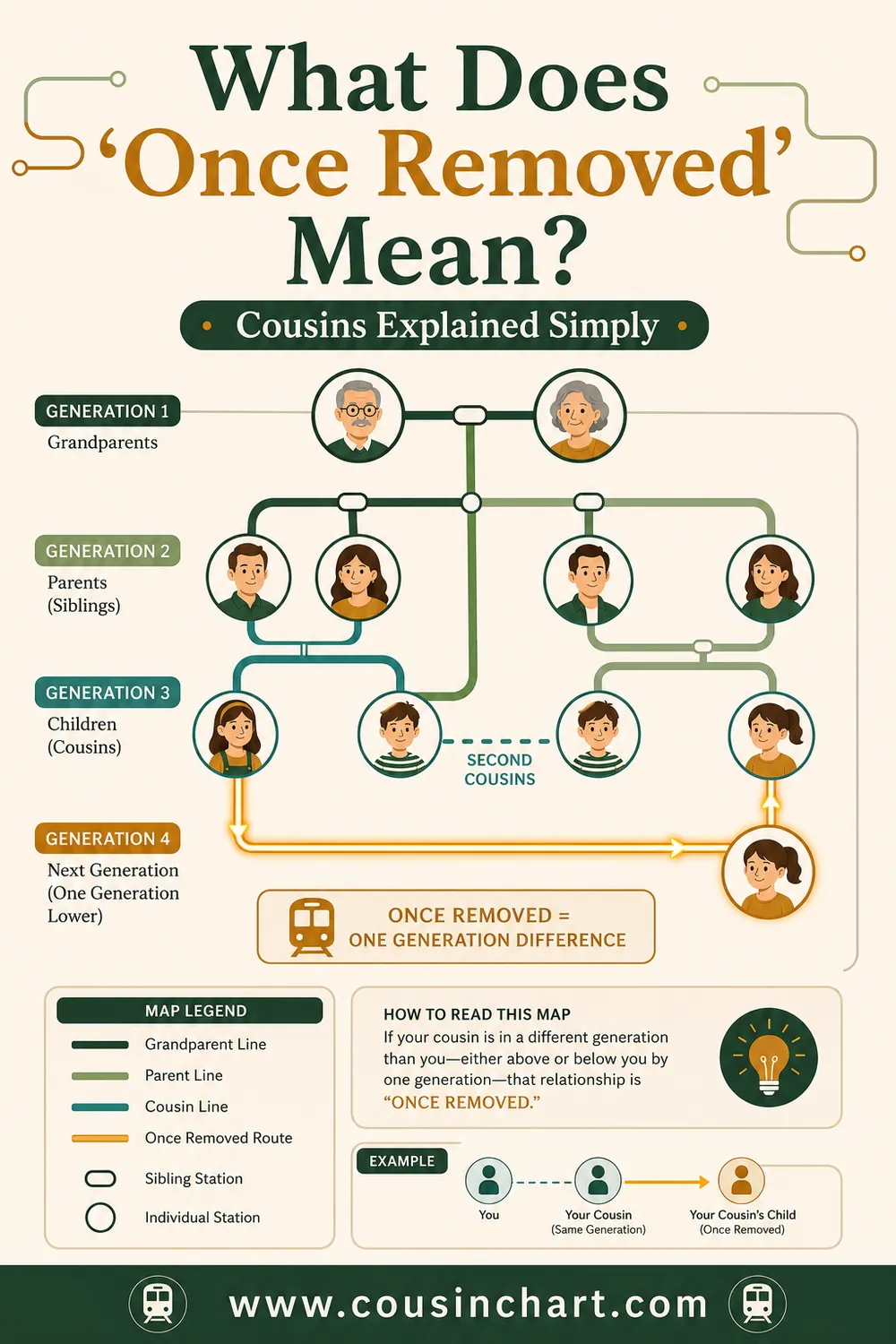
If the whole "removed" system is new to you, our guide to what once removed means builds it up from scratch — this article is the two-step version of that idea.
The Math in Ten Seconds
Cousin terms come from two counts:
- Degree: count the generations from the shared ancestor down to whichever person is closer, then subtract one. First cousins are each two generations below shared grandparents: 2 − 1 = 1.
- Removal: the generation gap between the two people. Two rows apart = twice removed.
Run it on your grandmother's cousin: she's two generations below their shared grandparents; you're four. Closer count is two, so the degree is first. Gap is 4 − 2 = 2, so twice removed. First cousin twice removed — done.
The same two counts power our free cousin calculator, which is handy when the relative in question is something gnarlier, like a half great-uncle's step-grandson.
Chart: The First-Cousin Line, Removed 0–3 Times
| Who they are | What they are to you | Generation gap |
|---|---|---|
| Your first cousin | First cousin | 0 |
| Your cousin's child / your parent's cousin | First cousin once removed | 1 |
| Your cousin's grandchild / your grandparent's cousin | First cousin twice removed | 2 |
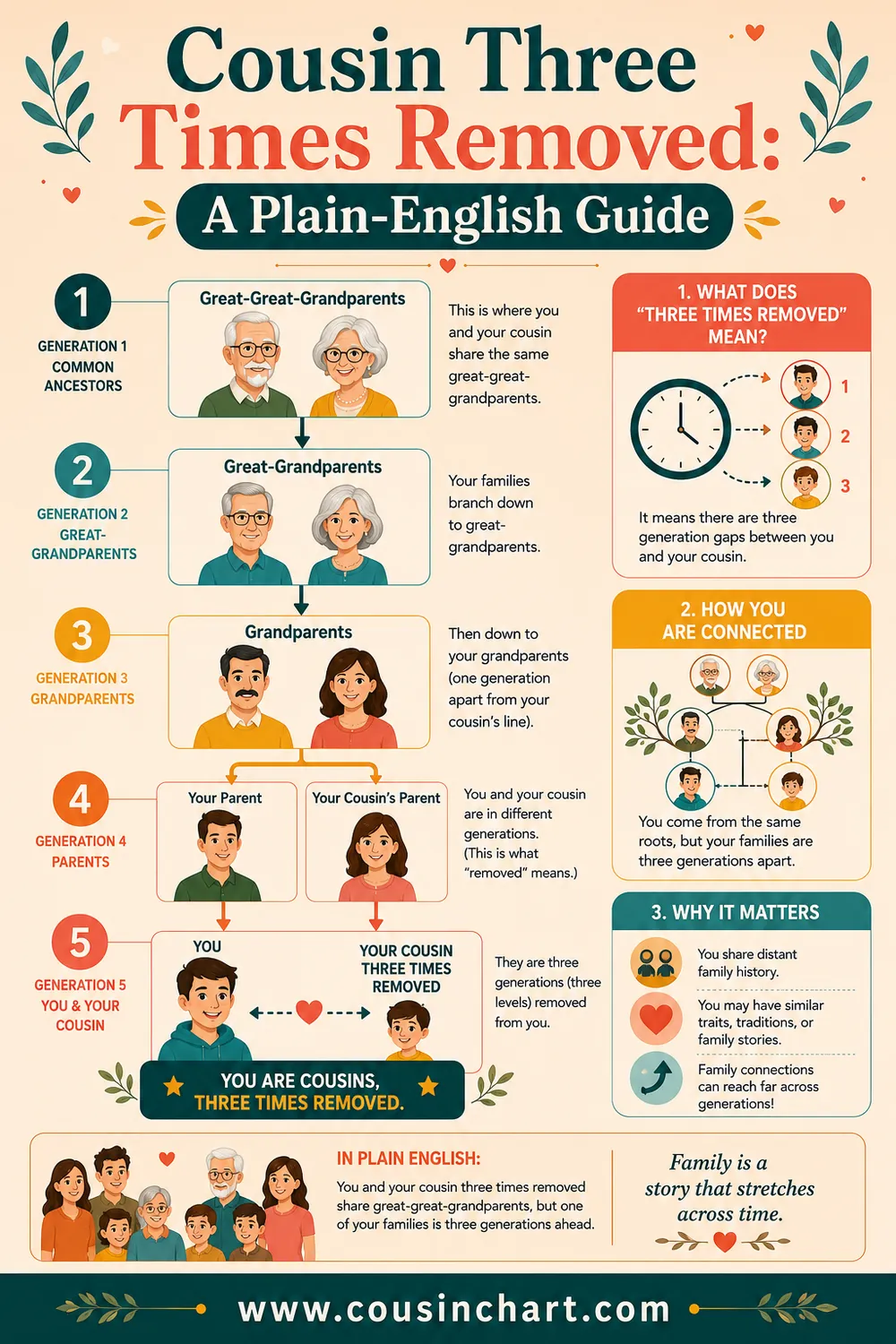
| Your cousin's great-grandchild / your great-grandparent's cousin | First cousin three times removed | 3 |
The degree — "first" — never changes as you slide up or down one side of the tree. Only the removal climbs. That's the single most useful fact for keeping these terms straight: one-sided generations change the removal; new generations on both sides change the degree.
So your cousin's grandchild is your first cousin twice removed, but your grandchild and your cousin's grandchild — stepping down on both sides — are third cousins to each other.
Meet the Kowalskis: A Worked Example
Your grandfather Stan and his cousin Helena grew up on the same street. They share grandparents — your great-great-grandparents — so Stan and Helena are first cousins.
Now walk down the tree:
- Helena to your father: she's his father's cousin, so Helena is your father's first cousin once removed.
- Helena to you: she's your grandfather's cousin — your first cousin twice removed.
- You to Helena: same term back again. To Helena, you're her cousin Stan's grandchild.
Meanwhile Helena's own grandchildren are a different story. They and you are both four generations below the shared ancestors — same generation, shared great-great-grandparents — which makes you third cousins, not removed at all. One family, one shared couple at the top, and half a dozen different labels depending on which two people you pick. This is why genealogists draw charts.
DNA: The Second-Cousin Look-Alike
Here's the fact that surprises people. First cousins twice removed share about 3.1% of their DNA on average — roughly 220–230 centimorgans (cM). That's the same average as a full second cousin.
| Relationship | Average shared DNA | Approx. cM |
|---|---|---|
| First cousin | ~12.5% | ~865 |
| First cousin once removed | ~6.25% | ~430 |
| First cousin twice removed | ~3.1% | ~220–230 |
| Second cousin | ~3.1% | ~230 |
| Second cousin once removed | ~1.5% | ~120 |
Why the overlap? Each step — whether it's a removal or a degree — halves the expected shared DNA. Two removals on the first-cousin line and one degree jump to second cousin both land you three halvings from a full sibling relationship. Same math, same percentage.
The practical takeaway: when a DNA site labels a match "2nd cousin," the real relationship might be a first cousin twice removed (usually a much older or much younger relative). Check ages and generations before you update the family tree.
When You'd Actually Meet Yours
First cousins twice removed turn up in real life more than the clunky name suggests:
- The family elder. Your grandmother's cousin at the reunion — the one with the photo albums — is your first cousin twice removed. In many families she's the best living source for names three generations back.
- The new baby. When your first cousin becomes a grandparent, that baby is your first cousin twice removed. If you're wondering what the baby's parent is to you, that's your first cousin once removed.
- The DNA match. A 200 cM match with a 50-year age gap is very often this relationship.
Socially, call them cousin, aunt-ish, or whatever your family already uses. The formal term is for trees, records, and settling arguments.
Don't Confuse It With These
- Great-aunt or great-uncle. Your grandparent's sibling is your great-aunt or great-uncle. Your grandparent's cousin is your first cousin twice removed. Sibling lines use aunt/uncle words; cousin lines use removals.
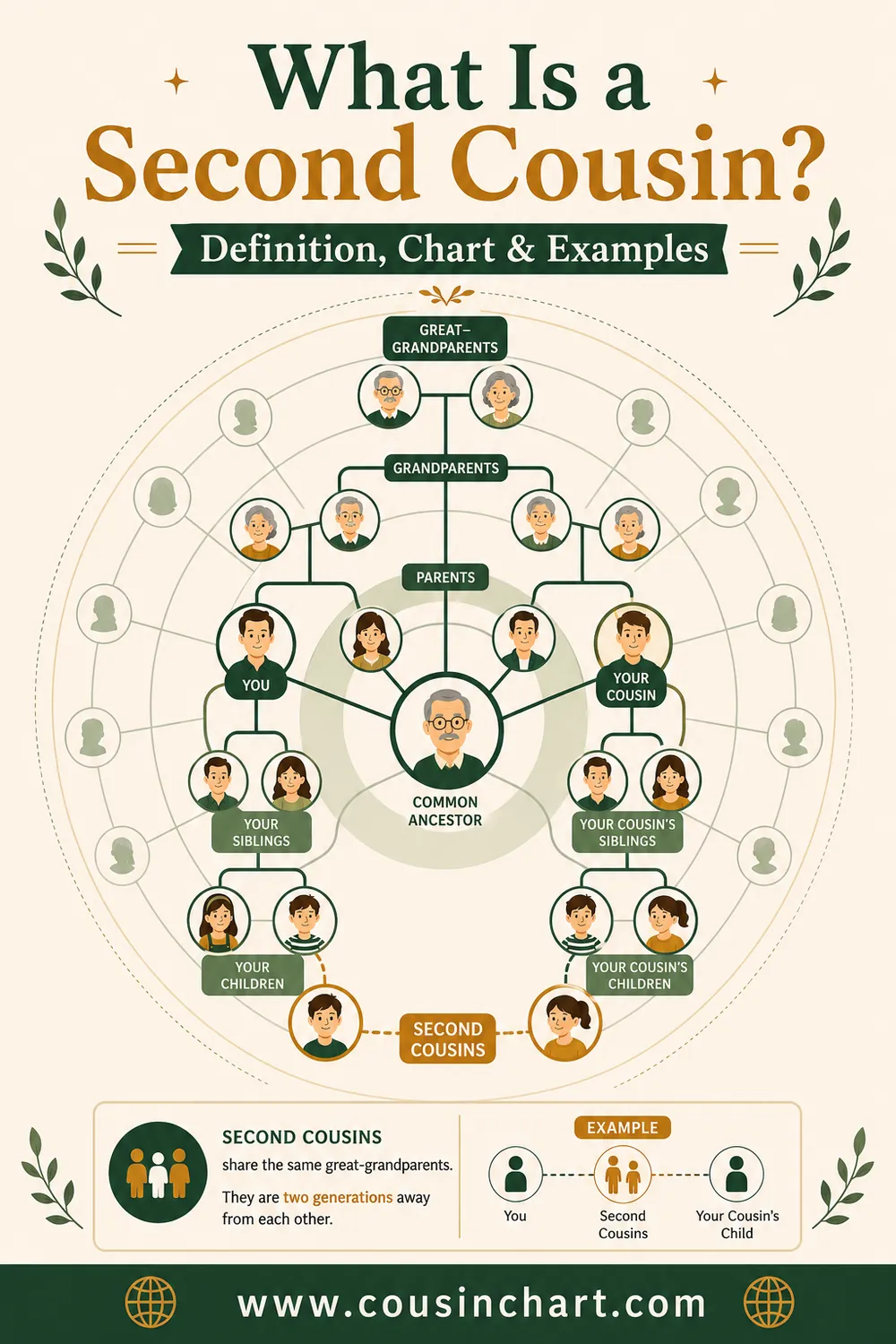
- Second cousin. Your grandparent's cousin's grandchild is your second cousin... close, but not quite — count it: they'd be three generations below the shared great-great-grandparents and so would you, making you third cousins. Second cousins share great-grandparents. When in doubt, count.
- First cousin once removed. One generation gap instead of two — your parent's cousin or your cousin's child. See the second cousin comparison if you're sorting a whole match list.
The pattern for all of these: find the shared couple at the top, count down both sides, and the term assembles itself.
Why Yours Might Be Your Age (or Younger)
"Two generations apart" sounds like it guarantees a big age gap. It doesn't — generations drift. A line of eldest children born to young parents stacks up birth years quickly, while a line of youngest-of-eight kids born to older parents stretches them way out.
Picture two brothers born in 1900. One becomes a father at 20 and a grandfather at 45; the other has his last child at 45, and that child waits until 40 to have kids. Within two generations, cousins on the same row of the tree are forty years apart in age — and someone two rows down one branch can easily be older than someone higher up the other.
So don't be thrown when your grandfather's first cousin turns out to be younger than your mom, or when your first cousin twice removed is a toddler at your own birthday party. The label tracks positions on the tree, never birthdays — which is exactly why guessing relationships from age alone goes wrong at reunions.
Half and Step Versions
Real families come with asterisks, and the term stretches to fit:
- Half first cousin twice removed. If your grandparent and their cousin descended from half-siblings, they share one grandparent instead of two. Everything else works the same — the removal still counts the gap — but the expected DNA is halved, to roughly 1.5% (about 110 cM).
- Step first cousin twice removed. Your step-grandparent's first cousin, or your step-cousin's grandchild. No shared DNA at all — it's a courtesy label, and most families just say "cousin" and move on.
For DNA purposes, only the blood versions count; for the seating chart, they're all family.
FAQ
What is a first cousin twice removed in simple terms?
Your first cousin's grandchild, or your grandparent's first cousin. "First cousin" is the line; "twice removed" means a two-generation gap between you.
What is my grandmother's cousin to me?
Your first cousin twice removed. She and your grandmother share grandparents (your great-great-grandparents), and you're two generations below your grandmother.
Is my cousin's grandchild my second cousin?
No — that's your first cousin twice removed. Second cousins are same-generation relatives who share great-grandparents, like the children of two first cousins.
How much DNA do first cousins twice removed share?
About 3.1% on average, roughly 220–230 cM — essentially identical to a second cousin. Age and generation clues are how you tell those two apart on a DNA match list.
Can first cousins twice removed marry?
Rules on cousin marriage focus on first cousins and vary by state and country; some US states also address first cousins once removed. A two-generation gap relationship is genetically similar to second cousins, which no US state restricts — but laws change, so check the current law where you live.
Is the term the same whether they're older or younger than me?
Yes. Your grandparent's cousin and your cousin's grandchild both get the same label, and the relationship reads identically from both sides.
Is there such a thing as a "grand-cousin"?
You'll hear it informally — some families call a cousin's grandchild their "grand-cousin," borrowing the grandparent pattern. It's a friendly shortcut, but it isn't standard genealogy. On charts, in records, and on DNA sites, the recognized term is still first cousin twice removed.
The Bottom Line
First cousin twice removed = the first-cousin line with a two-generation gap: your cousin's grandchild or your grandparent's cousin. It shares its DNA average with second cousins, its "removed" logic with every other cousin term, and its best explanation with a simple chart.
Next time the reunion debate starts, don't argue from memory — open the free family relationship calculator, tap through the two people, and read out the answer.