Distant Cousins: 5th, 6th, 7th and 8th Cousins Explained
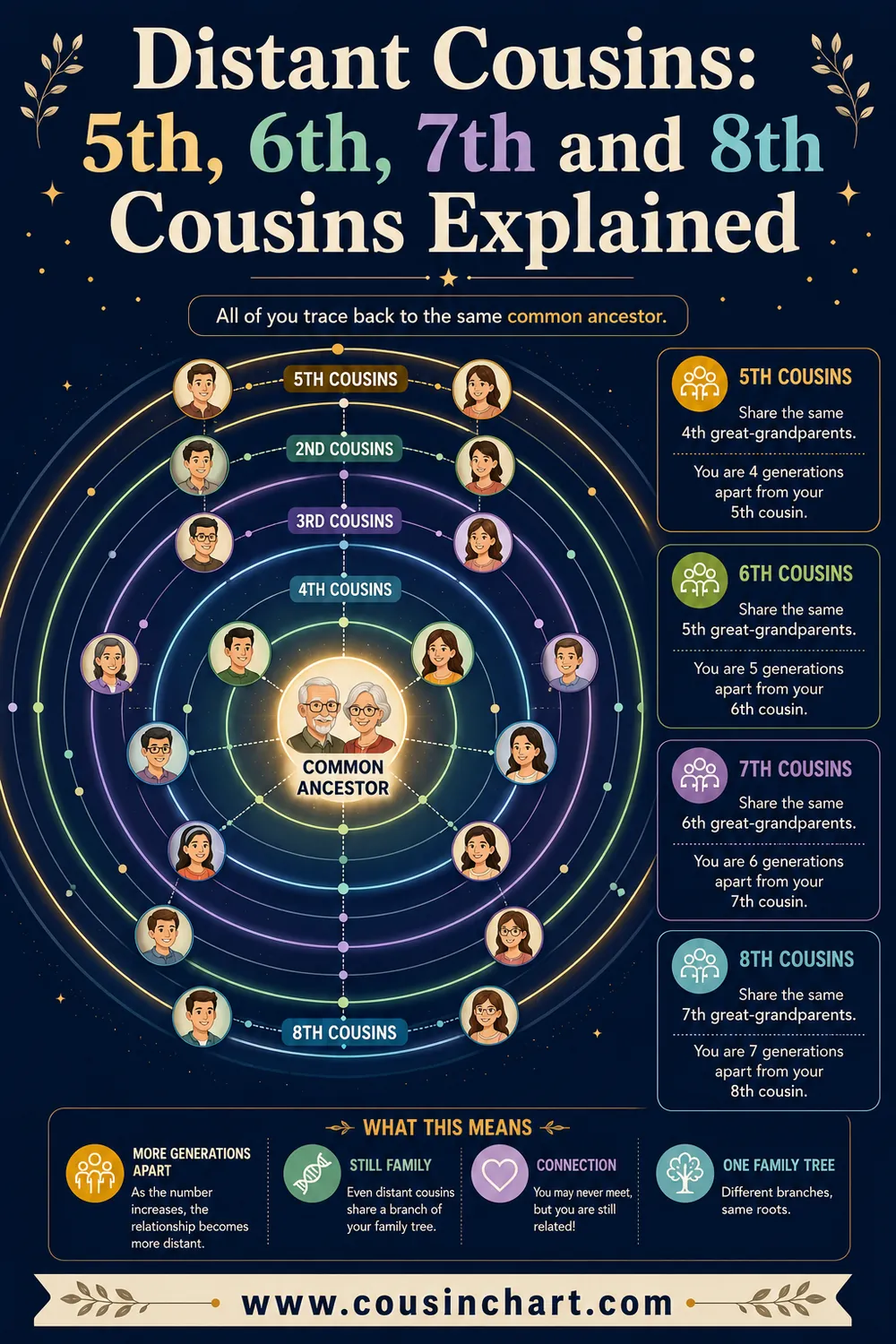
A fifth cousin shares your 4×great-grandparents, a sixth cousin your 5×great-grandparents, and so on — each degree pushes the shared couple one generation further back. By the time you reach eighth cousins, the common ancestors lived around the 1700s, and you probably have more of these cousins than there are people in your town.
Distant cousins are where genealogy stops being about people you know and starts being about history. This guide gives you the chart, the DNA reality (mostly: none), the head-spinning cousin counts, and what distant cousins are actually good for. And when you need to name a specific relationship, the free relationship calculator on our homepage handles any degree and removal instantly.
Relationship quick-check. Tap a phrase to see the correct term:
The answer will appear here.
The Distant Cousin Chart
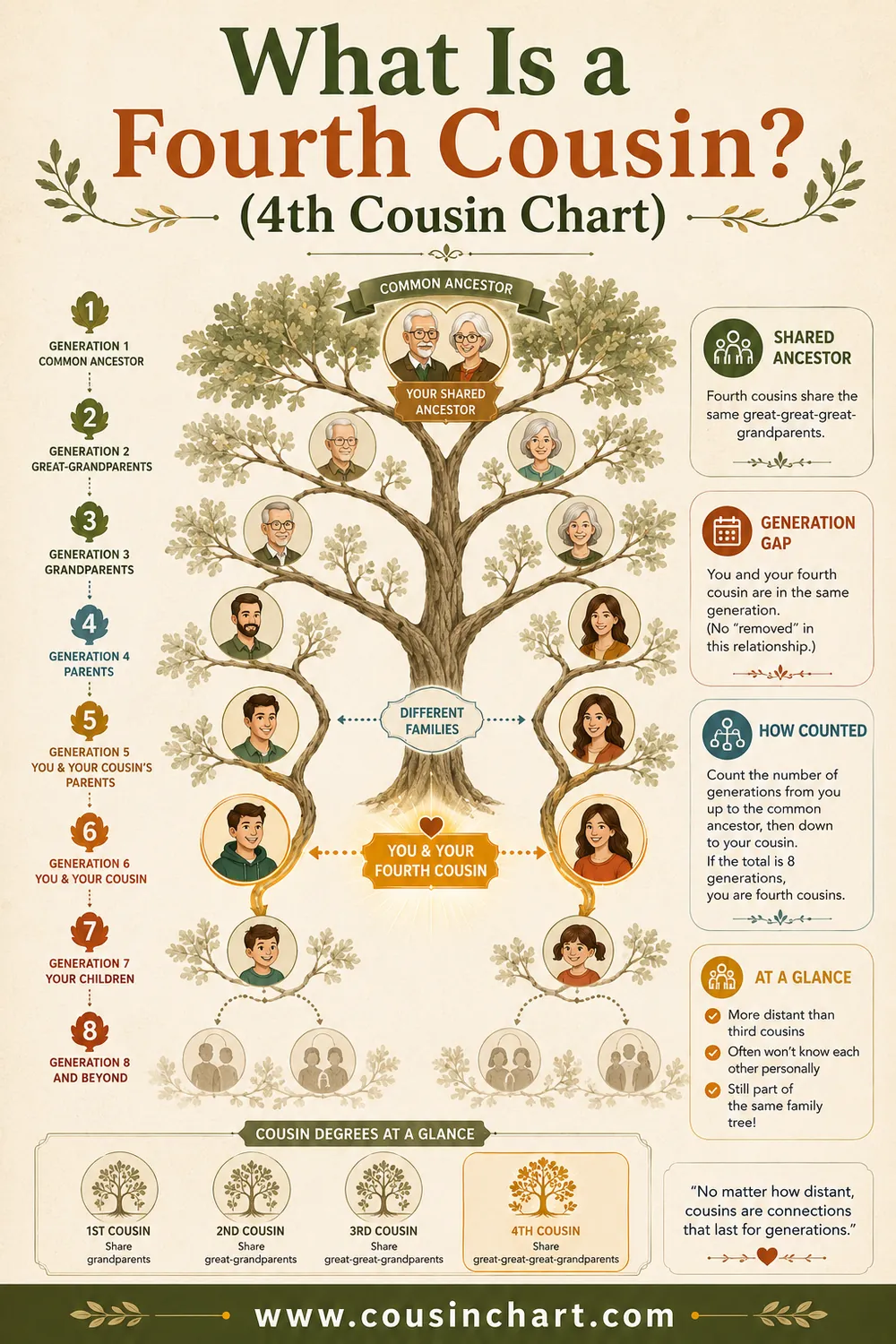
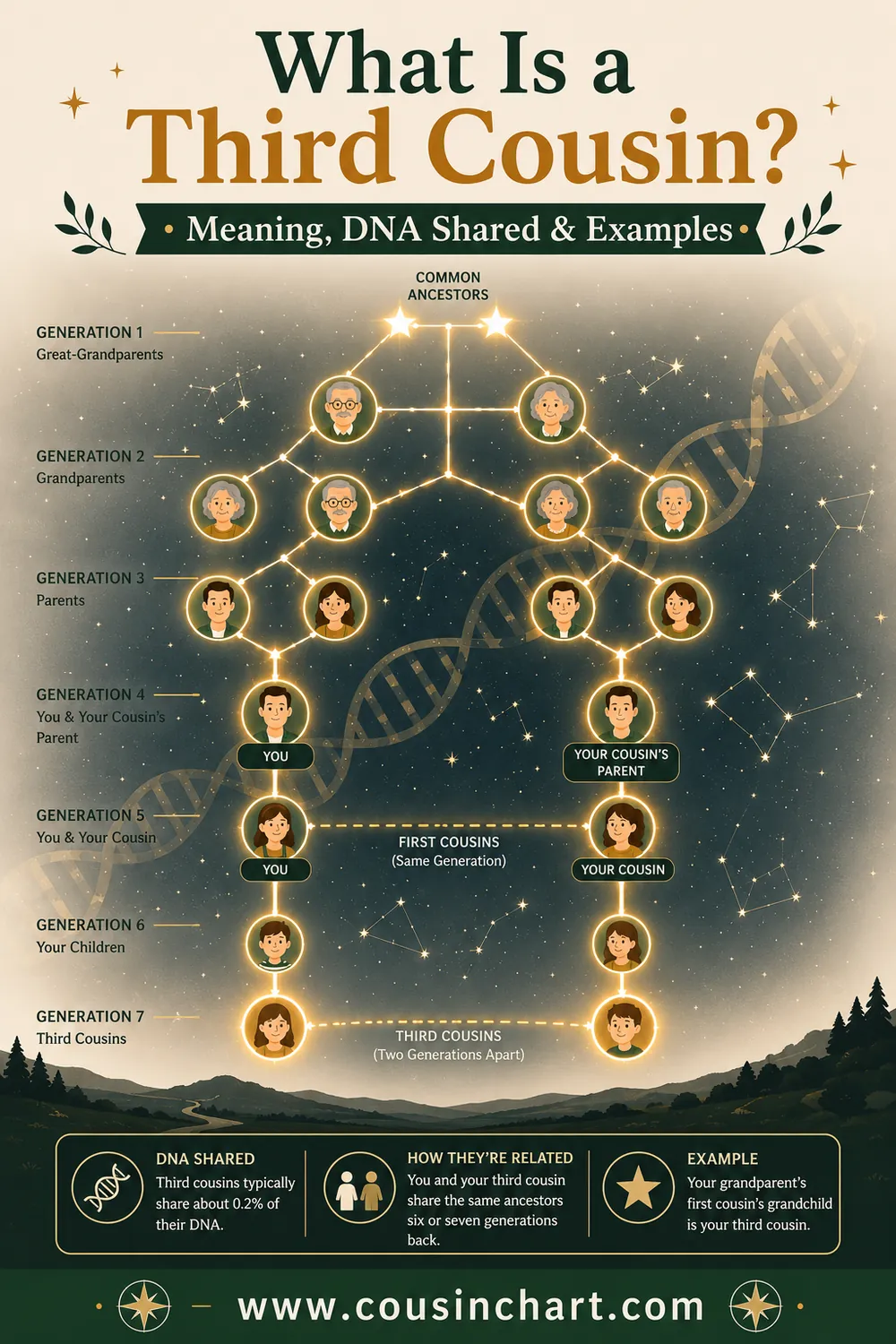
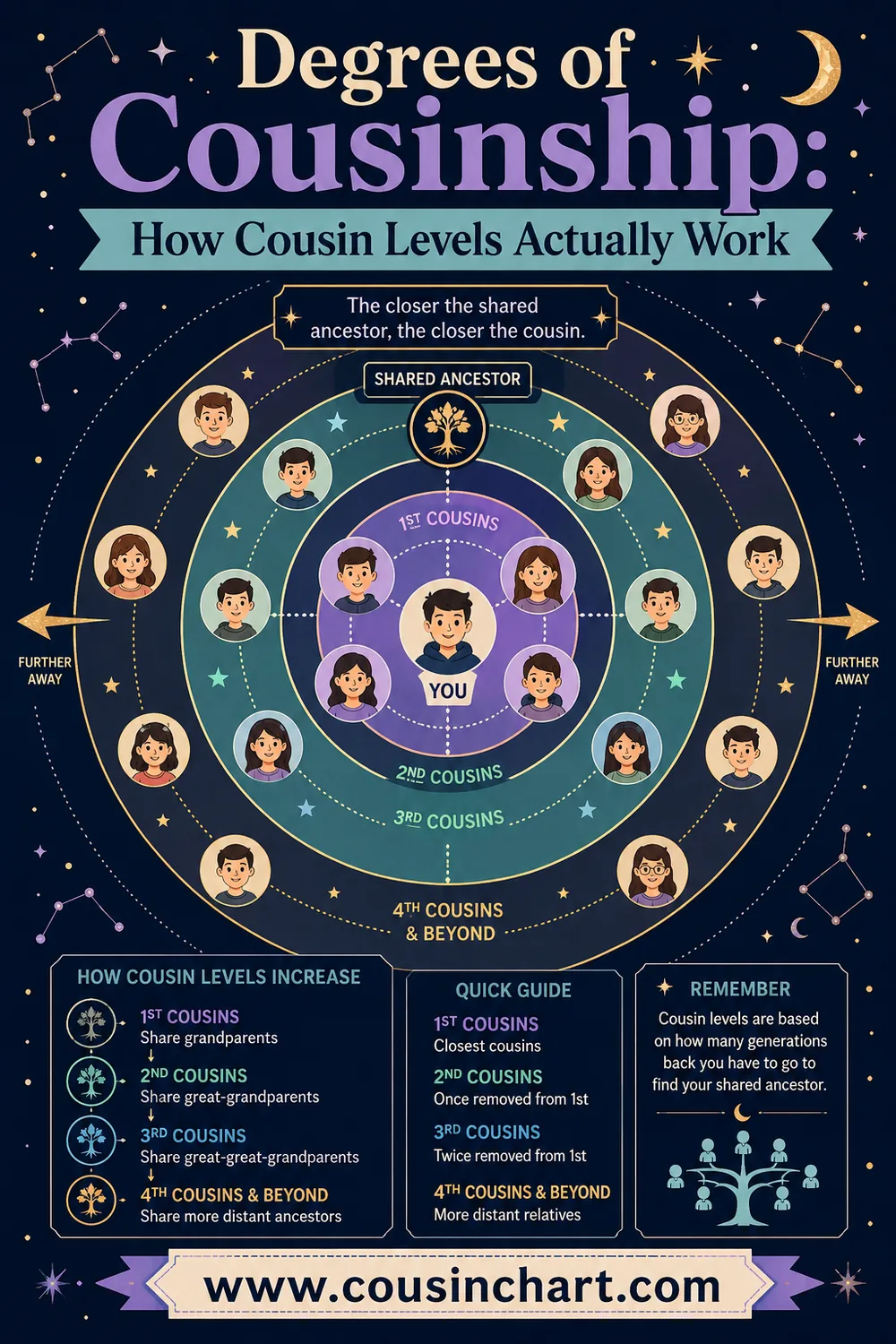
The rule never changes: an nth cousin shares your (n − 1)×great-grandparents, and you're both n + 1 generations below that couple.
| Relationship | Shared ancestors | Generations below them | Shared couple born (very roughly) |
|---|---|---|---|
| Fourth cousins | 3×great-grandparents | 5 | ~1820s–1880s |
| Fifth cousins | 4×great-grandparents | 6 | ~1790s–1850s |
| Sixth cousins | 5×great-grandparents | 7 | ~1760s–1820s |
| Seventh cousins | 6×great-grandparents | 8 | ~1730s–1790s |
| Eighth cousins | 7×great-grandparents | 9 | ~1700s–1760s |
(The birth-year column assumes generations of 25–30 years; your family's dates will vary.)
Removals still work the same way out here: your fifth cousin's child is your fifth cousin once removed, and your grandparent's sixth cousin is your sixth cousin twice removed. The degrees of cousinship math doesn't care how distant the line gets.
The DNA Reality: Mostly Silence
Every generation between you and the shared couple halves the expected DNA — and by the fifth degree, the halving wins:
| Relationship | Average shared DNA | Realistic detection odds |
|---|---|---|
| Fourth cousin | ~0.2% (~35 cM) | A coin flip to solid odds |
| Fifth cousin | ~0.05% | Low — most share nothing detectable |
| Sixth cousin | ~0.01% | Very low |
| Seventh–eighth cousin | Trace | Rare luck |
Three takeaways for anyone staring at a match list:
- Most of your true distant cousins are invisible to DNA tests. They're genuinely related on paper and share zero overlapping segments with you.
- **The distant matches you do see are survivors of luck.** A 20 cM match labeled "5th–8th cousin" is real DNA, but the label is a wide guess — the actual relationship could span several degrees and removals.
- Segments can also be misleading at this size. Very small segments (under ~10 cM) are sometimes false positives. Treat tiny distant matches as hints, not proof.
The practical rule genealogists use: DNA confirms relationships out to about the fourth-cousin level reliably; beyond that, the paper trail carries the weight.
How Many Distant Cousins Do You Have? (Brace Yourself)
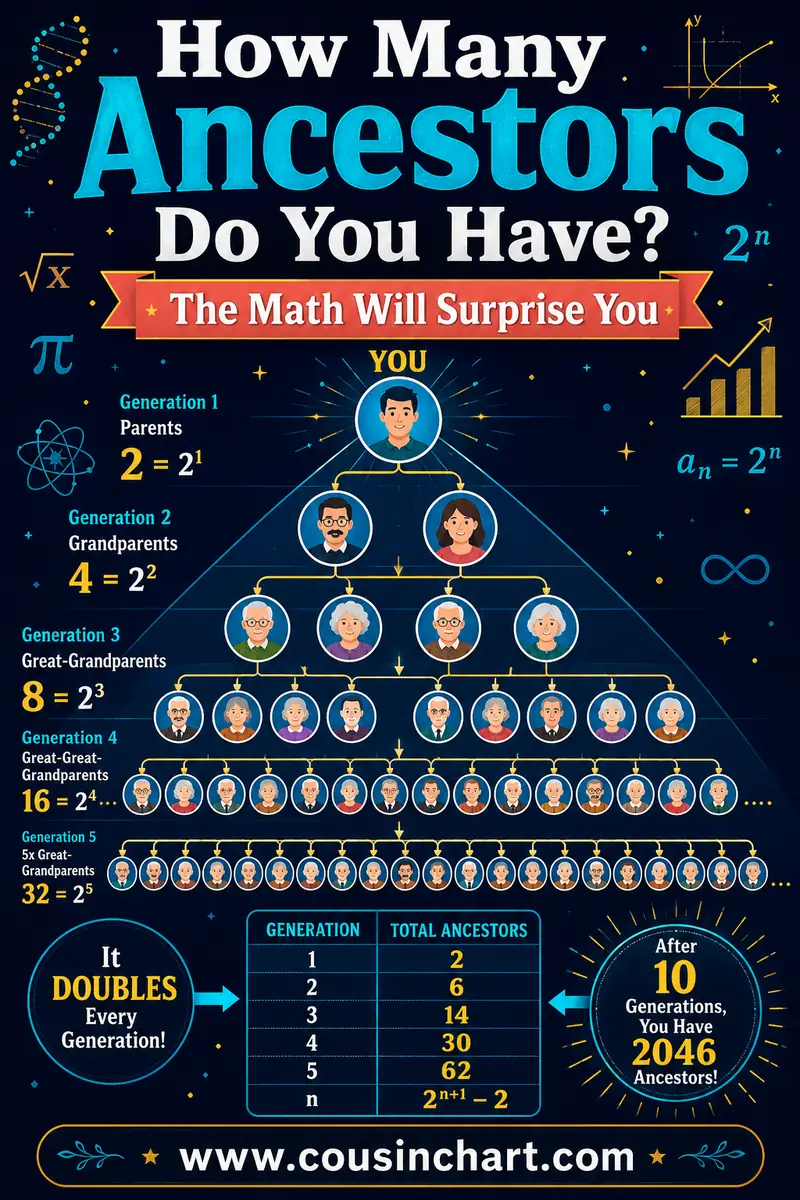
Your ancestor count doubles each generation — 2 parents, 4 grandparents, 8 great-grandparents, up to 512 ancestors at the 7×great-grandparent level. Every one of those couples has been producing descendants for two centuries or more. (Our how many ancestors do you have guide walks the doubling math — it gets weird fast.)
Nobody can count their cousins exactly, but demographic estimates consistently land in ranges like:
- Fifth cousins: thousands to tens of thousands
- Sixth cousins: tens of thousands to low hundreds of thousands
- Eighth cousins: hundreds of thousands into the millions
Which produces a fun conclusion: you have almost certainly stood in line behind a fifth cousin, married into a sixth cousin's family, or followed an eighth cousin on social media without any of you knowing. In smaller or more rooted populations — islands, valleys, endogamous communities — distant-cousin overlap is even denser, and many couples are distant cousins several ways at once.
So Is Everyone Related? (Pretty Much)
Push the doubling far enough and your family tree demands more ancestors than the human population — the tree has to fold in on itself, with the same people appearing on multiple branches (genealogists call it pedigree collapse). The consequence: go back far enough and everyone shares common ancestors; the only question is the degree.
Researchers estimate that all people of European descent, for example, share ancestors within roughly the last thousand years, and all humans share common ancestors a few thousand years back. "We're all cousins" isn't a greeting-card sentiment — it's arithmetic. Distant cousinship is simply the visible, nameable edge of that bigger fact.
That's also why the terms stay useful: "eighth cousin" doesn't mean "barely family," it means this specific couple, nine generations up, connects us — a claim you can actually document.
Pedigree Collapse in Practice: Related Twice (or Five Times) Over
Pedigree collapse isn't just a far-past curiosity — it shows up in living match lists, and it explains some very confusing DNA numbers.
In any community where people married locally for generations — islands, mountain valleys, farming villages, or endogamous groups like Ashkenazi Jewish, Acadian/Cajun, Mennonite, and Polynesian populations — the same ancestor couples appear on multiple branches of everyone's tree. The result: two people who are "officially" sixth cousins through one line may also be seventh cousins two other ways and fifth cousins once removed a fourth way. Each connection contributes a little DNA, and the pieces add up.
That's why endogamy breaks the usual match-list logic:
- The shared cM overstates the closest relationship. A 60 cM match in an endogamous community might not be a third cousin at all — it might be a distant cousin connected six different ways.
- Everyone matches everyone. People with Ashkenazi ancestry routinely have tens of thousands of matches, most of them distant multiples rather than close kin.
- The fix is segments, not totals. Researchers look for single large segments (roughly 20 cM or more) as evidence of one recent connection, and discount lots of tiny scattered segments as background relatedness.
If your family tree loops back on itself — and go back far enough, everyone's does — don't panic when the labels disagree. Document each path to each shared couple separately. "Fifth cousins two ways and seventh cousins once" is a perfectly good genealogical answer, even if it doesn't fit on a name tag.
Famous Distant-Cousin Pairs
Distant cousinship sounds abstract until you see how often it turns up among well-documented families:
- Franklin D. Roosevelt and Theodore Roosevelt were fifth cousins — two branches of one Dutch-American family that had been in New York since the 1600s.
- Franklin and Eleanor Roosevelt were fifth cousins once removed. Eleanor didn't even change her name when she married; she was born a Roosevelt. Teddy was her uncle, and he gave her away at the wedding.
- Barack Obama and Dick Cheney made headlines in 2007 when researchers traced them to a shared 17th-century ancestor, making the political opposites roughly eighth cousins.
- Genealogists connect long lists of US presidents to each other and to European royalty at the fifth-to-tenth-cousin level — not because presidents are special, but because their trees are unusually well documented.
That last point is the real lesson. Famous families don't have more distant cousins than you do; they just have better paperwork. Trace any two people with deep colonial-American, or centuries-in-one-parish European, ancestry and you'll usually find a connection in ten generations or less. Your own eighth-cousin link to someone notable is probably sitting in the records, waiting for the two paper trails to meet.
How to Verify a Distant Cousin (Without Fooling Yourself)
Claiming a fifth cousin is easy; proving one takes discipline, because a single wrong link anywhere in eleven or more connecting steps breaks the whole chain. The working method:
- Anchor the shared couple. Identify the specific 4×great-grandparents (or deeper) both lines claim, with dates and places — "a John Miller in Pennsylvania" is not an anchor, it's a trap.
- Verify every generation with a record. Walk each line down from the couple, child by child, confirming each parent-child link with a birth, baptism, census, will, or probate record. Online trees are leads, not evidence — a mistake copied across a thousand trees is still a mistake.
- Beware same-name cousins. Distant lines recycle names relentlessly; every generation of a large family may contain three cousins named for the same grandfather. Dates and places, not names, tell them apart.
- Count and label. Generations from the couple to you, generations to the cousin — smaller count minus one gives the degree, the difference gives the removal. The relationship calculator turns the two counts into the term instantly.
- Use DNA as a bonus, not a requirement. A shared segment supports the paper trail; a missing one, at this distance, proves nothing either way.
Do it right and you get something genuinely solid: a documented, nameable relationship across two or three centuries — which beats "I think we're related somehow" every time.
What Distant Cousins Are Good For
Since the DNA is negligible and nobody's inviting 40,000 people to Thanksgiving, why care? Genealogists have concrete answers:
- Records you don't have. A sixth cousin descends from your shared couple through a different line — and their line may have kept the letters, photos, family Bible, or homestead deed that names your ancestor.
- Brick-wall breakthroughs. When your line goes cold in 1840, a distant cousin's better-documented line through the same couple can leap the gap.
- Cluster research. Even weak DNA matches, grouped by shared distant ancestors, can triangulate which family a mystery match belongs to.
- The story itself. Meeting a fifth cousin who grew up an ocean away, then tracing both of you to one farmhouse, is the kind of payoff that keeps people in this hobby.
And when a distant cousin emails asking "so what exactly are we?", you can answer precisely: count each person's generations from the shared couple, take the smaller number minus one for the degree, the difference for the removal — or let the free cousin calculator assemble the term for you.
Which Records Reach Each Cousin Level
Every degree of distant cousin corresponds to a historical era — and each era has its own record sources. Knowing which is which tells you whether a connection is even provable before you start:
| Degree | Shared couple's era (roughly) | Records that can prove the line |
|---|---|---|
| Fifth cousins | 1790s–1850s | Censuses, county vital records, church books, wills |
| Sixth cousins | 1760s–1820s | Early censuses, parish registers, deeds, probate |
| Seventh cousins | 1730s–1790s | Parish registers, colonial land and court records |
| Eighth cousins | 1700s–1760s | Parish registers, colonial records, published lineages |
The pattern: past the sixth-cousin level, government paper thins out and church registers and land records carry the load. That makes some distant cousinships very provable (families rooted in one well-kept parish for centuries) and others practically impossible (lines that moved often or lived where records burned). If your shared couple sits in a strong record area, an eighth-cousin claim can be rock solid; if not, be honest that it's a well-supported guess.
Writing to a Distant Cousin You Found Online
Sooner or later you'll want to message one — a match, a tree owner, someone who posted your 4×great-grandmother's photo. A few things that make those messages land:
- Lead with the shared couple, not the relationship math. "I think we both descend from Silas and Nancy Whitfield of Casey County" gets replies; "you're my 5th cousin 2x removed!!" gets ignored.
- Offer before you ask. Mention what you have — dates, photos, a transcribed will — and people reciprocate.
- Keep the first message short and save the 40-page family history for message three.
- Expect indifference gracefully. Most people tested for ethnicity pie charts, not cousins; a silent match isn't a rude one.
The distant cousins who do write back tend to be the other family historians — exactly the people holding the pieces you're missing.
FAQ
What is a fifth cousin?
Someone who shares your 4×great-grandparents. Your parents are fourth cousins, and you're each six generations below the shared couple.
Do fifth cousins share DNA?
Usually not detectably. The average is about 0.05%, and most true fifth cousins share no measurable segments at all. A missing DNA match doesn't disprove a documented relationship.
How far back do eighth cousins go?
Eighth cousins share 7×great-grandparents — a couple born around the early 1700s in most families, nine generations above you.
Are distant cousins still "real" relatives?
Yes, in the documented sense: you descend from the same couple. Genetically the link is trace-level, and socially it's whatever you make of it — but the shared line is a fact you can trace in records. Plenty of lasting research partnerships (and a few great friendships) started with exactly this kind of paper-thin cousinship.
Can distant cousins marry?
Cousin-marriage laws concern first cousins (rules vary by US state and by country). No state restricts fifth or more distant cousins — statistically, many married couples already are distant cousins without knowing it.
Why does my "5th–8th cousin" match share more DNA than expected?
Usually one of two reasons: the relationship is actually closer than the label (a half-relation or a removal the algorithm can't see), or you're related through multiple lines — common in endogamous communities — and several small connections are adding up to one inflated total.
What is my fifth cousin's child to me?
Your fifth cousin once removed. Removals work the same at every distance: a one-generation gap adds "once removed" without changing the degree.
The Short Version
Fifth through eighth cousins share a couple four to seven "greats" up your tree. The DNA has mostly washed out, the numbers run into the thousands and beyond, and the real value is documentary — different branches holding different pieces of one shared story.
Whatever pair of relatives you're trying to label — close, distant, removed, or half — the free family relationship calculator turns the path into the proper term in seconds.