What Is a Fourth Cousin? (4th Cousin Chart)
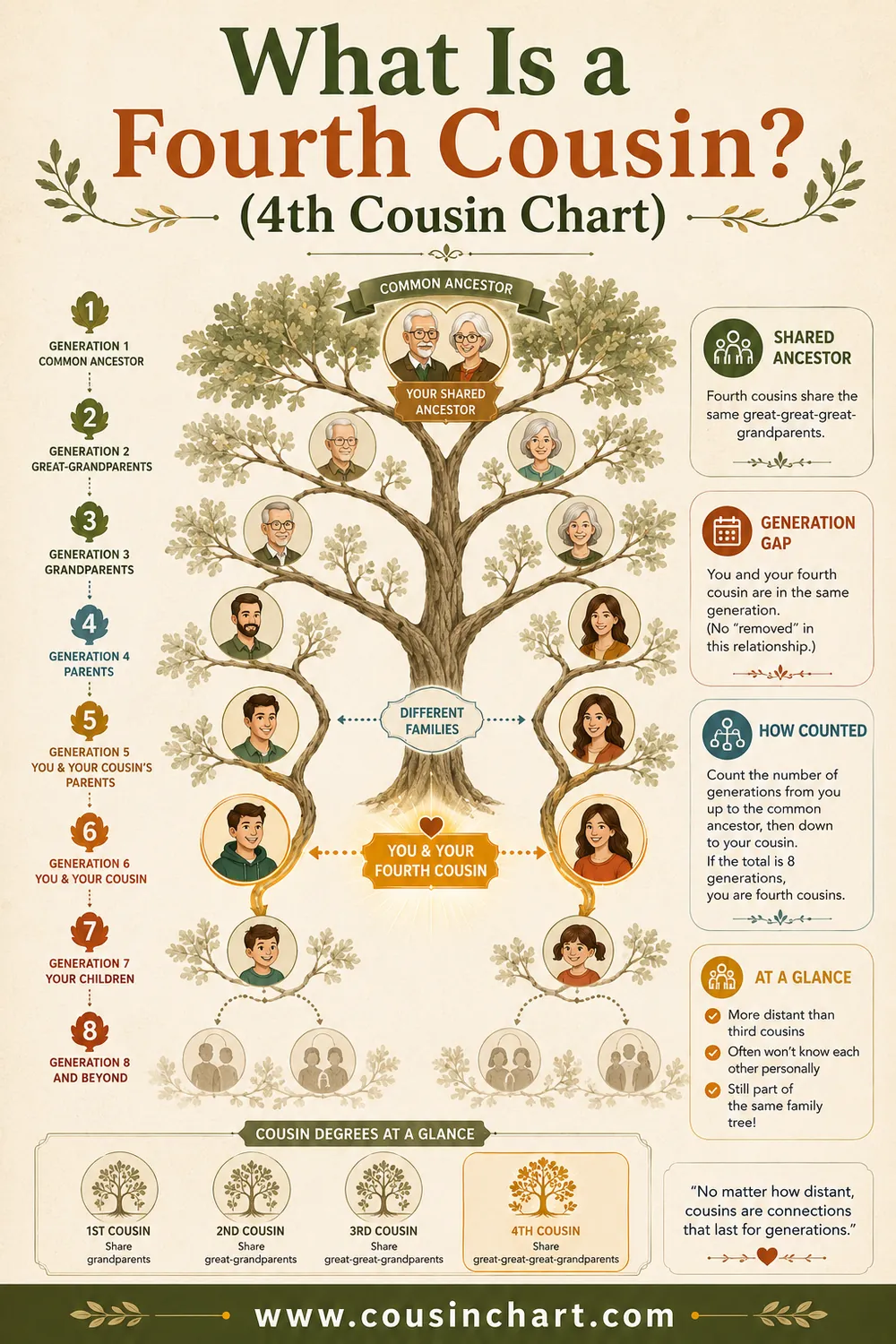
A fourth cousin is someone who shares your great-great-great-grandparents (3×great-grandparents) — which means your parents are third cousins. You're both five generations below the shared couple, on the same generation as each other.
Fourth cousins are where family trees get interesting: the relationship is genuinely real on paper, yet distant enough that you might share no detectable DNA at all. This guide lays out the 4th cousin chart, the odds your DNA test will spot one, and why testing sites claim you have thousands of them. To place any specific relative, the free relationship calculator on our homepage does the counting for you.
Relationship quick-check. Tap a phrase to see the correct term:
The answer will appear here.
The 4th Cousin Chart
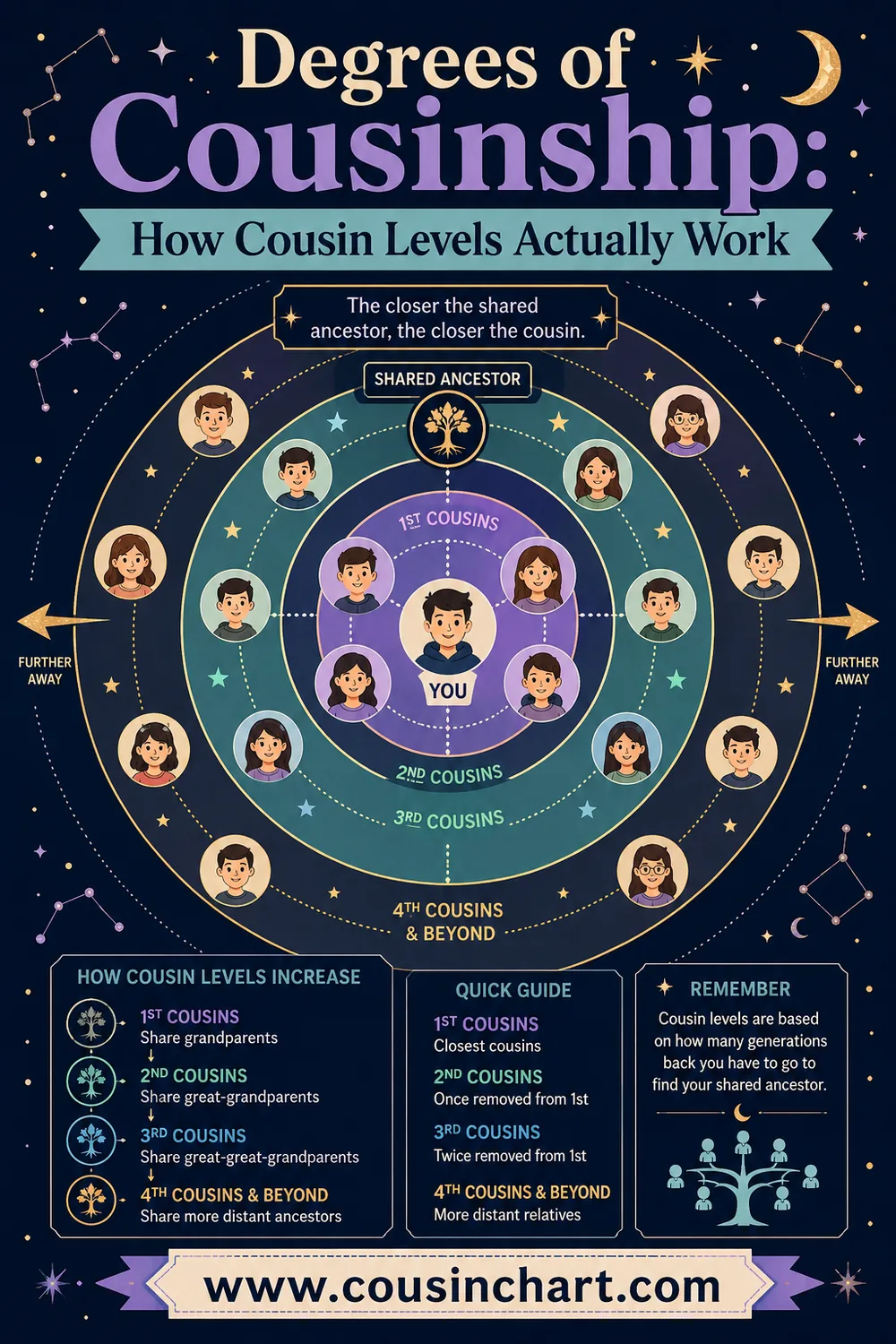
Cousin degrees are just a count of how far up the tree the shared couple sits. Here's the full ladder with fourth cousins in place:
| Relationship | Shared ancestors | Generations below them | Your parents are... |
|---|---|---|---|
| First cousins | Grandparents | 2 | Siblings |
| Second cousins | Great-grandparents | 3 | First cousins |
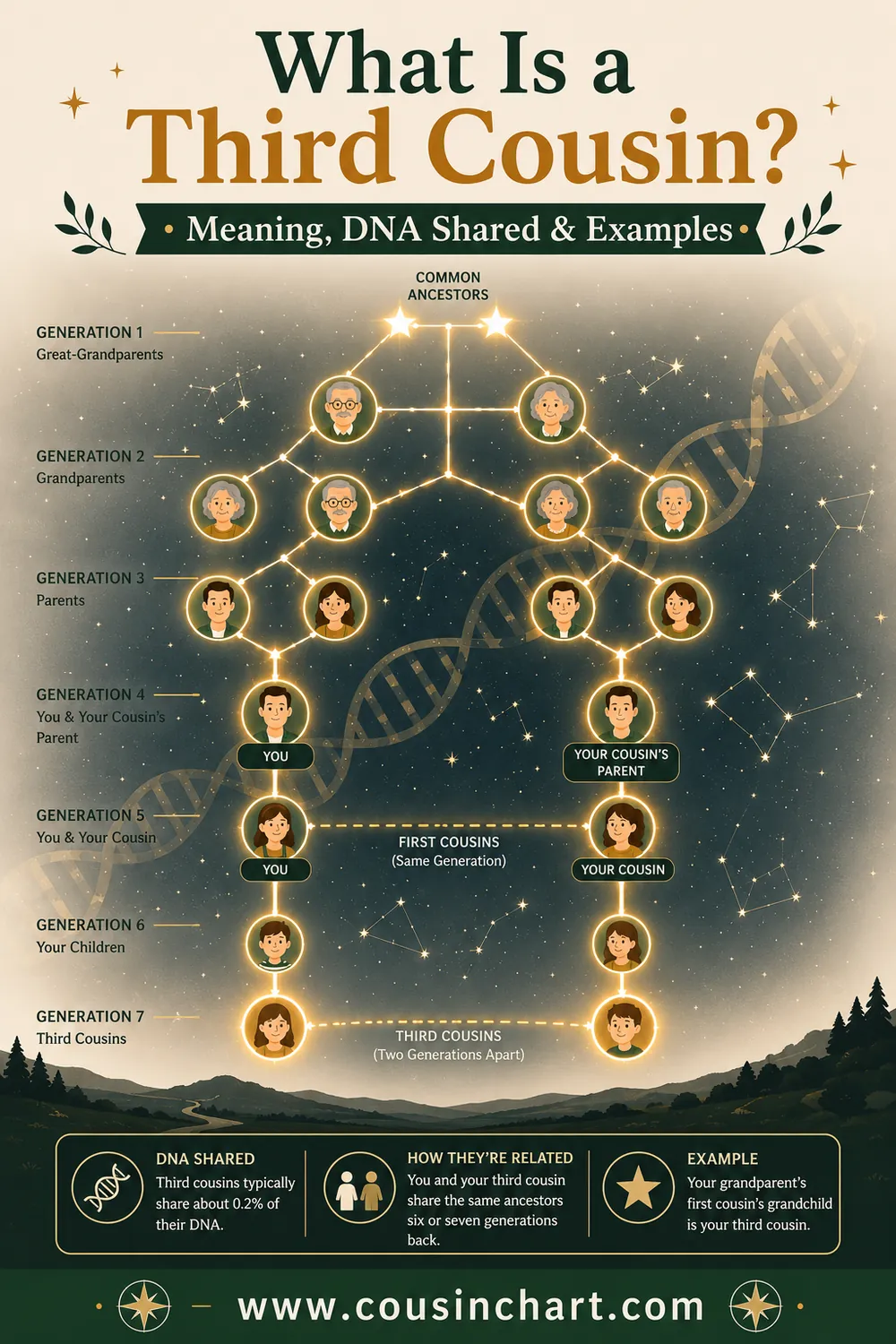
| Third cousins | Great-great-grandparents | 4 | Second cousins |
| Fourth cousins | 3×great-grandparents | 5 | Third cousins |
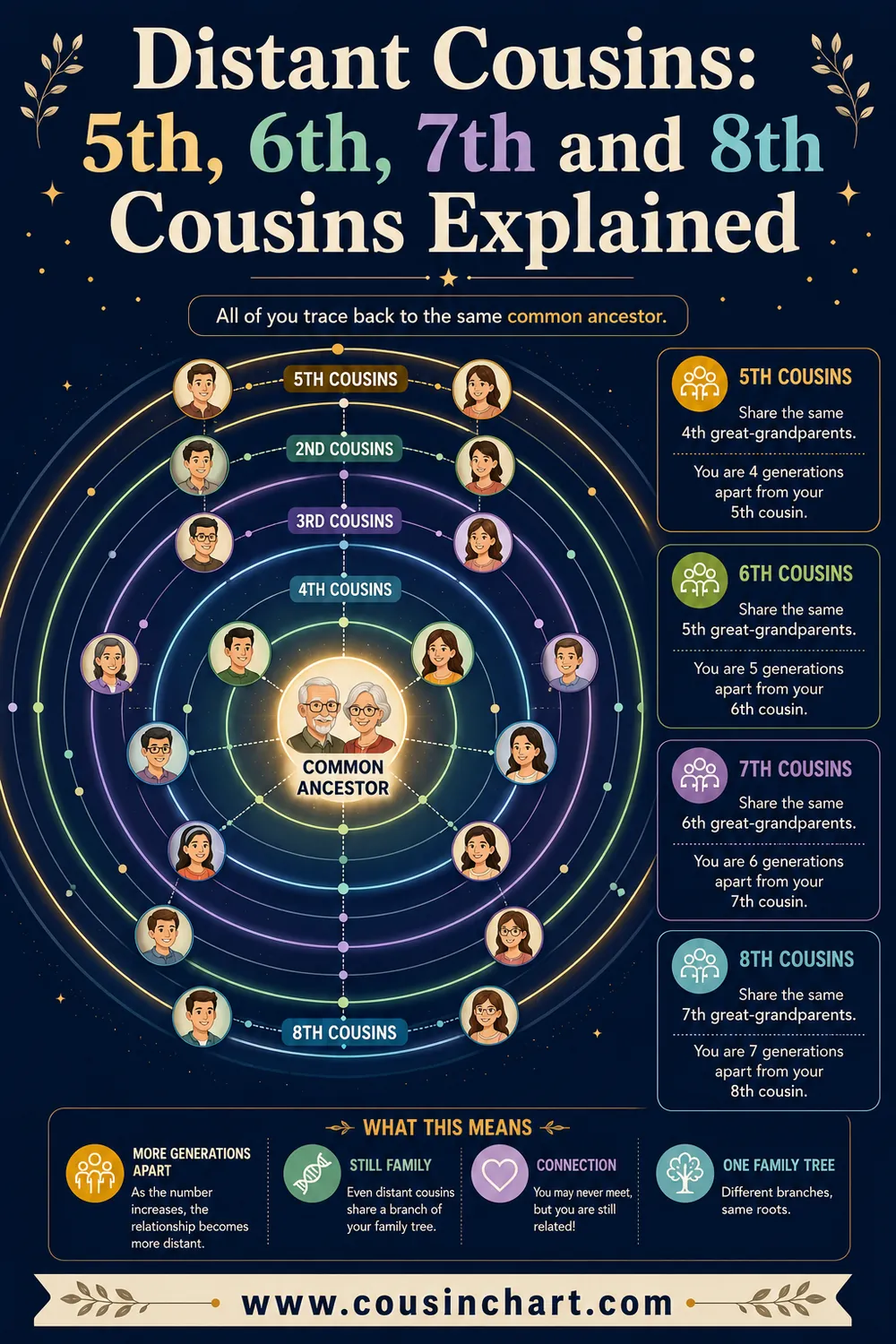
| Fifth cousins | 4×great-grandparents | 6 | Fourth cousins |
The pattern: an nth cousin shares your (n − 1)×great-grandparents, and your parents are (n − 1)th cousins. Every degree is one more "great" in the shared couple. That's the entire degrees of cousinship system in one table.
How Far Back Is That, Really?
Your 3×great-grandparents were likely born somewhere between the 1820s and 1880s, depending on your family's generation lengths. That means you and a fourth cousin are connected by:
- A couple who may have lived through the Civil War era or emigrated in the great migration waves.
- Around 160–200 years of separate family history since the branches split.
- Five generations of surname changes, moves, and lost contact on each side.
This is why almost nobody knows their fourth cousins by name. First and second cousins come from living memory; third cousins from grandma's stories; fourth cousins come from records and DNA tests. When one turns up, it usually means a paper trail or a match list brought you together — which is half the fun of genealogy.
Fourth Cousins and DNA: The Coin-Flip Zone
Here's the fact that surprises everyone: you might share zero DNA with a real fourth cousin.
On average, fourth cousins share about 0.2% of their DNA — roughly 35 centimorgans. But that's an average across people who share anything at all. Because DNA halves and shuffles every generation, a meaningful fraction of true fourth cousins — commonly estimated at somewhere around a third to a half — inherit no overlapping segments whatsoever.
| Relationship | Average shared DNA | Chance of detectable match |
|---|---|---|
| Second cousin | ~3.1% (~230 cM) | ~100% |
| Third cousin | ~0.8% (~73 cM) | ~90%+ |
| Fourth cousin | ~0.2% (~35 cM) | Roughly a coin flip to solid odds |
| Fifth cousin | ~0.05% | Low — most share nothing |
Two practical consequences:
- A "no match" doesn't disprove the relationship. Your documented fourth cousin can be genuinely related and still absent from your match list.
- **A small match doesn't prove which relationship.** A 35 cM match could be a fourth cousin, a fifth cousin with lucky inheritance, or a closer half-relation. The paper trail decides.
Why DNA Sites Say You Have Thousands of Them
Open any testing dashboard and you'll see hundreds or thousands of matches labeled "4th cousin or closer." Both halves of that phrase deserve a squint.
The quantity is real: each generation back doubles your ancestor couples, and each of those couples has descendants fanning out for five generations. Even modest family sizes put the typical person's true fourth-cousin count in the hundreds to several thousand. Prolific families push it far higher.
The label is looser. "4th cousin" on a match list means "the shared DNA amount is consistent with a fourth cousin" — the actual relationship could be anywhere from third cousin twice removed to sixth cousin. Testing companies estimate from centimorgans; they can't see the tree. To turn a match into a named relationship, you find the shared ancestor couple and count the generations — exactly what the free cousin calculator does once you know the path.
Are Fourth Cousins Actually Family?
Legally and genetically, the connection is thin — thin enough that no US state restricts fourth cousins from marrying (marriage laws focus on first cousins; rules vary by state, so check current law if it matters to you). Statistically, most people have unknowingly met, worked with, or dated a distant cousin; at the fourth-cousin level, the relationship is closer to "shared heritage" than "shared household."
But genealogically, fourth cousins are gold:
- They hold different pieces of the same puzzle. A fourth cousin descends from the same 3×great-grandparents through a different child — their family may have kept the Bible, the photos, or the ship manifest yours lost.
- They confirm your tree. A documented fourth cousin who also shares DNA with you is strong evidence that five generations of your paper trail are correct.
- They cluster your matches. Grouping DNA matches around one shared fourth-cousin ancestor couple is a standard research technique.
How to Confirm a Fourth Cousin, Step by Step
- Find the candidate ancestor couple. Compare family trees (or match-list trees) and look for a surname and place both lines share, five generations up.
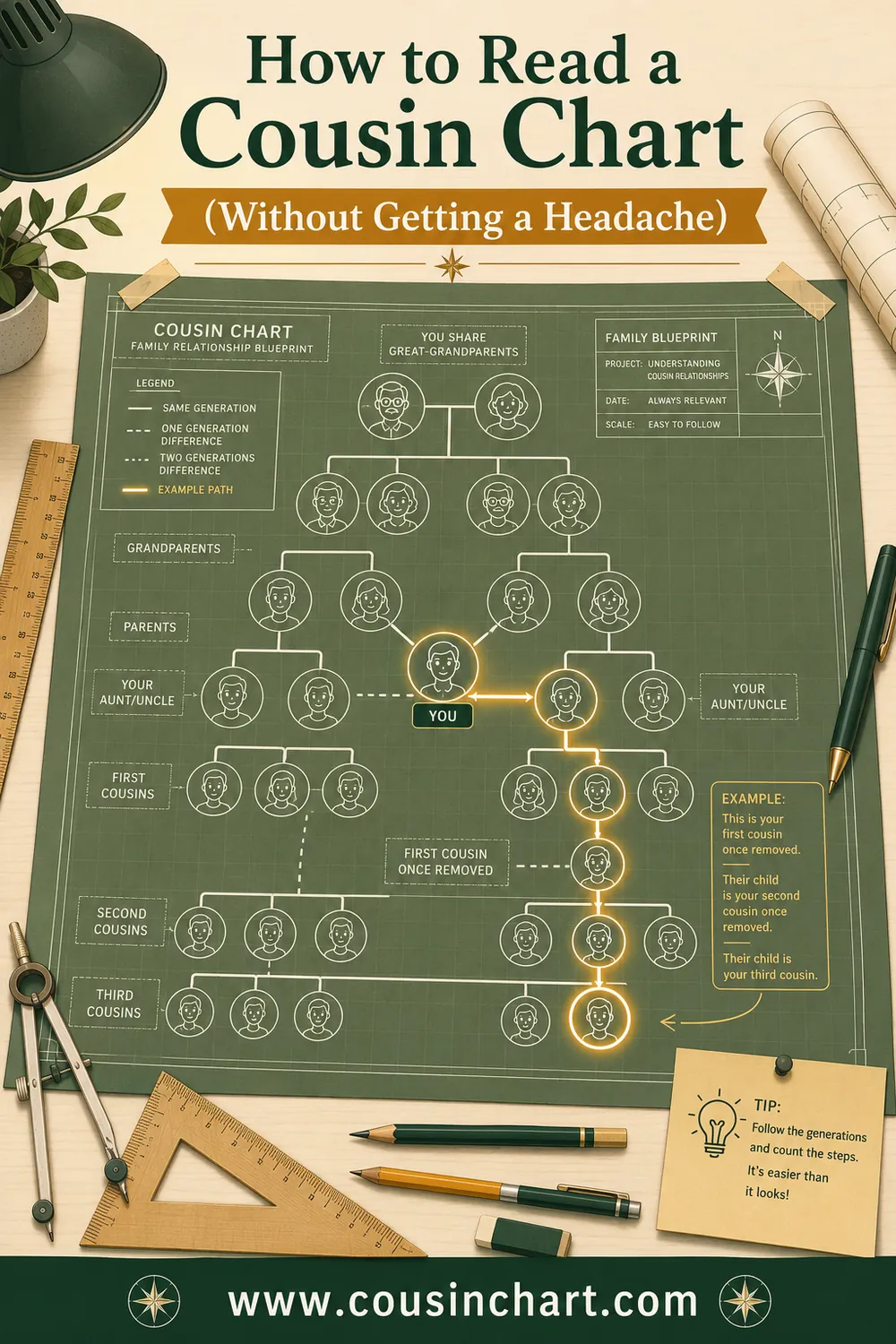
- Count generations from the couple to each of you. Five and five means fourth cousins. Five and four means third cousins once removed — see distant cousins explained for the wider ladder.
- Check the removal. Any difference in generation counts becomes "once/twice removed."
- Sanity-check the term. Enter the path into the relationship calculator and confirm the label and the expected DNA range fit what you're seeing.
A Worked Example: From 38 cM to a Named Cousin
Here's how those steps play out in practice. Maya notices a 38 cM match named Dale on her list — labeled, unhelpfully, "4th cousin or closer." Neither recognizes the other's surname. But comparing trees, both spot the surname Whitfield in the same Kentucky county, five generations up.
Maya descends from Silas and Nancy Whitfield through their son Eli — five generations, mother to daughter to son and on down. Dale descends from Silas and Nancy's daughter Rose, also five generations down. Same couple, five steps each: fourth cousins, confirmed. As a bonus, three of Maya's other small matches also descend from Silas and Nancy — an instant research cluster, and three more cousins who might hold photos of the Whitfield farm.
Notice what settled it: not the centimorgans, which could have meant half a dozen relationships, but the two counted paths back to one couple. DNA opened the door; the tree named the cousin.
Fourth Cousins With Removals
The removal system works at this depth too — it just gets harder to see in the DNA:
| Who they are | Relationship | Average shared DNA |
|---|---|---|
| Your fourth cousin | Fourth cousin | ~35 cM |
| Your parent's fourth cousin, or your fourth cousin's child | Fourth cousin once removed | ~20 cM |
| Your grandparent's fourth cousin, or your fourth cousin's grandchild | Fourth cousin twice removed | ~10 cM |
By twice removed, the average sits near the minimum segment size many testing companies will even report — so most fourth cousins twice removed are invisible to DNA entirely. The paper trail doesn't have that problem: a documented line to the shared couple proves the relationship whether or not a single segment survived the shuffle.
FAQ
What is a fourth cousin in simple terms?
Someone who shares your great-great-great-grandparents. Your parents are third cousins, and you both sit five generations below the shared couple.
How much DNA do fourth cousins share?
About 0.2% on average — roughly 35 cM — but a sizable share of true fourth cousins share no detectable DNA at all. Absence of a match doesn't disprove the relationship.
Is a 4th cousin a blood relative?
Yes, on paper — you descend from the same couple. In practice the genetic connection is tiny, and sometimes literally zero, thanks to how DNA shuffles each generation.
How many fourth cousins does the average person have?
Estimates vary widely with family size, but hundreds to a few thousand is typical. That's why "4th cousin or closer" match lists are so long.
Can fourth cousins marry?
No US state restricts fourth-cousin marriage — legal limits focus on first cousins and vary by state. Genetically, fourth cousins are barely more related than strangers. Check the current law where you live if it's a real question.
Is my third cousin's child my fourth cousin?
No — that's your third cousin once removed. Fourth cousins require both branches to step down: your child and your third cousin's child are the fourth cousins.
The Short Version
Fourth cousin = shared 3×great-grandparents = parents who are third cousins. Real relationship, tiny DNA footprint, and probably several hundred of them out there sharing your ancestor couple's story.
Found one on a match list, or arguing about one at a reunion? Run the path through the free family relationship calculator and get the exact term — degree, removal, and all — in about ten seconds.