What Is My Cousin's Grandchild to Me?
Your first cousin's grandchild is your first cousin twice removed. The relationship stays "first cousin" because that part never changes once it's set — what changes is the removal, which counts generation gaps. Your cousin's child is once removed, their grandchild is twice removed, their great-grandchild is three times removed. It's a system that sounds fiddly and is actually just two numbers: the cousin degree, which comes from your shared ancestor, and the removal, which counts how many generations apart you are. This page explains both, works through the variations, and covers what to actually call these people. To check any relationship instantly, use the what do I call them tool.
Why Is It "First Cousin Twice Removed"?
Two separate ideas, and keeping them separate is what makes the system click.
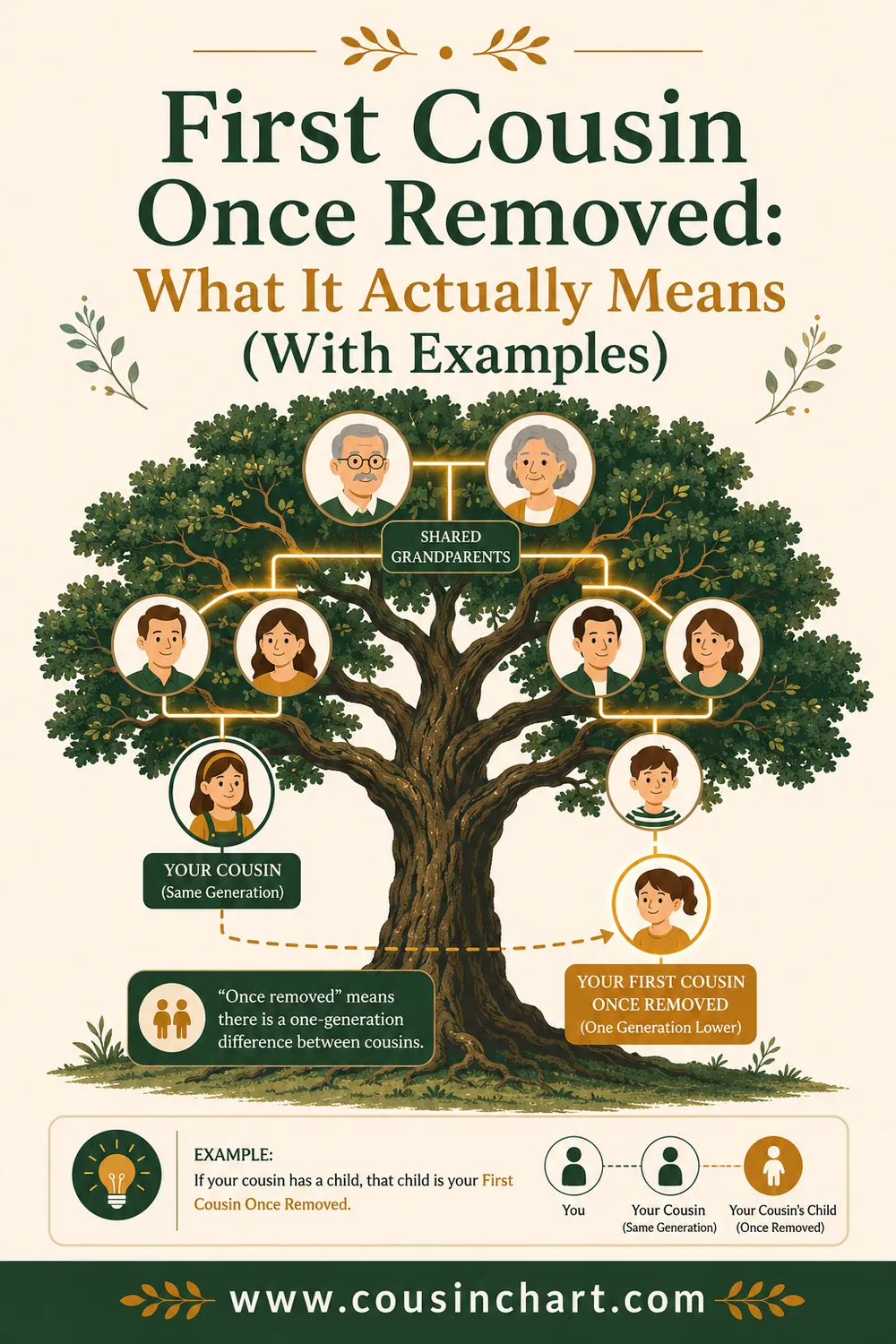
The cousin degree comes from your shared ancestor. First cousins share grandparents. Second cousins share great-grandparents. Third cousins share great-great-grandparents. That number is fixed by which ancestor you have in common, and it never changes as you move down the generations.
The removal counts generation gaps. "Removed" means you and the other person are a different number of generations from the shared ancestor. One generation apart is once removed, two is twice removed, and so on.
So for your cousin's grandchild:
- You share grandparents with your cousin — that makes it first cousin
- Their grandchild is two generations below your cousin, and therefore two generations below you — that makes it twice removed
- Result: first cousin twice removed
The mistake people make is assuming the degree increases as you go down — that a cousin's child becomes a "second cousin". It doesn't. A second cousin is someone in your own generation who shares great-grandparents with you. Different relationship entirely, and it's covered in the comparison at first cousin once removed.
How Does the Pattern Continue?
Once you see it, it's mechanical.
| Their relationship to your cousin | Their relationship to you |
|---|---|
| Your first cousin | First cousin |
| Their child | First cousin once removed |
| Their grandchild | First cousin twice removed |
| Their great-grandchild | First cousin three times removed |
| Their great-great-grandchild | First cousin four times removed |
And it works upward too. Your parent's first cousin is also your first cousin once removed — the removal doesn't tell you which direction, only how many generations. Your grandparent's first cousin is your first cousin twice removed, exactly like your cousin's grandchild.
That symmetry surprises people. Two very different-feeling relationships get the same name, because the system only records the shared ancestor and the generation gap, not who's older. Detail on the upward version is in first cousin twice removed.
The same math applies to any degree:
| Starting relationship | Their grandchild is your |
|---|---|
| First cousin | First cousin twice removed |
| Second cousin | Second cousin twice removed |
| Third cousin | Third cousin twice removed |
| Fourth cousin | Fourth cousin twice removed |
One removal per generation, degree unchanged. That's the whole rule.
What Are the Related Relationships?
The questions that usually follow.
Your child and your first cousin's child are second cousins to each other. They're in the same generation, and they share great-grandparents — your grandparents. This is the relationship people mistakenly assign to the cousin's child themselves.
Your grandchild and your cousin's grandchild are third cousins. Each generation down adds one to the cousin degree, provided both people move down together.
Your cousin's child's child is the same person as your cousin's grandchild — worth stating, because phrasing it the long way makes people think it's a different relationship.
Your first cousin once removed's child is your first cousin twice removed, if the removal was downward. If it was upward — your parent's cousin — then their child is your second cousin.
That last one is the genuinely confusing case, and it's why the direction matters even though the name doesn't record it. Your parent's first cousin is your first cousin once removed; that person's child is in your generation and shares great-grandparents with you, making them your second cousin.
In shorthand: moving down from a cousin adds removals. Moving across a generation — comparing people who are both descendants at the same level — increases the degree. The what do I call them tool does this reliably, which is faster than reasoning it out each time.
What About Aunts, Uncles and the Other Terms?
Cousins get the removal system; the rest of the family uses "great" and "grand" instead, and mixing them up is common.
Your parent's sibling is your aunt or uncle. Your grandparent's sibling is your great-aunt or great-uncle — sometimes called a grand-aunt or grand-uncle, which is arguably the more logical form and much less used. Your great-grandparent's sibling is your great-great-aunt, and so on, adding a "great" per generation. The full explanation is in what is a great uncle.
Your sibling's child is your niece or nephew. Their child is your great-niece or great-nephew.
Why two systems? Because direct-line relatives and their siblings are described by their distance from you in generations, while cousins are described by a shared ancestor plus a gap. English ended up with both, which is why the vocabulary feels inconsistent.
A useful cross-check: your great-uncle's grandchild is your first cousin once removed — your grandparent and their grandparent were siblings, making their child your parent's first cousin, and that person's child your... first cousin once removed. Working these out from the shared ancestor is always more reliable than reasoning from the labels.
And for the sideways cases: a half aunt is your parent's half sibling, a step-aunt is your uncle's wife where there's no blood relationship, and a great-aunt by marriage is your great-uncle's spouse. All are family; none is a blood relative in the genealogical sense, which matters for DNA and not for anything else.
What Should You Actually Call Them?
Precision matters in records and DNA work. It matters much less at a family gathering.
In everyday use, "cousin" is entirely normal and what most families say. Nobody introduces someone as their first cousin twice removed at a wedding.
Where the precise term matters:
- Genealogy records and trees, where an ambiguous label makes a tree unusable
- DNA match interpretation, where the exact relationship determines the expected shared centimorgans
- Legal contexts — inheritance, succession, some marriage laws
- Medical family history, where degree of relatedness affects risk assessment
Cultural variation is significant. Many languages have specific words for relationships English handles with compound phrases, and in a good number of cultures the whole extended family is addressed with a single kinship term regardless of the precise degree. The English system's precision is a genealogical convention rather than a universal one.
Some families use their own conventions — "cousin" for anyone related, or "auntie" and "uncle" for close family friends with no blood relationship at all. Both are perfectly reasonable and neither is wrong.
A practical suggestion: use the precise term when writing it down and the loose one when speaking. Your tree needs "first cousin twice removed"; your conversation needs "my cousin Sarah's granddaughter".
How Much DNA Would You Share?
The practical genealogical reason to get the label right.
| Relationship | Average shared cM | Typical range |
|---|---|---|
| First cousin | 866 | 396–1,397 |
| First cousin once removed | 433 | 102–980 |
| First cousin twice removed | 221 | 43–531 |
| First cousin three times removed | 123 | 14–353 |
| Second cousin | 229 | 41–592 |
| Second cousin twice removed | 71 | 0–244 |
Each removal roughly halves the expected amount, in the same way each extra cousin degree does.
Notice the overlap. A first cousin twice removed averages 221 cM and a second cousin averages 229 — statistically indistinguishable. If a DNA match shares about 220 cM with you, the number alone cannot tell you which of those two relationships it is. Ages, shared matches and documented trees are what separate them.
Which is why the terminology matters in DNA work specifically: labeling a match wrongly leads to placing them in the wrong generation of your tree, and everything built on top of that placement inherits the error.
And further along the same line, the pattern continues predictably — three times removed averages around 123 cM, four times removed lower still, as set out in first cousin three times removed.
Further out, the amounts fall low enough that relatives frequently share nothing detectable at all — which is normal rather than evidence of anything, and applies well before you reach the distances covered in what is a fifth cousin.
How Do You Work Out Any Relationship Yourself?
A method that handles every case without memorising anything.
Step 1: Find the most recent common ancestor. The nearest person, or couple, that you both descend from. This is the only thing you actually need to establish.
Step 2: Count your generations back to them. You to your parent is 1, to your grandparent 2, to your great-grandparent 3, and so on.
Step 3: Count their generations back to the same ancestor.
Step 4: Take the smaller number and subtract one. That gives the cousin degree. Smaller number 2 means first cousins, 3 means second cousins, 4 means third, and so on.
Step 5: The difference between the two numbers is the removal. Same number means no removal; a difference of one is once removed; two is twice removed.
Worked example. Your cousin's grandchild: you are 2 generations from your shared grandparents. They are 4 generations from those same people — parent, grandparent (your cousin), great-grandparent, great-great-grandparent. Smaller number is 2, minus one gives first cousin. Difference is 4 minus 2 equals twice removed.
A second example. Your grandmother's first cousin. Your grandmother is 2 generations from their shared great-grandparents; you are therefore 4. Their cousin is 2 generations from the same ancestors. Smaller number 2 minus one gives first cousin; difference of 2 gives twice removed. First cousin twice removed — the same label as the previous example, from the opposite direction.
Two warnings. If the two people descend from only one shared ancestor rather than a couple, it's a half relationship. And if they descend from the shared ancestors by more than one route — which happens when cousins married — the relationship is genuinely double and the simple method understates it.
Frequently Asked Questions
What is my cousin's grandchild to me?
Your first cousin's grandchild is your first cousin twice removed. The cousin degree stays "first" because it's set by your shared grandparents, and the "twice removed" counts the two generations between you.
Is my cousin's child my second cousin?
No. Your first cousin's child is your first cousin once removed. Your own child and your cousin's child are second cousins to each other, which is where the confusion usually comes from.
What does "twice removed" actually mean?
That you and the other person are two generations apart from each other relative to your shared ancestor. It doesn't indicate direction — your cousin's grandchild and your grandparent's cousin are both your first cousin twice removed.
What is my second cousin's grandchild called?
Your second cousin twice removed. The same removal rule applies at every degree: one removal per generation of difference, with the cousin degree itself staying the same.
How much DNA do you share with a first cousin twice removed?
Around 221 cM on average, with a typical range of roughly 43 to 531. That overlaps almost exactly with second cousins at 229 cM, so shared DNA alone can't distinguish the two relationships.
Do I need to use these terms in everyday conversation?
Not at all. Most families simply say "cousin", and that's perfectly normal. The precise terms matter for genealogy records, DNA interpretation, legal questions and medical family history — not for introductions.
Two numbers, and the rest follows: the cousin degree comes from your shared ancestor and never changes, while the removal counts the generation gap. Your cousin's grandchild is a first cousin twice removed, their great-grandchild three times removed, and so on for as long as the line continues. Check any relationship in seconds with the what do I call them tool.