What Is a Great Uncle?
A great uncle is your grandparent's brother — and, in ordinary use, also your grandparent's sister's husband. The same relationship is sometimes called a grand uncle, which is arguably the more logical term and much less commonly used, and both are correct. Going further back, your great-grandparent's brother is your great-great-uncle, adding one "great" per generation. This page explains the terminology, why two versions exist, how the half and step variants work, and how much DNA you'd expect to share. To check any relationship in seconds, use the what do I call them tool.
Great Uncle or Grand Uncle?
Both are correct, and the argument for each is worth knowing.
"Grand uncle" is the more consistent form. Your parent's parent is your grandparent, so your grandparent's brother being your granduncle follows the same logic. Genealogists and formal reference works often prefer it for exactly this reason.
"Great uncle" is what almost everyone actually says. It's the dominant form in everyday English, in most dictionaries, and in the majority of published family histories. The usage evolved by analogy with great-grandparent rather than by strict logic.
Neither is wrong. Use whichever you prefer, and be consistent within a single document. If you're recording relationships formally, "grand uncle" removes a small ambiguity; if you're writing for family, "great uncle" is what people will understand without pausing.
Going further back, the forms diverge slightly:
| Relationship | Common form | Formal alternative |
|---|---|---|
| Grandparent's brother | Great uncle | Grand uncle |
| Great-grandparent's brother | Great-great-uncle | Great-grand uncle |
| Great-great-grandparent's brother | Great-great-great-uncle | Great-great-grand uncle |
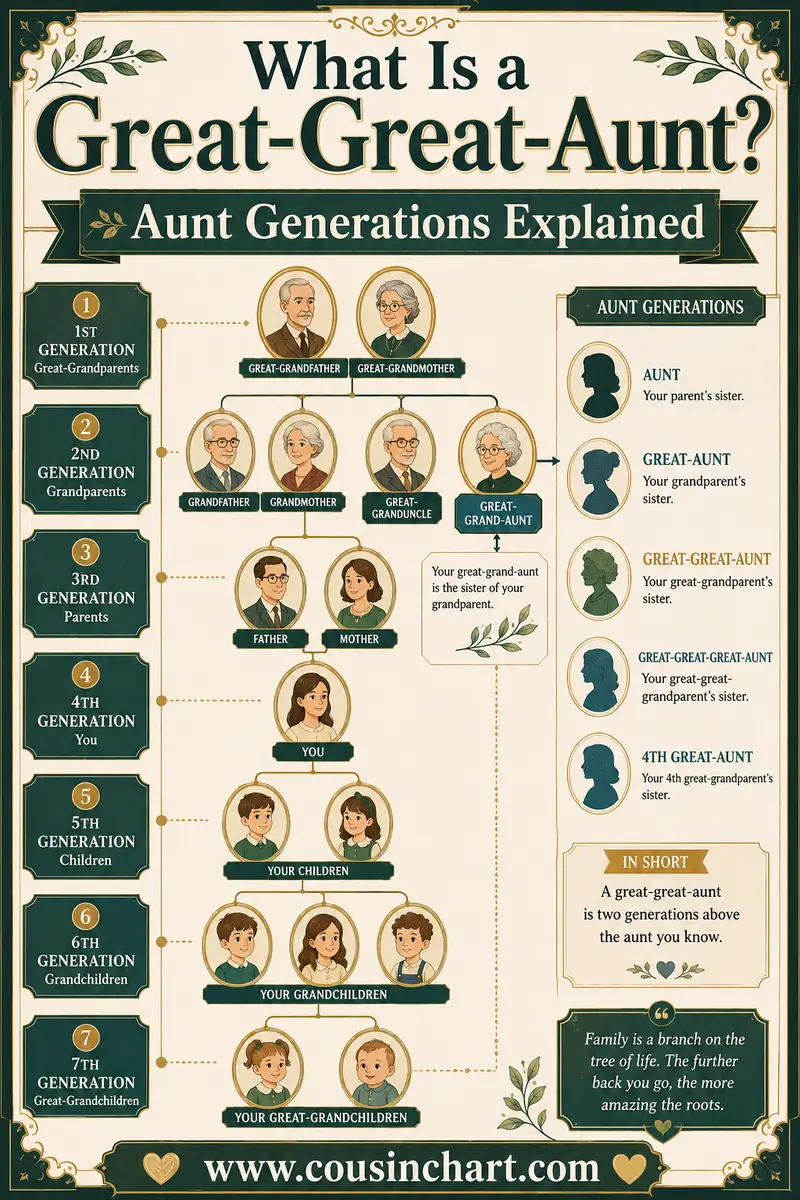
The everyday form just stacks "greats", which is simpler to say and count. The formal version inserts "grand" once and then adds greats, which is more precise and harder to read aloud. The same pattern applies to aunts — see what is a great-great-aunt.
Who Exactly Counts as a Great Uncle?
Three categories, and only one of them is a blood relative.
By blood: your grandparent's brother. Either grandparent, either side. He shares your great-grandparents, which makes him a genuine genetic relative.
By marriage: your great-aunt's husband. Universally called a great uncle in ordinary family use, and shares no DNA with you at all. He may have been the more present figure in your life; that's a separate question from what a genealogical chart records.
Half blood: your grandparent's half brother. Shares one great-grandparent with you rather than two, so roughly half the expected DNA. Called a half great uncle in genealogical writing, and simply a great uncle by most families.
Also worth knowing: your parent's uncle is the same person as your great uncle. People sometimes think these are different relationships because the phrasing differs, but "my father's uncle" and "my great uncle" describe one man.
Step relationships — a step-great-uncle would be a step-grandparent's brother, which is far enough out that virtually nobody uses the term. "Family" covers it.
The distinction that matters practically: blood relatives appear in DNA results, and relatives by marriage don't. For everything except genetic genealogy, the distinction rarely matters at all.
How Much DNA Would You Share?
Only relevant for the blood versions, and useful for identifying a DNA match.
| Relationship | Average shared cM | Typical range |
|---|---|---|
| Uncle or aunt | 1,740 | 1,201–2,282 |
| Great uncle or great aunt | 850 | 251–2,108 |
| Half great uncle | 425 | 125–765 |
| Great-great-uncle | 425 | 90–1,000 |
| Great uncle by marriage | 0 | 0 |
The great-uncle range is unusually wide — 251 to 2,108 cM — because the relationship spans a large generational gap where recombination has more room to vary.
The overlap problem is significant here. A great uncle averages 850 cM and a first cousin averages 866. Those are statistically indistinguishable, so a DNA match sharing around 850 cM could be either. What separates them is age: a great uncle is typically two generations older than you, a first cousin roughly your own age.
That's the general principle with DNA relationship identification — the number narrows the possibilities, and ages, shared matches and documented trees settle which one it is.
Half versions share about half. A half great uncle averages around 425 cM, which overlaps with a first cousin once removed at 433 — another pair that shared DNA alone can't separate.
A practical note: great uncles and aunts are among the most valuable people to DNA test, because they're a generation closer to your great-grandparents than you are and carry DNA you didn't inherit. If one is still living and willing, that test is worth more to your research than almost any other.
What Are Their Children to You?
The question that follows immediately, and the answer surprises people.
Your great uncle's child is your first cousin once removed. Not a second cousin, and not a cousin of any other degree.
Why: your great uncle's child and your parent are first cousins — they share grandparents. Since that person is one generation above you, they're your first cousin once removed.
And their grandchild is your second cousin once removed, following the same rules set out in what is my cousin's grandchild to me.
| Person | Relationship to you |
|---|---|
| Great uncle | Great uncle |
| His child | First cousin once removed |
| His grandchild | Second cousin |
| His great-grandchild | Second cousin once removed |
| His great-great-grandchild | Third cousin |
Notice the pattern. His grandchild is in your generation and shares great-grandparents with you — the definition of a second cousin. That's the row people most often get wrong, and it's the same confusion covered in first cousin once removed.
A useful check: whenever you're unsure, find the shared ancestor and count generations from both sides. The labels follow mechanically from that, and reasoning from labels alone is where errors creep in.
Where Do Great Uncles Fit in Your Research?
More usefully than their position on a chart suggests, and they're routinely under-used.
They knew your great-grandparents as people. A great uncle grew up in the household you're researching. He can tell you what his parents were actually like, where the family lived, what the work was, why they moved — the material that never appears in a record. If one is still living, an interview is the highest-value thing you can do.
They hold different papers. Family documents get divided between siblings, so photographs, certificates and letters your own line doesn't have frequently sit with a great uncle's branch. So do the objects — medals, bibles, tools.
They remember the people nobody else does. Siblings who died young, a first marriage, a relative who emigrated and lost contact. Details that vanished from your direct line often survive in a sibling's.
Their descendants are your closest useful cousins. A great uncle's grandchildren are your second cousins, which is close enough that DNA matching is essentially guaranteed and their trees overlap substantially with yours.
Their records fill your gaps. If your great-grandfather's birth record is missing, his brother's may exist and name the same parents. Whole-family research works precisely because siblings appear in different record sets — one enlisted, one emigrated, one stayed and appears in every census.
And they're a generation closer for DNA. A great uncle carries DNA from your great-grandparents that you didn't inherit. Testing one effectively extends your reach back a generation, which no amount of analysis on your own kit can do.
Does the Terminology Vary Between Cultures?
Considerably, and it's worth knowing if your research crosses languages.
English is unusually vague about extended family. One word — "uncle" — covers a mother's brother, a father's brother, and both aunts' husbands, four relationships many languages distinguish clearly.
Many languages are more specific. Chinese, Korean, Hindi, Arabic and others have distinct terms for maternal and paternal relatives, for older and younger siblings of a parent, and for relationships by blood versus marriage. A translated family history can lose information English simply has no words for.
Some cultures are broader, using kinship terms for the whole extended family or for close family friends. Being called "uncle" by someone with no blood relationship at all is entirely normal in a great many places, and this appears constantly in oral family history.
Which matters for research, because a relative described as an "uncle" in a letter, an obituary or an interview may be anything from a blood uncle to a family friend. Historical records are equally loose — "cousin" in older documents frequently meant any relative, and "nephew" occasionally meant grandson.
The practical rule for genealogy: record the documented relationship, note the term the source used, and don't assume the two match. Terms used in a family are worth recording as they were said; the tree needs the precise version alongside — and further out, the terminology gives way to numbered cousins entirely, as in first cousin three times removed and what is a fifth cousin.
How Do the Aunt and Uncle Terms Compare Overall?
Setting them side by side makes the whole vocabulary easier to hold.
| Relationship to you | Term | Blood? | Avg cM |
|---|---|---|---|
| Parent's brother | Uncle | Yes | 1,740 |
| Parent's sister's husband | Uncle by marriage | No | 0 |
| Parent's half brother | Half uncle | Yes | 871 |
| Grandparent's brother | Great uncle | Yes | 850 |
| Great-aunt's husband | Great uncle by marriage | No | 0 |
| Grandparent's half brother | Half great uncle | Yes | 425 |
| Great-grandparent's brother | Great-great-uncle | Yes | 425 |
| Sibling's son | Nephew | Yes | 1,740 |
| Sibling's grandson | Great-nephew | Yes | 850 |
Two things worth noticing. First, the relationships are symmetrical — you are your uncle's nephew or niece, and the shared DNA is identical in both directions. Second, a half uncle and a great uncle share almost the same amount of DNA, around 850 to 870 cM, despite being quite different relationships. Ages separate them.
Nieces and nephews mirror aunts and uncles exactly. Your sibling's grandchild is your great-nephew or great-niece, at the same 850 cM average as a great uncle. The vocabulary reverses and the genetics doesn't.
And in-laws sit outside the system entirely. Your uncle's wife, your great-aunt's husband, your nephew's spouse — all family, none genetic, and none appearing in a DNA match list.
Frequently Asked Questions
What is a great uncle?
Your grandparent's brother. In everyday use it also covers your great-aunt's husband, who is family by marriage rather than by blood and shares no DNA with you.
Is it great uncle or grand uncle?
Both are correct. "Grand uncle" is more logically consistent, since your parent's parent is your grandparent. "Great uncle" is far more common in everyday English and in most dictionaries. Use either, but be consistent.
Is my parent's uncle my great uncle?
Yes — they're the same person. Your parent's uncle is your grandparent's brother, which makes him your great uncle. The two phrasings describe one relationship from different starting points.
What is my great uncle's child to me?
Your first cousin once removed. Their child and your parent are first cousins, and because they're one generation above you, the "once removed" applies. Their grandchild is your second cousin.
How much DNA do you share with a great uncle?
Around 850 cM on average, with a wide range of roughly 251 to 2,108. That overlaps almost exactly with first cousins at 866 cM, so age is usually what distinguishes the two in a DNA match list.
What is a great-great-uncle?
Your great-grandparent's brother. Each additional generation adds another "great" — so your great-great-grandparent's brother is your great-great-great-uncle. The formal alternative inserts "grand": great-grand uncle.
One closing suggestion, if you have great uncles or great aunts still living: record them. They are the last generation with direct memory of your great-grandparents, they hold papers and photographs your own line doesn't, and their DNA reaches a generation further back than yours ever will. Of all the relatives on a family tree, they're the ones where the window closes soonest.
A great uncle is your grandparent's brother, one "great" per generation further back, and "grand uncle" is the same relationship by a more logical name that fewer people use. Whether he's a blood relative or family by marriage only matters for DNA — for everything else, he's your great uncle either way. Check any relationship quickly with the what do I call them tool.