What Is a Great-Great-Aunt? Aunt Generations Explained
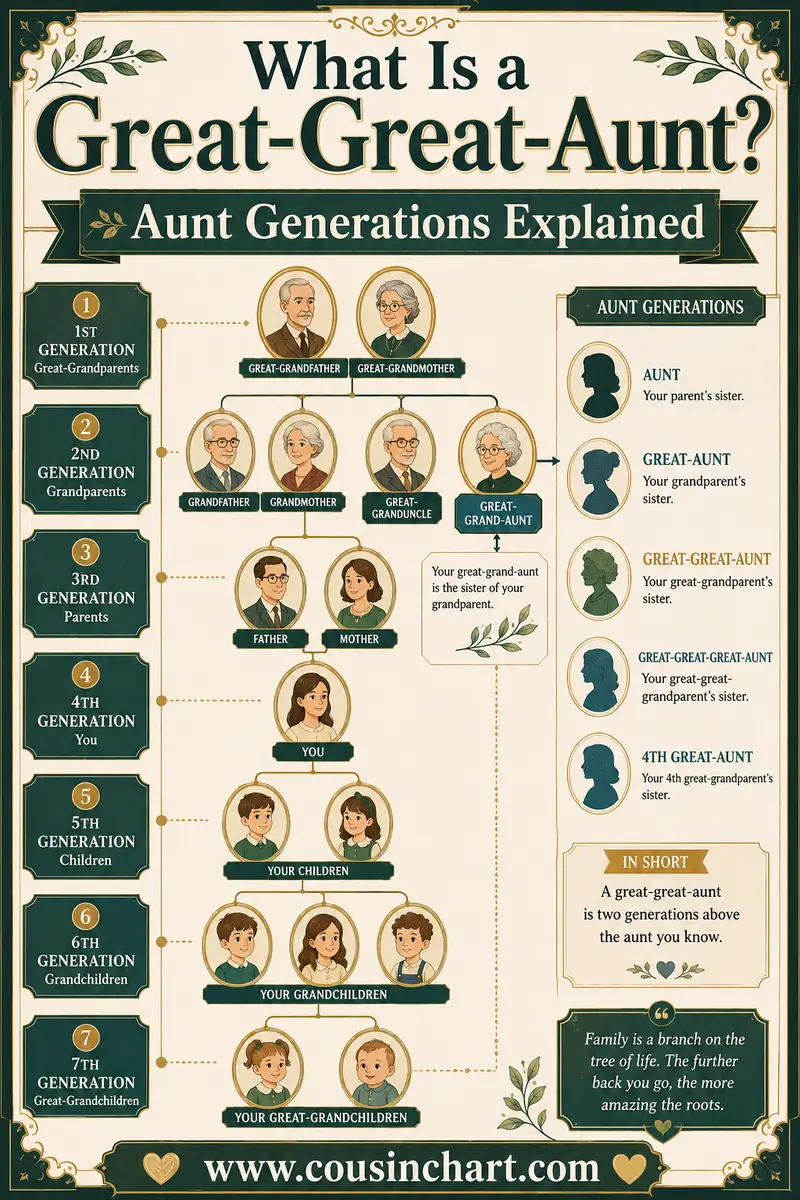
A great-great-aunt is your great-grandparent's sister — the aunt who sits four generations up your tree, one rung above your great-aunt. You share about 6.25% of your DNA with her, and you are her great-great-niece or -nephew. Genealogists often write the same relationship as "great-grandaunt," which is arguably tidier, but both names point at the identical person.
Aunts stack in a perfectly regular ladder — one "great" per generation — and once you see the ladder, you can name an aunt at any height without counting on your fingers. This guide climbs it rung by rung, covers what a great-great-aunt's descendants are to you, and untangles the great/grand naming feud. For any single relative, the free family relationship calculator on our homepage gives you the term instantly.
Relationship quick-check. Tap a phrase to see the correct term:
The answer will appear here.
The Aunt Ladder, Rung by Rung
Every aunt title is built the same way: find the ancestor, take their sister. The ladder:
| Whose sister she is | Her title (common) | Genealogist's version | Avg shared DNA |
|---|---|---|---|
| Your parent's | Aunt | Aunt | ~25% |
| Your grandparent's | Great-aunt | Grand-aunt | ~12.5% |
| Your great-grandparent's | Great-great-aunt | Great-grandaunt | ~6.25% |
| Your 2×great-grandparent's | Great-great-great-aunt | 2×great-grandaunt | ~3.125% |
| Your 3×great-grandparent's | 4×great-aunt | 3×great-grandaunt | ~1.5% |
Two things make the ladder easy to trust. First, the aunt's title always matches her sibling's generation: great-grandparent → great-great-aunt sits beside them, one branch over. Second, DNA halves at every rung, exactly as it does on your direct ancestral line — an aunt at any height shares about half of what the matching grandparent-level ancestor would.
Uncles work identically, and the mutual terms mirror down: she's your great-great-aunt, you're her great-great-niece or -nephew.
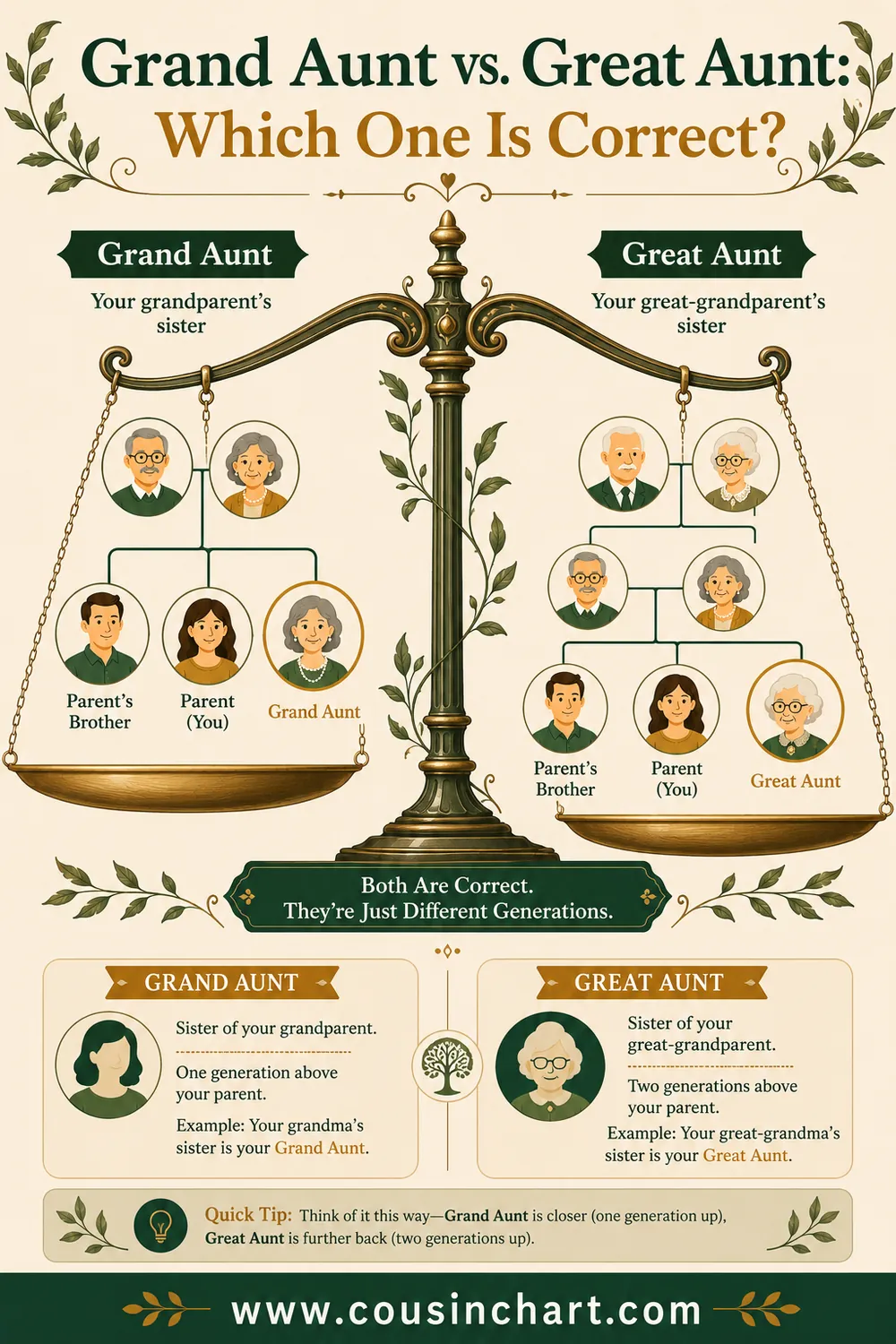
Great-Great-Aunt or Great-Grandaunt? (Both. Here's the Story.)
You'll meet two naming systems, and they disagree by exactly one word:
- Everyday English stacks "greats": great-aunt, great-great-aunt, great-great-great-aunt.
- Genealogy convention mirrors the ancestor titles: your grandparent's sister is your grand-aunt, your great-grandparent's sister is your great-grandaunt — so the prefixes always match the sibling ancestor exactly (grandmother/grandaunt, great-grandmother/great-grandaunt).
The genealogists have logic on their side: in their system, counting "greats" on an aunt tells you precisely which generation she belongs to, with no off-by-one confusion. Everyday usage won the popularity contest anyway. Both are correct; just be consistent inside one family tree, and expect software like Ancestry or FamilySearch to prefer the grandaunt style. (The same debate one rung down — grand-aunt vs great-aunt — has its own full article.)
Her Descendants: Where the Cousin Lines Begin
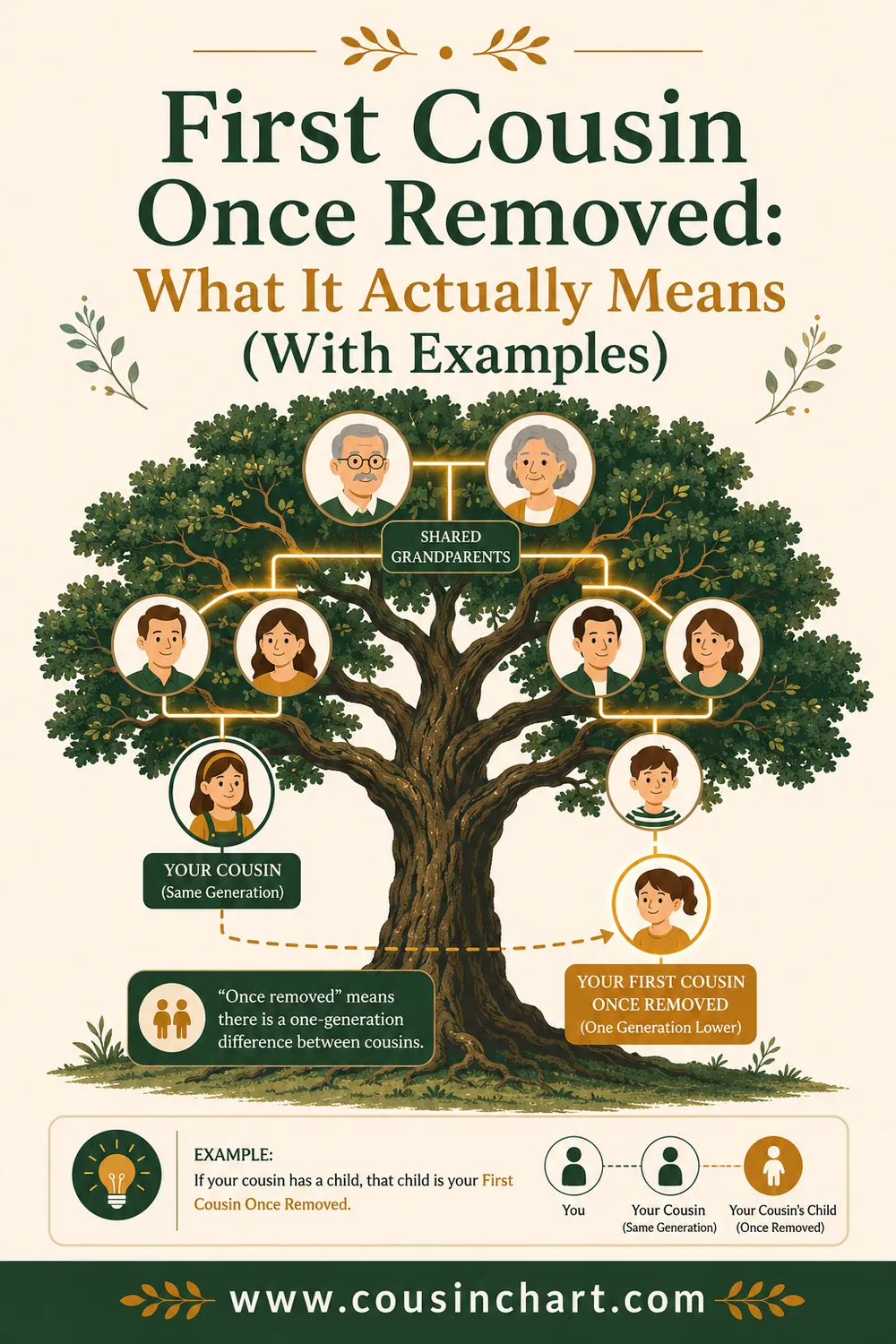
A great-great-aunt is more than a portrait on the wall — she's the head of a cousin branch, and her descendants convert into cousins of yours at completely regular intervals:
| Her descendant | Relationship to you | Why |
|---|---|---|
| Her child | First cousin twice removed | Your grandparent's first cousin |
| Her grandchild | Second cousin once removed | Your parent's second cousin |
| Her great-grandchild | Third cousin | Your generation — shared great-great-grandparents |
| Her great-great-grandchild | Third cousin once removed | One below you |
The pattern to internalize: her line "catches up" to yours one label per generation, and the meeting point — the first pair standing in the same generation as you — are your third cousins. That's because the ancestors you share (her parents) are your great-great-grandparents, and same-generation descendants of great-great-grandparents are, by definition, third cousins. It's the rung a lot of DNA matches labeled "3rd cousin" actually come from.
This is also why great-great-aunts matter enormously in genealogy research: identify one, and you've unlocked an entire testable cousin branch of your tree.
The DNA Picture (and Its Look-Alikes)
At ~6.25% average (roughly 200–850 cM), a great-great-aunt sits in a crowded band. Relationships with the same expected share include:
- First cousin once removed (~6.25%)
- Half first cousin (~6.25%)
- Half-great-aunt/uncle (~6.25%)
- Great-great-grandparent (~6.25%)
A DNA site can't separate these by percentage — it will file them under one label and let you sort it out. The tiebreakers are the usual pair: generation logic (a great-great-aunt is typically two-plus generations older than you, though big families blur this) and shared matches (which side of your tree the match clusters with). In practice, an unexplained ~700 cM match who's elderly is worth checking against your great-grandparents' sibling lists — and the relationship calculator will confirm what each candidate path would be called.
One caveat genealogy veterans know well: age is a hint, never a rule. In long families, a great-great-aunt can be younger than her great-great-niece — titles come from tree position, not birthdays.
Aunts by Marriage, Halves, and Steps at This Height
The modifier system works at altitude exactly as it does at ground level:
- Great-great-aunt by marriage — your great-great-uncle's wife. Same title socially, zero shared DNA; on the tree she's recorded through the marriage.
- Half-great-great-aunt — your great-grandparent's half-sister (~3.125%). The halving stacks with the ladder's own halving, exactly as you'd expect.
- Step-relationships rarely get named this far up ("step-great-great-aunt" is technically constructible and practically never said) — by this height, families just say "Aunt Ruth" and move on.
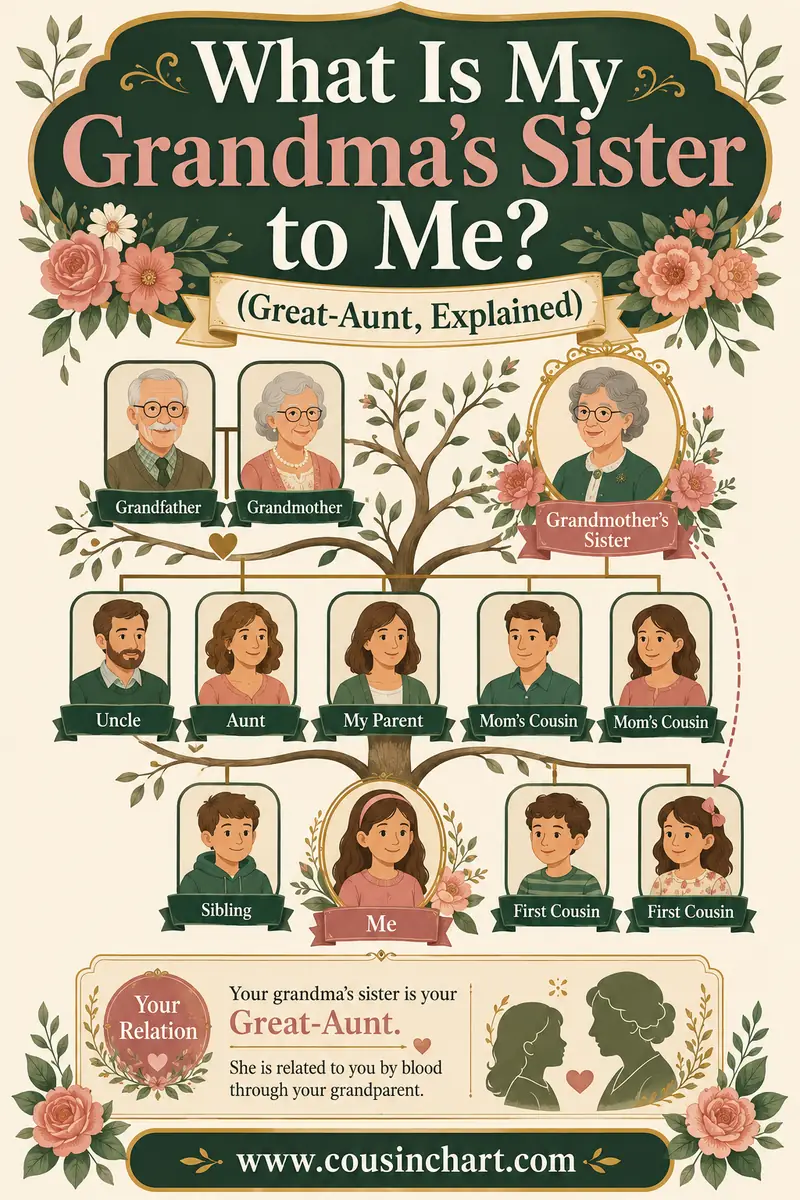
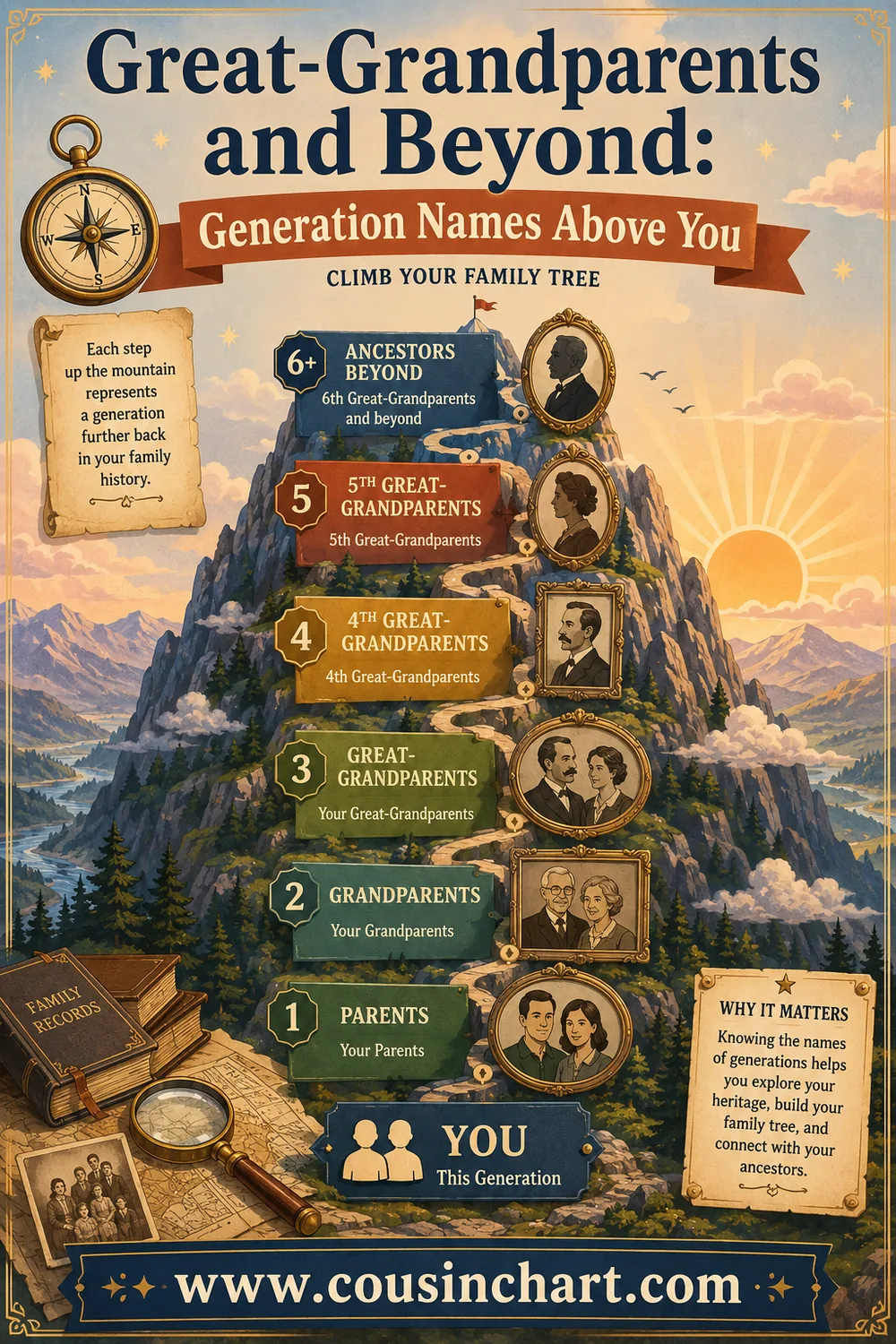
If you're recording a tree: enter the sibling relationship and the marriages accurately, and let the software generate labels. Four generations up, memory and guesswork start inventing relatives — records and math don't. Our great-grandparents chart covers the ancestor side of this same altitude, and what is my grandma's sister to me handles the rung below in plain language.
A Worked Example: One Ladder, Climbed with Names
Rules stick better with people attached, so here's the whole article in one family.
Your great-grandmother, Adele, born 1912, had a sister, Vera, born 1915. Vera is your great-great-aunt (great-grandaunt on Ancestry). You share Vera's parents — your great-great-grandparents — and about 6.25% of your DNA with her.
Now run her branch down alongside yours:
- Vera's daughter June (b. 1940) is your grandparent's first cousin → your first cousin twice removed.
- June's son Paul (b. 1965) is your parent's second cousin → your second cousin once removed.
- Paul's daughter Kayla (b. 1995) is your generation → your third cousin, sharing great-great-grandparents with you at ~0.8% average DNA.
Notice what happened to the numbers: you share ~6.25% with Vera at the top of the branch, but only ~0.8% with Kayla at the bottom, even though Kayla is the one your own age. Each generation her line descended, the shared DNA halved — which is why elderly relatives at Vera's rung are genealogical gold. Testing a living great-great-aunt (or her children) captures big, unambiguous chunks of the ancestral DNA that has faded to a whisper by your generation. Serious DNA genealogists chase exactly these tests, politely and with cake.
And the mutual view: to Vera, you're a great-great-niece or -nephew; to June, a first cousin twice removed; to Kayla, just "my third cousin who does the family tree." Every pair of people on this chart gets one precise term each way — the calculator will echo any of them back if you feed it the path.
Finding Great-Great-Aunts in the Records
Most people can name their great-grandparents with a little effort — but the sisters of great-grandparents are where family memory usually goes blank. The records fill the gap:
- Start with the census, in the sibling's childhood. Find your great-grandmother at age 8 in her parents' household, and every sister listed beside her is a great-great-aunt candidate. One census page can hand you four of them at once.
- Chase the maiden name problem immediately. A great-great-aunt born Adele Kowalski may die as Adele Marsh, and every record after her marriage hides the connection. Marriage indexes and church registers are the bridge — find her wedding, and her married surname unlocks the rest of her life.
- Read your great-grandparents' obituaries. Old obituaries routinely list surviving siblings by married name and town ("she is survived by sisters Mrs. Vera Holt of Dayton..."). That single line often does the maiden-name bridging for you.
- Check witnesses and godparents. Sisters show up as bridesmaids, baptism sponsors, and informants on death certificates for each other's families. A recurring unexplained name in your direct line's paperwork is very often a great-great-aunt in disguise.
- Then work each sister's line downward. Every great-great-aunt you document adds a testable third-cousin branch to your tree — the exact branches that later explain mystery DNA matches in the 50–200 cM range.
A quick expectation-setter on timing: for most people researching today, great-great-aunts were born roughly between the 1880s and the 1930s. That places their childhoods inside the best census coverage many countries ever produced, their marriages inside civil registration, and their deaths recent enough for findable obituaries — a genuinely lucky documentary window. The same search for a 3×great-aunt, one rung higher, is often twice the work for half the records.
Why bother with someone four generations up and one branch over? Because sideways is how genealogy actually advances. Direct ancestors leave a limited paper trail; their siblings multiply it. A great-great-aunt's obituary can name the home village your great-grandmother's records never mention; her passenger manifest can list the family's origin when your own line's is illegible. In records as in DNA, the sisters carry copies of the same story.
FAQ
What exactly is a great-great-aunt?
Your great-grandparent's sister (equivalently: your grandparent's aunt, or your great-aunt's sister-position one generation up). Genealogy software often labels her your great-grandaunt — same person.
How much DNA do I share with a great-great-aunt?
About 6.25% on average, roughly 200–850 cM. That's the same expected share as a first cousin once removed or a great-great-grandparent, so the label needs tree logic, not just the percentage.
What am I to my great-great-aunt?
Her great-great-niece or great-great-nephew. Blood relationships are mutual, so the titles mirror across the generations.
What are my great-great-aunt's children to me?
Your first cousins twice removed — they're your grandparent's first cousins. Her grandchildren are your second cousins once removed, and her great-grandchildren are your third cousins.
Is "great-grandaunt" more correct than "great-great-aunt"?
Genealogists prefer grandaunt-style titles because the prefixes then match the ancestor generation exactly. Everyday English prefers stacking greats. Both are correct — pick one style per family tree and stay consistent.
Can a great-great-aunt be younger than me?
Yes. If each generation on her side came late (or early on yours), the tree positions can invert the ages entirely. Titles follow the tree, never the birth certificate.
Is it worth asking a great-great-aunt to take a DNA test?
Very much so, if she's willing. She carries roughly twice the ancestral DNA from that line that your grandparent's generation does, and four times what reaches you — her test can confirm or break through brick walls that your own results can only hint at. Her children are the next-best testers if she isn't available.
What's the difference between a great-great-aunt and a great-grand-aunt?
Nothing — they're two naming styles for the same person, your great-grandparent's sister. Everyday English stacks "greats"; genealogy software mirrors the ancestor title (great-grandmother → great-grandaunt). Pick one style per tree and stay consistent.
Name Any Rung of the Ladder Instantly
So: great-great-aunt = great-grandparent's sister, ~6.25% shared DNA, "great-grandaunt" to the software, and the gateway to your third-cousin branches. The aunt ladder is regular all the way up — but four generations of "greats," halves, and marriages is exactly where hand-counting starts to slip. The free family relationship calculator climbs any ladder for you and returns the precise term, every time.