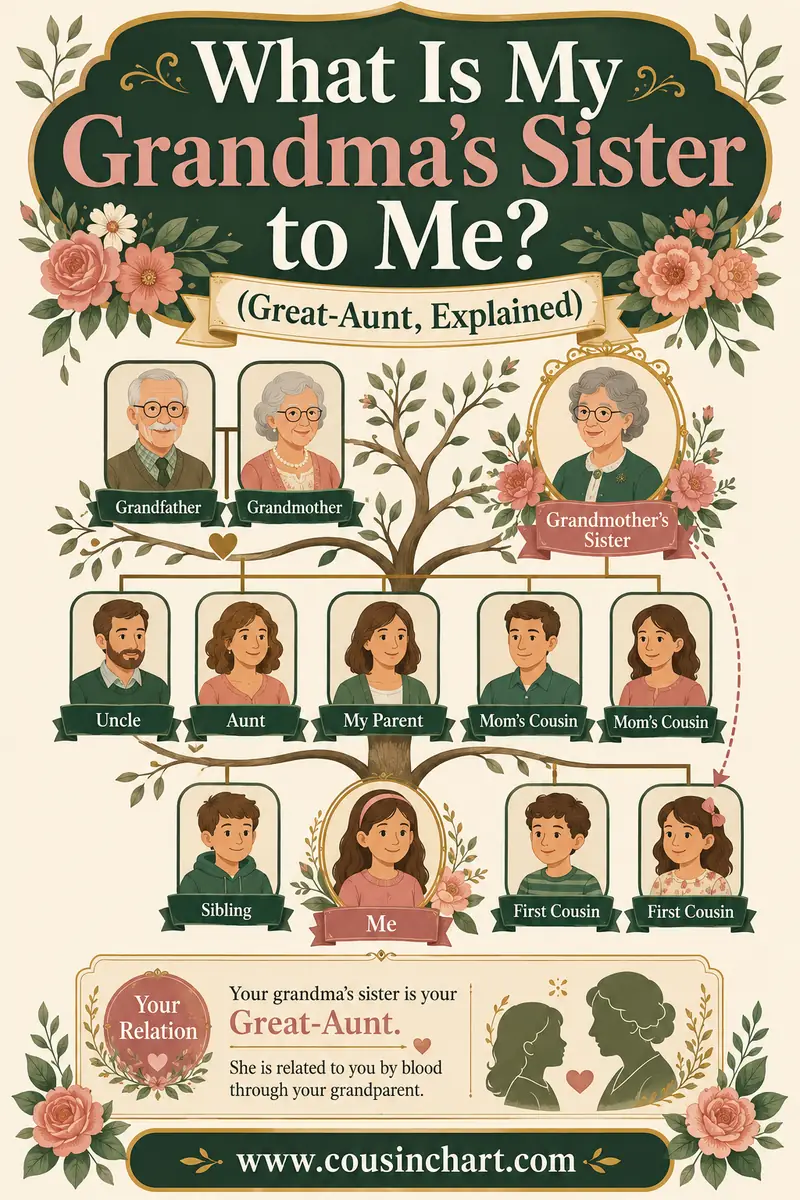
What Is My Grandma's Sister to Me? (Great-Aunt, Explained)
Your grandmother's sister is your great-aunt — also correctly called your grand-aunt. She's the sister of one of your grandparents, which puts her one generation above a regular aunt, and you share about 12.5% of your DNA with her. From her side of the relationship, you're her grandniece or grandnephew.
Simple enough — but this one relative unlocks a whole branch of your family tree: her children are your first cousins once removed, and her grandchildren are your second cousins. This guide maps all of it, settles the "great vs. grand" wording question, and covers the marriage and half-sibling variations. For any relative you can't quite place, the free family relationship calculator gives you the exact term in seconds.
Relationship quick-check. Tap a phrase to see the correct term:
The answer will appear here.
Where a Great-Aunt Sits on the Tree
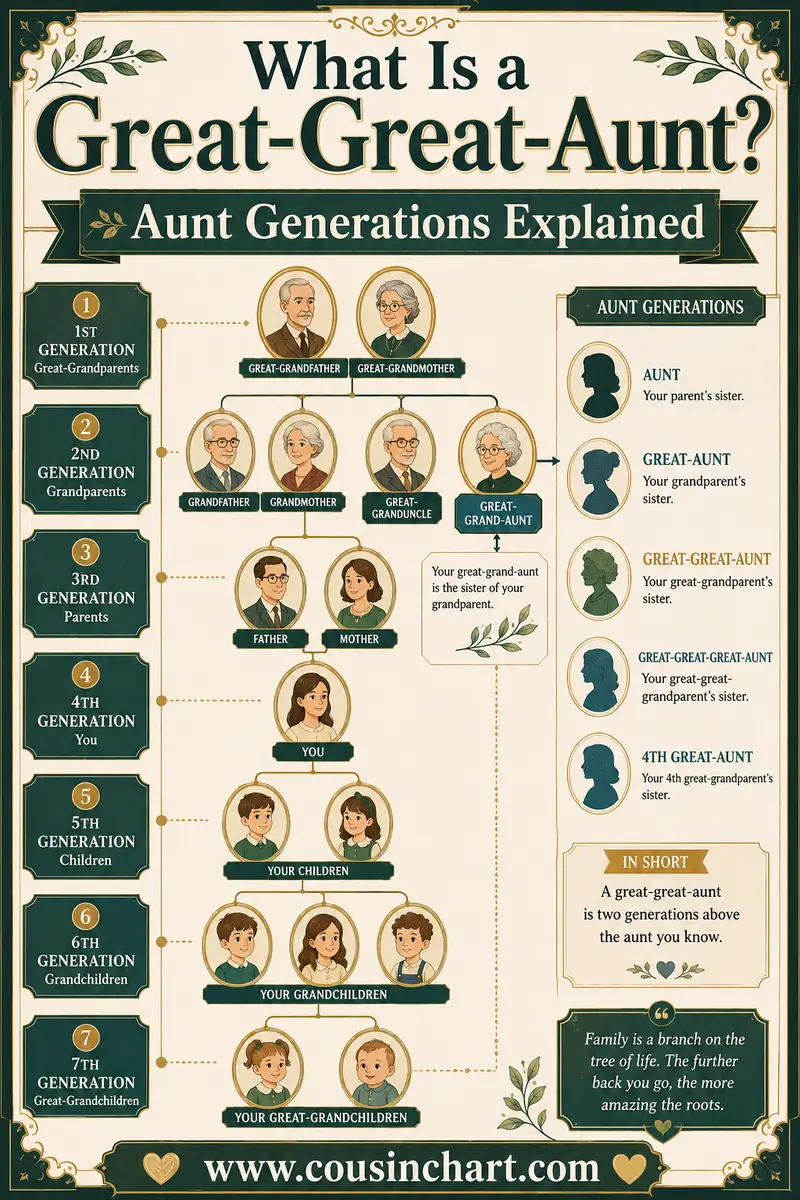
The aunt-and-uncle ladder climbs in lockstep with your ancestor ladder:
- Your parent's sister → aunt
- Your grandparent's sister → great-aunt (grand-aunt)
- Your great-grandparent's sister → great-grand-aunt
One "great" per generation, all the way up — the next rung gets its own article at what is a great-great-aunt. Two details people miss:
- The title comes only through siblinghood. Grandma's sister is a great-aunt; grandma's cousin is not — cousins of ancestors stay on the cousin grid (first cousin twice removed, in that case).
- It works on either side. Your grandfather's sister is equally your great-aunt; "grandma's sister" is just the most-searched version of the question.
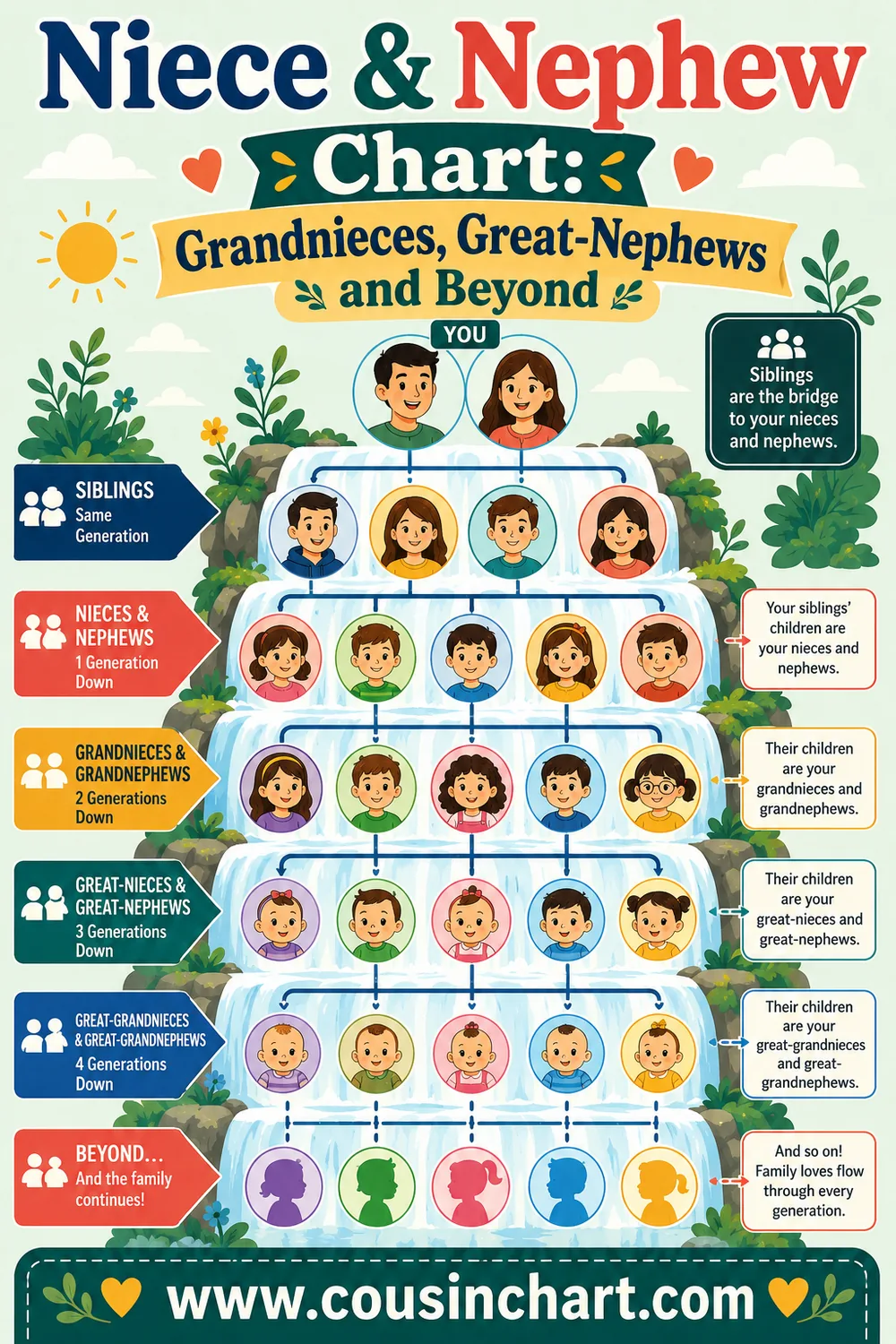
From her perspective, the ladder runs downward through the niece-and-nephew terms: your parent is her niece or nephew, you're her grandniece/grandnephew, and your kids are her great-grandnieces and -nephews. That downward system is charted in the niece and nephew relationship chart.
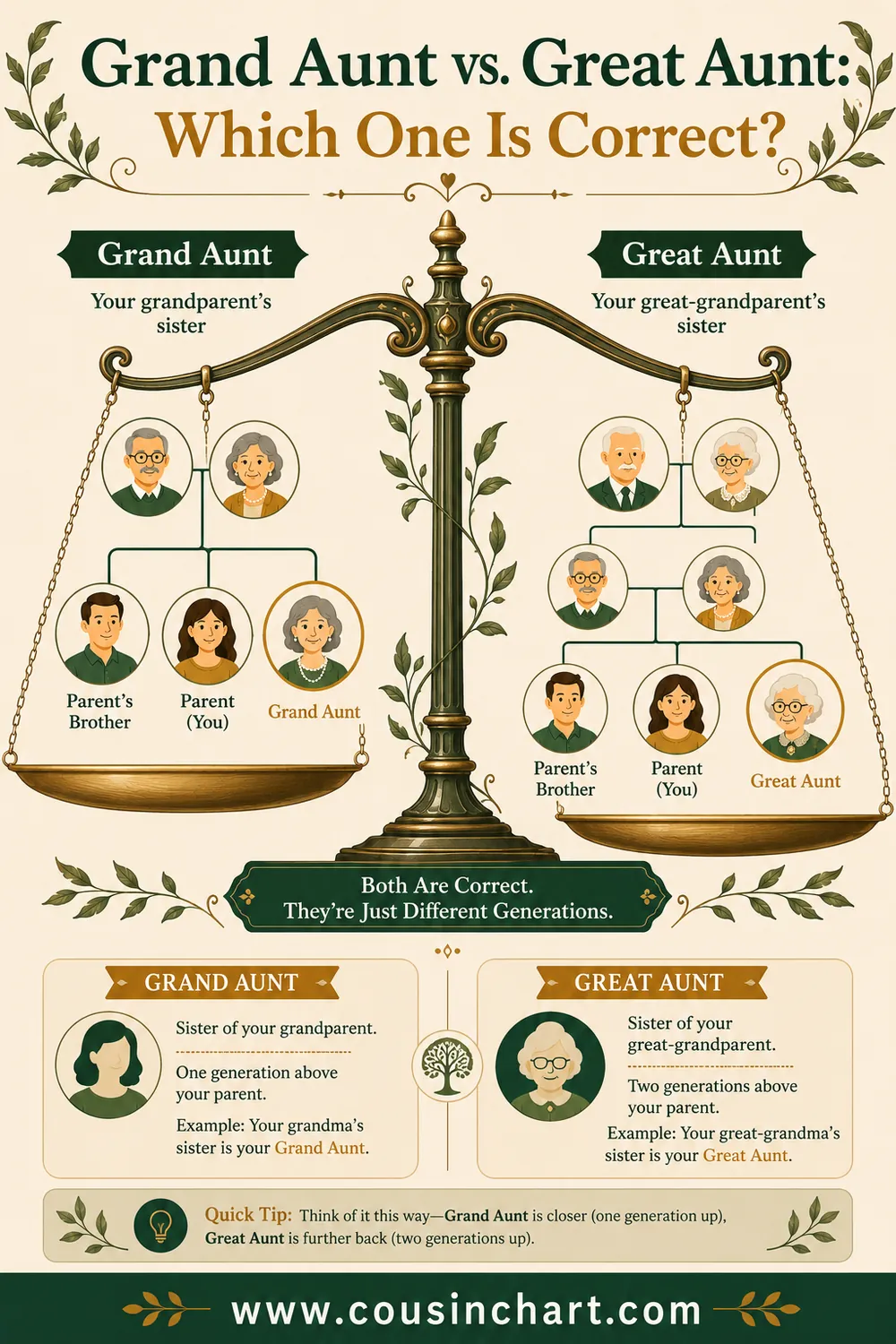
"Great-Aunt" or "Grand-Aunt" — Which Is Right?
Both. "Grand-aunt" is the genealogist's preference because it mirrors the grandparent generation exactly: grandmother's sister = grand-aunt, great-grandmother's sister = great-grand-aunt. Tidy, parallel, off-by-one-proof.
"Great-aunt" is what almost everyone says, and every dictionary blesses it. The only real cost is a small ambiguity two rungs up (is a "great-great-aunt" a great-grandparent's sister or a 2nd great-grandparent's?), which is why family tree software tends to use the "grand" forms internally. We've refereed the full debate at grand-aunt vs great-aunt. Use whichever your family uses; your tree file will translate.
Her Children and Grandchildren: The Branch That Follows
Learn one great-aunt and you've learned a whole limb of your tree. Say your grandma's sister is Aunt Dot:
| Person | What they are to you | Why | Avg. shared DNA |
|---|---|---|---|
| Aunt Dot | Great-aunt | Grandparent's sister | ~12.5% (~850 cM) |
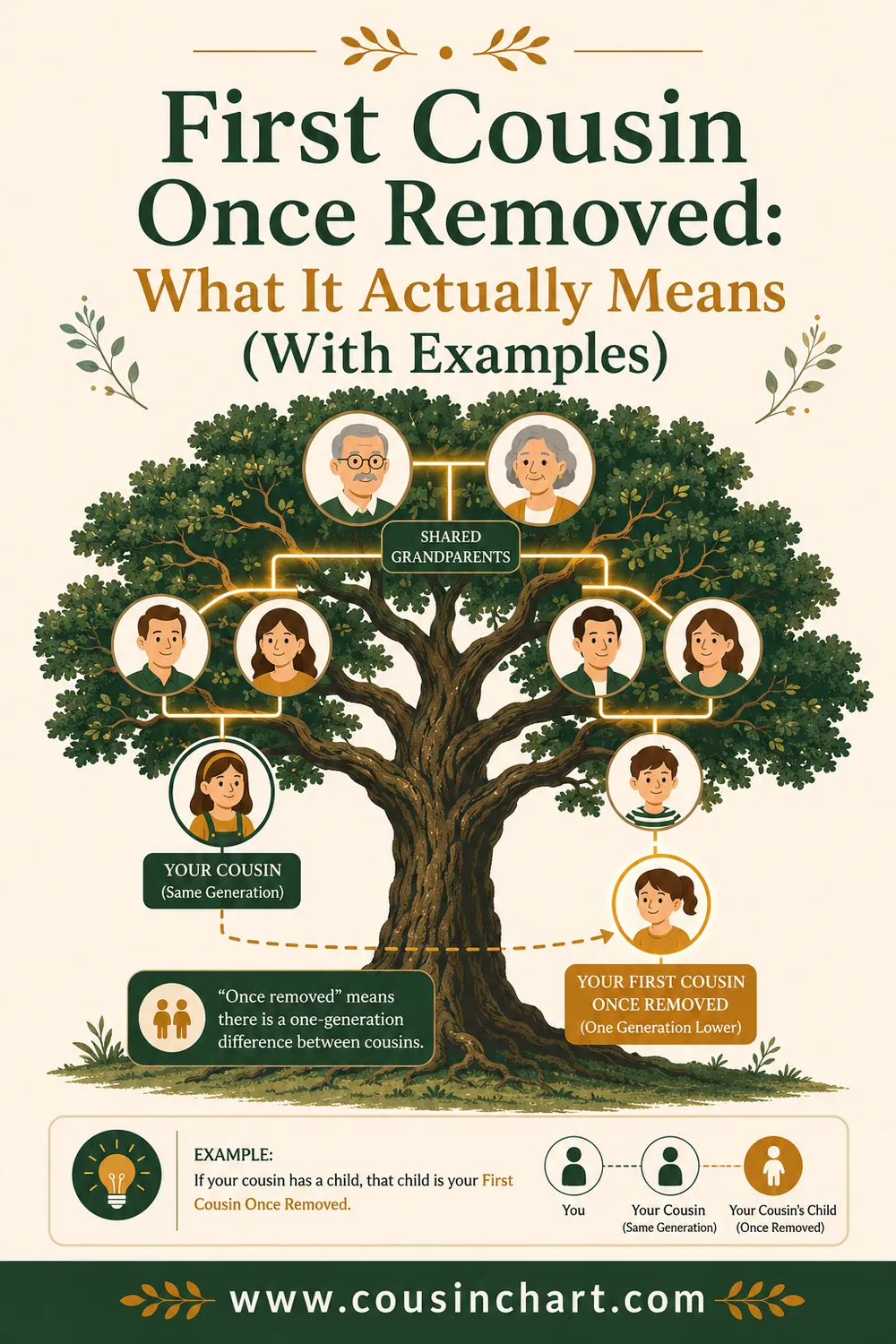
| Dot's children | First cousins once removed | They're your parent's first cousins | ~6.25% (~425 cM) |
| Dot's grandchildren | Second cousins | Same generation as you, shared great-grandparents | ~3.125% (~230 cM) |
| Dot's great-grandchildren | Second cousins once removed | One generation below your second cousins | ~1.56% |
The logic underneath: Dot and your grandma share parents — your great-grandparents — and every relationship in the table is just two paths counted down from that one couple. Dot's grandchildren and you are both three generations below it, same generation, hence second cousins.
This branch is also prime genealogy real estate. Great-aunts are frequently the family's last living link to the great-grandparent generation — the ones who remember the farm, the crossing, the original surname pronunciation. If you have a living great-aunt, she outranks every archive you'll ever search. Interview her first.
The DNA Between You
You and a great-aunt share about 12.5% of your DNA — roughly 850 centimorgans, typically ranging from about 500 to 1,450 cM. Worth knowing:
- It's the same average as a first cousin or half-aunt. DNA companies can't tell those apart from the number alone; age and tree position settle it.
- It's half of a regular aunt's share. Aunt ~25%, great-aunt ~12.5% — one extra generation, one halving.
- She's a generational amplifier. A great-aunt carries twice your genetic share of the great-grandparent generation (about 25% of it against your 12.5%). If she DNA-tests, her match list reaches meaningfully further back than yours on that side — a classic reason genealogists beg the oldest generation to spit in the tube.
Marriage, Halves, and Steps
- Her husband is your great-uncle by marriage — the title arrives with the wedding, the DNA never does. Families universally drop the "by marriage" in daily life, and rightly so.
- Grandma's half-sister is your half-great-aunt: a true blood relative through one shared great-grandparent, at about 6.25% shared DNA. Terminology and warmth need not match; many families neither know nor care which aunts are "half."
- Grandma's stepsister is your step-great-aunt — connected through a remarriage somewhere above you, sharing no DNA. Still brings the good casserole.
Each variation obeys the same two rules you've already learned: blood halves with each "half," and marriage adds titles without adding ancestry.
How to Interview a Great-Aunt (Do This Before Anything Else)
We said she outranks every archive; here's how to actually collect the goods. Family historians consistently rank "I waited too long to ask" as their biggest regret, so treat a living great-aunt as the most time-sensitive record you have.
Set it up gently. Don't announce a formal interview — great-aunts clam up for microphones and open up for coffee. "I've been trying to write down the family history and you're the only one who remembers Grandma's parents" works better than any questionnaire.
Ask about people, not dates. She won't remember that her father was born in March 1898; she'll remember that he whistled while he milked and lost his temper exactly twice in her childhood. Names, personalities, feuds, and places come first — dates can be dug out of records later. Good openers:
- "What was your mother's kitchen like?" (houses unlock everything)
- "Who was the difficult one in the family?" (every family has one; the answer explains a dozen mysteries)
- "What did your parents say about their parents?" — this reaches back four generations from you in a single question.
- "Who's this?" with every unlabeled photo you can find. Bring the whole shoebox.
Record it. Ask permission, set a phone between you, and forget it's there. Handwritten notes lose the exact wording, and exact wording matters — "they came over after the trouble" is a clue; your paraphrase of it is not.
Follow up twice. Memories surface for days after a good session. The second visit — "you mentioned your Uncle Emil, tell me about him" — is routinely better than the first.
One warning from hard experience: verify the facts, keep the flavor. Great-aunts are superb on atmosphere and relationships and genuinely unreliable on dates and ages, like all human beings. Her stories tell you where to dig; the records tell you what's true.
A Worked Example: One Great-Aunt Unlocks Four Generations
Here's how this plays out in practice. Suppose you know almost nothing beyond your grandparents' names, but Great-Aunt Dot, 89, is alive and sharp.
- Dot names her parents — your great-grandparents — including her mother's maiden name, which no document in your house contains. One conversation, one generation gained.
- Dot lists her siblings: your grandma, herself, two brothers, "and the baby who died." Five children means five branches of descendants — your complete map of first-cousins-once-removed and second cousins, most of whom you've never heard of.
- Dot mentions the town. "We grew up outside Abilene before Daddy moved us for the railroad work." Now the census will find them: a household in the right county with parents and five children whose ages match Dot's list.
- Dot identifies the photo. The stern couple in the oval frame turns out to be her grandparents — your great-great-grandparents — "Mama's people, the Kowalskis." That's a fourth generation, with a surname to research.
Total documentary evidence gathered by Dot alone: zero. Total research value: she just handed you the skeleton that every record you find for the next five years will hang on. This is why genealogists say the great-aunt interview is worth more than a paid archive subscription — the archive can't tell you which of the 4,000 Kowalskis are yours.
Finding a Great-Aunt in the Records
If your great-aunts are already gone, they're still findable — and still useful, because a great-aunt appears in exactly the records that describe your direct ancestors' family. Where to look:
- Census records. She's listed as a child in the same household as your grandma, which is precisely what proves their sisterhood. A census that shows your grandmother at age 7 with sister "Dorothy, 9" is the document that turns "family says they were sisters" into evidence.
- Obituaries. Great-aunts' obituaries routinely name their parents, all surviving siblings (your grandma), and married names of daughters — the single best cheat sheet for mapping her descendants, your 1C1Rs and second cousins.
- Marriage records. Her marriage record gives her parents' names — your great-grandparents — one more independent confirmation of the link.
- Wills and probate. A childless great-aunt's estate often names nieces and nephews individually. Your parent or grandparent appearing in her will is both evidence of kinship and occasionally a pleasant surprise.
- Her descendants' DNA. Dot's grandchildren are your second cousins at ~230 cM. Finding them in your match list confirms the whole branch genetically, even if every paper record burned.
The general principle: siblings of ancestors are witnesses to your ancestors' lives. Researching the sisters is not a detour from your direct line — it's usually the fastest road into it.
Great-Aunt vs. the Relatives She Gets Confused With
Four different women get called "Aunt" at the average family gathering, and they occupy four different spots on the chart. Side by side:
| Relative | Who she is | Avg. DNA with you | Her kids are your… | You are her… |
|---|---|---|---|---|
| Aunt | Your parent's sister | ~25% | First cousins | Niece / nephew |
| Great-aunt | Your grandparent's sister | ~12.5% | First cousins once removed | Grandniece / grandnephew |
| Great-grand-aunt | Your great-grandparent's sister | ~6.25% | First cousins twice removed | Great-grandniece / -nephew |
| Grandma's cousin | Your grandparent's first cousin | ~3.125% | Second cousins once removed | First cousin twice removed |
A few ways to keep them straight under holiday pressure:
- Count the "greats" against your ancestor ladder. Whoever's sister she is sets the title: parent → aunt, grandparent → great-aunt, great-grandparent → great-grand-aunt. If you can name the ancestor, you can name the aunt.
- The DNA halves at every rung. 25% → 12.5% → 6.25% — each generation of distance cuts the share in half. Useful when a DNA match's centimorgans don't fit the story you were told.
- Sisters get aunt titles; cousins never do. That last row is the classic mix-up. Grandma's cousin may have been at every Christmas since 1975, but genealogically she's on the cousin grid, and her descendants connect to you through great-great-grandparents rather than great-grandparents — a difference that matters the moment you start sorting DNA matches into branches.
- Age tells you nothing. In sprawling families, an aunt can be younger than a great-aunt, and either can be younger than you. Ignore birthdays; count generations.
If a gathering serves up a combination this table doesn't cover — grandma's half-sister's stepdaughter, say — that's not a failure of the system, just a job for the calculator.
FAQ
What do I call my grandmother's sister?
Your great-aunt — genealogists also say grand-aunt, and both are correct. She's one generation above a regular aunt, and you are her grandniece or grandnephew.
What are my grandma's sister's children to me?
Your first cousins once removed. They're your parent's first cousins (sharing grandparents with your parent), which puts them one generation above you on the cousin grid.
What are my grandma's sister's grandchildren to me?
Your second cousins. You're both three generations down from the same couple — your shared great-grandparents — and in the same generation as each other.
How much DNA do I share with my great-aunt?
About 12.5% on average, roughly 850 centimorgans — the same ballpark as a first cousin. A regular aunt shares about twice that (~25%).
Is it great-aunt or grand-aunt?
Both are standard. "Grand-aunt" mirrors "grandmother" and is preferred in genealogy software; "great-aunt" dominates everyday speech. Pick one and stay consistent in your family tree records.
What is my grandma's sister to my children?
Their great-grand-aunt (commonly said as great-great-aunt) — one more generation, one more "great." Your children are her great-grandnieces and great-grandnephews, sharing about 6.25% of their DNA with her.
Can my great-aunt be younger than my parent?
Absolutely — and it happens all the time in big families. If your great-grandparents' children spanned twenty years, grandma's youngest sister can easily be younger than grandma's own kids. Titles track generations, not ages: a great-aunt can be younger than her grandnephew, and the chart doesn't blink.
Is my grandma's cousin also my great-aunt?
No — only siblings of your grandparents are great-aunts and great-uncles. Grandma's cousin belongs to the cousin system: she's your first cousin twice removed.
One Sister, One Whole Branch
Grandma's sister is your great-aunt, her kids are your first cousins once removed, her grandkids are your second cousins — one relative, three rows of the chart filled in. And if she's still around, she's better than the chart: she remembers the people at the top of it. Ask her the stories, then map what she tells you. When her branch produces someone you can't place — her half-brother's granddaughter, her stepson's kids — open the free family relationship calculator, tap the path, and get the exact term with a diagram to match. Free, instant, and grandma-approved.