Niece & Nephew Chart: Grandnieces, Great-Nephews and Beyond
Last updated: September 30, 2026
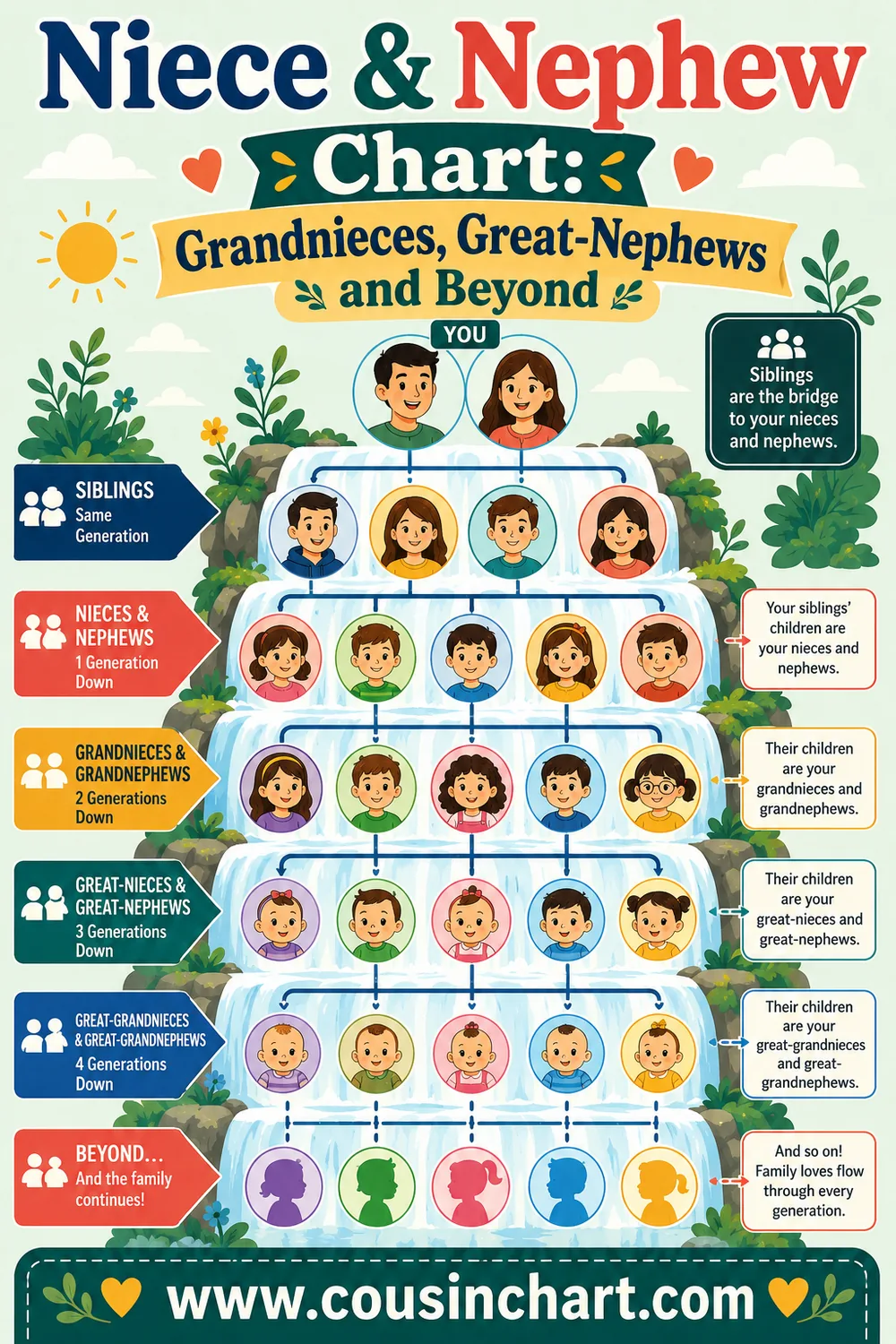
A niece or nephew is your sibling's child — and every generation below them adds a "grand" or "great" to the title. Your sibling's grandchild is your grandniece or grandnephew (most people say great-niece or great-nephew), and your sibling's great-grandchild is your great-grandniece or great-grandnephew.
That's the whole ladder in one paragraph. The rest of this guide charts it properly: what each generation is called, how much DNA you share at every step, what half- and step-siblings do to the titles, and the classic mistake of calling a cousin's child a niece. For any relative you can't place, the free family relationship calculator on our homepage names the connection in seconds.
Relationship quick-check. Tap a phrase to see the correct term:
The answer will appear here.
The Niece and Nephew Ladder, Charted
The system is beautifully regular: start at your sibling and walk down. Each generation adds one "grand"/"great" — exactly mirroring how grandchild becomes great-grandchild.
| Person | Your term for them | Their term for you | Avg. shared DNA |
|---|---|---|---|
| Sibling's child | Niece / nephew | Aunt / uncle | ~25% |
| Sibling's grandchild | Grandniece / grandnephew (great-niece / great-nephew) | Great-aunt / great-uncle (grand-aunt / grand-uncle) | ~12.5% |
| Sibling's great-grandchild | Great-grandniece / great-grandnephew | Great-grand-aunt / great-grand-uncle | ~6.25% |
| Sibling's 2nd-great-grandchild | Great-great-grandniece / -nephew | Great-great-grand-aunt / -uncle | ~3.125% |
Two things worth noticing. First, the DNA halves at every step — the same 50% dilution rule that governs the whole family tree. Second, the relationship is a mirror: whatever they are to you going down, you are the aunt/uncle equivalent going up. If she's your grandniece, you're her granduncle or grandaunt.
Grandniece or Great-Niece — Which Is Correct?
Both, honestly. Genealogists prefer "grandniece" because it keeps the system parallel: your sibling's grandchild is your grandniece just as your child's child is your grandchild. Everyday English overwhelmingly says "great-niece," and every dictionary lists both as standard.
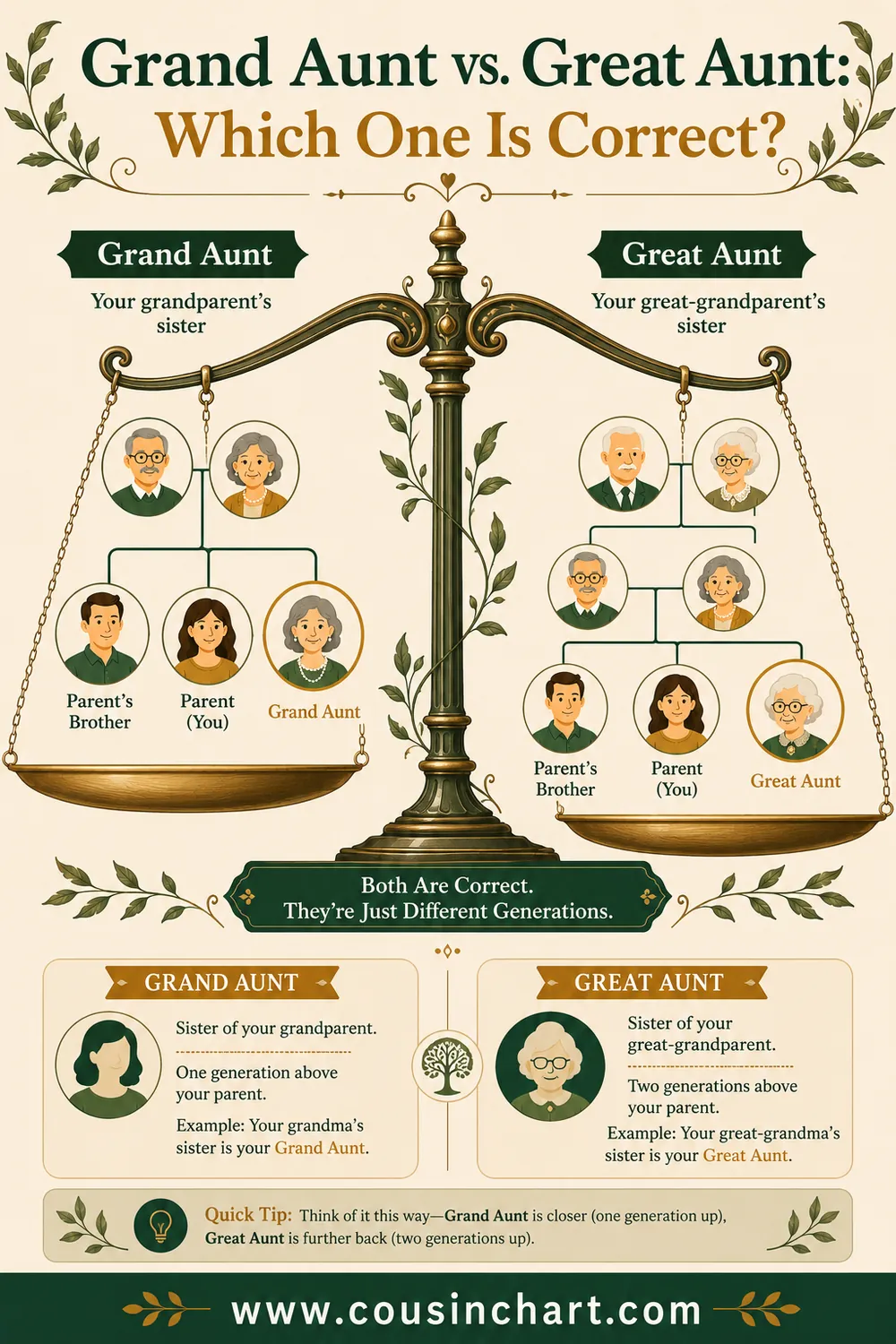
The same tug-of-war happens one branch over with grand-aunt versus great-aunt — we've covered that skirmish in grand-aunt vs great-aunt. Use whichever your family uses; just be consistent inside a family tree file, where software usually defaults to the "grand" forms.
Where precision genuinely helps is the next step down. "Great-grandniece" (sibling's great-grandchild) is unambiguous. But if you call your sibling's grandchild a "great-niece," what do you call their child — a great-great-niece? Now your "greats" are off by one from the genealogy standard. It's a small wrinkle, but it's why serious tree-builders start with "grand."
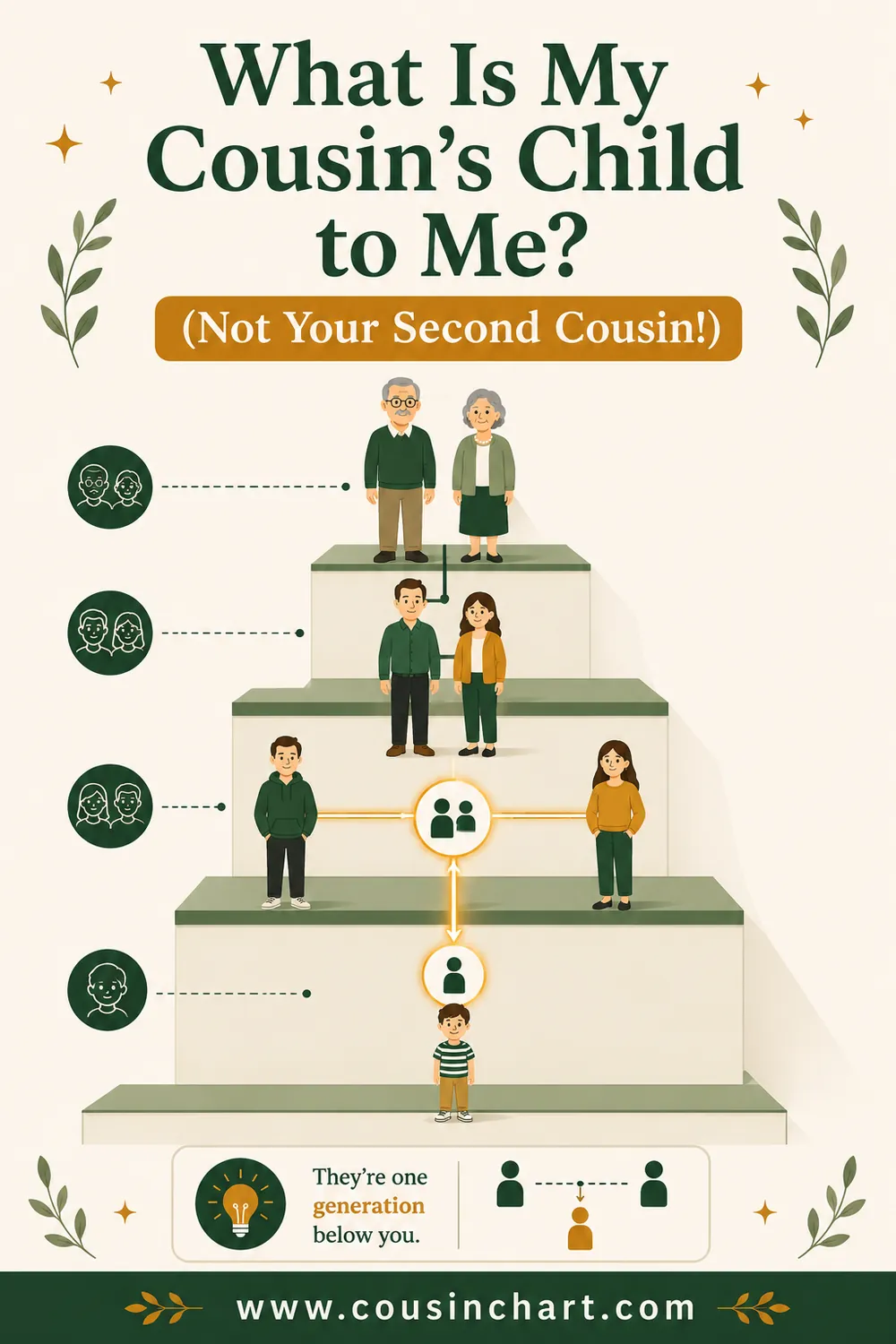
The Classic Mistake: Your Cousin's Child Is Not Your Niece
It feels like she should be — she's a little kid in your family orbit, and "first cousin once removed" sounds like legal paperwork. But niece and nephew belong exclusively to your sibling's line. Your cousin's child is your first cousin once removed: the cousin relationship stays, and the one-generation gap adds "once removed."
The full explanation (with diagrams) is in what is my cousin's child to me. Socially, plenty of families use "niece" or "auntie" here anyway, and that's a warm, harmless custom. Genealogically and genetically, though, the difference is real: a true niece shares about 25% of your DNA; a cousin's child only about 6.25%.
Half-Nieces, Step-Nephews, and Nieces by Marriage
Real families are blended, so the ladder comes in three materials:
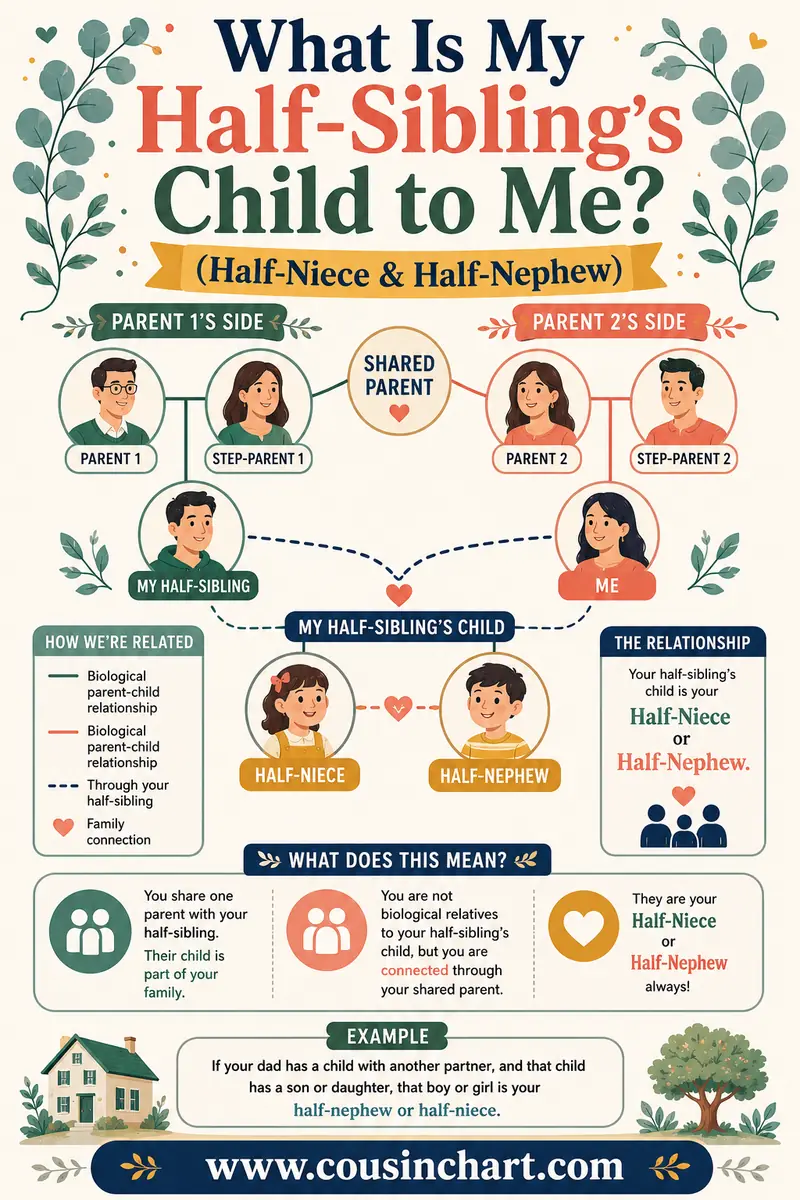
- Half-niece / half-nephew — your half-sibling's child. Fully real, fully blood: they share roughly 12.5% of your DNA rather than 25%, because you and your half-sibling share only one parent. Most families never say "half-nephew" out loud, and that's fine — the term matters mainly in DNA testing and inheritance contexts. More in what is my half-sibling's child to me.
- Step-niece / step-nephew — your step-sibling's child. No blood connection; the link runs through a parent's remarriage. Titles are entirely a matter of family custom.
- Niece / nephew by marriage — your spouse's sibling's child. Again no shared DNA with you, but in daily life these kids are simply your nieces and nephews, no asterisk. And here's a neat twist: your own children are blood-related to them — your kids and your spouse's sibling's kids are first cousins, sharing your spouse's parents as grandparents.
DNA testing makes these distinctions visible in a way earlier generations never saw. A ~1,700 cM match labeled "close family" could be a niece; a ~850 cM match could be a half-niece — same social role, different genetic story.
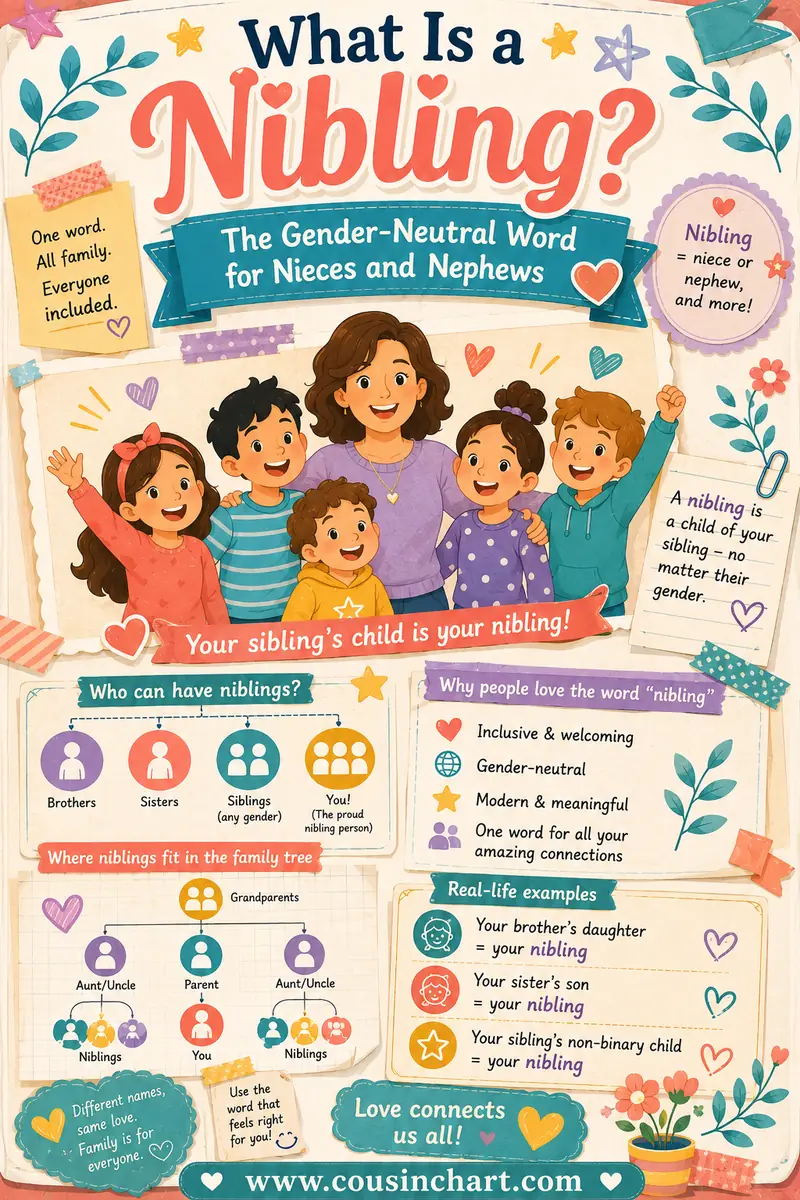
One Word for All of Them: Nibling
English has needed a gender-neutral, plural-friendly word for "nieces and nephews" forever, and nibling (coined by linguist Samuel Martin in the 1950s, on the model of sibling) has quietly filled the job. "I've got four niblings" beats "three nieces and a nephew" for economy, and it's genuinely useful when a nibling is nonbinary. It's informal but increasingly common — we give it a full article at what is a nibling.
Why the Precise Terms Actually Matter
Most days, "my niece" covers everyone and everything. Three situations reward precision:
- DNA match lists. Testing companies estimate relationships from shared centimorgans, and nephew vs. half-nephew vs. grandnephew all land in different (overlapping) ranges. Knowing the ladder helps you interpret a mystery match instead of jumping to conclusions.
- Wills and inheritance. Intestacy statutes rank relatives by class. Whether someone is a nephew or a grandnephew can change what they inherit when there's no will — courts use the genealogical definitions, not the family's warm shorthand.
- Family tree research. Old wills and obituaries say things like "my beloved grand-nephew" — knowing that means a sibling's grandchild keeps your tree accurate.
For any of these, work out the exact path before you rely on the label. The free relationship calculator does it visually: pick "my sibling → their child → their child" and it returns "grandniece," the reciprocal term, and the expected DNA share.
How the Two Ladders Interlock: Your Kids and Your Niblings
The niece/nephew ladder doesn't exist in isolation — it runs parallel to your own descendants' ladder, and the rungs connect in a completely predictable way. Every pairing between your line and your sibling's line is a cousin relationship, and the chart writes itself:
| Your side | Their side | They are... to each other |
|---|---|---|
| Your child | Your niece/nephew | First cousins |
| Your child | Your grandniece/-nephew | First cousins once removed |
| Your grandchild | Your niece/nephew | First cousins once removed |
| Your grandchild | Your grandniece/-nephew | Second cousins |
| Your great-grandchild | Your great-grandniece/-nephew | Third cousins |
The pattern: when both lines are the same distance below the original sibling pair, the kids are plain cousins (first, then second, then third as the generations stack). When the distances differ, the difference becomes the "removed." This is exactly the degrees of cousinship formula at work, with you and your sibling as generation zero.
It's also the answer to a question every new aunt or uncle eventually asks at a baby shower: "so what will my kids be to this baby?" First cousins — and your grandkids and the baby's kids will be second cousins, still connected through your parents, the couple at the top of both lines.
Reading Nieces and Nephews on a DNA Test
If you've tested, the ladder shows up as numbers — and the numbers are both helpful and sneaky.
| Relationship | Average shared DNA | Typical range |
|---|---|---|
| Niece / nephew | ~1,750 cM (25%) | ~1,300–2,300 cM |
| Half-niece / half-nephew | ~875 cM (12.5%) | ~500–1,400 cM |
| Grandniece / grandnephew | ~875 cM (12.5%) | ~500–1,400 cM |
| Great-grandniece / -nephew | ~440 cM (6.25%) | ~200–800 cM |
Two honest warnings come with that table.
First: identical averages. A half-niece and a grandniece share the same expected DNA (~12.5%) — the test literally cannot tell them apart by amount. The same goes one rung up: an aunt/niece pair, a half-sibling pair, and a grandparent/grandchild pair all average ~25%. When a testing company labels a match "close family," the label is a bucket, not a verdict. Generation clues (ages, known birth years) and tree work pick the right relationship out of the bucket.
Second: direction is invisible. DNA can't tell whether the match is your niece or your aunt — 25% is 25% in both directions. A surprisingly common mix-up in surprise-relative stories: someone assumes a strong match is a niece when she's actually an aunt from a grandparent's undisclosed second family. Age usually sorts it out, but not always — which brings us to the ladder's strangest feature.
When the Ladder and the Calendar Disagree
Nothing in genealogy requires a niece to be younger than her aunt. Titles follow generation, not age, and big families routinely produce inversions:
- The uncle in diapers. If your grandmother had children across twenty-five years, your mother's youngest brother might be born after you. He's still your uncle; you're still his niece or nephew — even if you're the one teaching him to ride a bike.
- The niece who babysits her aunt. Flip the same math: your much-older sibling's children can easily be older than your own younger siblings — or older than you, if your parent remarried and had you late. A nephew ten years your senior is perfectly ordinary in a family with long generations.
- Great-grandnieces before grandchildren. A family with short generations on one branch and long ones on another can produce a great-grandniece before anyone in your own line has had kids.
None of this breaks the chart — it's why the chart exists. Age tells you who's likely to win a footrace; only generation tells you who's the aunt. In genealogy records this matters practically: a census entry showing a "nephew" older than the head of household isn't an error, and treating it as one has sent many researchers down wrong paths. When a pairing seems impossible, count generations from the shared ancestors and trust the count. (Or hand the whole thing to the relationship calculator and let it do the trusting for you.)
A Trap for Genealogists: "Nephew" Didn't Always Mean Nephew
One more wrinkle, strictly for anyone digging in old documents. The word "nephew" comes from the Latin nepos — which meant grandson as readily as it meant sister's son. That double meaning survived into early modern English: in wills and parish records from the 1500s–1700s, "my nephew" can genuinely mean "my grandson," and "niece" can mean "granddaughter."
So when a 1670 will leaves the farm to "my beloved nephew John," don't automatically go hunting for a sibling's son named John — check the testator's own grandsons first. A few related snares in the same documents:
- "Cousin" meant almost anyone. In older usage it covered nephews, nieces, and kinfolk generally. A letter addressed to "my loving cousin" tells you they were related, not how.
- "In-law" once covered step-relations. A "son-in-law" in some old records is what we'd call a stepson — the "law" being church law, which treated both kinds of marriage-made kin alike.
- "Now wife" versus "late wife" and other qualifiers changed which family's children were meant — which matters enormously when nephews and stepsons inherit differently.
The defense is simple: in any document older than about 1800, treat relationship words as claims to verify, not facts to record. Cross-check ages, parents' names, and other records before you write "nephew" into your tree with its modern meaning. Modern usage, to be clear, is fully settled — sibling's child, and nothing else — but the older records were written by people who hadn't agreed to our chart yet.
Quick answer: your niece or nephew is always your sibling's child (or your spouse's sibling's child, by marriage). Your nephew's wife is your niece-in-law, and your cousin's grandchild is not a grandniece. That one is a first cousin twice removed.
Three Real-Life Examples, Walked Step by Step
Real families add marriages, half-siblings and cousins to the ladder. Here are three common questions, one step at a time.
1. "My husband's sister's granddaughter"
- Your husband's sister is your sister-in-law.
- Her child is your husband's niece or nephew, and your niece or nephew by marriage.
- Her grandchild is one more step down the ladder.
Answer: your grandniece by marriage. You share no DNA, but in everyday life you're simply her great-aunt.
2. "My half-sister's grandson"
- Your half-sister shares one parent with you.
- Her son is your half-nephew.
- His son is one generation further down.
Answer: your half-grandnephew (or half-great-nephew). On average you share about 6.25% of your DNA, half of what a full grandnephew would share. Half-siblings vs. step-siblings explains where that halving comes from.
3. "My cousin's grandson"
- Your cousin is on a side branch, not your sibling line.
- Your cousin's son is your first cousin once removed, not a nephew.
- His son adds one more generation of distance.
Answer: your first cousin twice removed, not your grandnephew. The niece and nephew ladder only grows from a sibling. The full cousin version is in first cousin twice removed.
Common Mix-Ups (and How to Untangle Them)
- "Niece-in-law" can mean two people. Most often it means your nephew's wife. Some people also use it for their spouse's niece, though "niece by marriage" is the clearer way to say that. The same goes for "nephew-in-law," which usually means your niece's husband. We cover the details in what is my nephew's wife to me.
- "Step-nephew" has two routes. It can mean your step-sibling's son, or your sibling's stepson (your brother's wife's son from an earlier relationship). Neither is a blood tie.
- Nieces by marriage after a divorce. On paper, the link to your ex-spouse's nieces and nephews ends with the marriage. In real life, many aunts and uncles stay close for good, and nobody needs permission to keep the title. More in in-laws after divorce or death.
- "My niece's kids are my cousins." Not quite. They are your grandnieces and grandnephews, one rung down the same ladder.
Nieces and Nephews Around the World
Other languages slice this relationship in different ways:
- Spanish: sobrino (nephew) and sobrina (niece). The plural sobrinos covers a mixed group of nieces and nephews. A grandnephew is a sobrino nieto.
- French: neveu and nièce, with petit-neveu and petite-nièce for grandnephews and grandnieces.
- German: Neffe and Nichte, with Großneffe and Großnichte one generation down, built just like the English "grand" forms.
- Tagalog: pamangkin means niece or nephew with no gender at all, so Filipino families have had a built-in "nibling" all along.
- Hindi: the word depends on which sibling is the parent. A brother's children are bhatija (son) and bhatiji (daughter), while a sister's children are bhanja and bhanji.
- Mandarin Chinese makes a similar split: a brother's son is zhízi, while a sister's son is wàishēng.
If your family uses one of these words, write it into your family tree next to the English title.
Checking a Tricky Case With the Calculator
For marriage and half-sibling routes, tap the path into the relationship calculator exactly as it runs ("my spouse → their sister → her child → her child") to see the title and what they'd call you back.
FAQ
What is my sibling's grandchild to me?
Your grandniece or grandnephew — commonly called a great-niece or great-nephew. You are their great-aunt or great-uncle, and you share about 12.5% of your DNA on average.
Is my cousin's daughter my niece?
No — she's your first cousin once removed. Nieces and nephews come only from your siblings' line. Many families use "niece" socially for a cousin's child, which is fine, but the genealogical term (and the DNA math) is different.
What's the difference between a great-niece and a grandniece?
Nothing — they're two names for the same person, your sibling's grandchild. Genealogists lean toward "grandniece" (parallel to grandchild); everyday speech leans toward "great-niece." Both are dictionary-standard.
What is a half-nephew?
Your half-sibling's son. He's a genuine blood relative sharing about 12.5% of your DNA — half the usual nephew amount, because you share only one parent with his parent.
What am I to my nephew's children?
Their great-aunt or great-uncle (grand-aunt/grand-uncle). Your nephew's children are your grandnieces and grandnephews — the mirror image of the same relationship.
Can a nephew be older than his aunt or uncle?
Absolutely — titles follow generation, not age. If your parents had children across a long span, your older sibling's kids can be born before your parents' youngest child, making the nephew older than his uncle. It looks odd at a birthday party and completely normal on a family tree.
What are my children to my nieces and nephews?
First cousins. Your children and your sibling's children share the same grandparents — your parents — which is the definition of first cousins.
What is my niece to my parents?
She's their granddaughter. Your niece is your sibling's child, and your sibling is your parents' child, so your nieces and nephews are all your parents' grandchildren.
Are my niece's children my cousins?
No. Your niece's children are your grandnieces and grandnephews (also called great-nieces and great-nephews). They are cousins to your children, but they are one generation removed: first cousins once removed.
What is my nephew's wife to me?
She's your niece-in-law. It isn't a formal genealogy term, but it's widely understood. Most aunts and uncles simply call her their niece.
Does my nephew stay my nephew after a divorce?
If he's your blood nephew, nothing changes. If he's your ex-spouse's nephew, the formal link ended with the marriage, but many families keep the relationship and the title, especially when the aunt or uncle has known the child since birth.
What is my half-sister's grandchild to me?
Your half-grandniece or half-grandnephew. You share about 6.25% of your DNA on average, compared with about 12.5% on average for a full grandniece or grandnephew.
Chart Your Whole Ladder in Seconds
The rule fits on a sticky note: sibling's child = niece/nephew, then add a "grand" or "great" for each generation down, and halve the DNA as you go. Half-siblings make half-nieces; marriages make nieces with no DNA but full hugging rights. When a real-world case gets tangled — your half-sister's granddaughter, your wife's nephew's baby — open the free family relationship calculator and tap out the path. It names the relationship, shows the reciprocal term, and settles the baby-shower debate before the cake is cut.