What Is My Nephew's Wife to Me?
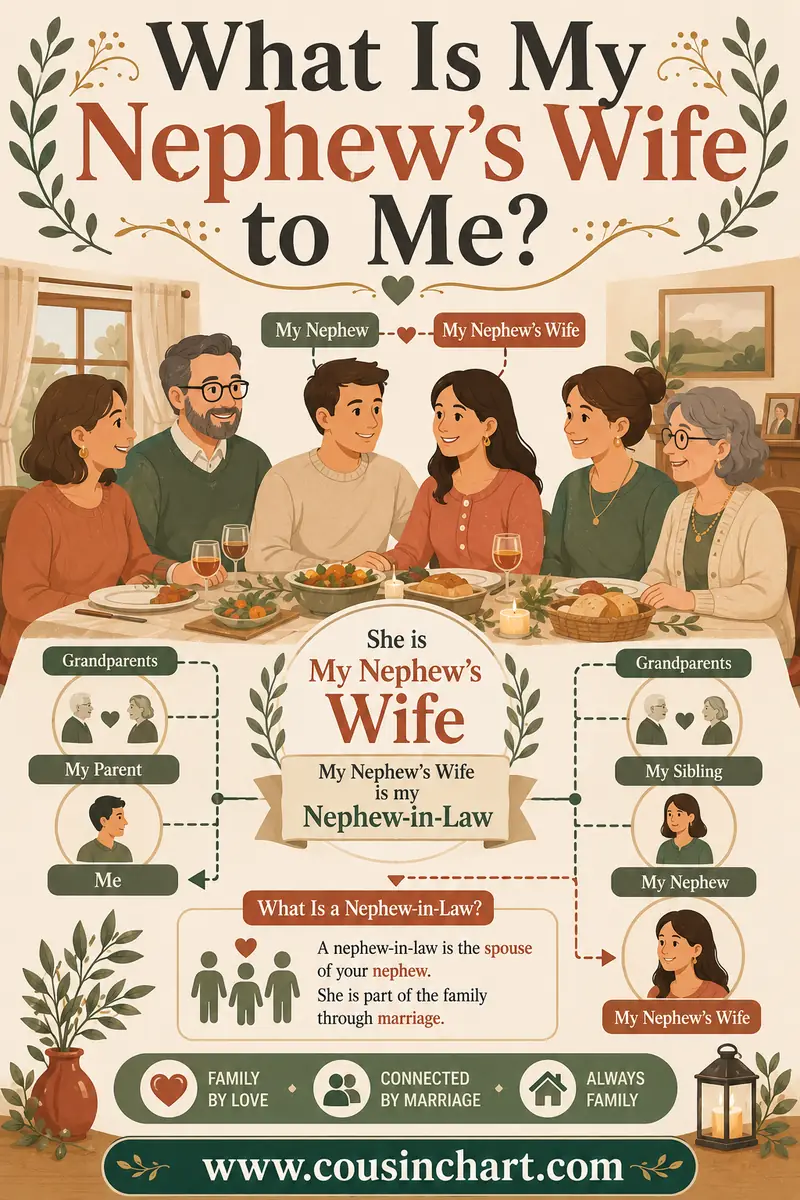
Your nephew's wife is your niece-in-law — and by the same token, a niece's husband is your nephew-in-law. She's family by marriage rather than blood, so no DNA connects you, but the children she and your nephew have together will be your great-nieces and great-nephews, who absolutely are blood relatives.
That's the whole answer in two sentences. The rest of this guide covers what she calls you, why "niece-in-law" almost never gets said out loud, what happens after a divorce, and how the surrounding branch fits together. For any relationship you can't put a name to, the free family relationship calculator on our homepage does it in seconds.
Relationship quick-check. Tap a phrase to see the correct term:
The answer will appear here.
Niece-in-Law: A Real Term Nobody Uses
"Niece-in-law" is legitimate — dictionaries record it, and genealogists understand it instantly. It follows the standard in-law formula: take the slot the person occupies (your nephew's wife stands where a niece would), add "-in-law" to flag that marriage, not blood, put her there.
In everyday life, though, the term is nearly extinct. Families overwhelmingly say one of these instead:
- Her first name — the default, since she's typically a generation or two younger than you.
- "My nephew's wife" — the plain descriptor when explaining the connection.
- "My niece" — very common once the marriage has some years on it; most aunts and uncles stop distinguishing.
All three are fine. The formal term only really earns its keep in genealogy notes and in articles like this one, where precision is the whole point.
What Does She Call You?
You're her aunt-in-law or uncle-in-law — her spouse's aunt or uncle. In practice, she'll almost certainly call you whatever your nephew calls you: "Aunt Rosa," "Uncle Dev," or just your name, depending on your family's style.
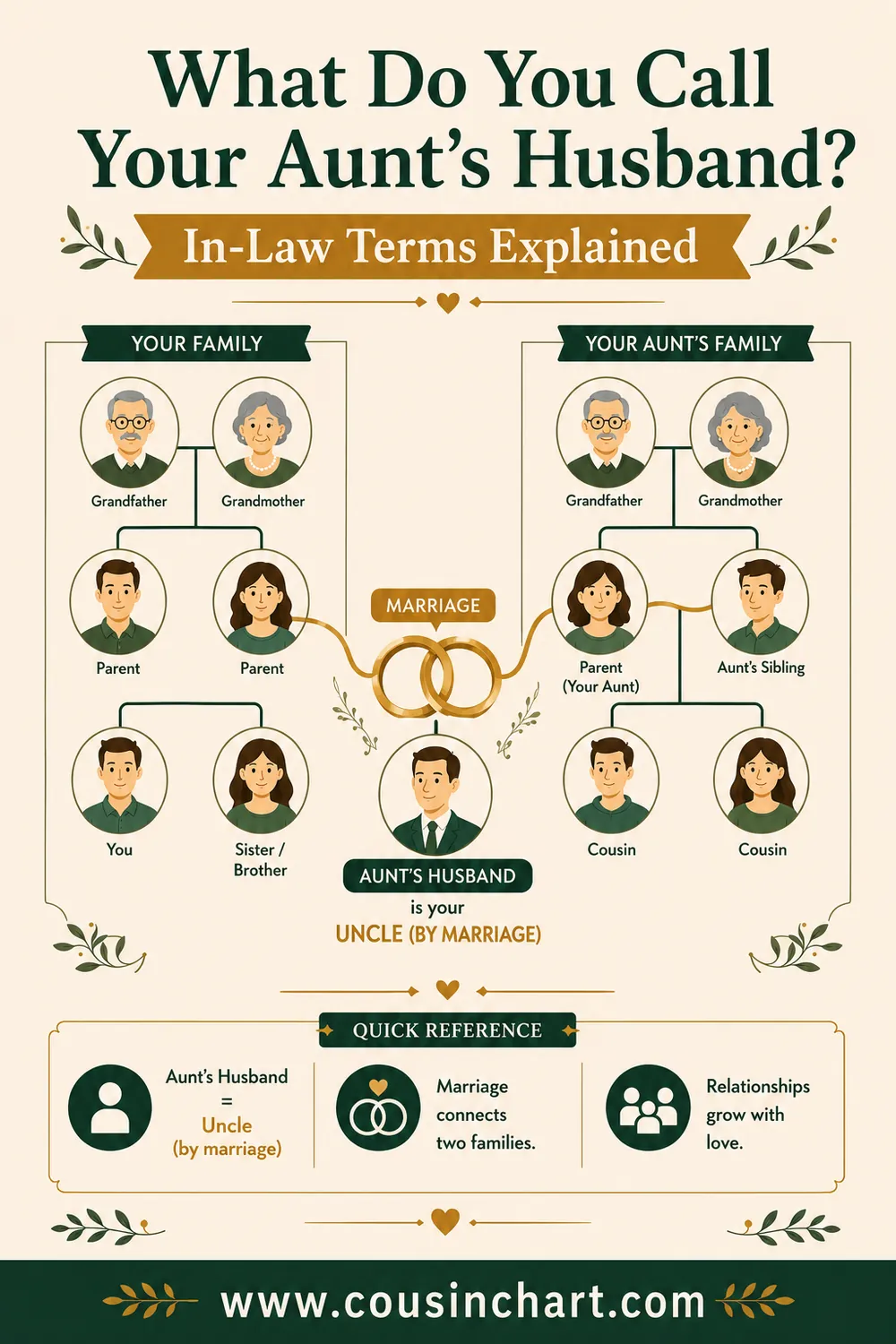
This is the comfortable thing about marrying into a family: the spouse generally inherits the existing name conventions rather than negotiating new ones. If the family's kids all say "Auntie," she'll probably land there too. (The same social physics apply one generation up, where an aunt's new husband usually gets promoted straight to "Uncle" — we cover that in what to call your aunt's husband.)
No Blood — But the Kids Are
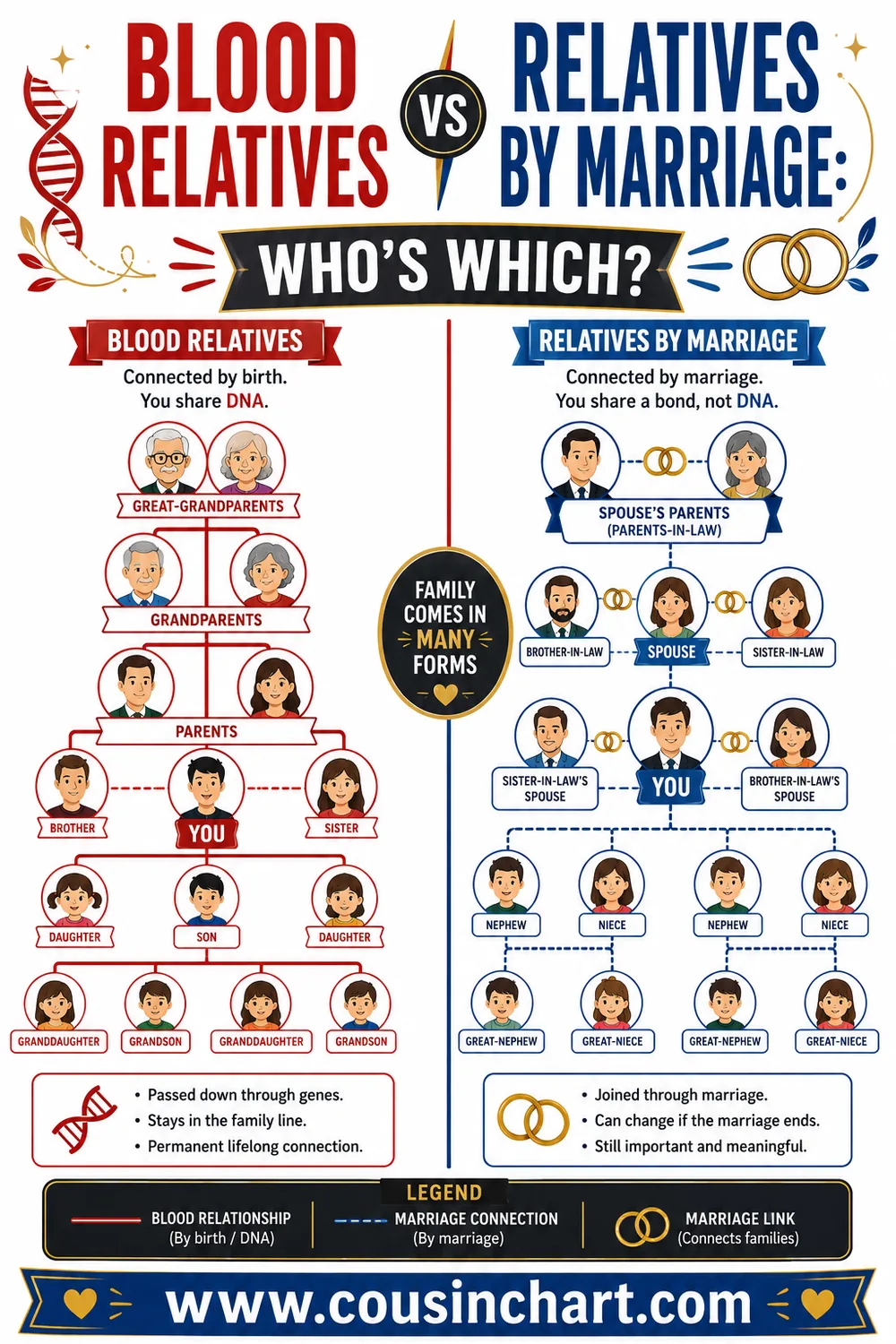
The key structural fact: your nephew's wife shares no ancestor with you, so no cousin number, no "removed," and no shared DNA. She's a relationship of affinity (marriage), not consanguinity (blood). The blood vs marriage explainer walks through that whole divide.
But she's the bridge to your next generation of blood relatives. Children she has with your nephew are your great-nieces and great-nephews — your sibling's grandchildren, sharing roughly 12.5% of your DNA on average.
Here's the whole branch at a glance:
| Person | Relationship to you | Type |
|---|---|---|
| Your sibling | Sibling | Blood (~50% shared DNA) |
| Their son | Nephew | Blood (~25%) |
| His wife | Niece-in-law | Marriage only |
| Their children together | Great-niece / great-nephew | Blood (~12.5%) |
| Her child from a previous relationship | Your nephew's stepchild — no formal relation to you | Marriage only |
| Her parents and siblings | No relation — they're your nephew's in-laws | Marriage only |
Two households can sit at the same holiday table with completely different genealogical wiring. The tree runs on biology and adoption — an adopted child of your nephew takes the great-niece/great-nephew slot with full standing, no asterisk.
Great-Niece, Grand-Niece — Which Is It?
Both. Your nephew's children are called great-nieces/great-nephews or grand-nieces/grand-nephews interchangeably. "Grand-" is the older, more logically consistent form (it mirrors grandchild — same generation distance), and many genealogists prefer it. "Great-" is what most Americans actually say.
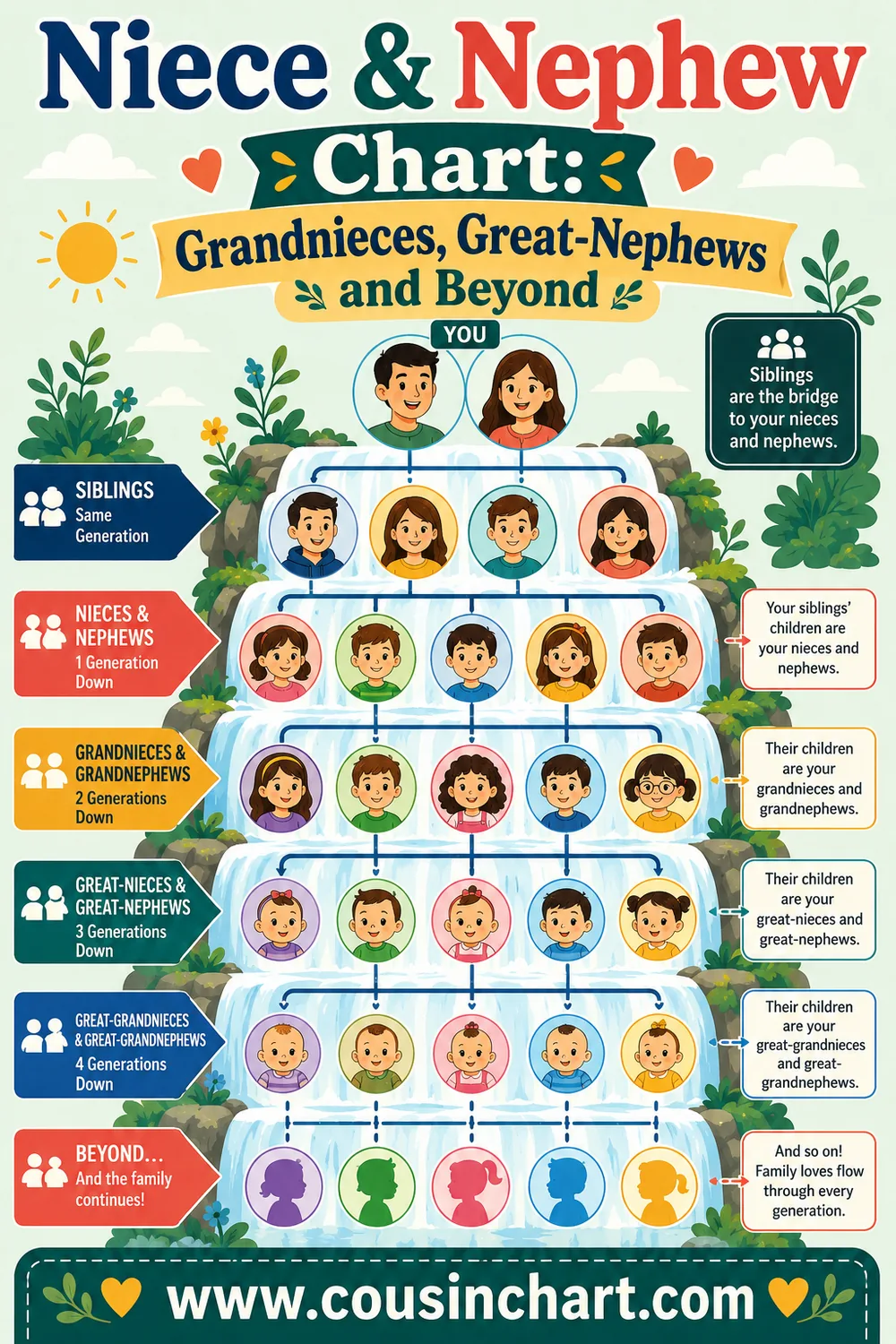
Whichever you choose, the ladder continues predictably: your nephew's grandchildren are your great-grand-nieces and -nephews, and so on, adding a "great" per generation. The niece and nephew chart maps the full ladder if your family's already several rungs deep.
Where Your Own Kids Fit In
A related puzzle that comes up at the same reunions: what are your children to your nephew and his wife?
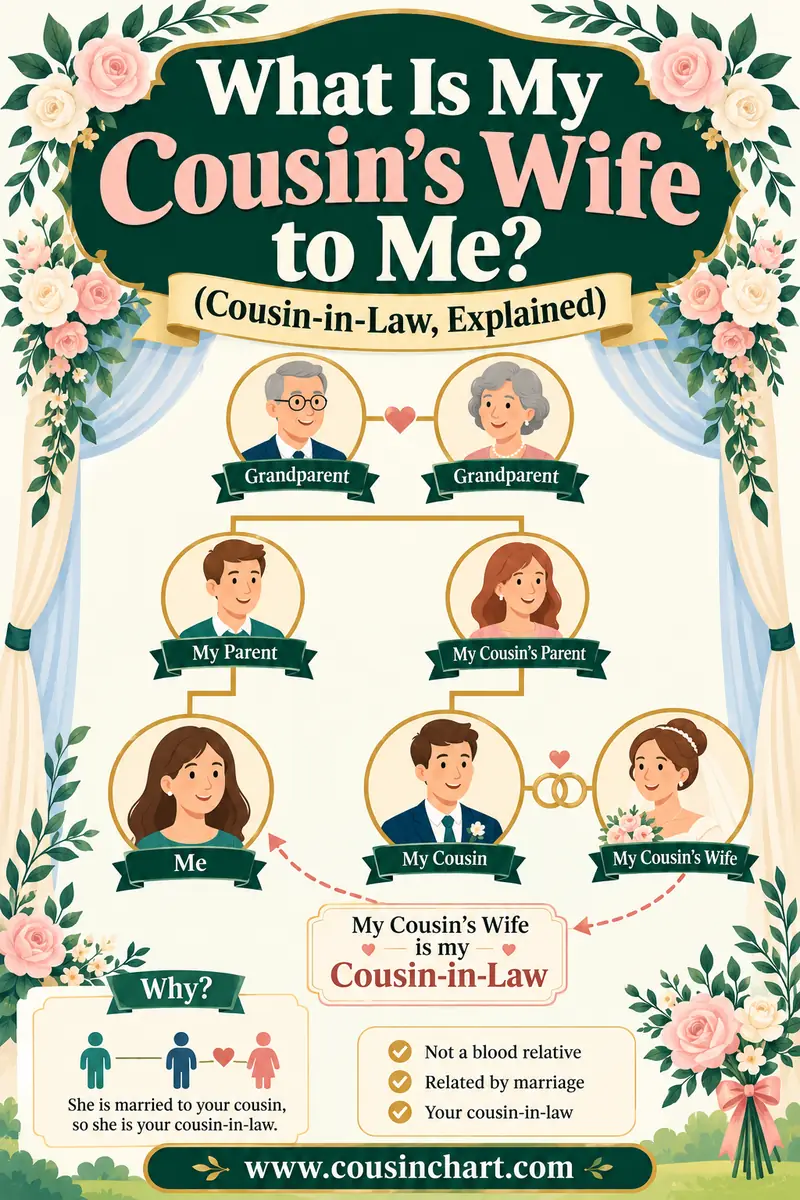
- Your kids and your nephew are first cousins — children of siblings. His wife is their cousin-in-law.
- Your kids and your nephew's kids are first cousins once removed — your kids sit one generation above his kids on the tree, because the cousin relationship belongs to your kids' and your nephew's shared generation.
- Your grandkids and your nephew's kids are second cousins — back on the same row, sharing great-grandparents (your parents).
If that diagonal logic makes your eyes cross, that's normal — it's exactly the kind of two-branch, two-generation path the relationship calculator was built to walk for you.
Divorce, Death, and Remarriage
In-law ties exist through the marriage that created them, so the labels shift when the marriage does:
- Divorce. Your nephew's ex-wife stops being your niece-in-law; she's "my nephew's ex-wife." Any children they had together remain your great-nieces and -nephews forever — blood doesn't divorce.
- Death. If your nephew dies, most families continue treating his widow as family indefinitely. There's no formal rule; genealogically the marriage still happened and still appears on the tree.
- Remarriage. If your nephew remarries, his new wife becomes your niece-in-law from the wedding day. Two niece-in-law entries on one tree is perfectly ordinary — trees record history, not just the current roster.
None of these events ever touch a blood relationship. That's the reliable rule underneath every messy family chapter: marriages come and go on the tree; ancestry lines don't move.
One Wedding, Eleven New Labels
A single "I do" from your nephew rewires terminology for the entire family at once, and seeing the whole update in one place makes the system click. Say your nephew Leo marries Priya. Here's what changed the moment the officiant finished:
| Family member | Priya is now their… | They are now Priya's… |
|---|---|---|
| You | Niece-in-law | Aunt/uncle-in-law |
| Your sibling (Leo's mom) | Daughter-in-law | Mother-in-law |
| Leo's dad | Daughter-in-law | Father-in-law |
| Leo's brother | Sister-in-law | Brother-in-law |
| Your children (Leo's first cousins) | Cousin-in-law | Cousin-in-law |
| Your parents (Leo's grandparents) | Granddaughter-in-law | Grandparents-in-law |
| Your other nephews and nieces | Cousin-in-law (via their cousin Leo) | Cousin-in-law |
Notice the pattern: everyone slots Priya into the position Leo's wife naturally occupies from their seat, then appends "-in-law." Nobody has to learn her position twice — it's Leo's position, mirrored.
Two connections from that wedding get no English label at all. Priya's parents and Leo's parents become each other's — well, nothing; English speakers resort to "my son's in-laws," while Spanish has the enviably precise consuegros and Yiddish has machatunim. And Priya's siblings are nothing formal to anyone on your side: your nephew's brother-in-law is a friendly stranger with excellent wedding-toast material.
The whole update also runs in reverse on Priya's side, where you just became a nameless-but-welcome "my husband's uncle" to her family. Every marriage doubles the chart this way — one blood tree gains a full mirror set of affinal labels, which is exactly why weddings produce more "wait, what are we?" conversations than any other family event.
Niece-in-Law on Paper: Records, Wills, and Family Files
Like most marriage-side relationships, "niece-in-law" shows up rarely in daily speech but regularly in paperwork. The conventions worth knowing:
- Obituaries. A nephew's wife traditionally appears in parentheses with her husband: "survived by nephews Leo (Priya) Alvarez…" — honoring the marriage without implying descent. If she predeceases you and mattered to your life, nothing stops a family from naming her outright; the parenthetical is convention, not law.
- Intestacy (dying without a will). Blood nieces and nephews can inherit under intestacy — in most U.S. states they take a share when there's no spouse, child, parent, or sibling, standing in for their deceased parent. A niece-in-law inherits nothing by default, no matter how beloved. If you want your nephew's wife (or widow) provided for, only a will or trust does it. Great-nieces and great-nephews, being blood, can inherit by representation in some situations. Laws vary by state; check yours.
- Genealogy software. Enter Priya as Leo's spouse, full stop. Her own ancestry becomes a new branch that touches your tree only at the marriage line — which is correct, and which future researchers will thank you for, because her documented maiden name and parents are exactly what her great-grandchildren will one day come looking for.
- Medical history. She contributes nothing to your family's genetic picture — but she contributes half of your great-nieces' and great-nephews' picture. When those kids' doctors ask about family history, her side suddenly matters as much as yours.
- Family photos and heirlooms. Label her with her full name, including maiden name, on the back of the print or in the file metadata. "Leo's wife" ages badly as a caption; "Priya Nair Alvarez, m. 2024" is a gift to the future.
The running theme: the law and the chart treat her as marriage-side, but good record-keeping treats her as a first-class person — because to half of your future blood relatives, she's an ancestor.
Why English Is Vague Here (and Other Languages Aren't)
Part of why "niece-in-law" feels awkward is that English genuinely under-invests in marriage-side vocabulary. It reuses one suffix — "-in-law" — for every affinal relationship and lets context sort out the rest.
Other languages spend more words on this corner of the tree. Spanish marks marriage-side kin with político/política — a nephew's wife is a sobrina política, literally a "niece by marriage" — giving every blood term an automatic affinal twin. German speakers can say angeheiratete Nichte, "married-in niece." Many South Asian and East Asian kinship systems go further still, with entirely distinct words depending on whether a connection runs through your father's side, mother's side, or a marriage — so the question this article answers wouldn't even arise; the word itself would carry the answer.
The practical takeaway for English speakers is liberating rather than limiting: since the language only offers a rough label, families are free to choose warmth over precision. "My niece" for a nephew's wife of twenty years isn't sloppy usage — it's the normal endpoint of a system that leaves the fine print to genealogists. Keep "niece-in-law" for the family tree file, where precision pays; use whatever the relationship has actually earned everywhere else.
Husbands, Partners, and the Not-Married-Yet
The same slot-plus-suffix logic covers every modern variation of the question:
- Your nephew's husband is your nephew-in-law — he takes the slot a nephew's spouse occupies, and since he's a man, the masculine form fits. Likewise your niece's wife is your niece-in-law. Same-sex marriages create exactly the same affinal map as any other marriage: his parents and your sibling still have no English term for each other, his children with your nephew — by adoption or surrogacy — are still your great-nieces and great-nephews with full standing.
- Your nephew's long-term partner, not married has no formal label at all. In-law terms are created by marriage, so the chart technically says "nothing yet" — while the family, sensibly, says "Priya" and sets a place at the table. If you need a descriptor, "my nephew's partner" is the standard one. A few states still recognize common-law marriage, which — where it validly forms — creates real in-law relationships without a wedding; most states don't, and cohabitation alone never does. (Laws vary; check yours.)
- Your nephew's fiancée is a niece-in-law-elect in spirit and nothing on paper. Obituary editors handle this daily and simply write "his fiancée, Priya Nair" — a good model for the rest of us: describe, don't force a title.
The general rule that covers all of it: marriage flips the label on; nothing else does. Everything short of marriage runs on names and warmth, which the chart has no jurisdiction over anyway.
Practice: Place These Three
Cover the answers first:
- Your niece's husband. Mirror of the title question: your nephew-in-law.
- Your nephew's wife's brother. The chain dies at the marriage — no relation (he's your nephew's brother-in-law).
- Your nephew's wife's son, adopted by your nephew. Adoption creates full kinship: your great-nephew.
Number 3 is the one worth remembering — adoption rewires the tree completely, while step-relationships leave it untouched.
FAQ
What do I call my nephew's wife?
Formally, your niece-in-law. In everyday life, her first name or simply "my nephew's wife" — and many families just say "my niece" once she's been around a while.
Is my nephew's wife related to me by blood?
No — the relationship is by marriage only, so you share no DNA. Her children with your nephew, however, are your blood relatives (great-nieces and great-nephews, ~12.5% shared DNA).
What are my nephew's kids to me?
Your great-nieces and great-nephews (equally correctly: grand-nieces and grand-nephews). You are their great-aunt or great-uncle.
What am I to my nephew's wife?
Her aunt-in-law or uncle-in-law. Socially, she'll usually call you whatever your nephew does.
Is my nephew's wife's family related to me?
No. Her parents and siblings are your nephew's in-laws, not yours. English has no term for the connection, and genealogically there isn't one — the link runs entirely through the marriage.
What is my nephew's wife to my parents?
Their granddaughter-in-law — she married their grandson. They're her grandparents-in-law, and any children she and your nephew have are your parents' great-grandchildren, blood all the way.
Can my nephew's wife inherit from me?
Not automatically. Intestacy laws pass estates to blood and adopted relatives (plus your own spouse) — blood nieces and nephews can qualify, but their spouses don't. If you want her included, name her in a will or trust. Laws vary by state.
If my nephew divorces, is his ex still my niece-in-law?
Formally no — in-law status ends with the marriage. Their children together remain your great-nieces and -nephews regardless; divorce never changes blood relationships.
Put a Name to Anyone at the Table
So: nephew's wife = niece-in-law, their kids = your great-nieces and -nephews, and her side of the family = friendly faces with no genealogical label. Every family gathering generates at least one connection nobody can name — next time it happens, skip the debate and let the free family relationship calculator trace the path and hand you the exact term.