Are In-Laws Still In-Laws After Divorce or Death?
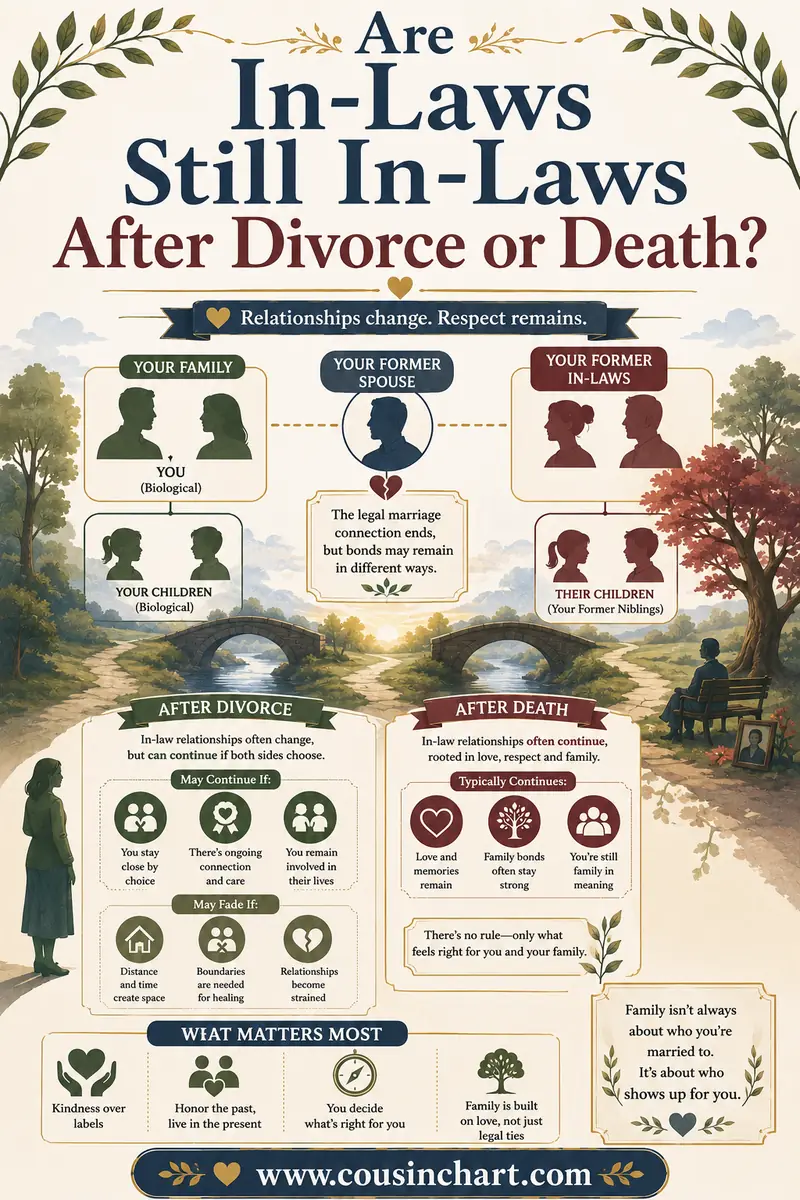
Short answer: after divorce, in-law relationships formally end — your ex-spouse's mother becomes your ex-mother-in-law. After a spouse's death, most families keep the titles — a widow's mother-in-law usually stays "my mother-in-law," because the marriage wasn't dissolved, it was ended by loss. In both cases, one thing never moves: every blood relationship in the family, especially the children's, stays exactly as it was.
That's the map in three sentences; the terrain has more texture. This guide covers the vocabulary for former in-laws, what (if anything) the law says, how grandparents fit after a split, and what to call people at the next wedding or funeral. For any specific connection, the free family relationship calculator on our homepage names it in seconds.
Relationship quick-check. Tap a phrase to see the correct term:
The answer will appear here.
The Core Rule: Marriage Made It, So the Marriage's End Reshapes It
In-law relationships are relationships of affinity — they exist because a marriage connects two families. That gives them a simple lifecycle logic:
- Divorce dissolves the marriage, so the affinity formally dissolves with it. Your ex-wife's father isn't your father-in-law anymore; he's your ex-father-in-law (or "former," which some prefer as gentler).
- Death ends a marriage without repudiating it. Nothing was dissolved, so most families — and most etiquette guides — treat the titles as continuing: a widower still says "my mother-in-law." Some people eventually shift to "my late wife's mother," especially after remarrying. Both are correct; the choice is emotional, not technical.
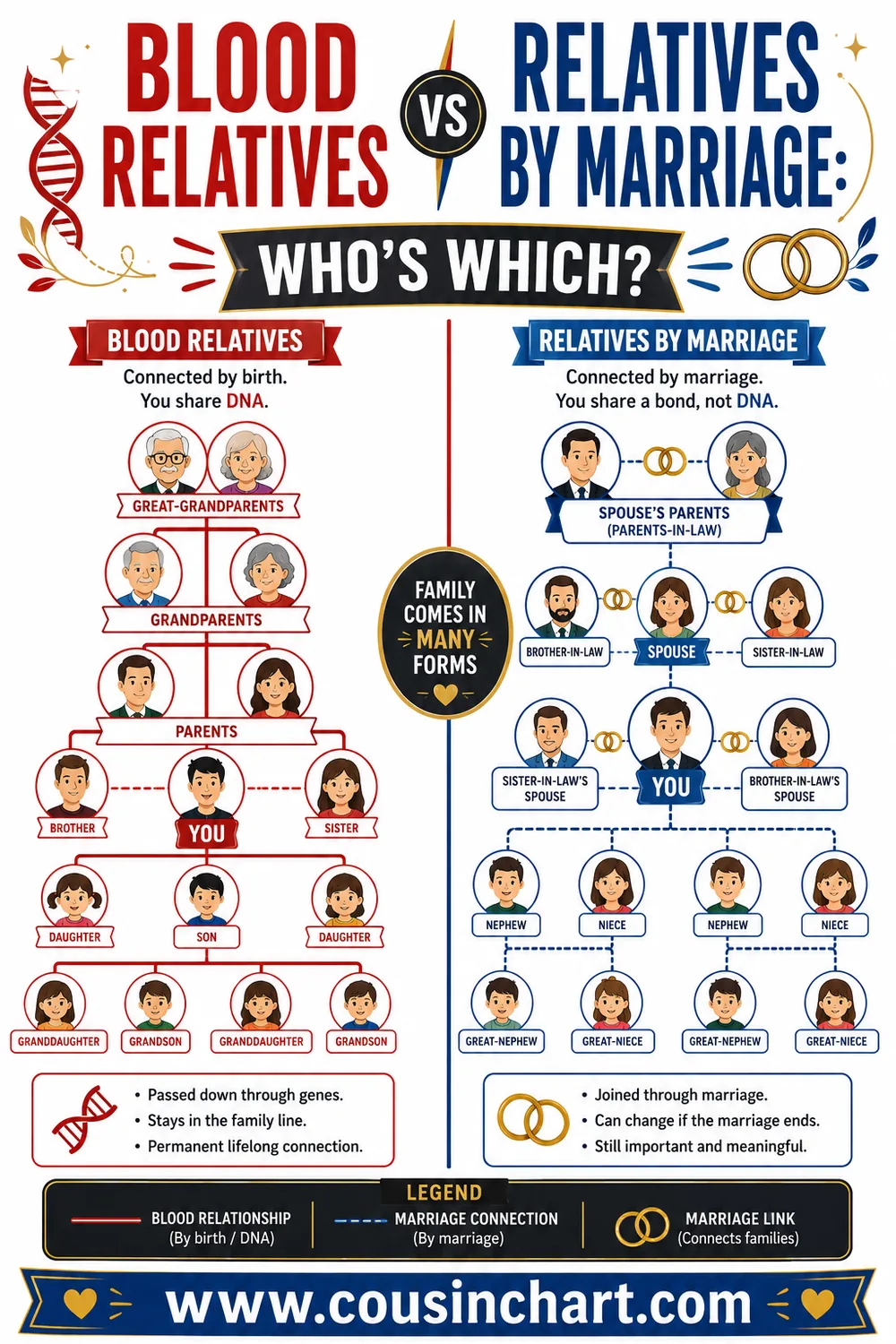
Meanwhile, consanguinity — blood — is untouchable. Your children's relationship to their grandparents, aunts, uncles, and cousins on your ex's side is written in descent, not in your marriage certificate. The blood vs marriage divide is the single most useful lens for every question on this page.
What to Call Former In-Laws (A Practical Glossary)
English has no elegant standard here, so people assemble labels from parts. All of these are in normal use:
| Situation | Common terms |
|---|---|
| Ex-spouse's mother | Ex-mother-in-law, former mother-in-law, "my kids' grandma" |
| Ex-spouse's sibling | Ex-brother/sister-in-law, "my ex's brother" |
| Late spouse's parents | Usually still mother-/father-in-law; "my late husband's parents" |
| Your child's ex-spouse | Former son-/daughter-in-law, "my grandkids' dad/mom" |
| Ex-spouse's new partner's family | No relationship, no term |
Two patterns worth noticing. First, "my kids' grandma" style descriptions are doing heavy lifting in modern families — they route the label through the children's blood tie, which is permanent and neutral, and neatly sidestep the ex- prefix. Second, the ex- prefix describes status, not hostility. "Ex-mother-in-law" can name a woman you have lunch with weekly; plenty of former in-law bonds outlast the marriages that created them.
After a Death: Titles Held in Love
When a marriage ends in death, the surviving family typically closes ranks around continuity:
- A widow or widower generally remains "our daughter-in-law / son-in-law" to the late spouse's parents — often for life, and frequently even after remarriage, softening to "our first son-in-law" or simply a name held with affection.
- The in-law titles have real work to do here: they describe an ongoing web of grief, grandchildren, and shared history. Dropping them would misdescribe the family, so people don't.
- If the survivor remarries, the two sets of in-laws coexist. The new spouse's parents are the current parents-in-law; the late spouse's parents remain what the family says they are. Trees record both marriages — genealogy has never required families to have only one chapter.
There's no etiquette failure in any direction: "my mother-in-law," "my late wife's mom," and "Barbara" are all respectful. Follow the lead of the people closest to the loss.
What the Law Thinks (Lightly — It Mostly Doesn't)
For most everyday purposes, in-law status carries little legal weight, so its ending changes little. Where it does surface:
- Affinity in legal rules. Some rules that mention relatives by marriage — conflict-of-interest, evidence, or ethics provisions — treat affinity as ending with divorce; a few contexts treat it as continuing while there are living children of the marriage. It's jurisdiction- and statute-specific, so if something legal actually turns on it, check the current law that applies to you.
- Inheritance. In-laws (current or former) generally have no place in default inheritance orders anyway; spouses do, and divorce removes an ex-spouse from that role in most US states. Wills can name anyone, including former in-laws.
- Grandparents. Grandparents' relationships to grandchildren are blood ties and don't end with the parents' divorce. Whether grandparents can enforce visitation over a parent's objection varies widely by state and circumstance — a genuine ask-a-lawyer topic, not a chart topic.
The honest summary: the emotional and social questions here are bigger than the legal ones for most families.
The People Who Don't Move: Kids, Cousins, Co-Grandparents
Redraw the tree after a divorce and notice how little actually changes:
| Relationship | After the divorce |
|---|---|
| Kids ↔ both parents | Unchanged — blood |
| Kids ↔ grandparents on both sides | Unchanged — blood |
| Kids ↔ aunts, uncles, cousins on the ex's side | Unchanged — blood |
| You ↔ ex's parents | Ex-in-laws (social choice from here) |
| You ↔ ex's new spouse's family | Never related, before or after |
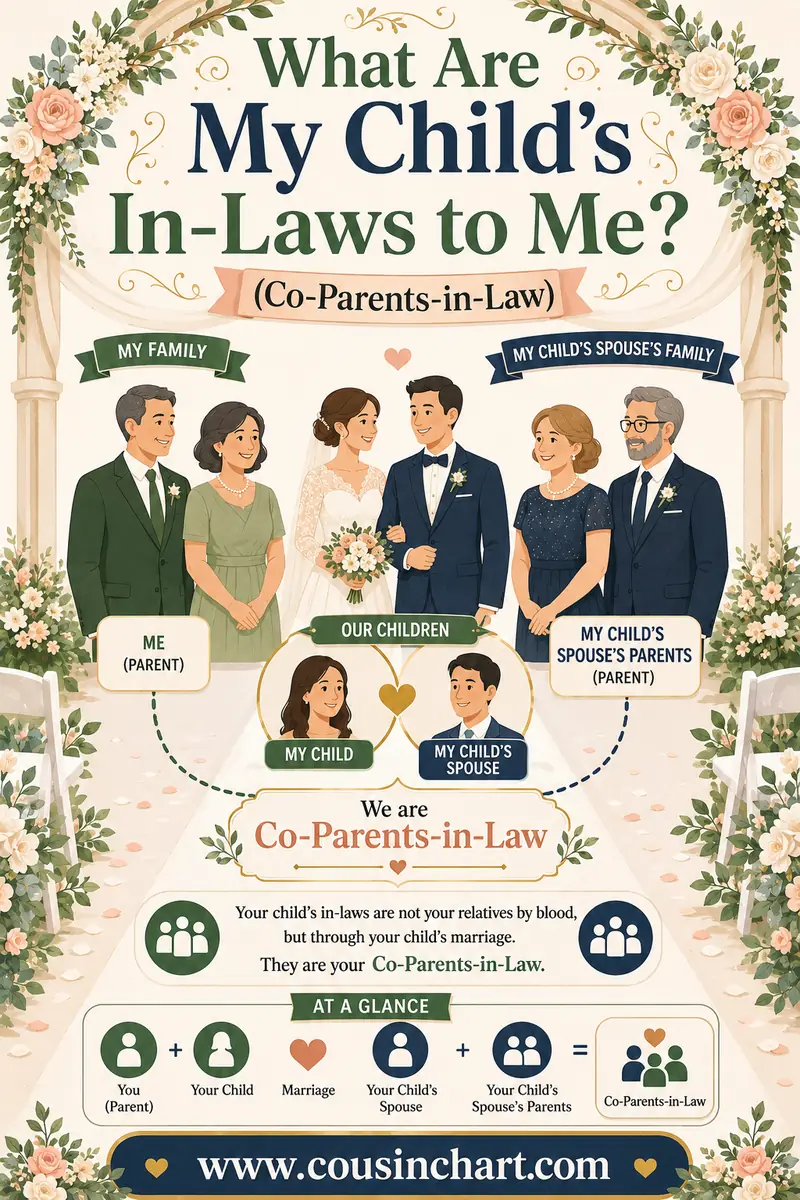
| You ↔ your child's ex's parents | No longer co-parents-in-law — but still co-grandparents of the same kids |
That last row is the quiet big one for the older generation: when your child divorces, you and the other grandparents lose the co-in-law label and keep the grandchildren — which means holidays, logistics, and diplomacy continue indefinitely. Families who name that reality early ("we're the grandparent team, whatever the kids do") tend to navigate it best.
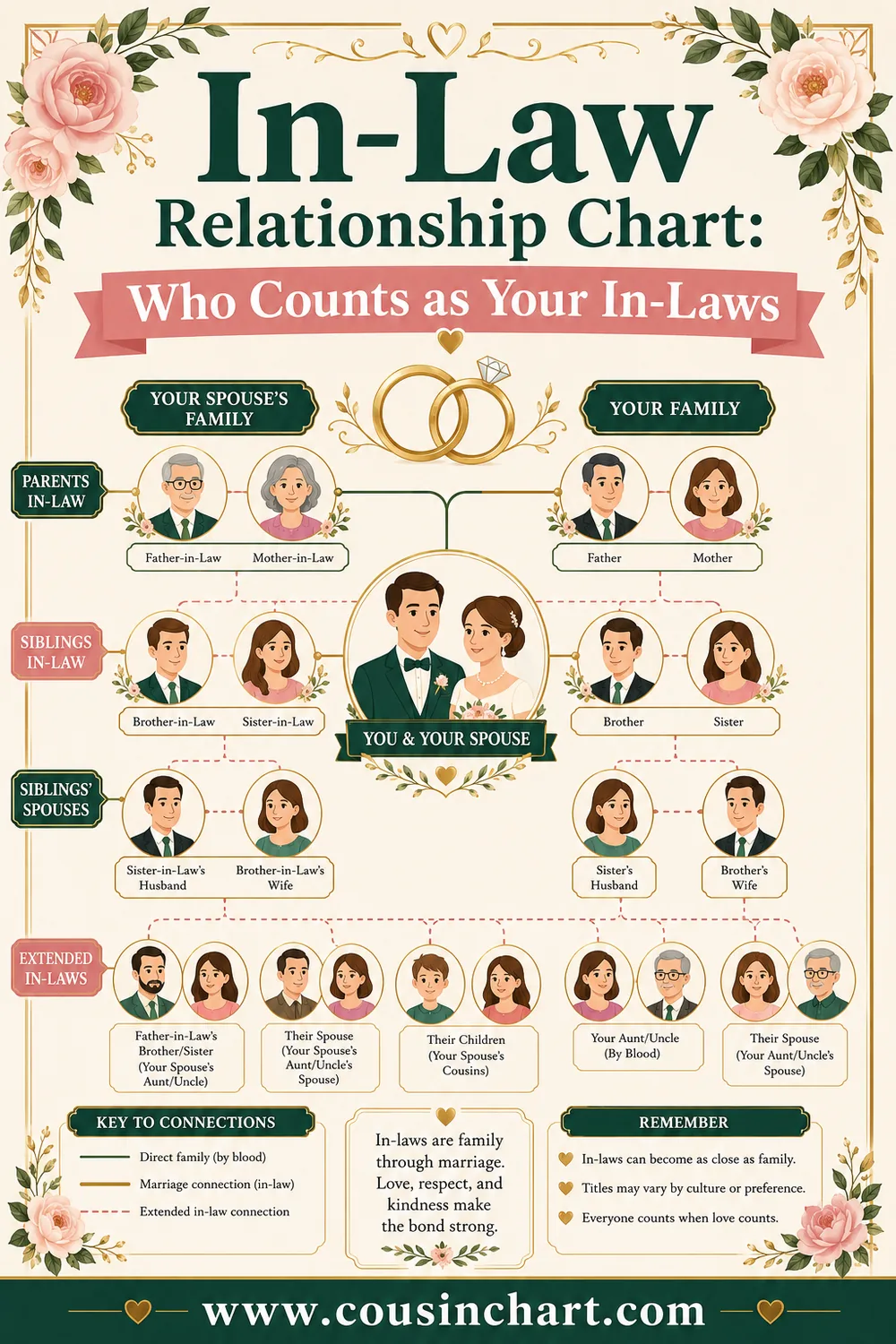
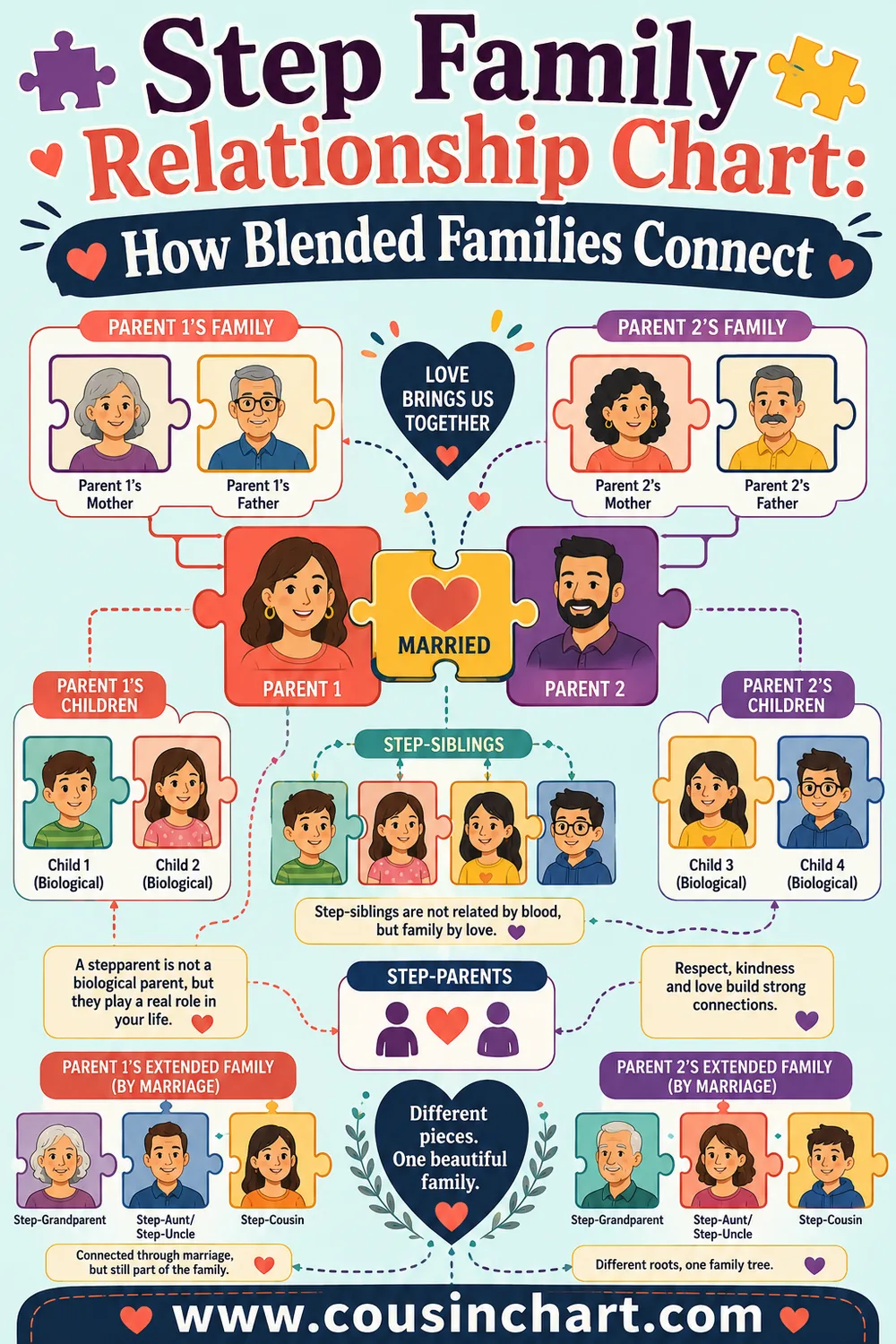
Remarriages then layer new people onto this stable core — step-parents, step-grandparents, step-siblings — without deleting anyone. That's the whole art of reading a blended tree: additions are real, deletions are rare. Our step family relationship chart maps those additions, and the in-law relationship chart covers the marriage-side vocabulary end to end.
Etiquette in the Wild: Four Common Moments
- Introducing an ex-in-law. Lead with the living connection: "This is Carol — my kids' grandmother." Accurate, warm, zero awkward prefixes.
- Weddings and funerals. Former in-laws attend on the strength of relationships, not titles. Seat by closeness, introduce by connection to the person being celebrated or mourned.
- The grandkids' vocabulary. Children keep calling grandparents, aunts, and cousins what they've always called them. Adults' splits shouldn't rewrite kids' kinship — and genealogically, they don't.
- Holiday cards and group chats. No rule survives contact with a real family. If "Mom" still fits your ex-mother-in-law, that's between the two of you, and the chart approves.
How to Record All This on a Family Tree
Genealogy has a calmer take than etiquette does: nothing gets erased. A divorce is an event, not a delete key.
- Record every marriage with its dates — start and, where applicable, end. Your ex-spouse remains on the tree as the other parent of your children forever; the divorce date simply closes the marriage's chapter. Software like Ancestry and FamilySearch handles multiple spouses per person routinely.
- Don't remove former in-laws' families. Your ex's parents stay on the tree as your children's grandparents. Deleting them orphans half your kids' ancestry — the most common self-inflicted wound in post-divorce tree editing.
- Late spouses stay exactly where they are. A remarriage after widowhood adds a spouse; it demotes no one. Descendants researching the family a century from now will want both marriages, both sets of in-laws, and the dates that sequence them.
- Use notes for the social layer. "Remained close to the Hendersons after the divorce" is genuinely valuable context that no relationship field can capture — future researchers puzzling over why your kids appear in Henderson family photos will thank you.
The chart-level takeaway mirrors the emotional one: the tree records what happened, all of it, and lets the living decide what the connections mean today.
FAQ
Is my ex-husband's mother still my mother-in-law?
Formally no — divorce ends in-law status, making her your ex- (or former) mother-in-law. Socially, you can maintain any relationship you both want; many people stay close, especially where grandchildren are involved.
After my wife died, are her parents still my in-laws?
By common usage, yes — death doesn't dissolve a marriage the way divorce does, and most widows and widowers keep saying mother- and father-in-law. "My late wife's parents" is equally correct if it fits better.
Are my kids still related to my ex's family?
Completely. Grandparents, aunts, uncles, and cousins on your ex's side are your children's blood relatives, and divorce has zero effect on blood relationships.
What do I call my daughter's ex-husband?
Former son-in-law, or route through the kids: "my grandchildren's father." If they had no children, "my daughter's ex-husband" is the plain, correct description.
Do former in-laws have any inheritance rights?
Not by default — in-laws generally aren't in intestate succession orders even during a marriage, and an ex-spouse loses spousal rights on divorce in most states. Anyone can still be named in a will. Laws vary by state; check current law for real decisions.
If I remarry after being widowed, do I lose my late spouse's in-laws?
No one is subtracted. Your new spouse's parents become your current parents-in-law, and your late spouse's parents remain whatever your family's usage has settled on — for many, still "Mom and Dad" plus a lifetime of shared grandchildren. Trees record both marriages side by side.
What are my ex-in-laws to my new spouse?
Nothing, in kinship terms — no marriage connects them. Descriptively, "my spouse's former in-laws," which even genealogists just call "the extended cast."
Keep the Permanent Map Straight
So: divorce retires in-law titles, death usually doesn't, blood never budges, and half the puzzle dissolves once you route labels through the kids. Post-split family trees are mostly additions on top of an unchanging core — and when you need to know what any two people in that layered tree actually are, the free family relationship calculator traces the path and hands you the term, no diplomacy required.