Step Family Relationship Chart: How Blended Families Connect
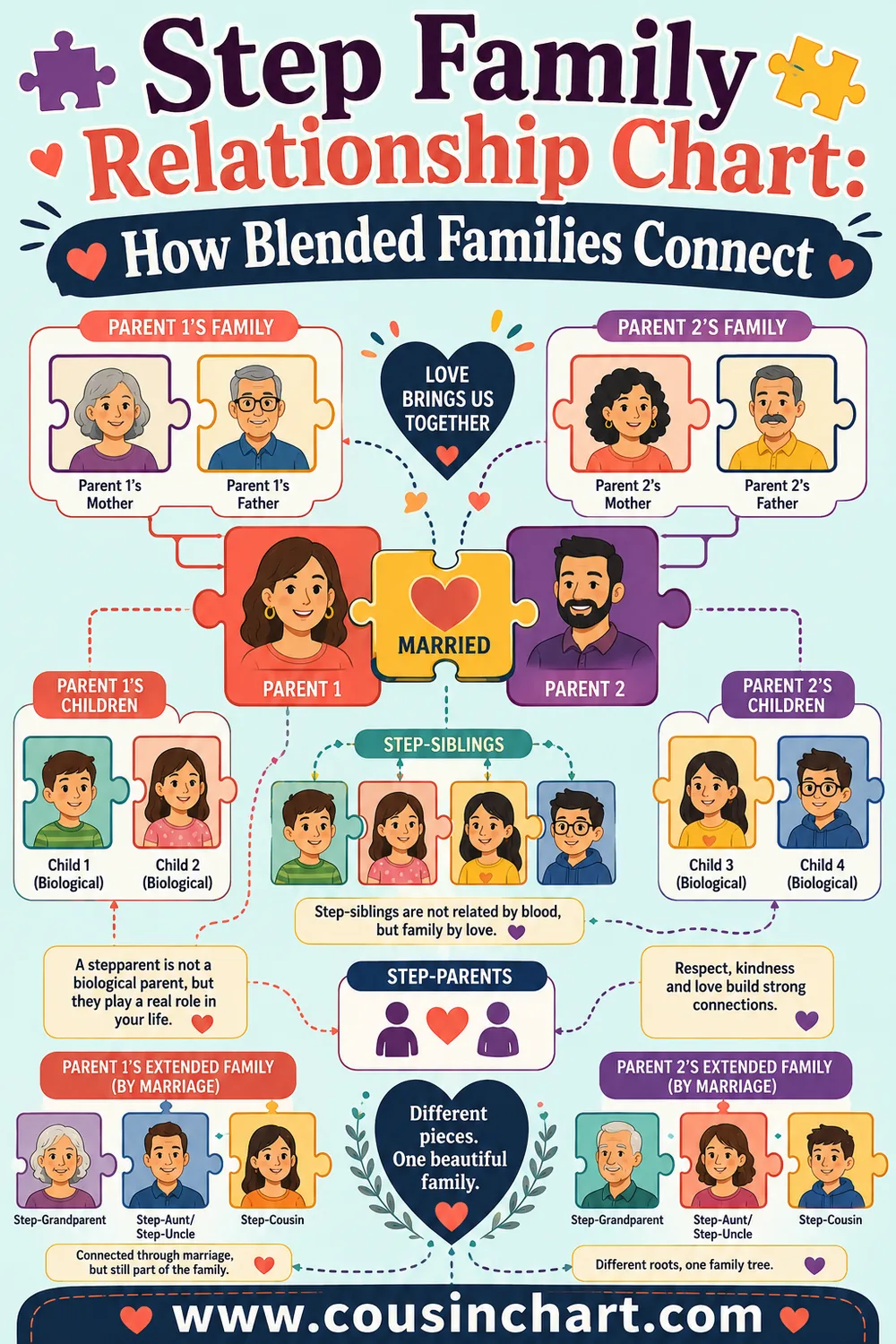
Step-relationships all come from one event: a parent (or grandparent) marries someone new. Your parent's new spouse is your step-parent, that spouse's existing children are your step-siblings, their parents are your step-grandparents — the "step-" prefix simply rides the new spouse's family tree. And the one big exception: if your parent and step-parent have a baby together, that child is your half-sibling, a full blood relative.
Blended families generate more "wait, what do I call them?" moments than any other family shape, so this guide charts the whole system: every step-term, the step/half distinction, what happens to titles after divorce or adoption, and the connections that have no name at all. For any specific tangle, the free family relationship calculator names the link in seconds.
Relationship quick-check. Tap a phrase to see the correct term:
The answer will appear here.
The One Rule Behind Every Step-Term
Take any relative of your step-parent, keep the relationship word, and bolt "step-" on the front. That's the entire system:
- Step-parent's children → step-siblings
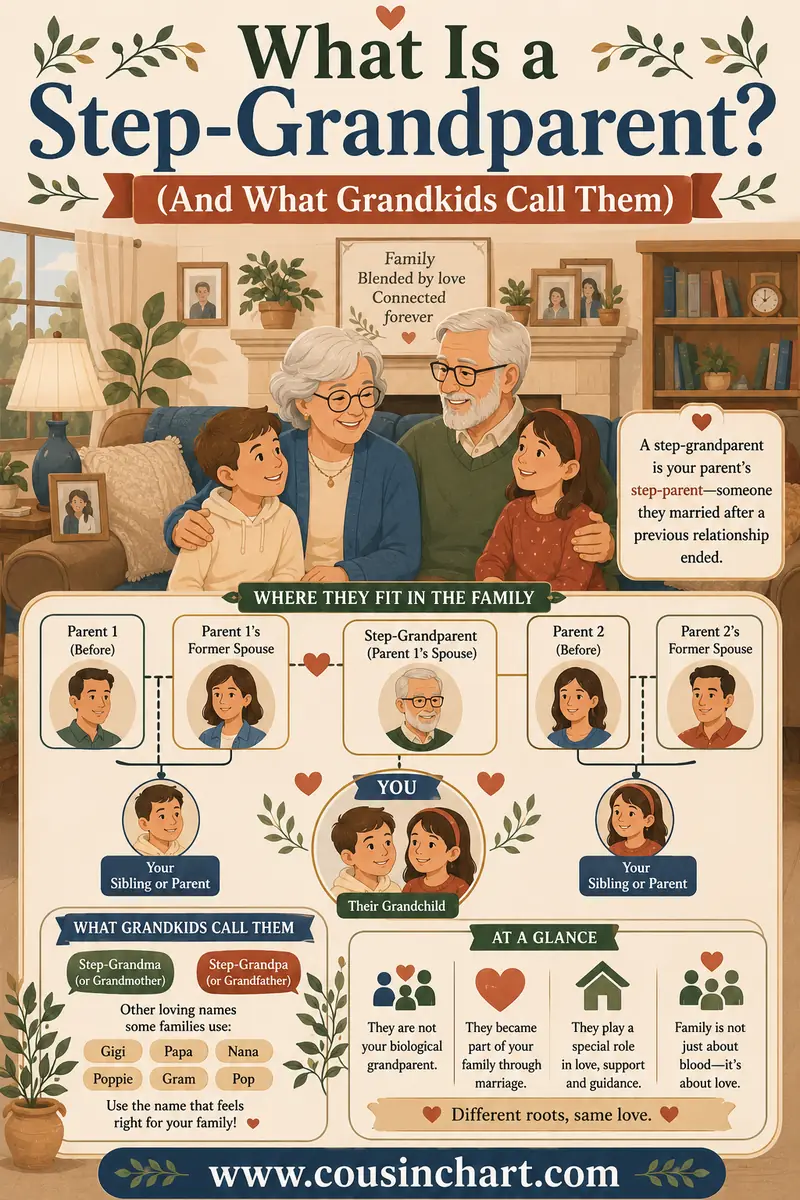
- Step-parent's parents → step-grandparents
- Step-parent's siblings → step-aunts and step-uncles
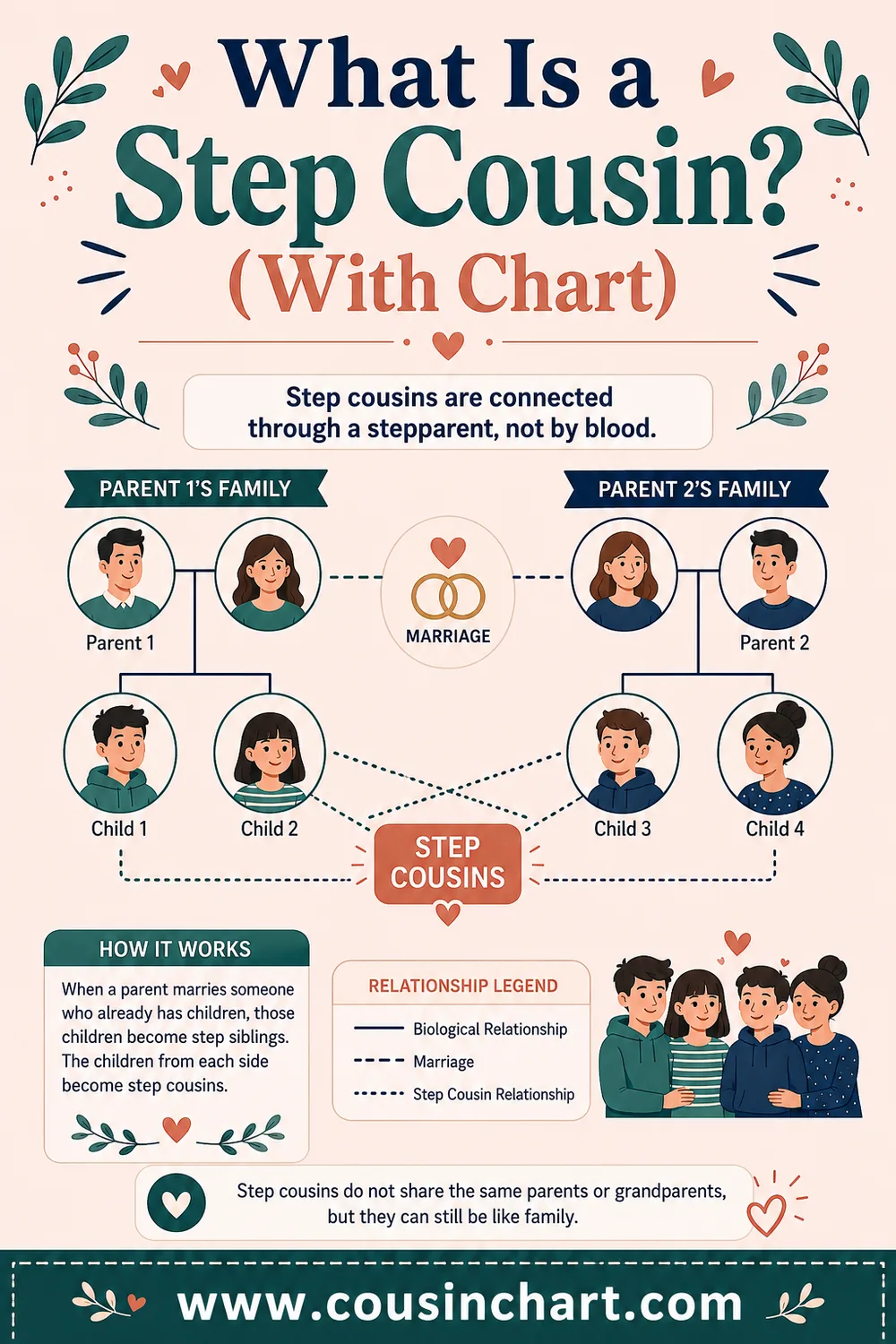
- Step-parent's nieces and nephews → step-cousins
The prefix also runs downhill from the other point of view: you are your step-parent's stepchild, your kids are their step-grandchildren, and if you remarry, your new spouse gains step-versions of your children and grandchildren.
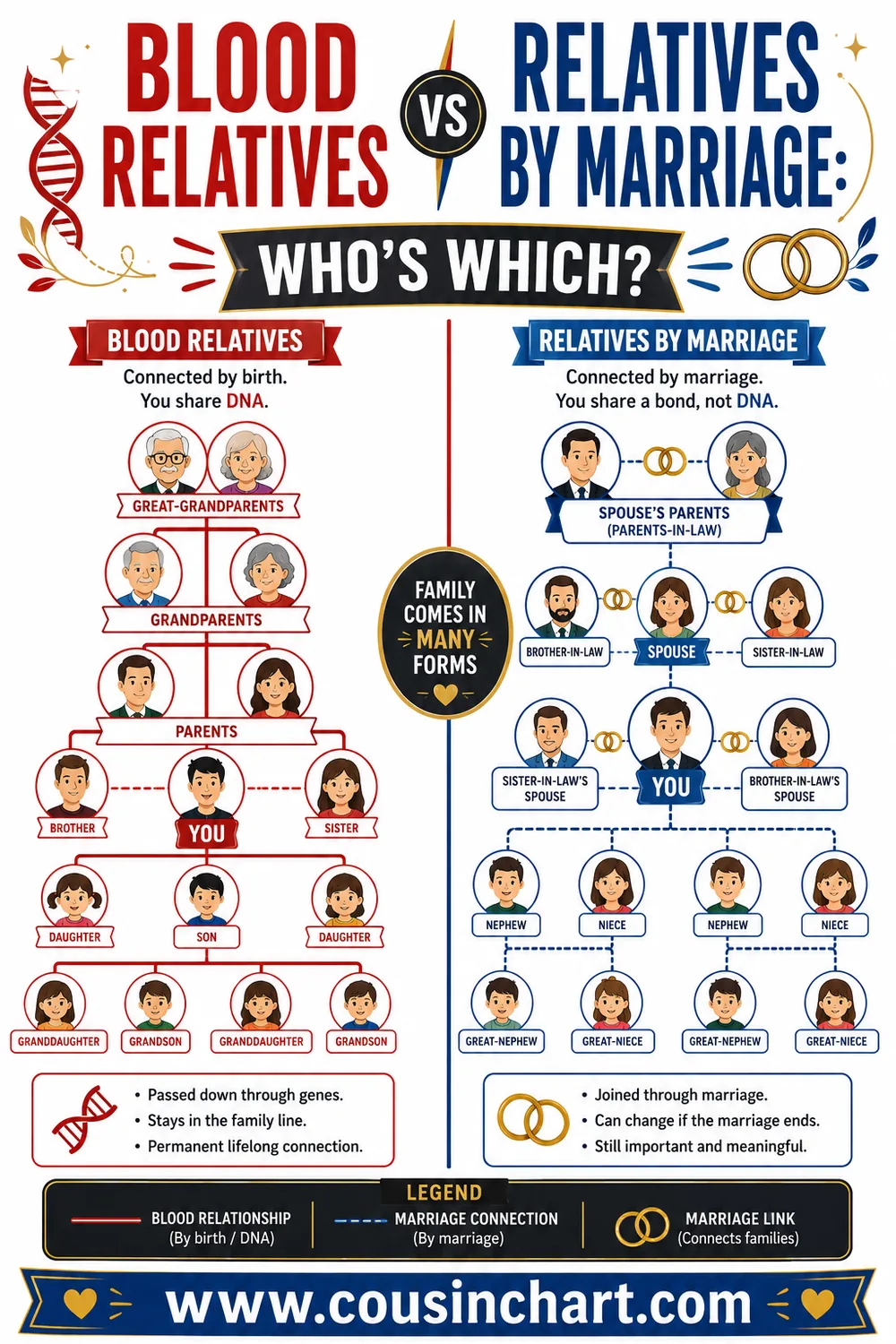
What "step-" always means underneath: connected by a remarriage, with no shared ancestor. Zero DNA travels across a step-link. That's not a value judgment — plenty of step-parents out-parent biological ones — it's just what the prefix records. The full blood-vs-marriage sort is in blood relatives vs relatives by marriage.
The Step Family Relationship Chart
| Person | Your term | Shared DNA |
|---|---|---|
| Parent's new spouse | Step-parent (stepmom / stepdad) | 0% |
| Step-parent's child (from elsewhere) | Step-sibling | 0% |
| Child born to your parent + step-parent | Half-sibling | ~25% |
| Step-parent's parents | Step-grandparents | 0% |
| Step-parent's siblings | Step-aunt / step-uncle | 0% |
| Step-parent's sibling's children | Step-cousins | 0% |
| Grandparent's new spouse | Step-grandparent | 0% |
| Your spouse's child (from elsewhere) | Stepchild | 0% |
| Stepchild's child | Step-grandchild | 0% |
| Step-sibling's child | Step-niece / step-nephew | 0% |
That bolded row is the hinge of every blended family, so let's give it its own section.
Step vs. Half: The Distinction Families Actually Need
The two prefixes get swapped constantly, and they mean completely different things:
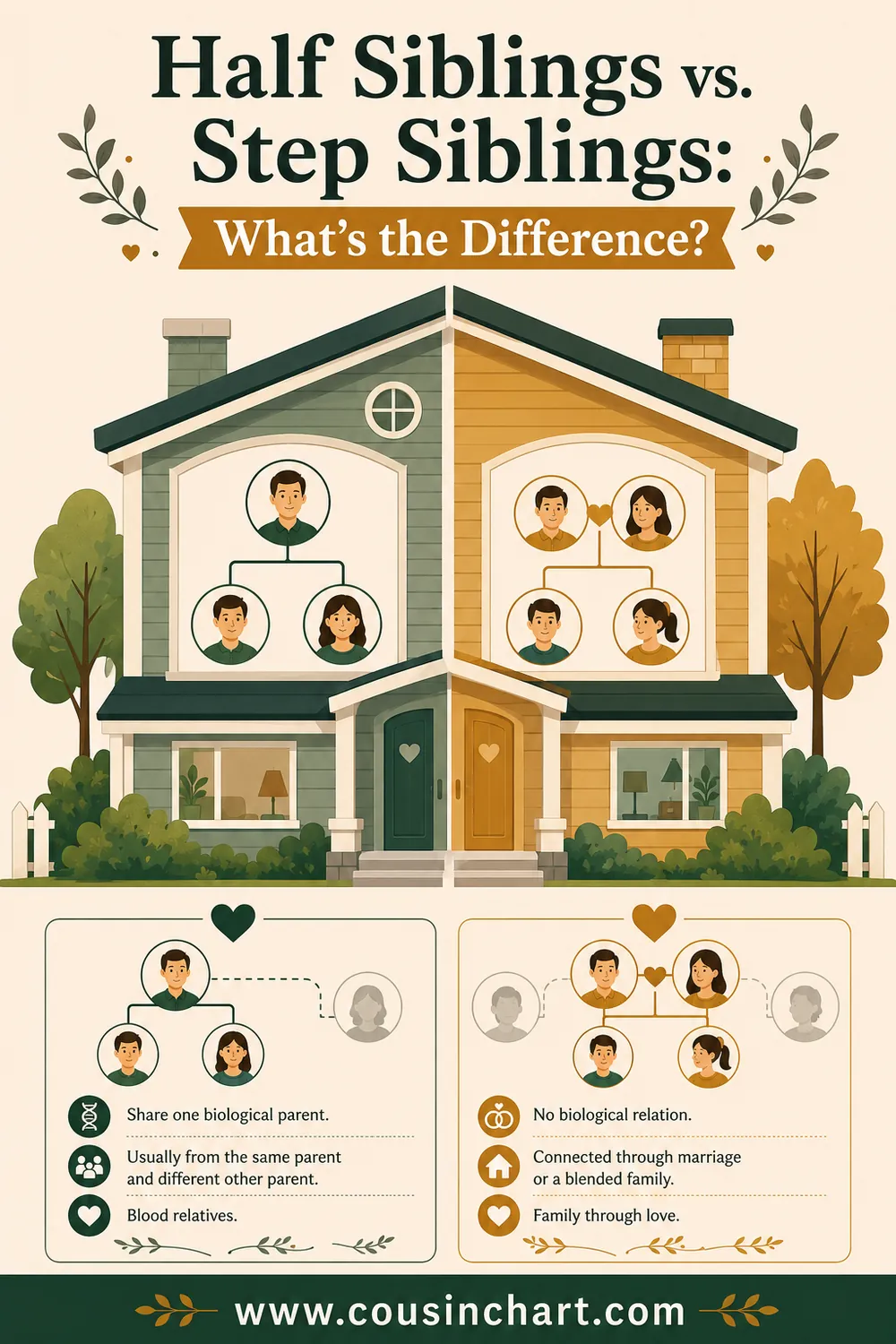
- Step-sibling: your step-parent's child by someone else. You share no parent and no DNA. Your families merged; your bloodlines didn't.
- Half-sibling: your parent's child with your step-parent (or anyone else). You share one parent — about 25% of your DNA, a genuine blood sibling in every genetic and legal sense.
A classic blended household holds both: Mom's kids from her first marriage, Stepdad's kids from his, and a new baby. The first two groups are step-siblings to each other; the baby is a half-sibling to everyone. One child can be the blood link between two families that otherwise share nothing. We compare the two relationships head-to-head in half siblings vs step siblings.
DNA tests draw the line mercilessly: a half-sibling shows up around 1,700–2,300 centimorgans; a step-sibling shows up not at all.
Step-Relationships the Chart Can't Name
Blended families quickly produce connections English never labeled:
- Your step-sibling's children and your children. No shared ancestor, no official term — most families just say cousins and mean it.
- Two step-parents' families to each other. Your stepmom's sister and your mom have no named relationship whatsoever.
- Serial remarriages. A step-parent's ex-spouse, a former step-sibling from a marriage that ended — genealogy software mostly shrugs. Family custom, not kinship charts, governs here.
That's worth saying plainly: the chart runs out before the love does. Kinship terminology tracks ancestry and marriage; it has no column for who showed up to your graduation. Families name these people whatever feels right, and they're right.
Divorce, Death, and Adoption: When Step-Titles Change
Divorce. Formally, step-relationships are created by a marriage and end with it — your ex-stepdad is, to the chart, no longer kin. In real life many step-bonds outlive the marriage that created them, especially for kids raised by a step-parent. "Former stepdad" is a legal description, not an instruction.
Death. When the biological parent dies, most families treat the surviving step-parent's status as unchanged — socially the tie usually deepens rather than dissolves.
Adoption. The big legal transformer. If a step-parent legally adopts a stepchild, the "step" disappears: the child becomes their child, full stop — inheritance rights, next-of-kin status, birth-certificate-level kinship. Step-parent adoption is the most common adoption type in the United States.
Inheritance warning. Absent adoption, stepchildren generally have no automatic inheritance rights from a step-parent in most U.S. states — a step-parent who means to provide for stepkids needs a will that says so. Laws vary by state; check current law.
The generational versions matter too: a grandparent's remarriage makes a step-grandparent, with the same social warmth and the same legal thinness. And step-cousins — the most distant commonly-used step-term — get their own explainer at what is a step cousin.
A Worked Example: One Blended Family, Fully Labeled
Abstract rules are fine, but blended families live in specifics. So here's one household, labeled end to end.
Maria has two kids from her first marriage, Ava and Ben. She marries Dan, who has a daughter, Chloe, from his first marriage. Dan's mother is Ruth, and his sister Kate has a son named Marcus. Two years in, Maria and Dan have a baby, Eli.
Now run the chart:
| Pair | Relationship | Why |
|---|---|---|
| Ava & Dan | Stepdaughter / stepfather | Dan married Ava's mom |
| Ava & Chloe | Step-sisters | Connected only through the remarriage |
| Ava & Ruth | Step-granddaughter / step-grandmother | The prefix rides up Dan's tree |
| Ava & Marcus | Step-cousins | Marcus is her step-parent's nephew |
| Ava & Eli | Half-siblings | Both are Maria's children — blood |
| Chloe & Eli | Half-siblings | Both are Dan's children — blood |
| Ava & Kate | Step-niece / step-aunt | Dan's sister |
| Maria & Chloe | Stepmother / stepdaughter | Maria married Chloe's dad |
Notice the quiet star of the table: Eli. He's a blood half-sibling to Ava, Ben, and Chloe — the only person in the house genetically related to both original families. Ava and Chloe still share no DNA with each other, but they now share a brother, which is its own kind of glue. Genealogists sometimes call kids like Eli a "bridge child," because on a family tree he's literally the point where two unconnected trees touch.
One more wrinkle worth tracing: Ava and Marcus are step-cousins, but Eli and Marcus are first cousins outright — Eli is Dan's son, Marcus is Dan's sister's son, shared grandparents, roughly 12.5% DNA. The same remarriage that creates step-relatives for the older kids creates plain old blood relatives for the new baby. Two children in the same bedroom can have completely different relationships to the same relative, and both labels are correct.
Recording Step-Relatives in a Family Tree
Step-relationships also trip people up on paper, so here's how the record-keeping world handles them:
- Genealogy software (Ancestry, FamilySearch, Gramps) doesn't draw a "step" line at all. You record the remarriage itself — parent marries new spouse — and the software infers the step-links from it. Enter Chloe as Dan's daughter and Dan's marriage to Maria, and Chloe correctly appears as connected by marriage, not descent. Never enter a step-parent as a biological parent to make the tree "look right"; it corrupts every DNA and descent calculation downstream.
- Medical history forms want blood only. A step-parent's heart disease is irrelevant to your genetic risk, but a half-sibling's absolutely counts. When a form says "family history," translate it as "biological family history."
- School and emergency forms are the opposite: they care about the household, not the bloodline. A step-parent is usually listed as a parent/guardian contact, and that's exactly what those forms are for.
- Obituaries traditionally name stepchildren and step-grandchildren explicitly ("survived by his children A and B, stepchildren C and D…"), though many families now merge everyone into "children." Either is fine; just be consistent so future genealogists aren't misled.
The pattern across all four: know which question the paperwork is really asking — who shares your DNA or who shares your life — and answer that one.
A tip for anyone researching a blended family line: always chase the marriage record for the remarriage itself. It's the document that creates every step-relationship in the household, it usually names both spouses' prior status (widowed or divorced), and it's often the only paper trail proving that two sets of children in one census household weren't biological siblings. A 1940 census taker who wrote "son" for every boy in the house wasn't wrong socially — but the marriage certificate is what untangles the tree.
What Do Kids Actually Call Step-Relatives?
Whatever works. Common patterns, all legitimate:
- First names for step-parents (the most common modern default, especially for older kids).
- "Mom"/"Dad" when the step-parent raised them — the child's call, never a demand.
- Hybrid titles: "Papa Joe," "Mama T," or a grandparent name invented on the spot for a step-grandparent.
- Dropping "step" entirely in introductions: "my brother," "my sister." Most blended families arrive here within a few years.
The chart terms exist for clarity — doctor's offices, obituaries, genealogy files — not to police the living room.
FAQ
What is my step-parent's family to me?
Step-versions of whatever they are to your step-parent: their parents are your step-grandparents, siblings your step-aunts and step-uncles, and nieces and nephews your step-cousins. All connected by the remarriage, none by blood.
Is my mom and stepdad's baby my step-sibling?
No — that baby is your half-sibling, a blood relative who shares your mother and about 25% of your DNA. Step-siblings are your stepdad's kids from a previous relationship.
Do step-siblings share DNA?
No. Step-siblings have no common ancestor, so a DNA test shows no match. If a test does show shared DNA, you've discovered a half-sibling or another blood connection.
Can stepchildren inherit from a step-parent?
Generally not automatically — in most U.S. states intestacy law passes estates to blood and adopted kin plus the spouse. A step-parent who wants stepchildren to inherit should make a will, or the "step" can be erased entirely through adoption. Laws vary by state.
Are you still step-siblings after your parents divorce?
Legally the tie ends with the marriage that created it; socially it's whatever the two of you decide. Many former step-siblings stay siblings in every practical sense.
What do I call my step-sibling's children?
Step-nieces and step-nephews is the standard extension, though there's no rulebook here. Many families skip the prefix and just say niece and nephew.
Is my step-parent's stepchild anything to me?
Officially, no. If your stepdad also has a stepdaughter from an earlier marriage, the two of you are connected by two different marriages and share neither blood nor a common household rule — English has no term for it. Some people jokingly say "step-step-sibling," which is as good a label as any.
Map Your Blended Family in Seconds
One remarriage, one prefix, one exception: "step-" rides the new spouse's whole tree, and any child the couple has together is a half-sibling — blood, not step. Everything else is family custom, which outranks the chart anyway. When your blended tree produces a genuine puzzler — your stepdad's mother's new husband, your half-sister's step-cousin — feed it to the free family relationship calculator. Tap the path, get the term (or the honest answer that English doesn't have one), and see the whole connection drawn out. Free, instant, and blend-proof.