What Is a Step-Grandparent? (And What Grandkids Call Them)
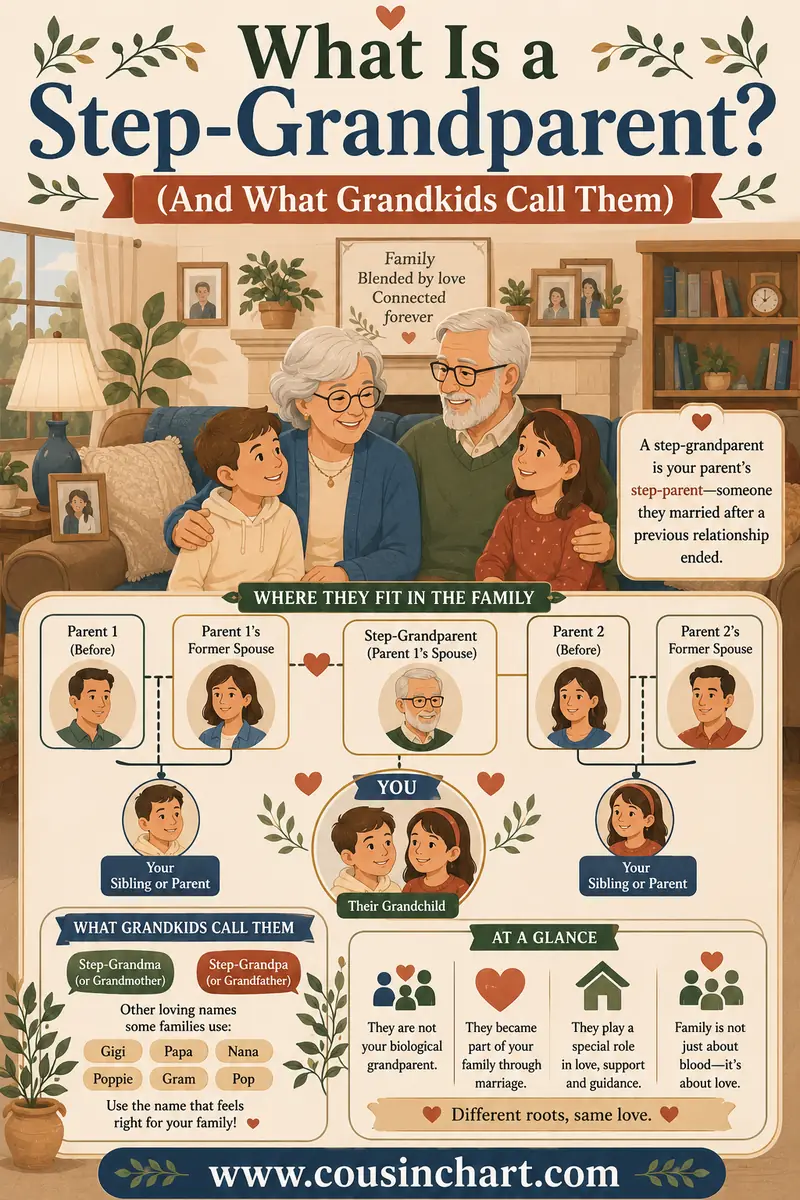
A step-grandparent is a grandparent by marriage rather than blood — either your grandparent's spouse who isn't your biological grandparent, or your step-parent's mom or dad. No DNA connects you, but the role can be every bit as real as any other grandparent's, and plenty of kids never even learn which of their grandparents came with a "step."
Two different family paths produce the same title, which is where most of the confusion lives. This guide separates the two routes, covers what grandkids actually call step-grandparents, and maps how the rest of the blended tree hangs together. For any specific pair of relatives, the free family relationship calculator on our homepage names the connection instantly.
Relationship quick-check. Tap a phrase to see the correct term:
The answer will appear here.
The Two Routes to "Step-Grandparent"
Both of these produce a genuine step-grandparent, and many families have one of each:
- A grandparent remarries. Your grandfather's second wife is your step-grandmother. Your parent's relationship to her is step-parent/step-child; yours is step-grandchild. This is the classic route — grandparent remarriage after divorce or widowhood.
- A parent remarries. Your stepmother's parents are your step-grandparents. Here the "step" starts at your own parent level and rides one generation up.
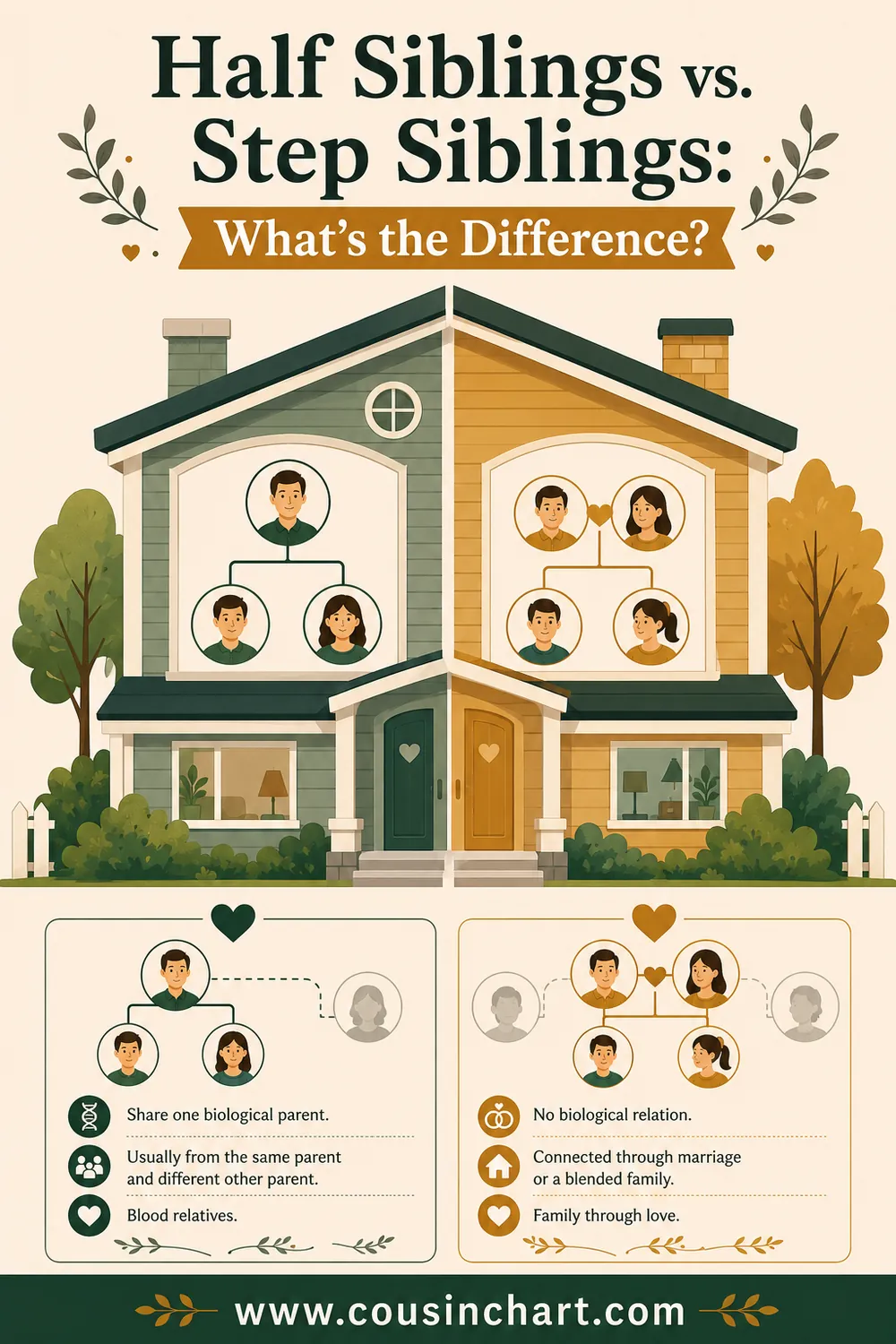
The mechanics are identical to every other step-relationship: a marriage bridges two families, and everyone on the far side of the bridge picks up a "step" title. Nobody gains shared DNA; the connection is affinity, not blood — the same distinction that separates half-siblings from step-siblings one generation down.
Step vs Blood vs Half: The Grandparent Tier
The grandparent generation collects labels fast in a blended family, so here's the tier sorted:
| Term | Who they are | Blood? | Avg shared DNA |
|---|---|---|---|
| Grandparent | Parent's biological/adoptive parent | Yes | ~25% |
| Half-relationships don't exist here* | — | — | — |
| Step-grandparent | Grandparent's spouse, or step-parent's parent | No | 0% |
| Great-grandparent | Grandparent's parent | Yes | ~12.5% |
One nuance worth a beat: there's no such thing as a "half-grandparent." Halves happen between siblings who share one parent — the grandparent themselves is always fully a grandparent to their own grandchildren. What a grandparent's remarriage does* create is half-relationships in the next generations: children from the new marriage are your parent's half-siblings, making them your half-aunts and half-uncles.
That's the key sorting trick for the whole blended tree: new babies from the remarriage = half relatives (blood); people who arrived with the new spouse = step relatives (no blood).
What Do Grandkids Call a Step-Grandparent?
Whatever the family decides — there's no rule, and that's genuinely the answer. The common patterns:
- The standard grandparent name. "Grandma Sue," "Papa Joe" — most families, especially when the step-grandparent arrived before the grandkids were born, use grandparent names without a second thought.
- A distinct grandparent-style name. Gigi, Mimi, Nonna, Pop — a warm title that sidesteps duplicate "Grandmas" at the same table. Handy when kids already have four grandmothers in rotation.
- First names. Common when the step-grandparent arrived later in the grandkids' lives.
- "Bonus grandma / bonus grandpa." The affectionate modern label some blended families prefer over "step" — same spirit as bonus mom.
One practical tip from blended-family veterans: let the step-grandparent and the parents pick together, early, and then be consistent. Kids adapt to any name instantly; it's the adults who trip over a mid-stream change.
The Rest of the Bridge: Who Else You're Step-Connected To
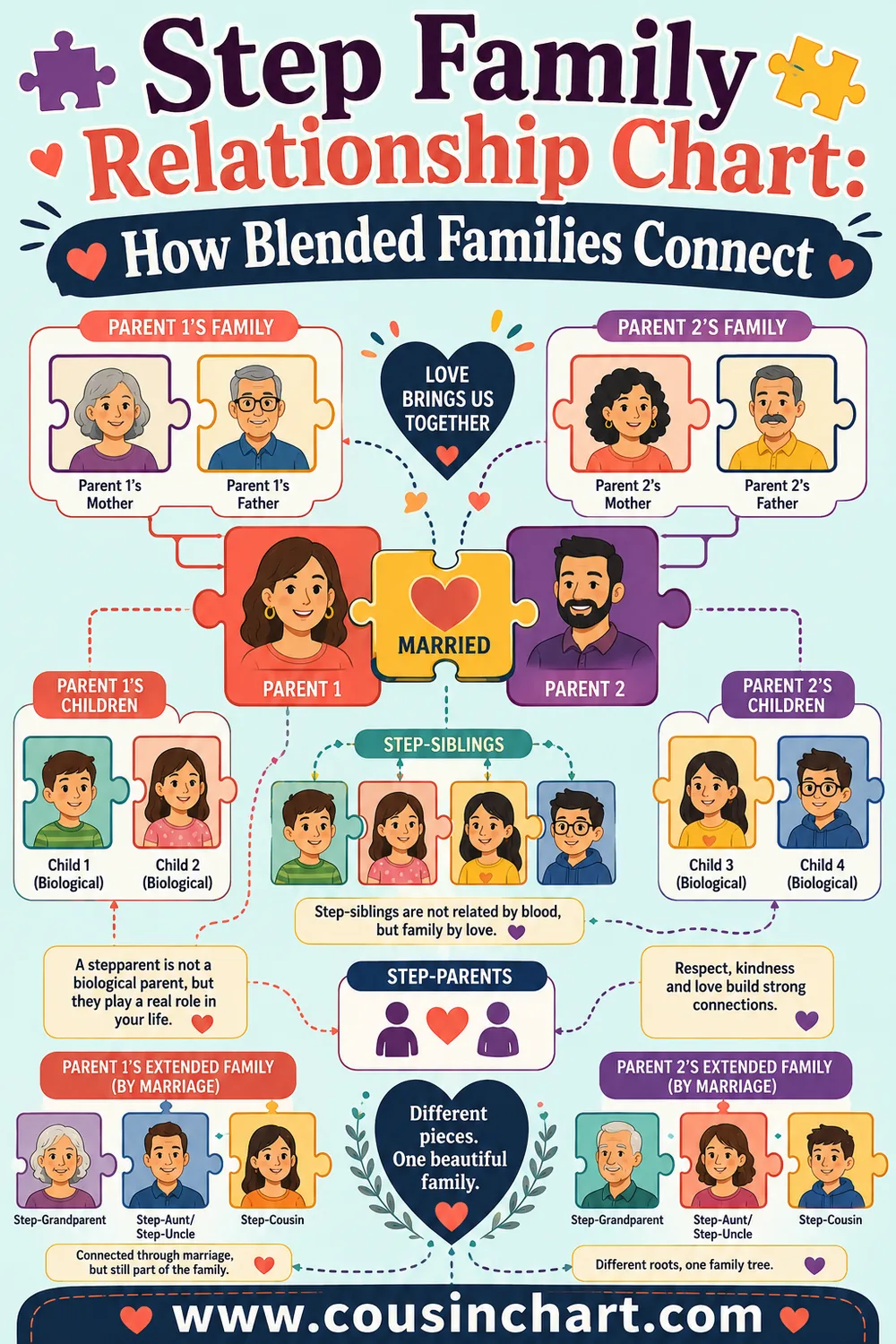
A grandparent's remarriage rarely brings just one person. Here's how the new spouse's family maps to you:
| Person | Relationship to you | Type |
|---|---|---|
| Grandpa's new wife | Step-grandmother | Step (marriage) |
| Her children (from before) | Step-aunts / step-uncles | Step |
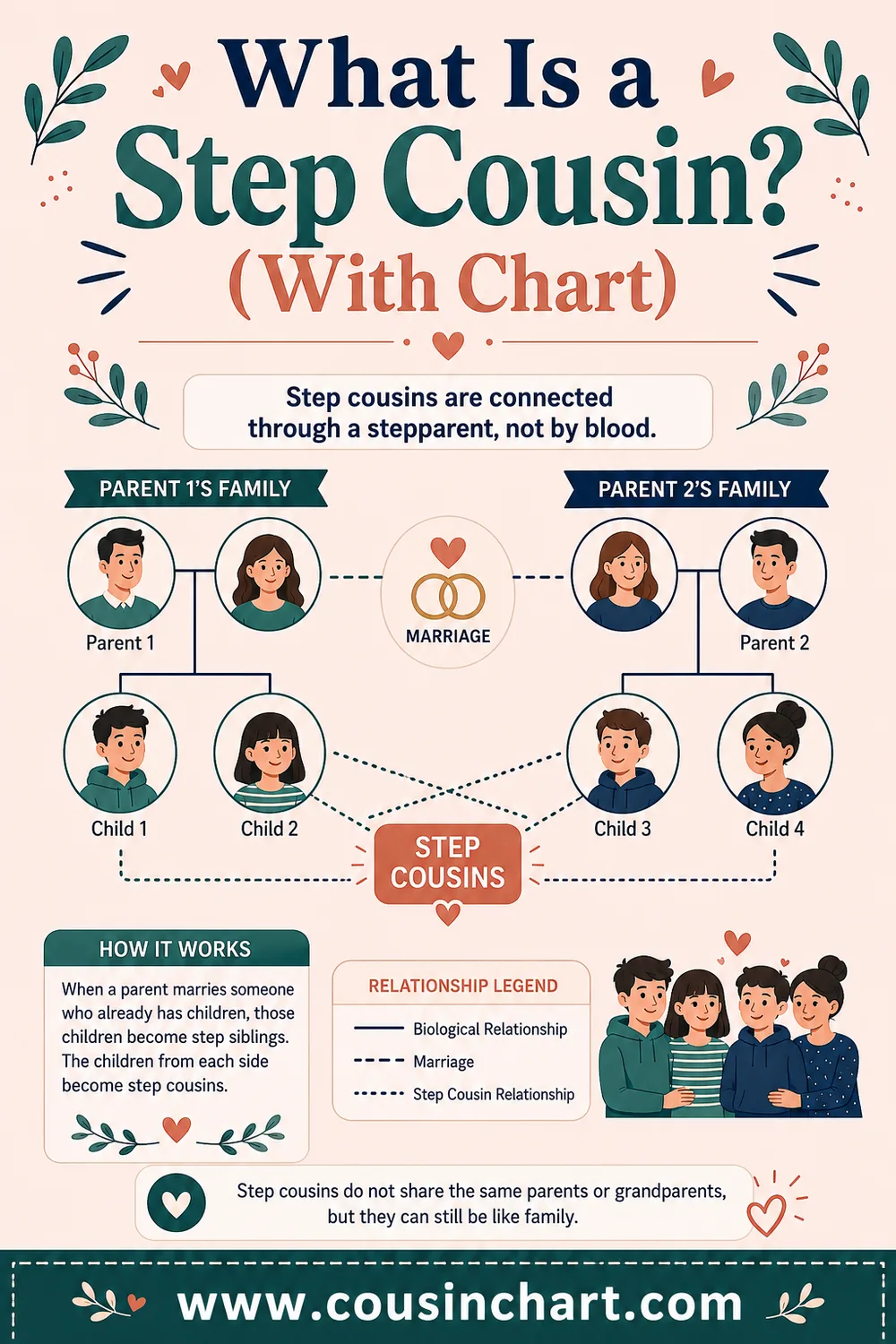
| Her grandchildren | Step-cousins | Step |
| Children she has with your grandpa | Half-aunts / half-uncles | Blood (~12.5%) |
| Those half-aunts' kids | Half first cousins to you | Blood (~6.25%) |
| Her parents, siblings | No standard term | The chain fades out |
Two families can therefore be woven together with blood on one strand and marriage on the other — which is exactly why blended trees feel impossible to narrate at Thanksgiving. Our step family relationship chart maps the full lattice, and the step-cousin explainer covers that corner in detail. Or skip the homework and let the calculator walk any single path for you.
Does a Step-Grandparent Have Legal Standing?
Generally, step-relationships by themselves don't create legal ties — a step-grandparent isn't in the default inheritance line, isn't automatic next of kin, and doesn't gain custody rights through the title alone. A few realities around that baseline:
- Wills work fine. Step-grandparents and step-grandchildren can simply name each other in estate documents; many do.
- Adoption rewires everything. If a step-grandparent legally adopted your parent, they became your parent's parent — full grandparent on the tree, full legal standing, no "step" remaining. Genealogy treats adoption as complete kinship.
- Grandparent visitation and similar family-law questions vary by state and by circumstances; if a real legal question is on the table, current local law is the only reliable source.
On the family tree itself, record the marriage and let the software label the step-relationships — and note adoptions explicitly, because they change the answers.
When the "Step" Quietly Disappears
Here's the human part the diagrams miss: step-grandparent is one of the step-roles most likely to shed its prefix in real life. A step-grandmother who was there for every birthday from day one simply is Grandma — many grandchildren only discover the "step" while building a family tree or sorting a DNA test's results.
Both truths coexist without conflict:
- On the tree and in DNA: step-grandparent, no shared centimorgans, connected via the marriage on such-and-such date.
- In life: Grandma, full stop.
Genealogy needs the first version so that records, matches, and medical histories stay accurate. Families run on the second. Keeping both straight — and knowing which one a given form is asking about — is most of what "understanding your blended tree" means.
A Worked Example: Sorting One Blended Table
Here's a single family that produces both routes at once — trace it slowly and every rule in this article shows up.
Nora's parents divorced when she was small. Her dad married Carol (Route 2: Carol's parents, Bill and June, become Nora's step-grandparents). Meanwhile Nora's maternal grandmother, widowed, married Walt (Route 1: Walt is Nora's step-grandfather).
Now the ripples:
- Walt's son from his first marriage is Nora's step-uncle — he arrived with Walt, so he's on the marriage side of the bridge. His kids are Nora's step-cousins.
- If Nora's grandmother and Walt had been young enough to have a child together, that child would have been Nora's mom's half-sibling — a blood half-aunt or half-uncle to Nora. New babies from a remarriage always land on the blood side.
- Carol's parents, Bill and June, are step-grandparents to Nora but nothing at all, genealogically, to Nora's future children unless the families choose otherwise — step-chains don't automatically extend down another generation the way blood does.
- Carol's sister is Nora's step-aunt; her kids are step-cousins. Same bridge, spreading sideways.
Count the grandparent figures at Nora's Thanksgiving: two biological grandparents, Walt, Bill, and June — five people in grandparent roles, one shared bloodline apiece at most. Perfectly normal blended arithmetic, and precisely the situation the calculator was built to referee.
How to Record a Step-Grandparent in Trees and DNA Notes
Step-grandparents trip up more family trees than almost any other relative, because software wants biological pairs and life keeps supplying remarriages. What works:
- Enter the marriage, not a parent-child link. Add the step-grandparent as your grandparent's spouse (with the marriage date if known). Never attach them as your parent's parent unless an adoption actually happened — that one wrong link silently corrupts every downstream calculation.
- Let the software derive the "step." Ancestry, FamilySearch, Gramps, and most desktop tools display step-relationships correctly once the second marriage is recorded as a marriage.
- Flag adoptions explicitly. If the step-grandparent adopted your parent, record the adoptive parent-child link alongside the biological one where the software allows both. Genealogy convention keeps both lines visible.
- In DNA-match notes, expect zero — and use it. A step-grandparent's own relatives should share no DNA with you. That's diagnostic: if your "step-grandma's nephew" turns up as a 200 cM match, something in the recorded tree is wrong (or there's an undiscovered connection), and that's worth investigating rather than shrugging off.
- Write the story down somewhere. Dates of remarriage, who raised whom, what the grandkids called them — the warm details are exactly what the next generation's researcher will wish existed. Tree software has note fields; use them.
Ten minutes of careful data entry here saves the classic blended-family mess: a tree that claims your step-grandmother is your blood grandmother, and a decade of cousins quietly copying the error.
FAQ
What makes someone a step-grandparent?
Either they married your grandparent (without being your biological grandparent), or they're the parent of your step-parent. Both routes are marriage-based — no shared DNA.
Do I share DNA with my step-grandmother?
No — the relationship is by marriage only. Any children she and your biological grandparent have together, however, are your half-aunts/uncles and do share DNA with you (~12.5%).
What should grandkids call a step-grandparent?
Whatever the family agrees on: a regular grandparent name, a distinct one like Gigi or Pop, a first name, or "bonus grandma." There's no rule — consistency matters more than the choice.
Is my step-grandmother's grandchild related to me?
Not by blood — they're your step-cousin, connected through the remarriage. Kids born to your grandparent and step-grandparent together are a different story: their children are blood relatives of yours.
Does a step-grandparent count as next of kin?
No — step-relationships don't enter default next-of-kin or inheritance orders. Estate planning documents can include anyone, though, and adoption converts a step line into a full legal one. Laws vary by state; check current law for anything consequential.
Is "step-grandparent" the same as "grandparent's partner"?
Technically "step" attaches through marriage. A grandparent's long-term unmarried partner has no formal genealogical title — though many families use grandparent names for them anyway, which is a social choice and a fine one.
Untangle Your Blended Tree in Seconds
So: a step-grandparent is family through a marriage — a grandparent's spouse or a step-parent's parent — with no DNA, no automatic legal standing, and very often a full-sized place in your life regardless. Blended families stack steps, halves, and fulls three generations deep, and nobody should have to diagram that by hand: the free family relationship calculator traces any two people through the tangle and hands you the exact term.