What Is a Step Cousin? (With Chart)
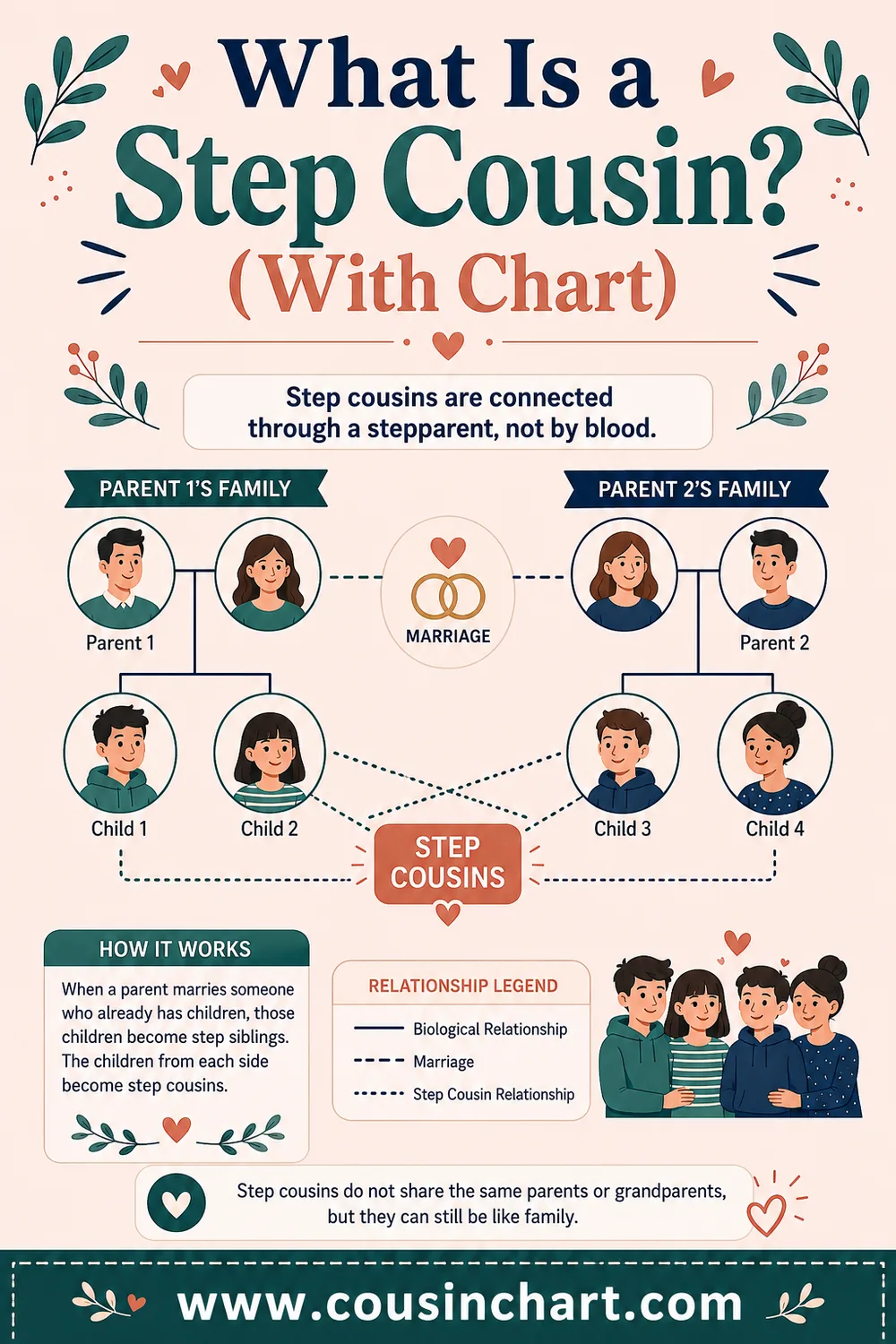
A step cousin is someone who lands in your cousin "slot" through a marriage rather than through blood — most commonly your step-parent's nieces and nephews, or the children of your parent's step-siblings. You share no ancestor and no DNA; you share a family, because two households merged.
Step cousins are held together by relationships, not genetics — which makes the label more flexible, and occasionally more confusing, than blood-cousin terms. This guide maps the three main ways step cousins happen, the chart that separates step from half from in-law, and what (if anything) the term means legally. For the blood side of any tangled tree, the free relationship calculator on our homepage names exact relationships in seconds.
Relationship quick-check. Tap a phrase to see the correct term:
The answer will appear here.
The Three Ways Step Cousins Happen
There's no single blueprint — a step cousin is anyone occupying cousin position through a marriage link. The three common routes:
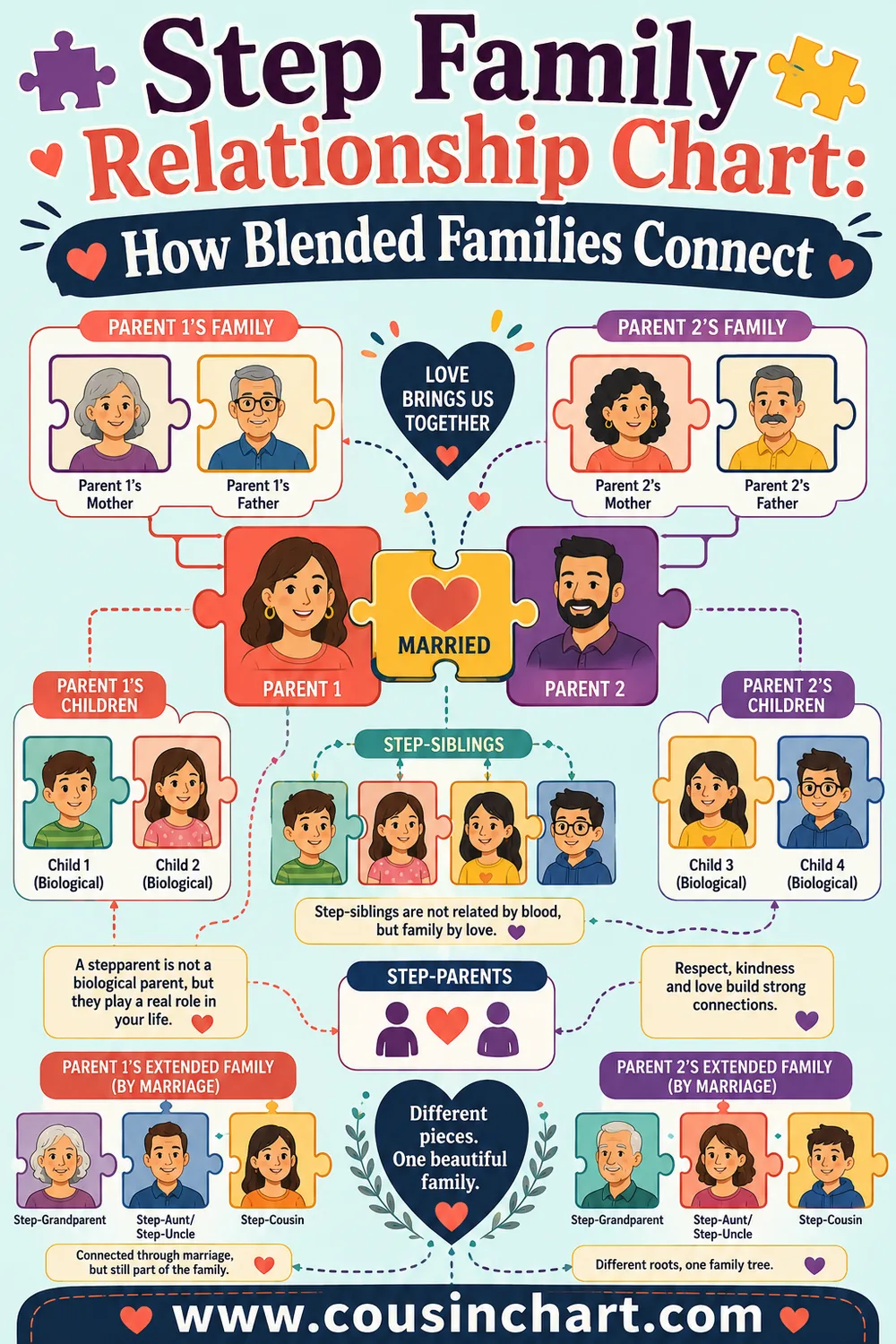
- Through your step-parent. Your parent remarries. Your new step-parent's siblings become your step-aunts and step-uncles, and their children are your step cousins. This is the most common meaning.
- Through a parent's step-sibling. Your grandparent remarried when your parent was young, giving your parent step-siblings. Those step-siblings' kids are your step cousins too.
- Through an aunt or uncle's remarriage. Your aunt marries a man with children from a previous relationship. Her stepchildren — your cousins' step-siblings — are your step cousins in everyday usage.
Notice what all three share: somewhere in the chain there's a marriage where a blood link would normally be. That's the defining feature. If you can walk person-to-person from you to them using only parent/child/sibling links, they're blood family. If one hop requires "married," you're in step (or in-law) territory.
Step vs Half vs In-Law: The Chart
These three prefixes get scrambled constantly, and they mean totally different things:
| Step-cousin | Half cousin | Cousin-in-law | |
|---|---|---|---|
| How connected | A remarriage in the chain | Blood — via half-siblings | Marriage to your cousin |
| Shared ancestor? | No | Yes — one grandparent | No |
| Shared DNA | 0% | ~6.25% | 0% |
| Example | Stepdad's nephew | Dad's half-brother's daughter | Cousin's husband |
| Shows up on DNA test? | No | Yes | No |
| On your family tree? | Optional side branch | Yes, always | Usually noted as spouse |
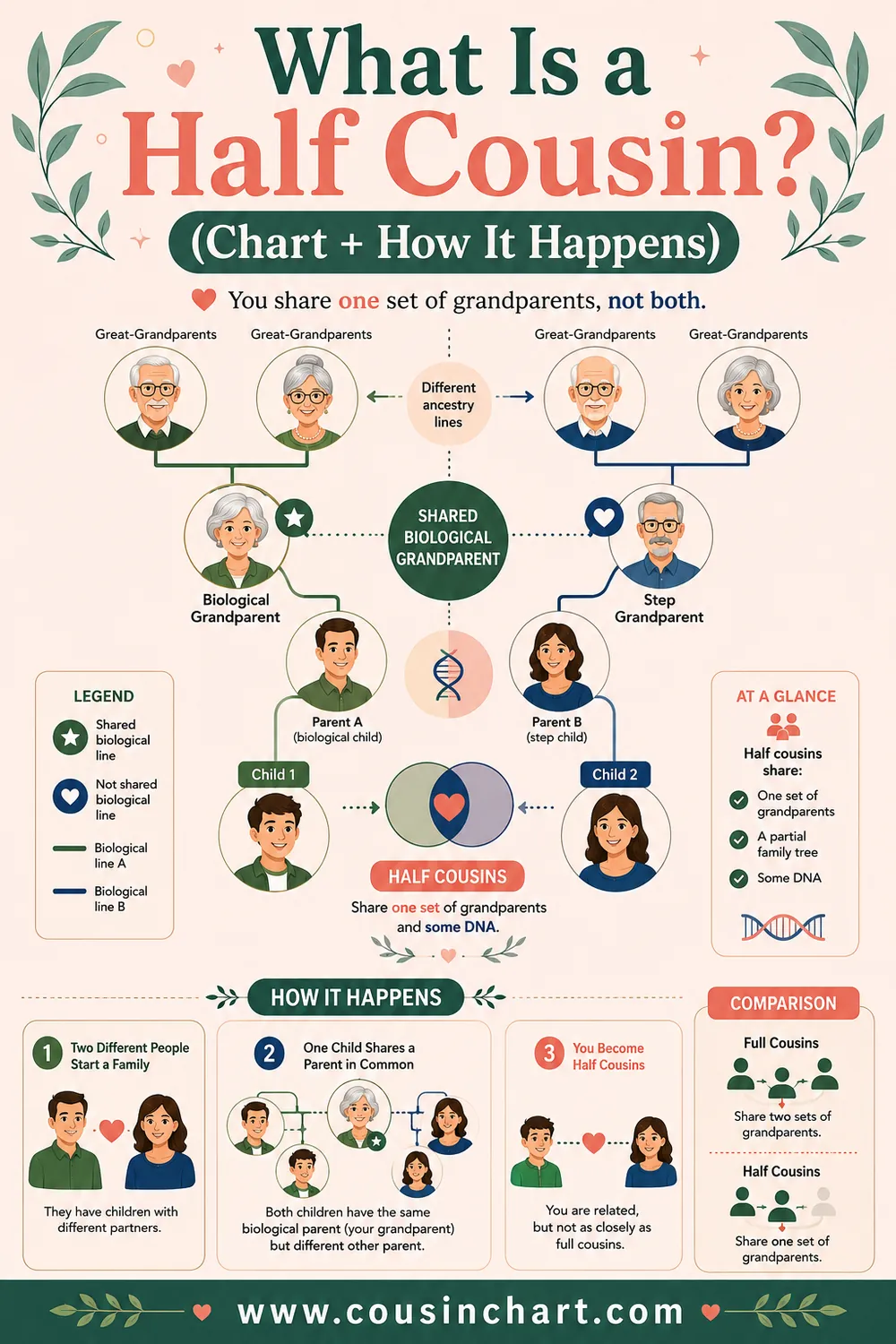
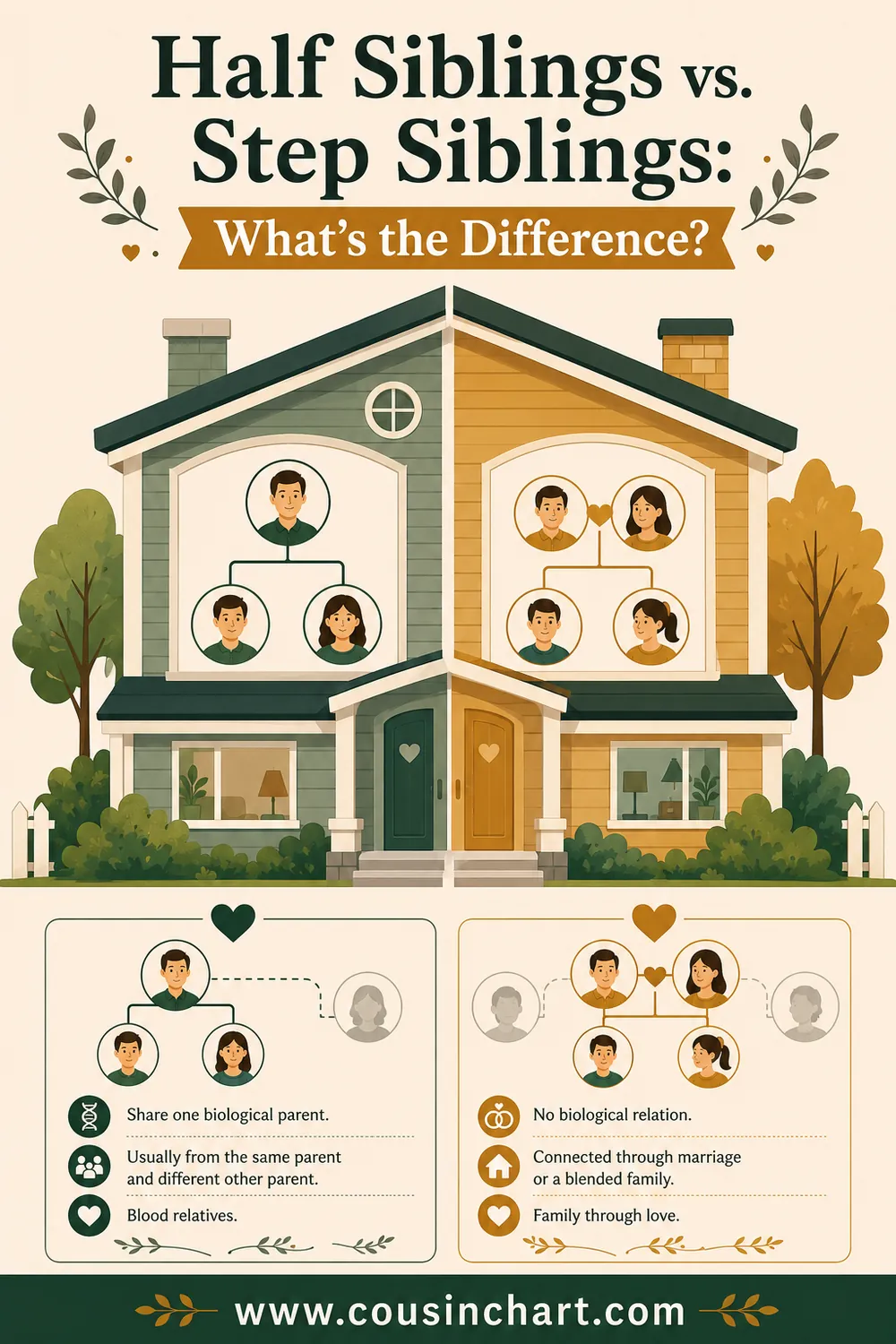
The one that trips people most: half is blood, step is not. Your dad's half-sister's son shares a grandparent (and measurable DNA) with you — he's a half cousin, a genuine relative. Your stepdad's nephew shares nothing genetic; the tie is real but social. The full comparison of the sibling versions lives in half siblings vs step siblings.
Do Step Cousins Count as Family?
There's no genealogical rulebook that says yes or no — so here's how the question breaks down in practice:
- Socially: whatever your family says. Kids who grow up sharing holidays don't audit each other's bloodlines. In many blended families, step cousins are simply "the cousins," full stop, and that's the healthiest reading of the word.
- Genealogically: recorded, not central. Family historians typically note step relationships (they explain households, guardianships, and surnames in the records) but don't trace step lines as ancestry — there's no descent to trace.
- Legally: mostly invisible. Step cousins generally have no legal relationship — no automatic inheritance rights, no next-of-kin standing. Even step-parents and stepchildren have limited default rights in most places, and the cousin tier is further out still.
A useful mental model: step relationships are as durable as the marriages and bonds that create them. If the marriage ends, the label often fades too — though plenty of former step cousins stay close for life, because the relationship was always about the people, not the paperwork.
Can Step Cousins Date or Marry?
A question people genuinely search, so here's the factual answer: step cousins are not blood relatives — no shared ancestor, no shared DNA. Laws restricting marriage between relatives are aimed at blood relationships (and, in some places, close step or adoptive relationships in the direct line, like step-parent and stepchild). Step cousins fall outside those categories in the United States generally.
So legally the answer is broadly yes, and genetically there's no relatedness at all — but marriage law is state-by-state and changes, so anyone with a real stake should check the current law where they live. Socially, families vary: some find it unremarkable (especially when the remarriage happened after everyone was grown), others find it odd if the step cousins were raised as family. Both reactions are common; neither is a legal fact.
What Do You Call a Step Cousin?
In conversation: "cousin." Nobody introduces someone as "my step first cousin through my mother's second marriage" at a barbecue.
For clarity — in genealogy notes, or when someone asks how you're actually related — a few conventions help:
- "Step cousin" covers all three origin routes; add detail only if asked.
- Name the bridge when precision matters: "my stepmom's nephew," "my uncle's stepson." Naming the marriage that connects you is clearer than any invented term.
- Don't force removals onto step lines. Terms like "step cousin once removed" aren't standard; if a step relative is a generation off, just describe it ("my step-cousin's daughter").
- On charts, mark step links with a distinct line style (dashed is the usual choice) so blood descent stays visually clean — the same trick used in the step family relationship chart.
And when a blood relationship hides inside the blended family — a half-aunt's kid, a grandparent's cousin's grandchild — that one has an exact name, and the free cousin calculator will produce it faster than the family group chat can argue about it.
A Worked Example: One Remarriage, a Whole New Cast
Abstract rules stick better with names attached, so meet a blended family.
Your mom, Teresa, remarries a man named Frank. Frank has a sister, Donna, and Donna has two kids, Kyle and Maya. Frank also has a son from his first marriage, Ethan.
Here's everyone's new label from your side of the tree:
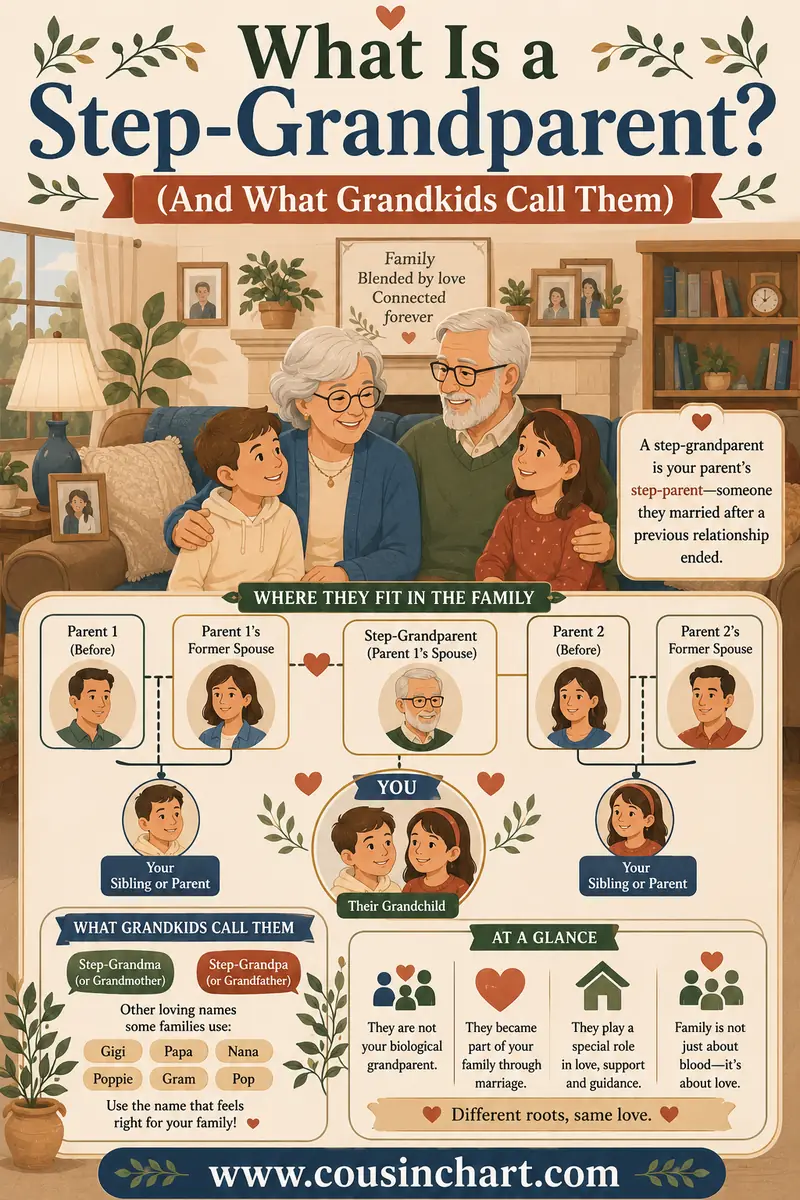
- Frank is your step-father — married to your parent, didn't raise you from birth or adopt you, so "step" it is.
- Donna is your step-aunt: your step-parent's sister.
- Kyle and Maya are your step cousins — route number one from the list above. You share zero ancestors with them; the entire connection runs through the Teresa–Frank marriage.
- Ethan is your step-brother. His cousins Kyle and Maya, though, are his blood first cousins — same people, totally different relationship depending on who's asking.
That last point is the one worth sitting with. Kyle is simultaneously Ethan's first cousin (12.5% shared DNA, shared grandparents) and your step cousin (0% shared DNA, shared Thanksgiving). Relationship labels aren't properties of a person — they're properties of a pair. One remarriage can hand a single person three or four different labels depending on which chair at the table is doing the introducing.
And if you married and had kids? Kyle and Maya would have no standard relationship to your children at all — the step-cousin label is generally treated as ending with the two people it describes, though plenty of families happily keep calling everyone "cousin" down the generations.
When a Step Cousin Line Turns Into a Blood Line
Here's the twist blended families produce all the time: a new baby can weld the two sides together.
Stay with Teresa and Frank. A few years into the marriage, they have a daughter — your half-sister, June. Suddenly:
- June shares a parent with you: you're half-siblings, roughly 25% shared DNA.
- June is Donna's blood niece, which makes Kyle and Maya her full first cousins — shared grandparents, ~12.5% DNA.
- You and Kyle still share nothing. Zero ancestors, zero DNA, same as before.
So you and your step cousin now have a close blood relative in common — June is genuinely related to both of you — without being any more related to each other than you were. This is why DNA match lists in blended families look so strange: June's matches include both your maternal relatives and Kyle's whole family, while your list and Kyle's list don't overlap at all (except June and her descendants).
It also explains a classic family-history head-scratcher. If you find a match who connects to your half-sibling but not to you, don't panic about the tree being wrong — the match is almost certainly on the half-sibling's other parent's side, exactly like Kyle. The pattern is a feature of blended families, not an error.
Step Cousins in Old Records
If you do genealogy, step cousins stop being a naming curiosity and start being a research clue. Marriage-made relationships explain records that otherwise look broken:
- Census households. A widow remarries and the census taker lists her children under her new husband's household — sometimes under his surname, sometimes marked "step-son" or "step-daughter" in the relationship column (US censuses from 1880 on record relationship to head of household). Children you'd never connect on paper turn out to be step-siblings, and their cousins step cousins.
- Obituaries. Older obituaries frequently name step-kin — "survived by... step-nephews Kyle and Maya" — and those names can lead you to the remarriage record you were missing.
- Guardianship and probate files. When a parent died young, a step-parent or step-uncle often appears as guardian. The relationship gets spelled out in legal language, which is gold for reconstructing the household.
- Family photos and Bibles. The people in the picture were chosen by affection, not descent. Unexplained "cousins" in a family photo are, more often than you'd guess, step cousins from a marriage the family later stopped mentioning.
The practical rule: record step links in your tree notes even though you don't trace them as ancestry. They're the connective tissue that explains why records land where they do.
FAQ
What is a step cousin in simple terms?
Someone in your cousin position through a marriage instead of blood — like your step-parent's nieces and nephews, or your parent's step-sibling's kids. No shared ancestor, no shared DNA.
Are step cousins blood-related?
No. That's the definition — the connecting link is a remarriage, not descent. (If the link is a half-sibling, that's a half cousin, which is a blood relationship.)
Can step cousins marry?
In general yes — they're not blood relatives, and US marriage restrictions target blood relationships (plus, in some states, direct-line step relationships like step-parent and stepchild). Laws vary by state and country, so check current law where you live.
What's the difference between a step cousin and a half cousin?
A half cousin shares one grandparent with you — real blood, about 6.25% shared DNA. A step cousin shares zero ancestry; the tie exists because someone remarried.
Do step cousins show up on a DNA test?
No — no shared ancestor means no shared DNA. If a "step cousin" appears in your match list, the families are also related by blood somewhere (it happens more than you'd think in small towns).
Should I put step cousins on my family tree?
If they're part of your family's story, yes — as a marked side branch. Use dashed lines or a "step" note so descent lines stay accurate for research.
The Short Version
Step cousin = cousin by marriage chain: no shared blood, real shared family. Keep the three prefixes straight — step means a remarriage bridges you, half means one shared ancestor, in-law means someone married your cousin — and blended-family introductions get much easier.
For everything on the blood side of the tree, from half cousins to thrice-removeds, the free family relationship calculator hands you the exact term in about ten seconds.