What Is a Nibling? The Gender-Neutral Word for Nieces and Nephews
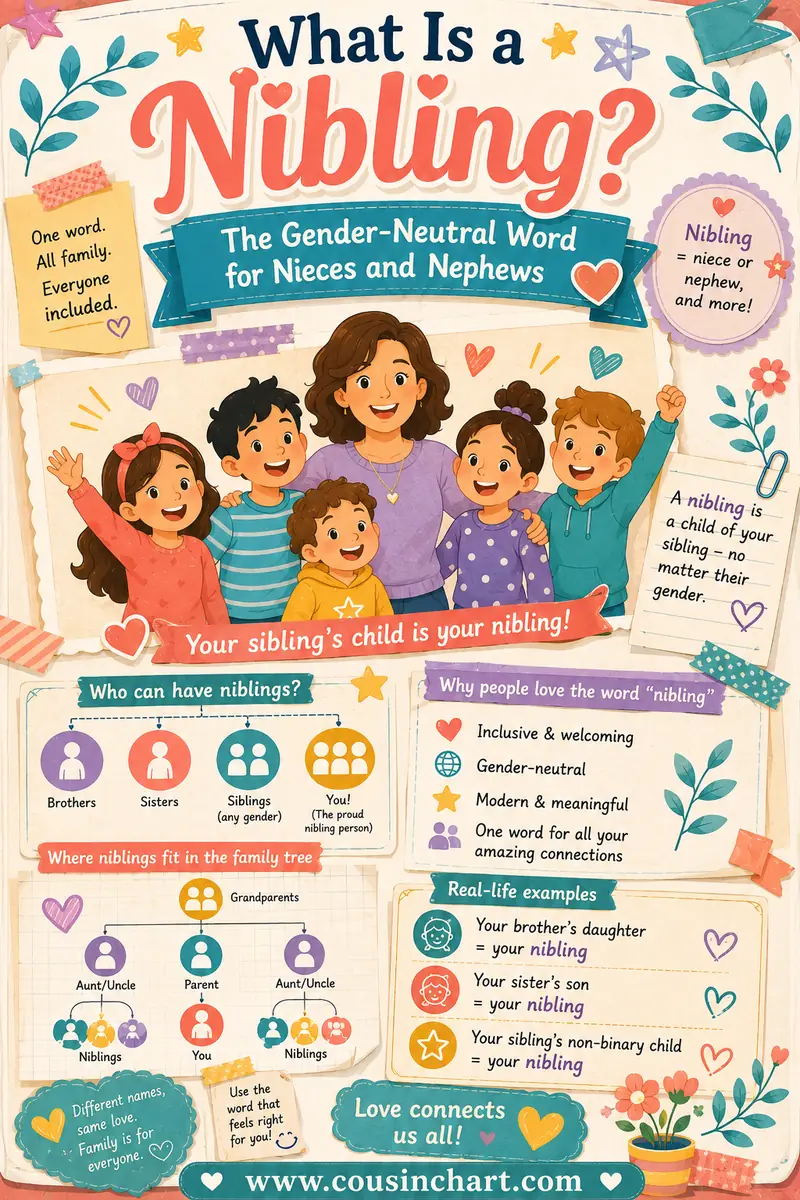
A nibling is your sibling's child — a gender-neutral word that covers both nieces and nephews, the way "sibling" covers brothers and sisters. It's pronounced NIB-ling, it was coined by a linguist in the early 1950s, and after decades of obscurity it's now common enough to appear in dictionary watchlists, baby announcements, and aunt-and-uncle merch.
Nibling fills a genuine hole in English, which never had a one-word way to say "my siblings' kids." This guide covers where the word came from, when it's useful, its companion terms (pibling, anyone?), and the genealogy of the relationship itself. And for any family connection you can't put a word to, the free family relationship calculator on our homepage names it in seconds.
Relationship quick-check. Tap a phrase to see the correct term:
The answer will appear here.
Where "Nibling" Came From
The word is a deliberate coinage, not folk slang. Linguist Samuel E. Martin proposed it around 1951, building it from n- (from niece/nephew) plus -ibling (from sibling). He wanted a collective term for anthropological kinship writing, where "nieces and nephews" gets clumsy fast.
For half a century the word stayed in academic corners. Then three forces pulled it mainstream:
- Practicality. "How are the niblings?" beats "how are your niece and your two nephews?" — collective terms win on convenience, which is why "sibling" and "grandparent" thrive.
- Inclusive language. Families with nonbinary kids needed a word that doesn't force a choice between "niece" and "nephew." Nibling was sitting right there.
- The internet's love of a good word. Nibling is objectively fun to say. Aunt-life social media did the rest.
Today Merriam-Webster tracks it as a "word we're watching," and it appears in mainstream journalism without a gloss. It's not fully standard English yet — but it's well past novelty.
What Exactly Counts as a Nibling?
Genealogically, a nibling is precisely what a niece or nephew is: your sibling's child, a blood relative sharing about 25% of your DNA on average (roughly 1,200–2,300 cM). The word changes nothing about the relationship — it just removes the gender flag.
The familiar modifiers all stack onto it cleanly:
| Term | Who they are | Avg shared DNA |
|---|---|---|
| Nibling | Sibling's child | ~25% |
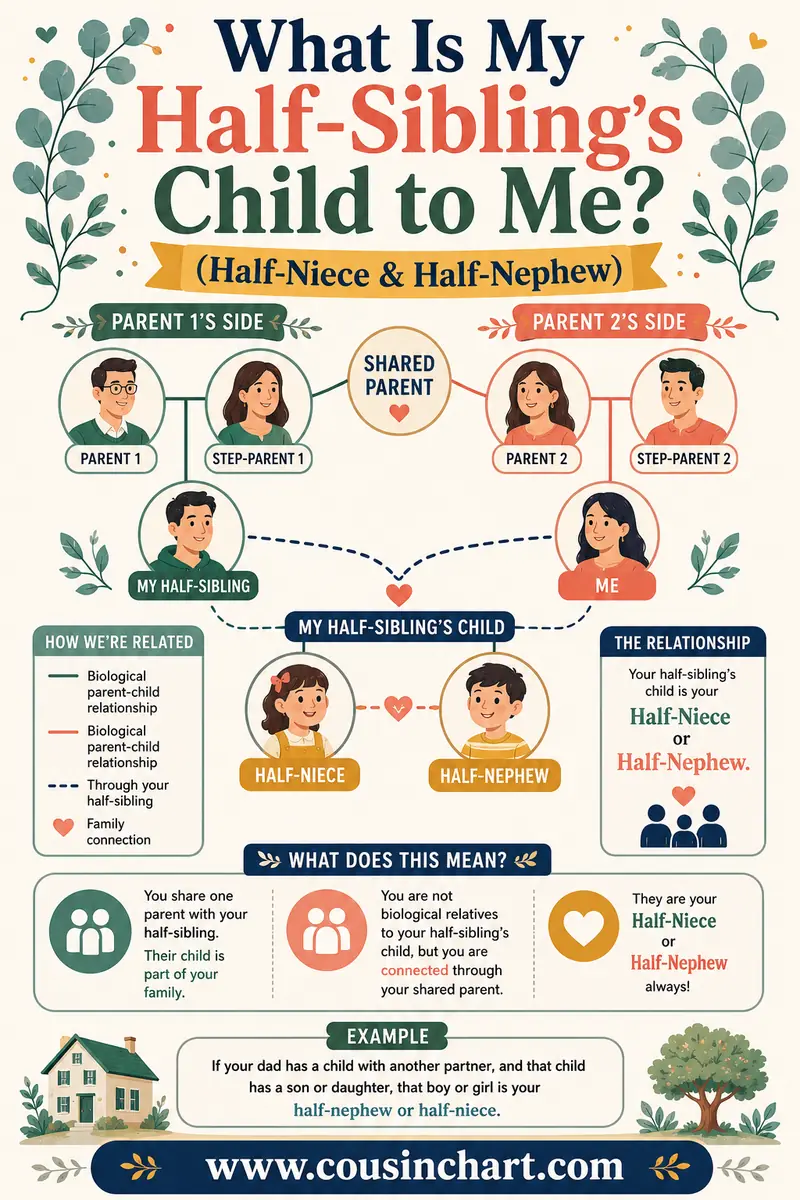
| Half-nibling | Half-sibling's child | ~12.5% |
| Grand-nibling / great-nibling | Nibling's child | ~12.5% |
| Step-nibling | Step-sibling's child | 0% (marriage link) |
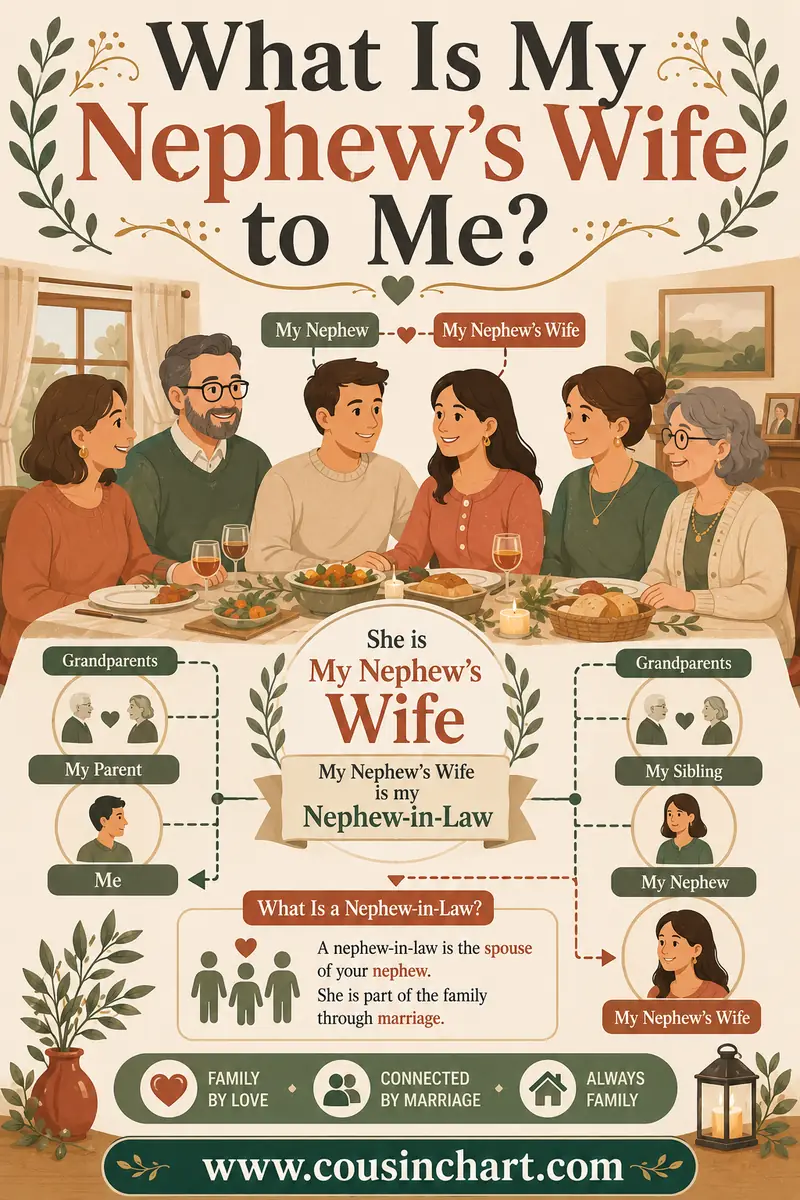
| Nibling-in-law (informal) | Nibling's spouse — a niece- or nephew-in-law | 0% (marriage link) |
One boundary worth marking: your cousin's kids are not your niblings. They're your first cousins once removed. Nibling stays strictly on the sibling branch, exactly as niece and nephew always have. (Plenty of families bend this socially — "auntie" for a cousin's kids is warm and fine — but the tree keeps the branches separate.)
Pibling, Chibling, and the Rest of the Neutral Kin Set
Nibling arrived alongside a whole workshop of gender-neutral kinship coinages. Some are catching on; some remain hobbyist vocabulary:
- Pibling — parent's sibling: the aunt/uncle counterpart. Less common than nibling but growing on the same logic.
- Auncle / untie / zizi / titi — candidate address terms for a nonbinary aunt/uncle figure; families are still voting, and no winner has emerged.
- Grandwit / grandy — occasionally floated for grandparents, though "grandparent" already works genderlessly.
- Cousin — the quiet overachiever: English's one core kin term that was gender-neutral all along.
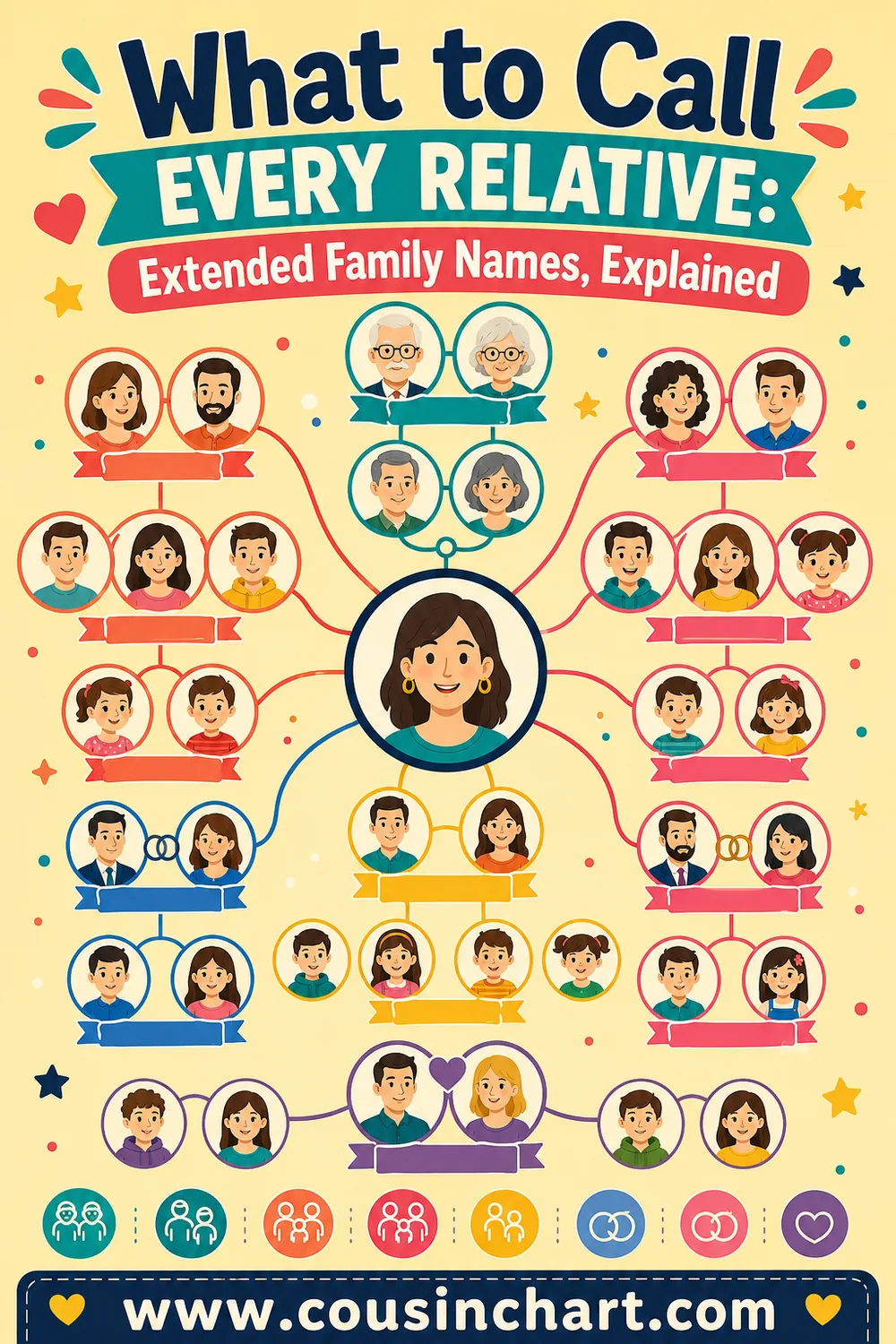
Notice the pattern in what sticks: reference terms (words for talking about someone — sibling, parent, nibling) go neutral easily. Address terms (what a child calls you to your face) change slowly, because they're chosen family-by-family and loaded with affection and habit. Our guide to what to call every relative tours the full vocabulary, traditional and new.
When "Nibling" Is the Right Word — and When It Isn't
Nibling earns its place in three situations:
- Collective convenience. Mixed group of nieces and nephews? "The niblings" is the shortest accurate phrase in English.
- Nonbinary family. For a sibling's child who is neither niece nor nephew, nibling isn't just convenient — it's the respectful default.
- Unknown referent. "Bringing a nibling to the wedding" when you don't know or need to specify which one.
And where it can misfire:
- Formal and legal writing. Wills, medical histories, and genealogy records should stick to established terms ("niece," "nephew," "sibling's child") — nibling has no legal definition yet.
- With unfamiliar audiences. Grandma may need a translation the first time. (She'll likely adopt it by the second.)
- When someone prefers otherwise. A niece who loves being "niece" gets to stay one. Kinship words are worn by people; fit beats fashion.
The Genealogy Underneath the Word
Whatever you call them, the nibling relationship itself is one of the closest in the tree — worth knowing cold:
- Shared DNA: ~25% average, the same band as grandparents and half-siblings. On a DNA site, those three can be indistinguishable by percentage alone; age and tree logic break the tie.
- Your kids and your niblings are first cousins to each other (shared grandparents — your parents).
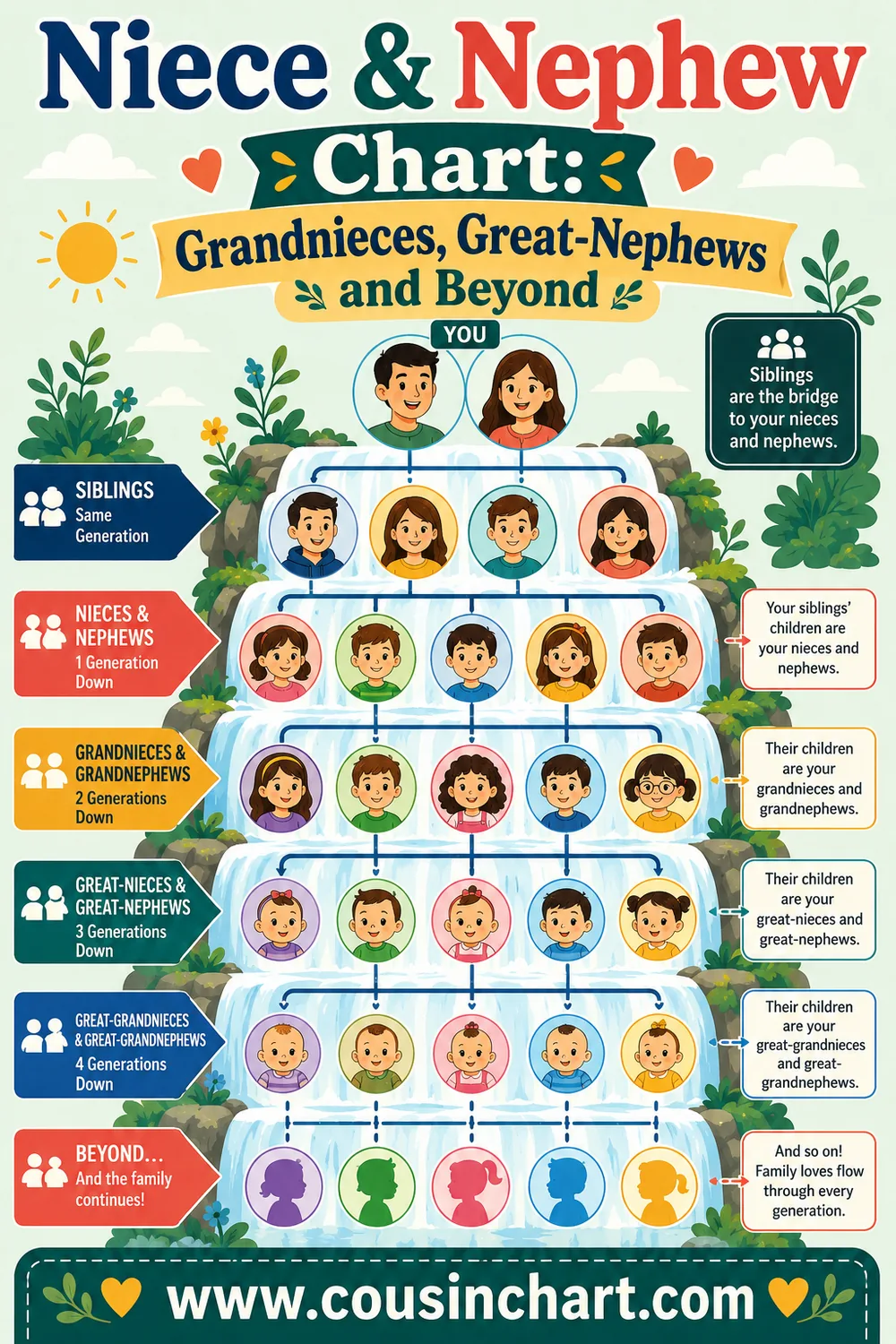
- Your niblings' kids are your grand-niblings (grand-/great-nieces and -nephews), at ~12.5%.
- You are their pibling — their parent's sibling — at the same ~25% from their side, because blood relationships are always mutual.
The full ladder — grand-niblings, great-grand-niblings, and where everyone's kids land — is mapped in our niece and nephew relationship chart, and the relationship calculator walks any specific pair instantly, whichever vocabulary your family uses.
How Other Languages Handle the Nibling Problem
English needing to coin a word for "sibling's child" isn't universal — languages slice the kinship pie in wildly different ways, and some solved this centuries ago:
- Swedish has syskonbarn — literally "sibling-child" — a perfectly ordinary, gender-neutral everyday word for exactly what nibling means. (It also offers brorsbarn and systerbarn when you want to specify a brother's or sister's child.)
- Tagalog uses pamangkin for a niece or nephew of any gender — no coinage required, gender-neutral by default, like most kinship terms in Philippine languages.
- Spanish gets partway there with the masculine plural: sobrinos covers a mixed group of nieces and nephews. For a single child, though, you still must pick sobrino or sobrina — grammatical gender allows no escape hatch.
- Mandarin Chinese runs the opposite direction and adds more distinctions: a brother's son (侄子) is a different word from a sister's son (外甥), and the daughters differ too. Four words where English has two and nibling proposes one.
- Hungarian historically didn't even force the sibling distinction English takes for granted — one word covered younger siblings regardless of gender, with age mattering more than sex.
Two takeaways for word-watchers. First, there's nothing "natural" about which distinctions a language encodes — gender, side of family, and relative age are all optional, and every language chooses differently. Second, nibling isn't an eccentric invention; it's English belatedly acquiring a slot that Swedish and Tagalog speakers never knew they were lucky to have.
This is also, incidentally, why Samuel Martin coined the word in the first place. Anthropologists comparing kinship systems across cultures kept needing to say "sibling's children, regardless of gender" — because that's the natural category in so many of the languages they studied — and English made them spell it out every single time. Nibling was scholarly plumbing before it was ever cute.
English Has Patched Kinship Holes Before
Nibling can feel like a novelty, but English kinship vocabulary has always been a renovation project.
Start with nephew itself: it comes (via French) from Latin nepos, which meant grandson as readily as "sister's son." For centuries, English "nephew" could mean either — old wills saying "my nephew" sometimes meant a grandchild, a trap genealogists still fall into when reading pre-1700 documents.
Cousin was even looser. In Shakespeare's era it meant almost any relative outside the immediate household — nieces, nephews, and grandchildren included — and monarchs addressed fellow royals as "cousin" with no genealogy implied. The precise modern system (first cousin, second cousin, once removed) only settled into common use as legal and inheritance questions demanded exactness.
Even sibling — the word nibling is built on — is a modern revival. It existed in Old English, vanished for centuries, and was resurrected around 1900 by researchers who needed a collective term for genetic studies. Within a couple of generations it went from technical jargon to a word toddlers use.
That's the pattern nibling is riding: a need appears (scientific, legal, or social), someone reaches for a coinage or a revival, the word lives in specialist writing for a while, then convenience carries it into the living room. Sibling took roughly fifty years to complete the trip. Nibling, coined in 1951 and hitting mainstream media by the 2010s, is arguably running the same route on the same schedule.
Introducing "Nibling" to Your Family (Without the Eye-Roll)
Words for people work best when the people are on board, so a little rollout strategy helps:
- Use it casually and let context teach. "The niblings are coming over Saturday" in a family group chat is self-explanatory within one message. Announcing "we will now be saying NIBLING" is how a fun word becomes a family argument.
- Expect one round of jokes. Someone will say it sounds like a snack or a hobbit. They're not wrong — and the joke is the word bedding in. By the third use, it's just vocabulary.
- Keep it as a reference term first. Nibling describes; it doesn't have to replace names or titles anyone loves. "My nibling Sam" and "my niece Ava" can coexist in the same sentence indefinitely.
- Follow the kid's lead where it matters. If the word is doing inclusive work — for a nonbinary nibling — their preference sets the standard, and the rest of the family's job is simply to match it.
- Give the elders a hook. "It's like 'sibling' but for nieces and nephews" lands instantly with anyone who knows English's other collective kin terms. Most grandparents adopt it faster than the middle generation expects.
The quiet truth about kinship vocabulary: families adopt whatever words get used warmly and often. No memo required.
FAQ
What does nibling mean?
A nibling is your sibling's child — a gender-neutral term covering nieces, nephews, and children who identify as neither. It's pronounced NIB-ling.
Is nibling a real word in the dictionary?
It's a recognized coinage from around 1951 (linguist Samuel E. Martin) and is tracked by major dictionaries as an emerging word. It's widely understood, though not yet fully standard in formal writing.
Is my cousin's child my nibling?
No — niblings are strictly your sibling's children. A cousin's child is your first cousin once removed. Families sometimes use aunt/uncle titles across that line socially, but the genealogical terms stay distinct.
What's the gender-neutral word for aunt or uncle?
"Pibling" (parent's sibling) is the reference-term counterpart to nibling. For what a child actually calls someone, families use various coinages — auncle, zizi, titi — with no single standard yet.
How much DNA do I share with a nibling?
About 25% on average — the same band as a grandparent or half-sibling. Half-niblings (a half-sibling's child) average ~12.5%.
What is a grand-nibling?
Your nibling's child — a grand-niece or grand-nephew, gender-free. Each generation down adds a "grand" (or "great") and halves the average shared DNA.
Are my spouse's niblings my niblings too?
Formally they're your nieces- and nephews-by-marriage, but in everyday use, yes — nearly everyone folds a spouse's niblings into their own set, the same way "my in-laws" becomes "my family." Genealogy keeps the paths separate (no shared DNA on your side); life rarely bothers.
Do other languages have a word like nibling?
Several got there first. Swedish syskonbarn and Tagalog pamangkin are ordinary gender-neutral words for a sibling's child, and Spanish covers mixed groups with the plural sobrinos. English is late to a party other languages have been hosting for centuries.
One Word for the Kids, One Tool for Everything Else
So: nibling = sibling's child, coined in 1951, increasingly mainstream, and genuinely useful — with pibling, half-niblings, and grand-niblings rounding out the set. English will keep inventing kinship words, but the relationships underneath never change, and neither does the math. Whenever you need the precise term — nibling or otherwise — the free family relationship calculator traces the path between any two relatives and hands it to you instantly.