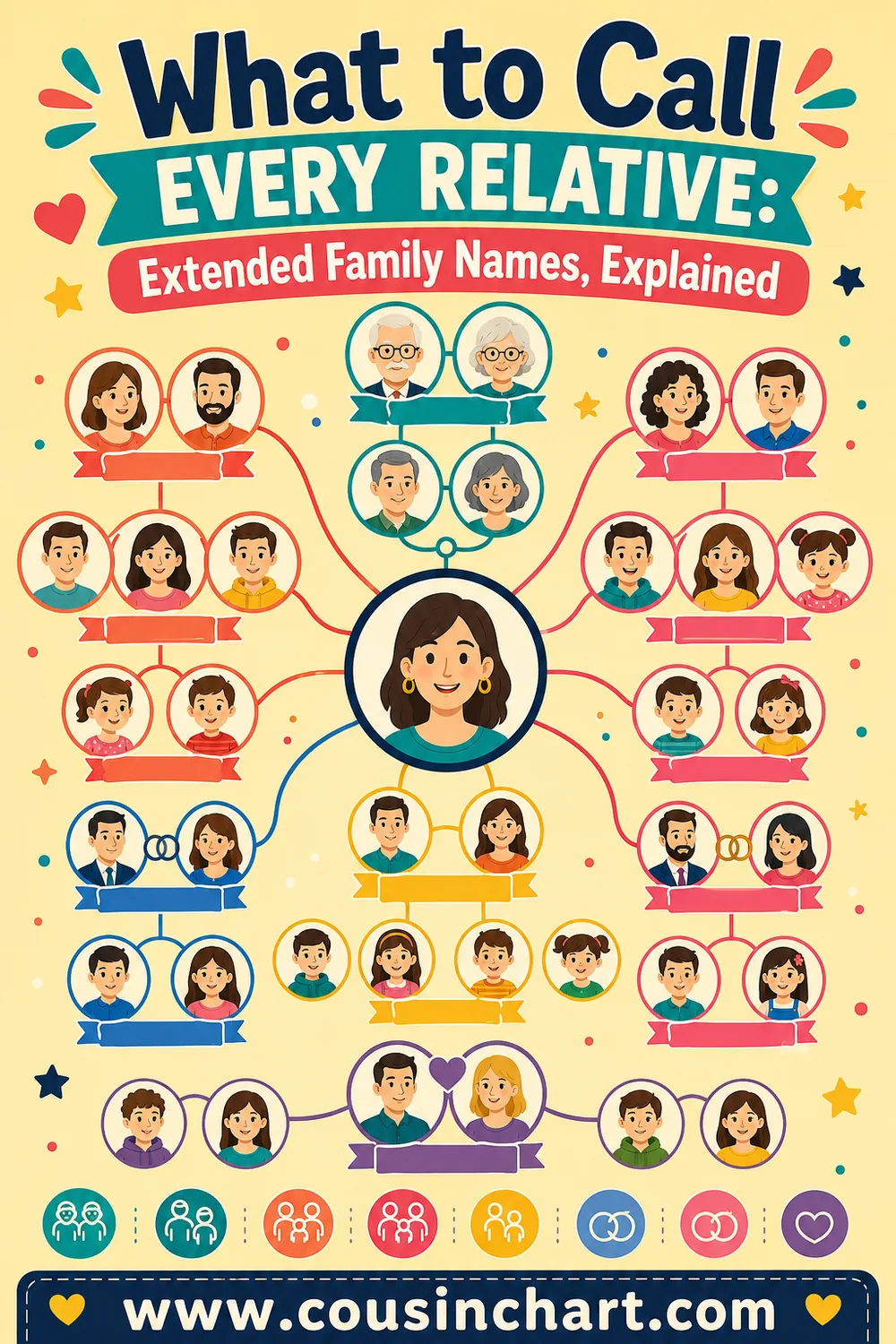
What to Call Every Relative: Extended Family Names, Explained
Every relative on your extended family tree has an official name, and they're all built from a handful of parts: grand- and great- climb generations, "removed" counts generation gaps between cousins, "-in-law" marks marriage links, and half- and step- describe shared parents (or the lack of them). Learn those five building blocks and you can name anyone — from your grandma's cousin to your son-in-law's parents.
This is the full glossary: your generation, everyone above and below, the whole cousin grid, the marriage column, and the rare terms English almost forgot. Bookmark it for reunion season — or skip the memorizing entirely and let the free family relationship calculator name any relative in a few taps.
Relationship quick-check. Tap a phrase to see the correct term:
The answer will appear here.
The Five Building Blocks
Every English kinship term is assembled from these parts:
- Core words — mother, father, sister, brother, son, daughter, aunt, uncle, niece, nephew, cousin.
- Grand- / great- — climbs (or descends) one generation per "great." Grandmother → great-grandmother; nephew → grandnephew → great-grandnephew.
- Numbers on cousins — first, second, third: how far back your shared ancestor is. Shared grandparents = first cousins; great-grandparents = second; add one per generation back.
- "Removed" — cousins only: counts the generation gap between you. Your cousin's child is once removed; their grandchild, twice.
- Prefixes and suffixes for how they joined — -in-law (marriage), step- (a parent's remarriage), half- (one shared parent).
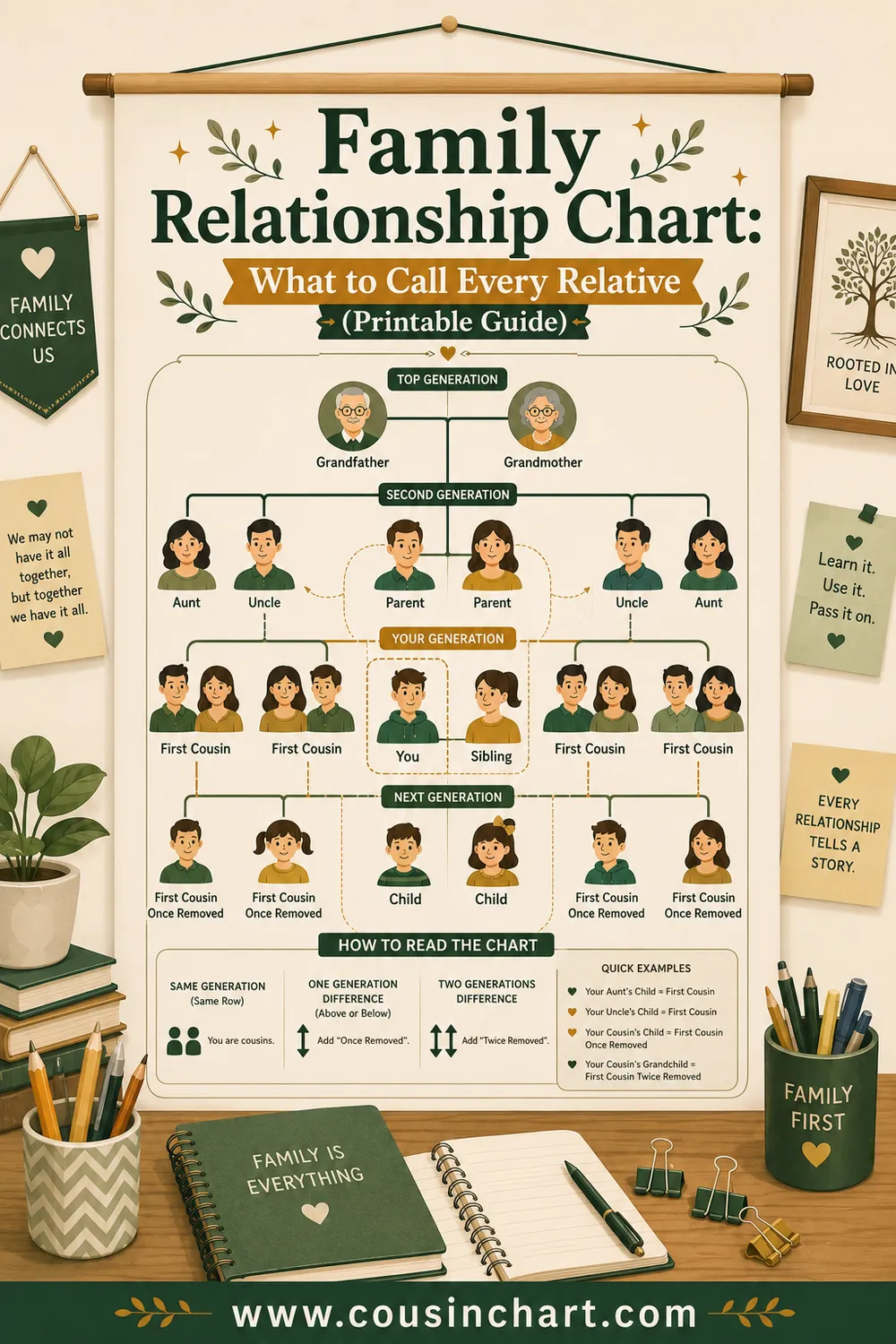
Everything below is these five parts in action. If you want the visual version, our printable family relationship chart lays the whole grid on one page.
Your Generation
- Sibling — full siblings share both parents (~50% DNA).
- Half-sibling — one shared parent (~25% DNA). Blood family, smaller genetic overlap.
- Step-sibling — your step-parent's child. No shared ancestor.
- First cousin — child of your aunt or uncle; you share grandparents (~12.5%).
- Second cousin — you share great-grandparents (~3%). Third cousin — great-great-grandparents (~0.8%).
- Brother-/sister-in-law — your spouse's sibling, or your sibling's spouse.
- Co-sibling-in-law — your spouse's sibling's spouse. Real term, rarely spoken.
The Generations Above You
- Parents → grandparents → great-grandparents → great-great- (2nd great-) grandparents, adding one "great" per generation. You have 2, 4, 8, 16 of them respectively.
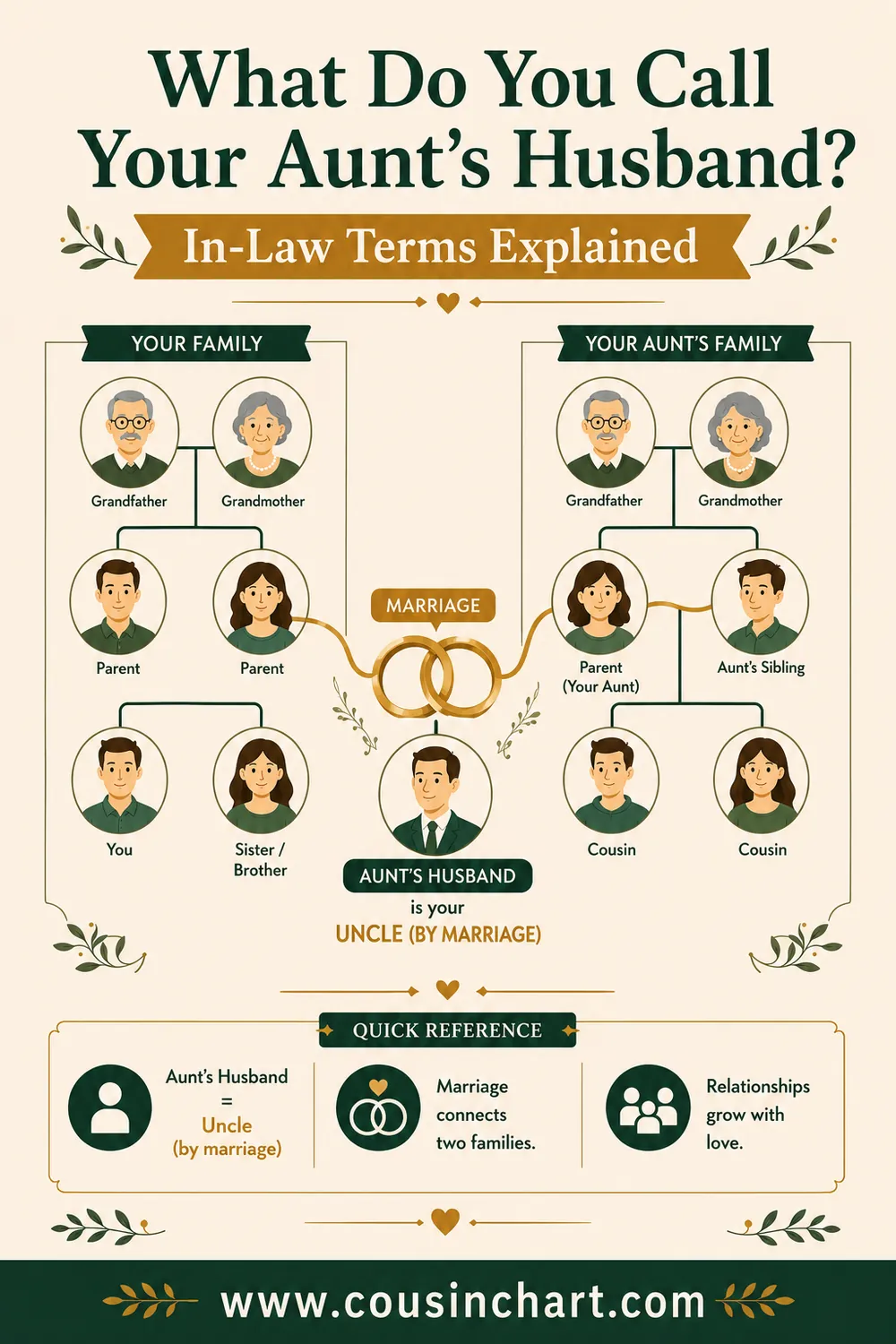
- Aunt / uncle — a parent's sibling (~25% DNA). Their spouses are aunts and uncles by marriage — nearly every family drops the asterisk, a custom we explore in what do you call your aunt's husband.
- Great-aunt / great-uncle (genealogists say grand-aunt/grand-uncle) — a grandparent's sibling (~12.5%).
- Great-grand-aunt / -uncle — a great-grandparent's sibling.
- Parent's cousin — not an "uncle": your first cousin once removed (~6.25%).
- Grandparent's cousin — your first cousin twice removed.
The Generations Below You
- Children → grandchildren → great-grandchildren, mirroring the upward ladder.
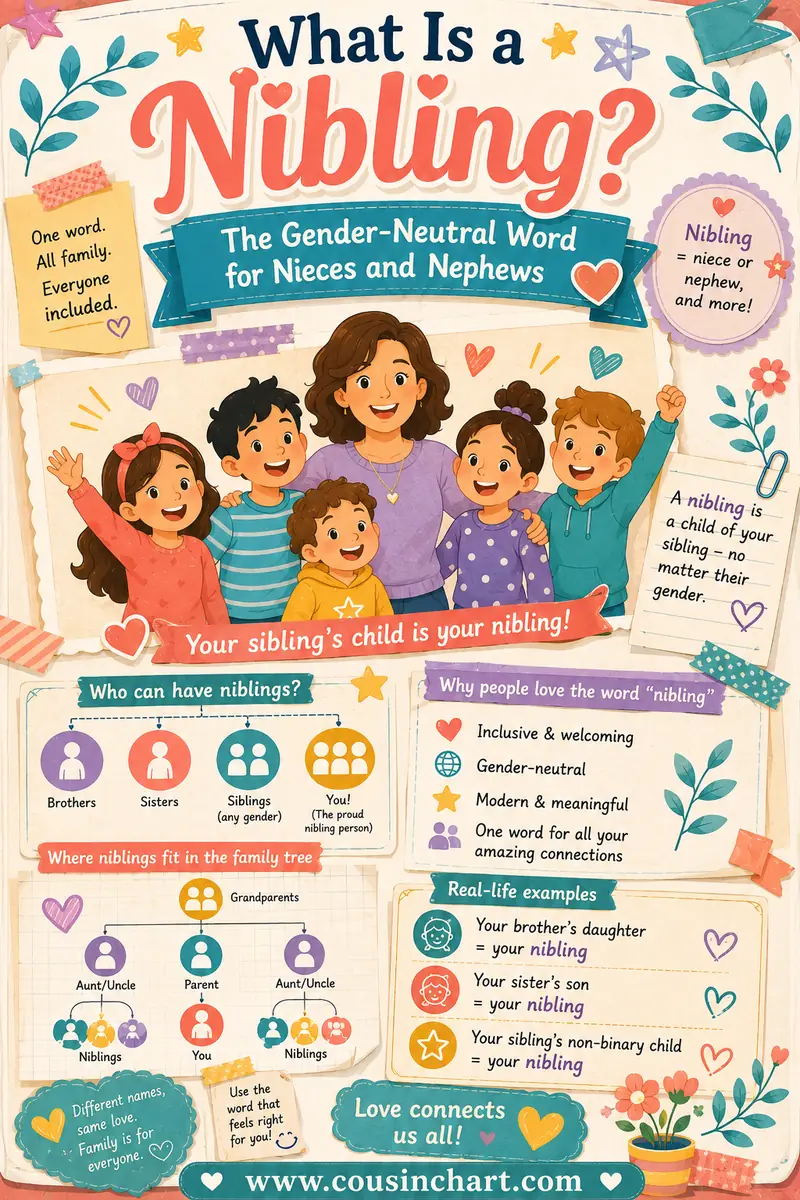
- Niece / nephew — your sibling's child (~25%). Gender-neutral: nibling, a genuinely useful coinage covered in what is a nibling.
- Grandniece / grandnephew (great-niece/-nephew) — a sibling's grandchild (~12.5%).
- Half-niece / half-nephew — a half-sibling's child (~12.5%).
- Your cousin's child — not your niece: your first cousin once removed, again. The term covers both directions of the same one-generation gap.
The Cousin Grid
Two dials set every cousin term:
| Same generation | 1 generation apart | 2 apart | |
|---|---|---|---|
| Shared grandparents | First cousin | First cousin once removed | First cousin twice removed |
| Shared great-grandparents | Second cousin | Second cousin once removed | Second cousin twice removed |
| Shared 2nd great-grandparents | Third cousin | Third cousin once removed | Third cousin twice removed |
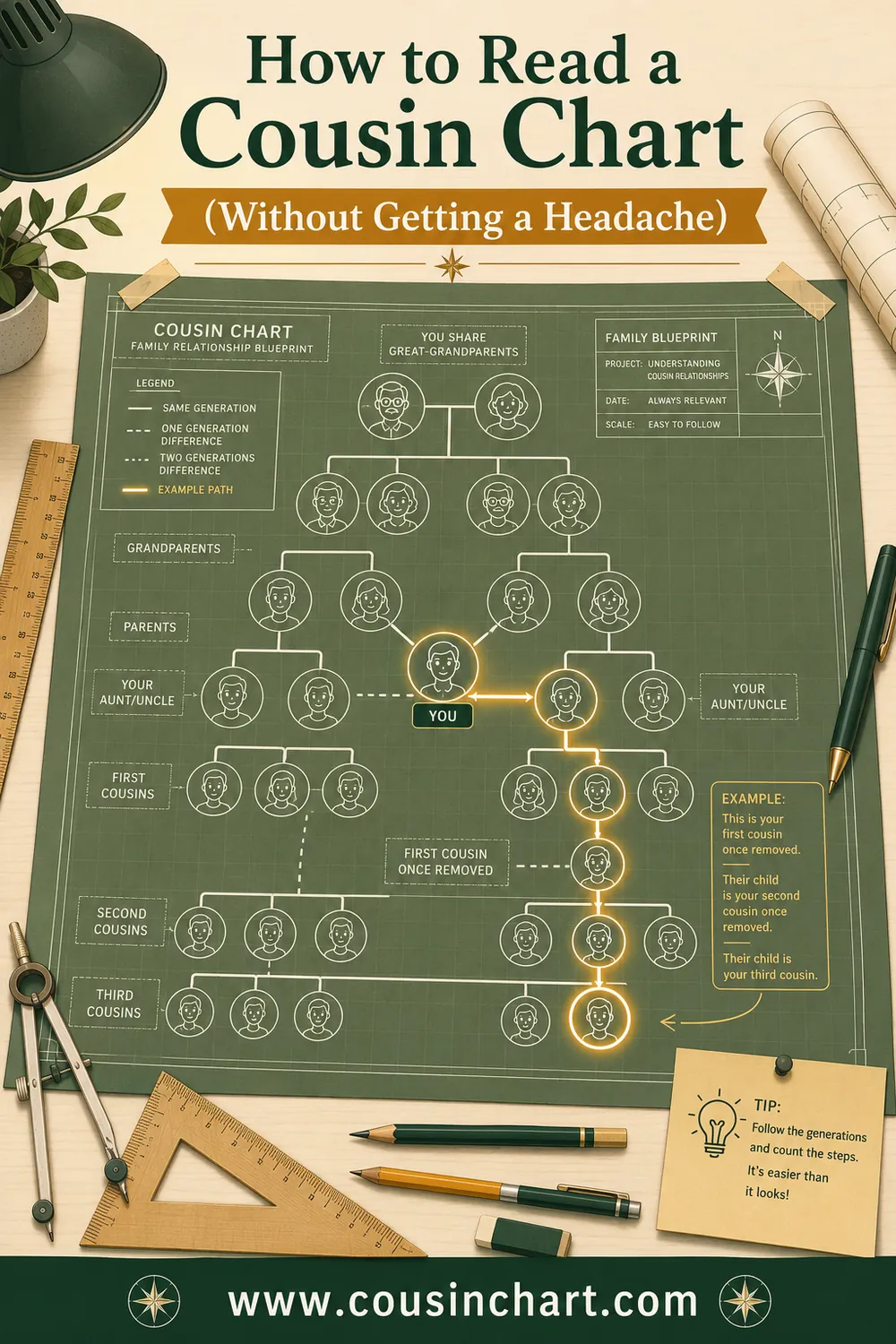
The row (degree) comes from the closest shared ancestor, counted from whichever of you sits nearer to it; the column (removal) is the generation gap between you. That's the entire system — and reading it off a chart is a skill worth two minutes, so we wrote how to read a cousin chart. Or let the calculator spin both dials for you.
The Marriage Column
- Spouse's parents — father-/mother-in-law. Spouse's siblings — brothers-/sisters-in-law.
- Your child's spouse — son-/daughter-in-law.
- Spouse's grandparents — grandparents-in-law. Spouse's aunt/uncle/cousin — aunt-, uncle-, cousin-in-law (informal).
- Your child's spouse's parents — co-parents-in-law; Yiddish machatunim, Spanish consuegros. You'll share grandchildren with them, so it's odd English never coined a household word.
- Step-parent / step-sibling / step-child — created by a parent's (or your own) remarriage. Step-relatives of every flavor exist: step-grandparents, step-aunts, step-cousins.
Remember the boundary rule: in-law status stops one marriage from your bloodline. Your brother's wife is family; her sister is, formally, nobody to you.
The Rare and Wonderful Terms
- Double first cousin — cousins through both parents (two siblings married two siblings); ~25% shared DNA.
- Half-cousin — your parent's half-sibling's child (~6.25%).
- Three-quarter sibling — rarer than rare: siblings whose shared parentage falls between half and full (for example, children of one mother by two fathers who are brothers).
- Milk kin — in some cultures, kinship through a shared wet nurse.
- Shirttail cousin — American folk term for a distant or by-marriage cousin of vague coordinates.
- Kissing cousin — a cousin distant enough to marry, or just any affectionately-greeted relative, depending who you ask.
- Fictive kin — the aunties and uncles who aren't related at all and are family anyway.
Decoding Practice: Five Monster Terms, Taken Apart
The building blocks really do assemble into anything. Here are five intimidating labels dismantled piece by piece — read the bold parts in order and each one deflates:
- Half great-grand-uncle. Work outward from the core: uncle = sibling of an ancestor; great-grand- = that ancestor is your great-grandparent; half- = he shared one parent with your great-grandparent, not two. Translation: your great-grandmother's half-brother.
- Second cousin twice removed. Second cousin = the lines split at great-grandparents (counted from whoever sits closer); twice removed = you're two generations apart. Your second cousin's grandchild — or, going up, your grandparent's second cousin.
- Double first cousin. First cousin = shared grandparents; double = shared on both sides, because a pair of siblings married another pair of siblings. All four grandparents in common, ~25% DNA — cousin geometry with sibling-level genetics.
- Step-grandmother. Grandmother slot, step- mechanism: she married your grandfather after your parent was already born. No blood, real title. (Compare grandmother-in-law — your spouse's grandmother — same generation, different suffix, different family.)
- Half first cousin once removed. All three dials at once: first cousin line (split at grandparents), half (the linking siblings shared one parent), once removed (one generation gap). Your parent's half-cousin, or your half-cousin's child.
Notice the decoding order never changes: find the core word, apply the generation modifiers, then the joining mechanism. Any term that still resists after those three passes is either a regionalism ("shirttail cousin") or a mistake ("uncle once removed" — a real person, wearing the wrong label).
What They Call You Back: Reciprocals
Every kinship term has a mirror — the word the other person uses for you — and the mirrors follow three simple rules:
| They are your... | You are their... |
|---|---|
| Aunt / uncle | Niece / nephew |
| Great-aunt / great-uncle | Grandniece / grandnephew |
| Grandparent | Grandchild |
| First cousin | First cousin |
| First cousin once removed | First cousin once removed |
| Mother-in-law | Daughter-/son-in-law |
| Step-parent | Step-child |
The rules: vertical relationships flip (aunt↔niece, grandparent↔grandchild, in-law parent↔in-law child), same-generation relationships are their own mirror (sibling, every unremoved cousin), and — the one that surprises people — removed cousin terms don't flip either. Your dad's cousin is your first cousin once removed, and you are exactly the same thing to her. There's no "upward" and "downward" version of the term; the phrase names the pair, not a direction. If you need to specify, genealogists say "once removed ascending" or "descending," but in conversation nobody does.
This is worth knowing for one practical reason: it halves the memorizing. Learn one side of the table and you own both.
How Other Languages Do It: A Humbling Comparison
English gets by with maybe two dozen kinship words. Other languages look at our glossary and see missing entries everywhere:
- Swedish refuses to blur the grandparents: mormor (mother's mother), morfar (mother's father), farmor (father's mother), farfar (father's father). Four distinct words where English has two — and the maternal/paternal information travels free with every mention.
- Chinese distinguishes relatives by side, by relative age, and by whether the link is by blood or marriage. Your father's elder brother, father's younger brother, and mother's brother are three different words, and each of their wives gets her own term too.
- Tagalog encodes birth order into everyday address: kuya (elder brother), ate (elder sister), and further terms for the second- and third-born — plus the in-law precision covered in our glossary's gaps, like bilas and balae.
- Hindi and Urdu split "aunt" and "uncle" six or more ways: chacha (father's younger brother), taya (father's elder brother), mama (mother's brother), each with a matching feminine term for his wife.
The pattern linguists find: languages keep sharp distinctions where the culture assigns different duties to those relatives — inheritance customs, who arranges marriages, who you can joke with. English's ancestors let most of those distinctions fade as extended-family households did. So when your bilingual relatives wince at translating tita or mama into flat English "aunt" and "uncle," they're not being fussy — real information genuinely falls on the floor.
For your family tree, the practical tip is simple: record kin terms in the language the family actually used. "Grandma Rosa (Lola Rosa)" preserves what a plain "grandmother" erases.
When One Person Wears Two Labels
Real trees occasionally hand somebody two valid titles at once:
- Marriage overlaps blood. If your aunt married your other parent's cousin — it happens — the same man is your uncle by marriage and your first cousin once removed by blood. Convention: lead with the blood term in genealogy records, the social term at dinner.
- Pedigree collapse. When cousins married upstream, one ancestor can be, say, both your 3rd great-grandfather and your 4th great-grandfather by different paths. Genealogy software lists every path; humans usually cite the shortest.
- Adoption inside the family. A grandmother who legally adopted her grandchild is both mother (legally) and grandmother (biologically) to the same person. Records need both facts; the family picks one word and gets on with life.
The tie-break rule genealogists actually use: closest relationship wins for daily use; all paths get recorded for research. No one is obliged to introduce their uncle-slash-cousin with a footnote.
Rapid-Fire Round: Eight Oddballs, Answered
The tangled cases people actually ask about, one line each:
- My mom's identical twin. Your aunt — but a genetic curiosity: identical twins carry the same DNA, so on paper she's indistinguishable from your mother to a DNA test, and her kids match you like half-siblings (~25%) despite being, legally and socially, plain first cousins.
- My grandma's second husband. Step-grandfather, if he married her after your parent was grown (or at least after your parent was born). If he raised your parent, many families just say grandpa, and no chart objects.
- My sister's husband's parents. Formally nothing to you — the in-law chain stops at your sister's husband. "My sister's in-laws" is all English offers.
- My step-sister's baby. Step-niece or step-nephew: real title, no blood, custom-governed.
- My wife's ex-husband. No kinship term at all — "my stepkids' father" or "co-parent" if you share a household calendar with him.
- My daughter's husband's brother. Nothing formal; two steps of family (a marriage plus a blood link on the other side) put him outside every column.
- My great-grandfather's brother's great-grandson. Third cousin — both of you sit four generations below the shared couple. Yes, really; run it through the grid.
- My parent's godmother. Fictive kin to your parent, doubly fictive to you — though in compadrazgo families she may outrank several blood aunts in practice.
If a case at your own table survives all eight of these plus the decoder section above, congratulations: you've found a genuinely rare tree, and the calculator would love to meet it.
FAQ
What do I call my cousin's child?
Your first cousin once removed — not your niece or nephew. Niece/nephew is reserved for a sibling's children. Socially, "niece" gets borrowed all the time, and no one minds.
What is my grandma's sister to me?
Your great-aunt (genealogists prefer grand-aunt). Her children are your first cousins once removed, and her grandchildren are your second cousins.
What's the word for nieces and nephews together?
Nibling — coined in the 1950s on the model of "sibling." Informal but increasingly standard, and handy for gender-neutral use.
What do I call my son-in-law's parents?
English has no everyday term; genealogists say co-parents-in-law. Many American families borrow the Yiddish machatunim or Spanish consuegros, or just say "our kids' in-laws."
Is my mom's cousin my second cousin?
No — your parent's first cousin is your first cousin once removed. Your second cousins are that person's children: same generation as you, sharing great-grandparents.
What is a cousin-german?
An old-fashioned term for a plain first cousin — "german" here comes from the Latin germanus, "having the same parents," not from Germany. You'll meet it in older wills and English novels; a "brother-german" likewise meant a full brother as opposed to a half-brother. Modern usage: just say first cousin.
Do I capitalize family titles like mom and grandma?
Capitalize when the word stands in for a name ("I asked Mom," "tell Grandma Rosa") and lowercase when a possessive or article sits in front ("my mom," "the grandma of the bride"). It's the one kinship rule that's about grammar rather than genealogy, and it trips up wedding programs constantly.
What's the difference between a half-sibling and a step-sibling?
A half-sibling shares one biological parent with you (blood, ~25% DNA). A step-sibling is your step-parent's child from another relationship — family by marriage, no shared DNA.
Name Anyone at the Reunion
Five building blocks, one grid, one marriage column — that's the entire English kinship system. You now know why your grandma's cousin is a first cousin twice removed and why your brother's wife's sister is technically a stranger. But when someone at the buffet line asks about their mother's half-brother's granddaughter, don't run the algebra on a napkin. Open the free family relationship calculator, tap the path person by person, and hand them the exact term with a little chart to prove it. It's free, instant, and settles arguments faster than grandma can.