Great-Grandparents and Beyond: Generation Names Above You
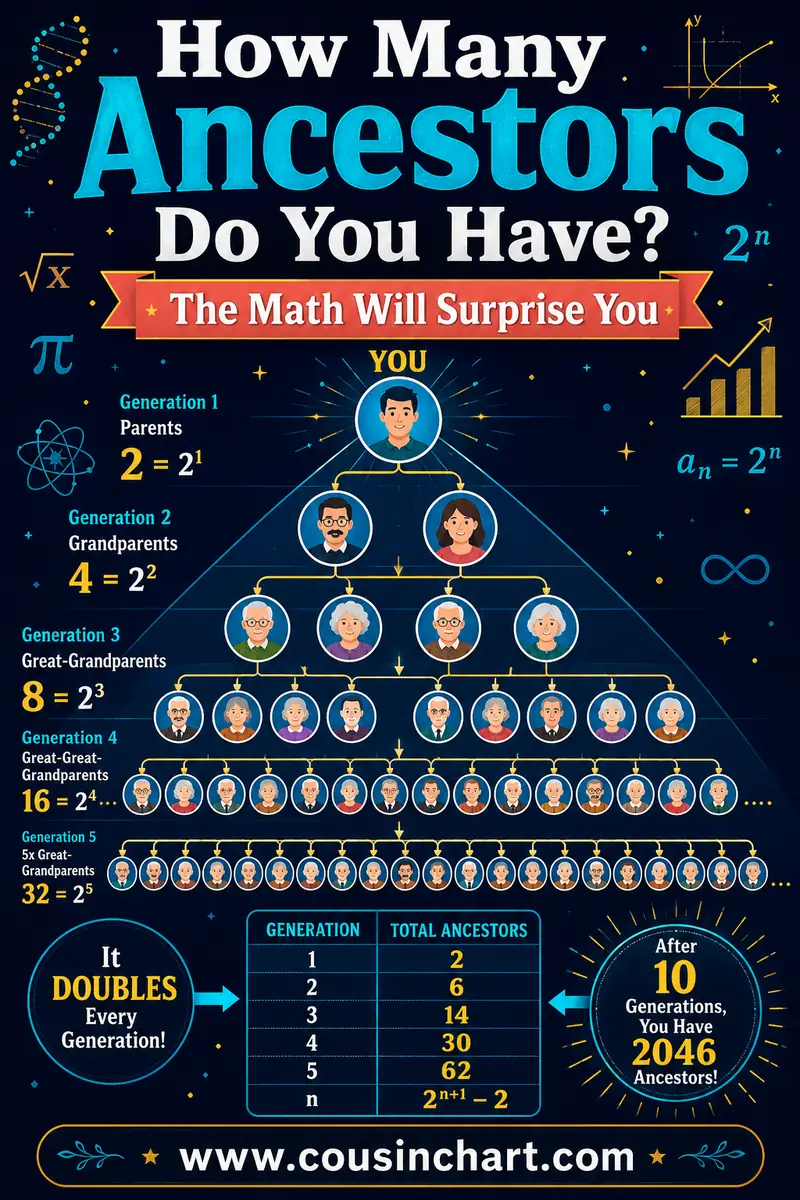
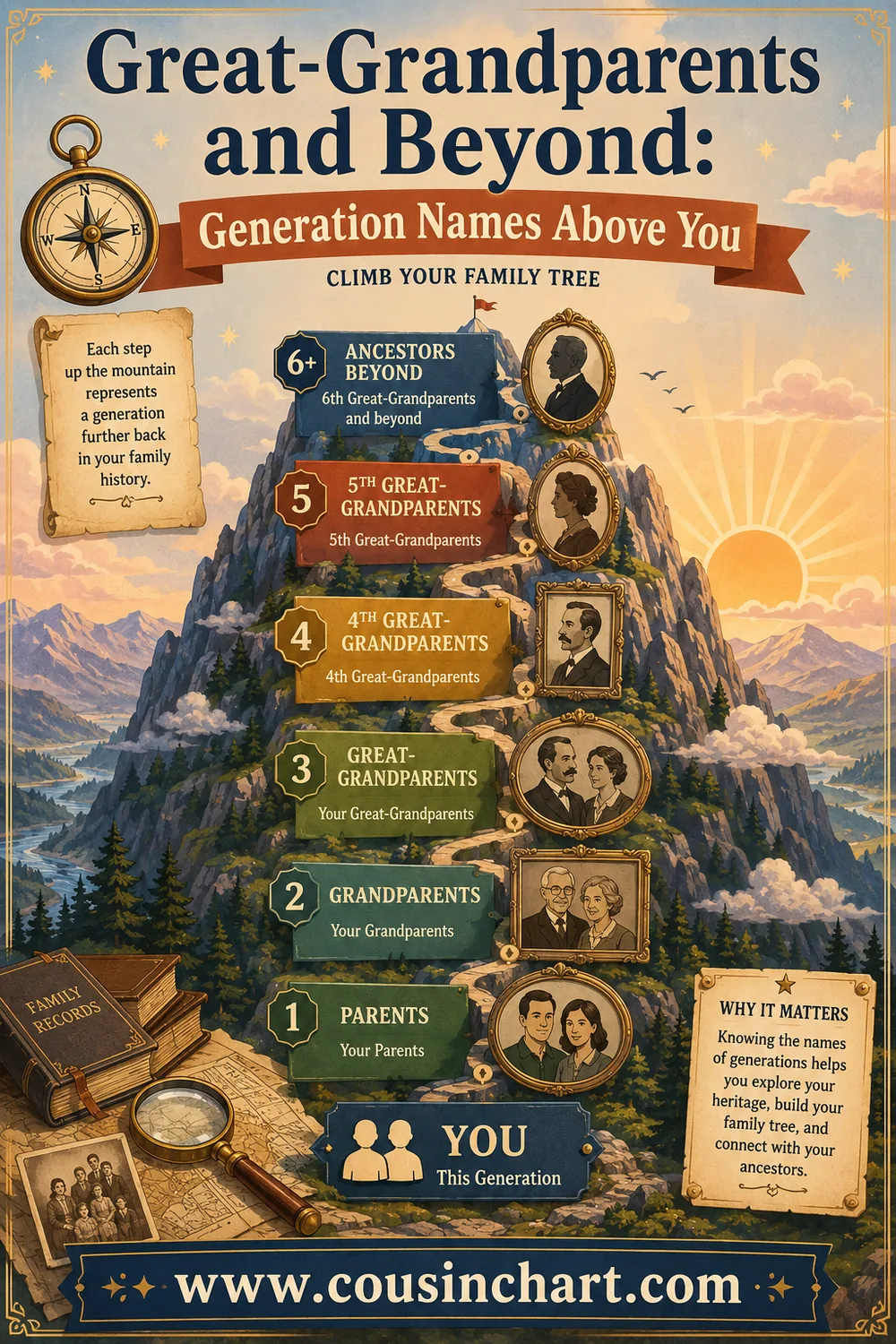
The generations above you follow one simple pattern: parent, grandparent, great-grandparent — then add one more "great" for every generation after that. Your great-grandparent's parent is your great-great-grandparent (also written 2nd great-grandparent), then 3rd great-grandparent, and so on, doubling in number every step: 2 parents, 4 grandparents, 8 great-grandparents, 16 great-great-grandparents.
That's the whole naming machine. The rest of this guide charts it out properly — including the two competing ways to write "great-great-great," how genealogists number ancestors, how many years back each generation reaches, and what to call your ancestors' brothers and sisters. And when you need to work out how you connect to someone descended from those ancestors, the free family relationship calculator does it in seconds.
Relationship quick-check. Tap a phrase to see the correct term:
The answer will appear here.
The Generation Chart Above You
Here's the full ladder for eight generations, with both naming styles and the headcount at each level:
| Generations up | Common name | Numbered form | How many you have |
|---|---|---|---|
| 1 | Parent | — | 2 |
| 2 | Grandparent | — | 4 |
| 3 | Great-grandparent | 1st great-grandparent | 8 |
| 4 | Great-great-grandparent | 2nd great-grandparent | 16 |
| 5 | Great-great-great-grandparent | 3rd great-grandparent | 32 |
| 6 | (four greats) | 4th great-grandparent | 64 |
| 7 | (five greats) | 5th great-grandparent | 128 |
| 8 | (six greats) | 6th great-grandparent | 256 |
Two patterns run the whole table. Names: after "grandparent," each generation adds one "great." Numbers: each generation doubles, because every ancestor has two parents. Keep doubling and the math turns absurd surprisingly fast — 10 generations up you have 1,024 ancestor slots; 20 generations up, over a million. (Spoiler: you don't actually have a million distinct ancestors — the same people start filling multiple slots. That wrinkle, called pedigree collapse, gets its own treatment in how many ancestors do you have.)
"Great-Great-Great" vs. "3rd Great": The Two Naming Styles
Both styles are correct; they just serve different masters.
- Stacked greats ("great-great-great-grandmother") is how families talk. It's warm and instantly clear — up to about three greats, where everyone loses count mid-sentence.
- Numbered greats ("3rd great-grandmother," often written 3x great-grandmother or GGG-grandmother) is how genealogists write. It's compact, sortable, and survives being read aloud. The number equals how many "greats" you'd stack: 3rd great = great-great-great.
One conversion trap: the numbered form is always generations minus two. Your 4th great-grandparent is six generations above you, not four. If you're reading an old family history that says "five generations back," check whether the writer counted from you or from your parents — off-by-one errors here have sent many researchers hunting the wrong century.
Your DNA Share With Each Generation
Every generation up halves your genetic connection, on average:
- Parent — 50%
- Grandparent — ~25%
- Great-grandparent — ~12.5%
- 2nd great-grandparent — ~6.25%
- 3rd great-grandparent — ~3.125%
- 4th great-grandparent — ~1.56%
By the 5th great-grandparent level (~0.78%), you may carry no detectable DNA at all from a genuine documented ancestor. Autosomal DNA is inherited in chunks, and beyond six or seven generations some ancestors simply drop out of your genome while others are overrepresented. It's a humbling genealogy fact: your paper tree and your genetic tree are not the same tree.
Ancestors' Siblings: Aunts and Uncles All the Way Up
Your ancestors' brothers and sisters don't become "grandparents" of any kind — they take aunt and uncle titles that climb in parallel:
- Grandparent's sister → great-aunt (grand-aunt)
- Great-grandparent's sister → great-grand-aunt
- 2nd great-grandparent's sister → great-great-grand-aunt (2nd great-grand-aunt)
And their descendants slide over onto the cousin grid: a great-grand-aunt's children are your first cousins twice removed, and her great-grandchildren are your third cousins. This is exactly how distant-cousin matches on DNA sites connect to you — through a sibling of one of your "greats." When one of those matches emails you, the relationship calculator can translate "descended from my 3rd great-grandfather's brother" into an actual term without any finger-counting.
How Many Years Back Is Each Generation?
Genealogists usually figure 25 to 30 years per generation — closer to 30 in modern Western families, closer to 20–25 in earlier centuries when people married younger. Rough rule of thumb from today:
- Great-grandparents: born roughly 75–100 years before you
- 2nd great-grandparents: roughly 100–130 years
- 4th great-grandparents: roughly 150–190 years
- 6th great-grandparents: roughly 200–250 years
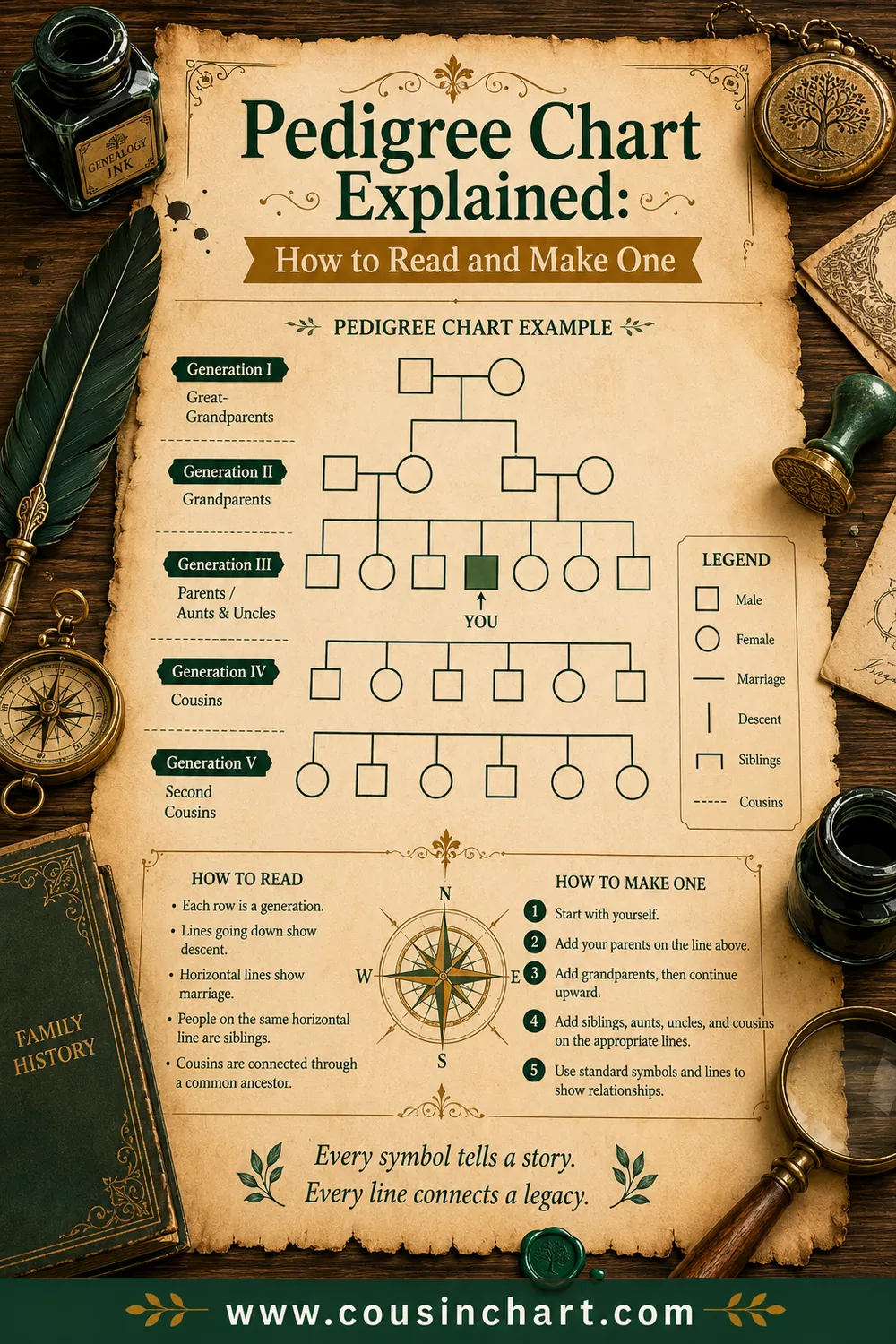
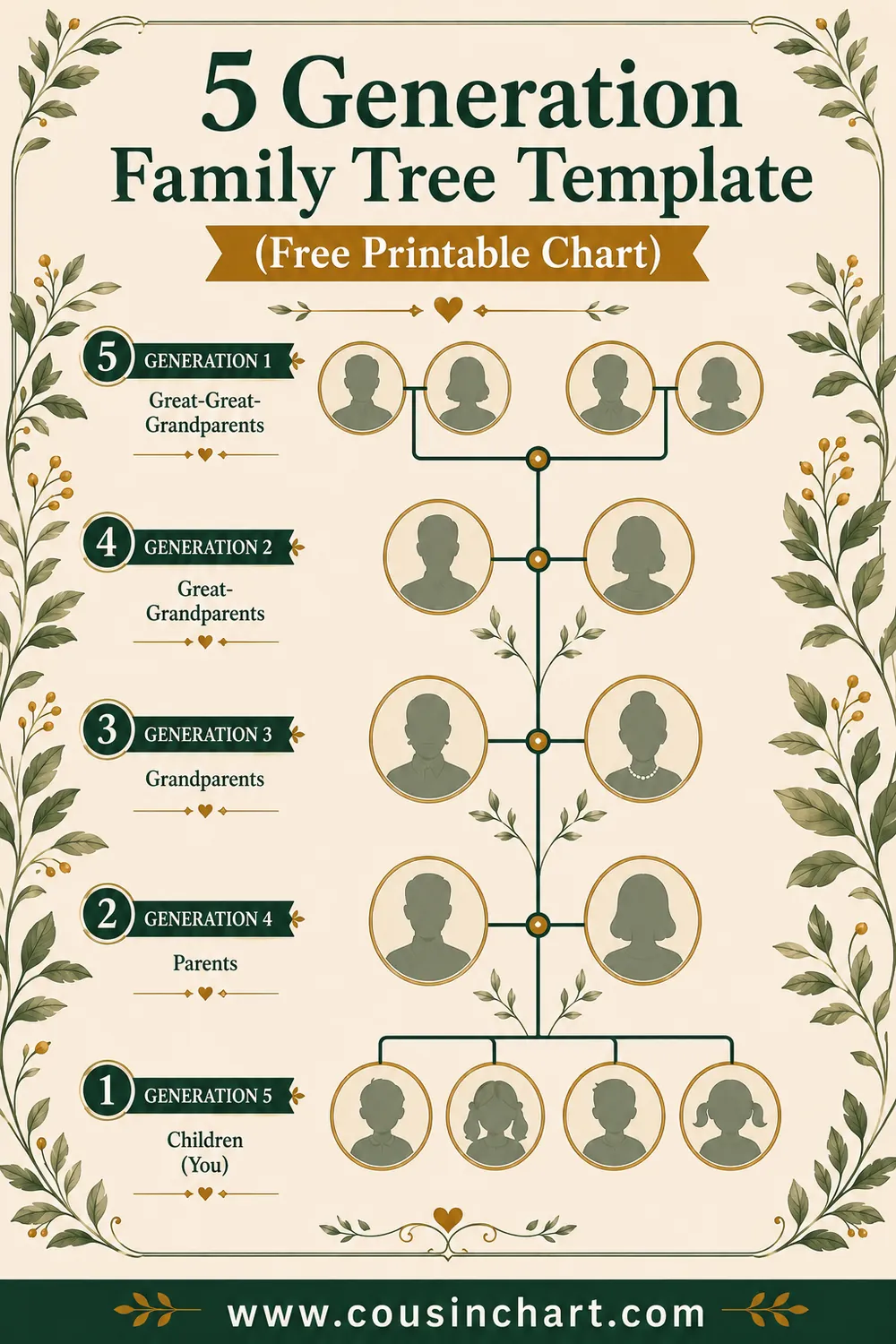
So a person born in 2000 likely has 4th great-grandparents born in the early-to-mid 1800s — the generation you'll hunt through 19th-century census records. This matters practically: it tells you which records can even exist for a given ancestor level. If you're building the paper trail, a pedigree chart keeps the levels straight, and a 5 generation family tree template covers you back to the great-great-grandparents in one page.
Ahnentafel: The Numbering System That Tames the Doubling
Once you're juggling 32 third-great-grandparents, names stop being enough. Genealogy's classic fix is the ahnentafel (German for "ancestor table"): you are 1, your father is 2, your mother is 3, and from there every person's father is their number doubled, and their mother is doubled plus one. Your father's father is 4; your mother's mother is 7; ancestor #23 is your mother's father's mother's mother (odd numbers are always women, evens always men, except you).
You don't need ahnentafel for a casual tree, but the moment you meet it in a genealogy book or software export, the doubling rule decodes any number back into a position on the chart above.
Worked Example: Climbing One Line, Record by Record
Abstract ladders get real when you attach dates. Take someone born in 1995 and walk straight up one line, using the ~28-years-per-generation average:
- Parent — born around 1967. Alive and reachable: the single best genealogy resource you have. Interview first, search archives later.
- Grandparent — born around 1939. Likely appears as a child in the 1940 US census, has a Social Security record, and may have WWII-era documents for their own parents.
- Great-grandparent — born around 1911. Childhood in the 1920 census, marriage in the 1930s, WWII draft registration if male (the 1942 "old man's registration" covered men born 1877–1897, their fathers' generation, while the younger cards covered them).
- 2nd great-grandparent — born around 1883. This is Ellis-Island-era territory if the family immigrated, and the 1900 census (which handily recorded month and year of birth) probably catches them as a teenager.
- 3rd great-grandparent — born around 1855. Pre–Civil War birth: you're now dependent on church registers, land records, and the 1860–1880 censuses.
- 4th great-grandparent — born around 1827. Few or no civil birth records exist in most places; genealogy at this level runs on baptisms, wills, and luck.
Two lessons from the climb. First, each rung up the chart is also a step into a different documentary era — knowing an ancestor's level tells you which archives can even help before you open a single one. Second, notice this was one line of many: at the 4th-great level there are 64 slots, and every single one has its own version of this climb. Nobody researches all 64. Pick the lines that pull at you.
The Special Lines: Which "Greats" Gave You Your mtDNA and Y-DNA
The doubling chart treats all 16 great-great-grandparents as equal, but two of them are genetically special.
- The direct maternal line — your mother's mother's mother's mother — is the source of your mitochondrial DNA (mtDNA), which passes from mother to child essentially unchanged. Everyone has this line, and only one ancestor per generation sits on it.
- The direct paternal line — father's father's father's father — carries the Y chromosome for males, passed father to son, which is also why it usually tracks the surname in cultures with inherited paternal surnames.
Count them against the chart: at the 2nd great-grandparent level you have 16 ancestors, but exactly one is your matrilineal ancestor and one your patrilineal. The other fourteen contributed autosomal DNA only, in ever-shrinking average shares. This is why specialized mtDNA and Y-DNA tests can reach much deeper than the ~6-generation ceiling of ordinary autosomal testing — they follow a single unbroken thread instead of a halving pool — but only along those two specific lines. If your brick wall is your mother's father's people, neither special test touches it.
Practical corollary for the chart above: when a genealogist says "I've traced my direct line back nine generations," they usually mean one thread through the doubling tree — 1 ancestor out of the 512 slots at that level — not the whole fan.
One Couple, All Your Second Cousins
Here's a compact way to see why great-grandparents matter beyond the direct line: every level of the ladder above you "owns" one degree of cousin. Take a single great-grandparent couple and follow their other descendants — the ones who aren't your ancestors:
| Their descendant | Relationship to you |
|---|---|
| Their child (your grandparent's sibling) | Great-aunt / great-uncle |
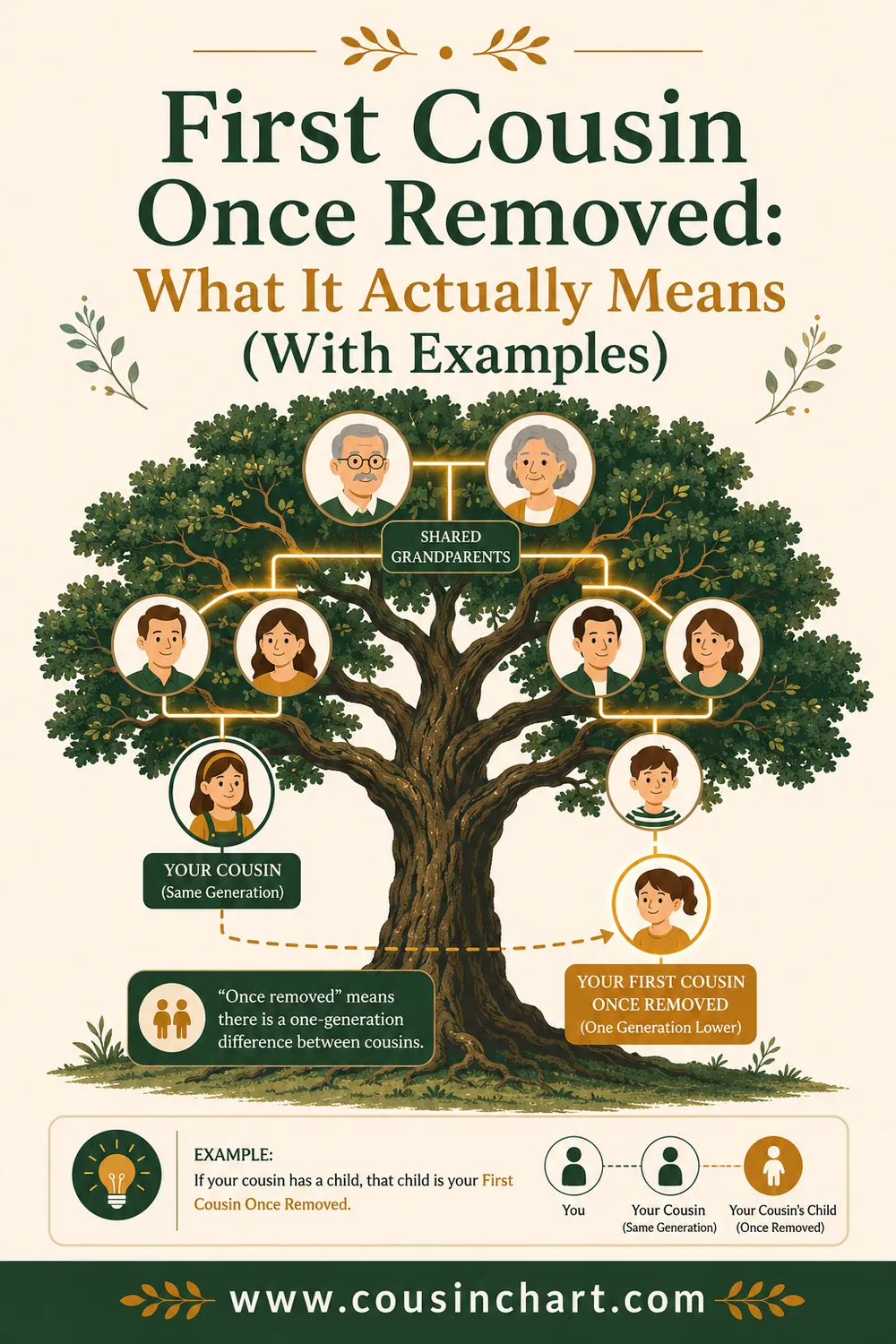
| Their grandchild (another line) | First cousin once removed (your parent's cousin) |
| Their great-grandchild | Second cousin |
| Their 2nd great-grandchild | Second cousin once removed |
Every second cousin you have on that side descends from this one couple — 8 great-grandparents means at most 4 couples, so your entire second-cousin population traces to (at most) 4 households. Repeat the logic one rung up: your third cousins all funnel through your 8 great-great-grandparent couples. When a DNA site labels a match "2nd–3rd cousin," it's really telling you which rung of your ladder to search for the shared couple — that's the entire trick behind figuring out mystery matches.
How Many Rungs Can Be Alive at Once?
A pleasant question the chart invites: how much of your ladder can you actually meet?
Most people overlap with two or three generations above them. Four-generation photos — baby, parent, grandparent, great-grandparent — are common enough that studios have a name for them. Five living generations (down to a great-great-grandparent) is rare but well documented; it takes short generations stacked consistently, roughly early-twenties parenthood four times in a row. Guinness has recorded families with as many as seven generations alive simultaneously, which requires an almost unbroken chain of teenage parenthood and formidable longevity at the top.
The arithmetic explains why the record stops there. Seven generations at ~20 years apiece puts the eldest at 120+ years old if the youngest is a newborn — right at the documented ceiling of human lifespan. The doubling chart may run upward forever on paper, but biology grants you eye contact with, at best, the first four or five rungs. Which is the genealogist's favorite argument for interviewing the older rungs now: every great-grandparent you can still ask is three generations of secondhand research you won't have to do later.
FAQ
What comes after great-grandparent?
Great-great-grandparent, also written 2nd great-grandparent — four generations above you. After that: 3rd great-grandparent (five generations), 4th great (six), adding one "great" or one number per generation.
How many great-great-grandparents does everyone have?
Sixteen slots: 2 parents × 2 × 2 × 2. In practice some slots can be filled by the same person if cousins married anywhere in your tree — common in small communities — which is why real ancestor counts eventually fall behind the doubling math.
Is it "3rd great-grandfather" or "great-great-great-grandfather"?
Same person, two styles. The number equals the count of stacked greats: 3rd great-grandfather = great-great-great-grandfather, five generations above you. Genealogists prefer the numbered form because it stays readable past three greats.
What do I call my great-grandmother's sister?
Your great-grand-aunt. Siblings of your direct ancestors take aunt/uncle titles that climb with the same "great" pattern; only your direct line gets grandparent titles.
How much DNA do I share with a great-grandparent?
About 12.5% on average — an eighth of your genome. Each further generation halves it again, and past roughly the 5th great-grandparent level you may share no measurable DNA at all despite a true paper-trail connection.
Can the same person appear twice in my great-grandparent chart?
Yes — whenever cousins married anywhere upstream, one ancestor fills two slots. Genealogists call it pedigree collapse, and in small communities it was the norm rather than the exception. Your tree still has 16 great-great-grandparent positions; it just may have fewer than 16 distinct people standing in them.
How many years is a generation?
Typically 25–30 years. Historical generations ran shorter (20–25) because people married younger. Multiply generations by ~28 for a decent modern estimate of how far back an ancestor level sits.
Put Your Ladder to Work
The pattern above you never changes: add a "great" per generation, double the headcount, halve the DNA. The interesting part is what happens sideways — because every one of those hundreds of ancestors had siblings, and their descendants are your living cousins. When one surfaces at a reunion or in a DNA match list, don't count greats on your fingers: open the free family relationship calculator, trace the two paths down from the shared ancestor, and get the exact relationship — degree, removal, and all — in one tap.