What Is a First Cousin? 1st Cousins Explained Simply
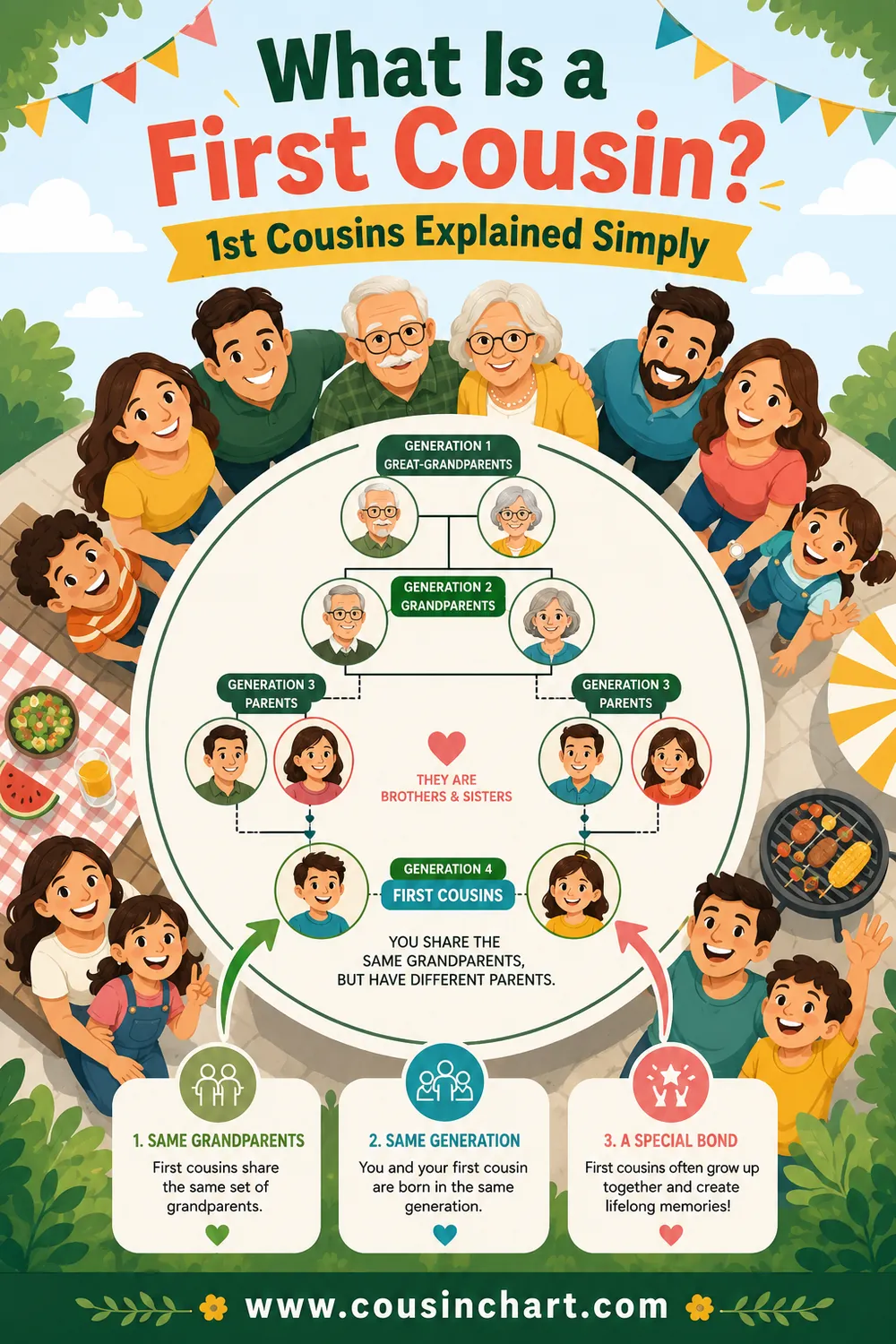
A first cousin is the child of your aunt or uncle — in other words, someone who shares a set of grandparents with you. Your parents are siblings, so you and your 1st cousins sit on the same generation of the family tree, one branch apart.
That's the whole idea, and it's the foundation every other cousin term is built on. This guide covers how first cousins work, who doesn't count (more people than you'd think), how much DNA you share, and what happens when the generations start drifting. For anything trickier than "my uncle's kid," the free relationship calculator on our homepage names any family relationship in seconds.
Relationship quick-check. Tap a phrase to see the correct term:
The answer will appear here.
The Definition, Three Ways
The same relationship, described from three angles — whichever clicks for you:
- Through your parents: your first cousin is your aunt or uncle's child. Your parent and their parent are siblings.
- Through your grandparents: first cousins share a set of grandparents but have different parents.
- Through the tree: you're both exactly two generations below the shared couple, on different branches.
All three say the same thing. The grandparent version is the one genealogists lean on, because "who is the shared ancestor?" is the question that unlocks every cousin relationship, from first cousins to second cousins and beyond.
Who Counts as a First Cousin (And Who Doesn't)
People stretch the word "cousin" to cover half the neighborhood, so it's worth drawing the line precisely. These people are your first cousins:
- Your mom's brother's kids
- Your dad's sister's kids
- Any child of any full sibling of either parent
These people are not first cousins, even though families often call them cousins:
| Person | Actual relationship | Why |
|---|---|---|
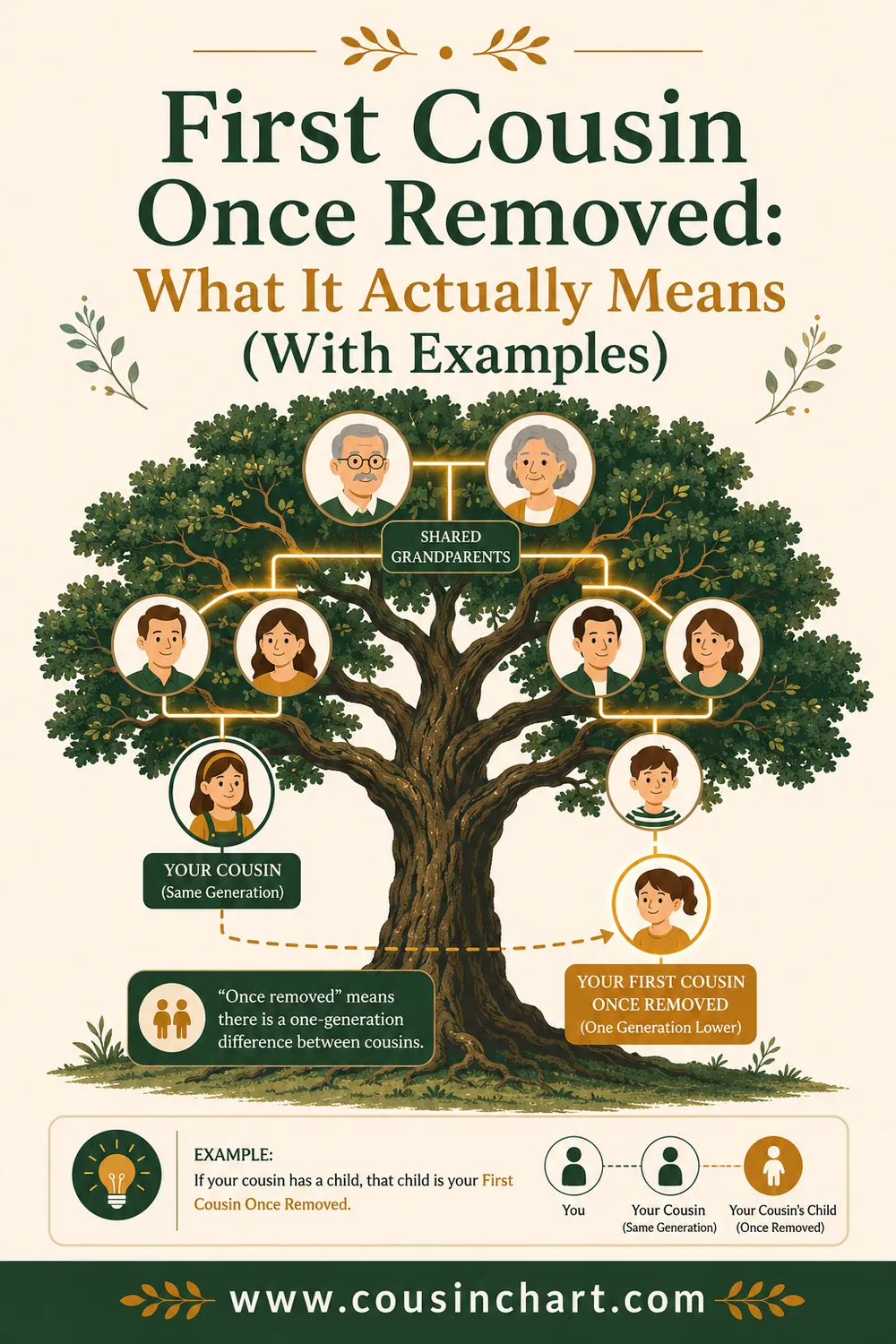
| Your cousin's child | First cousin once removed | One generation below you |
| Your parent's cousin | First cousin once removed | One generation above you |
| Your parent's cousin's child | Second cousin | Shares great-grandparents, not grandparents |
| Your aunt's husband's kids (from a prior marriage) | Step-cousins, informally | No shared ancestor |
| Your half-aunt's child | Half first cousin | Shares one grandparent, not two |
| Your sibling's spouse's siblings' kids | No standard term | No shared ancestor |
The first two rows cause most of the world's cousin arguments. "Removed" means a generation gap, and our guide to the first cousin once removed relationship untangles it fully.
How Much DNA Do First Cousins Share?
First cousins share about 12.5% of their DNA on average — roughly 850–870 centimorgans (cM) on tests like AncestryDNA and 23andMe. Real results typically range from about 500 to 1,200 cM, because DNA is shuffled randomly in every generation.
For context, here's the cousin ladder:
| Relationship | Shared ancestor | Average shared DNA |
|---|---|---|
| First cousin | Grandparents | ~12.5% |
| First cousin once removed | Grandparents (1-gen gap) | ~6.25% |
| Second cousin | Great-grandparents | ~3.1% |
| Third cousin | Great-great-grandparents | ~0.8% |
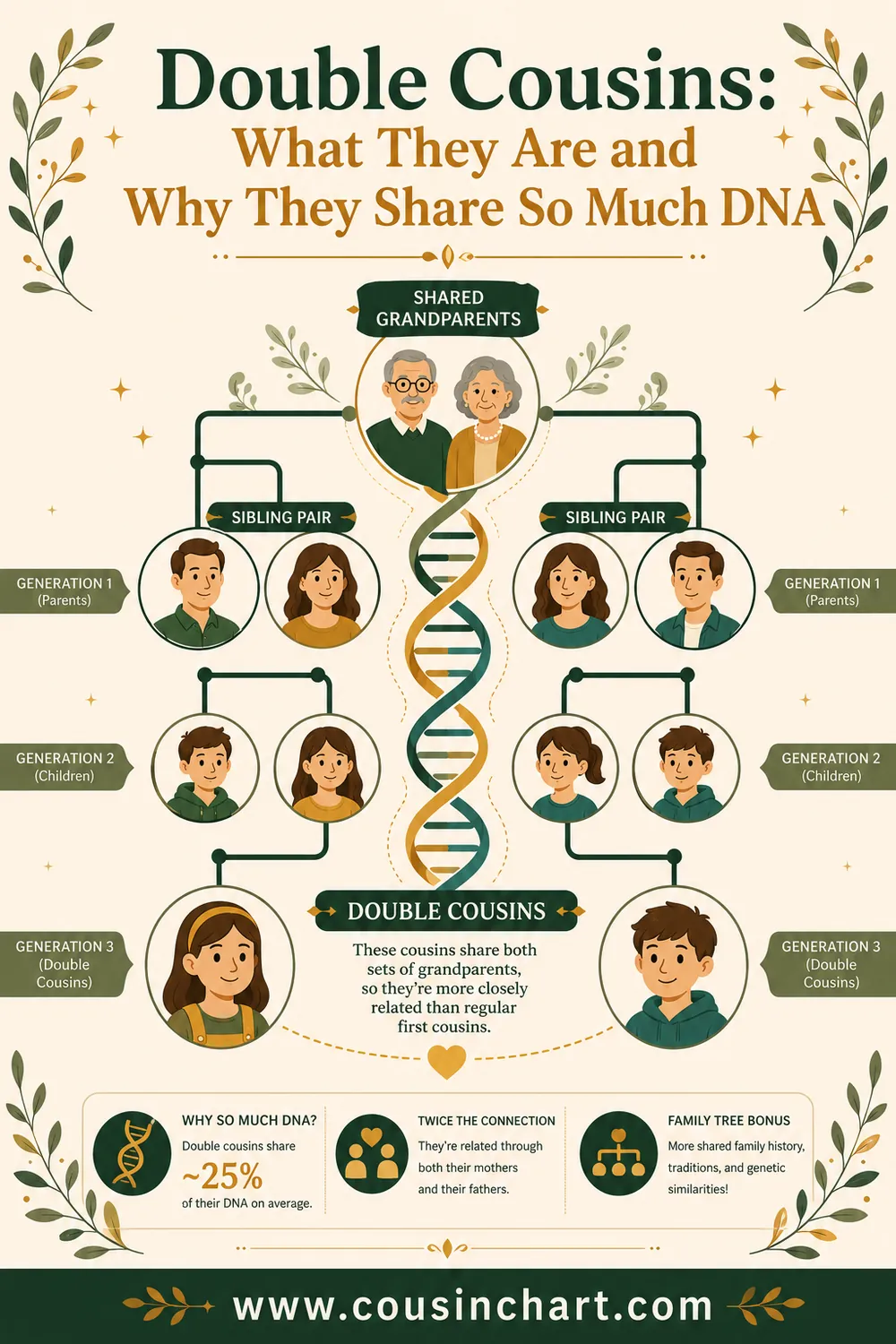
Two footnotes worth knowing. First, double cousins — when two siblings from one family marry two siblings from another — share both sets of grandparents and average ~25%, sibling-adjacent territory. Second, half first cousins (children of half-siblings) average ~6.25%, which looks identical to a first cousin once removed on a DNA report. Numbers alone can't always name the relationship; trees can.
First Cousins and the Generations Around Them
Your first cousins are the anchor point — everything nearby is named relative to them:
- Your cousin's children are your first cousins once removed.
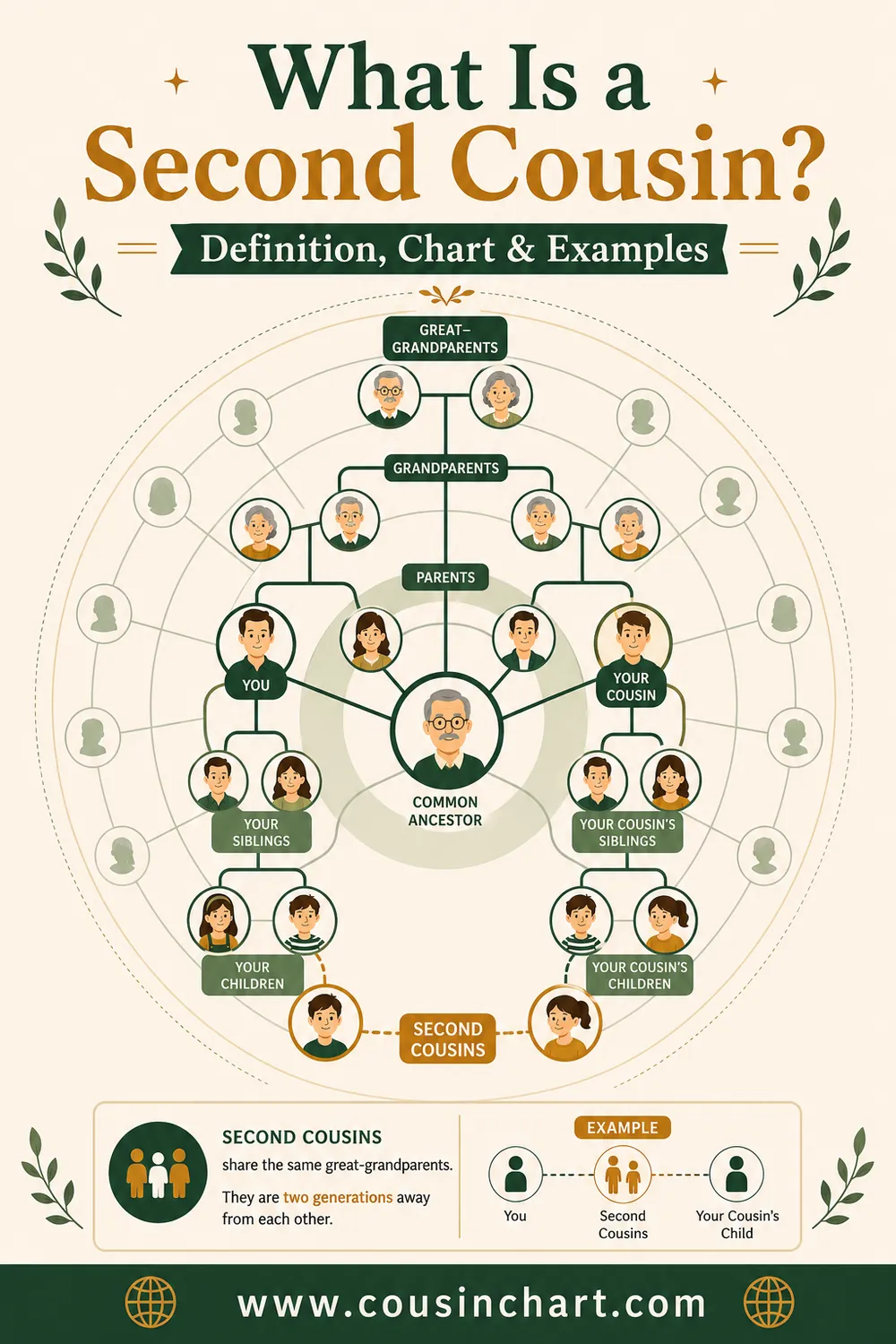
- Your children and your cousin's children are second cousins to each other.
- Your grandchildren and your cousin's grandchildren are third cousins.
- Your parent's cousins are your first cousins once removed, in the upward direction.
Notice the rule hiding in that list: when both branches step down a generation, the cousin degree grows (first → second → third). When only one branch steps, you get a removal instead. Master that and you can derive any relationship in the family — or skip the deriving and let the cousin calculator do it while you refill the coffee.
How Many First Cousins Do People Have?
It depends entirely on how many siblings your parents have and how many kids those siblings had. Someone whose parents were both only children has zero first cousins. Someone with eight aunts and uncles averaging three kids each has twenty-four.
Studies of Western family sizes put the typical number somewhere around four to eight first cousins, and falling — smaller families mean fewer aunts and uncles, which means fewer cousins each generation. In many cultures, though, first cousins function like extra siblings: same age range, same grandparents' kitchen, same childhood summers.
First cousins are also usually the relatives you can name without a chart. It's the next ring out — the once-removeds and second cousins — where everyone starts guessing. (That's the ring our free calculator was built for.)
Can First Cousins Marry?
A common question with a factual answer: it depends where you live. Roughly half of US states allow first-cousin marriage, some allow it only under specific conditions, and others prohibit it. Many countries around the world permit it, and historically it was common — Charles Darwin and Queen Victoria both married first cousins.
Genetically, first cousins share about 12.5% of their DNA, and children of first-cousin couples carry a moderately elevated risk of recessive genetic conditions compared to unrelated couples. Laws change and vary widely, so if the question is more than trivia, check the current law in your state or country.
Meet the Riveras: One Family, Every Kind of Cousin
Abstract rules stick better with names attached, so here's one family that manages to produce nearly every cousin variety on this page.
Luis and Carmen Rivera raised three kids: Marco, Elena, and Sofia. Marco's daughter is Ava; Elena's son is Ben. Ava and Ben are textbook first cousins — children of siblings, sharing grandparents Luis and Carmen. Sofia never had children, which is a quiet reminder that your number of cousins depends entirely on which aunts and uncles had kids.
Now the asterisks:
- Luis had a son from his first marriage, Tomás — a half-brother to Marco, Elena, and Sofia. Tomás's daughter and Ava are half first cousins: they share one grandparent (Luis) instead of two, and they'd share roughly half the usual cousin DNA.
- Marco remarried, and his second wife brought a son into the house. That boy and Ben are step-cousins — family at every holiday, but no shared ancestor and no shared DNA.
- Elena's husband has a brother with three kids. Those kids are Ben's first cousins on his dad's side, but to Ava they're nothing at all — the classic "my cousin's cousin" situation, where the two of you connect through Ben without being related to each other.
- And if Marco had married his wife's sister's... let's not. But had two Rivera siblings married two siblings from another family, their kids would be double first cousins, sharing all four grandparents.
One backyard barbecue, five different relationships, all answering to "cousin." When a real-life Rivera situation gets tangled, the free calculator sorts out exactly which one you're looking at.
How Other Languages Handle First Cousins
English is unusually lazy here: one word, "cousin," covers your mother's sister's daughter and your father's brother's son alike. Plenty of languages find that absurd.
- Chinese splits cousins by which side they're on: children of your father's brothers are táng cousins, while children of your father's sisters and all your mother's siblings are biǎo cousins — and each term further splits by gender and by whether the cousin is older or younger than you. Eight distinct words where English uses one.
- South Asian English often says "cousin-brother" and "cousin-sister" for first cousins, reflecting how close the relationship functions in many families there.
- Spanish calls a first cousin primo hermano — literally "cousin-brother" — to distinguish them from more distant primos.
- Swedish gives second cousins their own word, syssling, so nobody has to say "the child of my parent's cousin."
- Arabic distinguishes cousins through the father's brother (ibn ʿamm / bint ʿamm) from cousins on other sides — a distinction with real social weight historically.
Anthropologists add one more split you may meet in genealogy reading: parallel cousins (children of two brothers or two sisters) versus cross cousins (children of a brother and a sister). Some cultures treat parallel cousins almost as siblings while placing cross cousins in a different category entirely.
Why this matters for your tree: if your family records or your relatives switch between languages, "cousin" may not map one-to-one. A great-grandmother's letter calling someone "brother" might mean a parallel cousin; an aunt's "cousin-sister" is a plain first cousin. Translate the relationship, not just the word.
When a DNA Match Says "First Cousin" (But Isn't)
DNA companies label matches by centimorgan ranges, not by actual relationships — and the ~12.5% neighborhood is crowded. All of these average roughly 850 cM and can land in the same "first cousin" bucket:
- A true first cousin
- A half-aunt or half-uncle (your parent's half-sibling)
- A half-niece or half-nephew
- A great-aunt or great-uncle
- A great-grandparent or great-grandchild
The numbers alone cannot separate them. What can:
- Age and generation. An 850 cM match forty years older than you is far more likely a great-aunt or a half-uncle than a cousin.
- Shared matches. If the mystery match also matches your known maternal cousins, you've at least got the side of the family.
- The paper trail. A quick look at who your grandparents' siblings married often settles it in one evening.
Watch the edges, too: a low-end first cousin (around 500 cM) overlaps with first cousins once removed, and double cousins at ~25% can get mislabeled as half-siblings by the algorithm. When a DNA label contradicts the family tree you trust, believe the tree first and the label second — then look for the half-relationship or the double-marriage that explains the number.
First Cousins and Inheritance
Cousins also show up in probate court. Under most US intestacy laws — the rules for when someone dies without a will — first cousins inherit only when there's no surviving spouse, child, parent, sibling, niece, nephew, aunt, or uncle. It happens more than you'd think: estates of people who never married and outlived their siblings routinely pass to a crowd of first cousins, split evenly, and professional "heir hunters" earn their living reconstructing exactly the kind of tree this site helps you draw.
Two practical notes. Some states cut inheritance off at first cousins or first cousins once removed, so more distant relatives get nothing even if they're the closest kin left. And when a will just says "to my cousins," courts have to decide who that includes — one more reason to use precise terms (or a chart) when family and money mix.
Quick Answers for Family-Reunion Debates
Keep these in your back pocket:
- "We're cousins on both sides!" If two siblings married two siblings, their kids are double cousins — first cousins through both parents.
- "She's my little cousin." If she's your cousin's daughter, she's technically your first cousin once removed. Adorable either way.
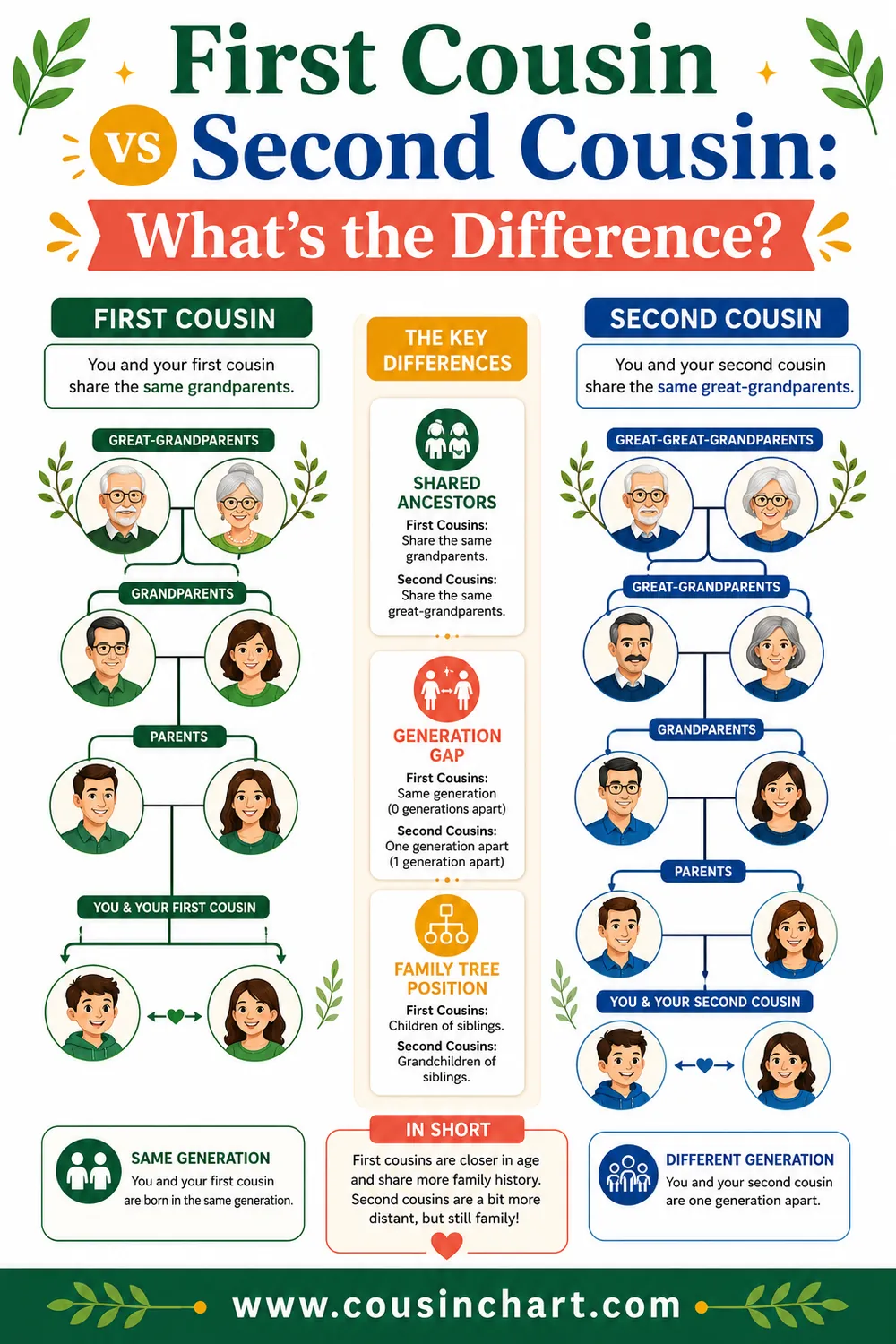
- "We're cousins, but I don't know how." Find the shared ancestors. Grandparents = first cousins. Great-grandparents = second cousins. One generation of mismatch = once removed.
- "Is my cousin's cousin my cousin?" Not necessarily. Their cousins on the other side of their family share no ancestors with you.
FAQ
What is a first cousin in simple terms?
Your aunt or uncle's child. You share a set of grandparents and sit on the same generation of the family tree.
Are 1st cousins blood-related?
Yes — first cousins share about 12.5% of their DNA on average through their shared grandparents. Cousins by marriage (your aunt's husband's kids, for example) are not blood relatives.
What's the difference between a first cousin and a second cousin?
First cousins share grandparents; second cousins share great-grandparents. Each additional "great" in the shared couple adds one to the cousin number — the full breakdown is in our first cousin vs second cousin comparison.
Is my cousin's child my second cousin?
No — that's your first cousin once removed. Second cousins are your parent's cousin's children: same generation as you, sharing great-grandparents.
How much DNA do first cousins share?
Around 12.5% on average (roughly 850–870 cM), with a normal range of about 500–1,200 cM. Double cousins share about twice that; half first cousins about half.
What is a cousin-brother?
A first cousin. "Cousin-brother" and "cousin-sister" are standard in Indian, Pakistani, and other South Asian English to describe an aunt or uncle's child — the wording signals how sibling-like the relationship is in many families, but the tree position is ordinary first cousin.
Is my adopted cousin still my first cousin?
Yes, in every way that matters day to day: adoption makes a child fully part of the family, so your aunt's adopted son is your first cousin legally and socially. On a DNA test you won't share segments, and careful genealogists record both the adoptive line and (when known) the biological one.
Do first cousins count as immediate family?
Usually not — "immediate family" typically means parents, siblings, spouses, and children. But definitions vary by context (employers, hospitals, courts), so check the specific policy when it matters.
Put It to Work
First cousin = aunt or uncle's kid = shared grandparents. Everything else in cousin-land is a variation on that theme: more "greats" in the shared couple push the degree up, generation gaps add removals.
When a relationship doesn't fit the simple cases — a grandmother's cousin's grandson, a half-uncle's daughter — don't squint at a chart. Open the free family relationship calculator, tap the path, and get the exact term with a one-line explanation.