First Cousin vs Second Cousin: What's the Difference?
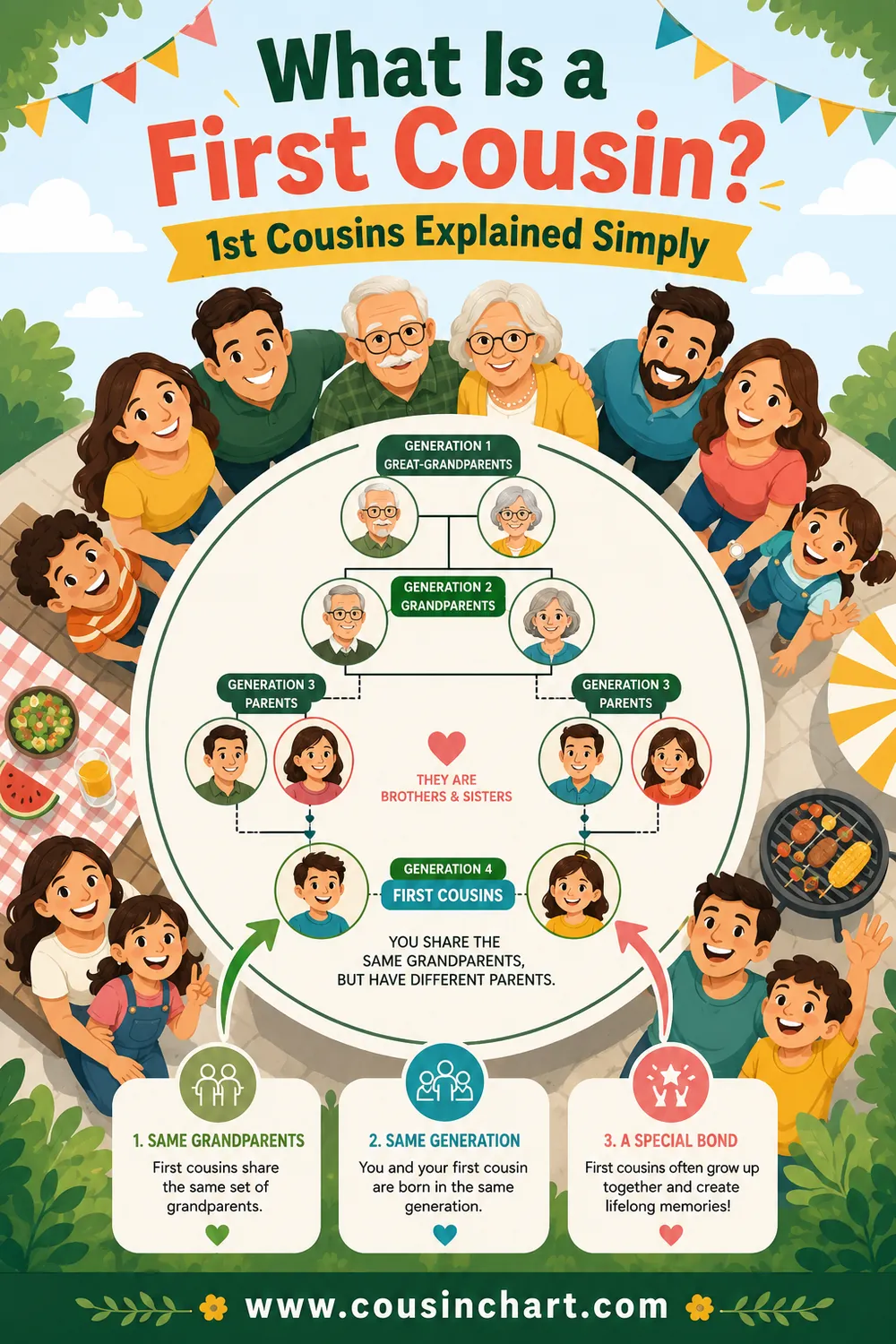
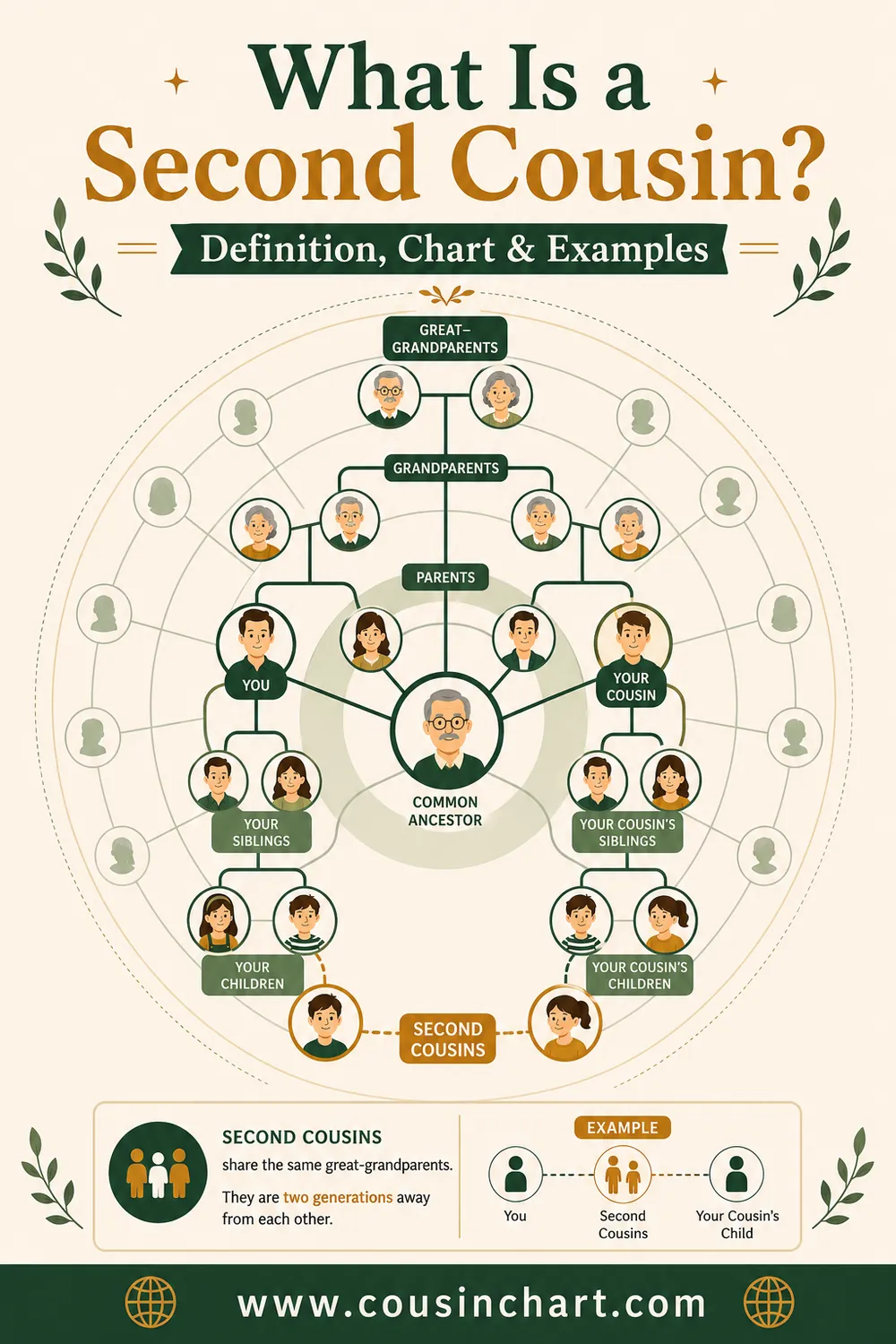
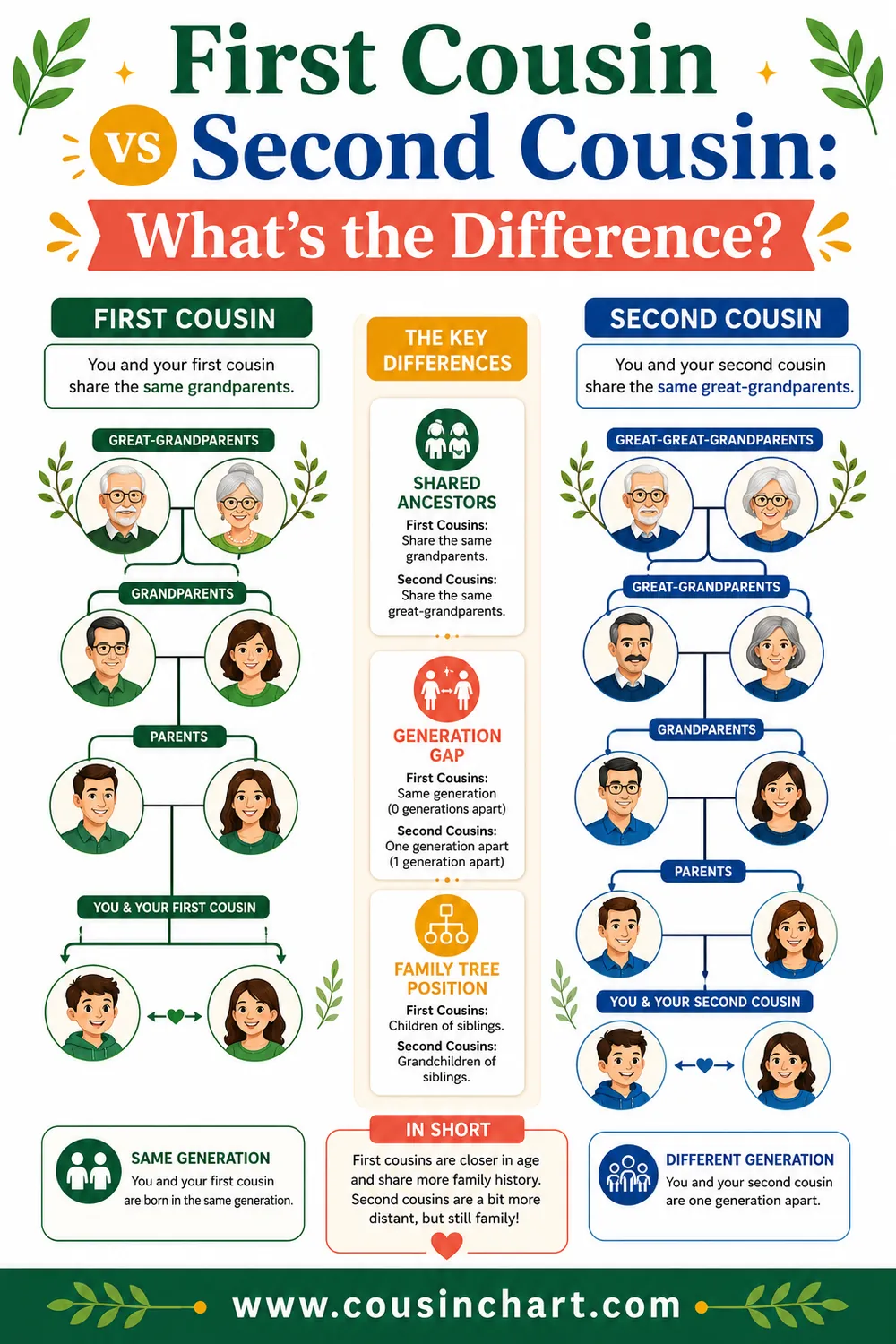
The difference comes down to one question: which ancestors do you share? First cousins share grandparents — your parents are siblings. Second cousins share great-grandparents — your parents are first cousins.
Same generation in both cases; the family split just happened one generation earlier for second cousins. This guide gives you the side-by-side chart, two foolproof tests, the DNA numbers, and the classic mix-up that fools almost everyone. If you'd rather point and click, the free relationship calculator on our homepage sorts any pair instantly.
Relationship quick-check. Tap a phrase to see the correct term:
The answer will appear here.
The Side-by-Side Chart
| First cousin | Second cousin | |
|---|---|---|
| Shared ancestors | Grandparents | Great-grandparents |
| Your parents are... | Siblings | First cousins |
| Generations from shared couple | 2 | 3 |
| Same generation as you? | Yes | Yes |
| Average shared DNA | ~12.5% (~850–870 cM) | ~3.1% (~230 cM) |
| Typical DNA range | ~500–1,200 cM | ~40–530 cM |
| How you usually know them | Childhood, holidays, grandparents' house | Reunions, weddings, DNA matches |
| Everyday name | "My cousin" | Also "my cousin," honestly |
Both relationships are horizontal — you and the cousin stand on the same rung of the family ladder. What changes is how high the branch that connects you goes: one rung up to grandparents for first cousins, two rungs up to great-grandparents for second cousins.
Test One: The Parent Test
The fastest check uses your parents:
- Are your parents siblings? You're first cousins.
- Are your parents first cousins? You're second cousins.
- Are your parents second cousins? You're third cousins — the pattern continues forever.
Each generation of cousins produces the next degree down the line. Two siblings' kids are first cousins; those first cousins' kids are second cousins to each other; their kids are third cousins. The degree only ever grows when both branches add a generation.
Test Two: The Grandparent Test
If the parent test is fuzzy (big families, uncertain memories), go up instead:
- Name the most recent ancestors you both descend from.
- Grandparents? First cousins. Great-grandparents? Second cousins. Great-great-grandparents? Third cousins.
- If one of you is closer to the shared couple than the other, you've got a "removed" situation — more on that below.
This test never fails, because the shared-ancestor level is the definition of the cousin degree. It's exactly the logic behind how to read a cousin chart, just without the grid.
The Mix-Up That Fools Everyone
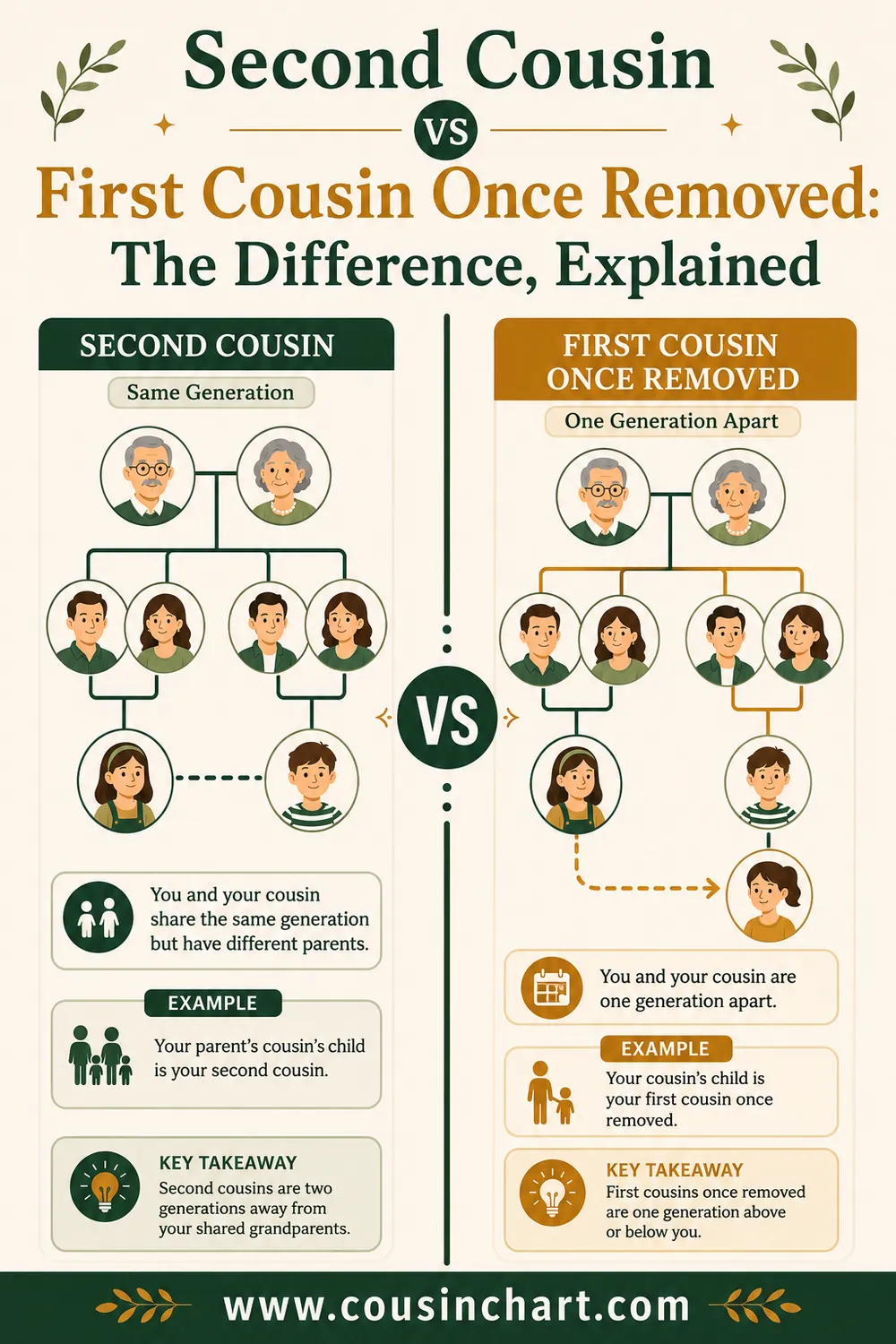
Here's the error that fuels most family debates: assuming your parent's cousin or your cousin's child is your second cousin. Neither is.
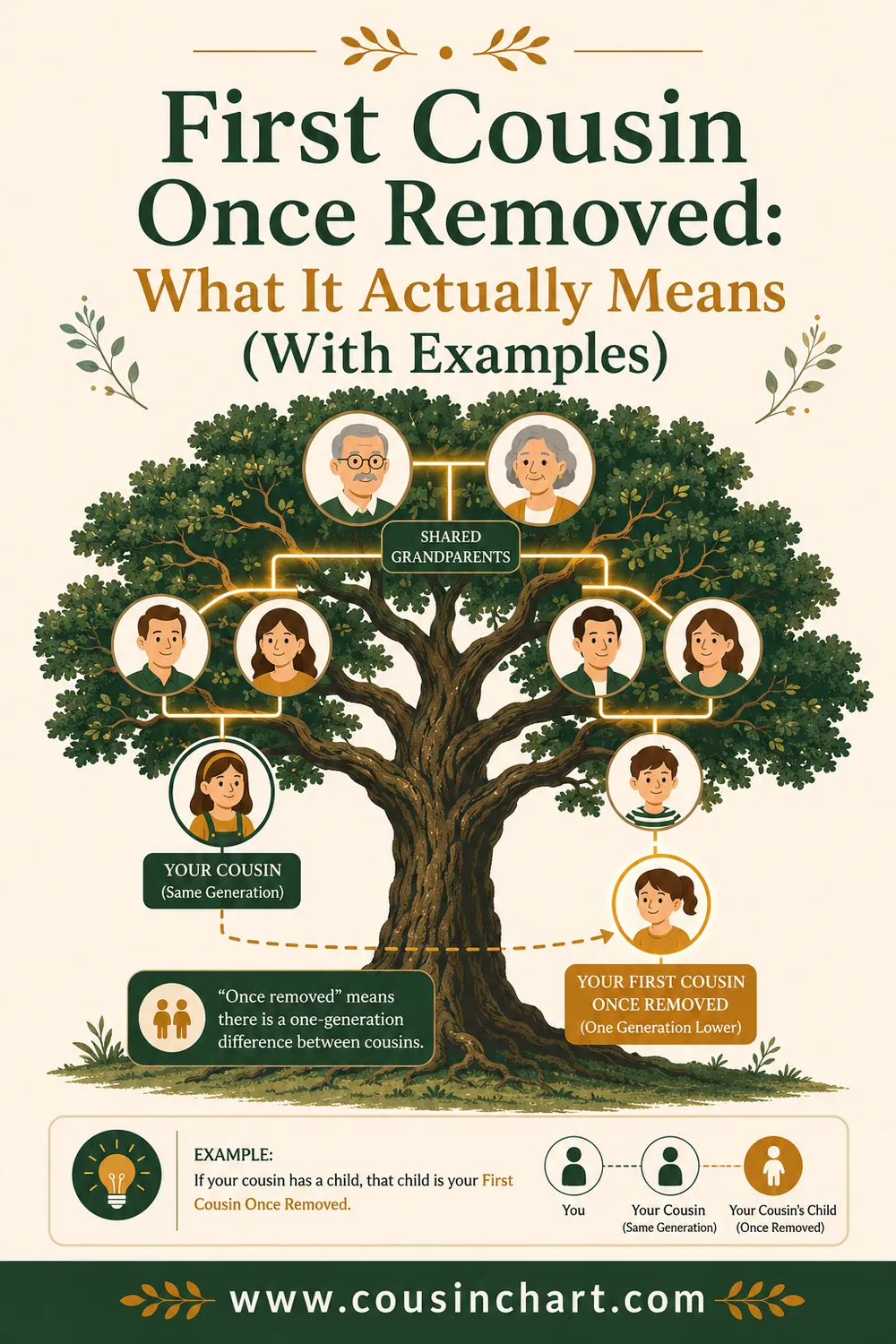
- Your parent's first cousin is your first cousin once removed (one generation above you).
- Your first cousin's child is also your first cousin once removed (one generation below you).
- Your parent's first cousin's child — same generation as you — is your second cousin.
"Second" requires stepping down on both sides of the split. Stepping down on one side only creates a removal. If the once-removed relationships are the ones tangling you up, our second cousin vs first cousin once removed guide takes that specific pair apart — it's the single most-confused matchup in the whole cousin system.
A memory hook that works: degree = distance up, removal = difference in level. First vs second is about how far up the tree the split is; removed is about whether you're standing on the same rung.
One Couple, Every Degree: The Bakers
Here's the detail that makes the whole system click: the shared couple never moves — you do.
Meet Harold and June Baker. They raise two daughters, Alice and Betty.
- Alice's son Tom and Betty's daughter Kate are first cousins. Harold and June are their shared grandparents.
- A generation later, Tom's daughter Emma and Kate's son Jack are second cousins. Same Harold, same June — but now they're the shared great-grandparents, because Emma and Jack stand one rung further down.
- When Emma and Jack have kids of their own, those kids will be third cousins, still tracing back to Harold and June, now their great-great-grandparents.
One couple at the top of the tree quietly serves as the anchor for first cousins, second cousins, and third cousins — it just depends which generation you're asking about. So when someone at a reunion says "we're all Bakers," the real question is never whether you're cousins; it's how many rungs down from Harold and June each of you stands. Count Emma's rungs, count Jack's, and the label writes itself — or let the cousin calculator count for you.
How the Pattern Continues: Third, Fourth, and Beyond
First vs second is just the start of a ladder that runs as deep as your tree does:
| Degree | Shared ancestors | Your parents are... | Avg shared DNA |
|---|---|---|---|
| First cousins | Grandparents | Siblings | ~12.5% (~850 cM) |
| Second cousins | Great-grandparents | First cousins | ~3.1% (~230 cM) |
| Third cousins | Great-great-grandparents | Second cousins | ~0.8% (~73 cM) |
| Fourth cousins | 3×great-grandparents | Third cousins | ~0.2% (~13 cM) |
Two things to notice. The "parents are" column is the whole system in miniature — every cousin degree is simply the previous degree's kids. And the DNA column falls off a cliff: by fourth cousins, a meaningful share of genuine cousins share no detectable DNA at all, even though the paper relationship is real. That's why DNA sites confidently confirm second cousins, hedge on third, and shrug at fourth.
The ladder is also a research shortcut. The degree tells you roughly when the shared couple lived: for first cousins, the shared grandparents were typically born 50–90 years before you; for second cousins, the great-grandparents land 80–120 years back; third cousins push the couple past the century mark. So the moment you establish "we're second cousins," you know which census decades and which courthouse books to open to find the family you share. Degree isn't just a label — it's a date range.
Half and Double Cousins: The Boundary Blurrers
A few real-world variations sit between the tidy first and second cousin categories, and they're worth knowing because they sabotage the DNA numbers:
- Half first cousins — your parents were half-siblings, so you share one grandparent instead of two. Average DNA: ~6.25% (~425 cM), landing squarely between first and second cousin territory. A DNA site will often call this match a "first cousin once removed" or even a strong second cousin.
- Half second cousins — one shared great-grandparent. About 1.5% (~115 cM), which looks exactly like a second cousin once removed on paper.
- Double first cousins — two siblings from one family married two siblings from another, so the kids share both sets of grandparents. Around 25% shared DNA, double the usual, and easily mistaken for half-siblings by the algorithms.
The lesson for both charts and DNA lists: "first vs second" is clean on paper, but real families add asterisks. When a match's number doesn't fit either category neatly, a half-relationship or a double-marriage in the tree is usually the explanation.
What the DNA Difference Looks Like
The gap between first and second cousins is dramatic on a DNA test:
- First cousins: ~12.5% shared DNA. You'll never miss a first cousin on a match list — they're in the top handful of results, around 850 cM.
- Second cousins: ~3.1% shared DNA. Solid, reliable matches around 230 cM. Testing companies detect essentially all second cousins, but the number is a quarter of the first-cousin figure.
Each generation between you and the shared ancestors halves the expected DNA. That's why the degrees fall off so fast: third cousins are at ~0.8%, and fourth cousins sometimes share nothing detectable at all.
One caution for match lists: a "second cousin" label on a DNA site is a range, not a verdict. Half first cousins, first cousins twice removed, and first cousins once removed can all land near second-cousin numbers. Confirm with the paper trail — or reconstruct the path with the relationship calculator and see which explanation fits the ages involved.
Do Second Cousins "Count" as Family?
Genealogically, of course — you share great-grandparents, and there's a decent chance your grandparents grew up together as first cousins. Socially, it varies by family. Some people see their second cousins weekly; others couldn't pick them out of a lineup.
A few places the distinction actually matters:
- Weddings and reunions: figuring out who's invited, who's related to whom, and what the kids at table nine are to each other.
- DNA testing: second cousin is roughly the boundary where matches stop being obvious and start needing research.
- Marriage law: US states that restrict cousin marriage restrict first cousins; no state bars second cousins. Laws vary and change, so check current law if it's relevant to you.
- Inheritance: intestacy rules in some jurisdictions walk out through cousin degrees when closer kin don't exist.
And there's a quieter reason to know your second cousins: they carry different pieces of the same family story. Their grandparent was your grandparent's first cousin, which means their branch may hold photos, letters, and names from the shared great-grandparents that your branch lost along the way.
FAQ
What's the difference between a 1st cousin and a 2nd cousin?
First cousins share grandparents (their parents are siblings). Second cousins share great-grandparents (their parents are first cousins). Both are same-generation relationships.
Is my dad's cousin my second cousin?
No — your dad's cousin is your first cousin once removed. Your dad's cousin's child is your second cousin.
How much DNA do first and second cousins share?
First cousins average about 12.5% (~850–870 cM); second cousins average about 3.1% (~230 cM). Each generation of distance halves the expected amount.
Can second cousins marry?
No US state restricts marriage between second cousins; first-cousin marriage rules vary by state. Laws differ around the world and change over time, so check the current law where you live.
Are second cousins blood-related?
Yes — through shared great-grandparents. The connection is real but light: about a quarter of the DNA that first cousins share.
Which is closer, a second cousin or a first cousin once removed?
Genetically, the first cousin once removed — about 6.25% shared DNA versus a second cousin's 3.1%. Socially they feel similar, since one is your generation and one is a generation off, but on a DNA match list the once-removed first cousin shows up roughly twice as strong.
What is a "cousin-german"?
An old term for a plain first cousin — you'll meet it in wills and older records. "German" here comes from the Latin for "of the same stock," not the country.
What are my second cousin's kids to me?
Your second cousins once removed. And your kids and their kids will be third cousins to each other.
The One-Sentence Version
First cousins share grandparents; second cousins share great-grandparents — and anyone who's a generation off from you isn't either one, they're "removed." Keep those two facts and you can settle 90% of family-tree arguments on the spot.
For the other 10% — the half-cousins, the twice-removeds, the "my grandma's cousin's grandson" puzzles — the free family relationship calculator gives you the exact term, both directions, in seconds.