Lineage Definition: What Lineage Means, With Simple Family Tree Examples
Lineage means your line of descent from an ancestor. It is the chain that runs from you to your parent, to your grandparent, to your great-grandparent and on back, one generation at a time. When someone says they can trace their lineage to a town, a ship or a family, they mean they can follow that chain, step by step, all the way back. Below is a simple definition, real family tree examples and an easy way to start tracing your own.
Tap one to see the answer.
▶ Check how you're related in the free calculator
Lineage definition in plain words
A lineage is a straight line on your family tree. Think of a ladder: each rung is one generation, and every rung is a parent of the one below it. Your lineage does not step sideways to brothers, sisters or cousins. It only goes up (to your ancestors) or down (to your descendants).
- Example: You, your mother, her father, his mother. That is one lineage.
- Another example: You, your father, his father, his father's father. That is your paternal line.
- Going down: You, your child, your grandchild. That is your lineage moving forward.
Lineal vs collateral relatives
This is the easiest way to see what lineage covers and what it leaves out.
| Type | Who they are | Part of your lineage? |
|---|---|---|
| Lineal (ancestors) | Parents, grandparents, great-grandparents | Yes |
| Lineal (descendants) | Children, grandchildren, great-grandchildren | Yes |
| Collateral | Brothers, sisters, aunts, uncles | No, a side branch |
| Collateral | Cousins, nieces, nephews | No, a side branch |
| By marriage | In-laws, step-relatives | No |
For more, read lineal vs collateral relatives and what is a direct descendant.
Paternal and maternal lineage
You have many lineages, because every ancestor starts a new line. Two of them get special names:
- Paternal lineage: you, your father, his father, his father's father. In many families this line follows the last name.
- Maternal lineage: you, your mother, her mother, her mother's mother.
DNA tests can follow these two lines. Y-DNA is passed from father to son, so it tracks the direct paternal line. Mitochondrial DNA (mtDNA) is passed from a mother to all her children, so it tracks the direct maternal line. Our guide to Y-DNA vs mtDNA vs autosomal tests explains which test shows what. Some cultures also trace family membership through only one parent; see matrilineal vs patrilineal.
Lineage vs ancestry vs heritage
| Word | What it usually means |
|---|---|
| Lineage | One line of descent, traced generation by generation |
| Ancestry | All of your ancestors together, every branch at once |
| Heritage | The traditions, language and culture passed down to you |
| Descent | Coming from a certain ancestor or group |
| Pedigree | A chart of your ancestors, often drawn as a tree |
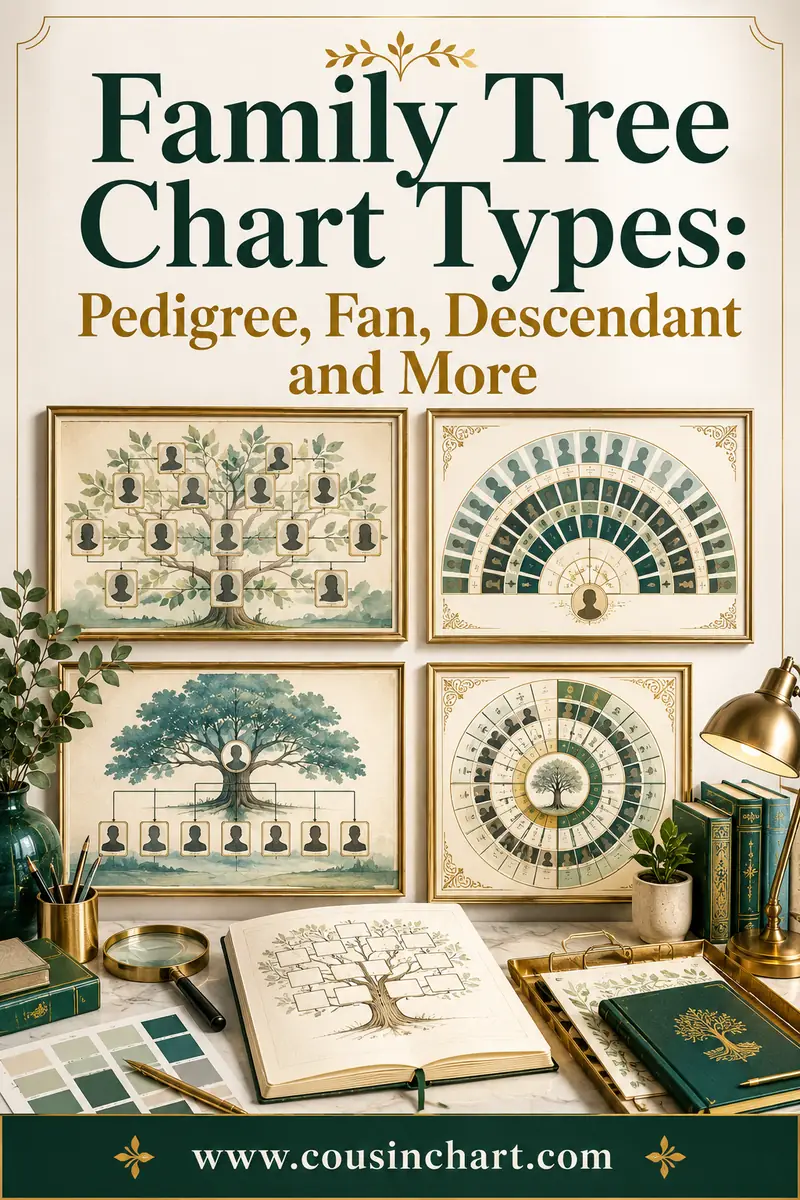
A pedigree chart is the classic way to show many lineages on one page. See pedigree chart explained.
How many ancestors are in your lineages?
The number doubles every generation: 2 parents, 4 grandparents, 8 great-grandparents, 16 great-great-grandparents. Go back 10 generations and that is 1,024 spots on your tree. Each one starts its own lineage. Our page on how many ancestors you have shows the full count, and family generations explained covers how long a generation usually is.
How to trace your lineage
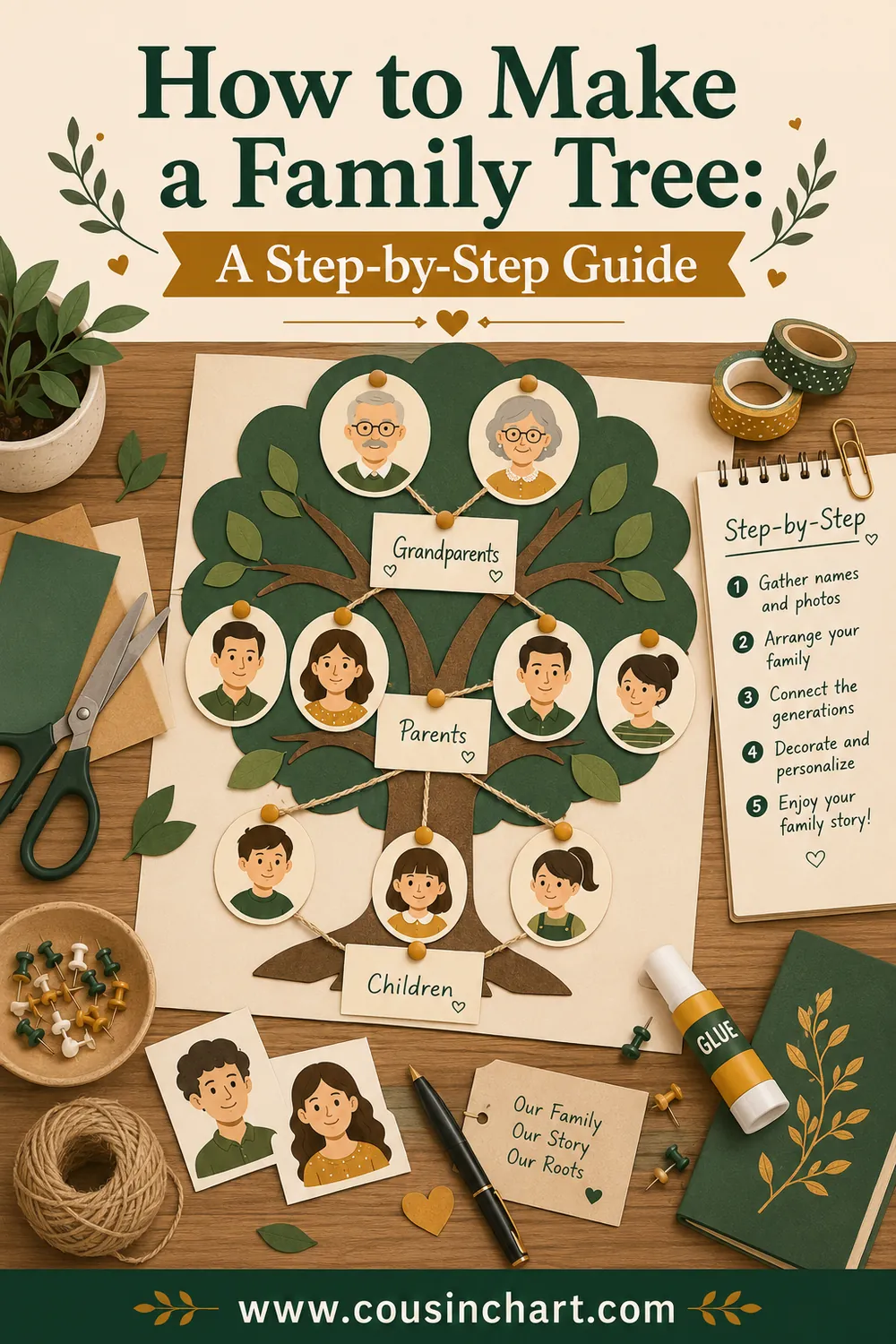
- Start with yourself. Write your full name, birth date and birthplace.
- Add your parents and grandparents. Ask relatives for full names, dates and towns.
- Pick one line to follow first, such as your mother's mother's line, so you do not get lost.
- Use records to go back. Birth, marriage, death and census records each link one generation to the next.
- Write down your sources so you can check them later.
- Fill in a chart. A free printable family tree or a descendant chart keeps everything in order.
Wondering how far you can go? Read how far back you can trace your family tree.
Proving lineage
Some groups, called lineage societies, welcome members who can prove they descend from a certain ancestor, such as a Revolutionary War patriot or an early settler. To join, you show a document for each link in the chain: your birth record, your parent's, your grandparent's and so on back to that ancestor. If you think you have a patriot in your tree, our guide to Revolutionary War ancestors is a good place to start.
Where cousins fit in
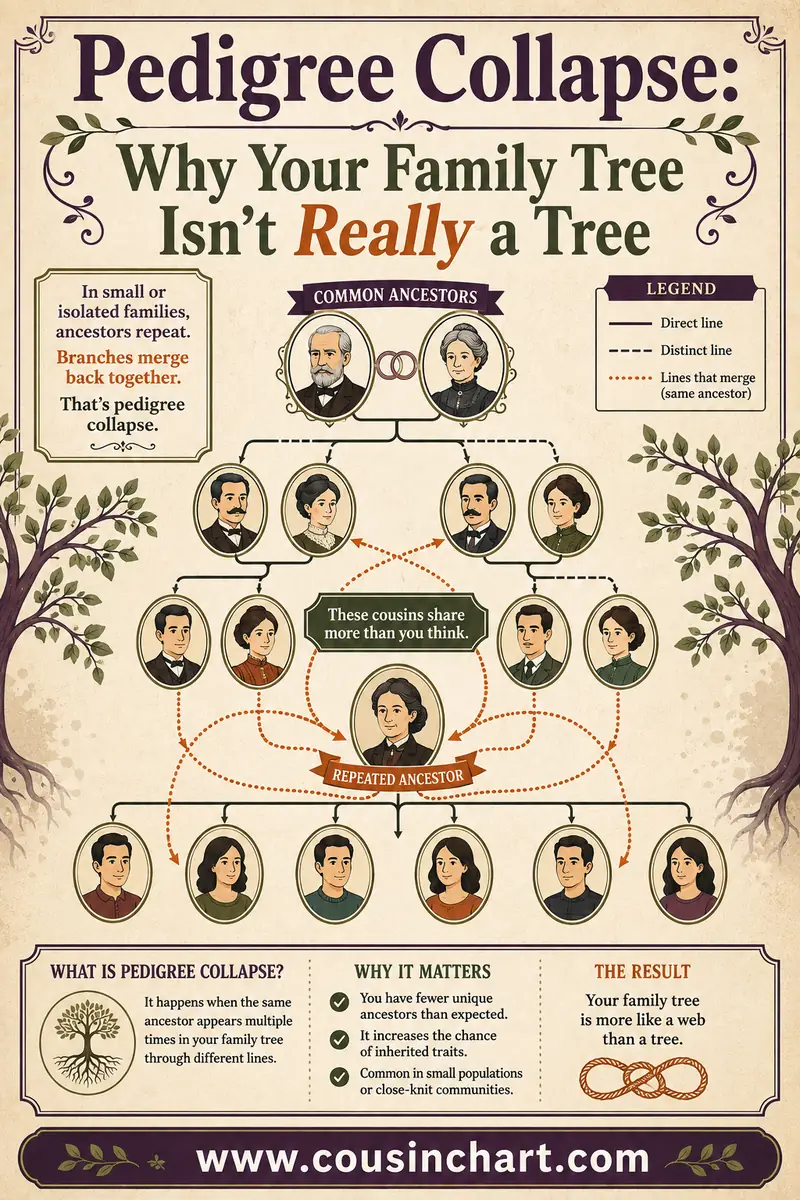
Your cousins are not in your direct lineage, but they share it. You and your first cousin share a set of grandparents, so above that point your lineages are the same. Below it, you each come down a different branch. Read about kinship terms or see a common ancestor chart to picture it.
Want to know exactly how two people on your tree are related? The free relationship calculator works it out for you.
▶ Check how you're related in the free calculator
Frequently Asked Questions
What is the simple definition of lineage?
Lineage is your line of descent: the chain of parents, grandparents and earlier ancestors that leads straight down to you.
Is lineage the same as ancestry?
They overlap. Ancestry usually means all of your ancestors together, while lineage usually means one line traced step by step, such as your father's father's line.
Are my cousins part of my lineage?
Not your direct lineage. Cousins share an ancestor with you, but they come down a side branch. They are collateral relatives, not lineal ones.
What is a paternal lineage?
It is the line that runs from you to your father, his father, his father's father and so on. A maternal lineage runs through your mother, her mother and so on.
How do I trace my lineage?
Start with yourself, add your parents and grandparents, then use records like birth, marriage and census records to go back one generation at a time.