Y-DNA vs mtDNA vs Autosomal: Which DNA Test Answers Your Question?
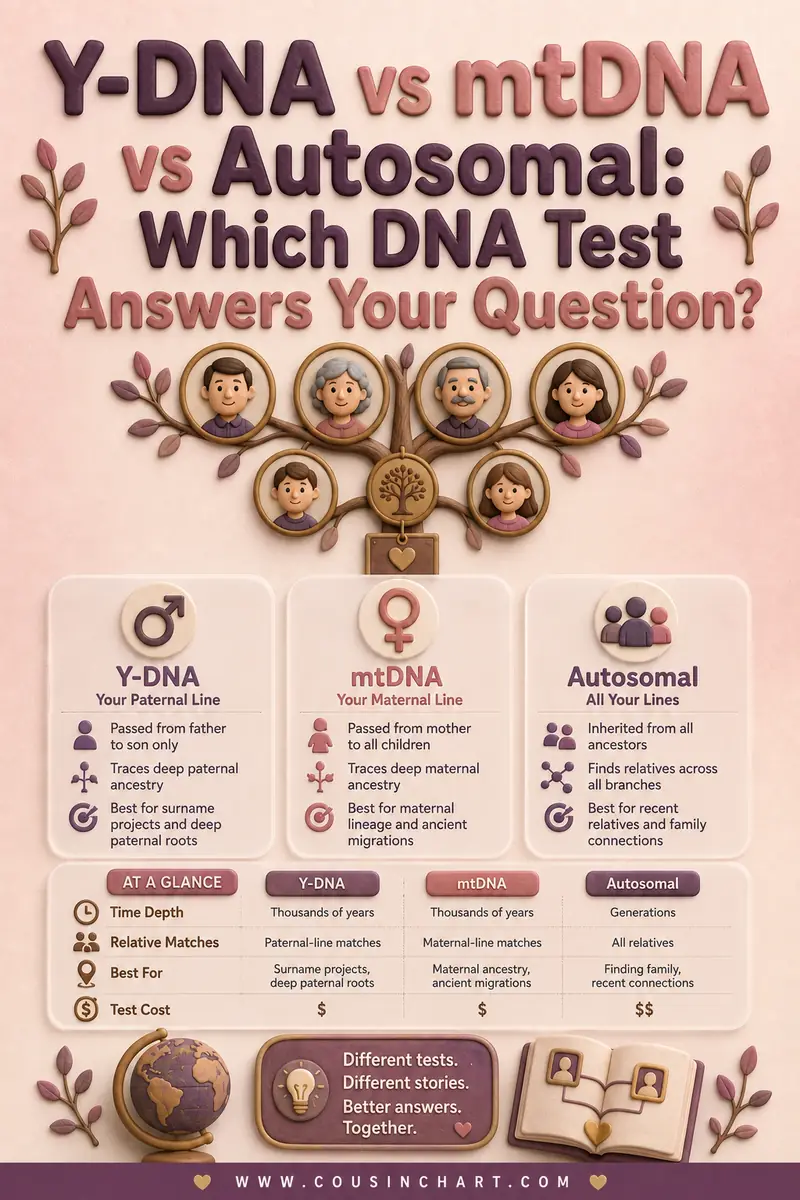
There are three kinds of genealogical DNA test, and they answer completely different questions. Autosomal DNA (what AncestryDNA, 23andMe, MyHeritage and FamilyTreeDNA's Family Finder sell) covers every branch of your tree but only reaches back reliably about 5 to 7 generations. Y-DNA follows one line only — father to son to son — and reaches back many centuries, but only people with a Y chromosome can test it. mtDNA follows the direct maternal line — your mother's mother's mother — and everyone can test it, though only daughters pass it on.
Put simply: autosomal answers broad and recent questions, while Y-DNA and mtDNA answer narrow and deep ones. If you already have a match list and a centimorgan number in front of you, our DNA match calculator will turn that number into the relationships that actually fit. If you're still deciding which test to buy, keep reading — the choice depends entirely on the question you're trying to answer.
Which DNA test should you take? Tap your goal:
Tap a goal above to see which test fits.
Already have match numbers? Check them →The three tests at a glance
| Autosomal (atDNA) | Y-DNA | mtDNA | |
|---|---|---|---|
| What it is | The 22 non-sex chromosome pairs | The Y chromosome | Mitochondrial DNA, outside the cell nucleus |
| Who can test | Everyone | Only people with a Y chromosome (typically men) | Everyone |
| Who passes it on | Both parents, to all children | Father to sons only | Mother to all her children; only daughters pass it on further |
| Lines covered | All ancestral lines | Direct paternal line only | Direct maternal line only |
| Useful range | About 5–7 generations | Many centuries, sometimes millennia | Millennia, but very imprecise in time |
| Recombines? | Yes — reshuffled every generation | No (apart from rare mutations) | No (apart from rare mutations) |
| Gives ethnicity estimate | Yes | Haplogroup / deep origins only | Haplogroup / deep origins only |
| Sold by | AncestryDNA, 23andMe, MyHeritage, FamilyTreeDNA (Family Finder) | FamilyTreeDNA | FamilyTreeDNA |
| Best for | Finding cousins, close relationships, ethnicity, unknown parentage | Surname studies, deep paternal origins, confirming paternal lines | Deep maternal origins, ruling relationships out |
| Typical cost | The cheapest of the three; frequently discounted | More than autosomal, rising with test depth | More than autosomal for a full sequence |
The rest of this article unpacks each row — and, more importantly, explains which question each test can and can't settle.
What does an autosomal DNA test actually test?
Autosomal DNA is everything except the sex chromosomes: 22 pairs of chromosomes, one of each pair from your mother and one from your father. It's what every mainstream consumer test analyses, and it's what produces both your match list and your ethnicity estimate.
Its great strength is coverage. Autosomal DNA comes from all your ancestral lines — your father's mother's father, your mother's father's mother, all of them. A single test can turn up a cousin on any branch of your tree.
Why does autosomal DNA fade after 5 to 7 generations?
Because it gets halved every generation, and because inheritance is random.
You got exactly 50% of your autosomal DNA from each parent. But you did not get exactly 25% from each grandparent — you got roughly 25%, and the actual figure varies. Go back another generation and the variation widens. By the time you're at fourth cousins, the DNA you inherited from a given ancestor may have been shuffled out of existence entirely.
That's why:
- Third cousins share detectable DNA roughly 90% of the time.
- Fourth cousins show up as a match only about half the time.
- Fifth cousins and beyond more often than not share nothing detectable at all — even though the paper relationship is perfectly real.
None of that is a fault in the test. It's how inheritance works. A silent match list says nothing about whether a relationship exists; it says the DNA didn't survive the shuffle. Our guide to what centimorgans really measure explains the units behind all of this.
What autosomal DNA is genuinely brilliant at
- Finding living cousins. The databases are enormous, and a close match arrives with a name, sometimes a tree, and usually shared matches.
- Close relationships. Parent, sibling, half-sibling, aunt, uncle, grandparent, first cousin — autosomal reads all of these confidently.
- Unknown parentage. For adoptees and people with a misattributed parent, autosomal is the workhorse. Everything else is a supplement.
- Ethnicity estimates. Approximate, regularly revised, and best read as broad regions rather than tidy percentages — but only autosomal produces them.
What it can't do
It can't tell you which ancestor a match comes through — a 60 cM match is a number, and the relationship has to be worked out from trees, shared matches and clustering. It can't reach reliably past the early 1800s. And it can't separate relationships in the same shared-DNA band: a half-sibling, a grandparent, an aunt and a niece all land near 25%. Our shared cM chart shows how much those bands overlap, and how DNA matches work covers reading a match list properly.
How does Y-DNA testing work?
The Y chromosome passes from father to son essentially unchanged. No reshuffling, no halving — a son gets his father's Y, who got his father's Y, back and back for as long as the male line holds.
That makes Y-DNA a genetic tracer for one specific line: your father, his father, his father, and so on. In most Western cultures that line also carries the surname, which is why Y-DNA and surname research fit together so neatly.
Who can take a Y-DNA test?
Only people who have a Y chromosome — in practice, men. A woman has no Y chromosome to test, because she didn't inherit one.
That isn't the end of the road, though. If you're a woman researching your paternal line, you find a male relative who carries the same Y: your father, your brother, your father's brother, your father's brother's son, or a more distant male cousin descending from the same paternal line. You ask him to test, and his results speak for that whole line — including yours.
The same trick works for any line you want to chase. Want your mother's father's paternal line? You need a male descendant of that man through sons only: her brother, or a male cousin on that side.
What do Y-DNA results look like?
Two things come back, and they answer different questions.
- Marker comparisons. Y-DNA tests count repeating patterns at a set number of locations on the chromosome. Two men who match on nearly all markers share a paternal-line ancestor, usually within a genealogically interesting timeframe. The more markers tested, the more confidently you can judge how close that ancestor is.
- A haplogroup. This is a branch on the global paternal family tree, assigned from the mutations you carry. Deeper sequencing tests read far more of the chromosome and place you on a much finer branch — sometimes narrow enough to be genealogically meaningful rather than merely ancient.
What Y-DNA is genuinely brilliant at
- Surname studies. Do the Millers of Ohio descend from the Millers of Pennsylvania? Y-DNA gives you a clean answer that no amount of paper ever will.
- Confirming a paternal line. If your paper trail says you descend from a particular man, and a documented descendant of his brother tests, a Y match supports the whole structure at once.
- Reaching past the paper. Y-DNA doesn't care that the courthouse burned in 1840. The chromosome carried on regardless.
- Detecting a break in the male line. An unexpected non-match is itself a major finding: an adoption, a name change, a stepfather, or an event nobody wrote down.
What Y-DNA can't do
It covers one line out of hundreds. Eight generations back you have 256 ancestors, and Y-DNA speaks for exactly one of them. It also can't give you dates or names — it tells you two men share a paternal ancestor, not who he was or when he lived. Estimates of "how long ago" are statistical ranges, often wide ones. And a match with a stranger who shares your surname doesn't tell you where the connection is on paper; it tells you to go and find it.
How does mtDNA testing work?
Mitochondrial DNA sits outside the cell nucleus, in the mitochondria, and it's inherited in a way that trips almost everyone up at first.
A mother passes her mtDNA to all of her children — sons and daughters alike. But only her daughters pass it on. A son carries his mother's mtDNA his whole life and gives none of it to his own children.
So mtDNA traces your mother, her mother, her mother, and so on. That means:
- Everyone can take an mtDNA test, regardless of sex, because everyone inherited it from their mother.
- A man's mtDNA result describes his mother's line, not any line he passes on.
- To chase a different maternal line, you need someone descended from that woman through daughters only (a son at the end of the chain is fine — he still carries it).
Why is mtDNA less useful for recent genealogy?
Because it mutates very slowly. That stability is wonderful for anthropology and terrible for finding your great-great-grandmother.
Two people can be an exact mtDNA match and share a common maternal ancestor who lived several centuries ago — or several thousand years ago. The test can rarely tell you which. That's why mtDNA match lists are often long, geographically scattered, and hard to act on.
There's also the surname problem working in reverse. A direct maternal line changes surname at every generation, so even when mtDNA points you at a relationship, the paper trail is far harder to follow than a paternal line where the surname persists.
Where mtDNA genuinely earns its place
- Ruling relationships out. This is its most practical use. If two people are supposed to descend from the same woman through unbroken maternal lines and their mtDNA doesn't match, they don't — full stop. A negative result here is definitive in a way few genealogical findings are.
- Deep maternal origins. Your maternal haplogroup places your mother's line on the global human migration map.
- Supporting a specific hypothesis. If you have two candidate maternal lines and one is testable, mtDNA can support or destroy the theory.
- Identification work. mtDNA's durability makes it valuable in historical identification cases, where nuclear DNA has degraded.
What mtDNA can't do
It can't date a connection usefully, it can't name anyone, and it covers exactly one of your hundreds of ancestral lines. It also doesn't produce an ethnicity estimate in the way autosomal tests do — a haplogroup describes a deep ancient branch, not a modern country.
What about the X chromosome?
Worth a brief mention, because it confuses people and occasionally solves problems.
The X isn't a fourth test — it comes along with autosomal testing on platforms that report it, and it has its own inheritance pattern. A man inherits his single X from his mother only, so any X match he has comes through his mother's side. A woman inherits an X from each parent, but her father's X came entirely from his mother.
The upshot: X matching eliminates lines. A man's X can't have come through his father's father, so that branch is off the table immediately. A narrowing tool, not a standalone test.
Which test should you buy for your goal?
| Your goal | Test to buy | Why |
|---|---|---|
| Find living cousins across all branches | Autosomal | Only test with broad coverage and huge databases |
| Ethnicity / origins estimate | Autosomal | The only test that produces regional percentages |
| Find an unknown parent or grandparent | Autosomal first | Close matches are the fastest route; add Y-DNA later if male |
| Confirm a surname line | Y-DNA (male tester) | Follows the surname line unchanged for centuries |
| Test whether two same-surname families connect | Y-DNA (one male from each) | Cleanest yes/no answer in genetic genealogy |
| Confirm two people share a direct maternal ancestor | mtDNA | Only test that follows the mother's mother's mother line |
| Rule a maternal-line theory out | mtDNA | A mismatch is definitive |
| Deep ancient origins and migration | Y-DNA or mtDNA haplogroup | Reaches far past any paper record |
| Break an 1800s brick wall | Autosomal, plus Y-DNA if the line is paternal | Autosomal reaches this era; Y-DNA confirms the line |
| Prove a specific 1700s ancestor | Often no test alone will | Autosomal fades; Y and mt cover only two lines |
If you're only buying one test, buy autosomal. For the overwhelming majority of family history questions it's the right answer, it's the cheapest, and it has the largest databases. Y-DNA and mtDNA are specialist follow-ups for specific questions — genuinely powerful, but pointless if the question you have isn't the question they answer.
Our comparison of the best DNA test for ancestry covers which company to choose once you've decided on autosomal.
How do the three tests work together?
The most productive researchers don't pick one — they use each for what it's built for.
Take a common scenario. You want to know who your paternal great-great-grandfather's father was. The paper trail dies in 1848.
- Autosomal finds you a cluster of matches at the 60–150 cM range who all descend from the same unfamiliar surname. That gives you a candidate family.
- Trees and clustering narrow it to a specific couple. Methods like the Leeds method sort your matches into groups that correspond to grandparent lines and speed this up enormously.
- Y-DNA from a male descendant of your paternal line, compared with a male descendant of the candidate family, confirms or destroys the theory outright.
Autosomal found the neighborhood; Y-DNA confirmed the house. Neither could have done both.
The same layering works for a maternal question, with mtDNA confirming — though less decisively, because an mtDNA match fits a much wider range of connection points.
What people get wrong about these tests
Some persistent mix-ups, worth clearing up:
- "23andMe gave me a haplogroup, so I've had a Y-DNA test." Not quite. Several autosomal platforms read enough Y and mitochondrial markers to assign a haplogroup, which is genuinely useful — but it isn't a dedicated Y-DNA test with marker-level matching against other testers.
- "I'm a woman, so I can't research my father's line." You can — test a male relative on that line. Your father, brother, uncle or paternal cousin's result speaks for the line you're researching.
- "mtDNA is the women's test." No. Everyone inherits mtDNA; only daughters pass it on. Men test it all the time, and the result describes their mother's line.
- "My ethnicity estimate proves my Y-DNA origins." Different systems. Ethnicity estimates come from autosomal DNA across all lines; a haplogroup describes one deep line.
- "No match means we're not related." For distant cousins, no. Beyond about fourth cousins, sharing nothing detectable is a normal outcome between real relatives.
- "DNA can prove any ancestor." It can't. Some questions are unanswerable with current tests, and some brick walls never break. More in our roundup of DNA testing myths.
What do these tests cost, and is the extra worth it?
Prices move constantly and get discounted heavily around holidays, so treat any figure you read as out of date. The reliable pattern is the ordering:
- Autosomal is the cheapest and goes on sale most often. It's also the one that gets you the most for your money as a beginner.
- Y-DNA costs more, and scales with depth. Testing more markers, or sequencing a large portion of the chromosome, costs progressively more. Start modest if you only want to check whether two men match; go deeper if you need fine resolution between close branches.
- A full mitochondrial sequence costs more than a basic autosomal kit and typically returns fewer actionable matches, which is why most researchers don't start there.
Two costs aren't on the price tag. The first is time: Y and mtDNA results reward real work — joining a surname project, corresponding with matches, building out other people's trees. The second is disappointment: buy a Y-DNA test expecting a named 1600s ancestor and you'll be let down; buy it expecting a clean yes/no on a specific hypothesis and it often delivers.
Our piece on how accurate AncestryDNA really is covers where the raw matching is reliable and where the interpretation layers are much softer.
FAQ
What is the difference between Y-DNA, mtDNA and autosomal DNA?
Autosomal DNA comes from both parents and covers every ancestral line, but is reliable only about 5 to 7 generations back because it's halved and reshuffled each generation. Y-DNA passes father to son essentially unchanged and traces the direct paternal line for centuries. mtDNA passes from a mother to all her children and traces the direct maternal line, but mutates so slowly that matches are often very distant.
Can a woman take a Y-DNA test?
No — a woman has no Y chromosome to test. To research a paternal line, she asks a male relative who carries that same Y to test: her father, brother, paternal uncle, or a male cousin descending through the male line. His results represent the whole line, including hers.
Can men take an mtDNA test?
Yes. Everyone inherits mitochondrial DNA from their mother, so any man can test his and learn about his direct maternal line. What he can't do is pass it on — only daughters transmit mtDNA to the next generation.
Which DNA test should I take first?
An autosomal test, in almost every case. It's the cheapest, it covers all your ancestral lines, it produces an ethnicity estimate, and it puts you in databases of millions of people where close matches can actually be identified. Add Y-DNA or mtDNA later, when you have a specific narrow question that only they can settle.
How far back can each DNA test reach?
Autosomal reliably reaches about 5 to 7 generations — beyond that, many real relatives share no detectable DNA. Y-DNA and mtDNA reach much further, potentially thousands of years, because they pass down largely unchanged. The trade-off is precision: they cover only one line each and rarely pinpoint when a shared ancestor lived.
Do Y-DNA and mtDNA tests give ethnicity percentages?
No. They assign a haplogroup, which places one line on the deep human family tree and describes ancient migrations — not a modern country or a percentage breakdown. Ethnicity estimates come only from autosomal tests, and even those are approximate regional estimates that companies revise as their reference data improves.
Start with the question, not the test
The single most common mistake in genetic genealogy is buying a test and then looking for something to do with it. Reverse that. Write down the question first — "did these two Miller families share an ancestor?", "who was my biological father?", "does my line descend from this woman?" — and the right test usually names itself.
For most people, most of the time, that's an autosomal test. When your results land, bring your shared centimorgan numbers to our DNA match calculator to see which relationships genuinely fit, and use the family relationship calculator to work out what to call the new cousins you find.