Family Generations Explained: How Long Is a Generation?
A generation is usually counted as about 25 to 30 years — the average gap between parents and their children. Genealogists often use 25 years as a working estimate for rough date math, though the real figure varies by era, family, and whether you're tracing the mother's or father's line. So four generations back covers roughly a century.
That's the number most people are after. But "how long is a generation" hides a few useful subtleties — the difference between a genealogical generation and a social generation (like Gen Z or Boomers), why the female line runs shorter than the male line, and how to use the 25-year rule to estimate when an ancestor was born. This guide covers all of it. And when you want to know exactly how many generations separate two relatives, the free relationship calculator counts them for you.
Relationship quick-check. Tap a relative to see how many generations away they are:
The answer will appear here.
The Short Answer: 25 to 30 Years
Ask a genealogist how long a generation is and you'll usually hear 25 years for quick estimates, or a range of 25–30 years to be safe. That figure represents the average age a person is when they have children — the "generational interval."
Why 25 and not, say, 20 or 35? It's a long-run average across many families and many centuries. Some people have kids at 18, others at 40; some family lines are packed close together, others spread wide. Averaged out, roughly a quarter-century per generation holds up well enough for rough date math. Modern first-time parenthood has crept older in many countries, so recent generations often run a bit longer than the historical average.
Genealogical Generation vs. Social Generation
These are two completely different meanings of "generation," and mixing them up causes real confusion:
- A genealogical generation is a step on the family tree — you, your parents, your grandparents. It's a relationship, not a date range. Two cousins can be the same genealogical generation even if one is 60 and the other is 20.
- A social generation groups everyone born within a certain span of years — Baby Boomers, Gen X, Millennials, Gen Z. It's about when you were born, not where you sit in a family.
So your 22-year-old aunt and your 55-year-old aunt are the same genealogical generation (both your parent's siblings) but belong to different social generations. When this article talks about counting generations between relatives, it always means the genealogical kind.
For reference, here are the commonly used social generation spans (boundaries vary a year or two by source):
| Social generation | Birth years (approx.) |
|---|---|
| Baby Boomers | 1946–1964 |
| Generation X | 1965–1980 |
| Millennials | 1981–1996 |
| Generation Z | 1997–2012 |
| Generation Alpha | 2013–mid-2020s |
Notice these spans run about 15–16 years — noticeably shorter than the 25–30 year genealogical interval. That mismatch is exactly why big families straddle labels: in a family of five kids spread across 18 years, the oldest can be Gen X while the youngest is a Millennial, all of them one single genealogical generation. The labels describe shared cultural context, not positions on a tree.
Counting Generations Between Relatives
On a family tree, you count generations by the number of parent-to-child steps between two people and their shared ancestor:
| Relative | Generations from you |
|---|---|
| Sibling | Same generation (0) |
| Parent | 1 up |
| Grandparent | 2 up |
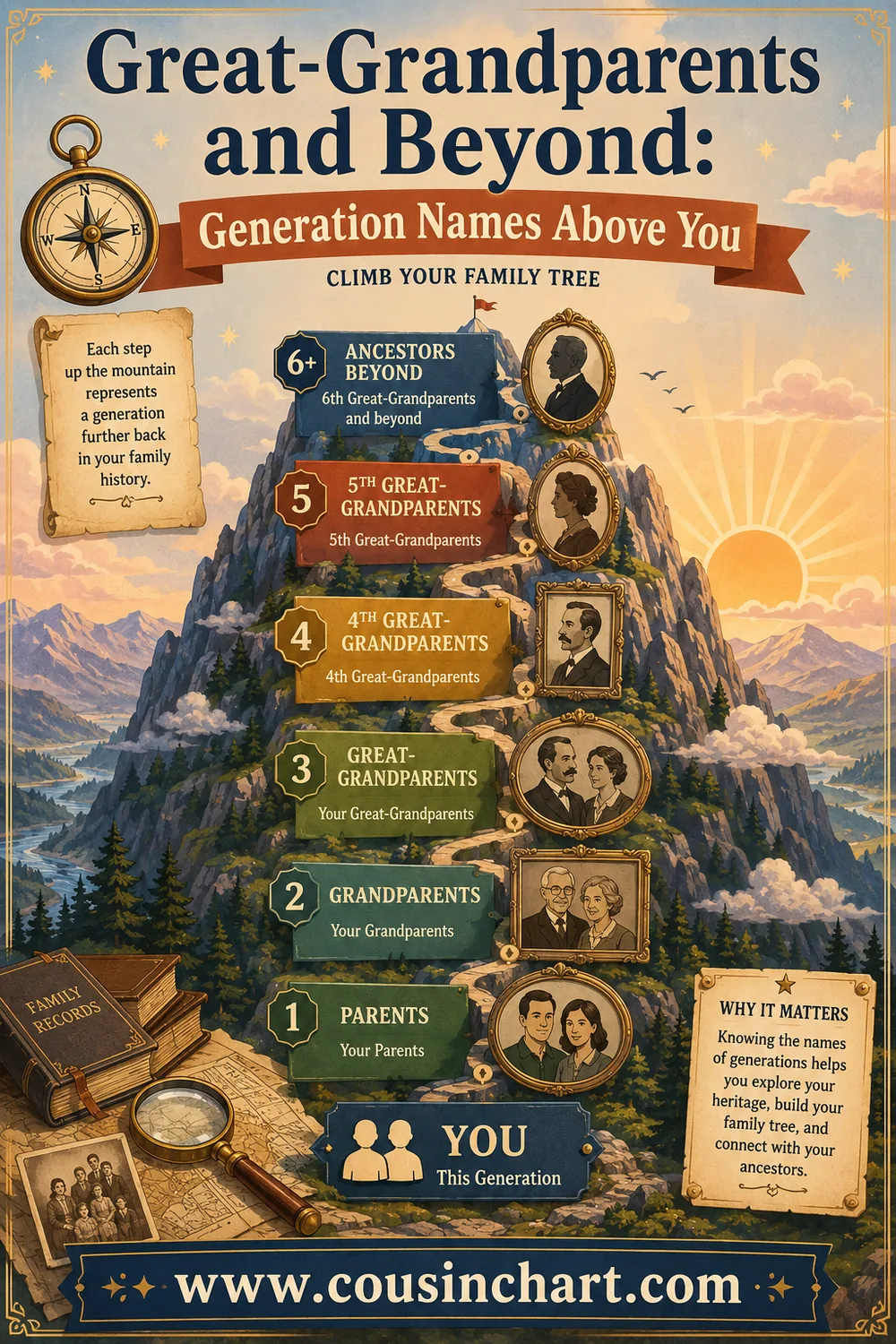
| Great-grandparent | 3 up |
| Child | 1 down |
| Grandchild | 2 down |
| First cousin | Same generation (0) |
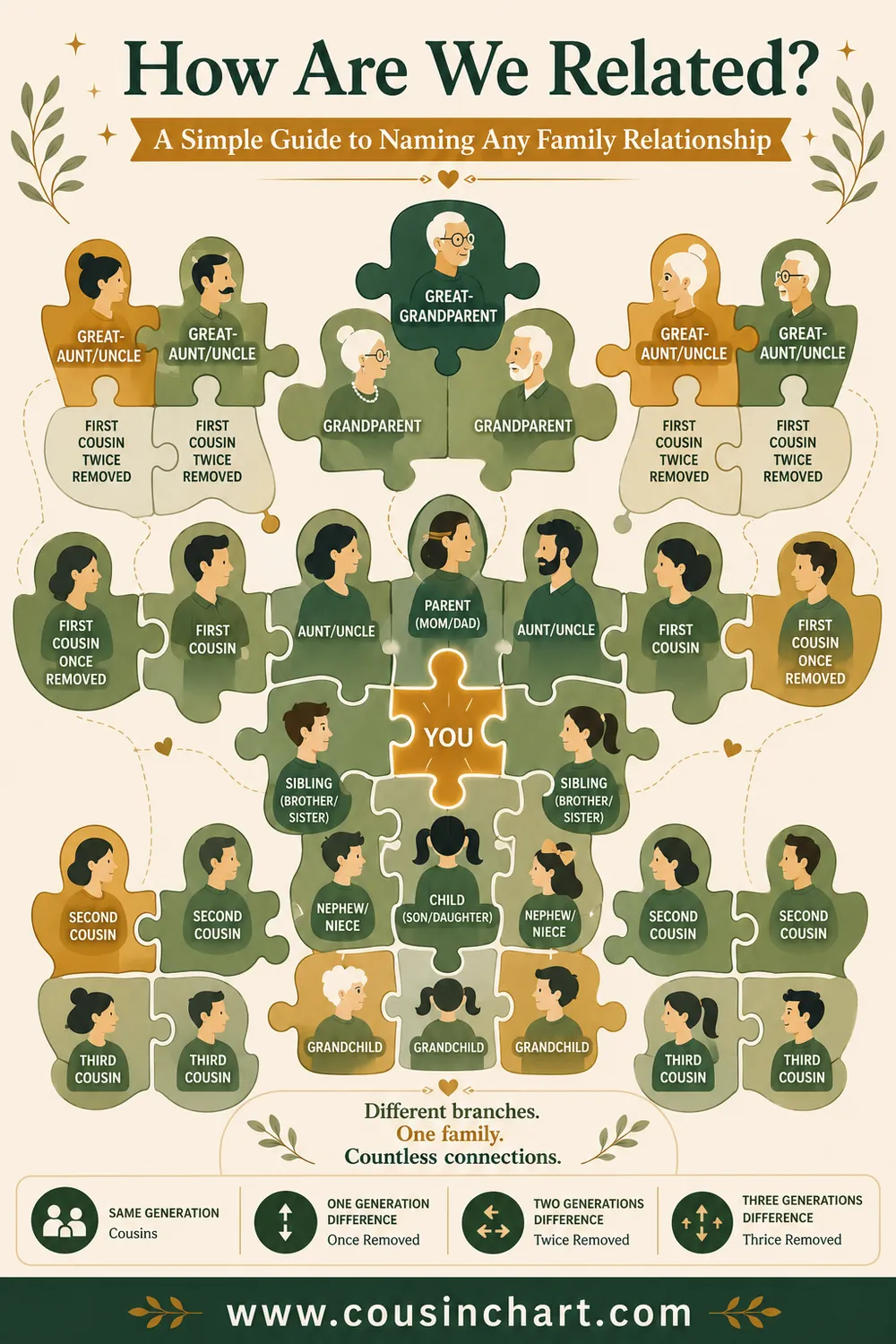
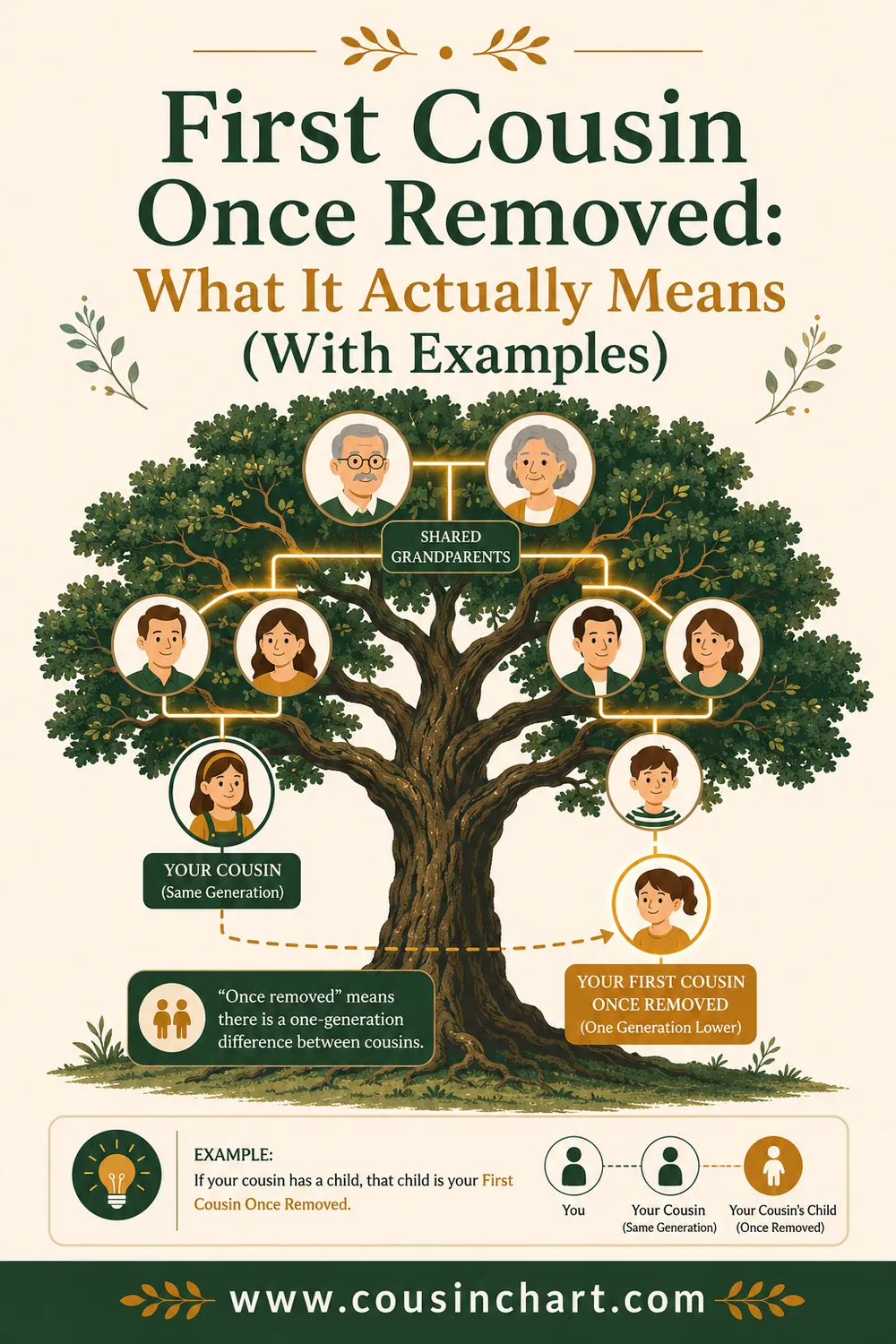
This is also the key to cousin math. The "removed" in a relationship like first cousin once removed is simply a one-generation difference between the two people. Same generation, no removal; one generation apart, once removed. If you want the full walkthrough, how are we related traces it step by step, and great-grandparents chart stacks the upward generations for you.
Using the 25-Year Rule to Estimate Dates
Here's where the number earns its keep in real research. If you know roughly when one person was born, you can estimate an ancestor's birth by multiplying generations by ~25 years:
- You were born in 2000. Your parents were likely born around 1975, your grandparents around 1950, your great-grandparents around 1925.
- Going back four generations (to great-great-grandparents) lands you around 1900 — a full century for four generations.
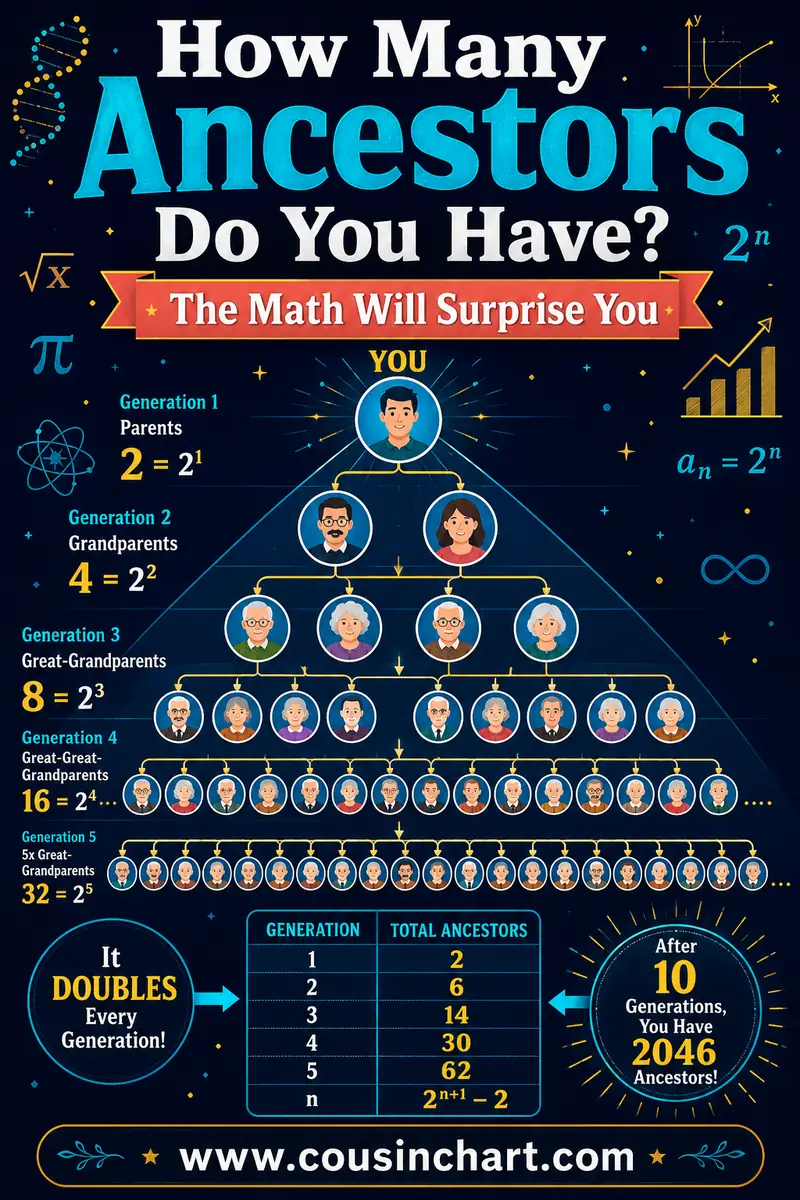
This gives you a search window when you don't have exact dates. If a census index shows three men with your ancestor's name, the 25-year rule helps you rule out the one who'd have been born in the wrong decade. It's an estimate, not a fact — but a surprisingly reliable one for pointing your search in the right direction. Curious how fast the ancestor count balloons as you go back? How many ancestors do you have does that eye-opening math.
Why the Female Line Runs Shorter Than the Male Line
A subtle but real detail: maternal generations tend to be shorter than paternal ones. Women's childbearing years end earlier, so mother-to-daughter intervals average lower — studies of long genealogies often land the female line closer to 25 years and the male line closer to 30–32 years, because men can (and historically did) father children later in life.
The practical upshot: if you're estimating dates up a purely paternal line (father to father to father), you might stretch the interval toward 30+ years per step. Up a purely maternal line, hold closer to 25. Most real trees zigzag between the two, so the middle estimate works fine.
How Generation Length Has Changed
The "average" has never been fixed. A few forces push it around:
- Later parenthood. In much of the world, people now have their first child later than their great-grandparents did, nudging recent intervals upward.
- Family size and spacing. In eras of large families, the gap between the first and last child could be 20+ years — so siblings might belong to noticeably different points in time while sharing one genealogical generation.
- Culture and geography. Marriage and childbearing ages vary widely across societies and centuries.
None of this breaks the 25–30 year rule of thumb; it just reminds you it's an average. For any single family, the real intervals are whatever the birth records say.
One Family, Five Generations: A Worked Example
Abstract rules stick better with real dates, so here's a plausible five-generation line, using intervals that wobble the way real families do:
| Generation | Person | Born | Interval before them |
|---|---|---|---|
| You | Ava | 2000 | — |
| 1 up | Her mother | 1972 | 28 years |
| 2 up | Her grandmother | 1946 | 26 years |
| 3 up | Her great-grandfather | 1921 | 25 years |
| 4 up | Her great-great-grandmother | 1895 | 26 years |
Four generations, 105 years — almost exactly the "century per four generations" estimate, even though no single interval was exactly 25. That's the whole trick of the rule: individual gaps bounce around, but they average out fast.
Notice what the table makes easy. Ava's great-great-grandmother, born 1895, would appear as a child in the 1900 census, a young woman in the 1920 one, and (if she lived long enough) a grandmother by World War II. Before you've found a single document, the generation math has already told you which records to open first. That's why genealogists reach for this estimate constantly — it converts "some ancestor, sometime back then" into a decade you can actually search.
How Far Back Do the Generations Take You?
Stack the 25-year average and the past organizes itself into a rough timeline. For someone born around 2000:
| Generations back | Ancestor level | Born around | Historical landmark |
|---|---|---|---|
| 2 | Grandparents | 1950 | Post-WWII boom |
| 4 | Great-great-grandparents | 1900 | Turn of the century |
| 6 | 4th-great-grandparents | 1850 | US Civil War era |
| 8 | 6th-great-grandparents | 1800 | Napoleonic era |
| 10 | 8th-great-grandparents | 1750 | Colonial America |
| 20 | 18th-great-grandparents | ~1500 | Age of exploration |
Two things jump out. First, "ten generations" sounds mythic but is only about 250 years — well within the reach of surviving church and civil records in many countries. Second, the number of ancestors explodes far faster than the years do: at 10 generations back you have 1,024 ancestral slots at that level alone. The centuries pile up slowly; the ancestors pile up exponentially.
How Many Generations Are Alive at Once?
Generation length also answers a question families love: how many generations can overlap in one lifetime?
With ~25–30 year intervals, three living generations is the norm (child, parents, grandparents) and four is common — a baby born when the parent is 25, grandparent 52, and great-grandparent 78 is nothing unusual. Five living generations takes short intervals on every link (four gaps averaging about 20 years lands the great-great-grandparent at 80 when the baby arrives) — rare enough that local newspapers still run the five-generation photo. Verified six-generation families exist but are genuine record-book material, requiring teenage parenthood in nearly every link plus exceptional longevity at the top.
Run the same math the other direction and you get the bittersweet version: with 30-year intervals, a great-grandparent would need to reach 90+ just to meet the newest baby. Long generations buy each parent more life experience per step — and quietly cost the family those five-generation photos.
FAQ
How many years is one generation?
Genealogists generally use about 25 to 30 years for one generation — the average age gap between parents and their children. Twenty-five years is a common working figure for quick date estimates, though any individual family's intervals can be shorter or longer.
How many generations are in 100 years?
About four genealogical generations fit in a century, using the ~25-year average. So going back roughly 100 years from a person usually reaches their great-great-grandparents. It's an estimate — real family intervals shift the exact figure.
What's the difference between a generation and a social generation like Gen Z?
A genealogical generation is a step on your family tree (you, your parents, your grandparents). A social generation like Gen Z groups everyone born in a range of years. One is about your position in a family; the other is about your birth date.
Are maternal and paternal generations the same length?
Not exactly. Maternal (mother-to-daughter) generations tend to average around 25 years, while paternal (father-to-son) generations often run closer to 30–32 years, since men can father children later in life. Most family lines mix the two.
How many generations back can a DNA test see?
Autosomal DNA tests are reliable to about 5 or 6 generations back (out to roughly fourth or fifth cousins). Beyond about 7 generations, many ancestors contributed no detectable DNA to you at all, so a paper-trail connection can be real even when no match shows up. Y-DNA and mitochondrial DNA tests trace single lines much further, but only the strict father-to-father or mother-to-mother line.
How do I count generations between two relatives?
Count the parent-to-child steps from each person up to their closest shared ancestor. Same number of steps means the same generation; a difference of one step means one generation apart — which is where the "removed" in cousin relationships comes from.
Count the Generations Instantly
The length of a generation — about 25 to 30 years — is one of genealogy's most useful shortcuts, turning a stack of unknown dates into a searchable estimate. And counting the number of generations between two relatives is the heart of every cousin and "removed" relationship. When you'd rather not count by hand, the free family relationship calculator tallies the generations and names the exact relationship for you in seconds.