How Far Back Can You Trace Your Family Tree? Realistic Limits by Record Type
So, how far back can you trace your family tree? For most people with solid records on every branch, the honest answer is somewhere between the late 1700s and the 1600s, which works out to roughly 8 to 12 generations. A few lines with unusually good records reach the 1500s, and a very small number of well-documented lines connect to medieval families. Most branches stop earlier, often in the 1800s, when a record is lost, a name changes, or a family crosses an ocean.
The limit isn't your effort or your software. It's paper. Your family tree can only go back as far as someone wrote your ancestors down, kept that record, and made it possible to link one generation to the next. This guide walks through the main record types, the years they start in the US, Britain and Ireland, what DNA can and can't add, and why charts that run straight back to Charlemagne or the year 1000 deserve a raised eyebrow.
The short answer: what most people can realistically reach
Think of your tree as a set of separate lines, not one big ladder. Each line hits its own wall at its own date. Your father's father's line might be documented to a 1680s parish in England, while your mother's mother's line stops at a 1920s immigration record because the old-country records were never kept, never filmed, or were destroyed.
Here's a rough guide to what's realistic for a careful researcher. These are typical outcomes, not promises, and any single line can do better or worse.
| Research situation | Typical reach for a well-researched line | What usually stops you |
|---|---|---|
| Recent immigrant family (arrived after 1900) | Early 1800s to late 1700s, if old-country records survive and you can read them | Records held abroad, language, name spellings |
| US family present since before 1850 | About 1750 to 1800 on many lines | 1790 to 1840 censuses name only the head of household |
| English line with surviving parish registers | 1600s, sometimes the 1550s | Gaps in registers, common names, lost early books |
| Irish Catholic line | Often early to mid 1800s | Many registers lost or started late |
| Family enslaved in the US before 1865 | Often 1870 on paper, earlier with slaveholder records | Enslaved people unnamed in the 1850 and 1860 slave schedules |
| Line that joins a documented gentry or royal family | Medieval period, through published, sourced pedigrees | Proving the link into that family is the hard part |
Notice what the table says about the last row. Royal and noble pedigrees go back a long way because those families were written about constantly. The weak point is almost never the royal end. It's the bridge between your well-documented 1700s farmer and the minor gentry family someone says he belonged to.
Why every line has a "brick wall"
Genealogists call a dead end a brick wall: the point where you can't find the parents of an ancestor. Brick walls happen for a handful of predictable reasons, and once you know them, you can usually tell whether a wall is likely to come down.
- The record was never made. Before civil registration, births weren't recorded by the government at all. If your ancestor's church didn't keep a register, or they didn't belong to a church, there may be no baptism to find.
- The record was made but lost. Fires, floods, wars, damp storage and simple neglect have destroyed huge numbers of records. You'll see some famous examples below.
- The record survives but doesn't link people. A census that lists only the head of household tells you a man lived somewhere with "two females under 16." It doesn't name his daughters.
- The record survives but you can't match it. Common names are a real problem. In a parish with four John Smiths baptized in the same decade, picking the right one takes careful work.
- Access is restricted. Recent census records are closed for privacy, and some archives haven't been filmed or indexed.
The first two causes are usually permanent. The last three often aren't. A huge share of "brick walls" are really "haven't found the right record yet" walls, which is why methods like the step-by-step family tree process matter more than any single database.
Record types and the years they start
This is the heart of the question. Each record type has a start date, and that date sets an outer limit on how far it can carry you. The table below covers the main sources for the US, England and Wales, Scotland and Ireland.
| Record type | Place | Starts | What it gives you |
|---|---|---|---|
| Federal census | United States | 1790, every 10 years | Head of household only until 1840; everyone named from 1850 |
| Statewide birth and death registration | United States | Early 1900s in most states | Exact dates, parents' names |
| Parish registers (Church of England) | England | Ordered in 1538 | Baptisms, marriages, burials |
| Bishops' transcripts | England | 1598 | Annual copies of parish registers, a backup when the original is lost |
| Civil registration | England and Wales | 1 July 1837 | Birth, marriage and death certificates |
| Census with every name | England and Wales | 1841 | Every person in the household |
| Parish registers | Scotland | Around 1553 | Baptisms, marriages, some burials |
| Civil registration | Scotland | 1855 | Birth, marriage and death certificates |
| Civil registration | Ireland | 1864 (marriage indexes from 1845) | Birth, marriage and death certificates |
Sources for these dates: the National Archives census page, the FamilySearch wiki on US vital records, the FamilySearch wiki on England church records, the UK National Archives census guide, and its guide to births, marriages and deaths in Scotland and Ireland.
Two patterns jump out. First, government records (censuses and civil registration) are mostly a 19th-century invention, so before about 1840 in Britain and before 1850 in the US you're leaning on church and local records. Second, church records in Britain start in the 1500s, which is why English lines often go back further than American or Irish ones.
How far back can you trace your family tree in the US?
American research usually runs backward through a predictable sequence: living memory and recent documents, then 20th-century vital records, then the censuses, then older local records like deeds, wills, tax lists and church books.
The census: 1950 back to 1790
The National Archives explains that the first federal census was taken in 1790 and has been taken every ten years since. Individual census records are closed for 72 years to protect privacy, so the most recent one you can see is 1950, released in 2022.
The censuses don't all give you the same thing. The big dividing line is 1850. The FamilySearch wiki on the 1850 census lists it as the first census to name everyone in the household. Before that, from 1790 through 1840, the census named only the head of household and counted everyone else in categories. The FamilySearch wiki on the 1790 census describes those first categories: free white males 16 and older, free white males under 16, free white females, other free persons, and the number of enslaved people.
That's why many US lines slow down around 1850. In the 1850 census you might find your ancestor, age 6, living with parents named Thomas and Mary. In 1840 you'll find only "Thomas" plus a tally of people. You have to use other records to prove that the boy counted in Thomas's household was your ancestor.
The 1790 and 1890 gaps
Two census years have serious holes. For 1790, the FamilySearch wiki notes that no schedules are known to exist for Delaware, Georgia, Kentucky, New Jersey, Tennessee and Virginia. If your family was in Virginia in 1790, there's no federal census to find them in.
The 1890 census is worse. According to the National Archives page on the 1890 census, a fire in the Commerce Department building in Washington, DC, in January 1921 destroyed most of it. The general population fragments that survive cover a little over 6,160 people in 10 states and the District of Columbia. In practice, that leaves a 20-year gap between 1880 and 1900, a span when many families moved, married and had children.
The 1890 gap isn't hopeless, though. The same National Archives page lists surviving special schedules for Union Civil War veterans and their widows, which cover many states. If your ancestor served, that schedule may place him in 1890 even though the main census is gone. Researchers also bridge the gap with state censuses (several states took their own in the 1880s and 1890s), city directories, tax lists, church records and newspapers. The goal is simply to show the same family in the same place with the same people, so the 1880 and 1900 entries can be linked with confidence.
Birth and death certificates
People are often surprised that their great-great-grandparents have no birth certificate. Statewide registration came late. The FamilySearch wiki on US vital records says these records don't exist until the early 1900s in most states, and that it took up to about 20 years after a state's law was passed for most states to record at least 90 percent of births and deaths. Some cities and New England towns kept records much earlier, so it's worth checking the specific state and town.
Before 1790: colonial and local records
Before the first census, American research depends on local records: land deeds, probate files and wills, tax lists, court minutes, militia lists and church registers. These can carry a line back into the 1600s in some colonies, especially New England, where towns kept vital records early. In other areas, early records are thin, and many families can only be followed to the late 1700s.
Families who were enslaved
For Black American families with ancestors who were enslaved, the federal record wall often falls at 1870, the first census after emancipation. The FamilySearch wiki notes that the 1850 slave schedules did not list enslaved people by name. They recorded the slaveholder's name, plus the age, sex and color of each person. Research before 1870 is possible, but it usually means working through the records of the enslaving family, such as wills, estate inventories, deeds and plantation papers, to find first names and connect them across time. It's slower, and it's some of the most meaningful work in genealogy.
How far back you can go in England, Wales, Scotland and Ireland
British and Irish research follows a similar pattern: civil registration and census records for the 1800s, then church registers before that. The dates are what change.
England and Wales: the 1538 parish register order
The single most important date in English genealogy is 1538. The FamilySearch wiki on England church records explains that a nationwide order was given in 1538 for each parish to keep a register of baptisms, marriages and burials. That gives English research a theoretical floor almost 500 years ago.
The real floor is usually later, and the same wiki page says why. Many parishes didn't start keeping registers until later, and some early records have since been lost or destroyed. Beginning in 1598, ministers had to send a copy of their registers to a bishop or archdeacon each year. These copies, called bishops' transcripts, sometimes survive when the original register doesn't, so they're your backup.
Civil registration started on 1 July 1837, according to the FamilySearch wiki, and the UK National Archives' census guide says 1841 was the first census to list the name of every person. Earlier censuses (1801, 1811, 1821 and 1831) were taken, but names were not collected centrally. The same guide notes that the 1931 census for England and Wales was destroyed by fire in 1942 and that no census was taken in 1941, and that later censuses stay closed for 100 years.
Put that together and a typical English line runs like this: certificates and censuses from the present back to 1837 and 1841, then parish registers back through the 1700s and 1600s. With good registers, a line can reach the late 1500s. With common names, missing registers or a move between parishes, it may stall in the 1700s.
Scotland
The UK National Archives' guide to births, marriages and deaths in Scotland and Ireland says Scottish civil registration started in 1855 and parish registers began around 1553. Scottish certificates are known for being detailed, which helps a lot with the first generations back. Before 1855, coverage depends on the parish and on whether your family belonged to the established church.
Ireland
Ireland is where many family trees slow down. The same National Archives guide says Irish civil registration started in 1864, with civil marriage indexes available from 1845. Before that, you need parish registers, and the guide notes that many Irish records have not survived. In practice, many Irish Catholic lines reach the early 1800s and then depend on land and tax records, or on DNA, to go further.
Other countries in brief
Most of the world follows the same broad shape: modern civil records for the last century or two, and church or religious records before that. The exact dates vary a lot by country, by region, and even by religion within one country. Wars, border changes and record destruction create gaps that don't line up with any national rule.
The best single starting point is the FamilySearch research wiki, which has a page for nearly every country and many regions. Search the wiki for "[country] church records" and "[country] civil registration" and note the start dates before you plan your research. If the church records for your ancestor's town begin in 1690, that's your realistic floor for that line, whatever a hint or online tree says.
Some general patterns hold up well:
- Catholic and Protestant church registers in much of Western Europe start sometime in the 1500s or 1600s, but local survival varies.
- Civil registration in most European countries is a 19th-century development.
- Families of immigrants usually need the exact town of origin before overseas records become useful. "Germany" or "Italy" isn't enough; you need the parish.
- Jewish families often hit walls in the early 1800s in Eastern Europe, partly because fixed surnames came late in some areas and partly because of record destruction in the 20th century.
How DNA reach compares to paper records
DNA testing has changed genealogy, but it doesn't extend your tree in the way many people expect. It works best for confirming and finding relationships within the last several generations, which overlaps with the paper record rather than going beyond it.
The three kinds of DNA test
MedlinePlus, from the National Library of Medicine, describes three main types of ancestry DNA tests:
- Autosomal DNA looks at many places across your chromosomes and reflects ancestry from all your lines. It's what the big consumer companies use for cousin matching.
- Y-chromosome DNA passes from father to son, so it follows one direct paternal line. Only people with a Y chromosome can take it.
- Mitochondrial DNA (mtDNA) is passed from mothers to all their children, so it follows one direct maternal line.
Y-DNA and mtDNA change very slowly, so they can reach deep into the past. The catch is that they cover just two lines out of thousands, and they usually can't tell you whether a shared ancestor lived 300 years ago or 1,000 years ago without lots of extra testing and paper research. Autosomal DNA covers all your lines, but the signal fades quickly with each generation.
Why autosomal DNA fades
You get half your autosomal DNA from each parent, about a quarter from each grandparent, and so on, but the pieces are random. After several generations, some of your ancestors left you no detectable DNA at all. A large study of European genomes by Ralph and Coop in PLOS Biology notes that our genealogical ancestors often contribute no genetic material to us, and that the chance of DNA passing down any particular path more than eight generations deep is small.
Eight generations back means your great-great-great-great-great-great-grandparents. If a generation is about 30 years (the figure Ralph and Coop use), that's roughly 240 years, so your ancestors born in the mid to late 1700s. That lines up neatly with where many paper trails start to thin out. DNA can help you solve a 1700s or 1800s brick wall, especially by matching you to cousins who descend from the same couple, but it rarely proves who your ancestors were in the 1500s.
For the cousin side of this, see our guides to centimorgans and whether cousins share DNA. The short version: close cousins almost always share detectable DNA, while distant cousins often don't, even when the paper trail is perfect.
| Tool | Lines covered | Useful time depth for genealogy | Best use |
|---|---|---|---|
| Paper records | All lines, if records survive | Back to the start of local records (often 1600s to 1800s) | Names, dates, places and relationships |
| Autosomal DNA | All lines, fading with distance | Strongest within about 5 to 8 generations | Confirming a tree, solving recent brick walls, finding unknown parents |
| Y-DNA | Direct paternal line only | Recent to very deep | Surname studies, testing whether two men share a paternal line |
| mtDNA | Direct maternal line only | Usually deep and hard to date | Testing a specific maternal-line hypothesis |
Why "back to royalty" and "back to 1000 AD" claims are usually unreliable
You've probably seen online trees that run neatly back 40 generations to a Viking king, or a family history that "traces the family to 1066." Some of these are well-founded. Most aren't. Here's how to tell the difference.
The math makes royal descent likely and meaningless at the same time
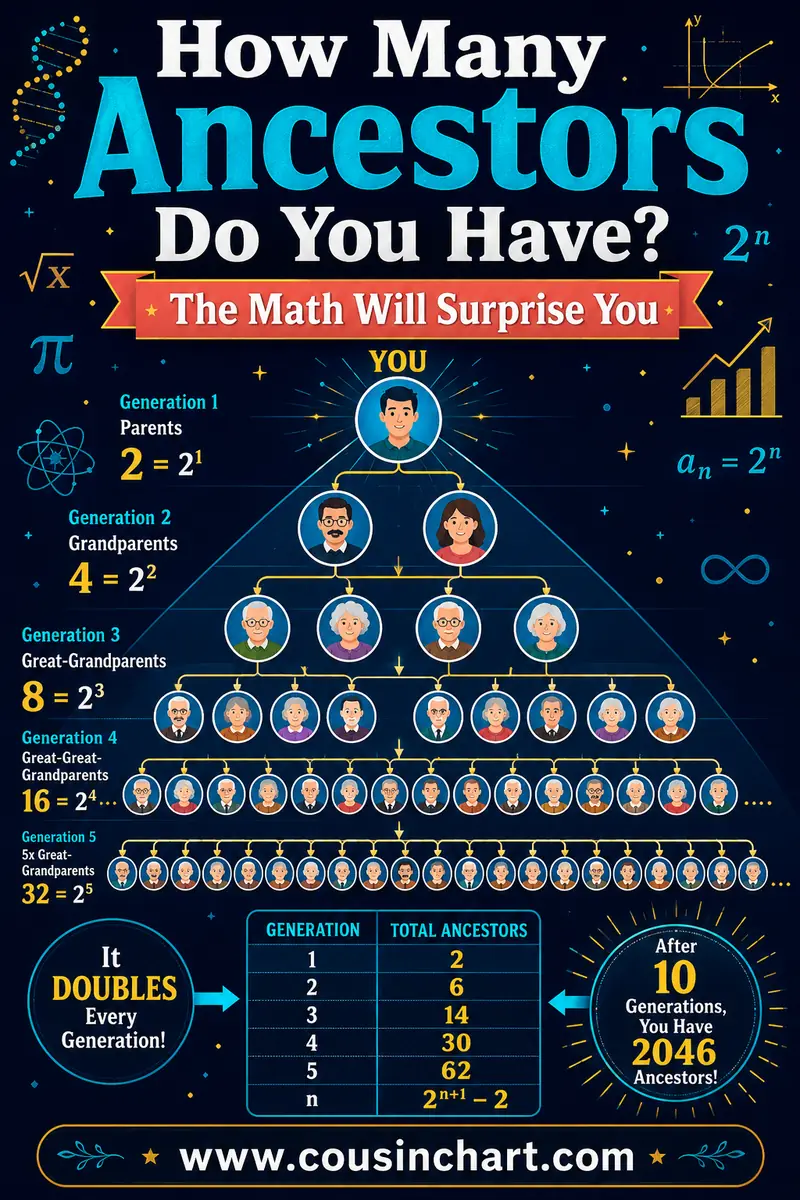
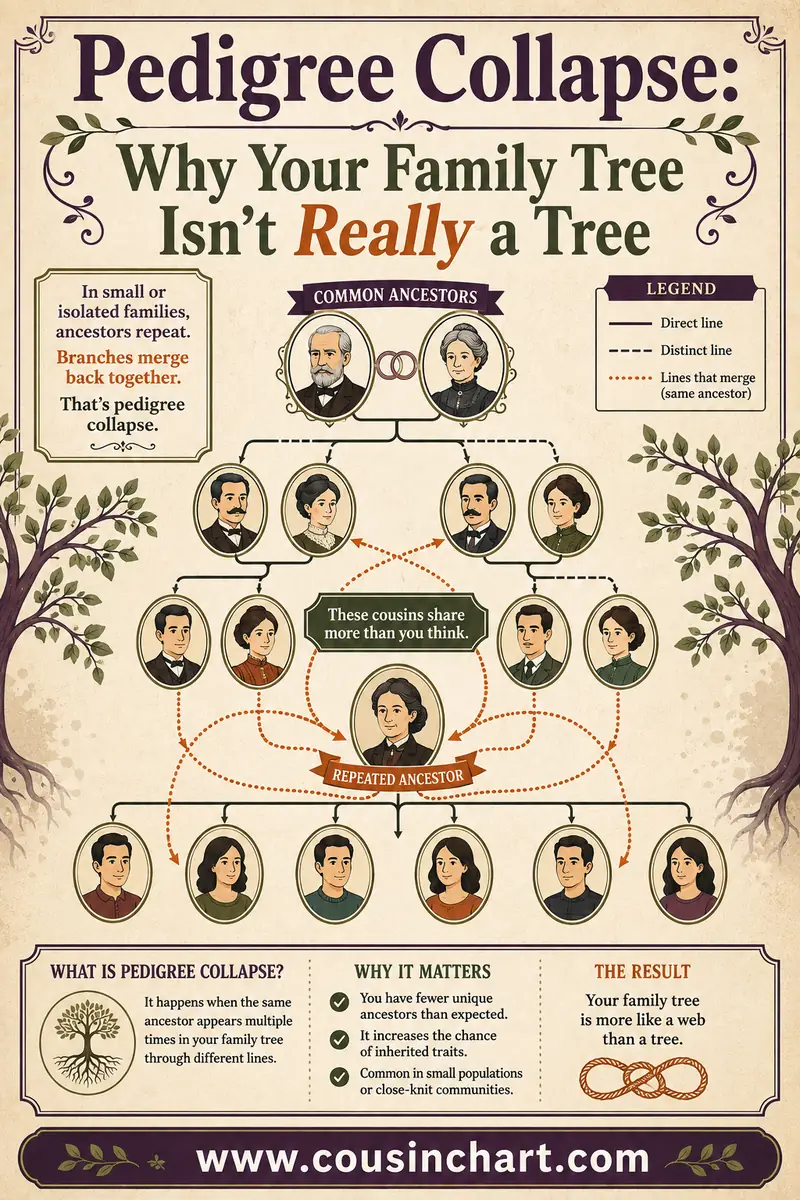
Your number of ancestor slots doubles each generation: 2 parents, 4 grandparents, 8 great-grandparents. At 10 generations back, that's 2 to the 10th power, or 1,024 slots in a single generation. At 30 generations back, roughly the year 1000 if you use 30 years per generation, it's 2 to the 30th power, which is just over 1 billion slots. There were nowhere near that many people available to fill them, so the same people must show up in your tree many times. This is called pedigree collapse, and our guide to how many ancestors you have walks through the numbers.
Ralph and Coop's PLOS Biology study estimates that people across Europe share thousands of common genealogical ancestors within the last 1,000 years. If you have European ancestry, it's very likely that some medieval ruler is among your ancestors, simply because almost everyone from that time who has living descendants is the ancestor of a huge number of people. That makes the claim "I descend from a medieval king" probably true and not very special. What's hard is showing the actual generation-by-generation path with records.
Common problems in long pedigrees
- Copied trees. One unsourced online tree gets copied hundreds of times, and the number of copies starts to look like proof. It isn't.
- Same name, different person. A John Howard in a 1700s American colony gets attached to a famous English Howard family because the names match, with no record connecting them.
- Old printed family histories. Many 19th and early 20th-century books were written to flatter the family that paid for them. Some are excellent. Others invented links to nobility.
- Impossible dates. Mothers giving birth at 8 or 65, children born after a parent's death, or a man living in two countries at once.
- Medieval sources treated as modern ones. Before parish registers, links depend on things like land charters, court rolls and chronicles. Those can work, but they rarely state a birth date or name every child.
When a long pedigree is credible
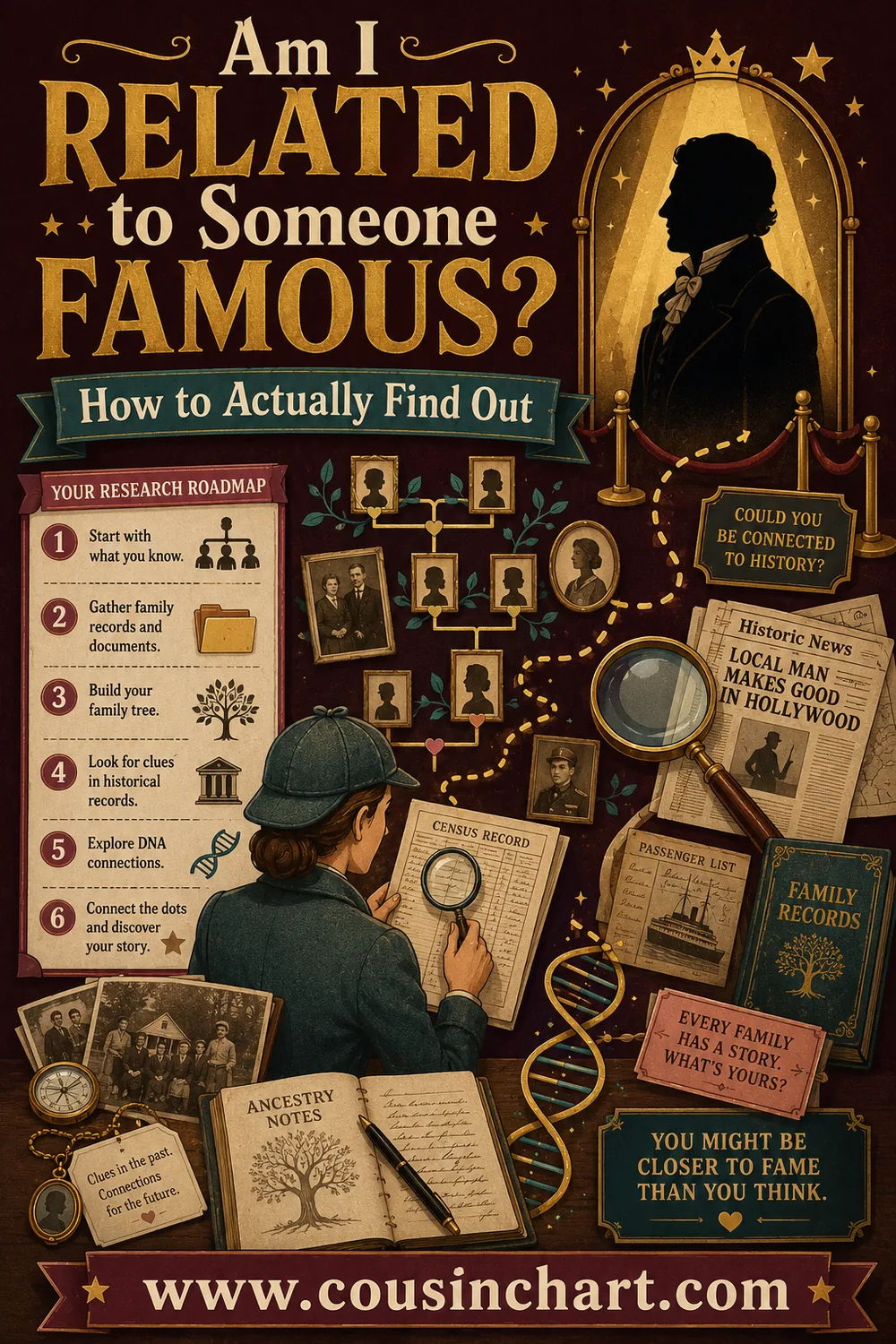
A long line can be trustworthy when each link is supported by records that a reader can check, when it uses well-known published research by respected genealogists, and when the tricky link between ordinary records and gentry or royal records is explained rather than assumed. If a pedigree gives you sources for every generation and openly flags its weak spots, take it seriously. If it jumps from a 1750s farmer to an earl with no source in between, treat it as a hypothesis. Our guide on how to check whether you're related to someone famous covers this in more detail.
Worked example: one family, four lines, four different limits
Here's a realistic composite example of how far one person's tree might reach on each of four grandparent lines. Names are made up, but the record pattern is typical.
- Paternal grandfather's line (English): Census and certificates take the family back to a Kent baker born in 1832. His baptism is in a parish register. The registers for that parish survive from the 1560s, and careful work moves the line back to a baptism in 1612. Earlier entries exist, but the name is too common to link with confidence. Reach: about 1612, roughly 12 generations.
- Paternal grandmother's line (Irish): She was born in New York in 1905 to Irish-born parents. Their marriage record names a county, and an 1866 Irish civil birth record identifies her father. His parents married in a Catholic parish whose registers start in the 1830s. Reach: about 1810, roughly 7 generations.
- Maternal grandfather's line (US, pre-1850): The 1850 census names the whole family in Ohio. The 1840 and 1830 censuses list only the father as head of household. A deed and a will in Pennsylvania connect him to his father, who appears in the 1790 census as a head of household. Reach: about 1760, roughly 8 generations.
- Maternal grandmother's line (recent immigrant): She arrived in 1921. Her naturalization papers give a village, but the village's church books from before 1880 were destroyed. A DNA match with a cousin still living in the region confirms her parents and one set of grandparents. Reach: about 1850, roughly 6 generations.
So how far back does this person's tree go? On paper, 1612. On average across the four lines, closer to 1760. Both answers are true, and that's normal. When people ask "how far back can you go," the better question is often "how far back can I go on this particular line?"
How to estimate your own limit, step by step
Before you spend months on a line, you can make a rough prediction of where it will stop. Here's a practical method.
- Start with what you can prove. Write down the earliest ancestor on each line you've confirmed with records, not just family stories.
- Identify the place. For each earliest ancestor, find the most specific place you can: county, parish or town, not just country.
- Look up the record start dates for that place. Use the FamilySearch wiki to find when church registers, civil registration and census records begin there.
- Check survival. Find out if that specific parish or county has gaps, such as burned courthouses, lost registers or missing census years.
- Think about access. Are the records online, on film, or only in a local archive? Can you read the language and handwriting?
- Weigh the name. A rare surname in a small parish goes further than a common one in a big city.
- Add DNA where it helps. If your wall is in the 1800s, autosomal DNA matches may confirm or break it. If it's in the 1600s, DNA is unlikely to be the answer on its own.
Try it yourself: pick your earliest confirmed ancestor born in England. Suppose she was baptized in 1790 and her parish registers start in 1602. Each generation back is roughly 30 years, so the registers give you room for about (1790 minus 1602) divided by 30, which is about 6 more generations, if every entry survives and every link can be proven. That's your best-case ceiling for that line.
Common mistakes that make trees look longer than they are
It's easy to "find" far more ancestors than you can actually prove. These are the habits that most often lead to a tree that looks impressive but falls apart.
- Accepting hints without checking them. Record hints and tree hints are suggestions, not conclusions. Open the record, read it, and ask whether it really fits.
- Assuming the same name means the same person. Always look for at least two pieces of matching evidence beyond the name, like a spouse, a place, a child or an occupation.
- Skipping the 1840 to 1850 bridge in US research. The jump from a named family in 1850 to a head-of-household tally in 1840 needs proof from other records.
- Ignoring the gaps. If you "found" an Irish ancestor's baptism in a parish whose registers don't start until decades later, something is wrong.
- Counting generations from a printed book without checking it. Treat old family histories as leads, and look for the records they used.
- Overreading DNA ethnicity estimates. MedlinePlus notes that companies use different reference databases and methods, so estimates can differ. An ethnicity result is not evidence for a specific ancestor.
It also helps to keep generations straight. If you're not sure what to call the person 8 generations back, our guide to family generations lays out the names and numbers.
Wrap-up: a realistic target for your family tree
Most people can trace at least some lines back to the 1700s, and English lines with good parish registers often reach the 1600s. Census records carry US families to 1850 with every name and to 1790 with heads of household, while civil registration in Britain and Ireland starts in 1837, 1855 or 1864 depending on where your family lived. DNA is a strong partner for the last several generations, not a time machine. And a line that runs back to a medieval king is only as good as its weakest documented link.
Once you've worked out a few lines, it's fun to see how the people in your tree connect to each other and to living cousins. Our free family relationship calculator tells you exactly what to call any relative, from a second cousin to a distant cousin several times removed.
Keep reading: Do You Inherit DNA From All Your Ancestors? Genetic vs. Family-Tree Ancestors.
Frequently Asked Questions
How many generations back can the average person trace their family tree?
With steady research, many people can document most lines back 6 to 8 generations, which usually means ancestors born in the 1700s or early 1800s. Some lines go further, especially English lines with surviving parish registers, which can reach 10 to 12 generations or more. Other lines stop much sooner, often at an immigrant ancestor whose home-country records are missing. It's normal for one branch to reach the 1600s while another stops in the 1880s. The limit depends on where your ancestors lived and which records survived there, not on how hard you try.
Is it possible to trace your family tree back to 1000 AD?
For almost everyone, no, not with records that prove each generation. Ordinary people in the year 1000 rarely appear in surviving documents by name with their parents. The exceptions are lines that connect to well-documented noble or royal families, whose pedigrees were recorded in charters, chronicles and later scholarly work. Even then, the weak point is usually the link between your documented ancestor of the 1600s or 1700s and that gentry family. Statistically, many people of European descent do have medieval rulers among their ancestors, but showing the actual path, generation by generation, is a very different thing.
Why does my family tree stop in the 1800s?
The 1800s is where many record types begin, so it's also where many trails stop. In the US, censuses before 1850 name only the head of household, and most states didn't register births and deaths until the early 1900s. In Ireland, civil registration didn't start until 1864, and many earlier church records were lost. Immigrant families also hit a wall when you don't yet know the exact town of origin. Finding a specific parish or village name, often from a marriage record, naturalization file or obituary, is usually the key that opens the next set of records.
How far back do US census records go?
The first federal census was taken in 1790, and there's been one every ten years since. Records are closed for 72 years, so the 1950 census is the latest one open to the public. From 1790 through 1840, the census named only the head of each household and counted everyone else in age and sex categories. The 1850 census was the first to list every person in the household by name. Most of the 1890 census was destroyed in a 1921 fire, and some 1790 schedules, including Virginia's, don't survive at all.
How far back can a DNA test trace your ancestry?
It depends on the test. Autosomal DNA, the kind used for cousin matching, works best within about five to eight generations, because the DNA you inherit from any single distant ancestor gets smaller each generation and often disappears. Y-DNA and mitochondrial DNA can reach thousands of years back, but each follows only one line, father to son or mother to child, and they usually can't pin down which generation a shared ancestor lived in without paper records. Ethnicity estimates describe broad populations, not specific ancestors, so they don't extend your family tree.
What was the 1538 parish register mandate?
In 1538, an order was issued in England requiring every parish to keep a register of baptisms, marriages and burials. It's the reason English research can, in theory, go back almost 500 years. In practice, many parishes started later than 1538, and many early volumes have been lost. From 1598, ministers had to send yearly copies of their registers to the bishop or archdeacon. These bishops' transcripts can fill in gaps when the original book is missing. Parish registers stayed the main source for English baptisms, marriages and burials until civil registration began in 1837.
Can I trust an online family tree that goes back to royalty?
Treat it as a lead, not a fact, until you can see sources for each generation. Many royal lines online are copied from one unsourced tree to another, and the number of copies can make them look more solid than they are. Check the link where an ordinary documented ancestor joins a gentry or noble family, since that's where errors usually sit. Look for impossible dates and same-name mix-ups. A trustworthy pedigree cites records or respected published research for every step and openly says where the evidence is weak.
What should I do when I hit a brick wall in my family tree?
First, list everything you know about the ancestor and where each fact came from. Then look up which records exist for their exact place and time, using a guide like the FamilySearch research wiki. Search records you haven't tried yet, such as land deeds, wills, tax lists, church records, newspapers and military files. Research the person's siblings, neighbors and in-laws too, since their records often name the family. If the wall is in the 1800s, an autosomal DNA test and careful comparison of your matches' trees can also help confirm or break it.
Do English family trees really go back further than American ones?
Often, yes. Church of England parish registers were ordered in 1538, so English lines can be traced through baptisms, marriages and burials from the 1500s onward wherever registers survive. American research before 1850 relies on head-of-household censuses and local records like deeds and wills, which link generations less directly. Early colonial New England is an exception, with good town records from the 1600s. But many American families also descend from English settlers, so once you've proven an immigrant ancestor's English parish, you can often continue the line in English records.
Sources
We checked every source below while writing this guide. Last reviewed October 30, 2026, by Joan Ramos.
- Census Records (U.S. National Archives and Records Administration)
- 1890 Census (U.S. National Archives and Records Administration)
- United States Census 1790 (FamilySearch Research Wiki)
- United States Census 1850 (FamilySearch Research Wiki)
- United States Vital Records (FamilySearch Research Wiki)
- England Church Records (FamilySearch Research Wiki)
- Census records (research guide) (The National Archives (UK))
- Births, marriages and deaths in Scotland and Ireland (research guide) (The National Archives (UK))
- What is genetic ancestry testing? (MedlinePlus, U.S. National Library of Medicine)
- The Geography of Recent Genetic Ancestry across Europe (Ralph and Coop, 2013) (PLOS Biology)