Am I Related to Someone Famous? How to Actually Find Out
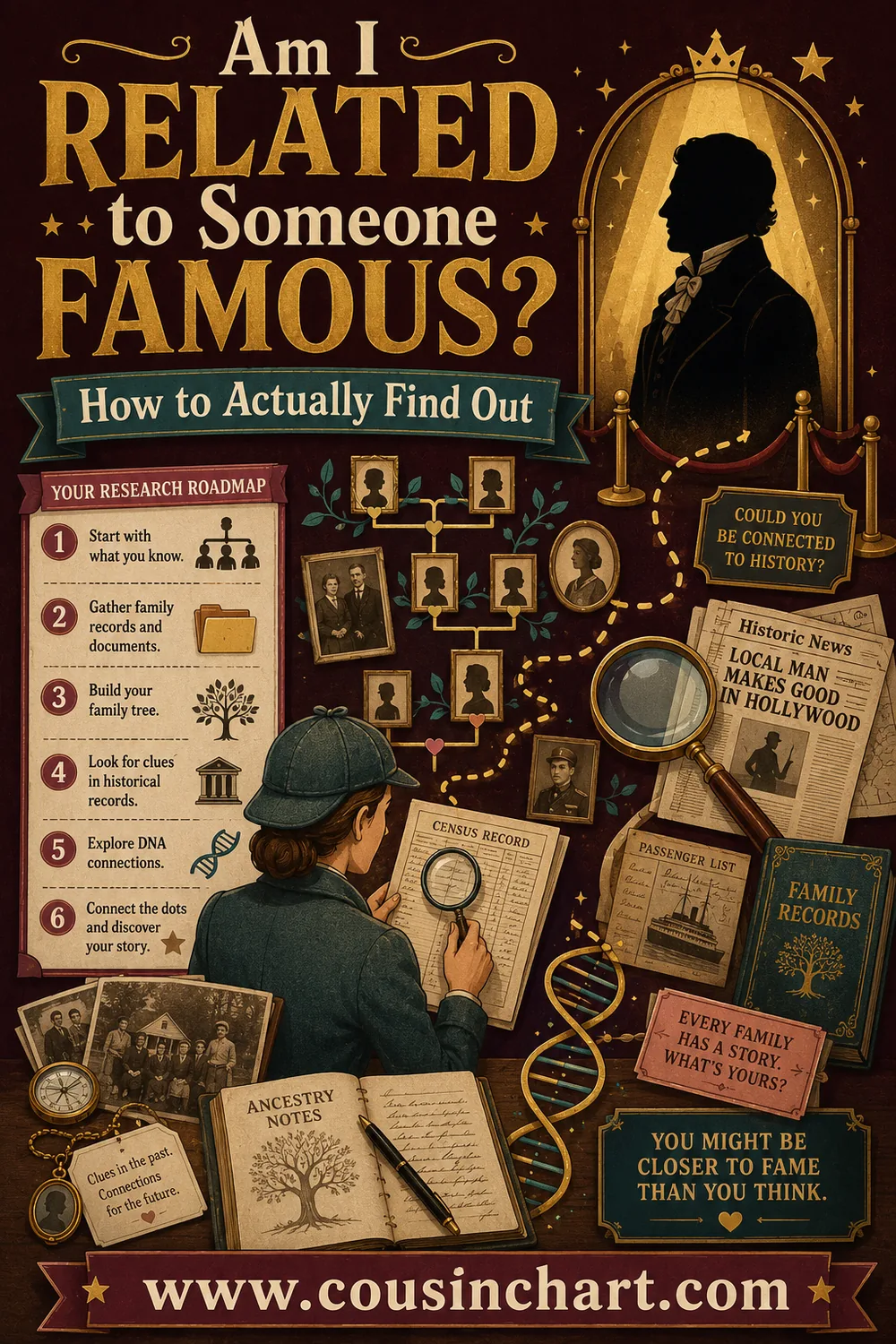
Almost certainly yes — go back far enough and you're related to virtually everyone, famous people included. The real question is whether you can document the connection, and for that there are three practical routes: build your family tree and run it through a relative-finder tool, take a DNA test and work your match list, or trace your line to a "gateway ancestor" whose famous connections are already proven.
This guide walks through all three, explains what a "9th cousin of Abraham Lincoln" actually means (and why it's less rare than it sounds), and shows you how to tell a solid connection from wishful clicking. When you do land a famous cousin, the free family relationship calculator will translate the paper trail into the exact relationship term.
Relationship quick-check. Tap a connection you might discover, and see what it really means:
The answer will appear here.
Why the Answer Is Almost Always Yes
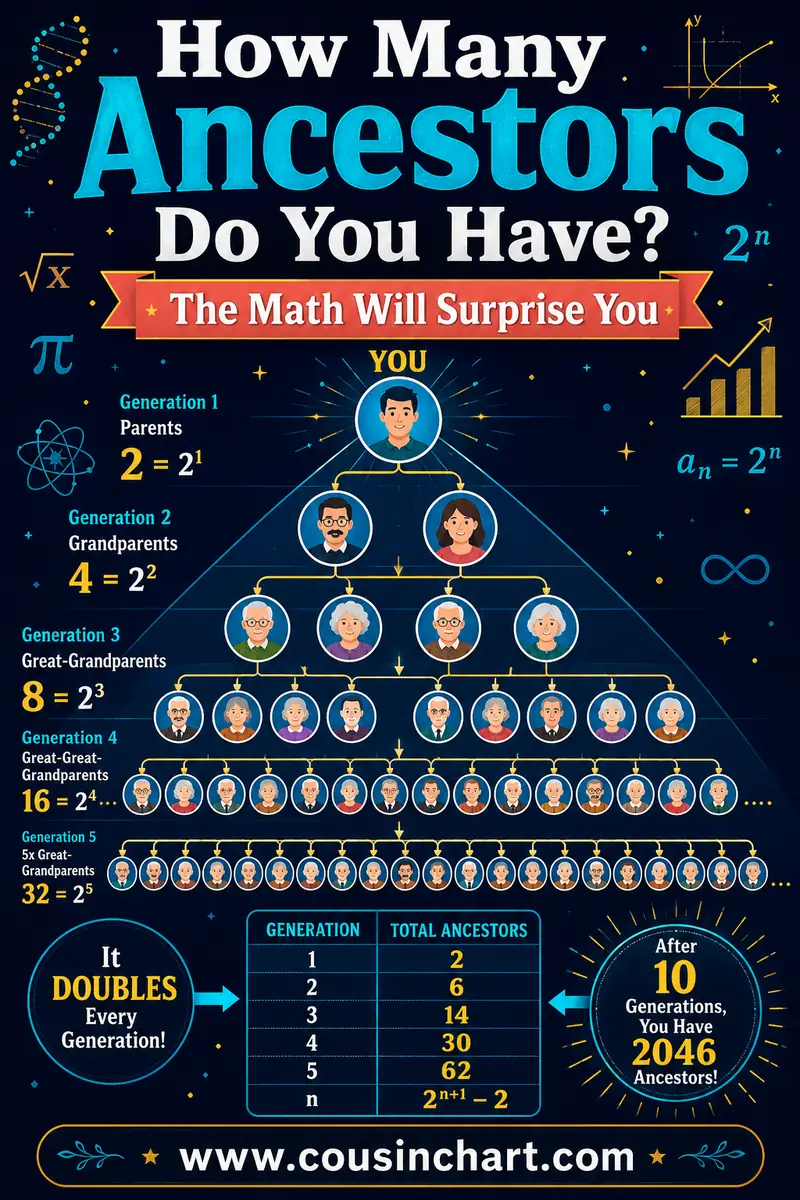
Your ancestor count doubles every generation: 2 parents, 4 grandparents, 1,024 slots ten generations back, over a million at twenty. Long before then, the same people start filling multiple slots (the math behind that is in how many ancestors do you have) — which means family trees don't stay separate. They braid.
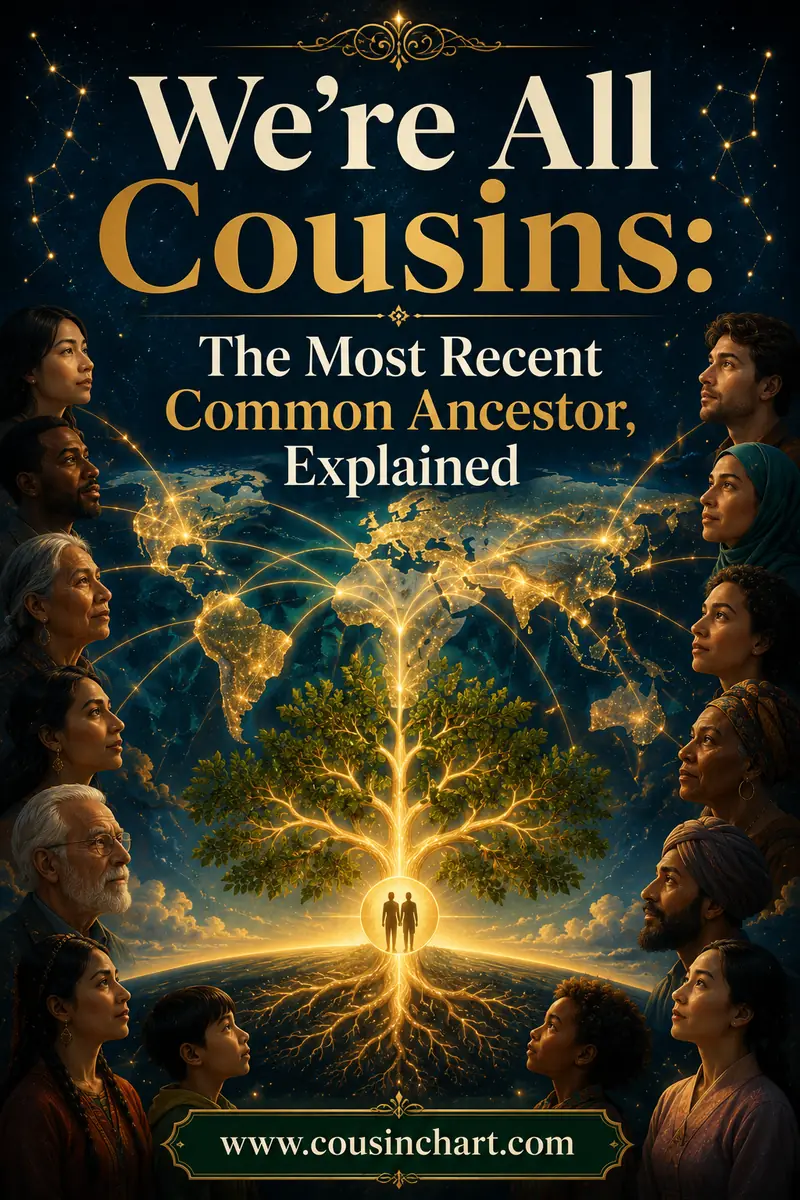
Statisticians have shown the consequence: everyone with substantial European ancestry is likely descended from Charlemagne, and the most recent common ancestor of all living humans may have lived just a few thousand years ago — the full argument is laid out in we're all cousins. So "related to someone famous" is a mathematical near-certainty.
Which is exactly why the documented path is the fun part. "Everyone descends from Charlemagne" is trivia; "here are the eleven grandmothers between me and Charlemagne, with a baptism record for each" is genealogy.
Route 1: Build Your Tree and Run a Relative Finder
The highest-success route, and it's free:
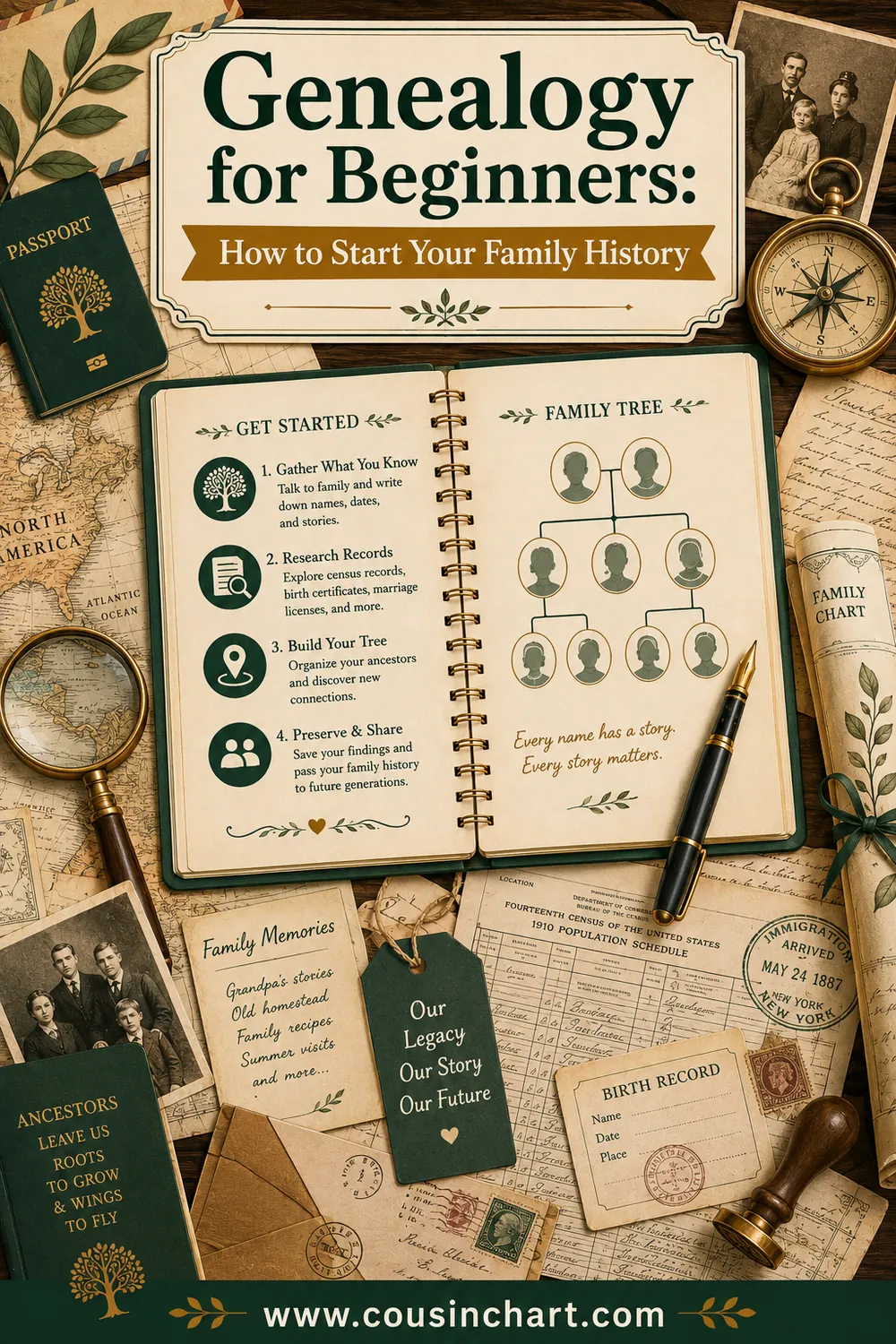
- Build 4–6 generations of your tree. Interview relatives, gather names, birthplaces, and dates. Our genealogy for beginners guide walks you through the first steps.
- Put your tree on FamilySearch.org (free, run by a nonprofit). Its shared Family Tree already contains billions of profiles, including most famous historical figures.
- Run the famous-relatives tools. FamilySearch's "Famous Relatives" discovery pages and BYU's Relative Finder (relativefinder.org, free, works off your FamilySearch tree) will scan the shared tree and list every U.S. president, author, pioneer, or European royal it can path you to — with the exact relationship, like "9th cousin 2 times removed."
One honest caveat: the shared tree is community-edited, and the further back a line goes, the more likely somebody grafted in a hopeful-but-wrong link. Treat the output as a lead list, not a verdict.
Route 2: DNA Testing — Powerful but Short-Range
A DNA test can prove a connection paper can't — with limits worth knowing up front:
- Detectable range is roughly out to 5th–6th cousins. Beyond that, most genuine cousins share no measurable DNA at all. A test will never "show" your link to a 12th-cousin president.
- Living famous relatives appear only if they (or their close family) tested and made results visible. It happens more than you'd think — but it's luck.
- Where DNA shines: confirming the recent generations of a paper trail. If records say you and a documented Lincoln-cousin line are 4th cousins, a DNA match to that line turns a good story into evidence.
Ancestry, 23andMe, and MyHeritage all label matches by estimated range ("3rd–4th cousin"). To convert a match plus a paper trail into a precise term, count both paths down from the shared couple — or let the relationship calculator do the counting.
Route 3: Gateway Ancestors — the Genealogist's Shortcut
A gateway ancestor is a person with two well-documented halves: a proven line down to modern families, and a proven line up into famous territory (usually medieval royalty and nobility). Several dozen colonial American immigrants are established gateways with royal descent.
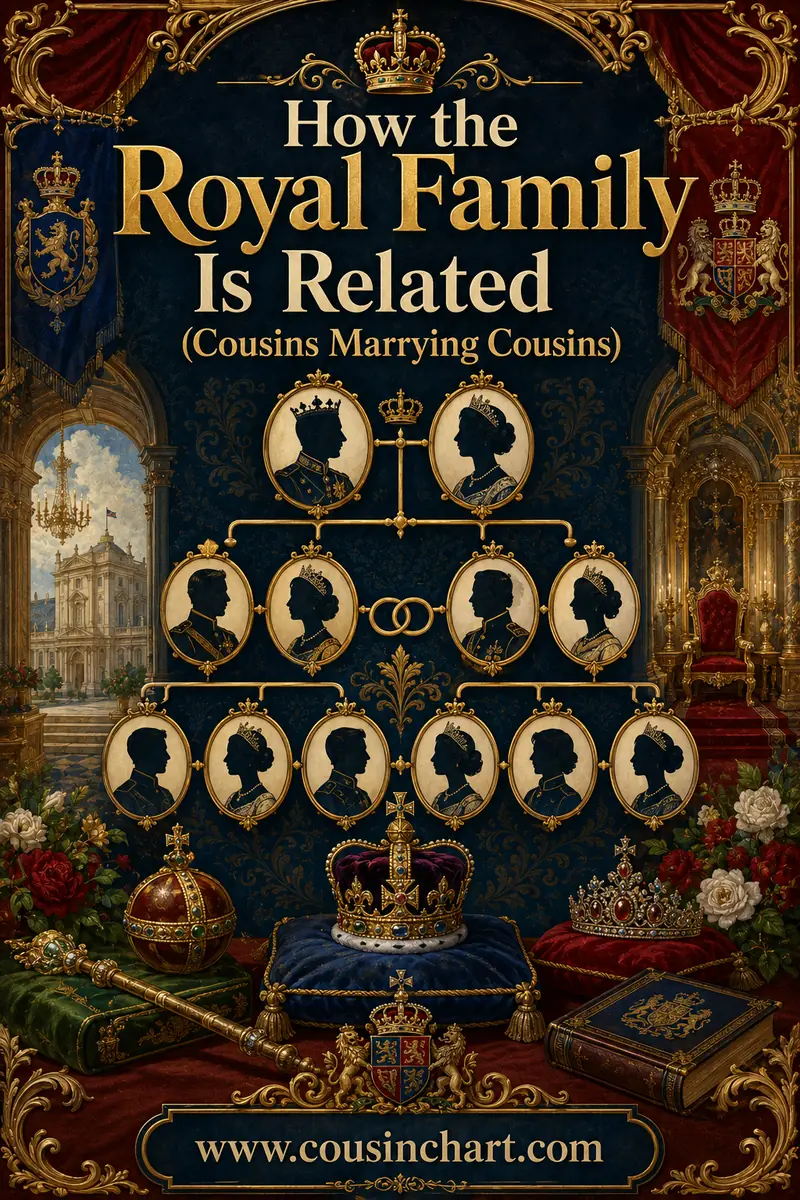
The strategy: you only have to prove your line back to the gateway — typically 8–12 generations — and the rest of the climb is already published in peer-reviewed genealogies. Descend from one gateway and you inherit, in one stroke, kinship with much of European royalty (whose own thoroughly intertwined tree we tour in how the royal family is related).
Sources genealogists trust here: the Magna Carta Sureties and Ancestral Roots volumes, Douglas Richardson's Royal Ancestry series, and lineage societies (Mayflower Society, Daughters of the American Revolution) whose applications are documentation gauntlets by design.
How to Verify a Famous Connection (Before You Print the T-Shirt)
Five checks separate real cousins from clickbait cousins:
- Demand a record for every link. Each parent-child step needs a birth, baptism, census, or probate record. One undocumented step breaks the whole chain.
- Beware same-name merges. The #1 error in shared trees: two different John Halls, born ten years apart, fused into one person. Check that dates and places make biological sense.
- Watch for impossible generations. Mothers aged 8 or 60, children born after a father's death (beyond nine months), ancestors in two continents the same year.
- Prefer lines vetted by lineage societies or published scholarship for the deep (pre-1700) portion.
- Cross-check with DNA where the connection is recent enough (within ~5 generations).
Do that, and "we're related to Emily Dickinson" becomes something you can actually show people — ideally with the relationship spelled out correctly.
What the Relationship Terms Mean at This Distance
Famous connections usually come back as things like "8th cousin 3 times removed." Decode it with the same two dials as any cousin term: the number says how far back the shared couple sits (8th cousins share 7th great-grandparents), and removed counts the generation offset between you and the famous person. A president born 150 years before you will almost always be several times removed — you're comparing different floors of the tree.
Distance context: you have thousands of 8th cousins — likely hundreds of thousands. That's not deflating; it's the point. Fame is rare, but kinship is the most evenly distributed thing humans have.
Family Legends That Usually Don't Survive the Records
Almost every family carries at least one famous-kin story, and a few templates show up so often that genealogists can recite them in their sleep. Worth knowing before you spend a weekend chasing one:
- "We're descended from a Cherokee princess." The single most common American family legend — and one of the least-often verified. The Cherokee had no princesses, and DNA plus tribal rolls (the Dawes Rolls are searchable free) debunk the story far more often than they confirm it. When there is Native ancestry, it's usually a different tribe, a different generation, or a documented ancestor nobody romanticized.
- "Three brothers came over, and we descend from one of them." A tidy story that almost never matches the passenger lists. Immigrant families usually arrived in messier waves — a father first, cousins later, a sister who went back.
- "Our name was changed at Ellis Island." Inspectors at Ellis Island didn't write names down at all; they checked arrivals against ship manifests written at the port of departure. Name changes were real, but immigrants made them themselves, later, to sound more American — which means the old spelling is findable in records.
- "We're related to [famous person with our surname]." Sharing a surname with Daniel Boone or Wyatt Earp is weak evidence by itself — most surnames arose independently in many places. It's a fine lead, but the connection has to be proven person by person, not name by name.
None of this means your legend is false. It means legends are hypotheses. The families who confirm a version of their story usually find the truth is slightly different and considerably more interesting than the legend — a different famous cousin, a closer connection, or an unfamous ancestor with a better story than the myth.
A Worked Example: From Rumor to "6th Cousin 4 Times Removed"
Here's what the process actually looks like, compressed. Say the family story is "we're related to Abraham Lincoln through Grandpa's mother."
- Anchor the recent generations. Birth and marriage records take you from yourself to Grandpa's mother, born 1902 — three documented steps.
- Ride the censuses backward. The 1910, 1880, and 1860 censuses chain her line back to a farmer born in Kentucky in 1811. Each census lists the household together, tying each child to the right parents.
- Hit the published research. Lincoln's ancestry is exhaustively documented. Comparing trees shows your 1811 farmer and Lincoln's father shared great-grandparents — making the farmer and Abraham Lincoln second cousins once removed, not the "cousins" the legend claimed.
- Count your own path. The farmer is your 4th great-grandfather. Feed both paths into the relationship calculator and out comes the verdict: Lincoln is your 6th cousin 4 times removed (or thereabouts, depending on your exact line).
Total cost: zero dollars, several evenings, one corrected family legend — and unlike the rumor, every step now has a document behind it. That's the difference between "I heard we're related to Lincoln" and "here's how."
FAQ
Is everyone related to someone famous?
Statistically yes — ancestor lines braid so quickly that within 15–20 generations your tree intersects nearly every family of your ancestral region, famous ones included. The meaningful question is whether the paper trail survives to prove your specific path.
What's the best free tool to find famous relatives?
Build your tree on FamilySearch.org, then run BYU's Relative Finder against it. Both are free and return exact relationship labels to presidents, authors, royals, and more. Verify the weakest links before you celebrate.
Can a DNA test show I'm related to a celebrity?
Only if the celebrity or their close relatives have tested and share results, or if you match a documented branch of their family. DNA reliably detects cousins out to about the 5th–6th degree; older connections need records instead.
What does "9th cousin twice removed" actually mean?
You and the person descend from the same couple — your 8th great-grandparents on the closer side — and you sit two generations apart on the tree. It's a genuine, traceable relationship shared with a very large crowd.
Are famous-relative claims on family tree sites reliable?
Treat them as leads. Community trees contain merge errors and wishful links, especially pre-1700. A claim becomes reliable when every parent-child step has a source document — lineage-society-vetted lines are the gold standard.
Does sharing a last name with someone famous mean we're related?
Not by itself. Most surnames sprang up independently in many towns — occupational names like Smith or Carter arose everywhere someone did that job. A shared surname is a lead worth checking, especially if it's rare and your families lived in the same county, but the relationship still has to be proven one parent-child record at a time.
How closely related counts as "related"?
There's no official cutoff. DNA-detectable kinship fades around 5th–6th cousins; documented kinship extends as far as records do. Most people treat anything with a provable paper trail as fair game for bragging rights.
Turn the Rumor Into a Relationship
Grandma's story about the outlaw, the president, or the poet is probably not 100% right — and probably not 0% right either. Build the tree, run the free finders, verify the weak links, and let DNA confirm the recent stretch. Then take the final step that makes it real: trace both paths down from the shared ancestor and name the relationship exactly. The free family relationship calculator does that part in seconds — degree, removals, and a little chart you can screenshot next to the famous face. Every family has one good story. Go find out if yours is true.