Do You Inherit DNA From All Your Ancestors? Genetic vs. Family-Tree Ancestors
No. You don't inherit DNA from all your ancestors. You get DNA from every parent, grandparent and great-grandparent, but a few generations further back some of the people in your family tree stop showing up in your genome at all. If you've wondered "do you inherit DNA from all your ancestors?", the honest answer is: from all the recent ones, yes. From the distant ones, only from a lucky subset.
That isn't a flaw in DNA testing. It comes from how DNA is passed down. Each generation you double your number of ancestors, but your DNA only gets cut into a few more pieces. Sooner or later there are more ancestors than pieces to go around. This guide walks through why that happens, how fast the odds drop, what it means for your DNA matches, and how to work out the numbers for your own family tree.
Do you inherit DNA from all your ancestors? The short version
Here's the quick picture before we get into the details:
- Parents: you get almost exactly half your DNA from each one. Always.
- Grandparents: you get DNA from all four, on average about a quarter each, but the exact share varies.
- Great-grandparents through 4th-great-grandparents: you almost certainly carry some DNA from every one of them, though the amounts get small and uneven.
- 5th- and 6th-great-grandparents: most of them still contributed DNA to you, but a growing minority did not.
- 8th-great-grandparents and beyond: more than half of these ancestors left you no DNA you can detect, and the share keeps falling fast.
Population geneticist Graham Coop and his lab at UC Davis worked through this math in a well-known series of posts. In How many genetic ancestors do I have?, the Coop lab explains that because DNA is inherited in chunks, a specific ancestor becomes likely to have contributed nothing to you after roughly nine generations. We'll show where that comes from below.
One important point up front: an ancestor who left you no DNA is still your ancestor. Your family tree doesn't change. The paper trail, the stories and the legal relationship are all still real. DNA just can't "see" every branch.
Genetic ancestors vs. family-tree ancestors
Geneticists separate your ancestors into two groups, and it helps to learn both terms.
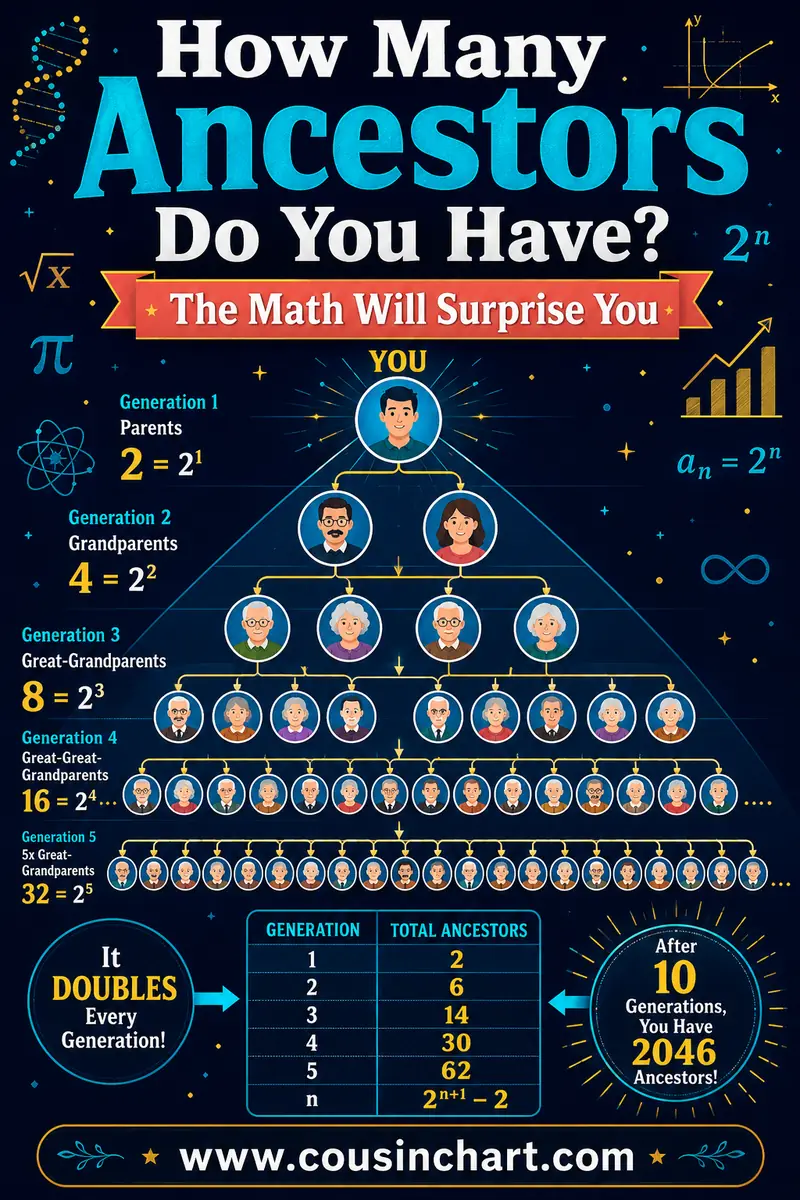
A genealogical ancestor is anyone in your family tree: your parents, their parents, and so on back. You have 2 parents, 4 grandparents, 8 great-grandparents, and the number doubles every generation. Ten generations back that's 1,024 slots in your tree. If you want to see how fast that grows, our guide to how many ancestors you have has the full table.
A genetic ancestor is a genealogical ancestor who actually passed some DNA down the line to you. Every genetic ancestor is a genealogical ancestor, but not the other way around.
A 2024 paper in the journal Genetics by Lily Agranat-Tamir, Jazlyn Mooney and Noah Rosenberg, Counting the genetic ancestors from source populations in members of an admixed population, puts it neatly: the two ideas are nearly the same for recent generations, but they drift apart as you go back. The number of genealogical ancestors grows exponentially (doubling each generation), while the number of genetic ancestors grows only linearly (adding roughly the same amount each generation).
| Question | Genealogical ancestors | Genetic ancestors |
|---|---|---|
| Who counts? | Everyone in your direct family tree | Only ancestors whose DNA you carry |
| How fast does the number grow? | Doubles every generation | Grows by a roughly fixed amount each generation |
| How do you find them? | Records: births, marriages, census, wills | DNA testing and matching with relatives |
| Can someone drop out? | No. Your tree is your tree | Yes. Distant ancestors can leave no trace |
| Same in recent generations? | Yes | Yes. Parents through roughly 4th-great-grandparents overlap almost completely |
How recombination shuffles your DNA each generation
To see why some ancestors drop out, you need one idea from biology: recombination.
Your DNA is packaged into chromosomes. According to MedlinePlus from the National Library of Medicine, each of your cells normally holds 23 pairs of chromosomes, 46 in all. Twenty-two of those pairs are autosomes, the non-sex chromosomes, and the 23rd pair is the sex chromosomes (XX or XY). Autosomal DNA tests, the kind most people take for ancestry and cousin matching, read those 22 pairs.
In each pair, one copy came from your mother and one from your father. But when you make an egg or sperm cell, you don't hand over your mother's copy or your father's copy whole. The two copies line up and swap stretches of DNA first. The National Human Genome Research Institute's glossary entry on crossing over describes this as the exchange of DNA between paired chromosomes during the making of egg and sperm cells, which creates new combinations in the offspring.
So each chromosome you pass to a child is a patchwork: a block from your mother, then a block from your father, then maybe your mother again. The points where it switches are called crossovers.
How many crossovers happen?
In How much of your genome do you inherit from a particular ancestor?, the Coop lab uses about 33 crossovers each time a parent passes on a set of autosomes. That's not very many. Across 22 chromosomes, it means only one or two cuts per chromosome per generation on average.
Crossovers also differ between mothers and fathers. A 2019 study in PLoS Genetics by Caballero and colleagues, Crossover interference and sex-specific genetic maps shape identical by descent sharing in close relatives, reports that females produce on average 1.57 times more autosomal crossovers per meiosis than males. If we take 33 as the overall average and split it in that ratio, the simple math is:
- Father: 66 divided by 2.57 is about 26 crossovers per generation
- Mother: 26 times 1.57 is about 40 crossovers per generation
Those are rough figures we worked out to make the idea concrete, not lab measurements. The point is simple: DNA coming down through mothers gets chopped into a few more pieces than DNA coming down through fathers.
Counting the blocks
Here's the key piece of math from the Coop lab's post. Look back k generations on one side of your family, say your mother's. The DNA you got from your mother started as 22 chromosomes, and every generation of crossovers adds about 33 more cut points. So the DNA from that one side is broken into about:
22 + 33 x (k - 1) blocks
Those blocks are shared among the 2^(k - 1) ancestors (2 multiplied by itself k - 1 times) on that side. Let's try it at a few depths:
- Grandparents (k = 2): 22 + 33 = 55 blocks on your mother's side, shared between 2 people. Plenty for both.
- 3rd-great-grandparents (k = 5): 22 + 132 = 154 blocks, shared among 16 people. Still about 10 each.
- 7th-great-grandparents (k = 9): 22 + 264 = 286 blocks, shared among 256 people. That's barely more than one block each.
The Coop lab uses that same nine-generation example: about 286 blocks spread across 256 ancestors on one side. When there's only about one block per person, chance alone will hand some people two or three blocks and others none.
That's the whole story in one sentence: ancestors double every generation, but blocks only grow by about 33. Doubling always wins.
Why your share from each ancestor is only "about" a quarter or an eighth
You'll often read that you get 25% of your DNA from each grandparent and 12.5% from each great-grandparent. Those are averages, not rules.
Your mother gave you exactly half her autosomal DNA, but that half was a random mix of her mother's and her father's DNA. Because there are only a few crossovers per chromosome, the mix doesn't come out perfectly even. You might carry a bit more from your maternal grandmother and a bit less from your maternal grandfather. Your brother might have it the other way around.
Real data shows how wide this spread is. The Shared cM Project tool at DNA Painter, which presents Blaine Bettinger's crowdsourced Shared cM Project version 4.0, gives these figures for shared DNA measured in centimorgans (cM), a unit of genetic length (see our centimorgans explainer if that's new to you):
| Relationship | Average shared cM | Reported range (cM) | Average as a share of parent/child |
|---|---|---|---|
| Parent / child | 3,485 | 2,376 to 3,720 | 100% |
| Grandparent / grandchild | 1,754 | 984 to 2,462 | about 50% |
| Great-grandparent / great-grandchild | 887 | 485 to 1,486 | about 25% |
The last column is simple division: 1,754 divided by 3,485 is about 0.50, and 887 divided by 3,485 is about 0.25. So each generation back, the average really does halve, just as the Coop lab's model expects.
But look at the ranges. Someone at the low end shares 984 cM with a grandparent, and someone at the high end shares 2,462 cM. The top of the range is about two and a half times the bottom. That's the randomness of recombination at work, and it's why two siblings can get different ethnicity estimates and match different cousins. We cover the grandparent case in more depth in our guide to grandparent DNA test accuracy.
The chance of inheriting no DNA from an ancestor, generation by generation
Now we can put real numbers on the question. The Coop lab's post on genetic ancestors gives a way to estimate the chance that one specific ancestor k generations back passed you no DNA at all. It treats the number of blocks you got from that ancestor as a random count (a Poisson distribution, for the math fans) with an average of:
average blocks from one ancestor = (22 + 33 x (k - 1)) / 2^(k - 1)
and the chance of getting zero blocks is e raised to the power of minus that average. You don't need to do this by hand. We ran the numbers below. "Generation k" counts parents as generation 1.
| Generation back (k) | Ancestor | Ancestors in that generation | Expected share of your DNA from each | Chance a given ancestor left you no DNA |
|---|---|---|---|---|
| 1 | Parent | 2 | 50% | essentially 0% |
| 2 | Grandparent | 4 | 25% | essentially 0% |
| 3 | Great-grandparent | 8 | 12.5% | essentially 0% |
| 4 | 2nd-great-grandparent | 16 | 6.25% | essentially 0% |
| 5 | 3rd-great-grandparent | 32 | 3.1% | about 0.01% |
| 6 | 4th-great-grandparent | 64 | 1.6% | about 0.3% |
| 7 | 5th-great-grandparent | 128 | 0.8% | about 3% |
| 8 | 6th-great-grandparent | 256 | 0.4% | about 14% |
| 9 | 7th-great-grandparent | 512 | 0.2% | about 33% |
| 10 | 8th-great-grandparent | 1,024 | 0.1% | about 54% |
| 11 | 9th-great-grandparent | 2,048 | 0.05% | about 71% |
| 12 | 10th-great-grandparent | 4,096 | 0.02% | about 83% |
| 16 | 14th-great-grandparent | 65,536 | 0.002% | about 98% |
Two checks show these numbers line up with the published work:
- The 2024 Genetics paper, using the same Coop model, gives a probability of about 0.86 that you share DNA with an ancestor 8 generations back. Our table says about 14% chance of none at generation 8, and 1 minus 0.14 is 0.86.
- The same paper puts the chance of sharing DNA with an ancestor 16 generations back at about 0.016, or 1.6%. Our table gives about 98% chance of none at generation 16, which is the same thing.
Here's how to read the table in plain words. Pick any one of your 5th-great-grandparents. There's about a 97% chance you carry some of their DNA. Pick one of your 8th-great-grandparents and it's close to a coin flip. Pick a 10th-great-grandparent and the odds are better than 4 in 5 that none of their DNA reached you.
A note on how exact these numbers are
The Coop model is a good approximation, not a perfect one. Real crossovers don't land completely at random. The Caballero study found that a process called crossover interference (crossovers tend not to bunch up close together) and the difference between male and female crossover rates both change the spread of shared DNA a little. The Coop lab also notes that, because mothers produce more crossovers, DNA from a purely maternal line breaks into more blocks than DNA from a purely paternal line. So treat the table as "about right," good for planning and understanding, not as a precise prediction for any one ancestor.
How many genetic ancestors you actually have
Flip the question around. Instead of asking about one ancestor, ask how many of the people in a given generation actually left you DNA. That's just the number of ancestors times the chance each one contributed. The Coop lab's post on genetic ancestors uses this same approach, and notes it matches simulations based on real recombination data.
| Generation back | Genealogical ancestors | Expected genetic ancestors | Share of that generation who left you DNA |
|---|---|---|---|
| 5 (3rd-great-grandparents) | 32 | about 32 | about 100% |
| 7 (5th-great-grandparents) | 128 | about 124 | about 97% |
| 8 (6th-great-grandparents) | 256 | about 221 | about 86% |
| 9 (7th-great-grandparents) | 512 | about 344 | about 67% |
| 10 (8th-great-grandparents) | 1,024 | about 475 | about 46% |
| 12 (10th-great-grandparents) | 4,096 | about 702 | about 17% |
| 16 (14th-great-grandparents) | 65,536 | about 1,026 | about 1.6% |
Look at the middle column. Between generation 10 and generation 16, your genealogical ancestors multiply by 64, but your genetic ancestors only roughly double. In a comment under his first post, Coop gives a figure of about 700 genetic ancestors at 12 generations back, out of 4,096 in the tree, which matches our 702.
There's also a shortcut. The Coop lab points out that far enough back, the number of genetic ancestors in generation k is roughly 2 x (22 + 33 x (k - 1)), which is just the total number of blocks from both sides. At generation 12 that gives 2 x 385 = 770, close to the 702 above. Once there are far more ancestors than blocks, almost every block comes from a different ancestor, so blocks and genetic ancestors become nearly the same number.
Your genetic ancestors are a random sample
Which of your 8th-great-grandparents made the cut? Nobody chose. The Coop lab describes genetic ancestors as a random subset of your genealogical ancestors, picked by the chance of which chromosome pieces got passed down. That has a practical consequence: your DNA can over-represent some branches of your tree and under-represent others, purely by luck. It's one reason an ethnicity estimate can miss an ancestor you know from records, especially one many generations back.
The exceptions: Y-DNA, mitochondrial DNA and the X chromosome
Everything above is about autosomal DNA, the 22 numbered chromosome pairs. Three other parts of your genome follow different rules, and they change the answer for certain lines of your tree.
Mitochondrial DNA (mtDNA)
Mitochondria are small energy-producing structures inside your cells with their own tiny circle of DNA. The NHGRI glossary entry on mitochondrial DNA explains that children inherit mitochondria, and so mitochondrial DNA, from their mother. It isn't shuffled by recombination, so it passes down nearly unchanged.
That means you carry mtDNA from exactly one ancestor in every generation: your mother, her mother, her mother, and so on up your direct maternal line. You carry it from your 10th-great-grandmother on that line with essentially full certainty, while you carry none from the other 4,095 people in that generation.
Y-DNA
The Y chromosome is found only in males and is passed from father to son. Like mtDNA, most of it doesn't recombine. A man carries Y-DNA from his father, his father's father, and so on up the direct paternal line. Women don't have a Y chromosome, so they carry none, though a brother, father or paternal uncle can test that line for them.
X-DNA
The X chromosome follows its own pattern. A son gets his only X from his mother, so a man inherits no X-DNA from his father's side at all. A daughter gets one X from each parent. Because of this, many of your ancestors are impossible X-DNA ancestors, even in recent generations. For example, a man inherits no X-DNA from his father's father. Our guide to X-DNA inheritance maps out exactly which ancestors can and can't contribute.
| Type of DNA | Who has it | Which ancestors it comes from | Recombines? |
|---|---|---|---|
| Autosomal (22 pairs) | Everyone | All recent ancestors, a random subset of distant ones | Yes, every generation |
| Mitochondrial (mtDNA) | Everyone | Only the direct maternal line | No |
| Y chromosome | Males | Only the direct paternal line | Mostly no |
| X chromosome | Everyone (females two, males one) | Only certain lines; never father to son | Yes, when passed from a mother |
So if someone asks "do I have DNA from my 10th-great-grandmother?", the answer depends on which one. On your direct maternal line, yes, through mtDNA. Anywhere else in the tree, probably not.
What inheriting DNA from only some ancestors means for your DNA matches
The same block math explains why you don't match every cousin. If you and a cousin share a pair of ancestors, you each got a random sample of their DNA. For you to show up as a match, your two samples have to overlap somewhere. The further back the shared ancestors, the smaller each sample and the less likely they overlap.
In How many genomic blocks do you share with a cousin?, the Coop lab estimates that roughly 1 in 100 pairs of third cousins share no blocks from their common ancestors, and roughly 25% of fourth cousins share none. The Caballero study's simulations agree closely and go further:
| Cousin relationship | Shared ancestors | Chance of sharing no detectable DNA (Caballero et al.) | Average shared cM when they do match (Shared cM Project) |
|---|---|---|---|
| Second cousins | Great-grandparents | Very rare | 229 cM (range 41 to 592) |
| Third cousins | 2nd-great-grandparents | about 1.5% | 73 cM (range 0 to 234) |
| Fourth cousins | 3rd-great-grandparents | about 27% | 35 cM (range 0 to 139) |
| Fifth cousins | 4th-great-grandparents | about 67% | Often too small to detect |
| Sixth cousins | 5th-great-grandparents | about 87% to 91% | Often too small to detect |
The sixth-cousin row comes from the Caballero paper's finding that between 9.0% and 13.1% of sixth cousins have any shared segments, depending on whether they're related through male or female lines. The Shared cM Project ranges come from the DNA Painter tool, which notes that for relationships more distant than half second cousins, averages only include pairs who actually shared DNA.
Notice something interesting. You almost certainly carry DNA from your 4th-great-grandparents (our generation 6 row says about 99.7% for each one), yet most fifth cousins, who share 4th-great-grandparents with you, don't match. That's because a match needs both of you to have inherited the same piece. You each have a few blocks from that couple, but they're usually different blocks.
This is also why a failed match with a distant cousin isn't proof your tree is wrong. For a closer look at why known relatives sometimes don't show up, see why you might not match a known relative, and for the full picture on cousin sharing, our page on whether cousins share DNA.
Why you match people you can't place
The flip side is that you'll match some people through ancestors so distant that you'll never find the connection, or through several different lines at once. The Coop lab's cousin post makes this point too: pairs sharing only one or two small blocks may be related through deeper ancestry, so it's hard to say how they're related from the DNA alone. Small matches are where caution matters most.
Pedigree collapse and endogamy change the math
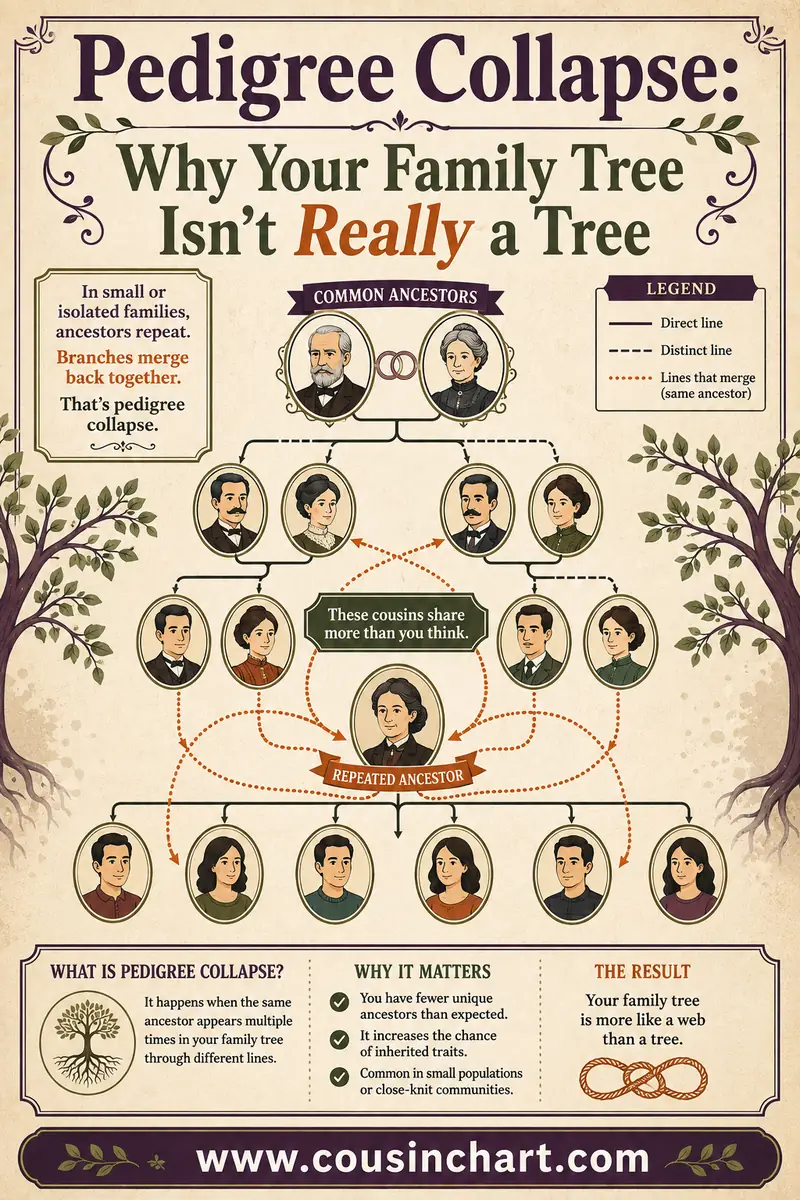
All the numbers so far assume every slot in your tree is a different person. That's never fully true. Go back far enough and the same person fills several slots, because your ancestors were related to each other. Genealogists call this pedigree collapse. The Coop lab notes this too: about 20 generations back you'd have roughly a million slots, so some people must appear more than once.
When an ancestor appears twice in your tree, you get two separate chances to inherit their DNA. That raises the odds that they're a genetic ancestor. If your great-grandparents were first cousins, for example, a couple of your 2nd-great-grandparents fill two slots each.
Endogamy is the bigger version: a community that married mostly within itself for many generations, so most people are related through many lines at once. In endogamous families you'll often share more DNA with distant cousins than the tables predict, and the shared cM numbers become harder to read. The DNA Painter tool warns that its statistics don't account for pedigree collapse or endogamy.
For more on how repeated ancestors work, see our guide to pedigree collapse.
Common mix-ups about inheriting DNA from ancestors
"If I have no DNA from an ancestor, they're not really my ancestor."
Not true. Ancestry is about who your parents were, and their parents. DNA is one kind of evidence for that, not the definition. A 9th-great-grandfather who passed you no DNA is every bit as much your ancestor as one who did.
"I'm 1/8 Irish because one great-grandparent was Irish."
On average, yes, you'd carry about 12.5% of your DNA from that great-grandparent. But the Shared cM Project range for great-grandparents runs from 485 to 1,486 cM, so your actual share could be noticeably higher or lower. Ethnicity estimates add their own uncertainty on top of that.
"My sibling and I should have the same ancestors in our DNA."
You have the same family tree, but not the same genetic ancestors. Each of you got a different random sample. Far enough back, there will be ancestors one of you carries and the other doesn't. Testing several siblings captures more of your parents' DNA, and so more of your distant ancestors.
"No DNA match means no relationship."
For close relatives like first cousins, a zero match is a red flag worth investigating. For fourth cousins and beyond, it's common and expected. Check the cousin table above before drawing any conclusion.
"Ancestors who left me no DNA can't show up in my test at all."
Mostly true for autosomal DNA, with two exceptions. Your direct maternal line always shows up in your mtDNA, and a male's direct paternal line always shows up in his Y-DNA, no matter how far back.
"Matching a famous person's descendant proves I'm related to them."
Not on its own. A small match could come through a different, unknown ancestor, especially in communities with pedigree collapse. A claimed link to a famous ancestor needs a documented tree as well as DNA. Our guide on whether you're related to someone famous explains how to check.
Try it yourself: work out the odds for one of your own ancestors
You can estimate the chance you carry DNA from any ancestor with a phone calculator. Here's the step-by-step method, using the Coop lab's formula.
- Count the generations. Parents are generation 1, grandparents 2, great-grandparents 3. A "4th-great-grandparent" is generation 6 (add 2 to the number of greats).
- Count the blocks on that side. Work out 22 + 33 x (k - 1).
- Count the ancestors on that side. Work out 2 to the power of (k - 1).
- Divide. Blocks divided by ancestors gives the average number of blocks you'd expect from that one person.
- Turn it into a chance of zero. Calculate e to the power of minus that average. Most phone calculators have an e^x button.
Worked example 1: a 6th-great-grandmother
Say your records trace a line to a 6th-great-grandmother born around 1740.
- Generation: 6 greats + 2 = generation 8.
- Blocks: 22 + 33 x 7 = 22 + 231 = 253.
- Ancestors on that side: 2 to the 7th power = 128.
- Average blocks from her: 253 / 128 = about 1.98.
- Chance of zero: e to the minus 1.98 = about 0.14.
So there's about a 14% chance you carry none of her DNA, and about an 86% chance you carry at least one piece.
Worked example 2: a 9th-great-grandfather
- Generation: 9 + 2 = generation 11.
- Blocks: 22 + 33 x 10 = 352.
- Ancestors on that side: 2 to the 10th power = 1,024.
- Average blocks from him: 352 / 1,024 = about 0.34.
- Chance of zero: e to the minus 0.34 = about 0.71.
About a 71% chance none of his DNA reached you. If he's on your direct paternal line and you're male, though, you carry his Y chromosome regardless.
Worked example 3: the same ancestor appears twice
Suppose pedigree collapse puts the same 7th-great-grandparent (generation 9) in two slots of your tree. From the table, each slot has about a 33% chance of passing you nothing. The two slots are separate lines of descent, so as a rough estimate you multiply: 0.33 x 0.33 = about 0.11. Now there's only about an 11% chance you carry none of that person's DNA, instead of 33%. This is a simplification, but it shows why repeated ancestors are more likely to show up in your DNA.
Worked example 4: how much of your DNA one ancestor makes up
Sometimes the question isn't "any DNA at all?" but "how much?" The expected share halves each generation, so you can work it out as 100% divided by 2^k. For a 3rd-great-grandparent (generation 5), that's 100 / 32 = about 3.1%. For a 5th-great-grandparent (generation 7), it's 100 / 128 = about 0.8%.
Remember these are averages across many people. Because you inherit DNA in a small number of blocks, your real share from any one 5th-great-grandparent is lumpy. You might have one medium-sized block, two small ones, or (about 3% of the time) none. That lumpiness is exactly what the "chance of zero" column in the table captures.
Quick practice
Try these on your own, then check against the main table: a 3rd-great-grandparent (generation 5) should come out close to 0%, and an 8th-great-grandparent (generation 10) should come out a little over 50%.
What this means for your family tree research
The big takeaway: your DNA is a reliable record of your recent ancestors and a partial, random sample of your distant ones. For roughly the last five or six generations, you can expect every ancestor to be represented in your genome. Beyond that, DNA becomes a set of clues rather than a complete record, and paper records do more of the work.
Here's how to use that in practice:
- For questions within four or five generations, autosomal DNA is strong evidence. Missing matches with close cousins are worth investigating.
- For questions six to eight generations back, look for patterns across many matches rather than relying on any one.
- For deeper questions, use mtDNA or Y-DNA on the direct lines, and rely on records for the rest.
- Test more relatives. Each sibling, parent or cousin who tests adds a different random sample of the same ancestors, which recovers DNA you didn't inherit.
If you're trying to work out exactly how you and a match connect, or what to call a relative once you've found the common ancestor, try our free family relationship calculator. Enter how each of you descends from the shared ancestor and it gives you the relationship name.
Frequently Asked Questions
How many generations back does your DNA go?
Your autosomal DNA reliably includes every ancestor for about five or six generations, which takes you back to your 3rd- or 4th-great-grandparents. After that, some ancestors start dropping out. Using Graham Coop's model, about 14% of your 6th-great-grandparents left you no DNA, and more than half of your 8th-great-grandparents did. Your DNA still traces back much further than that, but only through a random subset of ancestors. Mitochondrial DNA and Y-DNA are the exceptions: they follow one direct line back many generations, no matter how distant.
Is it possible to have no DNA from a great-grandparent?
No, not in practice. Graham Coop's block math gives about 88 blocks of DNA on each side of your family at the great-grandparent level, shared among just four people per side. That's roughly 22 blocks each, so every great-grandparent is all but certain to be represented in your autosomal DNA. The amount varies, though. The Shared cM Project reports that great-grandchildren share between about 485 and 1,486 cM with a great-grandparent, averaging 887 cM. So one great-grandparent can contribute noticeably more than another, but none will contribute nothing.
Why do I share more DNA with one grandparent than another?
Because your parent passed you a random mix of their own parents' DNA, and only a few crossovers happen on each chromosome per generation. That randomness means the split is rarely exactly 50/50. You might carry a bit more from your maternal grandmother and a bit less from your maternal grandfather. The Shared cM Project shows grandparent sharing ranging from 984 to 2,462 cM, with an average of 1,754 cM. Your siblings will have their own, different split.
Do siblings inherit DNA from the same ancestors?
Siblings share the same family tree, so they have the same genealogical ancestors. But they don't carry identical DNA, so their genetic ancestors differ, especially far back. One sibling might carry a block from a 7th-great-grandparent that the other sibling didn't inherit at all. That's why testing several siblings is a smart move for genealogy. Together, they recover more of their parents' DNA and pick up DNA matches that any one of them would miss.
Can a DNA test prove I descend from a specific distant ancestor?
Usually not on its own. For an ancestor eight or more generations back, there's a good chance you inherited none of their autosomal DNA, so a missing signal proves nothing. Even when you match other descendants, a small shared segment could come through a different line. The stronger approach is to combine a documented paper trail with a pattern of DNA matches to several descendants of the ancestor. On a direct maternal or paternal line, mtDNA or Y-DNA testing can add strong supporting evidence.
What is the difference between a genetic ancestor and a genealogical ancestor?
A genealogical ancestor is anyone in your family tree: your parents, their parents and so on. A genetic ancestor is a genealogical ancestor who actually passed DNA down to you. For recent generations the two groups are the same. Further back they split apart, because the number of ancestors doubles every generation while the number of DNA blocks you inherit grows only slowly. By around 12 generations back, Coop's model suggests only about 700 of your 4,096 ancestors in that generation are genetic ancestors.
Do you get more DNA from your mother or your father?
For your autosomes, the 22 numbered chromosome pairs, you get almost exactly half from each parent. You get slightly more total DNA from your mother because all of your mitochondrial DNA comes from her. Sex chromosomes also differ: a daughter gets one X from each parent, while a son gets his X from his mother and his Y from his father. Mothers also produce more crossovers, so DNA passed through the maternal side is cut into a few more pieces each generation.
Why don't I match some of my known fourth cousins?
Because it's normal. Research by Caballero and colleagues estimates that about 27% of fourth cousins share no detectable DNA, and Graham Coop's lab gives a similar figure of roughly 25%. You and your fourth cousin each inherited a small random sample of your shared 3rd-great-grandparents' DNA, and those samples often don't overlap. A missing match with a fourth cousin is not evidence that your tree is wrong. A missing match with a first or second cousin is much more unusual and worth looking into.
Sources
We checked every source below while writing this guide. Last reviewed October 30, 2026, by Joan Ramos.
- How much of your genome do you inherit from a particular ancestor? (Coop Lab, University of California, Davis (gcbias blog))
- How many genetic ancestors do I have? (Coop Lab, University of California, Davis (gcbias blog))
- How many genomic blocks do you share with a cousin? (Coop Lab, University of California, Davis (gcbias blog))
- Counting the genetic ancestors from source populations in members of an admixed population (Agranat-Tamir, Mooney and Rosenberg, Genetics, 2024) (Genetics Society of America, via PubMed Central)
- Crossover interference and sex-specific genetic maps shape identical by descent sharing in close relatives (Caballero et al., PLoS Genetics, 2019) (PLoS Genetics, via PubMed Central)
- How many chromosomes do people have? (MedlinePlus, U.S. National Library of Medicine)
- Crossing Over (Talking Glossary of Genomic and Genetic Terms) (National Human Genome Research Institute)
- Mitochondrial DNA (Talking Glossary of Genomic and Genetic Terms) (National Human Genome Research Institute)
- The Shared cM Project 4.0 tool (DNA Painter (data by Blaine T. Bettinger))