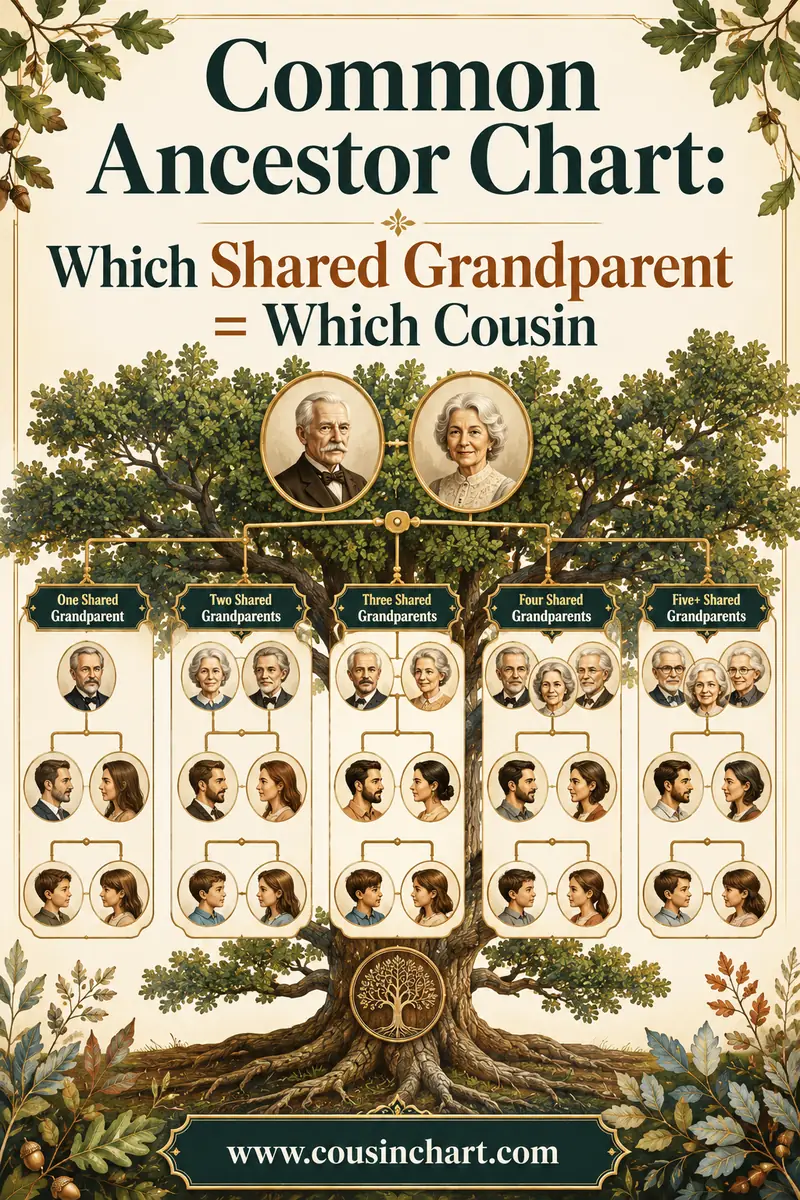
Common Ancestor Chart: Which Shared Grandparent = Which Cousin
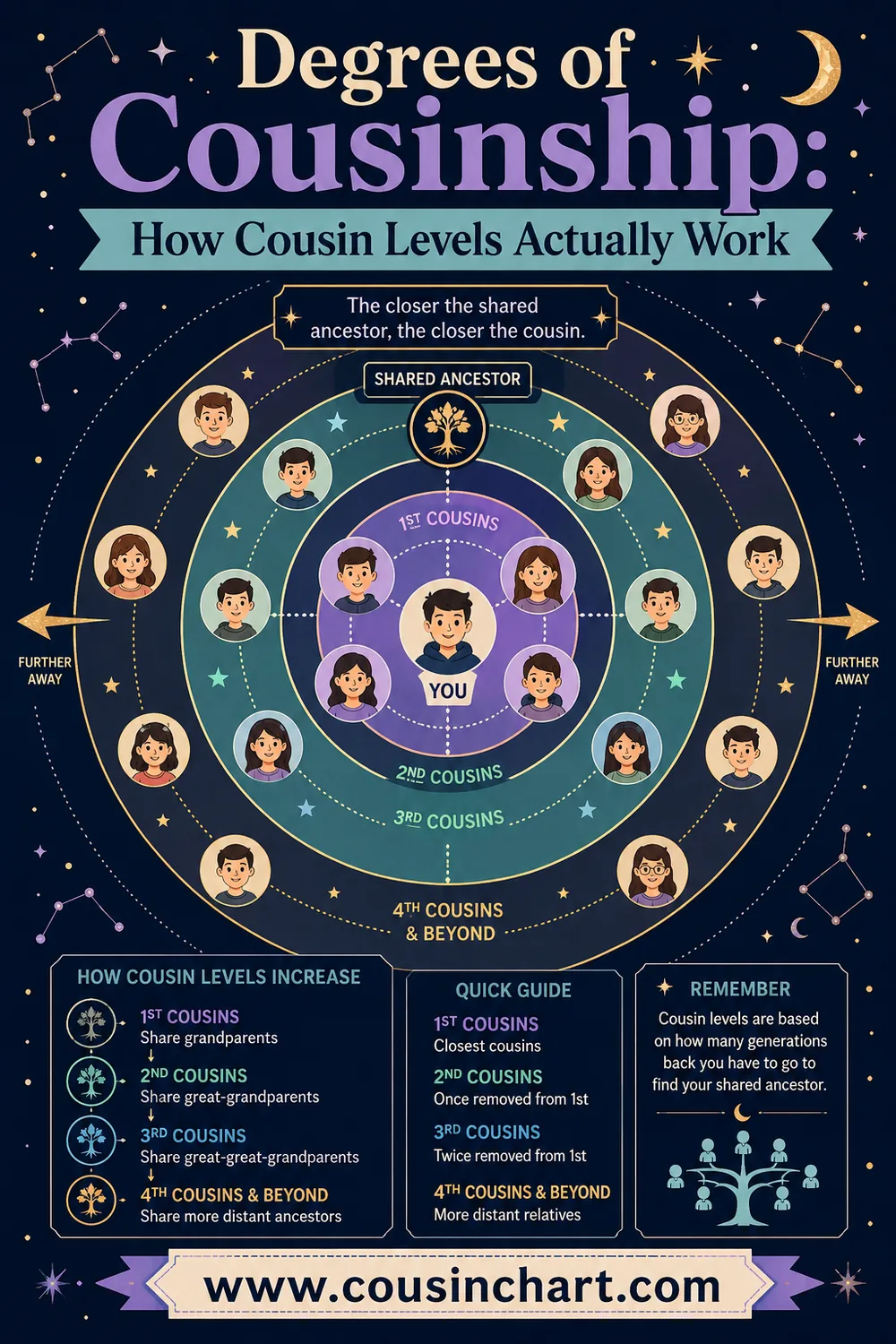
The shared ancestor is what sets your cousin number. If your closest common ancestor is a grandparent, you're first cousins. A great-grandparent makes you second cousins. A great-great-grandparent makes you third cousins. Each extra "great" pushes the cousin number up by one. When the two of you sit on different generations, the gap becomes "removed."
That's the whole system in three sentences. A common ancestor chart just draws it so you can see it at a glance. This guide gives you that chart, shows how to read it from either direction, and walks through real examples so you never have to guess again. When you want the answer without the counting, the free relationship calculator reads your two people and names the tie instantly.
Relationship quick-check. Tap the ancestor you share to see the cousin term:
The answer will appear here.
The One Formula Behind Every Cousin
Every cousin relationship comes from a single rule:
Cousin number = (generations from the nearer person to the shared ancestor) − 1.
Count from whichever of the two people is closer to the common ancestor. Then subtract one. That's your cousin number. And the difference in how far each person sits from that ancestor becomes the number of times "removed."
- Both people are grandchildren of the shared ancestor → 2 generations − 1 = first cousins.
- Both are great-grandchildren → 3 − 1 = second cousins.
- Both are great-great-grandchildren → 4 − 1 = third cousins.
If one is a grandchild and the other a great-grandchild of the same ancestor, use the nearer one (grandchild = first cousin level) and add one "removed" for the one-generation gap: first cousins once removed. We unpack the "removed" half of the system in full at what does once removed mean.
The Common Ancestor Chart
Here's the map. Find the closest ancestor you both descend from, and read across to your relationship:
| Closest shared ancestor | Your relationship | Generations to that ancestor |
|---|---|---|
| Same parents | Siblings | 1 |
| Grandparents | First cousins | 2 |
| Great-grandparents | Second cousins | 3 |
| Great-great-grandparents | Third cousins | 4 |
| 3rd-great-grandparents | Fourth cousins | 5 |
| 4th-great-grandparents | Fifth cousins | 6 |
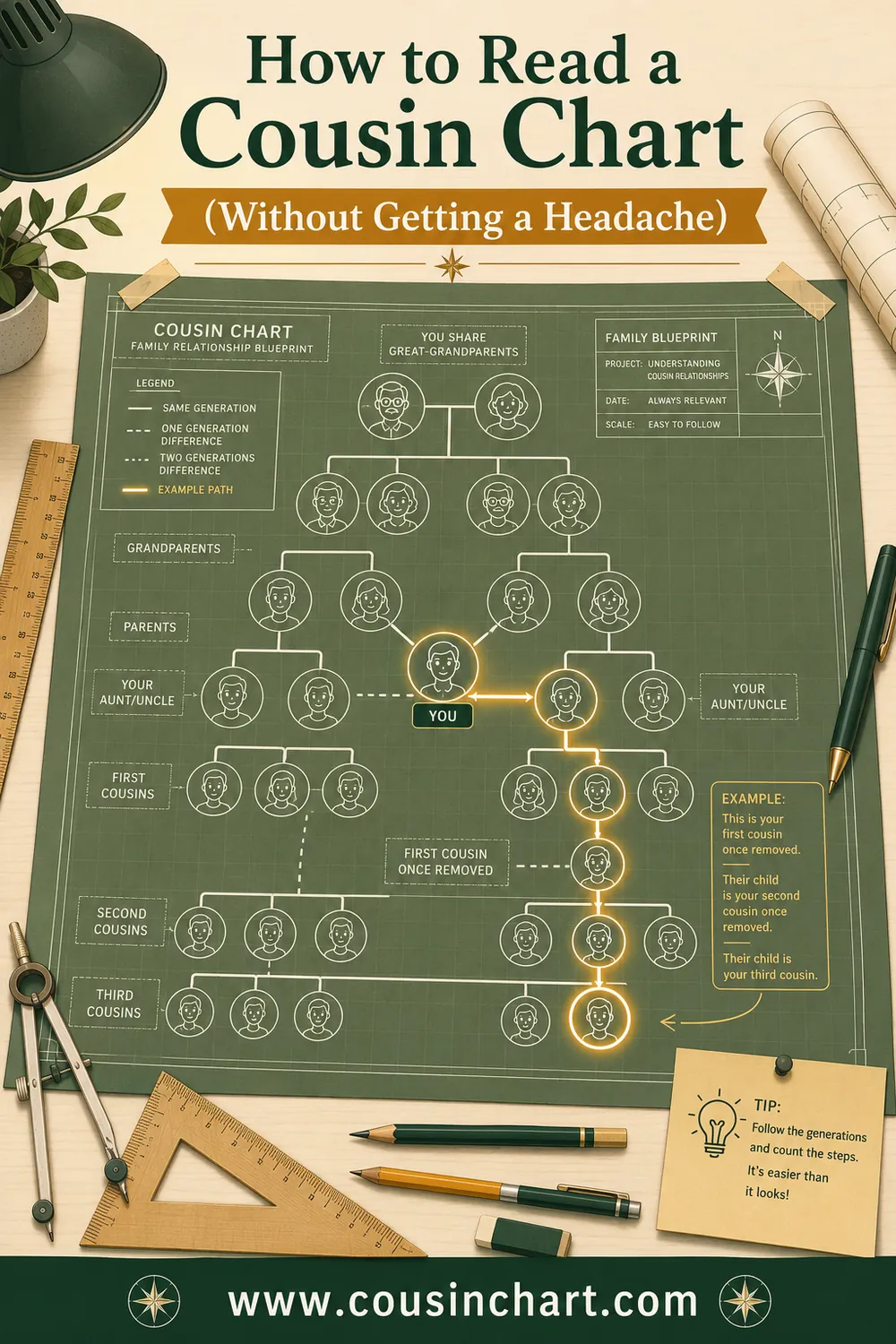
The pattern never breaks: count the generations up to the shared ancestor, subtract one, and that's the cousin number. A grandparent is 2 generations up (parent, then grandparent), so grandparent-sharing cousins are "first" (2 − 1). Great-grandparent is 3 up, so "second," and on it goes. Our companion piece how to read a cousin chart shows the same idea as a grid you can trace with two fingers.
When You're on Different Generations
The chart above assumes both people are the same number of steps from the shared ancestor. Real families rarely cooperate. When the two of you sit at different distances, two things happen:
- The cousin number comes from the person closer to the shared ancestor.
- The generation difference becomes the "removed" count.
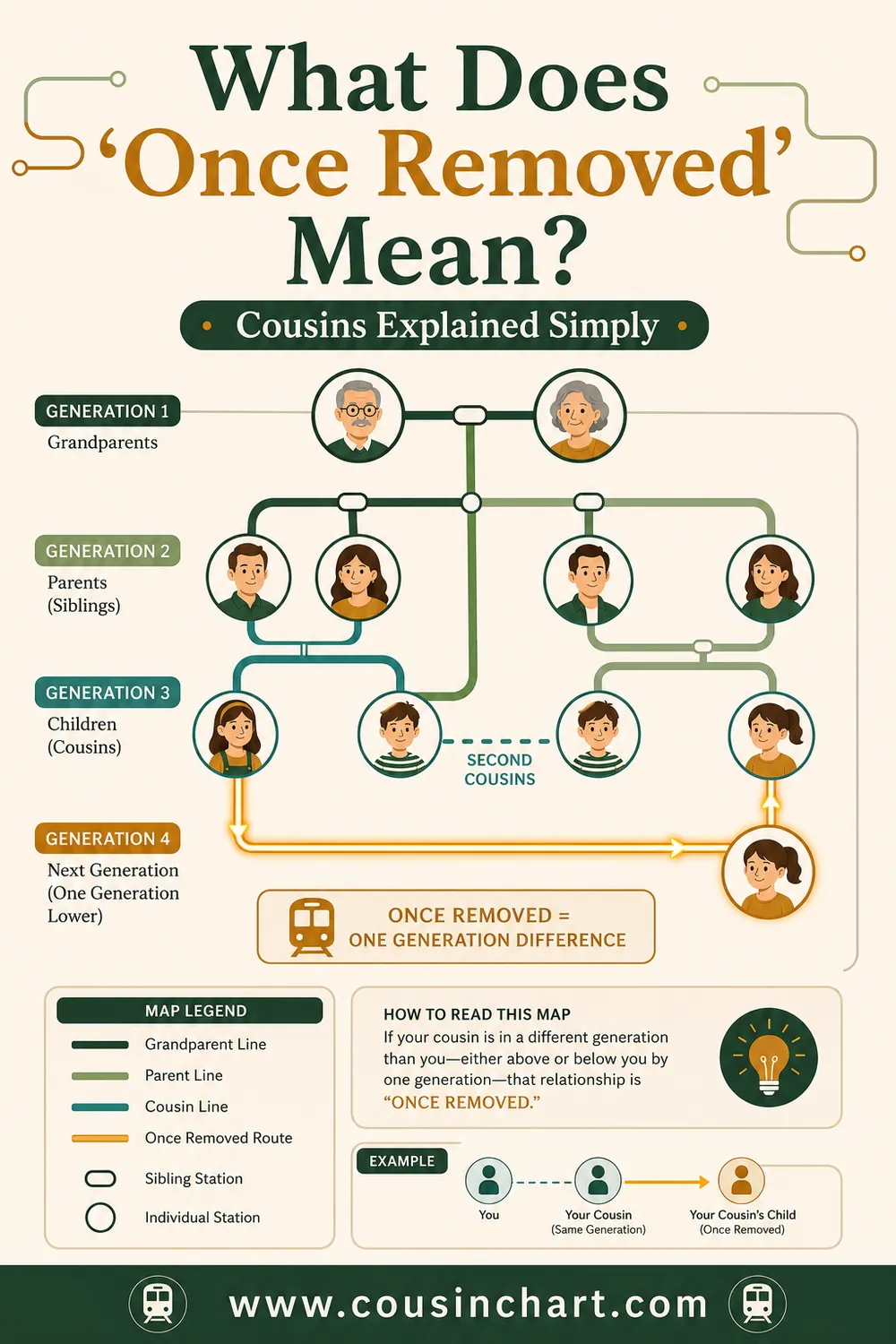
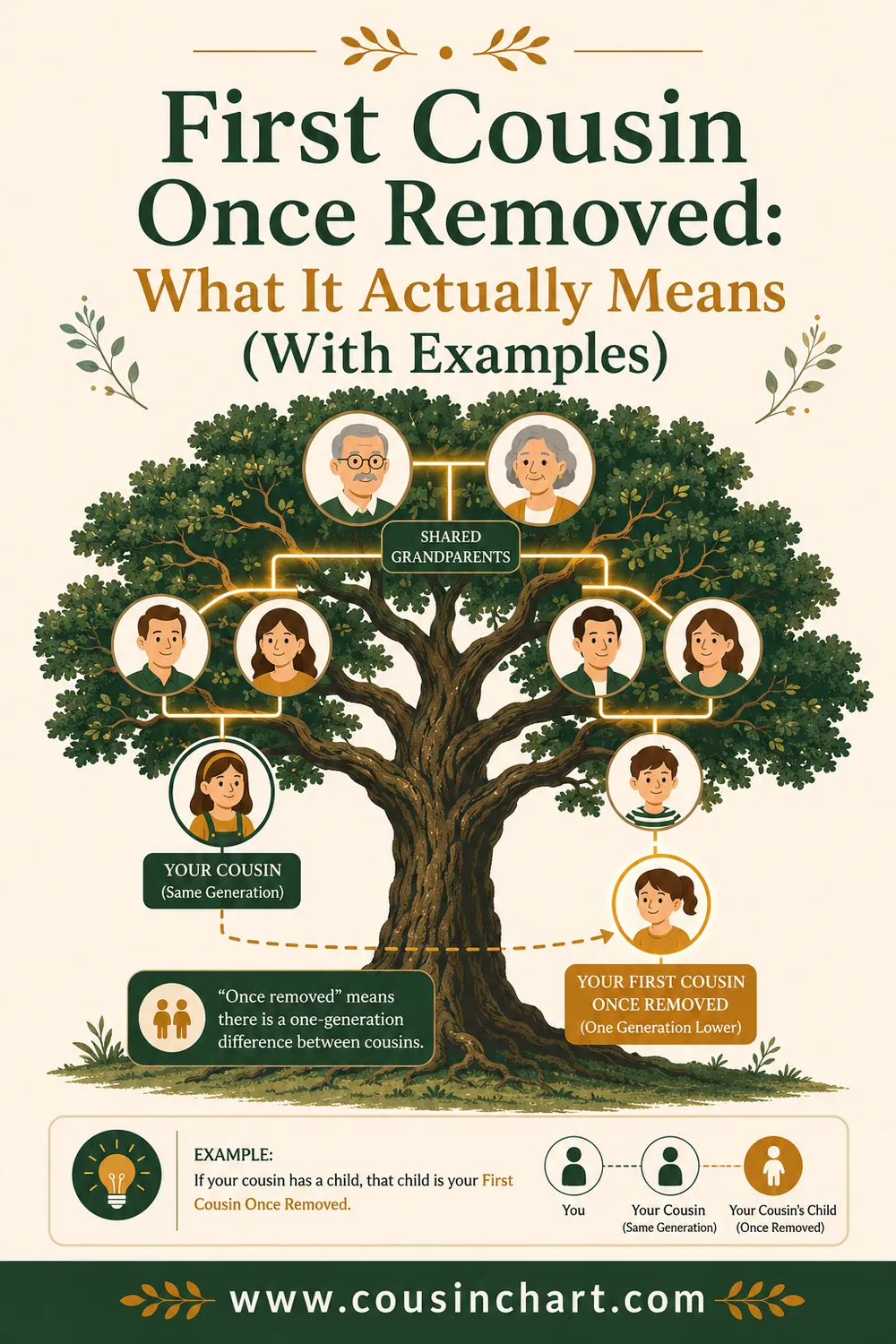
Example: Grandpa Joe is your grandfather but your relative Tina's great-grandfather. You're 2 generations from Joe; Tina is 3. Use the closer one — 2 generations means "first cousin" level. The one-generation gap adds "once removed." So you and Tina are first cousins once removed. For the removed side of things, the mini-tool above and degrees of cousinship both help.
Reading the Chart Backwards
The chart works in reverse too, which is handy when you know the relationship and want to find the ancestor to search for in genealogy records:
- Told you're second cousins with someone? Then you share a great-grandparent — go find which of your eight great-grandparents matches one of theirs.
- Third cousins? Look for a shared great-great-grandparent among your 16.
- Fourth cousins? A shared 3rd-great-grandparent, from your set of 32.
This reverse reading is the backbone of DNA-match detective work. When a testing site says "3rd cousin," it's telling you to hunt for a common great-great-grandparent — a specific, findable person a few generations back.
A Worked Example, Start to Finish
Let's trace two relatives all the way through.
- Your great-grandmother Rosa had two children: your grandfather Paul and his sister Elena.
- Paul's line: Paul → your mother → you.
- Elena's line: Elena → her son Diego → Diego's daughter Mia.
Now find the closest shared ancestor: it's Rosa, the great-grandmother you both descend from.
- You are 3 generations below Rosa (great-granddaughter/grandson).
- Mia is 4 generations below Rosa (great-great-granddaughter).
Use the nearer person — you, at 3 generations: 3 − 1 = second cousin level. The one-generation gap between you and Mia adds once removed. Final answer: second cousins once removed. Every cousin question yields to exactly this three-step method — find the shared ancestor, count from the nearer person, add the gap as "removed."
Why the Common Ancestor Is the Key to Everything
Genealogists obsess over the "most recent common ancestor" (often abbreviated MRCA) because it unlocks the entire relationship in one move. Once you know the shared ancestor and how many generations each person stands below them, you can name the exact relationship with no guessing — and you know precisely which ancestor's records to dig into. It's the single most useful fact in kinship math.
That's also why our whole homepage calculator is built around it: you tell it the path from each person up to where the family lines meet, and it applies the "minus one" rule and the removed count automatically. No mental arithmetic, no second-guessing.
Two Ancestors, Not One: Full vs. Half Cousins
A quick but important refinement. When we say cousins "share grandparents," we usually mean they share both members of an ancestral couple — the same grandmother and grandfather. These are full cousins, and the DNA percentages in the standard charts assume this.
But sometimes cousins share only one common ancestor at that level. If your grandfather remarried and had children with a second wife, your cousins through that second marriage share only your grandfather, not your grandmother. Cousins who share just one ancestor instead of a couple are half cousins, and they share roughly half the DNA of full cousins at the same degree.
This is why a careful common ancestor chart really asks two questions: which ancestor do you share, and do you share one or both of that ancestral pair? Most cousin relationships are "full," so the standard chart applies. But in families with remarriages, keep the half-cousin possibility in mind — it halves the expected DNA and can explain a match that seems too small for its predicted relationship.
Building the Chart From Your Own Tree
You can turn the general chart into a personalized one in three steps:
- Pick the two people whose relationship you want to name.
- Trace each one upward until their lines meet at a shared ancestor. Note how many generations each person is below that ancestor.
- Apply the rules: cousin number = (generations for the nearer person) − 1; removals = the difference in the two generation counts.
Do this a few times and the pattern becomes automatic — you'll start naming relationships in your head at family gatherings. The beauty of the common ancestor method is that it never needs memorizing dozens of relationship names; it rebuilds any one of them from two small numbers. And for the moments when you'd rather not trace lines on a napkin, the homepage tool does all three steps for you.
The Three Counting Mistakes Everyone Makes
When the chart "doesn't work," it's almost always one of these slips:
- Counting the ancestor as a generation. The climb is parent (1), grandparent (2) — you stop at the shared ancestor, you don't count them and then add one more. If you're tempted to call grandma "3 generations up," that's the error.
- Counting from the wrong person. The cousin number always comes from whoever sits closer to the shared ancestor. Count from the more distant person and you'll overshoot the cousin number by however many removals there are.
- Stopping at the wrong meeting point. The rule uses the closest shared ancestor. Two first cousins also share great-grandparents, but that doesn't make them second cousins — the nearer couple (the grandparents) wins. Always take the first place the two lines touch.
Avoid those three and the formula is honestly foolproof.
FAQ
How does the shared ancestor decide the cousin number?
Count the generations from the nearer person up to the closest ancestor you both share, then subtract one. Grandparents (2 generations) make first cousins, great-grandparents (3) make second cousins, great-great-grandparents (4) make third cousins, and so on.
What relationship shares great-grandparents?
Second cousins share great-grandparents. If both people are equally distant from those great-grandparents, they're plain second cousins. If one is a generation closer or farther, the difference adds "removed" — for example, second cousins once removed.
Does the common ancestor chart work for removed cousins?
Yes. Use the person closer to the shared ancestor to set the cousin number, then count the generation difference between the two people as the number of times "removed." A grandchild and a great-grandchild of the same ancestor are first cousins once removed.
How do I find my common ancestor from a DNA match?
Work backwards from the predicted relationship. A "3rd cousin" prediction means you likely share a great-great-grandparent, so compare your great-great-grandparents against the match's tree to find the overlapping couple. The relationship label tells you which generation to search.
Can two people be cousins with no common ancestor?
Not by blood. Cousin relationships are defined entirely by a shared ancestor. People with no common ancestor can still be related by marriage — as in-laws or step-relatives — but they aren't blood cousins.
Skip the Counting
A common ancestor chart turns the whole tangle of cousins into one clean rule: find who you both descend from, count the generations, subtract one, and add the gap as "removed." Once it clicks, you can name any blood relationship on the tree. And on the days you'd rather not count at all, the free family relationship calculator does the math for you and even shows the shared ancestor at the center of it.