Kinship Terminology: The 6 Systems Cultures Use to Name Relatives
Kinship terminology is the set of words a language uses for relatives, and the pattern behind which relatives share a word and which get their own. Anthropologists group the world's patterns into six classic systems: Eskimo (now often called lineal), Hawaiian, Iroquois, Crow, Omaha and Sudanese. If you speak English, you already use one of them, and once you see how the other five work, words like "cousin" and "aunt" start to look like choices rather than facts of nature.
This guide walks through each system in plain English, with the same family drawn six different ways, a side-by-side comparison table, real numbers on how common each system is, and a few "try it yourself" puzzles at the end. You don't need any background in anthropology. If you can picture your dad's sister and your mom's brother, you can follow every example here.
Kinship terminology at a glance: the six systems
Here's the short version before we go system by system. The key question for each one is simple: which relatives get lumped under the same word, and which get split apart?
| System | Other name | What it lumps together | What it splits apart | Where it shows up |
|---|---|---|---|---|
| Eskimo | Lineal | All cousins share one word; aunts on both sides share one word; uncles on both sides share one word | Your nuclear family (parents, siblings, children) from everyone else | English, most European languages |
| Hawaiian | Generational | Everyone in a generation by sex: all women of your parents' generation are "mother," all cousins are "brother" or "sister" | Only generation and sex | Common in Polynesia and many other places |
| Iroquois | Bifurcate merging | Father with father's brother; mother with mother's sister; parallel cousins with siblings | Cross cousins from parallel cousins; father's sister and mother's brother from parents | Very widespread worldwide |
| Crow | Matrilineal "skewed" system | Iroquois-style merging, plus father's sister's daughter with father's sister (across generations) | Cross cousins on the two sides from each other | Often in societies that trace descent through women |
| Omaha | Patrilineal "skewed" system | Iroquois-style merging, plus mother's brother's son with mother's brother (across generations) | Cross cousins on the two sides from each other | Often in societies that trace descent through men |
| Sudanese | Descriptive (bifurcate collateral) | Almost nothing | Almost every relative gets a separate term | Rarest of the six |
The names are labels, not descriptions. A system called "Iroquois" isn't limited to the Iroquois, and plenty of languages in Africa, Asia and South America use Iroquois-type terms. Each system is simply named after a society where early anthropologists described it.
Where these names came from, and a note on "Eskimo"
The systematic study of kin terms goes back to the American lawyer and ethnologist Lewis Henry Morgan. His big 1871 survey, Systems of Consanguinity and Affinity of the Human Family, collected relative terms from around the world. Researchers are still using that data: the team behind Kinbank, a global database of kinship terminology, digitized Morgan's terminologies as one of their sources. Morgan was also surprised to find that some Native American societies used the same word for relatives in different generations, a puzzle that the University of Arizona Press volume Crow-Omaha notes has "perplexed anthropologists" ever since.
Morgan drew a basic line between two kinds of systems:
- Classificatory systems put lineal relatives (your direct line, like your father) and collateral relatives (side branches, like your father's brother) under the same word.
- Descriptive systems keep them apart and describe each relationship more precisely.
The six-type scheme most textbooks use today was popularized by the anthropologist George Peter Murdock in his 1949 book Social Structure. It focuses especially on how a language handles cousins, because cousins are where the systems differ most.
Why many people now say "lineal" instead of "Eskimo"
You'll still see "Eskimo kinship" in older textbooks, exam questions and many websites. It's the traditional anthropology label, and it isn't going away overnight. But many teachers and writers now prefer "lineal" for the system, and that's the term we'll lean on here.
The reason is respect for how people name themselves. In 2010 the Inuit Circumpolar Council passed a resolution noting that "Eskimo" is not an Inuit term and calling on the research and science communities to use "Inuit" instead. Some people in Alaska still use "Eskimo" as an umbrella term that includes Yupik peoples, who are not Inuit, so usage varies by region. For the kinship system, though, "lineal" sidesteps the issue entirely and describes the system better anyway. The open textbook OpenStax Introduction to Anthropology takes this approach: it calls the system "lineal" and notes it was "initially referred to as" Eskimo kinship. It does the same for the others, using "bifurcate merging" for Iroquois and "generational" for Hawaiian.
If you're studying for a class, learn both names. Your exam might use either one.
The building blocks: what kinship terms pay attention to
Before looking at each system, it helps to know the handful of things a kin term can "notice" about a relative. Every language picks some of these and ignores others.
| Feature | What it means | English example |
|---|---|---|
| Generation | Is the relative above you, at your level, or below you? | Aunt (above) vs. cousin (same) vs. niece (below) |
| Sex of the relative | Is the relative male or female? | Uncle vs. aunt; brother vs. sister |
| Lineal vs. collateral | Is the relative in your direct line or on a side branch? | Father (lineal) vs. uncle (collateral) |
| Side of the family (bifurcation) | Is the relative on your mother's side or your father's side? | English ignores this: "aunt" covers both sides |
| Sex of the linking relative | Is the relative connected to you through a man or a woman? | English ignores this too |
| Relative age | Is the relative older or younger than you (or than your parent)? | English ignores this; many Asian languages don't |
| Blood vs. marriage | Is the relative related by descent or by marriage? | Brother vs. brother-in-law |
Two terms come up again and again, so let's pin them down now.
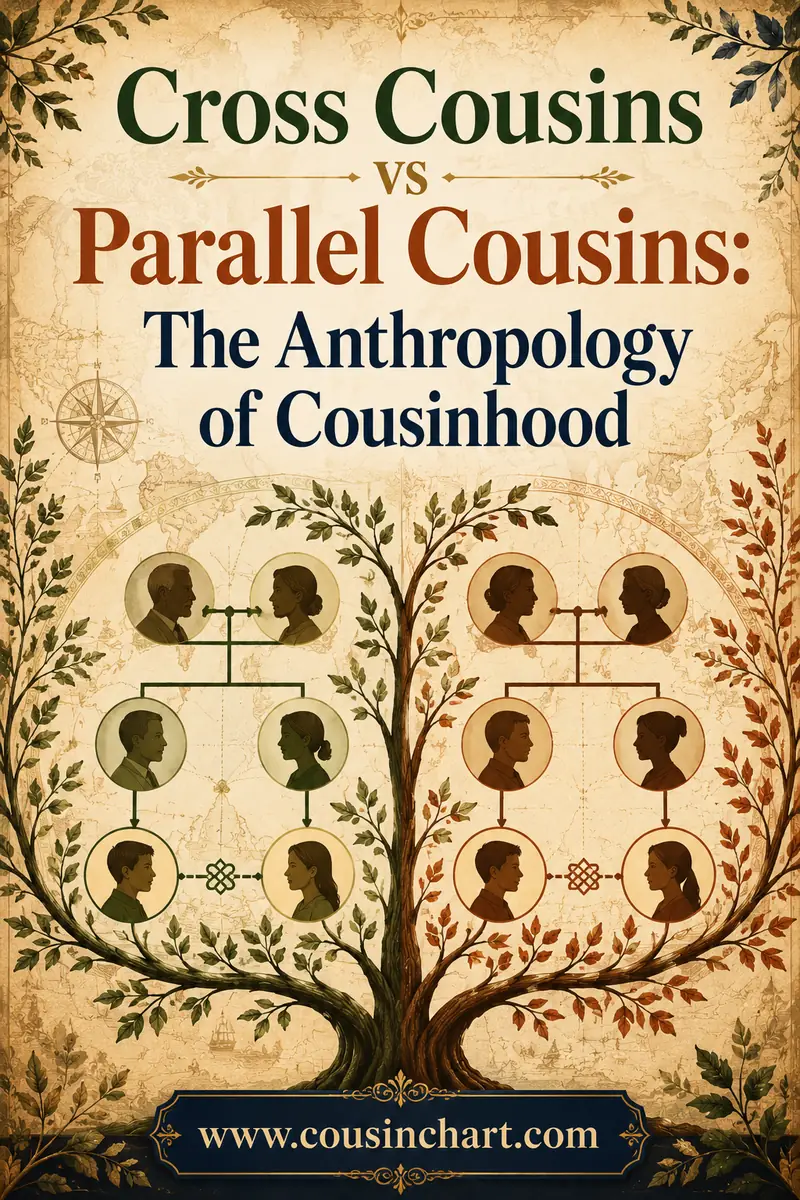
- Parallel cousins are the children of two same-sex siblings: your father's brother's children, or your mother's sister's children.
- Cross cousins are the children of two opposite-sex siblings: your father's sister's children, or your mother's brother's children.
English doesn't care about this difference, so it can feel strange at first. But in a large share of the world's societies, it's the single most important thing to know about a cousin. We cover it in more depth in our guide to cross cousins vs. parallel cousins.
The sample family we'll use
To compare the systems fairly, we'll use one family the whole way through. You're the person at the center, called "Ego" in anthropology. Here's who's around you:
- Your father and his brother (your paternal uncle) and his sister (your paternal aunt)
- Your mother and her sister (your maternal aunt) and her brother (your maternal uncle)
- Your own brother and sister
- Four sets of cousins: the children of each of those four aunts and uncles
In English, that family takes just six words beyond the nuclear family: aunt, uncle and cousin, plus the gendered sibling and parent words. Other systems carve up the same people very differently.
The lineal (Eskimo) system: how English names relatives
The lineal system draws a bright circle around the nuclear family. Your mother, father, brothers, sisters, sons and daughters each get their own word, and nobody outside that circle shares those words. Once you step outside the circle, the terms get broad and stop caring which side of the family someone is on.
In our sample family, English speakers say:
- Father for your father only. His brother and your mother's brother are both "uncle."
- Mother for your mother only. Her sister and your father's sister are both "aunt."
- Brother and sister for your siblings only.
- Cousin for all four sets of cousins, with no difference between sides, cross or parallel, male or female.
That last point is striking when you compare it to the other systems. English "cousin" doesn't even mark sex, which is unusual among kin terms. To be more precise, English speakers add phrases: "first cousin," "second cousin," "once removed," "on my mom's side." If those phrases confuse you, our guide to what "once removed" means breaks them down.
Why the lineal system fits certain societies
OpenStax notes that the lineal system emphasizes the nuclear family and is associated with North American and European societies. It tends to go with bilateral descent, where you count relatives on both your mother's and father's sides more or less equally. If both sides matter the same, there's little reason to have separate words for your mother's brother and your father's brother.
The same textbook calls bilateral descent the most common form of descent in the United States today. When households center on a couple and their children, and people often move away from extended family, a vocabulary that highlights the nuclear family makes practical sense.
Lineal terms in other languages
Most European languages work much the same way. Spanish has tío and tía for uncles and aunts on either side, and primo and prima for cousins, which does mark the cousin's sex but still ignores the side. French, German and Italian follow the same lineal pattern. So if you grew up speaking any of these, the lineal logic probably feels like common sense. It's worth remembering that it's only one option among six.
The Hawaiian (generational) system
The Hawaiian system is the simplest of the six. It sorts relatives by just two things: generation and sex. OpenStax calls it the least complicated terminology and notes it is widespread in Polynesia.
In our sample family, that means:
- Your father, your father's brother and your mother's brother all share one word, which translates roughly as "father."
- Your mother, your mother's sister and your father's sister all share one word, roughly "mother."
- Your brother and all your male cousins share the word for "brother."
- Your sister and all your female cousins share the word for "sister."
So instead of an English-style circle around the nuclear family, the Hawaiian system draws horizontal bands across the whole family tree. Everyone in your generation is a sibling. Everyone in your parents' generation is a parent.
Does that mean people can't tell their parents apart?
No. This is one of the most common misunderstandings about classificatory systems. People know perfectly well who gave birth to them. When they need to be precise, they can add a qualifier, much as an English speaker says "my real mom" or "my birth mother." The shared word signals that these relatives occupy a similar social role: the people of your parents' generation who look after you, teach you and have a claim on your help.
OpenStax points out that under this system your "family of orientation" (the family you grow up in) becomes very large, which can carry real social and political weight. A child raised with dozens of "mothers" and "fathers" has a wide safety net and a wide set of obligations.
The Iroquois (bifurcate merging) system
The Iroquois system is the one that tends to click once you see it. Its technical name, bifurcate merging, describes exactly what it does:
- Bifurcate means "split in two." The system splits your mother's side from your father's side.
- Merging means it merges some collateral relatives with your direct line.
The rule of thumb is about same-sex versus opposite-sex siblings. Your parent's same-sex siblings are merged with your parents. Your parent's opposite-sex siblings get separate words.
In our sample family:
- Your father and your father's brother share a word ("father").
- Your mother and your mother's sister share a word ("mother").
- Your father's sister gets her own word, a bit like "aunt."
- Your mother's brother gets his own word, a bit like "uncle."
- Parallel cousins (father's brother's kids, mother's sister's kids) are called "brother" and "sister."
- Cross cousins (father's sister's kids, mother's brother's kids) share a separate cousin word.
OpenStax gives a nice detail that shows how carefully the system works: a mother's sister is called "mother," but a mother's sister's husband is not called "father." The merging follows the bloodline, not just the household.
Why the parallel/cross split matters
Your parallel cousins are, in a sense, the children of your "other parents." Calling them brother and sister fits. Your cross cousins are different, and in many societies they're the very people you're expected or permitted to marry. OpenStax notes that in many tribal societies people marry cross cousins, which keeps the kin group stable across generations.
That's a big reason the Iroquois pattern is so widespread. In a society with marriage rules built around cross cousins, a vocabulary that sorts cousins into "sibling, never marry" and "cross cousin, possible spouse" is doing real work every day. Marrying a sibling-term cousin would feel, to speakers, a lot like marrying a sibling.
If you want to see how cousin marriage is treated in law and custom today, our guide to cousin marriage laws covers it.
The Crow system: when terms skip generations on your father's side
The Crow and Omaha systems are the ones that puzzle students, and they puzzled Morgan too. Both start from the Iroquois pattern: parallel cousins are siblings, and cross cousins are set apart. The twist is in how they treat cross cousins. Instead of giving cross cousins a cousin word, they give them a word from a different generation.
Anthropologists call this skewing. Here's how it works in the Crow system:
- Your father's sister's daughter is called by the same word as your father's sister. In English terms, you'd call her "aunt," even if she's your age or younger.
- Your father's sister's son is called by the same word as your father. You'd call him "father."
- Your mother's brother's children get a word from the generation below you, like "son," "daughter," "nephew" or "niece," depending on the language and the speaker.
The D-PLACE database's coding of cousin terms, which draws on the Ethnographic Atlas, defines the Crow pattern in just these terms: a father's sister's child is named like the father or father's sister, and/or a mother's brother's child is named like one's own child or a sibling's child.
Why would anyone call a cousin "father"?
It makes sense once you think in terms of descent groups instead of generations. Crow-type terms are often found in matrilineal societies, where you belong to your mother's line. In that setup:
- Your father belongs to his mother's line, not yours.
- His sister belongs to that same line.
- Her children also belong to that line, because descent passes through her.
- Her daughter's children will too, and so on down the generations.
So from your point of view, all the women of your father's line are "father's sister" and all the men are "father," whatever their age. The term isn't really saying "this person is one generation above you." It's saying "this person belongs to my father's group, and here's their sex." Generation takes a back seat to group membership.
The Omaha system: the mirror image on your mother's side
The Omaha system is the Crow system flipped. Instead of skewing your father's side, it skews your mother's side, and it's often found in patrilineal societies, where you belong to your father's line.
In the Omaha system:
- Your mother's brother's son is called by the same word as your mother's brother. You'd call him "uncle," even if he's a toddler.
- Your mother's brother's daughter is called by the same word as your mother. You'd call her "mother."
- Your father's sister's children get a word from the generation below you, grouped with your sister's children or your own children.
D-PLACE describes the Omaha pattern as a mother's brother's child sharing a term with the mother's brother or mother, and a father's sister's child being grouped with a sister's child or a child.
The logic is the same as Crow, just reversed. In a patrilineal society, your mother belongs to her father's line. Her brother belongs to that line, and so do his son, his son's son and so on, because descent passes through men. To you, all the men of your mother's line are "mother's brother" and all the women are "mother," regardless of generation.
A quick way to remember Crow vs. Omaha
| Question | Crow | Omaha |
|---|---|---|
| Which side gets "pushed up" a generation? | Father's side (father's sister's children) | Mother's side (mother's brother's children) |
| Which side gets "pushed down" a generation? | Mother's side (mother's brother's children) | Father's side (father's sister's children) |
| Usual descent rule | Matrilineal (through women) | Patrilineal (through men) |
| Father's sister's daughter is called | "Father's sister" | "Niece" or "daughter" |
| Mother's brother's son is called | "Son" or "nephew" | "Mother's brother" |
One memory trick: the side that gets pushed up is the side that isn't your own descent group. You "look up" to the line you married into through your parent.
The link between these systems and descent isn't a strict law. Anthropologists have debated it for well over a century, which is why the University of Arizona Press devoted a whole edited volume to the "Crow-Omaha problem." But "Crow tends to go with matrilineal, Omaha with patrilineal" is the standard, reliable starting point.
The Sudanese (descriptive) system
The Sudanese system goes the opposite direction from the Hawaiian one. Instead of lumping, it splits. Each type of relative tends to get its own term, so your father's brother, your mother's brother, your father's sister and your mother's sister all have different words, and so do the children of each.
D-PLACE's coding defines Sudanese cousin terms as distinguishing father's sister's children and mother's brother's children from siblings, from parallel cousins and from each other, in a way that doesn't fit the Crow or Omaha patterns. D-PLACE also keeps a separate "Descriptive" category for languages where all cousins are named with descriptive phrases instead of single basic words.
Examples you might recognize
You don't have to look far to see Sudanese-style splitting in the generation above you. Several well-known languages have four separate aunt and uncle words, a pattern anthropologists call bifurcate collateral:
| Relative | Latin | Turkish | Arabic (romanized) |
|---|---|---|---|
| Father's brother | patruus | amca | 'amm |
| Mother's brother | avunculus | dayı | khāl |
| Father's sister | amita | hala | 'amma |
| Mother's sister | matertera | teyze | khāla |
In Arabic, cousins are usually described by combining these words, so a father's brother's son is ibn 'amm, literally "son of paternal uncle." That's the descriptive approach in action: the cousin term tells you exactly how the person is connected to you.
Fun fact for English speakers: Latin avunculus, "mother's brother," is the ancestor of the English word "uncle" (by way of French). English kept the word but lost the "mother's side only" meaning. That's a small example of a language drifting from one terminology pattern toward another.
Sudanese-type terms are sometimes linked with societies that have strong class distinctions or complex political systems, where knowing your exact relationship to someone carries weight for inheritance or status. That link is looser than the Crow and Omaha ones, so treat it as a tendency, not a rule.
How common is each kinship terminology system?
It's easy to assume the English system is "normal" because it's what you know. The data says otherwise. The D-PLACE database (from the Max Planck Institute for Evolutionary Anthropology and partners) codes cousin terms for 955 societies from the Ethnographic Atlas. Here's how they break down, with the percentage worked out as count divided by 955:
| Cousin-term pattern | Societies | Share of 955 |
|---|---|---|
| Hawaiian | 338 | 35.4% |
| Iroquois | 256 | 26.8% |
| Eskimo (lineal) | 110 | 11.5% |
| Descriptive | 81 | 8.5% |
| Omaha | 79 | 8.3% |
| Crow | 58 | 6.1% |
| Mixed or variant | 18 | 1.9% |
| Sudanese | 15 | 1.6% |
A few things jump out:
- Hawaiian and Iroquois together cover about 62% of the coded societies (338 + 256 = 594, and 594 ÷ 955 ≈ 62.2%). Calling cousins "brother" and "sister" is the global majority, not an oddity.
- The lineal pattern is a minority, at roughly one society in nine. It's dominant among the world's most widely spoken languages, but that's a different thing from being common across cultures.
- Sudanese is the rarest of the six named types, at well under 2%.
Keep in mind what these numbers count: societies, not speakers. A small island community and a nation of millions each count as one. The sample also reflects which groups ethnographers documented, mostly in the 1800s and 1900s. Still, it's the best large-scale picture available.
For a sense of how much material researchers now work with, the Kinbank project has gathered 210,903 kin terms from 1,229 languages. Its authors also point out that older typologies like these are around 70 years old and don't always capture how varied real terminologies are. The six systems are a map, not the territory.
Comparing the systems side by side
Here's the payoff table. Each row is a relative from our sample family, and each column shows roughly what that person would be called in each system. Quoted words are English stand-ins for the local term.
| Relative | Lineal | Hawaiian | Iroquois | Crow | Omaha | Sudanese |
|---|---|---|---|---|---|---|
| Father's brother | "Uncle" | "Father" | "Father" | "Father" | "Father" | Own term |
| Mother's brother | "Uncle" | "Father" | "Uncle" | "Uncle" | "Uncle" | Own term |
| Father's sister | "Aunt" | "Mother" | "Aunt" | "Aunt" | "Aunt" | Own term |
| Mother's sister | "Aunt" | "Mother" | "Mother" | "Mother" | "Mother" | Own term |
| Father's brother's child (parallel) | "Cousin" | "Brother/Sister" | "Brother/Sister" | "Brother/Sister" | "Brother/Sister" | Own term |
| Mother's sister's child (parallel) | "Cousin" | "Brother/Sister" | "Brother/Sister" | "Brother/Sister" | "Brother/Sister" | Own term |
| Father's sister's child (cross) | "Cousin" | "Brother/Sister" | "Cross cousin" | "Father" / "Aunt" | "Nephew/Niece" or "Son/Daughter" | Own term |
| Mother's brother's child (cross) | "Cousin" | "Brother/Sister" | "Cross cousin" | "Son/Daughter" or "Nephew/Niece" | "Uncle" / "Mother" | Own term |
Read across any row and you can see the logic of each system. Read down any column and you get that system's "shape." Lineal is a circle around the nuclear family. Hawaiian is horizontal bands. Iroquois is a fork down the middle. Crow and Omaha are forks that tilt. Sudanese is a grid where almost every cell is different.
Common mix-ups about kinship terminology
Mix-up 1: "Classificatory terms mean people are confused about who's related how"
Not at all. Speakers in Hawaiian-type or Iroquois-type systems know exactly who their birth parents are. A kin term names a social category, with its rights and duties, not a genetic measurement. English does the same thing when it lumps a blood uncle and an uncle by marriage under one word.
Mix-up 2: "The Iroquois system is only used by the Iroquois"
The names are historical labels. Iroquois-type terms are the second most common pattern in the D-PLACE sample, found far beyond North America. The same goes for "Sudanese," "Hawaiian," "Crow" and "Omaha."
Mix-up 3: Mixing up Crow and Omaha
Remember: Crow skews the father's side upward and usually goes with matrilineal descent. Omaha skews the mother's side upward and usually goes with patrilineal descent. If you remember one, you can flip it to get the other.
Mix-up 4: Confusing terminology with descent
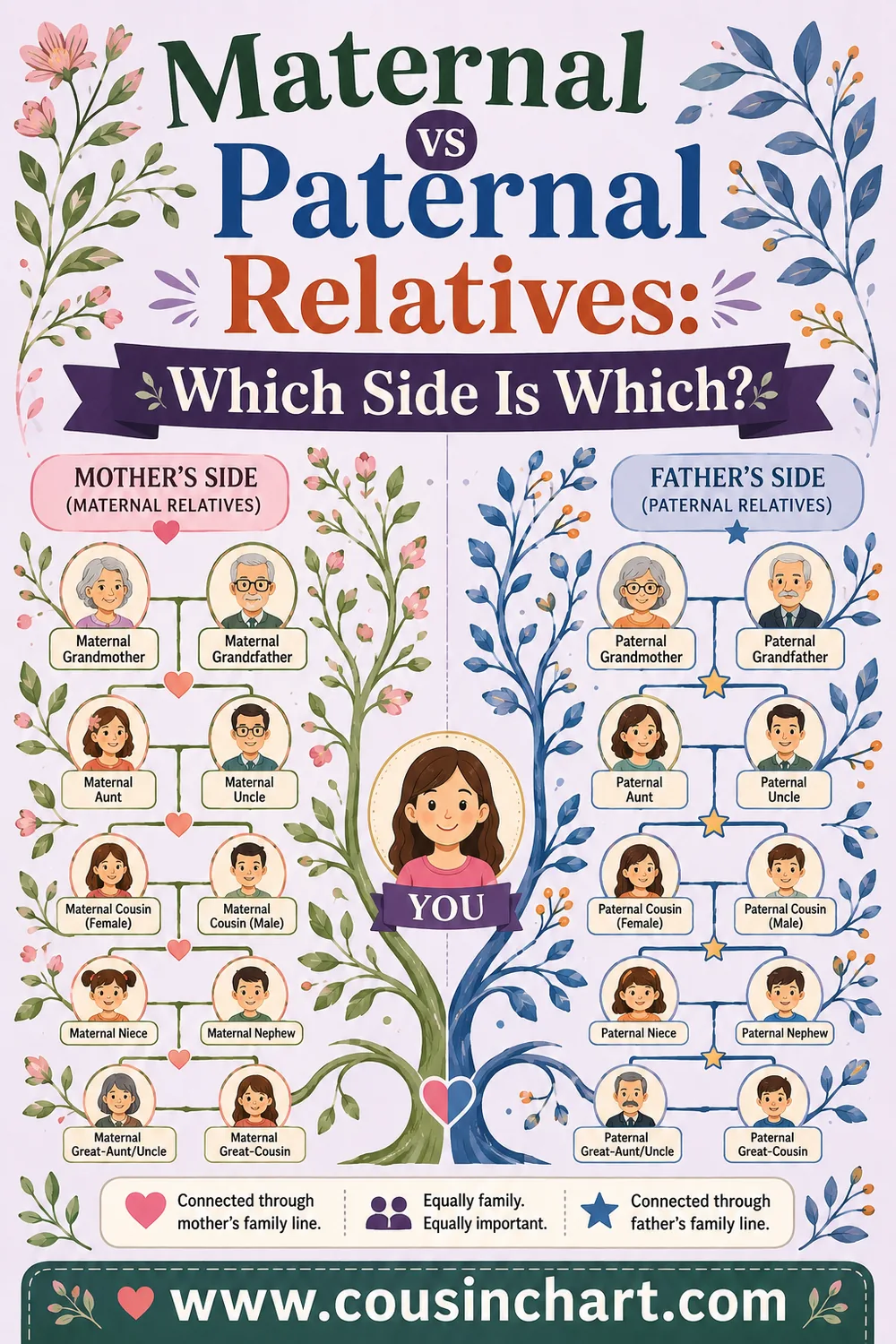
Kinship terminology is about words. Descent is about group membership: whose line you belong to, who you inherit from. The two often travel together, but they're different things. A society can be matrilineal without having Crow terms. For the descent side of the story, see our companion guide on matrilineal and patrilineal descent, and our explainer on maternal vs. paternal relatives.
Mix-up 5: Assuming every language fits one box
Real languages are messy. A language might be lineal for aunts and uncles but descriptive for cousins. Many languages also mark relative age, like separate words for an older and younger brother, which none of the six types is built to capture. D-PLACE even has a "mixed or variant" category for societies that don't fit cleanly. Use the six types as a starting vocabulary, not a set of rigid boxes.
Mix-up 6: Thinking "lineal" means the same as "lineal relative"
There's a word overlap that trips people up. A lineal relative is someone in your direct line, like a parent or grandparent. The lineal system is named that way because it keeps lineal relatives separate from collateral ones. Related idea, different use. Our guide to lineal vs. collateral relatives covers the family-tree meaning.
Try it yourself: identify the kinship terminology system
Here are four made-up languages. Each description tells you how speakers name some relatives. See if you can name the system before reading the answer.
Puzzle 1
Speakers call all their cousins by the same words they use for brother and sister. They call their mother's brother and their father's brother by the same word as their father.
Answer: Hawaiian. Both sides are treated the same, and everything is sorted by generation and sex.
Puzzle 2
Speakers call their father's brother "father" and their mother's brother by a different word. Children of the father's brother are "brother" and "sister." Children of the mother's brother share a special word with children of the father's sister.
Answer: Iroquois (bifurcate merging). Parallel cousins are siblings, and cross cousins share a separate term with no generation skewing.
Puzzle 3
A ten-year-old calls her mother's brother's newborn son by the same word she uses for her mother's brother.
Answer: Omaha. The mother's side is pushed up a generation: the baby belongs to the mother's patrilineal group, so he's "mother's brother" to her.
Puzzle 4
Speakers have four different words for aunts and uncles, depending on which side of the family they're on and whether they're male or female. Cousins are described with phrases like "father's sister's son."
Answer: Sudanese, or descriptive. Every relative type gets its own label or a precise description.
Bonus: classify a language you know
Try this with any language you or your family speak. Ask four questions:
- Do mother's brother and father's brother share a word? (If no, the system bifurcates.)
- Does father's brother share a word with father? (If yes, the system merges.)
- Do any cousins share a word with siblings? (If all do, think Hawaiian. If only parallel cousins do, think Iroquois, Crow or Omaha.)
- Do any cross cousins share a word with someone from a different generation? (If yes, think Crow or Omaha, and check which side.)
If none of the cousins share a word with siblings and aunts on both sides share a word, you're looking at a lineal system, just like English.
How kinship terminology connects to descent, marriage and daily life
Kin terms aren't just labels. They tend to line up with how a society organizes itself. Here's a simplified picture of the usual pairings:
- Lineal terms often go with bilateral descent and households built around a couple and their kids.
- Hawaiian terms often go with flexible descent, where people can affiliate with either parent's group, and with large, cooperative extended families.
- Iroquois terms often go with unilineal descent (through one parent's line) and cross-cousin marriage.
- Crow and Omaha terms often go with strong matrilineal or patrilineal clans, where group membership matters more than generation.
- Sudanese terms are sometimes linked with societies where precise relationships matter for status and inheritance.
The descent side has its own numbers. In D-PLACE's coding of major descent types, 590 societies are patrilineal, 362 bilateral and 160 matrilineal, out of 1,274 coded in total. That's roughly 46% patrilineal (590 ÷ 1,274), 28% bilateral (362 ÷ 1,274) and 13% matrilineal (160 ÷ 1,274). Since Omaha terms tend to go with patrilineal descent and Crow terms with matrilineal descent, it's no surprise that Omaha (79 societies) shows up a bit more often than Crow (58) in the cousin-term data.
Terms shape how you behave, too
In many societies, the kin term you use for someone tells you how to act around them: whom you joke with, whom you show formal respect to, whom you can marry, who will help pay for your wedding and who inherits from whom. In a Crow or Omaha system, calling a younger person by a senior term can mean treating them with real deference. That's one reason kin terms change slowly. They're tied up in everyday habits, not just vocabulary.
Kinship can also stretch beyond blood and marriage. Many cultures extend family words to close friends, godparents and neighbors. If that's your interest, our guide to fictive kin explains how "Auntie" and "Uncle" get applied to people who aren't related at all.
Bringing it back to your own family
Kinship terminology shows that there's more than one sensible way to name a family. English draws a tight circle around parents and siblings, lumps everyone else into "aunt," "uncle" and "cousin," and then leans on phrases like "second cousin once removed" to fill in the detail. Hawaiian speakers sort by generation, Iroquois speakers split cross and parallel cousins, Crow and Omaha speakers follow clan lines across generations, and Sudanese speakers give nearly everyone a name of their own.
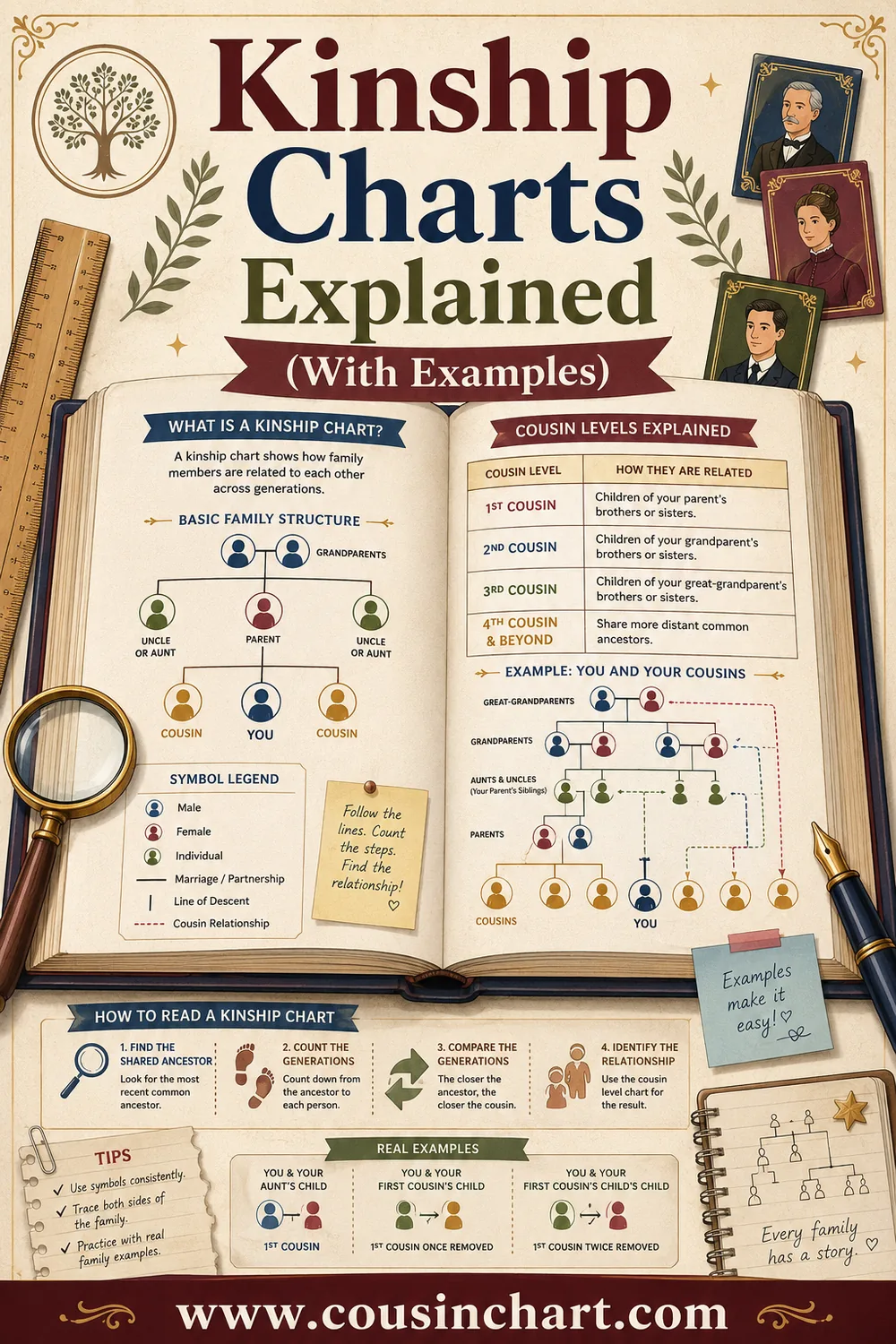
Whatever your family's language, the underlying relationships are the same, and you can always work them out precisely. If you want to know exactly how two people in your tree are related in English terms, try our free family relationship calculator. Pick the common ancestor and each person's path to them, and it'll name the relationship for you, cousins, removals and all. For a printable view of the English system, see our kinship chart guide.
Keep reading: Korean Family Titles: Oppa, Unnie, Hyung and Every Relative Explained.
Frequently Asked Questions
What are the six kinship terminology systems?
The six classic systems are Eskimo (also called lineal), Hawaiian (generational), Iroquois (bifurcate merging), Crow, Omaha and Sudanese (descriptive). They differ mainly in how they name aunts, uncles and cousins. Lineal keeps the nuclear family separate and lumps all cousins together. Hawaiian sorts relatives only by generation and sex. Iroquois splits cross cousins from parallel cousins. Crow and Omaha do the same but call some cross cousins by terms from another generation. Sudanese gives almost every relative a separate term. The names are historical labels, not limits on where each system is found.
What kinship system does English use?
English uses the lineal system, traditionally called the Eskimo system in anthropology. It gives unique words to your parents, siblings and children, then uses broad words for everyone else. Aunt covers your mother's sister and your father's sister, uncle covers both sides, and cousin covers all four kinds of first cousin without even marking whether the cousin is male or female. To add detail, English speakers use phrases like first cousin, second cousin and once removed. Most other European languages, such as Spanish, French and German, follow the same lineal pattern.
Why is the Eskimo kinship system now called lineal?
Many teachers and writers now prefer lineal because Eskimo is not a name Inuit people chose for themselves. In 2010 the Inuit Circumpolar Council asked research and science communities to use Inuit instead of Eskimo in their publications. Some people in Alaska still use Eskimo as an umbrella term that includes Yupik peoples, so usage varies by region. For the kinship system, lineal avoids the issue and is more descriptive anyway, since the system's key feature is keeping lineal relatives like parents separate from collateral relatives like aunts and uncles. You'll still see both names in textbooks.
What is the most common kinship terminology system in the world?
By number of societies, the Hawaiian pattern is the most common for cousin terms. In the D-PLACE database's coding of 955 societies from the Ethnographic Atlas, 338 use Hawaiian-type cousin terms, about 35 percent, and 256 use Iroquois-type terms, about 27 percent. The lineal pattern that English uses appears in 110 societies, about 12 percent. Keep in mind these figures count societies rather than speakers, so a small community and a large nation each count once. The lineal system is common among widely spoken languages but is a minority pattern across cultures overall.
What is the difference between Crow and Omaha kinship?
They are mirror images. Both treat parallel cousins as siblings, but they name cross cousins with terms from a different generation. In the Crow system, your father's sister's daughter is called by the same word as your father's sister, and her brother by the word for father. In the Omaha system, your mother's brother's son is called by the word for mother's brother, and his sister by the word for mother. Crow terms usually appear in matrilineal societies, and Omaha terms usually appear in patrilineal ones, because the terms follow descent-group membership rather than age.
Why do some cultures call cousins brother and sister?
In Hawaiian and Iroquois systems, some or all cousins share the words for brother and sister because they occupy a similar social role. In Hawaiian systems, everyone in your generation is a sibling. In Iroquois systems, only parallel cousins are, meaning the children of your father's brother or your mother's sister, since those aunts and uncles are themselves called father and mother. It doesn't mean people can't tell siblings and cousins apart. It means the relationship carries similar duties, closeness and, often, the same rules about who you cannot marry.
What does bifurcate merging mean?
Bifurcate merging is the technical name for the Iroquois kinship system. Bifurcate means split in two: the system separates your mother's side from your father's side. Merging means some collateral relatives share a term with your direct line. In practice, your father's brother is called father and your mother's sister is called mother, while your father's sister and mother's brother get separate words. Their children follow the same split: parallel cousins are called brother and sister, and cross cousins get a separate cousin term. It's one of the most widespread systems in the world.
What is a descriptive kinship system?
A descriptive kinship system, often called Sudanese, gives each type of relative its own term or describes the relationship precisely instead of lumping relatives together. For example, Latin, Turkish and Arabic each have four different words for aunts and uncles, depending on whether the relative is on your mother's or father's side and whether they are male or female. Arabic describes cousins with phrases such as ibn 'amm, son of the paternal uncle. In the D-PLACE sample, the Sudanese cousin pattern is the rarest of the six named types, at about 1.6 percent of coded societies.
Who first studied kinship terminology?
The systematic study of kinship terms began with the American ethnologist Lewis Henry Morgan. His 1871 survey, Systems of Consanguinity and Affinity of the Human Family, gathered relative terms from many societies and introduced the contrast between classificatory and descriptive systems. Morgan was struck that some Native American societies used the same word for relatives in different generations, which became known as the Crow-Omaha problem. The six-type scheme taught in most classes today was popularized later by George Peter Murdock in his 1949 book Social Structure. Modern projects like Kinbank now collect terms from over a thousand languages.
Sources
We checked every source below while writing this guide. Last reviewed October 30, 2026, by Joan Ramos.
- 11.3 Reckoning Kinship across Cultures, Introduction to Anthropology (OpenStax, Rice University)
- Variable: Kin terms for cousins [EA027] (D-PLACE, Max Planck Institute for Evolutionary Anthropology)
- Variable: Descent: major type [EA043] (D-PLACE, Max Planck Institute for Evolutionary Anthropology)
- Kinbank: A global database of kinship terminology (Passmore et al., 2023) (PLOS ONE)
- Resolution 2010-01 on the use of the term Inuit in scientific and other circles (Inuit Circumpolar Council)
- Crow-Omaha: New Light on a Classic Problem of Kinship Analysis (Trautmann and Whiteley, eds.) (University of Arizona Press (via UBC Press))