Korean Family Titles: Oppa, Unnie, Hyung and Every Relative Explained
Korean family titles change depending on who's speaking, not just on who's being named. A woman calls her older brother 오빠 (oppa), but a man calls his older brother 형 (hyeong). A woman calls her older sister 언니 (eonni), but a man calls his 누나 (nuna). The same pattern runs through aunts, uncles and in-laws, where the words also depend on which side of the family someone is on and whether they're older or younger.
This guide covers every common Korean family title with Hangul, Revised Romanization, the English meaning and who uses it for whom. It starts with the four sibling words everyone asks about, then works through grandparents, aunts and uncles on each side, cousins and the Korean "chon" counting system, nieces and nephews, and the in-law titles that even Koreans sometimes have to look up. The definitions are checked against the National Institute of Korean Language's dictionaries.
Oppa, Hyung, Unnie, Nuna: Korean Family Titles Depend on Who's Speaking
English has "brother" and "sister." Korean has four words for older siblings, and the right one depends on two things: the older sibling's gender and your own gender. Younger siblings are simpler, because the same word works for everyone.
| Hangul | Revised Romanization | Meaning | Who says it |
|---|---|---|---|
| 오빠 | oppa | older brother | A girl or woman |
| 형 | hyeong | older brother | A boy or man |
| 언니 | eonni | older sister | A girl or woman |
| 누나 | nuna | older sister | A boy or man |
| 동생 | dongsaeng | younger sibling | Anyone |
| 남동생 | namdongsaeng | younger brother | Anyone |
| 여동생 | yeodongsaeng | younger sister | Anyone |
The definitions in Korea's official dictionary are precise about this. The National Institute of Korean Language (NIKL) Standard Korean Dictionary defines 오빠 as the word a younger sister uses for an older brother, either a full sibling or a relative of the same generation. Its entry for 누나 says it's what a man uses for an older woman of his generation in the family. 형 is described as the word for an older male among men, and 언니 as the word for an older sibling of the same sex, used mostly between sisters.
So the quick rule is this: if you and your older sibling are the same gender, it's 형 or 언니. If you're different genders, it's 오빠 or 누나.
Eldest, middle and full siblings
When there's more than one older sibling, Koreans add 큰 (keun, "big, eldest") or 작은 (jageun, "small, younger"). NIKL's Basic Korean Dictionary lists 큰오빠 (keunoppa) for the eldest of two or more older brothers and 작은오빠 (jageunoppa) for one who isn't the eldest. The same pattern gives 큰언니 (keuneonni) and 큰누나 (keunnuna). Adding 친 (chin) stresses a full sibling born to the same parents, as in 친오빠 (chinoppa) or 친언니 (chineonni). People use 친 when they need to make clear they mean a real sibling, not a cousin or a close friend.
Respect goes upward
Korean family titles follow seniority. A younger person calls an older one by title, while an older person usually calls a younger one by name. It would sound odd for a younger brother to call his older sister by her first name. It's normal for her to call him by his. Keep that in mind, because the same "titles go up, names go down" rule shapes the in-law terms later on.
How to Read the Hangul and Romanization
Each term here is written in Hangul, the Korean alphabet, and then in Revised Romanization. That's the official system of the Republic of Korea, published by the National Institute of Korean Language. A few of its rules explain spellings that might look unfamiliar:
- ㅓ is written eo and ㅡ is written eu. That's why 언니 is eonni and 큰 is keun.
- ㅕ is yeo, so 형 is hyeong.
- ㄹ is r before a vowel and l at the end of a syllable, so 할아버지 is harabeoji.
- The system follows how words are actually pronounced, so sounds that blend across syllables are written as they sound. 큰아버지 is pronounced like "keu-na-beo-ji," so it's written keunabeoji. 숙모 is pronounced "sung-mo," so it's written sungmo.
You'll often see other spellings online, especially in K-pop and K-drama fan spaces: "hyung" for 형, "unnie" or "unni" for 언니, and "noona" for 누나. Those come from older or informal romanizations. They're widely understood, but this guide uses the official system so the spelling matches what you'll find in Korean textbooks and on signs.
Parents and Grandparents on Each Side
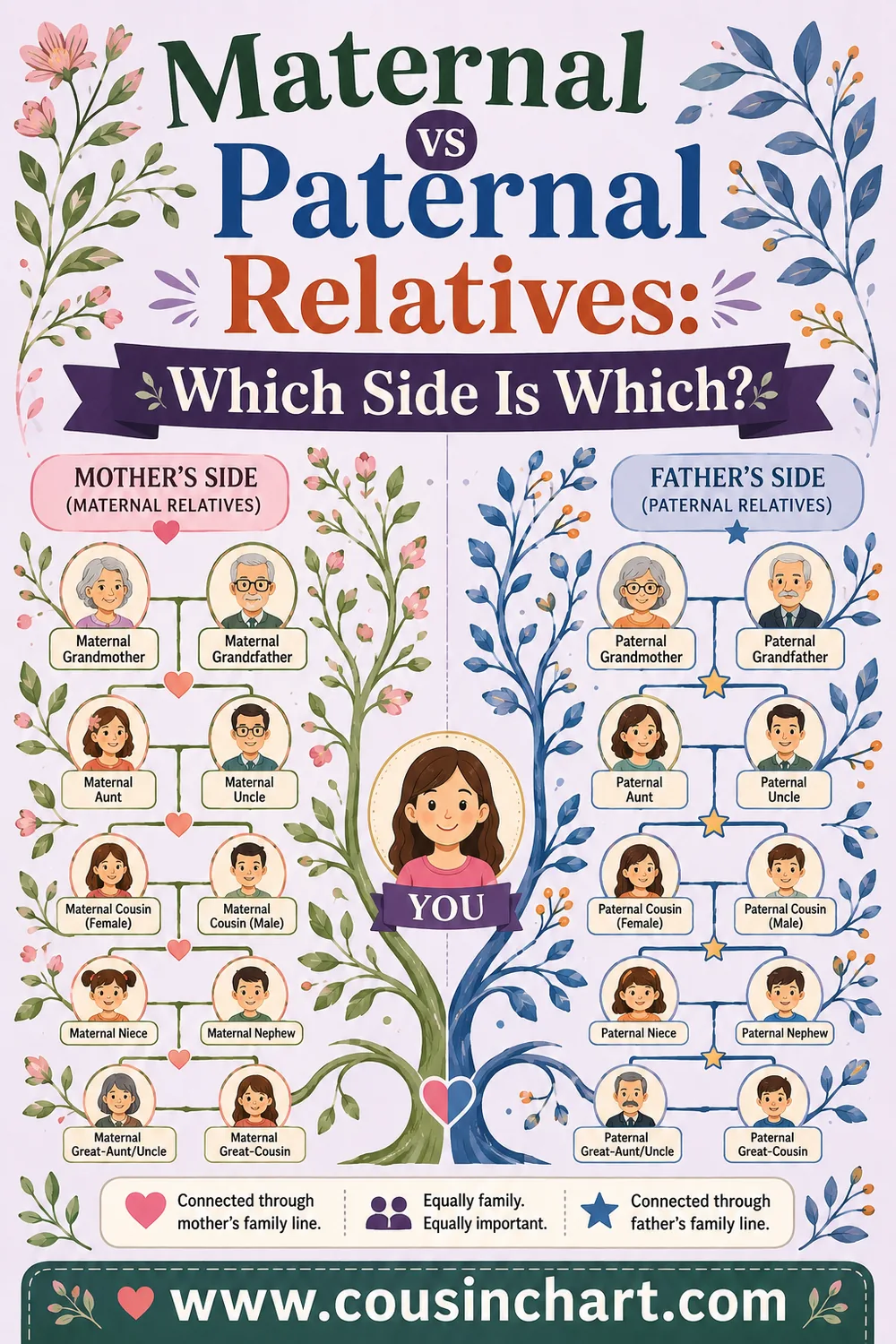
Korean marks the two sides of the family with two prefixes. 친 (chin) points to your father's side and 외 (oe) points to your mother's side. NIKL's Basic Korean Dictionary defines 친가 (chinga) as the father's side of the family and 외가 (oega) as the mother's family home. If you're new to these ideas, our guide to maternal vs. paternal relatives explains them in English first.
| Hangul | Revised Romanization | Meaning | Notes |
|---|---|---|---|
| 아버지 | abeoji | father | Standard; 아빠 (appa) is "dad" |
| 어머니 | eomeoni | mother | Standard; 엄마 (eomma) is "mom" |
| 할아버지 | harabeoji | grandfather | Either side; also any man of your grandparents' generation |
| 할머니 | halmeoni | grandmother | Either side |
| 친할아버지 | chinharabeoji | father's father | Used to specify the side |
| 친할머니 | chinhalmeoni | father's mother | Used to specify the side |
| 외할아버지 | oeharabeoji | mother's father | Common in everyday speech |
| 외할머니 | oehalmeoni | mother's mother | Common in everyday speech |
| 친가 | chinga | father's side of the family | Reference word |
| 외가 | oega | mother's side, her family home | Reference word |
Because 할아버지 and 할머니 work for either side, many children simply use those to their grandparents' faces and add 친 or 외 when they need to say which one they mean.
Great-grandparents and your grandparents' siblings
Going up another generation, Korean adds Sino-Korean prefixes rather than repeating "great." NIKL's Basic Korean Dictionary lists these alongside 할아버지:
| Hangul | Revised Romanization | Meaning |
|---|---|---|
| 증조할아버지 | jeungjoharabeoji | great-grandfather (your father's grandfather) |
| 고조할아버지 | gojoharabeoji | great-great-grandfather (your grandfather's grandfather) |
| 종조할아버지 | jongjoharabeoji | great-uncle (your grandfather's brother) |
| 작은할아버지 | jageunharabeoji | your grandfather's younger brother (your father's 작은아버지) |
| 왕고모 | wanggomo | great-aunt (your grandfather's sister) |
| 왕고모부 | wanggomobu | husband of your grandfather's sister |
Notice how 작은할아버지 reuses the uncle word one level up: the man your father calls 작은아버지, you call 작은할아버지. Korean often builds a new title by stacking a familiar one, which makes these easier to guess once you know the basics. Day to day, though, most children simply say 할아버지 to any man of their grandparents' generation in the family.
A newer option: name grandparents by place
Some families feel the 외 ("outside") prefix makes the mother's side sound less close. In a public guide on family titles, Korea's Ministry of Culture, Sports and Tourism, drawing on NIKL's etiquette guidance, suggests telling grandparents apart by where they live instead, like "서울 할아버지" (Seoul grandpa). You can read the summary in the ministry's card news on confusing address terms. The same guidance says 엄마 and 아빠 are fine in everyday life, and 어머니 and 아버지 suit formal settings.
Uncles and Aunts on Your Father's Side
On your father's side, uncles are named by their age compared with your father, and their wives take matching titles. Your father's sisters have their own word.
| Hangul | Revised Romanization | Meaning | Notes |
|---|---|---|---|
| 큰아버지 | keunabeoji | father's older brother | Strictly the eldest; in practice any older brother of your father |
| 큰어머니 | keuneomeoni | wife of father's older brother | Pairs with 큰아버지 |
| 작은아버지 | jageunabeoji | father's younger brother | Usually a married one |
| 작은어머니 | jageuneomeoni | wife of father's younger brother | Pairs with 작은아버지 |
| 삼촌 | samchon | uncle | Often used for a father's unmarried younger brother |
| 숙모 | sungmo | wife of father's younger brother | A more formal-sounding alternative |
| 고모 | gomo | father's sister | Older or younger |
| 고모부 | gomobu | father's sister's husband | Reference and address |
Dictionary definitions back this up. NIKL's Basic Korean Dictionary gives two senses for 큰아버지: the eldest brother of your father, and more broadly an older brother of your father. Its entry for 작은아버지 in the Standard Korean Dictionary says it means your father's younger brother, usually a married one, and that when there are several, you call them by order: 첫째 작은아버지 (first), 둘째 작은아버지 (second), and so on.
The Basic Korean Dictionary entry for 고모 defines it as your father's older or younger sister, and lists 고모부 as her husband. The same page lists 왕고모 (wanggomo), literally "king aunt," for your grandfather's sister.
What exactly does 삼촌 mean?
삼촌 literally means "three chon," the kinship distance between you and your parent's sibling (more on chon below). The Basic Korean Dictionary defines it as a brother of your father or mother, or a word to call him. In real family life, it's most often what children call their father's younger brother before he marries. Once he marries, families commonly switch to 작은아버지. Your mother's brother is 외삼촌, which you'll meet in the next section.
Uncles and Aunts on Your Mother's Side
Your mother's side is simpler, because Korean doesn't split these titles by age.
| Hangul | Revised Romanization | Meaning | Notes |
|---|---|---|---|
| 외삼촌 | oesamchon | mother's brother | Older or younger |
| 외숙모 | oesungmo | wife of mother's brother | Pairs with 외삼촌 |
| 이모 | imo | mother's sister | Older or younger |
| 이모부 | imobu | mother's sister's husband | Reference and address |
NIKL's Standard Korean Dictionary defines 이모 as a word for referring to or calling your mother's sister. The Basic Korean Dictionary defines 외삼촌 as your mother's brother and 외숙모 as his wife. If you have several, families add 큰 for the eldest or use birth-order words, just like on the father's side.
Both sides at a glance
| Relative | Father's side | Mother's side |
|---|---|---|
| Parent's older brother | 큰아버지 keunabeoji | 외삼촌 oesamchon |
| Parent's younger brother | 작은아버지 jageunabeoji / 삼촌 samchon | 외삼촌 oesamchon |
| His wife | 큰어머니 keuneomeoni / 작은어머니 jageuneomeoni | 외숙모 oesungmo |
| Parent's sister | 고모 gomo | 이모 imo |
| Her husband | 고모부 gomobu | 이모부 imobu |
A handy memory trick: aunts' husbands just add 부 (bu) to the aunt's title. 고모 becomes 고모부 and 이모 becomes 이모부. English uses "uncle" for both, which is why our page on what to call your aunt's husband has to explain the difference in words instead.
Cousins and the Korean Chon System
Korean measures how closely two relatives are related with a number called 촌 (chon). The Basic Korean Dictionary defines 촌수 (chonsu) as a number that shows how close or distant relatives are. Several family words are simply chon numbers: 삼촌 means "three chon" and 사촌 means "four chon."
How to count chon
You count the generational steps from one person up to the shared ancestor, then down to the other person. Each step is one chon. Here's the math for common relatives:
| Relative | Steps (up + down) | Chon | Korean word |
|---|---|---|---|
| Your parent | 1 up + 0 down | 1 | (parent) |
| Your sibling | 1 up to parent + 1 down | 2 | (sibling) |
| Your parent's sibling | 2 up to grandparent + 1 down | 3 | 삼촌 samchon |
| Your first cousin | 2 up to grandparent + 2 down | 4 | 사촌 sachon |
| Your parent's first cousin | 3 up to great-grandparent + 2 down | 5 | 당숙 dangsuk (father's male cousin) |
| Your second cousin | 3 up to great-grandparent + 3 down | 6 | 육촌 yukchon |
The dictionary entries match this count. 사촌 is defined as the relationship with your parents' siblings' children, and 육촌 as the relationship between children of 사촌 cousins, which is what English calls a second cousin. NIKL also lists 당숙 (dangsuk) as your father's male cousin and 당숙모 (dangsungmo) as his wife. This counting method is the same idea as the "degree of relationship" used in English-speaking law and genealogy, which our guide to degrees of cousinship explains.
Cousin words by side
Unlike Chinese, everyday Korean doesn't build cousin words from older/younger sibling terms. 사촌 covers any first cousin. When you need to say which side, there are specific words:
| Hangul | Revised Romanization | Meaning |
|---|---|---|
| 사촌 | sachon | first cousin (any side) |
| 고종사촌 | gojongsachon | child of your father's sister (고모) |
| 외사촌 | oesachon | child of your mother's brother (외삼촌) |
| 이종사촌 | ijongsachon | child of your mother's sister (이모) |
| 육촌 | yukchon | second cousin |
All four of the first-cousin words appear together in the Basic Korean Dictionary entry for 사촌. In conversation, though, cousins don't call each other 사촌. They use the sibling titles instead. A girl calls an older male cousin 오빠, and a boy calls an older female cousin 누나, exactly as with siblings. The dictionary definitions of 오빠, 누나, 형 and 언니 all include relatives "of the same generation" for this reason. To say "my cousin" to someone outside the family, you'd say 사촌 오빠 (sachon oppa) or 사촌 언니 (sachon eonni).
The Basic Korean Dictionary also lists a playful use: 이웃사촌 (iutsachon), literally "neighbor cousin," for a neighbor you've grown close to. It shows how naturally Koreans stretch family words to people they care about.
Nieces, Nephews and the Next Generation
Korean is simpler than Chinese here. One word covers nieces and nephews on both sides.
| Hangul | Revised Romanization | Meaning |
|---|---|---|
| 조카 | joka | nephew or niece (a sibling's child) |
| 조카딸 | jokattal | niece (a sibling's daughter) |
| 조카며느리 | jokamyeoneuri | nephew's wife |
| 조카사위 | jokasawi | niece's husband |
| 처조카 | cheojoka | wife's nephew or niece |
조카 works for both boys and girls, so you'll often hear it alone. 조카딸 is used when you need to say "niece" specifically. Aunts and uncles usually call nieces and nephews by their names, following the "names go down" rule.
Korean Family Titles for In-Laws: Parents and Children
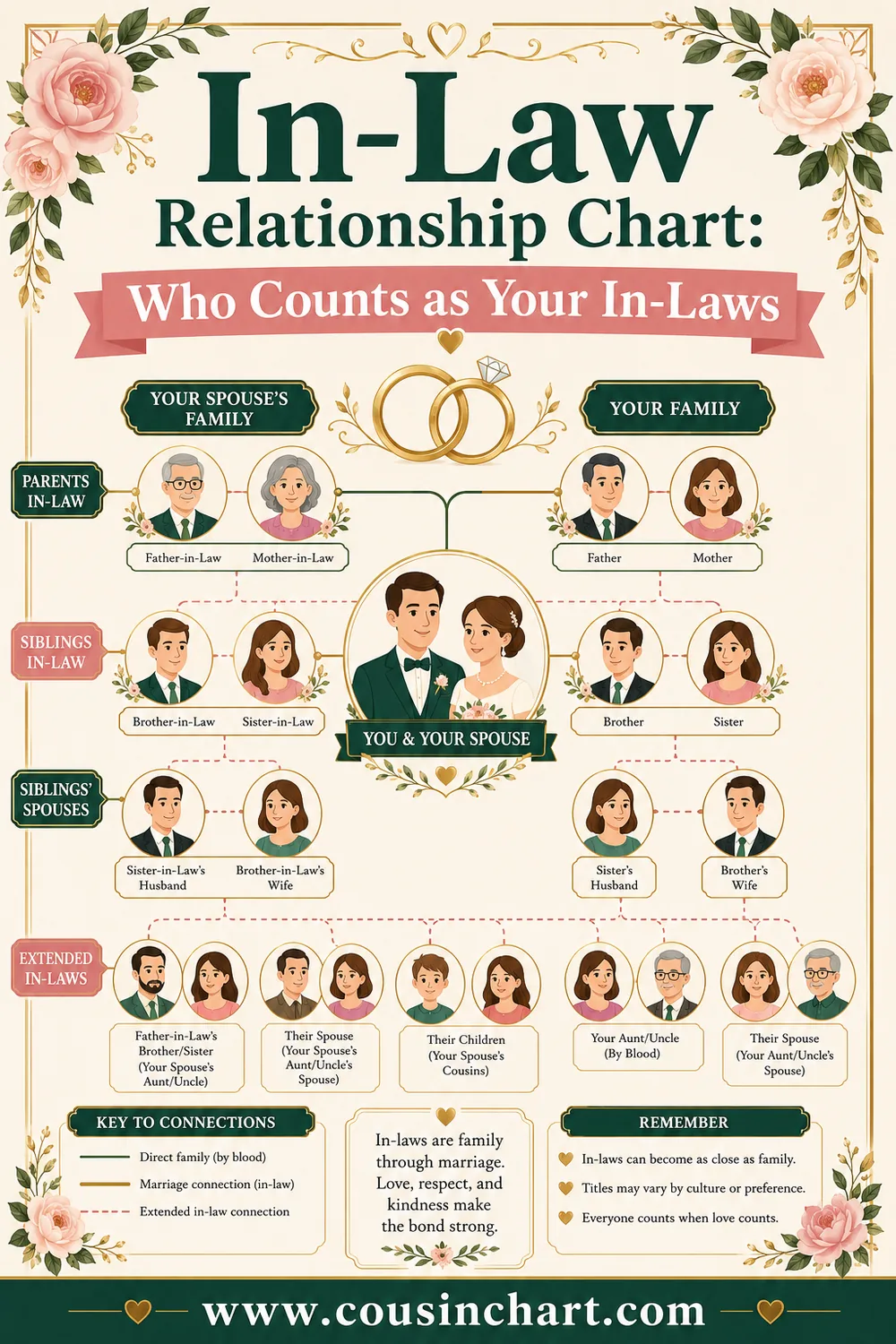
In-law titles are where Korean gets detailed, because the word depends on whether the speaker is the husband or the wife. Korean even has separate words for the two families. NIKL's Basic Korean Dictionary defines 시댁 (sidaek) as a polite word for the husband's parents' home or family, 처가 (cheoga) as the wife's family home, and 친정 (chinjeong) as a married woman's own birth family. For the English version of all this, see our in-law relationship chart.
| Hangul | Revised Romanization | Meaning | Who says it |
|---|---|---|---|
| 시아버지 | siabeoji | husband's father | A wife, in reference |
| 시어머니 | sieomeoni | husband's mother | A wife, in reference |
| 장인 | jangin | wife's father | A husband, in reference |
| 장인어른 | jangineoreun | wife's father (respectful) | A husband, in reference or address |
| 장모 | jangmo | wife's mother | A husband, in reference |
| 장모님 | jangmonim | wife's mother (respectful) | A husband, in reference or address |
| 아버님 | abeonim | father (honorific) | Common way to address a spouse's father |
| 어머님 | eomeonim | mother (honorific) | Common way to address a spouse's mother |
| 며느리 | myeoneuri | daughter-in-law (son's wife) | Her husband's parents |
| 사위 | sawi | son-in-law (daughter's husband) | His wife's parents |
| 사돈 | sadon | the parents of a married couple, to each other | Both sets of parents |
| 사돈어른 | sadoneoreun | your child's spouse's father (respectful) | The other set of parents |
The prefix 시 (si) marks the husband's family and 처 (cheo) or 장 (jang) marks the wife's family. Once you spot that, many words decode themselves: 시아버지 is "husband's-side father," and 처남 (coming up next) is "wife's-side male."
NIKL's Basic Korean Dictionary lists 아버님 and 어머님 as warm, honorific ways to address both a husband's and a wife's parents. That's what many married people actually say in person. 사돈 is a handy word English lacks: the dictionary entry for 사돈 defines it as the relationship between the parents of two families joined by marriage, and the word they use for each other. It also lists 안사돈 (ansadon) for the mother on the other side and 바깥사돈 for the father.
Siblings-In-Law: The Titles That Confuse Everyone
This is the part of Korean family titles that confuses even native speakers. The right word depends on three things: whose sibling it is (your spouse's or your own), whether that sibling is older or younger, and sometimes whether they're married.
A wife's titles for her husband's family
| Hangul | Revised Romanization | Meaning |
|---|---|---|
| 아주버님 | ajubeonim | husband's older brother (or older male relative of his generation) |
| 도련님 | doryeonnim | husband's unmarried younger brother |
| 서방님 | seobangnim | husband's married younger brother; also husband's younger sister's husband |
| 형님 | hyeongnim | husband's older sister; also husband's older brother's wife |
| 아가씨 | agassi | husband's younger sister |
| 시누이 | sinui | husband's sister (older or younger), in reference |
| 시동생 | sidongsaeng | husband's younger brother, in reference |
| 동서 | dongseo | wife of husband's brother (each other's co-sister-in-law) |
These all come straight from NIKL's dictionaries. The Basic Korean Dictionary defines 도련님 as an honorific for a husband's unmarried younger brother and 서방님 as a word for a husband's married younger brother or a husband's younger sister's husband (as well as, in its first sense, the husband himself). It gives 아가씨 the sense of a husband's younger sister, alongside its everyday meaning of "young lady." The Standard Korean Dictionary defines 아주버님 as the honorific of 아주버니, a man of the husband's generation who's older than the husband.
A husband's titles for his wife's family
| Hangul | Revised Romanization | Meaning |
|---|---|---|
| 형님 | hyeongnim | wife's older brother |
| 처남 | cheonam | wife's younger brother |
| 처형 | cheohyeong | wife's older sister |
| 처제 | cheoje | wife's younger sister |
| 동서 | dongseo | husband of wife's sister (each other's co-brother-in-law) |
The word 형님 does a lot of work. The Basic Korean Dictionary entry for 형님 lists six senses, including a polite word for an older brother, a wife's older brother, a husband's older sister, and a husband's older brother's wife. Context tells you which one someone means.
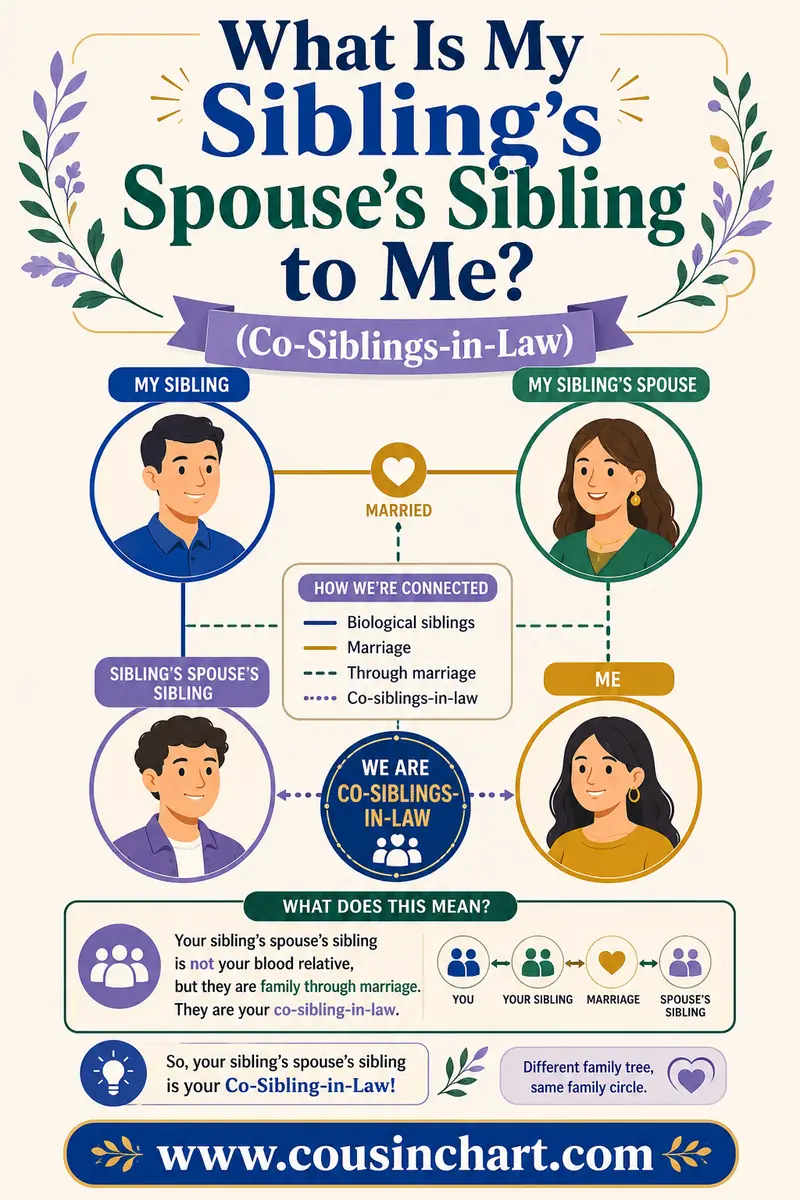
동서 is similar. The dictionary entry for 동서 covers both the wives of brothers and the husbands of sisters. It's the Korean word for what English calls co-siblings-in-law: two people who married siblings.
Titles for your own siblings' spouses
| Hangul | Revised Romanization | Meaning | Who says it |
|---|---|---|---|
| 형수 | hyeongsu | older brother's wife | A man |
| 제수 | jesu | younger brother's wife | A man |
| 매형 | maehyeong | older sister's husband | A man |
| 매제 | maeje | younger sister's husband | A man |
| 새언니 | saeeonni | older brother's wife | A woman |
| 올케 | olke | brother's wife (older or younger brother) | A woman |
| 형부 | hyeongbu | older sister's husband | A woman |
| 제부 | jebu | younger sister's husband | A woman |
The pattern here follows the sibling words from the first section. A man's older sister is 누나, and her husband is 매형. A woman's older sister is 언니, and her husband is 형부. 새언니 literally means "new 언니," which captures how a woman's older brother's wife becomes like a new older sister.
Changing Customs: Rethinking In-Law Titles
You may notice an imbalance in the tables above. A wife uses honorific titles ending in 님 for her husband's younger siblings (도련님, 서방님), while a husband uses plain words for his wife's younger siblings (처남, 처제). Many Koreans have pointed this out, and it's been a public discussion for years.
A 2020 Seoul Metropolitan Government article, "우리, 서로 뭐라고 부를까요?" (What should we call each other?), reports that in an NIKL survey, 65.8% of respondents said this imbalance should change. It also summarizes NIKL guidance that married women can use 도련님, 서방님 and 아가씨 flexibly, depending on their own judgment and the situation, and suggests alternatives:
- Use the child's name plus the title the child would use, like "민준이 삼촌" (Minjun's uncle) or "민준이 고모" (Minjun's aunt).
- Use the person's name with 씨, a polite suffix, like "지수 씨."
- For someone who's lower in family rank but older than you, add 님, as in 처제님 or 동서님.
- For grandparents, use a place name instead of 친 or 외, like "사직동 할머니" (the grandma who lives in Sajik-dong).
The Ministry of Culture, Sports and Tourism's card news makes similar points: adding 님 for respect is fine, and terms like 도련님 and 아가씨 can be used as the people involved prefer. The practical upshot is that the traditional titles are still correct, but families have more freedom than they used to. If you're marrying into a Korean family, it's perfectly polite to ask, "What would you like me to call you?"
How Korean Family Titles Compare With English
It can help to see how many Korean titles hide behind one English word. Each row below is a single English word, with the Korean titles you'd need to choose between. Every Korean term here appears earlier in this guide.
| English word | Korean titles it can mean | What decides the choice |
|---|---|---|
| older brother | 오빠, 형 | Speaker's gender |
| older sister | 언니, 누나 | Speaker's gender |
| grandmother | 할머니, 친할머니, 외할머니 | Whether you need to name the side |
| uncle | 큰아버지, 작은아버지, 삼촌, 외삼촌, 고모부, 이모부 | Side, age compared with your father, blood or marriage |
| aunt | 고모, 이모, 큰어머니, 작은어머니, 숙모, 외숙모 | Side, blood or marriage, uncle's age |
| cousin | 사촌, 고종사촌, 외사촌, 이종사촌 | Which parent's sibling links you |
| brother-in-law | 아주버님, 도련님, 서방님, 형님, 처남, 매형, 매제, 형부, 제부, 동서 | Spouse's side or your own, age, marital status, speaker's gender |
| sister-in-law | 형님, 아가씨, 시누이, 처형, 처제, 형수, 제수, 새언니, 올케, 동서 | Spouse's side or your own, age, speaker's gender |
| father-in-law | 시아버지, 장인, 장인어른, 아버님 | Husband's or wife's father, reference or address |
| mother-in-law | 시어머니, 장모, 장모님, 어머님 | Husband's or wife's mother, reference or address |
The pattern is clear: English gets by with one word per row because it ignores side, relative age and the speaker's gender. Korean usually encodes at least one of those. When you translate, work out those details first, and the right title nearly picks itself.
Using Korean Family Titles Outside the Family
Korean family titles don't stay inside the family, and that's where much of the confusion for non-Koreans comes from. NIKL's Basic Korean Dictionary includes these extended senses:
- 오빠: a woman's affectionate word for an older man. This is why a woman might call her boyfriend, or an older male friend, oppa.
- 언니: a woman's affectionate word for an older woman, such as an older friend or coworker.
- 누나: a man's affectionate word for an older woman.
- 형: a man's affectionate word for an older man.
- 형님: a polite word mainly used among men for an older man, and also among close women for an older woman.
- 동생: an older person's friendly word for a younger person.
- 할아버지: any elderly man, said in a friendly way.
So when you hear these words in a K-drama, they usually show age and closeness, not blood. Calling a friend's older brother 오빠 doesn't mean you're related. It means you're younger, you're a woman, and you're on friendly terms. This is close to what anthropologists call fictive kinship, which our page on fictive kin explains.
Using these words for non-relatives depends on age and closeness, so it's best to wait until someone invites you to. Using 오빠 or 언니 with someone you've just met can feel too familiar.
Common Mix-Ups With Korean Family Titles
1. Choosing the sibling word by the sibling's gender only
The word depends on your gender too. A man never calls his older brother 오빠, and a woman doesn't usually call her older sister 누나. Ask: same gender as me? Use 형 or 언니. Different? Use 오빠 or 누나.
2. Calling every uncle 삼촌
삼촌 is fine for a father's unmarried younger brother, and children use it loosely. But a father's older brother is 큰아버지, a married younger brother is usually 작은아버지, and a mother's brother is 외삼촌.
3. Mixing up 고모 and 이모
고모 is your father's sister. 이모 is your mother's sister. The 이 in 이모 and 이종사촌 is the clue for mom's sister's side.
4. Using 형님 in only one sense
형님 can mean a man's respected older brother, a husband's older sister, a husband's older brother's wife, or a wife's older brother. Don't assume a woman who says 형님 is talking about a man.
5. Assuming 아가씨 always means "young lady"
In a family setting, a married woman may use 아가씨 for her husband's younger sister. It's the same word, but a different meaning.
6. Using 도련님 for a married brother-in-law
Traditionally, 도련님 is for the husband's unmarried younger brother. Once he marries, the traditional title becomes 서방님. Many families now use names or "child's name + 삼촌" instead.
7. Romanization confusion
"Hyung," "hyeong," "unnie" and "eonni" are the same words in different spellings. Revised Romanization uses hyeong and eonni. Fan spellings are fine in casual writing, but use the official spelling in formal work.
Try It Yourself: Picking the Right Korean Title
Work through these step by step. For each one, ask: whose side, older or younger, and what's the speaker's gender?
Example 1: A boy talking about his father's older brother
- Side: father's side.
- Age compared with the father: older.
- Answer: 큰아버지 (keunabeoji). His wife is 큰어머니 (keuneomeoni).
Example 2: A girl talking about her mother's sister's son, who's three years older
- Relationship: first cousin through her mother's sister, so 이종사촌.
- In person: he's an older male and she's female, so she calls him 오빠.
- To someone else: 이종사촌 오빠 or simply 사촌 오빠.
Example 3: A woman talking about her husband's older sister
In reference she's 시누이 (sinui). In address, she's traditionally 형님 (hyeongnim). If it were her husband's younger sister, the traditional address would be 아가씨 (agassi).
Example 4: A man talking about his wife's younger sister
She's his 처제 (cheoje). Her husband and he are 동서 (dongseo) to each other.
Example 5: How closely related is your father's cousin?
Count it: you go up 3 generations to your great-grandparent, then down 2 to your father's cousin. That's 3 + 2 = 5 chon. If he's male, he's your 당숙 (dangsuk), and his wife is 당숙모 (dangsungmo). Your children and his grandchildren would be further apart still. Our calculator can tell you the English term for any of these.
Example 6: What do your parents and your spouse's parents call each other?
They're 사돈 (sadon) to each other. A respectful way to refer to the other father is 사돈어른 (sadoneoreun).
Find the Relationship, Then the Korean Title
Korean family titles answer several questions at once: which side of the family, older or younger, and the gender of both the relative and the speaker. Learn 오빠, 형, 언니 and 누나 first, then the side markers 친 and 외, the aunt words 고모 and 이모, and the in-law markers 시 and 처. With those pieces, most titles become easy to work out. When customs or family preferences differ from the textbook, follow the family, and don't be shy about asking.
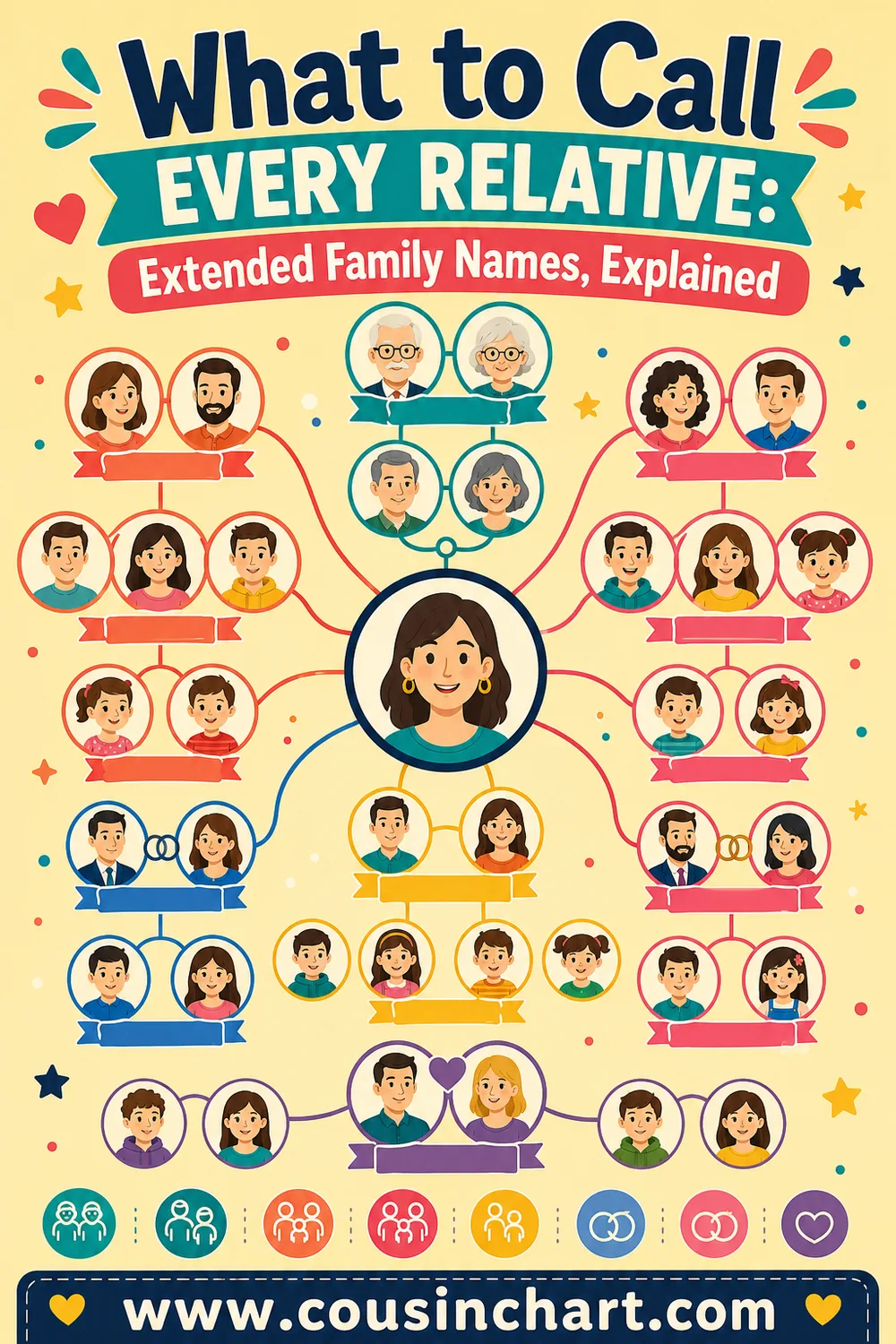
Before picking a Korean title, it helps to know the relationship in English. If you're not sure how someone fits into your family tree, try our free family relationship calculator. It'll tell you the English relationship, and you can use the tables above to find the Korean title. For a broader English reference, see our guide on what to call every relative.
Keep reading: Chinese Family Relationship Terms: What to Call Every Relative (With Chart) and Kinship Terminology: The 6 Systems Cultures Use to Name Relatives.
Frequently Asked Questions
What is the difference between oppa and hyung?
Both mean older brother, but the speaker is different. 오빠 (oppa) is what a girl or woman calls her older brother, or an older male cousin. 형 (hyeong, often spelled hyung) is what a boy or man calls his older brother or older male cousin. Korea's Standard Korean Dictionary defines 오빠 as the word a younger sister uses for an older brother, and 형 as the word for an older male among men. Outside the family, women also use 오빠 for close older male friends, and men use 형 for close older male friends.
Can a man call someone unnie?
In modern Korean, 언니 (eonni) is a woman's word for her older sister or an older woman she's close to. A man calls his older sister 누나 (nuna). The Standard Korean Dictionary describes 언니 as a word for an older sibling of the same sex that's used mostly between sisters, which reflects how it's used today. You might occasionally hear 언니 in older texts or in service settings used differently, but for family titles, stick with the rule: women say 언니, men say 누나.
What is the difference between imo and gomo?
Both mean aunt, but on different sides. 이모 (imo) is your mother's sister and 고모 (gomo) is your father's sister. Neither word changes for older or younger sisters. Their husbands add 부: 이모부 (imobu) and 고모부 (gomobu). The cousin words follow the same split: a child of your 이모 is your 이종사촌 (ijongsachon) and a child of your 고모 is your 고종사촌 (gojongsachon). Mixing them up is one of the most common mistakes learners make.
What does samchon mean in Korean?
삼촌 (samchon) literally means three chon, the kinship distance between you and a parent's sibling. NIKL's Basic Korean Dictionary defines it as a brother of your father or mother. In everyday family life, it's most often used for a father's younger brother, especially before he marries. A father's older brother is usually 큰아버지 (keunabeoji), a married younger brother is usually 작은아버지 (jageunabeoji), and a mother's brother is 외삼촌 (oesamchon). Children also use 삼촌 loosely for young men they know.
What does chon mean in Korean family terms?
촌 (chon) is a unit for measuring how closely two relatives are related. You count the generation steps from one person up to the shared ancestor and back down to the other. Your parent is 1 chon, a sibling is 2, a parent's sibling is 3 (삼촌), a first cousin is 4 (사촌), and a second cousin is 6 (육촌). That's why some Korean family words are just numbers. It works like the degree of relationship used in English-speaking law and genealogy.
What do you call your husband's siblings in Korean?
Traditionally, a wife calls her husband's older brother 아주버님 (ajubeonim), his unmarried younger brother 도련님 (doryeonnim) and his married younger brother 서방님 (seobangnim). She calls his older sister 형님 (hyeongnim) and his younger sister 아가씨 (agassi). Because these titles are more honorific than the words husbands use for their wife's siblings, the National Institute of Korean Language now says they can be used flexibly. Alternatives include the child's name plus 삼촌 or 고모, or the person's name with 씨.
What do you call your wife's family in Korean?
A husband refers to his wife's father as 장인 (jangin) or more respectfully 장인어른 (jangineoreun), and her mother as 장모 (jangmo) or 장모님 (jangmonim). Many husbands address them as 아버님 and 어머님. Her younger brother is 처남 (cheonam), her older sister is 처형 (cheohyeong), and her younger sister is 처제 (cheoje). Her older brother is addressed as 형님 (hyeongnim). The husband of his wife's sister is his 동서 (dongseo). The wife's family home as a whole is 처가 (cheoga).
Why do Korean girls call their boyfriend oppa?
Because 오빠 has a second meaning beyond older brother. NIKL's Basic Korean Dictionary lists it as a word a woman uses to refer to or call an older man affectionately. So a woman might use it for a boyfriend, a husband in casual talk, or a close older male friend. It signals that he's older and that they're close. It doesn't mean they're related. The same goes for 언니, 누나 and 형, which are all used for close friends of the right age and gender.
Is hyung or hyeong the correct spelling?
Both refer to the same word, 형. Hyeong is the spelling in Revised Romanization, the official system of South Korea, where the vowel ㅕ is written yeo. Hyung comes from older or informal spellings and is very common in K-pop and K-drama fandoms. The same thing happens with eonni and unnie, and with nuna and noona. Use the Revised Romanization spelling for formal writing, schoolwork or anything you want to match Korean textbooks and official signs.
Sources
We checked every source below while writing this guide. Last reviewed October 30, 2026, by Joan Ramos.
- 오빠, Standard Korean Dictionary (표준국어대사전) (National Institute of Korean Language)
- 형님, Basic Korean Dictionary (한국어기초사전) (National Institute of Korean Language)
- 고모, Basic Korean Dictionary (한국어기초사전) (National Institute of Korean Language)
- 사촌, Basic Korean Dictionary (한국어기초사전) (National Institute of Korean Language)
- 촌수, Basic Korean Dictionary (한국어기초사전) (National Institute of Korean Language)
- 동서, Basic Korean Dictionary (한국어기초사전) (National Institute of Korean Language)
- 사돈, Basic Korean Dictionary (한국어기초사전) (National Institute of Korean Language)
- Romanization of Korean (National Institute of Korean Language)
- [카드뉴스] 헷갈리고 궁금했던 호칭·지칭어, 정리해드립니다! (Ministry of Culture, Sports and Tourism, Republic of Korea)
- [슬기로운 말글살이 17] 우리, 서로 뭐라고 부를까요? (Seoul Metropolitan Government (내 손안에 서울))