Chinese Family Relationship Terms: What to Call Every Relative (With Chart)
Chinese family relationship terms work differently from English ones: almost every relative gets a word that tells you which side of the family they're on, whether they're older or younger than the linking person, and whether they're male or female. So instead of one word "uncle," Mandarin has 伯父 (bófù) for your dad's older brother, 叔叔 (shūshu) for his younger brother, and 舅舅 (jiùjiu) for your mom's brother. Once you learn three questions and a handful of building blocks, the whole system starts to click.
This guide walks through every common Mandarin term with characters, pinyin with tone marks, the English meaning, and who actually says it. It covers grandparents, parents and siblings, aunts and uncles on both sides, the famous 堂 (táng) vs 表 (biǎo) cousin split, nieces and nephews, and in-laws. There's also a short section on well-known Cantonese differences, a list of common mix-ups, and practice examples you can try yourself.
The Three Questions Behind Chinese Family Relationship Terms
English mostly asks one question about a relative: how are they connected to me? Chinese asks that, plus a few more. Before you pick a word, you need to answer these three questions.
- Which side? Is the person related through your father or through your mother? Traditional Chinese kinship is patrilineal, meaning family lines and surnames were traced through men. Relatives through your father's brothers share your surname. Relatives through your mother, and through your father's sisters, usually don't. The language marks that difference all the time.
- Older or younger? For siblings, cousins and your parents' siblings, the word changes depending on relative age. Your father's older brother and younger brother have different titles. Your older cousin and younger cousin have different titles.
- Male or female? English has gender words for most relatives already (aunt, uncle, niece), but not for "cousin" or "sibling." Chinese always marks gender for these.
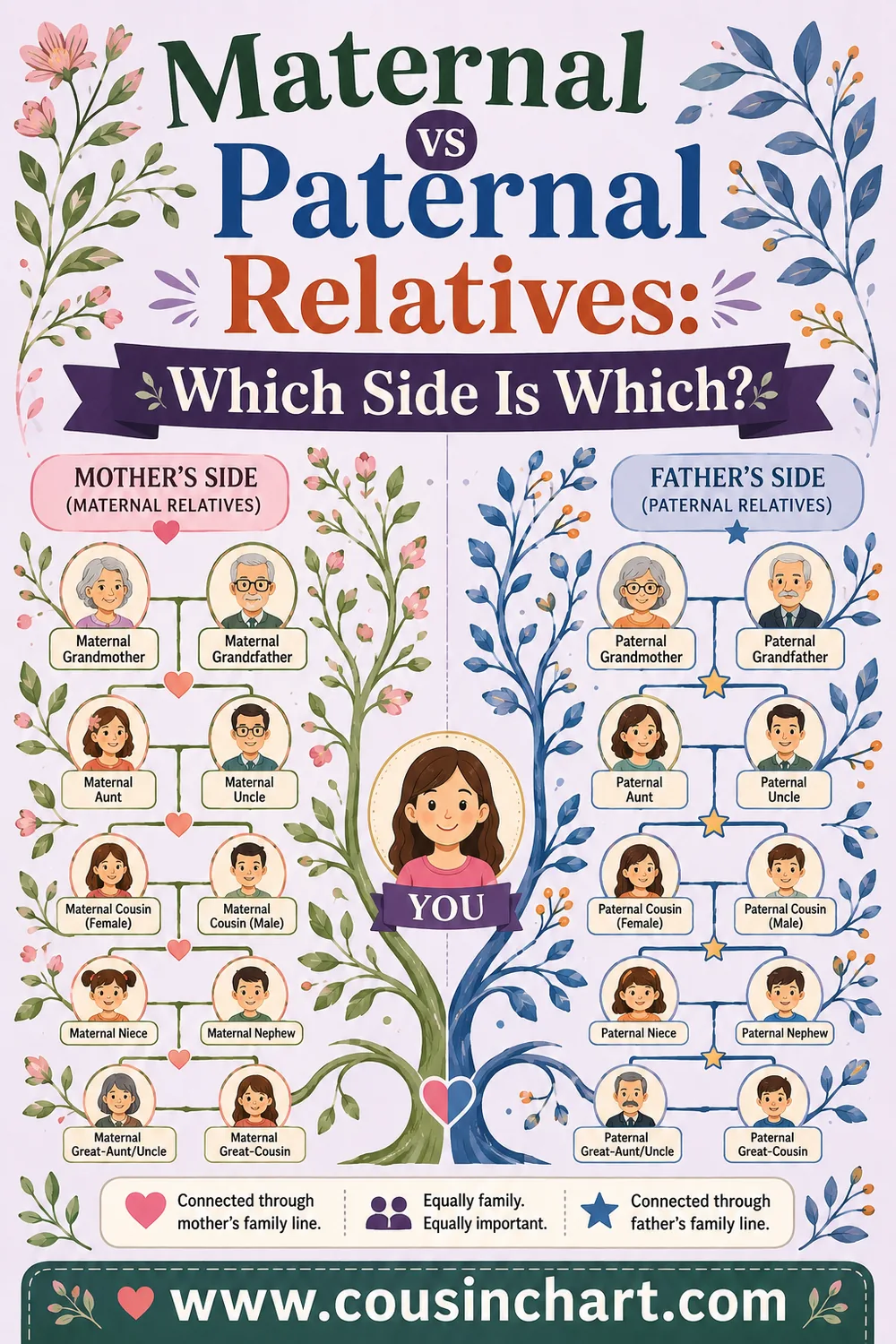
The Open University's introduction to Chinese culture makes the point neatly: where English has a single word, cousin, Chinese has eight everyday equivalents, because each one encodes side, age and gender. You can read their short table of cousin terms in Getting started with Chinese business culture essentials. If the idea of "sides" is new to you, our guide to maternal vs. paternal relatives explains it in English terms first.
The building blocks you'll see again and again
A small set of characters does most of the work. Learn these and you can often guess a new term correctly.
| Character | Pinyin | Basic meaning in kinship terms |
|---|---|---|
| 哥 | gē | older brother (or older male of your generation) |
| 姐 | jiě | older sister (or older female of your generation) |
| 弟 | dì | younger brother (or younger male of your generation) |
| 妹 | mèi | younger sister (or younger female of your generation) |
| 伯 | bó | father's older brother |
| 叔 | shū | father's younger brother |
| 姑 | gū | father's sister |
| 舅 | jiù | mother's brother |
| 姨 | yí | mother's sister |
| 外 | wài | "outside"; marks many relatives through a female link |
| 堂 | táng | cousin through your father's brother (same surname) |
| 表 | biǎo | cousin through a female relative |
The MDBG dictionary, a widely used Chinese-English dictionary built on the CC-CEDICT word list, defines 表 in this sense as "family relationship via females," and it glosses 堂哥 (tánggē) as an "older male patrilineal cousin". Those two glosses are the key to the whole cousin system.
How to Read the Characters and Pinyin in This Guide
Each table below gives the term in simplified characters, which are used in mainland China and Singapore. Where the traditional form (used in Taiwan, Hong Kong and Macau) is different, it appears in brackets, like 爷爷 (爺爺). Many family words are the same in both systems.
Pinyin is the official romanization for Mandarin. The marks over the vowels show the tone:
- ā first tone: high and level
- á second tone: rising
- ǎ third tone: low, dipping
- à fourth tone: sharp falling
- a (no mark) neutral tone: short and light
Lots of family words are doubled syllables, like 哥哥 or 妈妈. In everyday speech the second syllable is usually light and unstressed, so dictionaries write them with a neutral tone: gēge, māma, yéye. That's why you'll see no tone mark on the second half of these words. The pinyin here follows the MDBG dictionary entries.
One more thing to keep in mind: Chinese often separates the word you use to talk about someone from the word you use to call them. A formal word like 祖父 (zǔfù, paternal grandfather) is what you'd write on a form or say in a speech, while 爷爷 (yéye) is what you'd shout across the room. The tables mark which is which where it matters.
Grandparents on Each Side
Grandparents are where the paternal/maternal split first shows up. Your father's parents and your mother's parents have completely different words, and the maternal words often carry 外 (wài, "outside"). That reflects the old patrilineal idea that a married daughter's children belonged to her husband's family line. Today it's just vocabulary, and nobody hears it as a slight, but it's useful for remembering which word goes where.
| Characters | Pinyin | Meaning | Who says it, and how |
|---|---|---|---|
| 爷爷 (爺爺) | yéye | father's father | Grandchildren; everyday word and form of address |
| 奶奶 | nǎinai | father's mother | Grandchildren; everyday word and form of address |
| 外公 | wàigōng | mother's father | Grandchildren; very common in southern China and Taiwan |
| 外婆 | wàipó | mother's mother | Grandchildren; pairs with 外公 |
| 姥爷 (姥爺) | lǎoye | mother's father | Grandchildren; common in northern China |
| 姥姥 | lǎolao | mother's mother | Grandchildren; common in northern China |
| 祖父 | zǔfù | father's father | Formal or written |
| 祖母 | zǔmǔ | father's mother | Formal or written |
| 外祖父 | wàizǔfù | mother's father | Formal or written |
| 外祖母 | wàizǔmǔ | mother's mother | Formal or written |
For great-grandparents, the formal words add 曾 (zēng): 曾祖父 (zēngzǔfù) is your father's father's father and 曾祖母 (zēngzǔmǔ) is your father's father's mother. Colloquially, many families say 太爷爷 (太爺爺, tàiyéye) for the same paternal great-grandfather. Customs for great-grandparents vary a lot by region and family, so if you're writing a card to a great-grandparent, it's worth asking a parent what the family actually says.
Which maternal grandparent words should you use?
Both pairs, 外公/外婆 and 姥爷/姥姥, are standard Mandarin and both are listed in dictionaries. The choice is mostly regional and family habit. If your mother grew up in Beijing or the northeast, you'll likely hear 姥姥. If she grew up in Shanghai, Guangdong or Taiwan, 外婆 is more likely. Neither is wrong. Follow what your cousins say.
Parents, Siblings and the Older/Younger Rule
The parent words are the ones most learners already know. The sibling words are where the older/younger rule starts.
| Characters | Pinyin | Meaning | Notes |
|---|---|---|---|
| 爸爸 | bàba | dad | Everyday word and form of address |
| 妈妈 (媽媽) | māma | mom | Everyday word and form of address |
| 父亲 (父親) | fùqīn | father | Formal; you talk about him with it, you don't call him it |
| 母亲 (母親) | mǔqīn | mother | Formal |
| 哥哥 | gēge | older brother | Said by younger siblings of either gender |
| 姐姐 | jiějie | older sister | Said by younger siblings of either gender |
| 弟弟 | dìdi | younger brother | Usually a reference word; older siblings often just use his name |
| 妹妹 | mèimei | younger sister | Usually a reference word; older siblings often just use her name |
| 兄弟姐妹 | xiōngdì jiěmèi | brothers and sisters, siblings | The general word for "siblings" |
| 儿子 (兒子) | érzi | son | Parents' word |
| 女儿 (女兒) | nǚ'ér | daughter | Parents' word |
Notice the direction of politeness. A younger sibling calls an older one by title (哥哥, 姐姐), much like a polite form. An older sibling usually calls a younger one by name. That pattern runs all through the system: the junior person uses the kinship title for the senior person, while the senior person can use a name. It's one reason Chinese kinship words feel more like titles than labels.
Birth order inside a set of siblings
When there are several older brothers, families often add 大 (dà, "big, eldest"), 二 (èr, "second") and so on: 大哥 (dàgē) for the eldest brother, 二哥 (èrgē) for the second. The same works for 姐: 大姐, 二姐. This numbering also shows up with aunts and uncles, as you'll see in the next sections.
Aunts and Uncles on Your Father's Side
On your father's side, uncles split by age relative to your father, and each uncle's wife has her own title. Your father's sisters share one set of words regardless of age, though families often add numbers.
| Characters | Pinyin | Meaning | Who says it, and how |
|---|---|---|---|
| 伯伯 | bóbo | father's older brother | Nieces and nephews; everyday word and form of address |
| 伯父 | bófù | father's older brother | More formal; also a respectful term for an older man |
| 大伯 | dàbó | father's older brother, especially the eldest | Common in speech; it can also mean a woman's husband's older brother |
| 伯母 | bómǔ | wife of father's older brother | Nieces and nephews; also a polite word for a woman about your mother's age |
| 叔叔 | shūshu | father's younger brother | Nieces and nephews; children also call any man of their parents' generation this |
| 叔父 | shūfù | father's younger brother | More formal |
| 婶婶 (嬸嬸) | shěnshen | wife of father's younger brother | Nieces and nephews |
| 姑姑 | gūgu | father's sister | Nieces and nephews; everyday |
| 姑妈 (姑媽) | gūmā | father's sister (often a married one) | Nieces and nephews; colloquial |
| 姑父 | gūfu | father's sister's husband | Nieces and nephews |
The split between 伯 and 叔 is the classic example of the age rule. It doesn't matter how old the uncle is compared with you. What matters is how old he is compared with your father. If your dad is the middle of three brothers, the eldest is your 伯伯 and the youngest is your 叔叔. A 2023 doctoral thesis at the Australian National University on uncle-type kinship terms in Sinitic languages treats 伯, 叔 and 舅 as the three core "uncle" categories across Chinese varieties, which shows how basic this split is.
When there are several uncles of the same type, families add numbers: 二叔 (èrshū) for the second of your father's younger brothers, 三叔 (sānshū) for the third, and so on. Some families number all of the father's brothers in one sequence instead. Either way, you follow what the family already says.
Uncle words for people who aren't relatives
Two of these words do double duty. MDBG notes that 叔叔 is also the "form of address used by children for a male one generation older," and 伯母 is a polite word for a woman about your mother's age. So a child might call a family friend, a neighbor or even a friendly shopkeeper 叔叔. That doesn't mean they're related. It's like an American kid saying "Uncle Mike" for a dad's close friend, which our guide to fictive kin covers in more depth.
Aunts and Uncles on Your Mother's Side
Mom's side is simpler in one way: the main words don't split by age. Your mother's brothers are all 舅舅, and her sisters are all 姨 of some kind. Families add birth-order numbers or 大/小 when they need to tell them apart.
| Characters | Pinyin | Meaning | Who says it, and how |
|---|---|---|---|
| 舅舅 | jiùjiu | mother's brother | His sister's children; everyday |
| 舅妈 (舅媽) | jiùmā | mother's brother's wife | His sister's children; colloquial |
| 阿姨 | āyí | mother's sister | Her sister's children; also used for any woman of your mother's generation |
| 姨妈 (姨媽) | yímā | mother's sister | Her sister's children; colloquial |
| 大姨 | dàyí | mother's eldest sister | Her sister's children |
| 小姨 | xiǎoyí | mother's youngest sister | Her sister's children; the same word can mean a man's wife's younger sister |
| 姨父 | yífu | mother's sister's husband | Her sister's children |
The MDBG entry for 舅舅 glosses it as "mother's brother / maternal uncle," and that's the cleanest way to remember it: 舅 is only ever on your mother's side. If you hear 舅 inside a longer word, there's a maternal link somewhere.
Like 叔叔, the word 阿姨 is used far beyond the family. MDBG lists it for a maternal aunt, for any woman of your mother's generation, and for a nanny or domestic worker. A child will call a friend's mother 阿姨 as a matter of course. Context tells you whether someone's actually your aunt.
Putting both sides together
Here's the whole aunt-and-uncle picture in one place, so you can see the pattern at a glance.
| Relative | Father's side | Mother's side |
|---|---|---|
| Parent's older brother | 伯伯 bóbo | 舅舅 jiùjiu |
| Parent's younger brother | 叔叔 shūshu | 舅舅 jiùjiu |
| His wife | 伯母 bómǔ / 婶婶 shěnshen | 舅妈 jiùmā |
| Parent's sister | 姑姑 gūgu | 阿姨 āyí / 姨妈 yímā |
| Her husband | 姑父 gūfu | 姨父 yífu |
Only the father's brothers (and, through them, their wives) split by age. That's not an accident. Under the old patrilineal system, your father's brothers were the senior men of your own family line, so their rank relative to your father mattered most.
Cousins in Chinese: 堂 (Táng) vs 表 (Biǎo)
This is the part people search for most. Chinese has no single everyday word for "cousin." Instead, each cousin word combines a side marker (堂 or 表) with a sibling word (哥, 姐, 弟, 妹).
- 堂 (táng) cousins are the children of your father's brothers. They share your surname, because surnames pass from father to child.
- 表 (biǎo) cousins are everyone else: the children of your father's sisters, your mother's brothers and your mother's sisters.
Taiwan's Ministry of Education dictionary defines 表兄弟 (biǎoxiōngdì) as the sons of your 姑母 (father's sister), 舅父 (mother's brother) and 姨母 (mother's sister), with older ones called 表兄 and younger ones 表弟. The Open University explains the same split using surnames: cousins who share your family name are 堂, and those with a different family name are 表.
| Characters | Pinyin | Meaning | Related through |
|---|---|---|---|
| 堂哥 | tánggē | older male cousin | Father's brother |
| 堂姐 | tángjiě | older female cousin | Father's brother |
| 堂弟 | tángdì | younger male cousin | Father's brother |
| 堂妹 | tángmèi | younger female cousin | Father's brother |
| 表哥 | biǎogē | older male cousin | Father's sister, mother's brother or mother's sister |
| 表姐 | biǎojiě | older female cousin | Father's sister, mother's brother or mother's sister |
| 表弟 | biǎodì | younger male cousin | Father's sister, mother's brother or mother's sister |
| 表妹 | biǎomèi | younger female cousin | Father's sister, mother's brother or mother's sister |
Here "older" and "younger" are compared with you, not with your parent. So if your cousin was born a month before you, they're your 哥 or 姐 cousin. Formal writing sometimes uses 堂兄 (tángxiōng) and 表兄 (biǎoxiōng) for an older male cousin, and the collective words 堂兄弟 (tángxiōngdì) and 表兄弟 (biǎoxiōngdì) for groups of male cousins.
The trap: your father's sister's children
Learners often assume 堂 means "father's side" and 表 means "mother's side." That's close, but it misses one group. Your father's sister's children are on your father's side, yet they're 表 cousins, because they carry their own father's surname, not yours. The real rule is about the surname line, not the side.
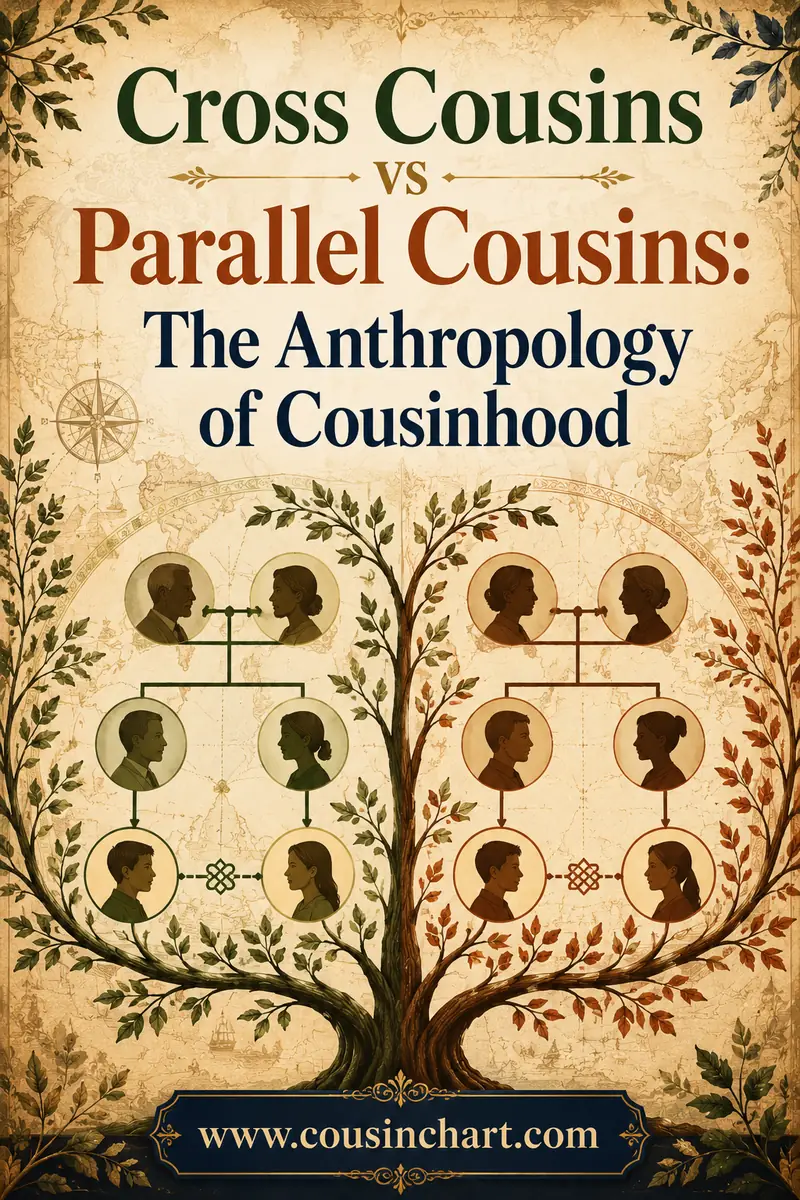
If you know the English terms for cousin types, here's a shortcut. 堂 cousins are exactly one kind of parallel cousin (children of your father's brother). 表 cousins include both kinds of cross cousins plus the children of your mother's sisters. Our page on cross cousins vs. parallel cousins explains those anthropology terms in plain English.
How cousins actually talk to each other
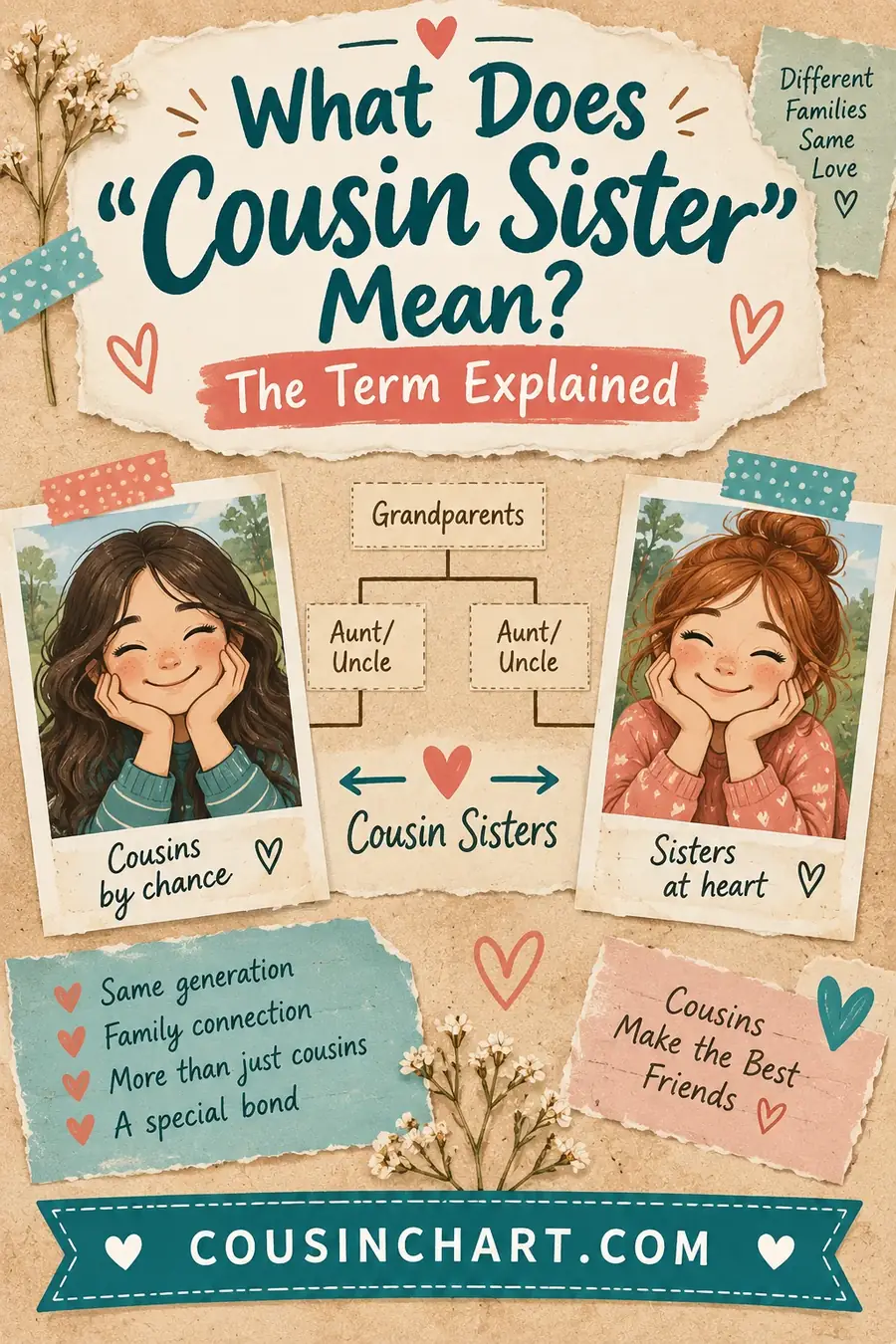
In conversation, cousins usually drop the 堂 or 表 and just say 哥, 姐 or the person's name. You'd introduce someone as "我表姐" (wǒ biǎojiě, "my older cousin") but call her 姐 at dinner. If you've heard English speakers say "cousin sister" or "cousin brother," that phrasing maps neatly onto words like 表姐 and 堂哥, which combine a cousin marker with a sibling word. Our article on what "cousin sister" means covers that usage.
Cousin words for more distant relatives
表 also stretches up a generation. MDBG lists 表叔 (biǎoshū) as the son of your grandfather's sister, the son of your grandmother's brother or sister, or your father's younger male cousin. In other words, it's roughly what English calls a first cousin once removed. If you're trying to work out those English labels, our guide on what "once removed" means walks through it.
Nieces, Nephews and Grandchildren
The same "which side" logic carries down a generation. A man's brother's children have one set of words, and a sister's children have another, marked again with 外.
| Characters | Pinyin | Meaning | Notes |
|---|---|---|---|
| 侄子 (姪子) | zhízi | brother's son | Used by the brother's siblings |
| 侄女 (姪女) | zhínǚ | brother's daughter | Used by the brother's siblings |
| 外甥 | wàishēng | sister's son | MDBG also lists "wife's sibling's son" |
| 外甥女 | wàishengnǚ | sister's daughter | MDBG also lists "wife's sibling's daughter" |
| 侄孙 (姪孫) | zhísūn | grandnephew (brother's grandson) | Less common in daily speech |
| 孙子 (孫子) | sūnzi | son's son | Grandparents' word |
| 孙女 (孫女) | sūnnǚ | son's daughter | Grandparents' word |
| 外孙 (外孫) | wàisūn | daughter's son | Grandparents' word |
| 外孙女 (外孫女) | wàisūnnǚ | daughter's daughter | Grandparents' word |
Look at the grandchildren rows and you'll see the mirror image of the grandparent table. Your 爷爷 calls you 孙子 or 孙女. Your 外公 calls you 外孙 or 外孙女. The 外 shows up on both ends of the same relationship.
The MDBG entry for 外甥 gives "sister's son / wife's sibling's son." So a husband would call his wife's sister's son 外甥 too. Usage for a wife's brother's children varies by family, so if you're unsure, ask how relatives already refer to them.
Chinese Family Relationship Terms for In-Laws
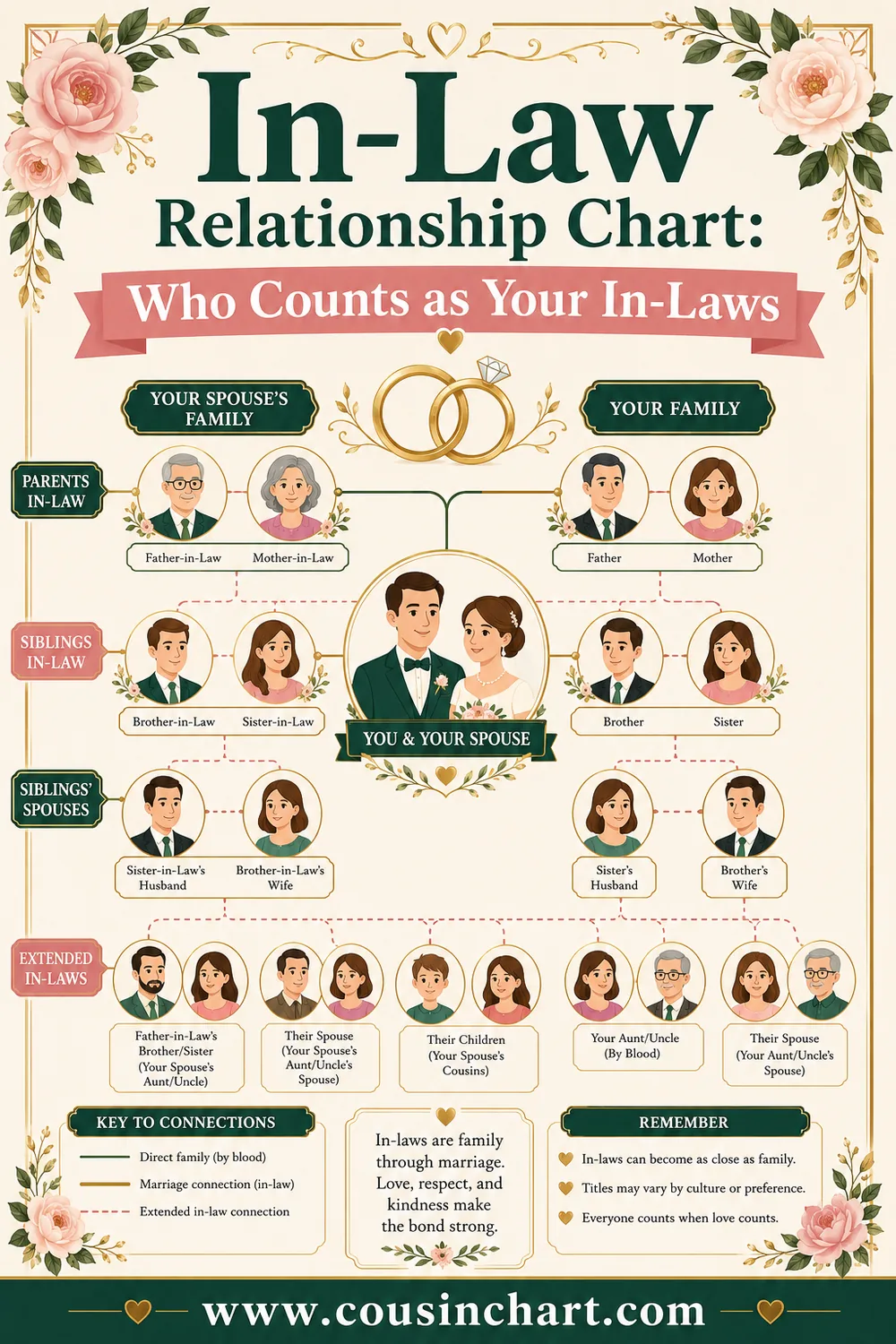
In-law words are where Chinese gets very detailed. The words depend on whether you're the husband or the wife, and on the age of the sibling compared with your spouse. English squeezes all of this into "brother-in-law" and "sister-in-law." For a refresher on the English side, see our in-law relationship chart.
Spouses and parents-in-law
| Characters | Pinyin | Meaning | Who says it |
|---|---|---|---|
| 丈夫 | zhàngfu | husband | Standard word |
| 老公 | lǎogōng | husband | Colloquial, very common |
| 妻子 | qīzi | wife | Standard word |
| 老婆 | lǎopó | wife | Colloquial, very common |
| 公公 | gōnggong | husband's father | A wife, when talking about him |
| 婆婆 | pópo | husband's mother | A wife, when talking about her |
| 岳父 | yuèfù | wife's father | A husband; formal |
| 岳母 | yuèmǔ | wife's mother | A husband; formal |
| 丈人 | zhàngrén | wife's father | A husband; colloquial |
| 丈母娘 | zhàngmǔniáng | wife's mother | A husband; colloquial |
| 儿媳妇 (兒媳婦) | érxífù | daughter-in-law | Her husband's parents |
| 女婿 | nǚxu | son-in-law | His wife's parents |
| 亲家 (親家) | qìngjia | your child's spouse's parents | The two sets of parents, about each other |
| 亲家公 / 亲家母 | qìngjiagōng / qìngjiamǔ | your child's spouse's father / mother | The two sets of parents |
Two details are worth pausing on. First, 亲家 is read qìngjia, not qīnjia, even though 亲 is normally qīn. Dictionaries list this special reading. Second, the parent-in-law words are mostly reference words. In many families, once you marry, you simply call your spouse's parents 爸 and 妈, the same as your own. The formal words are what you use when you're explaining who they are to someone else.
Chinese also has a word English lacks: 亲家 for the relationship between two sets of parents whose children married each other. English has no single everyday word for it, so people tend to say "my son's in-laws" or "my daughter's in-laws."
Siblings-in-law, by who's speaking
Here the speaker's own gender matters, because the word depends on whose sibling it is. The first table is from the wife's point of view and the husband's family. The second is from the husband's point of view and the wife's family. The third covers the spouses of your own siblings.
| Characters | Pinyin | Meaning (said by a wife) |
|---|---|---|
| 大伯子 | dàbǎizi | husband's older brother |
| 小叔子 | xiǎoshūzi | husband's younger brother |
| 大姑 | dàgū | husband's older sister (it can also mean father's eldest sister) |
| 小姑子 | xiǎogūzi | husband's younger sister |
| 妯娌 | zhóuli | wives of brothers, to each other |
| Characters | Pinyin | Meaning (said by a husband) |
|---|---|---|
| 大舅子 | dàjiùzi | wife's older brother |
| 小舅子 | xiǎojiùzi | wife's younger brother |
| 大姨子 | dàyízi | wife's older sister |
| 小姨子 | xiǎoyízi | wife's younger sister (MDBG notes it isn't used to address her directly) |
| 连襟 (連襟) | liánjīn | husbands of sisters, to each other |
| Characters | Pinyin | Meaning |
|---|---|---|
| 嫂子 | sǎozi | older brother's wife |
| 弟媳 | dìxí | younger brother's wife |
| 弟妹 | dìmèi | younger brother's wife (it also means "younger siblings") |
| 姐夫 | jiěfu | older sister's husband |
| 妹夫 | mèifu | younger sister's husband |
Notice how the in-law words reuse uncle and aunt syllables. A wife's word for her husband's younger brother, 小叔子, uses 叔, the same syllable her children will use for him (叔叔). A husband's word for his wife's brother, 小舅子, uses 舅, which is what his children will call that man (舅舅). The words line up with the children's point of view, which makes them easier to remember.
Also note the pronunciation trap in 大伯子: MDBG gives dàbǎizi, with 伯 read bǎi, not bó. It's one of those words you just have to learn.
The relationships 妯娌 and 连襟 are what English calls co-siblings-in-law: two people who married siblings. English has no everyday word for this, which is why our guide to co-siblings-in-law exists. Chinese has a specific word for each pairing.
Cantonese Family Terms: Well-Known Differences
Cantonese, spoken in Guangdong, Hong Kong, Macau and many overseas communities, shares much of its family vocabulary with Mandarin when written. But several everyday terms differ, and a couple of them flip meaning in ways that trip people up. A 2020 study in the journal Lingua Posnaniensis, The Comparison of Kinship Terminology in the Yulin Dialect and in Cantonese, lists Cantonese terms of address and reference side by side. The common ones below come from its tables. Hong Kong writes them in traditional characters.
| Cantonese characters | Meaning | Compare Mandarin |
|---|---|---|
| 爺爺, 阿爺 | father's father | 爷爷 yéye (same idea) |
| 嫲嫲, 阿嫲 | father's mother | 奶奶 nǎinai |
| 公公, 外公 | mother's father | 外公 wàigōng |
| 婆婆, 外婆 | mother's mother | 外婆 wàipó |
| 大佬, 阿哥 | older brother | 哥哥 gēge |
| 細佬 | younger brother | 弟弟 dìdi |
| 家姐 | older sister | 姐姐 jiějie |
| 阿叔 | father's younger brother | 叔叔 shūshu |
| 阿嬸 | wife of father's younger brother | 婶婶 shěnshen |
| 伯娘 | wife of father's older brother | 伯母 bómǔ |
| 舅父 | mother's brother | 舅舅 jiùjiu |
| 妗母 | mother's brother's wife | 舅妈 jiùmā |
| 姑丈 | father's sister's husband | 姑父 gūfu |
| 姨丈 | mother's sister's husband | 姨父 yífu |
| 家公, 老爺 | husband's father | 公公 gōnggong |
| 家婆, 奶奶 | husband's mother | 婆婆 pópo |
The big trap is in the last few rows. In Mandarin, 婆婆 is a woman's mother-in-law and 公公 her father-in-law. In Cantonese, 婆婆 and 公公 are your mother's mother and father. And 奶奶, which is a paternal grandmother in Mandarin, is a husband's mother in Cantonese. So a Cantonese speaker who says "我奶奶" may well mean her mother-in-law. If you're in a mixed Mandarin and Cantonese family, it's worth a quick conversation so nobody's surprised.
We've left out Cantonese romanization on purpose. Cantonese tones in family words often shift in casual speech, and sources write them differently. If you need pronunciation, ask a Cantonese-speaking relative or check a Cantonese dictionary. Other Chinese languages, such as Hokkien, Hakka and Shanghainese, have their own family words too. The ANU thesis mentioned earlier surveyed uncle terms across 34 Chinese varieties, which gives a sense of how much local variety exists.
Common Mix-Ups With Chinese Family Terms and How to Avoid Them
These are the mistakes that come up again and again, from heritage learners and newcomers alike.
1. Treating 堂 vs 表 as "dad's side vs mom's side"
Your father's sister's children are 表, not 堂. Ask "do they share my surname through the male line?" If yes, 堂. If no, 表.
2. Comparing ages with the wrong person
For uncles on your father's side, compare the uncle with your father. For cousins and siblings, compare the person with you. A 叔叔 can be older than your 伯伯's son, and that's fine, because they're measured against different people.
3. Calling every aunt 阿姨
阿姨 is only right for your mother's sisters (and for women who aren't relatives). Your father's sister is 姑姑. Calling her 阿姨 sounds like you've mistaken her for a family friend.
4. Mixing up 外孙 and 孙子
A grandparent's son's children are 孙子 and 孙女. A daughter's children are 外孙 and 外孙女. The 外 tells you there's a daughter in the link.
5. Reading 亲家 as qīnjia
In this word, 亲 is read qìng. Say qìngjia.
6. Forgetting reference vs address
Words like 岳父, 公公 and 小姨子 are mostly used to explain a relationship. When you're actually talking to the person, you'd usually use a friendlier title, like 爸 for a parent-in-law or 姐 for an older sister-in-law. MDBG specifically notes that 小姨子 isn't used to address her directly.
7. Mandarin vs Cantonese grandparent words
婆婆 and 公公 swap meanings between the two. 奶奶 does too. When someone writes in English "my 奶奶," check which language they grew up with before you assume.
Try It Yourself: Working Out Chinese Family Terms Step by Step
The best way to learn this is to work through real family links. For each example, ask the three questions: which side, older or younger, male or female.
Example 1: Your mother's younger sister's son, born two years before you
- Side: through your mother's sister, so it's a 表 cousin.
- Age compared with you: older.
- Gender: male.
- Answer: 表哥 (biǎogē). You'd call him 哥 in person.
Your mother's sister herself is younger than your mother, but that doesn't change her title: she's still your 阿姨 or 小姨 if she's the youngest.
Example 2: Your father's older brother's daughter, three years younger than you
- Side: through your father's brother, same surname, so 堂.
- Age compared with you: younger.
- Gender: female.
- Answer: 堂妹 (tángmèi). Her father is your 伯伯 or 大伯.
Example 3: Your father's sister's son, five years younger than you
- Side: father's side, but through a sister, so his surname comes from his own father. That makes him 表.
- Age: younger. Gender: male.
- Answer: 表弟 (biǎodì). His mother is your 姑姑 and his father is your 姑父.
Example 4: You're a woman. What do you call your husband's younger brother?
In reference, he's your 小叔子 (xiǎoshūzi). Your children will call him 叔叔. In person, many women just use his name or follow the children's term. His wife and you are 妯娌 (zhóuli) to each other.
Example 5: You're a man. What's your wife's older sister's husband to you?
You both married sisters, so you're 连襟 (liánjīn). Your wife's older sister herself is your 大姨子 (dàyízi).
Example 6: What does your daughter's father-in-law call you?
You're each other's 亲家 (qìngjia). He's your 亲家公 and his wife is your 亲家母.
Once you're comfortable, try drawing your own family and labeling each person in Chinese. A family relationship chart is a good template to start from.
Why the System Looks the Way It Does
It helps to know a little history, because the vocabulary isn't random. Traditional Chinese families were organized around the male line: sons stayed in the family home, daughters married into their husbands' families, and surnames passed from father to children. The Open University notes that kinship terms reflect each person's expected role and that the cousin hierarchy is tied to ancestor worship and continuing the family line.
That's why the paternal side has more words and more age distinctions. Your father's brothers and their sons were part of your household's line, so their exact rank mattered for things like ritual roles. Relatives through women got the 表 or 外 label because they belonged to other lines. Modern Chinese families, especially urban ones, don't live this way anymore, and many families are close to both sides equally. But the language has kept the old shape, so learning it is a bit like reading a family history written into everyday words.
The age distinctions matter for a different reason: respect for seniority. Juniors use titles for seniors, and seniors can use names for juniors. Calling an older cousin by name, without a title, can come across as rude in a traditional family. When in doubt, use the title.
Regional and Family Variation
Everything in this guide is standard Mandarin, and you can use it anywhere. But real families vary, so here's what to expect:
- North vs south: 姥姥/姥爷 are more common in the north and 外婆/外公 in the south and Taiwan, as mentioned above. Both are correct.
- Numbered titles: Families with many aunts and uncles use numbers (二姑, 三舅) heavily. Some count all siblings together, others count brothers and sisters separately.
- Dialect words: Cantonese, Hokkien, Hakka and other Chinese languages have their own words for many relatives. A family may use a dialect word at home and a Mandarin word at school.
- Overseas families: In Chinese communities outside China, people often mix Chinese and English, such as "Auntie" for a mother's sister alongside 姑姑 for a father's sister.
The safest approach is simple. Learn the standard terms, then listen to how your own relatives talk and follow them. Nobody will mind if you ask, "What should I call her?" It shows you care about getting it right.
Find Any Relationship Before You Translate It
Chinese family relationship terms answer three questions at once: which side, older or younger, and male or female. Learn the building blocks 伯, 叔, 姑, 舅, 姨, 堂, 表 and 外, and most terms become easy to decode. The trickiest parts are the 堂 vs 表 split for your father's sister's children, the many in-law words, and the Cantonese words that change meaning.
Before you can pick the right Chinese word, you need to know the relationship in English. If you're not sure how someone fits into your family, try our free family relationship calculator. Enter how you're each connected, and it tells you the English relationship. Then come back to the tables above to find the Chinese term.
Keep reading: Korean Family Titles: Oppa, Unnie, Hyung and Every Relative Explained and Filipino Family Terms: Kuya, Ate, Lolo, Tita and What They Mean.
Frequently Asked Questions
What is the difference between 堂 and 表 cousins in Chinese?
堂 (táng) cousins are the children of your father's brothers, so they share your surname through the male line. 表 (biǎo) cousins are the children of your father's sisters, your mother's brothers and your mother's sisters. Each prefix then combines with a sibling word to show age and gender, so you get 堂哥, 堂姐, 堂弟 and 堂妹 on one side, and 表哥, 表姐, 表弟 and 表妹 on the other. The common mistake is calling your father's sister's children 堂 cousins. They're 表, because their surname comes from their own father.
How do you say grandma and grandpa in Chinese?
It depends on the side. Your father's parents are 爷爷 (yéye) and 奶奶 (nǎinai). Your mother's parents are 外公 (wàigōng) and 外婆 (wàipó), or 姥爷 (lǎoye) and 姥姥 (lǎolao), which are especially common in northern China. The formal written words are 祖父 and 祖母 for paternal grandparents and 外祖父 and 外祖母 for maternal grandparents. In Cantonese, the maternal grandparents are often called 公公 and 婆婆, and the paternal grandmother is 嫲嫲.
Why are there so many words for uncle in Chinese?
Mandarin separates uncles by side and, on your father's side, by age. Your father's older brother is 伯伯 (bóbo) or 伯父, his younger brother is 叔叔 (shūshu) or 叔父, and your mother's brother is 舅舅 (jiùjiu). Uncles by marriage have their own words too: 姑父 (gūfu) is your father's sister's husband and 姨父 (yífu) is your mother's sister's husband. The extra detail comes from the traditional patrilineal family, where a man's rank among his brothers mattered for family roles.
Is 阿姨 only used for aunts?
No. 阿姨 (āyí) is the word for your mother's sister, but it's also a friendly, polite way to address any woman around your mother's age, such as a friend's mother or a neighbor. Dictionaries also list it for a nanny or domestic worker. 叔叔 (shūshu) works the same way for men. That means you can't assume two people are related just because a child calls one of them 阿姨. Your father's sister, on the other hand, is 姑姑, not 阿姨.
What do you call your husband's or wife's parents in Chinese?
A wife refers to her husband's parents as 公公 (gōnggong) and 婆婆 (pópo). A husband refers to his wife's parents as 岳父 (yuèfù) and 岳母 (yuèmǔ), or more casually 丈人 and 丈母娘. These are mostly words for talking about them. In many families, once you're married, you simply call your parents-in-law 爸 and 妈 to their faces. Your parents and your spouse's parents are 亲家 (qìngjia) to each other.
How do you say niece and nephew in Chinese?
It depends on whether the child is your brother's or your sister's. Your brother's son is 侄子 (zhízi) and his daughter is 侄女 (zhínǚ). Your sister's son is 外甥 (wàishēng) and her daughter is 外甥女 (wàishengnǚ). Dictionaries also list 外甥 for a man's wife's sibling's son. The 外 marks a link through a woman, the same way it does in 外公 and 外婆 for maternal grandparents and 外孙 for a daughter's children.
Do Chinese cousins call each other brother and sister?
Often, yes. In everyday conversation, cousins usually drop the 堂 or 表 prefix and use 哥, 姐 or the person's name, much like siblings do. A younger cousin will call an older one 哥 or 姐 as a sign of respect. The full terms like 表姐 or 堂弟 are mainly used when explaining the relationship to someone else, as in "this is my older cousin." That's why English speakers from Chinese families sometimes say "cousin sister" or "cousin brother."
Are Cantonese family terms different from Mandarin?
Many are written the same, but several common ones differ. In Cantonese, older brother is 大佬, younger brother is 細佬 and older sister is 家姐. Mother's brother is 舅父 and his wife is 妗母. The trickiest differences involve grandparents and in-laws: 公公 and 婆婆 mean a woman's parents-in-law in Mandarin but maternal grandparents in Cantonese, and 奶奶 means paternal grandmother in Mandarin but a husband's mother in Cantonese. Pronunciation is different throughout, so check with a Cantonese speaker.
What is the Chinese word for sister-in-law?
There isn't one. Chinese picks a word based on the exact link. Your older brother's wife is 嫂子 (sǎozi) and your younger brother's wife is 弟媳 (dìxí). A woman's husband's older sister is 大姑 (dàgū) and his younger sister is 小姑子 (xiǎogūzi). A man's wife's older sister is 大姨子 (dàyízi) and her younger sister is 小姨子 (xiǎoyízi). Two women married to brothers call each other 妯娌 (zhóuli). Work out the English relationship first, then choose the matching term.
Sources
We checked every source below while writing this guide. Last reviewed October 30, 2026, by Joan Ramos.
- 堂哥 (tánggē): dictionary entry (MDBG Chinese Dictionary (CC-CEDICT))
- 舅舅 (jiùjiu): dictionary entry (MDBG Chinese Dictionary (CC-CEDICT))
- 外甥 (wàishēng): dictionary entry (MDBG Chinese Dictionary (CC-CEDICT))
- 婆婆 (pópo): dictionary entry (MDBG Chinese Dictionary (CC-CEDICT))
- 4 The importance of family (Getting started with Chinese business culture essentials) (The Open University, OpenLearn)
- 表兄弟, Revised Mandarin Chinese Dictionary (重編國語辭典修訂本) (Ministry of Education, Taiwan)
- The Comparison of Kinship Terminology in the Yulin Dialect and in Cantonese (Lingua Posnaniensis 62(1), 2020) (Adam Mickiewicz University Press)
- Uncle-type Kinship Terms in Sinitic Languages: An NSM-based Semantic Typological Approach (PhD thesis, 2023) (Australian National University)