Maternal vs Paternal Relatives: Which Side Is Which?
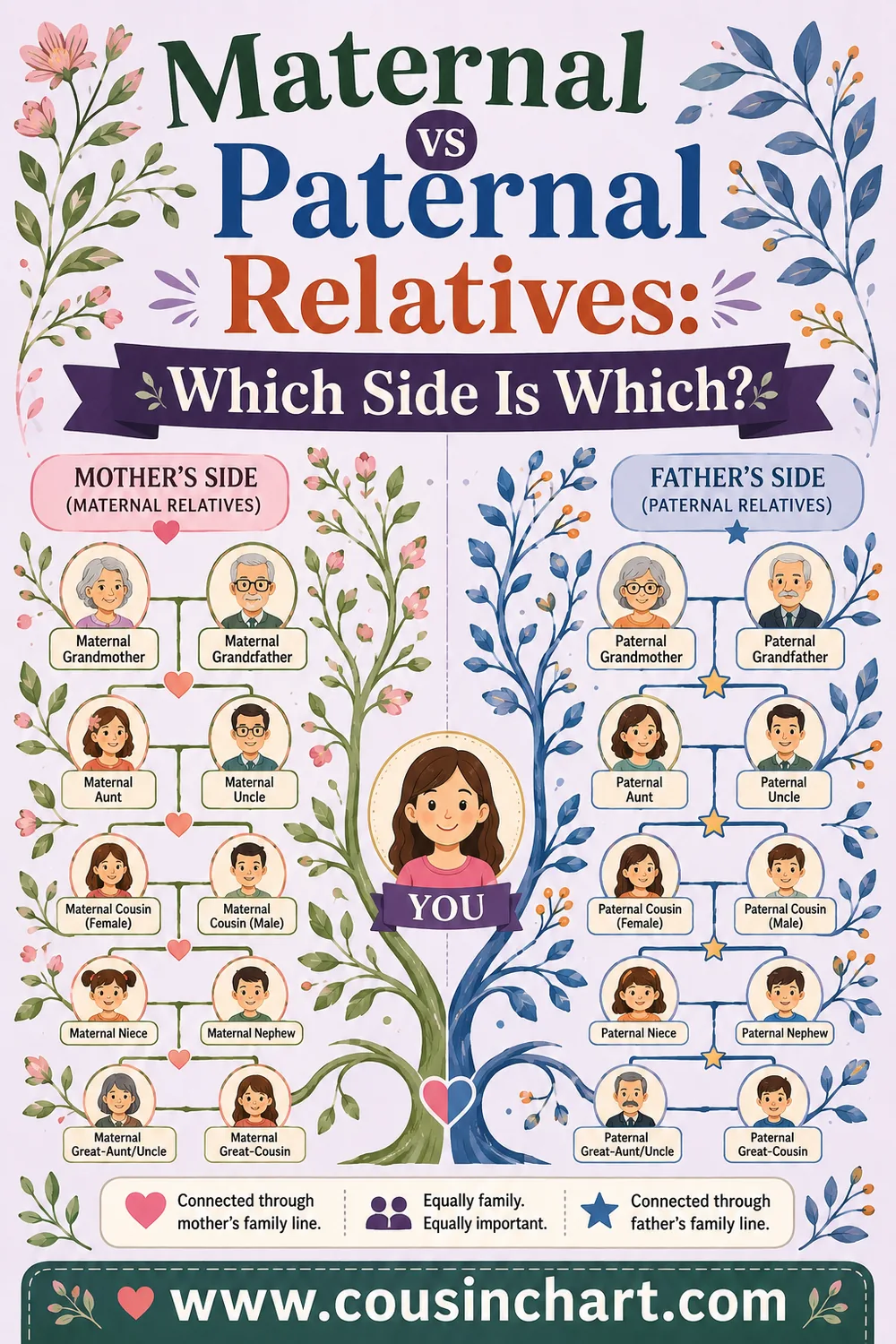
Maternal relatives are your mother's side of the family; paternal relatives are your father's side. Your maternal grandmother is your mom's mom, your paternal uncle is your dad's brother — the label simply tells you which parent the relationship runs through.
Simple rule, surprisingly useful. The maternal/paternal split organizes family trees, decides how DNA tests trace your deep ancestry, shapes medical-history questions at the doctor's office, and explains why some languages have four different words for "grandma." This guide charts the whole system. And whenever a specific relative needs naming — maternal or paternal, near or far — the free family relationship calculator works it out in seconds.
Relationship quick-check. Tap a phrase to see the correct term:
The answer will appear here.
How the Labels Work
"Maternal" and "paternal" are adjectives you bolt onto any relationship term, and they always answer one question: which of your parents does this connection pass through?
- Maternal grandfather = your mother's father
- Paternal aunt = your father's sister
- Maternal first cousin = a first cousin through your mother (her sibling's child)
- Paternal great-grandmother = one of your father's grandmothers
Two details trip people up. First, the label is anchored to you — your maternal grandmother is simultaneously somebody's paternal grandmother if she also has a son with kids. The adjective isn't a property of the person; it's a property of your path to them. Second, the label sticks for the entire branch: your maternal grandmother's brother is your maternal great-uncle, his kids are your maternal first cousins once removed, and so on down the branch.
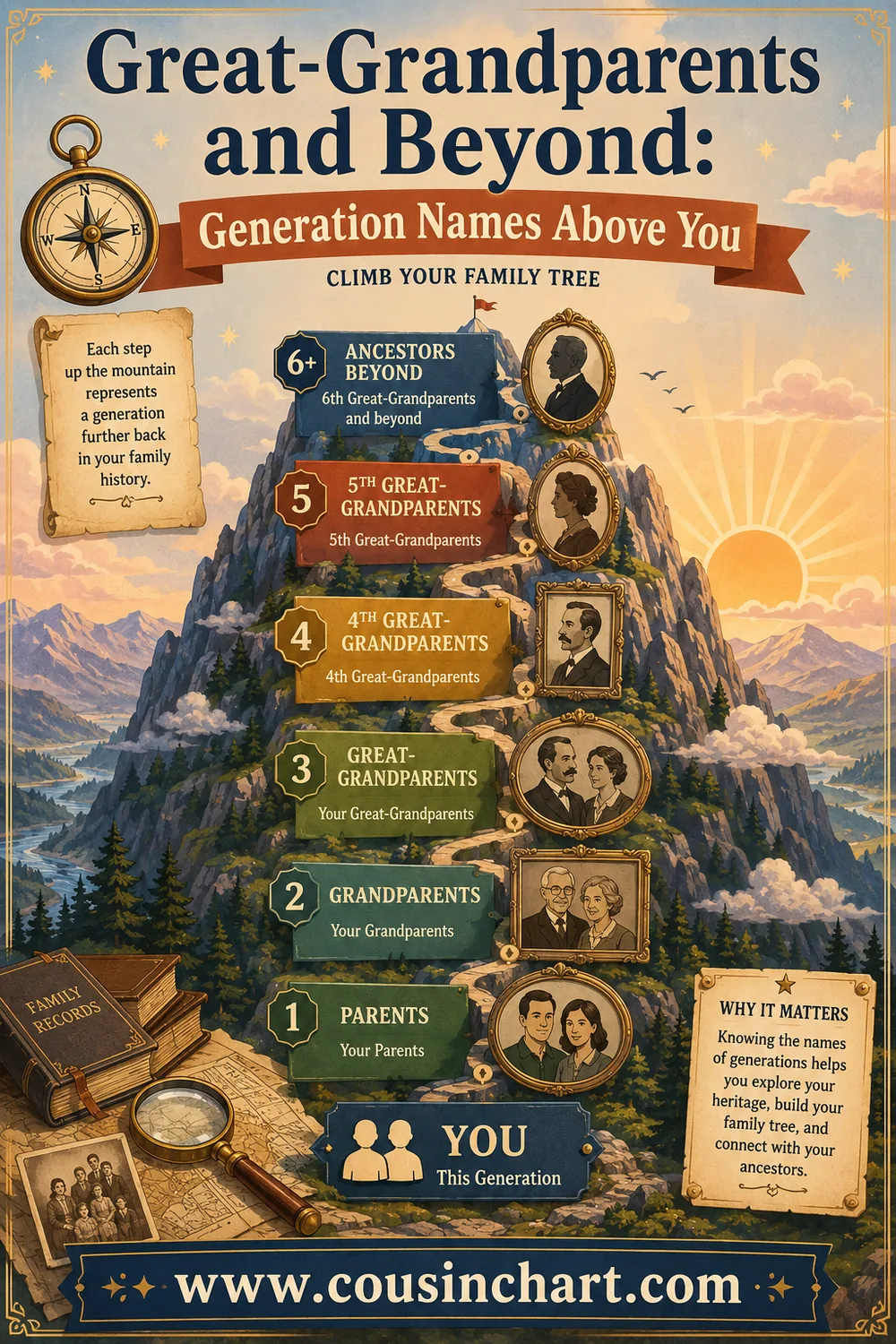
You have (barring family overlap) two grandparents, four great-grandparents, and half of every ancestor level on each side — the generations chart doubles identically on both wings.
The Maternal and Paternal Lineage Chart
| Relationship | Maternal version | Paternal version |
|---|---|---|
| Grandmother | Mom's mom | Dad's mom |
| Grandfather | Mom's dad | Dad's dad |
| Aunt | Mom's sister | Dad's sister |
| Uncle | Mom's brother | Dad's brother |
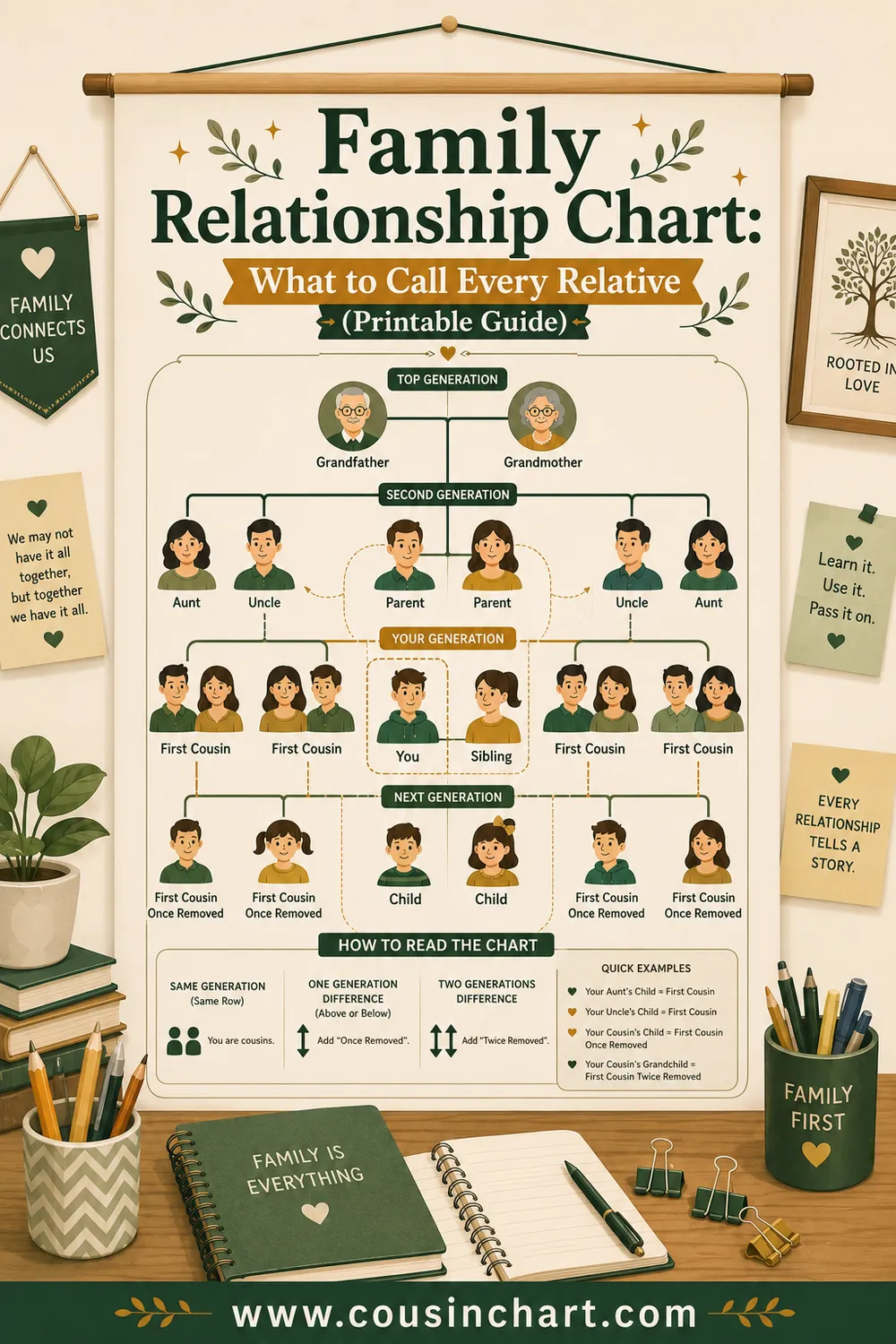
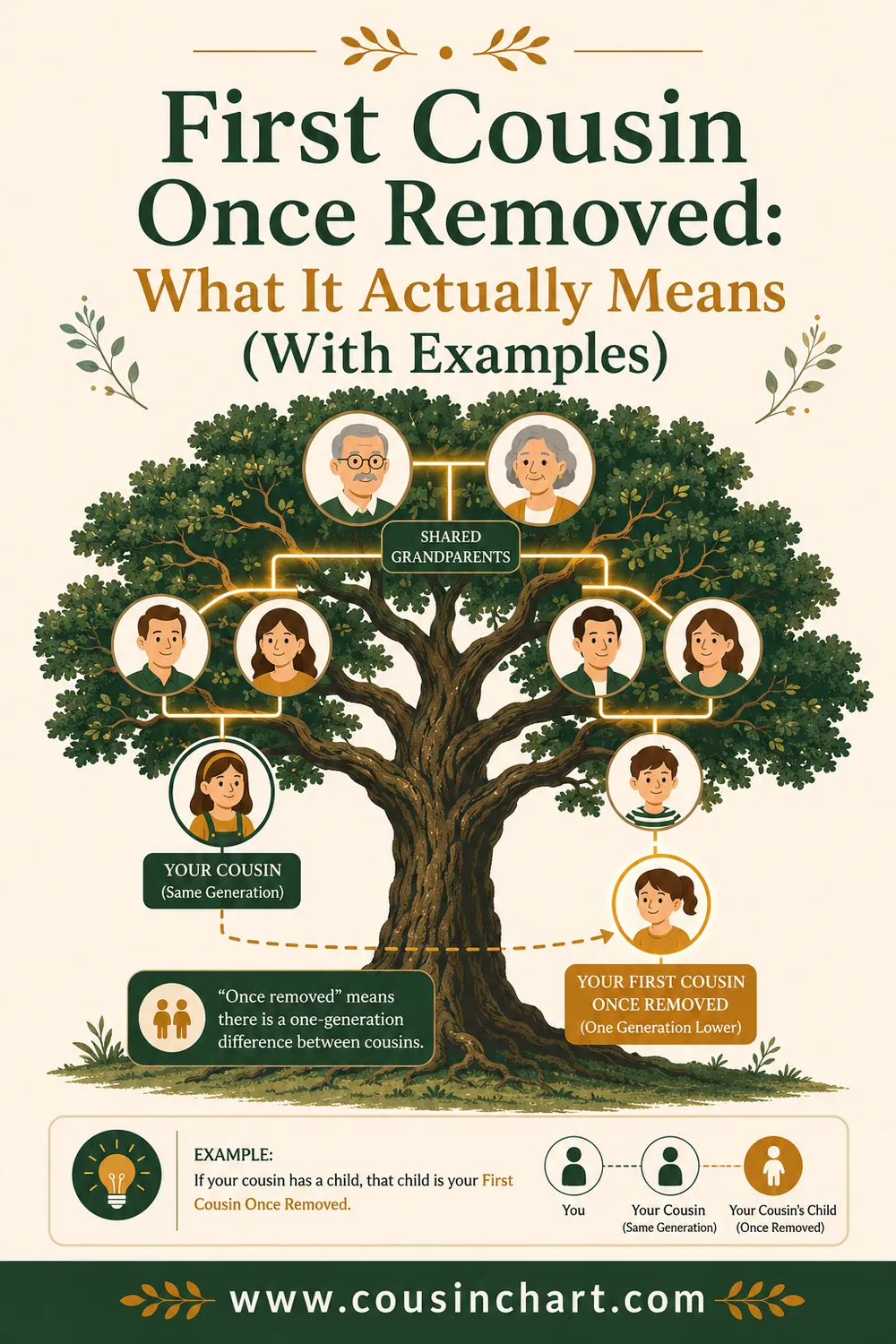
| First cousin | Mom's sibling's child | Dad's sibling's child |
| Great-aunt/uncle | Mom's aunt/uncle | Dad's aunt/uncle |
| Great-grandparents | Mom's grandparents (4 people) | Dad's grandparents (4 people) |
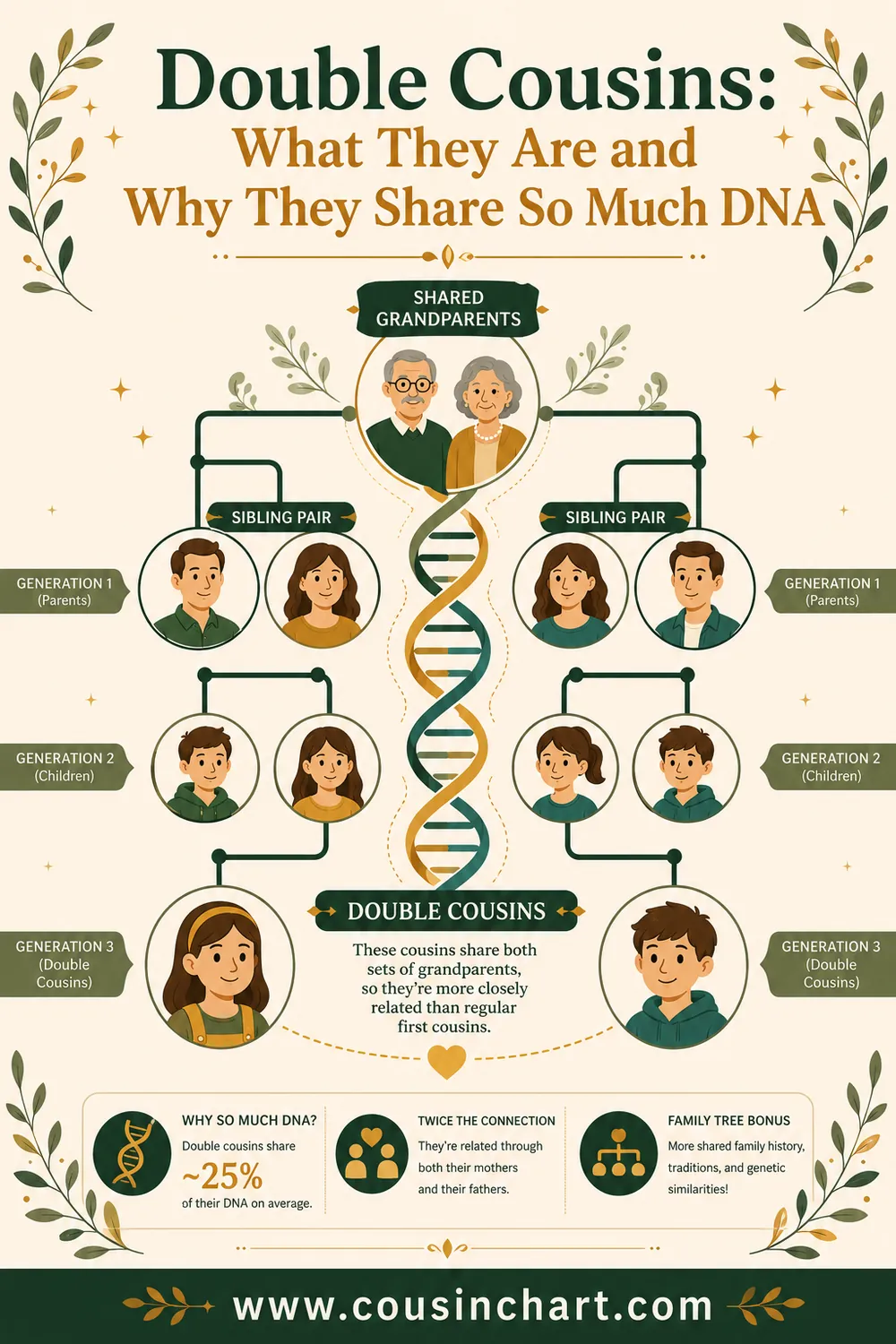
Note that some relatives take neither label: your siblings, your children, and everyone who married in from outside. And one wonderful case takes both: double cousins, who are related through your mother and your father because a pair of siblings married another pair of siblings.
Languages That Never Needed the Adjectives
English makes you say "maternal grandmother"; plenty of languages just have a different word:
- Swedish: mormor (mother's mother), morfar (mother's father), farmor (father's mother), farfar (father's father). The words literally spell out the path.
- Mandarin Chinese: 外婆/姥姥 (maternal grandma) vs. 奶奶 (paternal grandma), plus entirely different words for maternal and paternal uncles, aunts, and cousins.
- Hindi and Urdu: nani/nana (maternal grandparents) vs. dadi/dada (paternal), with the same side-split running through uncles (mama vs. chacha) and beyond.
- Danish and Norwegian: same mormor/farfar system as Swedish.
Kinship systems like these hint at something anthropologists confirm: many cultures treat the two sides as socially different — different obligations, different inheritance, different households. English's vagueness is the historical oddity, not the rule.
Matrilineal, Patrilineal, and Your Two "Pure" Lines
Beyond everyday labels, two special chains matter in genealogy and genetics:
- Your strict maternal line: your mother, her mother, her mother, and so on — an unbroken chain of mothers. This is the path your mitochondrial DNA (mtDNA) follows: everyone inherits mtDNA from their mother, so it traces this one thread back centuries.
- Your strict paternal line: your father, his father, his father — the chain the Y chromosome follows, father to son. (Only males carry it, so a woman explores her paternal line by testing a brother, father, or paternal uncle.) It's also, in most Western naming traditions, the surname line.
These two threads cover just a sliver of your ancestry — at ten generations back, each is 1 line out of 1,024 — but they're the deepest-reaching tools in genetic genealogy. The full comparison of what each test type can see is in mtDNA vs Y-DNA vs autosomal.
Whole societies have organized descent around one thread or the other: patrilineal systems (clan and surname through fathers — historically China, Rome, most of Europe) and matrilineal systems (descent through mothers — the Navajo, Hopi, Minangkabau, and Ashkenazi Jewish religious status, among many others).
Why the Side Matters in Practice
DNA test results. Autosomal tests inherit ~50% from each parent, and match lists become vastly more useful once you sort matches by side. If a parent has tested, sites do it automatically; if not, known maternal or paternal cousins become your sorting anchors. An unexpected match that shares DNA with your maternal cousins but not your paternal ones has just told you where to look.
Medical history. Doctors often ask which side a condition runs on. Some risks weight differently by side — X-linked conditions pass via the maternal line to sons, and mitochondrial disorders follow the mtDNA thread exactly.
Genealogy hygiene. Every serious family tree splits at you into two research projects. Filing records by side (and labeling photos "maternal grandparents' farm," not just "the farm") is the habit that saves descendants decades of confusion. A printable family relationship chart with the two wings marked makes a great research map.
Inheritance edge cases. Some intestacy statutes split certain estates between maternal and paternal kindred lines when only distant relatives survive — one more place the adjective quietly does legal work. Laws vary by state.
Half-Siblings: The One-Wing Relatives
Blended families give the maternal/paternal split an extra twist worth spelling out. A half-sibling shares exactly one wing with you — and owns a whole second wing you have no connection to at all.
Say you and your half-brother share a mother. Then:
- His maternal relatives are your maternal relatives — same grandmother, same aunts, same maternal cousins, no difference at all.
- His paternal wing — his father, that father's parents, siblings, and cousins — is a complete family tree of strangers to you. You'll meet them at his birthday parties for decades; genealogically, they're nobody to you.
- Your children and his children will be half first cousins, connected only through the shared maternal wing.
This one-wing structure is exactly what a DNA test displays: maternal half-siblings share ~25% DNA, all of it traceable to the mother's side, and none of his paternal matches will appear in your list. It's also a common source of confusion in family medical histories — your half-brother's paternal heart disease tells your doctor nothing about you, even though he's your close blood relative. When you fill in "brother" on an intake form for a half-sibling, mention the half: the side it removes from consideration is half the point.
Why One Side Often Feels Closer
Here's a pattern sociologists have measured repeatedly: in many Western families, people report knowing their maternal relatives better — more contact with the maternal grandmother, more holidays with mom's siblings, better recall of mom's family history. The usual explanations:
- Kin-keeping is gendered work. In most families, women disproportionately do the calling, card-sending, reunion-planning, and story-remembering. Mothers keep their own side warm, so children grow up marinated in it.
- Maternal grandmothers lean in. Across many studies of grandparental involvement, maternal grandmothers rank as the most involved grandparent on average, paternal grandfathers the least.
- Proximity habits. Young families historically settled nearer the wife's parents slightly more often in some communities — small effects that compound over a childhood of Sunday dinners.
None of this is destiny, and plenty of families run the other way — patrilineal cultures deliberately organize closeness around the father's side, and any individual family can defy every average. But the asymmetry has a practical genealogy consequence: most people's paternal wing is under-documented. Fewer stories, fewer labeled photos, fuzzier dates. If that's your tree, treat the paternal side as the priority interview list while the older generation is still around — the maternal side's stories usually have more caretakers.
And notice the irony baked into the records themselves: traditional Western genealogy followed surnames — the paternal thread — so official documents over-represent the father's line even while family memory over-represents the mother's. Balanced research needs both wings deliberately.
FAQ
What does maternal mean in a family tree?
Related through your mother. Your maternal relatives are her parents, siblings, cousins, and their descendants — the entire branch of the tree you reach through her.
Is my maternal grandmother my mom's mom or dad's mom?
Your mom's mom. Maternal always points through your mother, paternal through your father. Your dad's mom is your paternal grandmother.
Are cousins maternal or paternal?
Whichever parent connects you. Your mother's sibling's kids are maternal first cousins; your father's sibling's kids are paternal first cousins. Genealogically the relationship is identical — the label just records the route.
What is the maternal line in DNA testing?
The unbroken chain of mothers: your mother's mother's mother, back through time. Mitochondrial DNA passes along exactly this line, which is why mtDNA tests can trace it even where paper records run out.
How do I sort DNA matches by side if neither parent has tested?
Anchor on known cousins. Find a match you can already place — a confirmed maternal first cousin, say — and every match who shares DNA with both of you is very likely maternal too. Repeat with a paternal anchor and most of your list sorts itself into wings; the testing sites' shared-match tools do the comparing for you.
Can a relative be both maternal and paternal?
Yes — when the two sides intermarried. Double first cousins (two siblings married two siblings) are the classic case, and in communities with generations of intermarriage the same ancestor can appear on both wings of your tree.
Do step-relatives get maternal and paternal labels?
Informally, yes — "my paternal step-grandmother" is instantly understood as your father's stepmother. Just remember the label marks the path, not blood: a paternal step-grandmother shares no DNA with you and doesn't belong in your father's-side medical history, however firmly she belongs at his table.
Which grandparents are the "same side" as my surname?
In cultures with father-inherited surnames, the name follows your strict paternal line — your paternal grandfather, his father, and up. But that's naming custom, not genetics: your paternal grandmother contributed just as much DNA to your father as his father did, and Spanish and Filipino naming traditions famously carry the mother's family name too, one generation at a time.
Do I get more DNA from my maternal or paternal side?
Almost exactly half from each parent — that part is fixed. But which grandparent's DNA you carry more of varies: the 50% from your mom is a random shuffle of her two parents, so you might carry 28% maternal grandma and 22% maternal grandpa. Only the parent-level split is guaranteed.
Put Both Sides on One Chart
Maternal = through mom, paternal = through dad, and the label rides along the whole branch — that's the entire trick. The fun starts when you actually map both wings and see how a mom's-side great-aunt and a dad's-side second cousin fit around you. That's precisely what the free family relationship calculator draws: pick the person, tap the path through either parent, and get the exact term with the side built right into the picture. No signup, no chart-reading skills required — just which side is which, settled.