What Does "Cousin Sister" Mean? The Term Explained
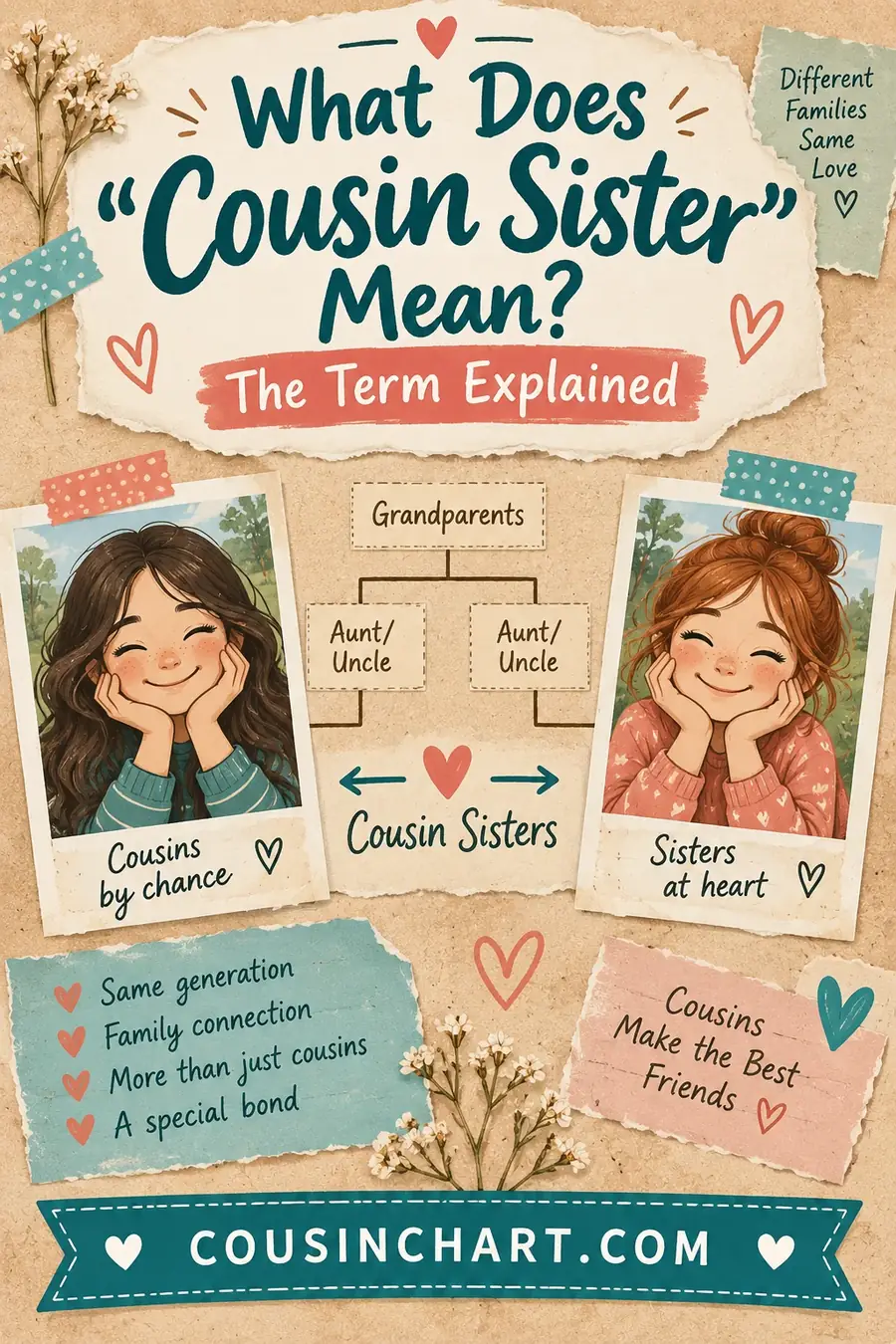
A cousin sister is a female cousin — most often the daughter of your aunt or uncle, which in standard American terminology is a first cousin. The compound is ordinary, unremarkable English in India, Pakistan, Bangladesh, Sri Lanka, Nepal and across the South Asian diaspora, and it exists for a straightforward reason: English is unusual among world languages in having only one word for cousin, with no way to say whether that cousin is male or female.
If you've heard the term for the first time and wondered whether it means something more specific than "cousin" — a cousin you were raised with, a cousin who is somehow also a sister, a step-relation — the answer is usually no. It means a female cousin. What it adds is precision that plain English doesn't offer, plus, quite often, a note about closeness.
The short definition
| Term | Means | Equivalent in American English |
|---|---|---|
| Cousin sister | Female cousin, usually a first cousin | Cousin (female) / first cousin |
| Cousin brother | Male cousin, usually a first cousin | Cousin (male) / first cousin |
| Cousin | Either, when gender isn't relevant | Cousin |
The construction follows a simple pattern: cousin narrows the relationship to your parents' siblings' children, and sister supplies the gender that English otherwise leaves out. You'll also see it written as a hyphenated cousin-sister, and occasionally as two words used in the reverse order in speech ("she's my sister — cousin sister"), which is a speaker clarifying after the fact.
This is standard English, not a mistake
It's worth stating plainly, because a lot of what's written about this phrase online gets it wrong: cousin sister is not broken English, not a translation error, and not something a speaker should be corrected on. It is a normal feature of Indian English, which is a fully developed variety of English with tens of millions of first-language speakers and hundreds of millions of fluent users. Indian English has its own vocabulary, its own idioms, and its own settled conventions, the same way American English and Australian English do.
Compare it to any other variety-specific term. An American says sidewalk, a British speaker says pavement. An American fills out a form, a British speaker fills in one. Nobody calls either of these mistakes. Cousin sister sits in exactly the same category — a term that is standard in its own variety and simply unfamiliar in others.
The reason it sometimes gets flagged as an error is that speakers of American and British English hear the compound as redundant, since they parse sister as strictly meaning a parent's daughter. But that's a fact about their variety, not about the phrase. In the varieties that use it, sister has a broader reach, and the compound resolves the ambiguity rather than creating it.
Why English has no gendered word for cousin
This is the actual root of the whole thing, and it's a quirk of English rather than a universal feature of language.
English kinship terms are what anthropologists call a lineal system. It draws sharp distinctions inside the nuclear family — mother, father, sister, brother, son, daughter — and then flattens almost everything outside it. Every child of every aunt and uncle, on both sides, of any age and any gender, gets one word: cousin. Their parents get two: aunt and uncle, with no indication of which side of the family they come from or whether they married in.
It wasn't always quite this bare. Old English had a richer set of compound terms built from fæder and modor to distinguish paternal from maternal relatives. Those were largely lost after the Norman period, when English borrowed cousin from Old French cosin, itself from Latin consobrinus. Middle English also had cousin-german, from Latin germanus meaning "full" or "of the same parents," which specified what we'd now call a first cousin. That term is archaic today but survives in older legal and genealogical documents. For centuries cousin was also used far more loosely than it is now — as a general word for kinsman, and as a form of address between monarchs and nobles.
So English arrived at the modern situation by subtraction. Most other languages did not.
The same construction in other languages
Here's the part that undercuts the "it's redundant" objection completely: several languages build their cousin words out of a sibling word plus a modifier. The English compound is doing something ordinary.
| Language | Female cousin | Literal structure |
|---|---|---|
| Russian | dvoyurodnaya sestra | "second-degree sister" |
| Polish | siostra cioteczna (alongside kuzynka) | "aunt-side sister" |
| Ukrainian | dvoyuridna sestra | "second-degree sister" |
| Mandarin Chinese | biao jie / tang mei and related forms | "outside elder sister" / "hall younger sister" |
| Hindi | chacheri bahan, mameri bahan, phupheri bahan | "paternal-uncle sister," "maternal-uncle sister," and so on |
| Bengali | khudtuto bon and related forms | uncle-derived + "sister" |
| Spanish | prima | gendered form of primo |
| French | cousine | gendered form of cousin |
| Portuguese | prima | gendered form of primo |
| Italian | cugina | gendered form of cugino |
| German | Cousine (also Kusine) | gendered form of Cousin |
| Arabic | bint al-amm, bint al-khal | "daughter of the paternal/maternal uncle" |
| Korean | sachon | "fourth degree" of kinship, gender added separately |
| Japanese | itoko | neutral in speech; written with different characters by gender and relative age |
Russian is the cleanest parallel. A Russian speaker saying dvoyurodnaya sestra is saying, almost word for word, "cousin sister" — a sister at two degrees of removal. Nobody describes that as an error in Russian, because it's the only available term.
Hindi and the other South Asian languages go further still. They don't just mark gender; they mark which side of the family the cousin comes from, because the relationship to a father's brother's daughter is socially different from the relationship to a mother's brother's daughter. A speaker moving from that system into English loses several distinctions at once. Restoring the gender with sister recovers the one that matters most in everyday conversation.
Why cousins are called sisters and brothers at all
There's a second layer, and it's cultural rather than grammatical.
In much of South Asia, extended families historically lived together or very close by, and first cousins were raised alongside siblings rather than seen at holidays. A cousin who shared your house, your meals and your school run isn't socially equivalent to a cousin you meet twice a year. The language reflects that: many South Asian speakers simply call such a cousin sister or brother, or use the kinship terms didi (elder sister), behen (sister), bhai (brother) directly.
Cousin sister is the bridge form. It carries the closeness of sister while staying precise enough that an outsider knows the exact blood relationship. That's why you'll often hear it used at weddings, in introductions and on forms — moments when the speaker wants both the warmth and the accuracy.
The same logic produces two related terms you may encounter:
- Own cousin or real cousin — a first cousin, as opposed to a more distant one. Used when someone wants to distinguish the closest relationship from the general use of cousin for any relative.
- Cousin brother — the male counterpart, and by far the most common companion term.
- Co-sister and co-brother — used in Indian English for the relationship between people married to two siblings. Your husband's brother's wife is your co-sister. Standard English has no single word for this at all; you'd have to say "my sister-in-law's..." and then explain.
How cousin sister maps to first, second, and removed cousins
Cousin sister is not a separate degree of kinship. It's a gender label applied on top of the ordinary cousin system, so the two vocabularies stack rather than compete.
| Relationship | Standard term | Common South Asian English |
|---|---|---|
| Your aunt's or uncle's daughter | First cousin | Cousin sister |
| Your aunt's or uncle's son | First cousin | Cousin brother |
| Your parent's first cousin's daughter | Second cousin | Second cousin sister, or just cousin sister |
| Your first cousin's daughter | First cousin once removed | Usually niece, or cousin's daughter |
| Your grandparent's sibling's grandchild's child | Third cousin | Rarely specified; simply cousin |
In practice, cousin sister used without qualification almost always means a first cousin — the daughter of a parent's sibling. Speakers who want to talk about more distant relatives usually reach for distant cousin or name the connection directly ("my mother's cousin's daughter"), because the compound loses its usefulness once the relationship gets far enough away that the sibling-like closeness no longer applies.
If you're trying to place a particular relative precisely — working out whether someone is a second cousin or a first cousin once removed, for instance — the degree and the removal are separate questions from gender. A cousin chart will settle the degree, and then sister or brother is simply added on top of whatever the chart tells you.
When to use it and when to explain it
Use it freely wherever it's understood, which is most of South Asia, much of the Gulf, and any English-speaking city with a substantial South Asian community. Nobody will blink.
In international or written contexts, you may want to add a word of context the first time, not because the term is wrong but because your reader may not have met it. "My cousin sister — my aunt's daughter" costs four words and prevents a misreading. American and British listeners occasionally hear it as step-sister or foster sister, which is a genuinely different relationship, so the clarification is worth it in a legal, medical or immigration setting where precision matters.
On official forms, write what the form is asking for. Immigration paperwork, insurance beneficiary forms and hospital next-of-kin fields usually want a fixed vocabulary: cousin, or first cousin, or a specific parental link. This isn't a judgment on the term; it's the same reason you write sibling on a form and my brother in a text message.
When someone else uses it, the correct response is to understand it, not to correct it. Asking "do you mean your cousin?" is technically a clarification, but it reads as a correction to most speakers, and it's an unnecessary one — the meaning was already clear.
Common misunderstandings
"It must mean a cousin who was raised as a sister." Sometimes true as a matter of fact, but not part of the definition. It means a female cousin. The closeness is often implied and never required.
"It's a translation of a Hindi phrase." It's more accurate to say it fills a gap that Hindi and dozens of other languages don't have. It isn't a word-for-word rendering of any single source phrase; several South Asian languages produce the same need independently.
"It's only used by older speakers." No. It's in current use across every age group, including among people who grew up speaking English as their first language, and it appears routinely in Indian newspapers, novels and everyday conversation.
"It means the same as sister-in-law." No — a sister-in-law is related by marriage. A cousin sister is a blood relative, the daughter of one of your parents' siblings.
"Cousin sister and cousin brother are the only compound kinship terms in Indian English." Not remotely. Co-brother, co-sister, cousin brother, own brother, and the widespread use of uncle and aunty as respectful terms for non-relatives all belong to the same system, which is generally more explicit about relationships than standard American English is.
A note on why precision here is worth having
There's a practical argument for the term that goes beyond politeness. English's flatness around cousins genuinely causes confusion. Say "my cousin is getting married" to an American and they know almost nothing: not the gender, not the side of the family, not the degree, not whether you grew up together. Say "my cousin sister is getting married" and you've resolved one of those in two words at no cost.
Anyone who has tried to explain a family tree over the phone knows how quickly the vocabulary runs out. The languages that keep more distinctions aren't being fussy — they're doing something English gave up somewhere around the fourteenth century, and speakers who use cousin sister in English are quietly patching a hole the language left behind.
Frequently Asked Questions
Is "cousin sister" correct English? Yes. It is standard in Indian English and other South Asian varieties of English, which are legitimate varieties with their own settled vocabulary. It may be unfamiliar to American or British listeners, but unfamiliar is not the same as incorrect.
Does cousin sister mean first cousin? Almost always, yes. Used without qualification it means the daughter of one of your parents' siblings, which is a female first cousin. Speakers occasionally extend it to second cousins, but usually add a word to say so.
What is the male equivalent? Cousin brother, built exactly the same way and used in the same contexts. The pair covers the gender distinction that plain English cousin leaves open.
Do other languages have a phrase like this? Many do. Russian and Ukrainian literally say "second-degree sister," Polish has an aunt-side sister form, Arabic says "daughter of the paternal uncle," and Hindi marks both gender and which side of the family the cousin comes from. English is the outlier for having no gendered cousin word at all.