Matrilineal vs. Patrilineal: Descent, Surnames and DNA Explained
Matrilineal vs patrilineal comes down to one question: which parent's line do you belong to? In a patrilineal system, descent, group membership and often inheritance pass from fathers to their children, so you belong to your father's line. In a matrilineal system, they pass through mothers, so you belong to your mother's line, even though men are still part of it and often hold authority within it.
Those two ideas show up in surprising places. They explain why most American kids carry their father's surname, why a man in some societies leaves his land to his sister's son instead of his own, and why a DNA test can trace your father's father's father's line or your mother's mother's mother's line but not the dozens of other ancestors in between. This guide covers all three: the anthropology, the surnames and the genetics, with real societies, real numbers and worked examples.
Matrilineal vs patrilineal: the quick comparison
| Patrilineal | Matrilineal | |
|---|---|---|
| Also called | Agnatic descent | Uterine descent |
| You belong to | Your father's line | Your mother's line |
| Line passes through | Men (father to son to son) | Women (mother to daughter to daughter) |
| Who passes membership to children | Only men | Only women |
| A man's typical heir (in many societies) | His son | His sister's son |
| Key male relative outside the household | Father's brother | Mother's brother |
| Matching DNA line | Y chromosome (Y-DNA), passed father to son | Mitochondrial DNA (mtDNA), passed mother to all children |
| Matching surname custom | Children take the father's surname | Children take the mother's surname (rare in surname cultures) |
| Share of societies in D-PLACE | About 46% | About 13% |
Both are types of unilineal descent, meaning descent traced through one line only. The open textbook OpenStax Introduction to Anthropology describes patrilineal (agnatic) descent as passing only through male ancestors and matrilineal (uterine) descent as passing only through female ancestors. It also points out that unilineal descent is a social rule for everyone in the society, not a choice each family makes.
What "descent" actually means
Descent sounds like it should just mean "who your ancestors are." Biologically, you descend from both parents, all four grandparents, all eight great-grandparents and so on. Nobody disputes that. In anthropology, though, descent means something narrower: the rule a society uses to decide which ancestors define your group membership, and with it your rights and duties.
OpenStax describes descent as the way families trace kinship and obligations across generations, shaping inheritance, alliances and marriage rules. So when anthropologists call a society matrilineal, they don't mean people think fathers aren't related to their kids. They mean that the group you belong to, with its land, names, titles and ritual duties, comes through your mother.
Four things that often travel together, but aren't the same
It's easy to blur these, so it helps to keep them separate:
- Descent: which line you belong to.
- Inheritance: who gets property, land or titles when someone dies.
- Residence: where a couple lives after marriage. Anthropologists use words like patrilocal (with or near the husband's family), matrilocal (with or near the wife's family) and neolocal (in a new, separate home).
- Authority: who makes decisions.
A society can be matrilineal in descent while still having men hold most formal authority. It can say couples "should" live with the wife's family while many actually don't. Keeping these four apart avoids most of the confusion around this topic.
Lineages and clans
Unilineal descent usually creates named groups. A lineage is a group of people who can trace their actual links back to a known common ancestor. A clan is a larger group that believes it shares an ancestor, even if nobody can trace every step. OpenStax notes that lineages can form clans and clans can form moieties, which divide a whole society into two halves. These groups often own land, arrange marriages, settle disputes and look after members in hard times.
Patrilineal descent: belonging to your father's line
In a patrilineal system, you're born into your father's group. Your father belongs to his father's group, and so on up the male line. Here's the important twist: women belong to their father's line but don't pass it on. A woman's children belong to her husband's line.
A worked example
Picture a patrilineal family over three generations:
- Grandfather Tomas belongs to Lineage T.
- His son Ben and daughter Ana both belong to Lineage T, because their father does.
- Ben's children belong to Lineage T, because they come through Ben.
- Ana marries Leo from Lineage L. Ana's children belong to Lineage L, their father's line, not to Lineage T.
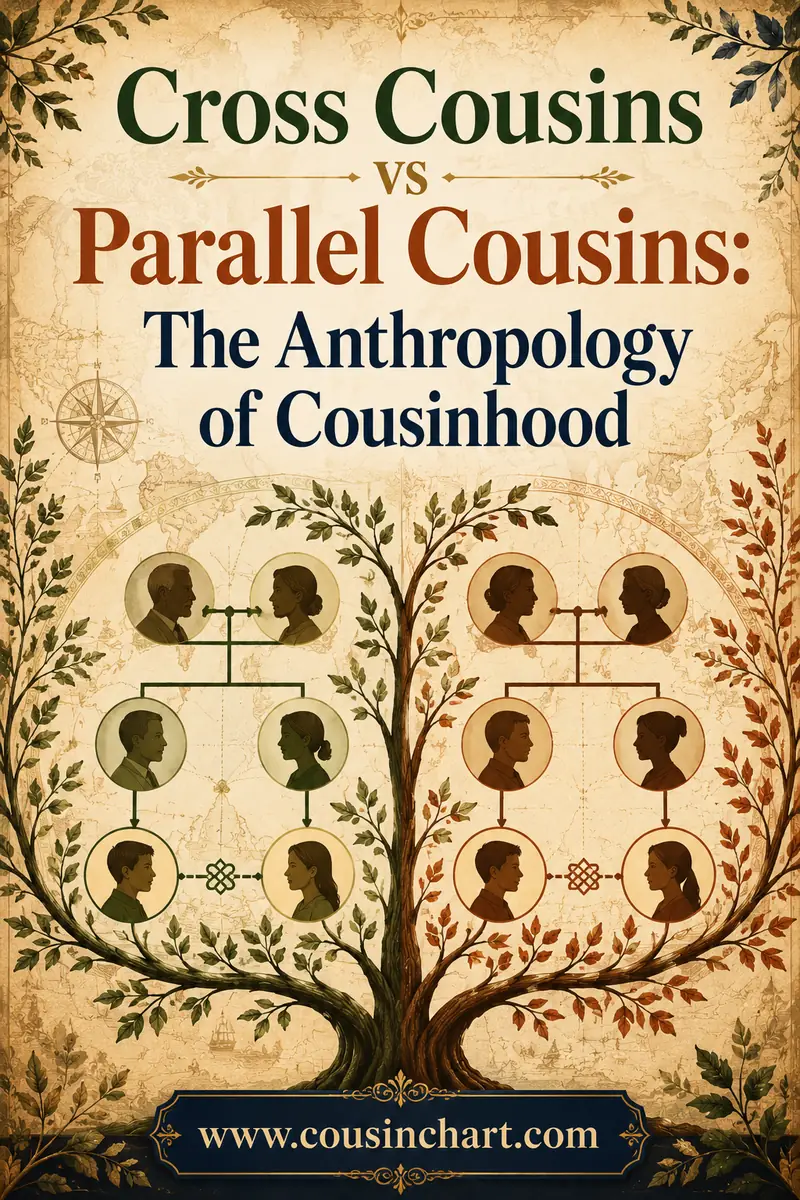
So Ben's kids and Ana's kids are first cousins by blood but belong to different groups. In many patrilineal societies, Ben's kids would be treated almost as siblings of Tomas's other male-line grandchildren, while Ana's kids are "outsiders" to the lineage in a social sense. This is exactly where the idea of cross cousins and parallel cousins comes from.
Where you find patrilineal descent
Patrilineal descent is the most common unilineal rule worldwide. It's been documented across Africa, Asia, the Pacific and the Americas, and it shaped the family structures of many historical societies in Europe and the Middle East, especially for inheritance of land and titles. The Ngoni of southern Africa are one example often contrasted with their matrilineal Chewa neighbors in Malawi, a comparison drawn in classic anthropological work summarized in the Open Encyclopedia of Anthropology's entry on matriliny.
Even societies that count kin on both sides, like the modern United States, often keep patrilineal traces. The most obvious one is the surname, which we'll get to shortly.
Matrilineal descent: belonging to your mother's line
In a matrilineal system, you're born into your mother's group. Your mother belongs to her mother's group, and so on up the female line. The mirror-image twist applies: men belong to their mother's line but don't pass it on. A man's children belong to his wife's line.
The Open Encyclopedia of Anthropology defines matriliny as a way of reckoning descent and belonging through the female line. It affects marriage arrangements, access to land and resources, a person's sense of "home" and even where people are buried.
The mother's brother: a key figure
Here's what surprises most people. In many matrilineal societies, a man's heirs to property or titles are his sister's children, not his own. That's because his sister's children are in his lineage, and his own children are in their mother's lineage. The same encyclopedia entry notes that this makes the bond between a mother's brother and his sister's children especially significant.
So in a matrilineal family, the person who passes down the family land, teaches a boy his clan duties or speaks for the family in disputes might well be the mother's brother, not the father. Fathers still love and raise their kids, of course. They just occupy a different slot in the system.
The "matrilineal puzzle"
That split creates a tension that anthropologists have studied for decades. The anthropologist Audrey Richards named it the matrilineal puzzle in 1950. Because people usually marry outside their own lineage, a father belongs to a different group than his children. He's pulled between his role as a father to his own kids and his role as a mother's brother to his sister's kids. The encyclopedia entry notes that early researchers saw this as a conflict for men, and that later scholars argued it reflected their own assumptions about the nuclear family being central.
Real matrilineal societies
| Society | Where | What's notable |
|---|---|---|
| Minangkabau | West Sumatra, Indonesia | Often described as one of the largest matrilineal societies in the world; studied for women's role in decision-making |
| Navajo (Diné) | Southwestern United States | Traditionally matrilineal, with descent and inheritance through mothers and grandmothers |
| Trobriand Islanders | Papua New Guinea | Made famous by the anthropologists Bronisław Malinowski and Annette Weiner |
| Bemba | Zambia | Part of south-central Africa's "matrilineal belt"; studied by Audrey Richards |
| Ashanti (Asante) | Ghana | A well-known matrilineal society in West Africa |
| Chewa | Malawi | Matrilineal; classically compared with their patrilineal Ngoni neighbors |
The Navajo example comes from OpenStax, which adds a useful reality check. The Navajo ideal was matrilocal residence, with couples living near the wife's family. But a 1983 study of the Shonto Navajo by William Yewdale Adams found matrilocal, patrilocal and neolocal residence all in use, with matrilocal not even the most frequent. Matrilineal kin still gave the most support during big life events like marriage and childbirth. Rules describe an ideal, and real families adapt.
The other examples come from the Open Encyclopedia of Anthropology, which describes matriliny as found on almost every continent and highlights the "matrilineal belt" across south-central Africa. It also quotes one scholar's observation that matrilineal groups "continue to be a minority in a sea of patriliny and patriarchy."
How matrilineal inheritance varies
Matrilineal societies don't all handle property the same way. The encyclopedia entry describes some that pass land from mothers to daughters, others that pass property from uncles to their sisters' sons, and some that combine the two. One scholar it cites suggests treating matriliny as a set of characteristics rather than a single fixed "system." That's a good mindset to bring to any society you read about.
Same family, two rules: who inherits?
To see how much the rule matters, take one man, Kofi, who has a son, a daughter, a sister and a sister's son. Imagine he holds a piece of lineage land when he dies. Here's who traditionally stands to inherit it under a strict version of each rule. (Real societies vary, and many now follow national inheritance laws instead.)
| Relative of Kofi | In Kofi's lineage under a patrilineal rule? | In Kofi's lineage under a matrilineal rule? | Likely heir to lineage land? |
|---|---|---|---|
| His son | Yes | No (belongs to his mother's line) | Patrilineal: yes. Matrilineal: no |
| His daughter | Yes, but she won't pass it on | No (belongs to her mother's line) | Usually not under either rule |
| His sister | Yes, but she won't pass it on | Yes, and she passes it on | Matrilineal: possibly, through her children |
| His sister's son | No (belongs to his father's line) | Yes | Patrilineal: no. Matrilineal: yes |
The same four people, with the same blood ties, end up in completely different positions. That's the heart of the matrilineal vs patrilineal difference: it isn't about who is related, it's about which relatives belong to the group that holds the property.
Matrilineal does not mean matriarchal
This is the most common mix-up of all. Matrilineal is about how descent is traced. Matriarchal is about who rules. They're different questions.
Early anthropologists in the 1800s and early 1900s often assumed matriliny meant matriarchy, partly because of now-discarded theories that cast "rule by women" as an early stage of human society. The Open Encyclopedia of Anthropology explains that matriliny describes how descent is traced, not necessarily who holds authority. In many matrilineal societies, formal authority rested with men, especially brothers and mothers' brothers. That said, later research also found "significant scope for women's authority" in matrilineal settings, so women's status there is often stronger than the word "patriarchy" would suggest.
The same goes for patrilineal societies and patriarchy. They often overlap, but tracing descent through men isn't the same thing as men holding all power. If you're curious about the household side of this, our guide to the family patriarch and matriarch covers how those words are used in everyday families.
Other descent systems: bilateral, ambilineal and double descent
Matrilineal and patrilineal aren't the only options. In fact, many people reading this live in a society that uses neither.
Bilateral descent
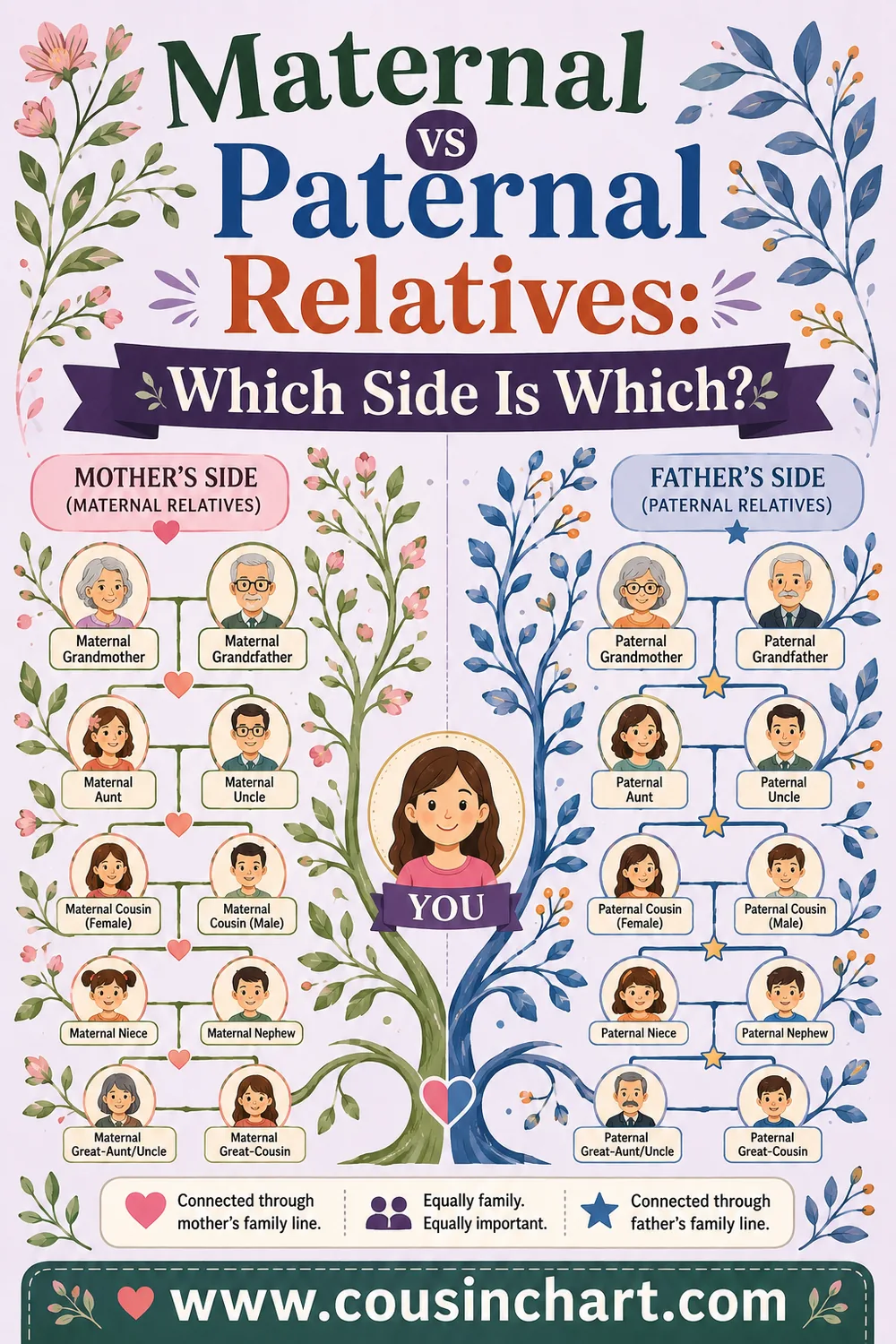
In bilateral (sometimes called bilineal) descent, you count relatives on both sides more or less equally. Your mother's sister and your father's sister are both just "aunt," and you don't belong to one exclusive lineage. OpenStax calls bilateral descent the most common form of descent in the United States today. Instead of a lineage, each person has a kindred: a personal network of relatives on both sides, centered on them. Our guide to maternal vs. paternal relatives shows how this works on a family tree.
Ambilineal descent
In ambilineal descent, a person or family can choose to affiliate with either the mother's or the father's group. OpenStax notes that the choice is often made at marriage, and that families within the same society may choose differently. It's flexible, and it's common in parts of the Pacific.
Double descent
Double descent, also called duolateral descent, means you belong to both your father's patrilineal group and your mother's matrilineal group, usually for different purposes. For example, you might inherit land through one line and movable goods or ritual roles through the other. It's less common, but it shows that matrilineal and patrilineal rules can coexist in one society.
How common is each descent system?
The D-PLACE database's coding of major descent types, built on the Ethnographic Atlas and hosted with the Max Planck Institute for Evolutionary Anthropology, gives a clear picture. It codes 1,274 societies in total. Here's the breakdown, with each share worked out as the count divided by 1,274:
| Descent type | Societies | Share |
|---|---|---|
| Patrilineal | 590 | 46.3% |
| Bilateral | 362 | 28.4% |
| Matrilineal | 160 | 12.6% |
| Duolateral (double descent) | 52 | 4.1% |
| Mixed | 50 | 3.9% |
| Ambilineal | 48 | 3.8% |
| Quasi-lineages | 12 | 0.9% |
What this tells us:
- Patrilineal societies outnumber matrilineal ones by more than 3 to 1 (590 ÷ 160 ≈ 3.7).
- Bilateral descent is the second most common, which matches the experience of most readers in North America and Europe.
- Matrilineal descent is a real, widespread minority, about one society in eight. It's not a curiosity found in one or two places.
As with any survey like this, the numbers count societies, not people, and they reflect groups ethnographers recorded mainly in the 1800s and 1900s. Many of these societies have changed since, often shifting toward bilateral or patrilineal patterns under the influence of colonial law, religion, wage labor and national legal systems.
Surnames: the patrilineal habit most of us live with
Even in a bilateral society like the United States, the surname is usually patrilineal. A child typically takes the father's last name, and that name passes down the male line. A woman who takes her husband's name at marriage effectively moves her household into his surname line. That's a patrilineal custom sitting on top of a bilateral kinship system.
Naming customs around the world
| Custom | How it works | Example |
|---|---|---|
| Patrilineal surname | Children inherit the father's family name, which stays the same down the male line | Most English-speaking countries, traditionally |
| Double surname | Children carry a surname from each parent | Spanish-speaking countries, where a child traditionally takes the father's first surname followed by the mother's first surname |
| Patronymic | Children take a name formed from the father's first name, so the "surname" changes every generation | Iceland: Jón's son is Jónsson, Jón's daughter is Jónsdóttir |
| Matronymic | A name formed from the mother's first name | Also possible in Iceland, used by some families |
| Hyphenated or chosen | Parents combine or choose between their surnames | Increasingly common in many countries |
Notice how the Spanish double-surname system gives a nod to the mother's line, but in the next generation it's the father's first surname that's passed on, so the male line still wins out over time. And patronymics don't create a lasting surname line at all, which is one reason genealogy research in patronymic cultures needs extra care.
Why surnames matter for family history
For genealogists, a patrilineal surname is both a gift and a trap. It's a gift because you can follow it back through records. It's a trap because it only tracks one line out of many. Go back five generations and you have 32 great-great-great-grandparents (2 × 2 × 2 × 2 × 2 = 32), but under a strict patrilineal custom only one of those 32 gave you your surname. Our guide to how many ancestors you have shows how fast those numbers grow.
DNA: how Y-DNA and mtDNA follow the paternal and maternal lines
Here's where matrilineal vs patrilineal stops being just a social rule and shows up in your cells. Two small parts of your DNA are inherited in a strictly one-line way, almost unchanged from generation to generation.
Y-DNA: the patrilineal line in your genes
The Y chromosome is one of the two sex chromosomes. People who are genetically male typically have one X and one Y, while people who are genetically female typically have two X chromosomes. MedlinePlus notes that the Y chromosome spans more than 59 million DNA base pairs, almost 2 percent of the DNA in cells.
Because a father passes his Y chromosome to his sons, and most of it doesn't mix with other DNA, a son's Y chromosome is nearly a copy of his father's, his father's father's and so on. Small changes called mutations build up slowly over many generations, which lets researchers estimate how closely two Y lines are related. The MedlinePlus guide to genetic ancestry testing explains that Y chromosome testing can be used to explore ancestry in the direct male line, and only males can take it.
mtDNA: the matrilineal line in your genes
Mitochondria are tiny energy-making structures inside your cells, and they carry their own small set of DNA. The National Human Genome Research Institute explains that offspring inherit mitochondria, and so mitochondrial DNA, from their mother, which is why mtDNA can be used to trace ancestry through the maternal line. According to MedlinePlus, mitochondrial DNA contains 37 genes.
Everyone has mtDNA, so anyone can take an mtDNA test. But only women pass it on. Your mtDNA came from your mother, who got it from her mother, who got it from hers. A man has his mother's mtDNA, but his children get theirs from their own mother.
Y-DNA vs. mtDNA side by side
| Y-DNA | mtDNA | |
|---|---|---|
| Follows which line | Direct paternal line (father's father's father...) | Direct maternal line (mother's mother's mother...) |
| Who has it | Males only | Everyone |
| Who passes it on | Fathers, to sons only | Mothers, to all their children |
| Who can take the test | Males | Anyone |
| Matches the descent rule | Patrilineal | Matrilineal |
| Usually tracks with | Patrilineal surnames | No surname (in most cultures) |
| What it can't see | Every ancestor not on the direct male line | Every ancestor not on the direct female line |
What about women who want their paternal line?
A woman doesn't have a Y chromosome, so she can't take a Y-DNA test herself. She can still learn about her father's direct male line by asking a male relative on that line to test: her father, her brother (full brother, sharing the same father), her father's brother or a son of her father's brother. Any of them carries the same Y line she's interested in.
And the rest of your DNA?
Y-DNA and mtDNA are just two narrow threads. Most of your genome is autosomal DNA, which you inherit from both parents and which gets shuffled every generation. MedlinePlus notes that autosomal testing looks at large numbers of genetic markers across these chromosomes and gives a broader view of your ancestry. That's the kind of test most popular consumer DNA kits use to find cousins. The X chromosome follows its own special pattern too, which our guide to X-DNA inheritance explains.
Surnames and Y-DNA: what happens when you put them together
Since patrilineal surnames and Y chromosomes both pass from father to son, you'd expect men with the same surname to often share a Y line. Geneticists Turi King and Mark Jobling made this point in a 2009 review, "What's in a name? Y chromosomes, surnames and the genetic genealogy revolution", noting that a patrilineal surname is inherited in the same way as the non-recombining part of the Y chromosome. They also flagged the factors that break the link: surnames founded by more than one unrelated man, non-paternity events (when the legal father isn't the biological father, including through adoption or name changes) and random drift over time.
What the data showed
In a companion study, "Founders, drift, and infidelity", King and Jobling analyzed 1,678 Y-chromosome types from men with 40 British surnames. Their findings:
- Men sharing a surname often shared ancestry, and that shared ancestry tended to be higher for rarer surnames.
- On average, 62% of the Y types fell into "descent clusters" within a surname, but the figure ranged from 0% to 87% depending on the name.
- Random variation in how many sons each man had (genetic drift) shaped the patterns so strongly that modern Y-DNA says little about how many founders a surname had when surnames were established, roughly 700 years ago.
The practical lesson for family historians: a surname DNA project can be powerful, especially for an uncommon name. But two men sharing a common surname shouldn't assume they share a paternal line, and a Y-DNA mismatch between two men with the same name isn't automatically a scandal. It might mean two separate founders, an adoption, a name change or an event centuries back.
Worked example: tracing both lines in one family
Let's make this concrete with a made-up family. Meet Maya and her brother Sam.
- Sam's Y-DNA came from their father, Daniel Park, who got it from his father, Henry Park, who got it from his father. If the surname followed the custom with no breaks, Sam's Y line and the Park surname have traveled together.
- Maya doesn't have a Y chromosome, so if she wants to explore the Park paternal line, Sam is her best tester.
- Both Maya and Sam have the same mtDNA, from their mother, Elena Ruiz, who got it from her mother, Rosa Ortiz, who got it from her mother, Lucia Vega. Notice that the surname changes every generation on this line: Vega, Ortiz, Ruiz, Park. mtDNA has no surname to follow.
- Only Maya will pass that mtDNA on. Sam's future children will get their mtDNA from their own mother.
How much of the family tree each line covers
Now step back 10 generations. Maya and Sam each have 2 to the 10th power, or 1,024, ancestor slots in that generation (2 × 2 × 2, ten times, equals 1,024). The Y line covers exactly one of those slots: their father's father's father, and so on. The mtDNA line also covers exactly one: their mother's mother's mother, and so on. That's 2 out of 1,024, or about 0.2 percent.
This is why Y-DNA and mtDNA are great for deep, single-line questions, like "did my direct paternal line come from this village?", but can't tell you about the overwhelming majority of your ancestors. For those, you need autosomal DNA and records. (In real families the number of distinct ancestors is often smaller, because of pedigree collapse, when the same ancestor appears in more than one slot.)
Try it yourself
Draw your own family tree back to your great-grandparents. You'll have 8 great-grandparents. Circle the one whose Y-DNA a male in your direct paternal line would carry (your father's father's father). Then circle the one whose mtDNA you carry (your mother's mother's mother). Six of your eight great-grandparents aren't covered by either test. Now ask yourself which of those eight your surname came from.
Common mix-ups about matrilineal vs patrilineal
Mix-up 1: "Matrilineal means women are in charge"
No. That's matriarchy, a separate idea. Matrilineal describes how descent and belonging are traced. Authority in matrilineal societies often sits with men, especially brothers and mothers' brothers, though women frequently have more standing than in many patrilineal societies.
Mix-up 2: "In a patrilineal society, mothers aren't considered relatives"
Not true. People know and value their mother's family. The rule decides which group you formally belong to and inherit through, not who counts as family in the everyday sense.
Mix-up 3: Confusing "maternal" with "matrilineal"
Your maternal relatives are everyone on your mother's side, including her father and her brothers' children. Your matrilineal line is narrower: only the chain that runs through women. Your mother's father is a maternal relative but isn't on your matrilineal line. The same goes for "paternal" versus "patrilineal."
Mix-up 4: "My mtDNA comes from my mother and my father, mixed"
mtDNA comes from your mother only. It's your autosomal DNA that comes from both parents and gets mixed.
Mix-up 5: "Same surname means same family"
Sometimes, especially for rare surnames. But King and Jobling's study found that the share of men sharing a Y line within a surname ranged from 0% to 87%. Common surnames were often founded many times by unrelated men.
Mix-up 6: "A Y-DNA or mtDNA match tells me exactly how we're related"
Because these lines change so slowly, two people can match closely and still share their common ancestor many generations back. A Y-DNA or mtDNA match points to a shared line, not a precise relationship. To pin down a relationship, you'll usually need autosomal DNA and records. Our guide to DNA matches walks through how to read them.
Putting it together for your own family tree
The difference between matrilineal vs patrilineal is simple to state: one traces belonging through mothers, the other through fathers. But it reaches into land and inheritance, the role of the mother's brother, the surname on your birth certificate, and two little threads of DNA that run straight back through your direct maternal and paternal lines. Most societies documented by anthropologists are patrilineal, a large minority are bilateral, and roughly one in eight is matrilineal. Your own family probably mixes bilateral kinship with a patrilineal surname, and your DNA quietly carries both a maternal and, for males, a paternal line.
When you're mapping out who's who on either side, our free family relationship calculator can name the exact relationship between any two people in your tree, whether they're connected through your mother's line, your father's line or both.
Keep reading: Kinship Terminology: The 6 Systems Cultures Use to Name Relatives.
Frequently Asked Questions
What is the difference between matrilineal and patrilineal?
Matrilineal and patrilineal are two ways of tracing descent through one line. In a patrilineal system, you belong to your father's line, and group membership, names and often property pass from fathers to their children. In a matrilineal system, you belong to your mother's line, and membership passes through women. In both, people of either sex belong to the line, but only one sex passes it on. Neither system means the other parent's family doesn't matter. The rule decides formal group membership, inheritance and duties, not who counts as family day to day.
Is the United States matrilineal or patrilineal?
Neither, mostly. Anthropologists describe the dominant kinship pattern in the United States as bilateral, meaning relatives on both your mother's and father's sides count about equally. You don't belong to one exclusive lineage, and aunts, uncles and cousins on both sides get the same words. The big exception is surnames. By custom, many American children take their father's last name, and that name passes down the male line, so a patrilineal naming habit sits on top of a bilateral kinship system. Hyphenated and chosen surnames are becoming more common.
Does matrilineal mean the same as matriarchal?
No. Matrilineal describes how descent and belonging are traced, through the mother's line. Matriarchal describes who holds power, meaning rule by women. Early anthropologists sometimes assumed the two went together, but research has shown they don't have to. In many matrilineal societies, formal authority rested with men, especially a person's mother's brothers. At the same time, women in matrilineal societies often have considerable influence over land, households and family decisions. So a matrilineal society may give women real standing without being a society where women rule.
What are some examples of matrilineal societies?
Well-known matrilineal societies include the Minangkabau of West Sumatra in Indonesia, the Navajo (Diné) in the southwestern United States, the Trobriand Islanders of Papua New Guinea, the Bemba of Zambia, the Ashanti (Asante) of Ghana and the Chewa of Malawi. South-central Africa has so many matrilineal groups that anthropologists speak of a matrilineal belt across the region. In the D-PLACE database, 160 of 1,274 coded societies, about 13 percent, are matrilineal. Many of these societies have changed over time, and real practice often differs from the ideal rule.
Why is patrilineal descent more common than matrilineal?
Patrilineal descent is far more common in anthropological records. In the D-PLACE database, 590 societies are patrilineal compared with 160 matrilineal, more than three to one. Researchers have proposed several reasons, such as links between patriliny and herding, plow farming or inheritance of land and livestock through men, while matriliny has often been linked with certain kinds of horticulture. None of these explanations works everywhere, and scholars still debate them. It's also worth remembering that colonial laws and national legal systems pushed many societies toward patrilineal or bilateral patterns.
Does Y-DNA come from your father?
Yes. The Y chromosome is passed from father to son, and most of it doesn't mix with other DNA, so a man's Y chromosome is nearly identical to his father's, his paternal grandfather's and so on up the direct male line. Small mutations build up slowly over generations, which lets researchers compare Y lines. Only males have a Y chromosome, so only males can take a Y-DNA test. A woman who wants to learn about her direct paternal line can ask her father, a full brother, a paternal uncle or that uncle's son to test instead.
Does mitochondrial DNA come only from your mother?
Yes. You inherit your mitochondria, and the small amount of DNA inside them, from your mother. She got hers from her mother, and so on up the direct female line. Everyone has mitochondrial DNA, so men and women can both take an mtDNA test, but only women pass it on to their children. That makes mtDNA the genetic match for a matrilineal line. Because it changes very slowly, two people can share an mtDNA match even when their common maternal ancestor lived many generations ago, so a match points to a shared line rather than a close relationship.
Do people with the same surname share the same Y-DNA?
Sometimes, but not always. Because a patrilineal surname and the Y chromosome both pass from father to son, men with the same surname often share a paternal line, especially if the name is rare. A study by Turi King and Mark Jobling of 40 British surnames found that on average 62 percent of men's Y types fell into shared descent clusters within a surname, but the figure ranged from 0 to 87 percent. Common surnames were often founded by several unrelated men, and adoptions, name changes and other events can break the link.
Can a woman trace her father's line with DNA?
A woman can't take a Y-DNA test herself because she doesn't have a Y chromosome. She can still explore her father's direct male line by asking a male relative who carries it to test. Good choices are her father, a full brother, her father's brother or a son of her father's brother, since they all share the same Y line. She can also take an autosomal DNA test, which looks at DNA from both parents and can find cousins on her father's side, even though it doesn't isolate the direct paternal line the way Y-DNA does.
Sources
We checked every source below while writing this guide. Last reviewed October 30, 2026, by Joan Ramos.
- 11.3 Reckoning Kinship across Cultures, Introduction to Anthropology (OpenStax, Rice University)
- Matriliny (Jessica Johnson) (Open Encyclopedia of Anthropology (Cambridge Encyclopedia of Anthropology))
- Variable: Descent: major type [EA043] (D-PLACE, Max Planck Institute for Evolutionary Anthropology)
- Y chromosome (MedlinePlus Genetics, U.S. National Library of Medicine)
- Mitochondrial DNA (MedlinePlus Genetics, U.S. National Library of Medicine)
- What is genetic ancestry testing? (MedlinePlus Genetics, U.S. National Library of Medicine)
- Mitochondrial DNA (Talking Glossary of Genomic and Genetic Terms) (National Human Genome Research Institute)
- What's in a name? Y chromosomes, surnames and the genetic genealogy revolution (King and Jobling, Trends in Genetics, 2009) (University of Bath Research Portal)
- Founders, drift, and infidelity: the relationship between Y chromosome diversity and patrilineal surnames (King and Jobling, Molecular Biology and Evolution, 2009) (University of Bath Research Portal)