What Is My Cousin's Grandparent to Me? (Same Side vs. the Other Side)
If you've ever typed "what is my cousins grandpa to me" into a search box, here's the answer: it depends on which side he's on. Your first cousin has four grandparents. Two of them are on the side you share, and those two are your own grandparents. The other two are on your cousin's other side, the family of your aunt's husband or your uncle's wife, and they're usually not related to you at all.
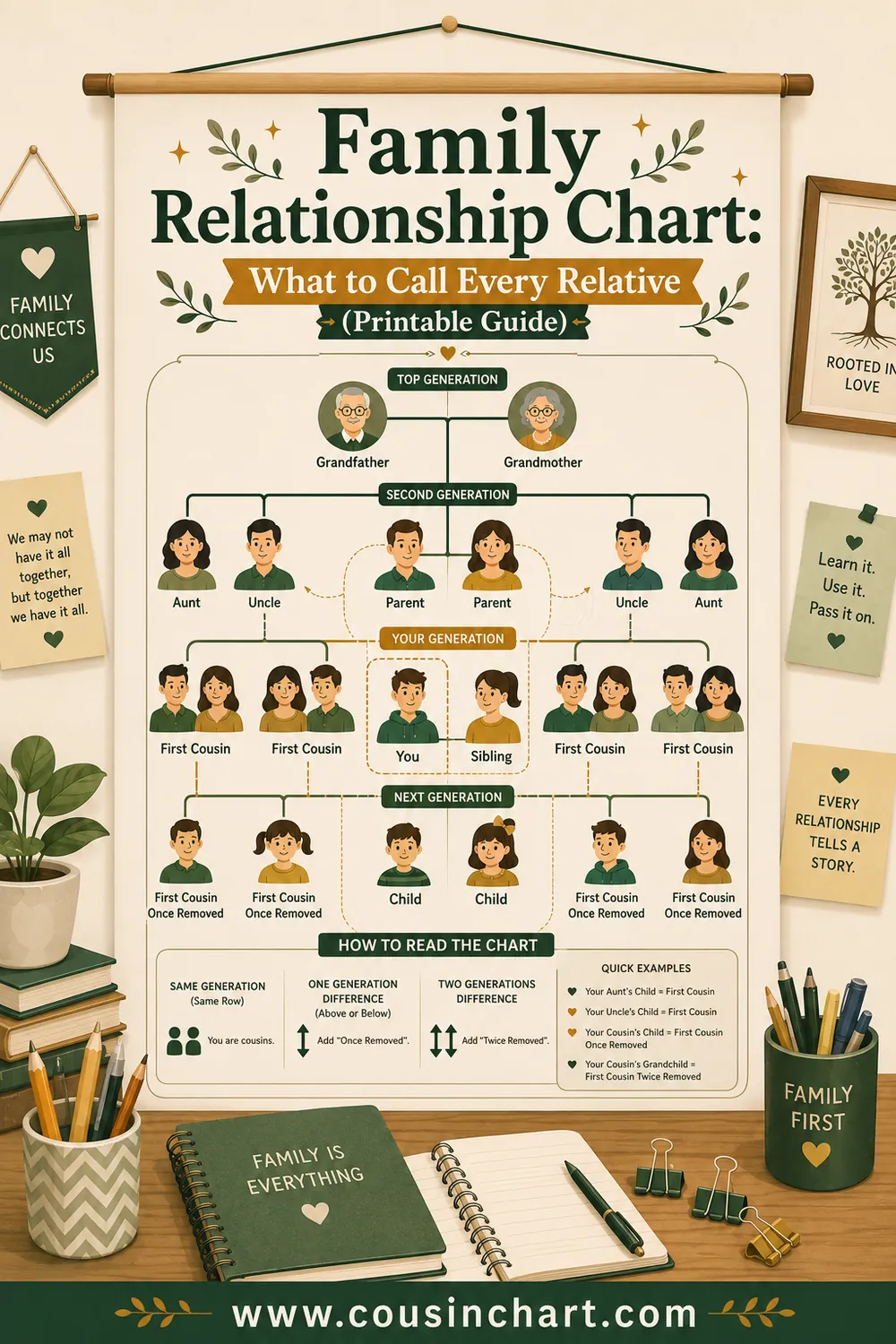
That's the core rule, and it covers most families. But cousins come in many kinds (half, double, second, step, "once removed"), and each one changes the answer. A second cousin's grandparent, for example, is your great-aunt or great-uncle. This guide walks through every case with tables, DNA figures and worked examples. For the bigger map of how every relative fits together, our family relationship chart shows the whole family on one page. This article zooms in on one row of it: your cousin's grandparents.
Quick check. Tap a question for the short answer:
What is my cousins grandpa to me? The two-sides rule
Start with what a cousin is. The American Heritage Dictionary defines a cousin as "a child of one's aunt or uncle," also called a first cousin. So you and your first cousin are connected through a pair of siblings: your parent and your cousin's parent.
Your cousin's parents are your aunt (or uncle) and that person's spouse. Each of those two people has two parents. That gives your cousin four grandparents, in two pairs:
- The shared side. The parents of your aunt or uncle. Since your aunt or uncle is your parent's sibling, these are also your parent's parents. They're your grandparents.
- The other side. The parents of your aunt's husband or your uncle's wife. That person married into your family, so their parents have no ancestor in common with you. They're your cousin's grandparents only.
That's why the question "what is my cousin's grandpa to me?" has two completely different answers. On the shared side, he's your grandpa too. On the other side, he's your cousin's grandpa and not your relative.
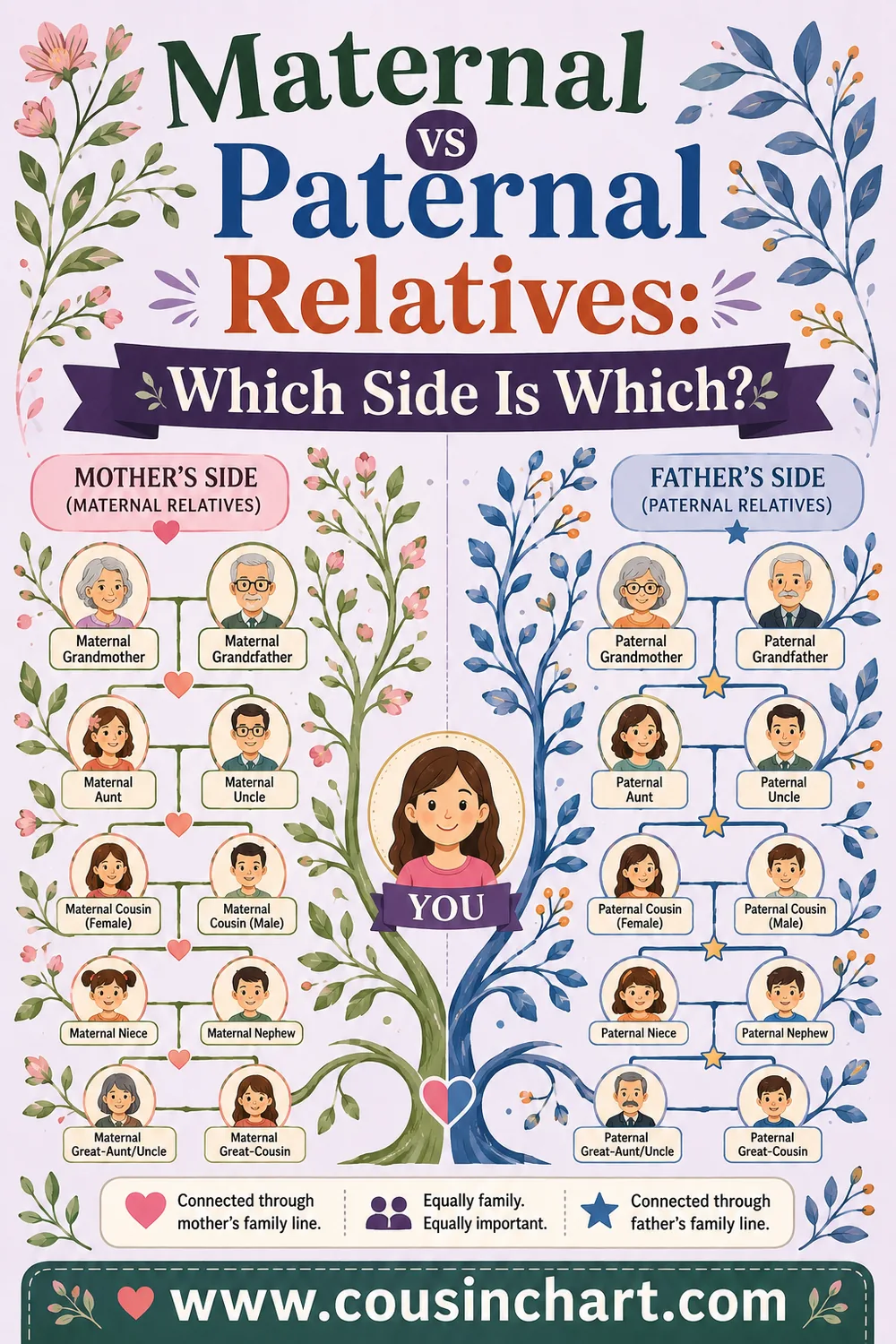
If "sides" are fuzzy for you, our guide to maternal vs. paternal relatives explains how families split into a mom's side and a dad's side. Your cousin has the same split, and only one of their sides overlaps with yours.
A worked example: the Rivera cousins
Here's an illustrative family. The names are made up to make the pattern easy to follow.
- Your mom, Elena, has a brother, Tomas.
- Elena and Tomas are the children of Rosa and Miguel. Those are your grandparents.
- Tomas married Jenny. Jenny's parents are Pat and Walt.
- Tomas and Jenny have a daughter, Sofia. Sofia is your first cousin.
Sofia's four grandparents are Rosa, Miguel, Pat and Walt. Here's what each one is to you:
| Sofia's grandparent | How Sofia is related | What they are to you |
|---|---|---|
| Rosa | Her dad's mother | Your grandmother (your mom's mother) |
| Miguel | Her dad's father | Your grandfather (your mom's father) |
| Pat | Her mom's mother | Not related to you; your aunt Jenny's mother |
| Walt | Her mom's father | Not related to you; your aunt Jenny's father |
So when you see Walt at Sofia's birthday party, he's "Sofia's grandpa." He's also your aunt Jenny's dad, and your uncle Tomas's father-in-law. You might greet him warmly and even call him by a family nickname, but there's no blood or legal link between you.
What Walt is to your grandparents
Here's a neat twist. Walt and Pat are the parents of Jenny. Rosa and Miguel are the parents of Tomas. Jenny and Tomas married each other. So the two sets of grandparents are each other's children's in-laws. English doesn't have a tidy word for this, though several other languages do. Our guide to what your child's in-laws are to you covers the terms people use, and it's exactly the relationship between your grandparents and your cousin's other grandparents.
When your cousin's grandparent is your grandparent
On the shared side, the answer is usually "your grandparent," full stop. But there are a few details worth knowing.
Your parents and your cousin's parent must be full siblings
If your mom and your uncle have the same two parents, then both of those parents are grandparents to you and your cousin. You share two grandparents, and you're full first cousins.
If they're half-siblings, you share only one
Say your mom and your uncle share a mother but have different fathers. Then you and your cousin share one grandparent: that mother. Your cousin's grandfather on that side is your uncle's father, who isn't your grandfather. You and your cousin are half cousins. In this case your cousin has one grandparent who's yours and three who aren't.
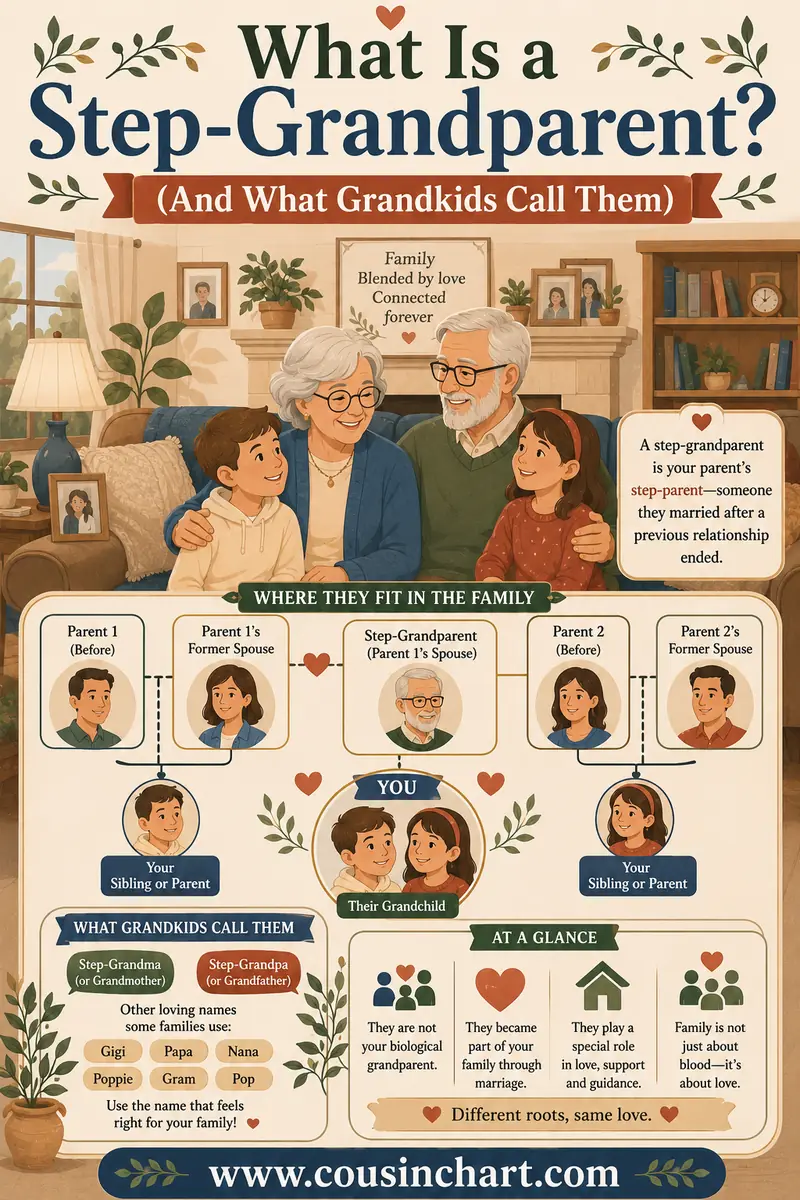
That third grandparent, your uncle's father, might still be part of your family story. If he married your grandmother and helped raise your mom, he was your mom's stepfather, which makes him your step-grandfather. If he and your grandmother never married, or their marriage ended before your mom was born, he's simply your half-uncle's father and not related to you. Our guide on what a step-grandparent is sorts through those cases.
Double cousins share all four
When two siblings marry two siblings (say, your mom's brother marries your dad's sister), the cousins share all four grandparents. These are double cousins. For them, every one of the cousin's grandparents is also their own grandparent, two on each side.
When your cousin's grandparent isn't related to you
This is the case behind most searches, especially the ones that say "not the same side of the family." If your cousin's grandparent is the parent of your aunt or uncle by marriage, there's no shared ancestor and no direct marriage between you. On a family tree, they don't sit on your branches at all.
Here's a quick checklist to confirm it:
- Name your cousin's parent who is your blood relative (your parent's sibling).
- Name your cousin's other parent (the one who married in).
- Ask whose parent the grandparent is. If it's the married-in parent's mother or father, the grandparent isn't related to you.
Don't let that sound cold. Many families treat the other-side grandparents as honorary family, especially when the cousins grow up together. Kids often call them "Grandma Pat" and "Grandpa Walt" just like their cousins do. That's a lovely custom, and nothing about it is wrong. The tree simply records it differently from a blood tie.
What about a grandparent's new spouse?
Grandparents remarry, and that adds another layer. If your cousin's other-side grandmother marries again, her new husband becomes your cousin's step-grandfather. He's still not related to you, because the person he married isn't related to you either.
If your shared grandparent remarries, though, the new spouse is a step-grandparent to both you and your cousin. That's the one kind of "cousin's step-grandparent" who is also yours.
And the other-side grandparent's family?
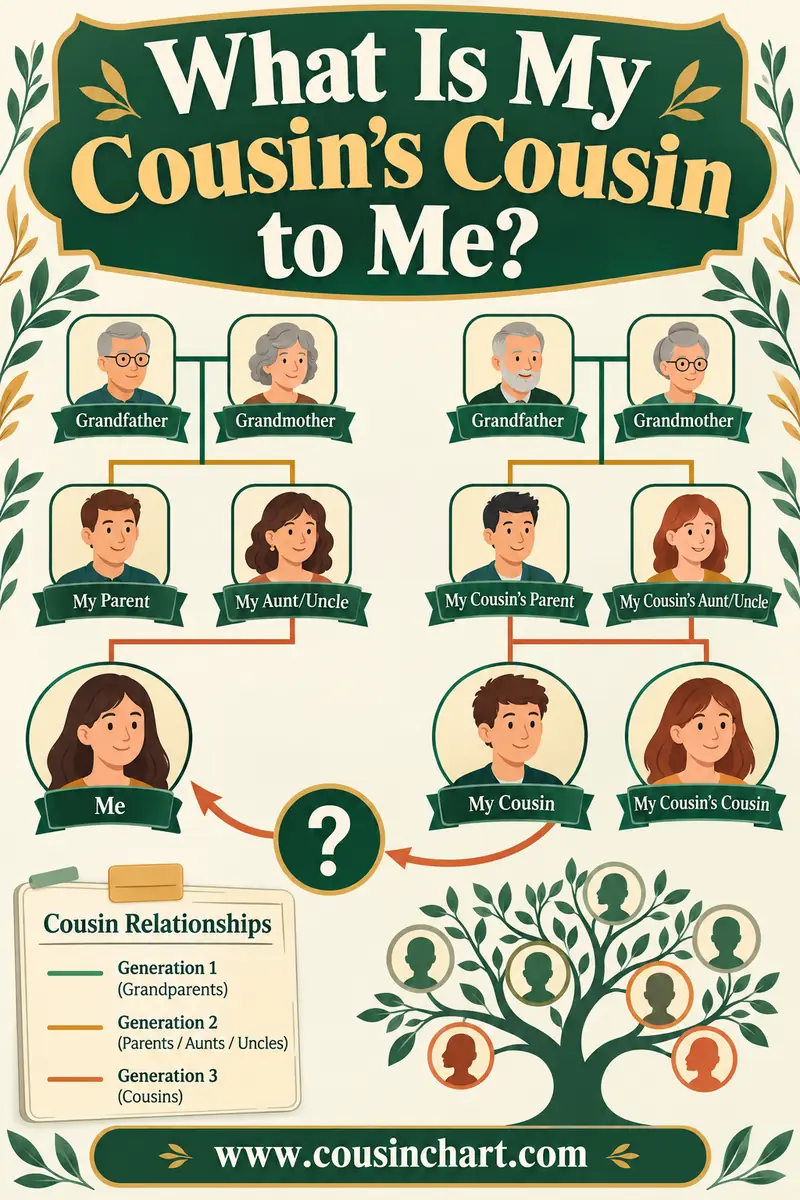
The same logic carries forward. Your cousin's other-side grandpa's siblings are your cousin's great-aunts and great-uncles, but not yours. His other grandchildren are your cousin's cousins from the other side, which is a separate puzzle we cover in what is my cousin's cousin to me.
Real questions, answered step by step
People phrase this question in lots of ways. Here are three common versions, each worked through with the same simple method: find your cousin's parent who is your blood relative, then look at that person's parents.
"What are my cousin's grandparents to me if they're my cousin's mum's parents?"
First, check who your cousin's mum (or mom) is to you. There are two possibilities.
- She's your parent's sister. Then her parents are your parent's parents. Your cousin's maternal grandparents are your grandparents. This happens when your cousin is your mom's sister's child or your dad's sister's child.
- She married your parent's brother. Then her parents are your uncle's in-laws. Your cousin's maternal grandparents aren't related to you. This happens when your cousin is your uncle's child.
So the same phrase, "my cousin's mom's parents," means your grandparents in one family and complete strangers to your bloodline in another. Everything turns on whether your blood tie runs through your cousin's mom or your cousin's dad.
"What is my cousin's grandpa to me if he's not on the same side?"
If you already know he isn't on your side, the answer is short: he's not your relative. The longer answer is that he's your aunt's or uncle's father-in-law. If you want to show respect while staying accurate, "my cousin's grandpa" is perfect. Nobody at a family gathering will think it's cold.
"My cousin and I have the same grandma, but different grandpas. How?"
This is the half-sibling case. If your parent and your cousin's parent share a mother but have different fathers, you have one grandparent in common and one each that the other doesn't share. You're half first cousins. Your cousin's grandpa on that side is your half-aunt's or half-uncle's father, who may or may not have been married to your grandmother. If he was, and he was part of your parent's life as a stepfather, he's your step-grandfather.
What am I to my cousin's grandparent?
Flip the question around and the same rule applies. To your shared grandparents, you're a grandchild, just like your cousin. To your cousin's other-side grandparents, you're "my grandchild's cousin." That's not a formal relationship, but it often turns into a real one. Plenty of grandparents end up treating their grandchild's cousins as honorary grandkids, especially when the cousins are together every holiday.
Here's how the picture looks from each grandparent's point of view, using the illustrative Rivera family from earlier.
- Rosa and Miguel (shared side) see you and Sofia as their grandchildren. You're equal in their family tree.
- Pat and Walt (Sofia's other side) see Sofia as their grandchild and you as Sofia's cousin from her dad's family. They're your aunt Jenny's parents, and you're their son-in-law's niece or nephew.
- Your parents are Pat and Walt's son-in-law's sibling and that sibling's spouse. Again, no formal title, but they likely know each other well from family events.
- Your own children have no relationship to Pat and Walt. Your kids are second cousins to Sofia's kids, through Rosa and Miguel.
Your relationship to your cousin's other-side grandparents never changes over time, unless a new marriage creates a link. Your relationship to the shared grandparents is lifelong and runs down to your own children, who are their great-grandchildren.
Every kind of cousin, every grandparent
"Cousin" covers far more than first cousins. Here's what a grandparent of each kind of cousin is to you, on the side you share and on their other side. (On the other side, the answer is "not related" every time, unless the families are connected some second way.)
| Your cousin | Their grandparent on the shared side is your... | Their grandparent on the other side is... |
|---|---|---|
| First cousin | Grandparent | Not related to you |
| Half first cousin | Grandparent (one shared) or step-grandparent | Not related to you |
| Double first cousin | Grandparent (on both sides) | Also your grandparent |
| Second cousin | Great-aunt or great-uncle | Not related to you |
| Third cousin | First cousin twice removed | Not related to you |
| Your parent's first cousin (first cousin once removed) | Great-grandparent | Not related to you |
| Your first cousin's child (first cousin once removed) | Aunt or uncle (your cousin's parent) | Not related to you (your cousin's spouse's parent) |
| Step-cousin | Step-grandparent, or not related | Not related to you |
Let's walk through the less obvious rows so the logic is clear.
Second cousin's grandparent: your great-aunt or great-uncle
Second cousins share great-grandparents. The AHD defines a second cousin as "a child of a first cousin of one's parent." So your second cousin's parent is your parent's first cousin, and your second cousin's grandparent (on the shared side) is a child of your great-grandparents. A child of your great-grandparents who isn't your grandparent is your grandparent's sibling. That's your great-aunt or great-uncle.
Here's a quick illustration. Your grandpa, Frank, has a sister, Irene. Irene's son, Paul, is your mom's first cousin. Paul's daughter, Amy, is your second cousin. Amy's grandmother is Irene, your great-aunt.
Third cousin's grandparent: your first cousin twice removed
Third cousins share second-great-grandparents. Go up from your third cousin two generations and you reach a grandchild of those shared ancestors. Your own grandparent is also a grandchild of those ancestors. Two grandchildren of the same couple are first cousins. So your third cousin's grandparent is your grandparent's first cousin, which genealogists call your first cousin twice removed.
Half second cousin's grandparent: your half great-aunt or half great-uncle
Half relationships carry upward too. Say your grandpa, Frank, and a woman named June are half-siblings: they share a mother but have different fathers. June's grandchild is your half second cousin, because the two of you share only one great-grandparent (that mother). June is your half great-aunt.
The DNA numbers reflect the "half." A full great-aunt shares about 850 cM with you on average in the Shared cM Project. A half great-aunt averages 431 cM, roughly half as much, because she and your grandpa share one parent instead of two. The simple math matches: half of 850 is 425, which is the project's expected value for a half great-aunt, and the observed average of 431 is close.
Your half second cousin's other grandparents, the ones not descended from that shared great-grandmother, aren't related to you at all. So in a half line, the "shared side" shrinks to a single ancestor at the top.
The "once removed" cousins
"Removed" just means you're in different generations. If the cousin is your parent's first cousin, their grandparent is one generation above your grandparent on that side, so it's your great-grandparent. If the cousin is your first cousin's child, their grandparents are your cousin's parents (your aunt or uncle) and your cousin's spouse's parents (not related to you).
A step-by-step method for any cousin
The table above covers the common cases, but you can work out any cousin's grandparent with a short method. It works for distant cousins, removed cousins, and anything a genealogy program throws at you.
- Find the shared ancestors. First cousins share grandparents. Second cousins share great-grandparents. Third cousins share second-great-grandparents. Each step adds one "great."
- Climb from your cousin. Go up two generations from your cousin to reach their grandparent. Only the grandparent on the line that leads to the shared ancestors can be related to you.
- Climb from yourself. Go up from you to the shared ancestors, counting generations as you go.
- Compare the two climbs. If your cousin's grandparent is one of the shared ancestors, they're your grandparent or great-grandparent. If not, they're a descendant of the shared ancestors, so figure out how they relate to your own ancestor at the same level. Siblings make great-aunts and great-uncles. Cousins make "cousin removed" relationships.
- Check the other side. Your cousin's grandparents on the other branch don't lead to the shared ancestors at all. They're not related to you, unless your families connect some second way.
Example: your parent's second cousin
Say your mom has a second cousin, Diane. Mom and Diane share great-grandparents, which are your second-great-grandparents. Diane's grandparent on that line is a child of those shared ancestors. Your mom's grandparent (your great-grandparent) is another child of the same couple. So Diane's grandparent is your great-grandparent's sibling: your great-great-aunt or great-great-uncle. That's a lot of "greats," which is why a quick calculation beats guessing.
The generation gap matters too. A cousin's grandparent on the shared side can be younger than your own parent if the generations moved at different speeds in different branches. Age doesn't change the relationship. A great-uncle who's only a few years older than you is still your great-uncle.
What DNA says about your cousin's grandparents
A DNA test is a quick way to confirm which side someone is on. If your cousin's grandparent is also yours, you'll share a large amount of DNA. If they're from your cousin's other side, you'll typically share none.
The reason is simple biology. Humans have 23 pairs of chromosomes, and, as the National Human Genome Research Institute puts it, one copy of each chromosome comes from the female parent and the other from the male parent. Each generation passes down a random half, so DNA sharing falls off as relationships get more distant.
DNA companies measure shared DNA in centimorgans (cM), a unit that roughly reflects the length of shared stretches. The Shared cM Project, Version 4.0, compiled by Blaine Bettinger from about 60,000 submissions, gives these ranges.
| Who your cousin's grandparent is to you | Average shared cM | Range in the project |
|---|---|---|
| Your grandparent | 1,754 | 984 to 2,462 |
| Your great-grandparent | 887 | 485 to 1,486 |
| Your great-aunt or great-uncle | 850 | 330 to 1,467 |
| Your half great-aunt or half great-uncle (a half second cousin's grandparent) | 431 | 184 to 668 |
| Your first cousin twice removed | 221 | 33 to 471 |
| Your aunt or uncle | 1,741 | 1,201 to 2,282 |
| Other-side grandparent or step-grandparent | 0 expected | No shared ancestor |
You can check any of these numbers in the interactive Shared cM Project tool at DNA Painter, which highlights which relationships match a given amount of shared DNA.
The math behind the grandparent figure
The project says its "expected" figures assume perfect 50% inheritance at each generation, and it gives 1,700 cM as the expected value for half-siblings, who share 25%. That puts the genome total the project uses at 1,700 ÷ 0.25 = 6,800 cM. A grandparent also passes down about 25% to each grandchild, so the expected figure is 6,800 × 0.25 = 1,700 cM. The observed average of 1,754 is close.
Real numbers swing more than you'd expect, though. The range for grandparents runs from 984 to 2,462 cM. Population geneticist Graham Coop explains why the share from a particular ancestor varies: DNA passes down in large chunks, so instead of an even 50/50 split between two grandparents on one side, you might get something like 45% and 55%. That's why two cousins can match the same grandparent by noticeably different amounts.
Your cousin and you match the same grandparent differently
Here's something that surprises people. You and your cousin might both share around 1,700 cM with Grandma Rosa, but not the same 1,700 cM. Each of you got a different random mix of her DNA through your own parent. That's why first cousins share about 866 cM on average with each other in the Shared cM Project, far less than either shares with the grandparent.
Special cases
A few family setups bend the usual answer. Here's how to handle each one.
Your cousin is related to you on both sides
Besides double cousins, some families are linked twice in a less obvious way. Maybe your cousin's other-side grandmother turns out to be your grandma's second cousin. In that case, she's not "unrelated" after all. She's a distant relative of yours through a separate line. When a DNA test shows you sharing a small amount of DNA with someone you expected to be unrelated, look for a second link like this.
Adoption
If your aunt or uncle was adopted, your grandparents are still your cousin's grandparents in every family and legal sense. The only difference shows up on a DNA test: the adoptive grandparents won't match your cousin genetically, although they will match you if your parent is their biological child. If your cousin was adopted, the same applies in reverse.
Your cousin's grandparent married your grandparent
Sometimes, after a death or divorce, one cousin's other-side grandparent marries the shared grandparent. Now that person is your step-grandparent, and your cousin's grandparent and step-grandparent at once. It's rare, but it happens in close communities, and it's one more reason to draw the tree before answering.
Your aunt or uncle divorces
Divorce doesn't change anyone's grandparents. If your uncle Tomas and his wife Jenny split up, Sofia still has the same four grandparents: Rosa and Miguel on her dad's side, Pat and Walt on her mom's. Rosa and Miguel are still your grandparents, and Pat and Walt still aren't related to you. What fades is the in-law link. Pat and Walt were your uncle's in-laws, and after a divorce many families stop using in-law titles. The cousins, though, are just as connected as ever, because the tie between them runs through your shared grandparents.
If your uncle remarries, many families treat his new wife's parents as step-grandparents to Sofia, and they become your uncle's new in-laws. They have no tie to you either. Only remarriages in your own direct line, such as a grandparent's new spouse, add a step-relative to your side of the tree.
Step-cousins
If your "cousin" is really a step-cousin (for example, the child of your stepparent's sibling), then none of their grandparents are your blood relatives. Their grandparents on the side connected to your stepparent are your stepparent's parents, which some families call step-grandparents. Their other grandparents aren't connected to you at all.
How to show both sets of grandparents on a family tree
When you build your family tree, your cousin's other-side grandparents can either be left off or attached in the right spot. Both choices are fine. What matters is that nobody reading the tree later thinks they're your ancestors. Here's a clean way to draw it.
- Put your grandparents at the top. Draw both of your shared grandparents and connect them with a marriage line.
- Add their children in the next row. Your parent and your aunt or uncle go here, side by side.
- Add spouses beside each child. Your aunt's husband or your uncle's wife sits next to your aunt or uncle, joined by a marriage line.
- Hang the in-law's parents above the in-law, not above you. If you want to include Pat and Walt, draw them directly above Jenny, off to the side. Their line runs down only to Jenny.
- Draw the cousins under their own parents. Sofia's line goes up to both Tomas and Jenny, so she visibly has four grandparents. Your line goes up only through your parent to Rosa and Miguel.
Drawn this way, the tree answers the question by itself. Any grandparent with a line running down to you is yours. Any grandparent whose line reaches your cousin but not you belongs only to your cousin.
Keep the tree useful for DNA matching
If you or a relative ever tests with a DNA company, a tree drawn like this makes it easy to sort matches. Matches who descend from Rosa and Miguel's ancestors may match both you and Sofia. Matches who descend from Pat and Walt's ancestors can match Sofia but not you. That one fact helps sort Sofia's DNA match list into her two sides, and it explains why she has matches you'll never see on yours.
What the paperwork says
Most of the time, this question is about what to call someone. But it can matter for official forms, too, and the rules there match the family-tree answer.
For example, in IRS Publication 501, the relatives who can be a "qualifying relative" without living with you include "your father, mother, grandparent, or other direct ancestor, but not foster parent," and also "your stepfather or stepmother." Your cousin's other-side grandparent isn't on that list, and neither is a step-grandparent. Tax rules have several other conditions, so check the current publication or a tax professional for any real decision. The point here is just that official definitions draw the same line between your own grandparent and your cousin's other one.
Common mix-ups
- Assuming all four of your cousin's grandparents are yours. Only two are, and only if your parent and your cousin's parent are full siblings.
- Calling the other-side grandparent your "step-grandparent." A step-grandparent married one of your grandparents. Your cousin's other grandparents married each other, not into your line.
- Calling them your grandparent-in-law. That phrase is used for your spouse's grandparents. Your cousin's other-side grandparent is your aunt or uncle's in-law, not yours.
- Thinking a second cousin's grandparent is your grandparent. Second cousins share great-grandparents, so their grandparent on that side is your great-aunt or great-uncle.
- Expecting the same DNA match. You and your cousin can share quite different amounts with the same grandparent, because each of you inherited a different random half from your own parent.
Try it yourself
Here are four quick practice puzzles. The families are illustrative.
- Puzzle: Your dad's sister, Nora, married Ben. Their son, Kai, is your cousin. What is Ben's mother to you? Answer: Not related. She's Kai's grandmother on his dad's side, and your aunt Nora's mother-in-law.
- Puzzle: Your mom and your uncle Ray share a father but have different mothers. What is Ray's mother to you? Answer: Not your grandmother. If she married your grandfather after your mom was born, families often call her a step-grandmother. If not, she's your half-uncle's mother and not related to you.
- Puzzle: Your second cousin Lily's grandmother is Grace. Grace's brother is your grandfather. What is Grace to you? Answer: Your great-aunt (also called a grand-aunt).
- Puzzle: Your cousin Max's grandpa on his mom's side recently married your widowed grandma. What is he to you now? Answer: Your step-grandfather. He's also Max's grandfather by blood and step-grandfather by marriage, all at once.
Wrap-up: one question settles it
What is your cousin's grandparent to you? Ask whose parent they are. If they're the parent of your parent's sibling, they're your grandparent too (or, for a second cousin, your great-aunt or great-uncle). If they're the parent of the aunt or uncle who married in, they're your cousin's grandparent and not related to you, however much you may love them. For the full family laid out in one view, keep our family relationship chart nearby. And when a family puzzle gets tangled, the free calculator on our homepage can help: you pick how two people connect, and it names the relationship.
Frequently Asked Questions
What is my cousin's grandpa to me if he's not on my side of the family?
He isn't related to you. Your first cousin has four grandparents. Two are the parents of your aunt or uncle by blood, and they're your grandparents too. The other two are the parents of the aunt or uncle who married into your family. Those two share no ancestor with you, so they're your cousin's grandparents only. You can describe him as my cousin's grandpa, or as my aunt's father-in-law or my uncle's father-in-law, depending on how the marriage runs.
Are my cousin's grandparents my grandparents?
Half of them usually are. If your parent and your cousin's parent are full siblings, the two grandparents on that shared side are yours as well. The two grandparents on your cousin's other side belong to the family your aunt or uncle married into, so they aren't yours. Double cousins are the exception: when siblings from two families marry each other, the cousins share all four grandparents. Half cousins share only one grandparent between them.
What are my cousin's grandparents on their mom's side to me?
It depends on whether their mom is your blood relative. If your cousin's mom is your parent's sister, her parents are your grandparents. If your cousin's mom married your parent's brother, her parents are not related to you; they're your uncle's in-laws. The same logic works for the dad's side. Find the parent who is your parent's sibling, and only that parent's mother and father are your grandparents.
What is my second cousin's grandmother to me?
On the side you share, she's your great-aunt, also called a grand-aunt. Second cousins share a set of great-grandparents. Your second cousin's grandmother is a daughter of those great-grandparents, and she's the sister of your own grandparent. A grandparent's sister is a great-aunt. If she's only a half-sister of your grandparent, she's your half great-aunt. On your second cousin's other side, their grandmother isn't related to you.
What do I call my cousin's grandparents who aren't related to me?
Whatever your family is comfortable with. Many kids who grow up with their cousins use the same names the cousins use, like Grandma Pat or Pop. Others use first names or Mr. and Mrs. with a last name. If you need a precise description, say my cousin's grandmother, or my aunt's mother. There's no single English word for this relationship, and there's no rule against using a warm, familiar name if everyone likes it.
Do I share DNA with my cousin's grandparent?
Only if they're your own grandparent or another relative of yours. In the Shared cM Project, grandparents share an average of 1,754 centimorgans with a grandchild, with a range of 984 to 2,462. A great-aunt or great-uncle averages 850. Your cousin's grandparent from the other side shares no ancestor with you, so you'd expect no shared DNA at all. A small unexpected match usually means a separate, distant connection between the two families.
Is my cousin's step-grandparent related to me?
Usually not. If your cousin's other-side grandparent remarries, the new spouse is your cousin's step-grandparent but has no tie to you. The exception is when one of your shared grandparents remarries. Then the new spouse is a step-grandparent to you and your cousin alike. Step-grandparents never share DNA with you through that marriage, but families often treat them as full grandparents, and that's entirely up to you and them.
What is my first cousin once removed's grandparent to me?
It depends on which first cousin once removed you mean. If it's your parent's first cousin, their grandparent on the shared side is your great-grandparent, because your parent and their cousin share grandparents. If it's your first cousin's child, their grandparents on the shared side are your aunt and uncle, your cousin's parents. In both cases, the grandparents on the other side, through a spouse who married in, aren't related to you.
Can my cousin's grandparent be my great-grandparent?
Yes, in a couple of situations. If the cousin is your parent's first cousin, the grandparents you share are your great-grandparents. It can also happen when generations move at different speeds. If your grandparent had a much younger sibling, that sibling's grandchild might be close to your age, and you could easily think of them as a first cousin, even though they're really your parent's first cousin. Drawing the tree, or using a relationship calculator, clears this up quickly.
What are my grandparents to my cousin's other grandparents?
They're the parents of a married couple, so they're each other's children's in-laws. Your grandparent's son or daughter married their son or daughter. English doesn't have a common single word for this, although several other languages do, and families often just say our kids are married or we share grandchildren. They have grandchildren in common, your cousins, even though they don't share any blood tie with each other.
Sources
We checked every source below while writing this guide. Last reviewed October 30, 2026, by Joan Ramos.
- cousin (The American Heritage Dictionary of the English Language, Fifth Edition) (HarperCollins / American Heritage Dictionary)
- second cousin (The American Heritage Dictionary of the English Language, Fifth Edition) (HarperCollins / American Heritage Dictionary)
- Chromosomes Fact Sheet (National Human Genome Research Institute)
- The Shared cM Project, Version 4.0 (March 2020) (Blaine T. Bettinger, The Genetic Genealogist)
- The Shared cM Project 4.0 tool v4 (DNA Painter)
- How much of your genome do you inherit from a particular ancestor? (Graham Coop, gcbias (Coop Lab blog))
- Publication 501 (2025), Dependents, Standard Deduction, and Filing Information (Internal Revenue Service)