What Is My Cousin's Cousin to Me?
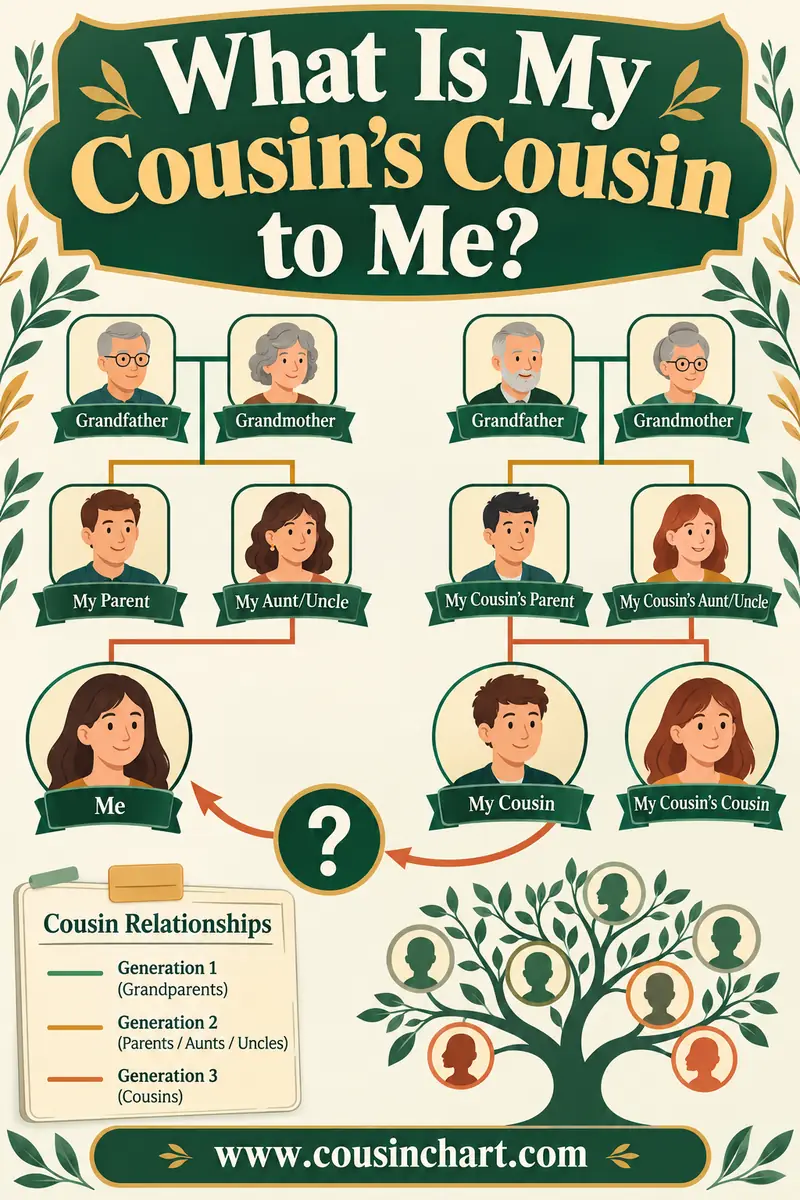
It depends on which side of your cousin's family they come from. **If your cousin's cousin connects through the grandparents you share, they're your first cousin too. If they connect through your cousin's other parent, they're no blood relation to you at all** — just a fellow guest at the same birthday parties.
That's the whole secret: a first cousin has two sets of cousins, and you belong to only one of them. This guide gives you the ten-second test, walks through named examples, covers the fun edge cases (you are your cousin's cousin; so are your siblings), and shows when a cousin's cousin is distantly related after all. For any specific person, the free family relationship calculator settles it instantly.
Relationship quick-check. Tap a phrase to see the correct answer:
The answer will appear here.
Why "Cousin's Cousin" Splits Into Two Answers
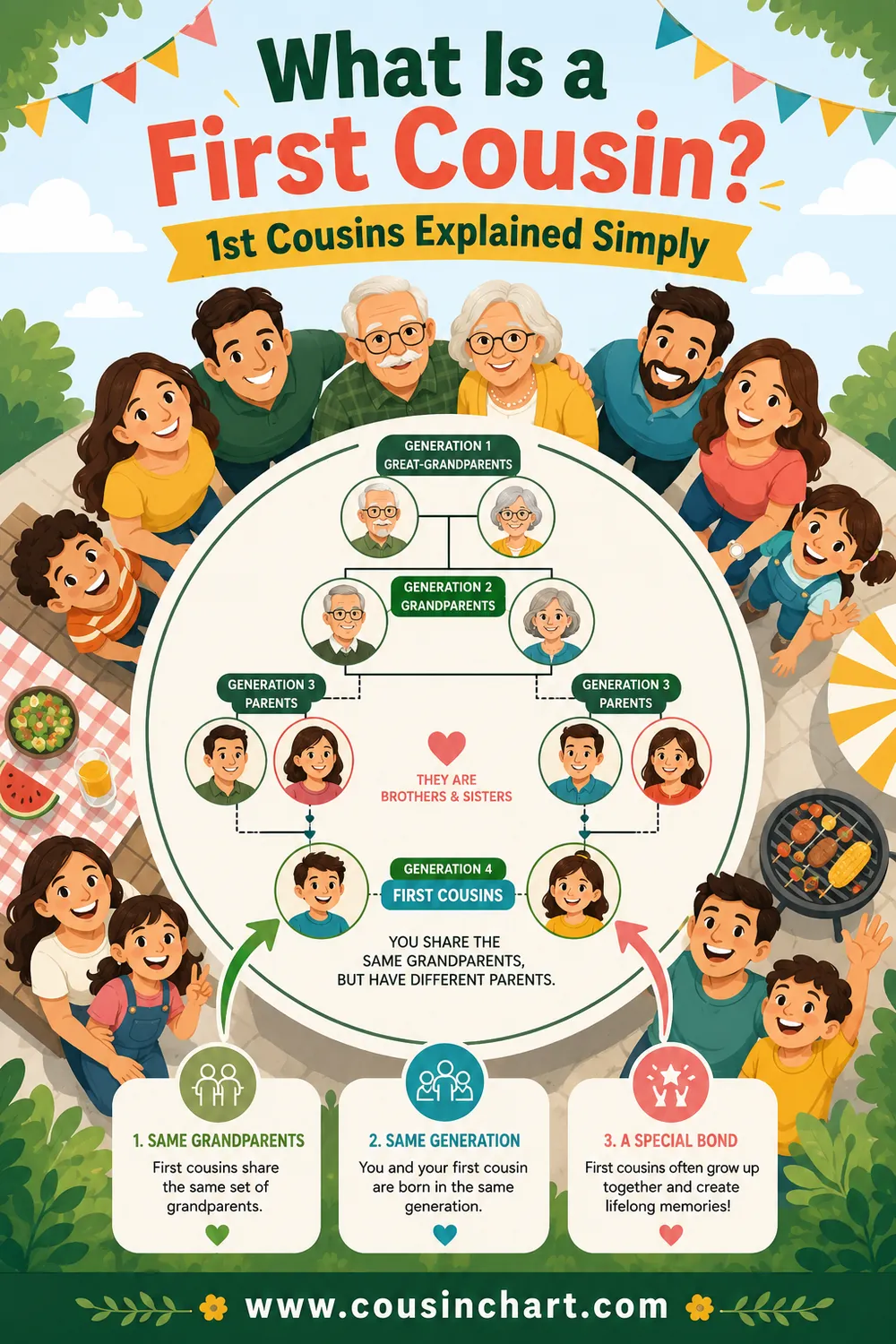
A first cousin is the child of your aunt or uncle — you two share one pair of grandparents. But your cousin has two pairs of grandparents, and each pair comes with its own crop of cousins. (A refresher on the basic relationship is at what is a first cousin.)
Take a concrete family. Your mom's sister is Aunt Carmen; her son Jake is your first cousin. Jake's cousins come in two sets:
- Set A — through Carmen (your shared side): children of Carmen's and your mom's other siblings. These people share your grandparents, so they're your first cousins too. You're in this set, along with your siblings.
- Set B — through Jake's dad: children of his dad's siblings. They share Jake's paternal grandparents — people you don't descend from. To you they're strangers, genealogically speaking: no common ancestor, no shared DNA, no term.
So when someone says "my cousin's cousin," the first question is always: through which parent? Same side → your cousin. Other side → your cousin's cousin, full stop, and English rightly gives it no name.
The Ten-Second Test
For any "cousin's cousin," ask one question: do they descend from your grandparents?
- Yes → they're your first cousin (or your sibling, or you).
- No → no blood relationship. If you want a social label, "my cousin's cousin" communicates it perfectly, and some families jokingly say "cousin-by-cousin" or just merge everyone into "cousin."
The same test scales up. Your second cousin's cousins split identically: those through your shared great-grandparents are your second cousins; those through the other side are unrelated. Whenever a chain of relatives makes your head swim, that's exactly the moment to hand the problem to the relationship calculator — tap the actual path and let it decide whether any blood flows along it.
You Are Your Cousin's Cousin (A Useful Brain-Teaser)
The phrase "my cousin's cousin" technically includes you — you are a cousin of your cousin. It also includes your siblings. This sounds like a party trick, but it teaches the deep point: "cousin of" is not a chain you can walk link by link. Relationship terms don't compose like directions; they must be recomputed from common ancestors every time.
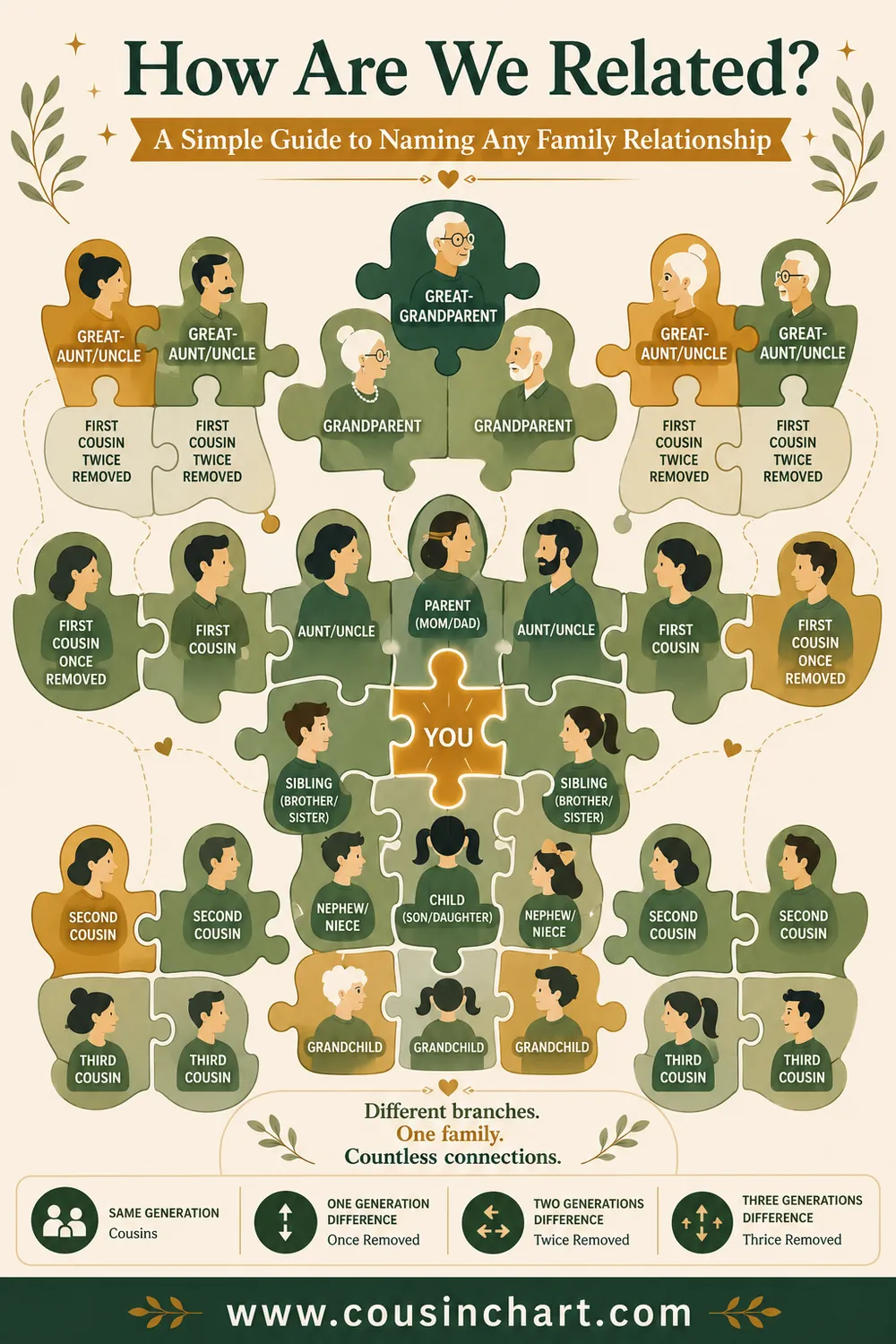
That's the mistake behind guesses like "my cousin's cousin must be my second cousin." Second cousins are defined by shared great-grandparents — the term names a position on the tree, not a number of hops through people. Cousin-of-a-cousin can equal sibling, self, first cousin, or nothing, depending entirely on the geometry. If you enjoy this kind of puzzle, our guide to working out any connection from scratch is how are we related.
When Both Sides Are Related After All
Three real-world situations where your cousin's "other side" isn't a genealogical stranger:
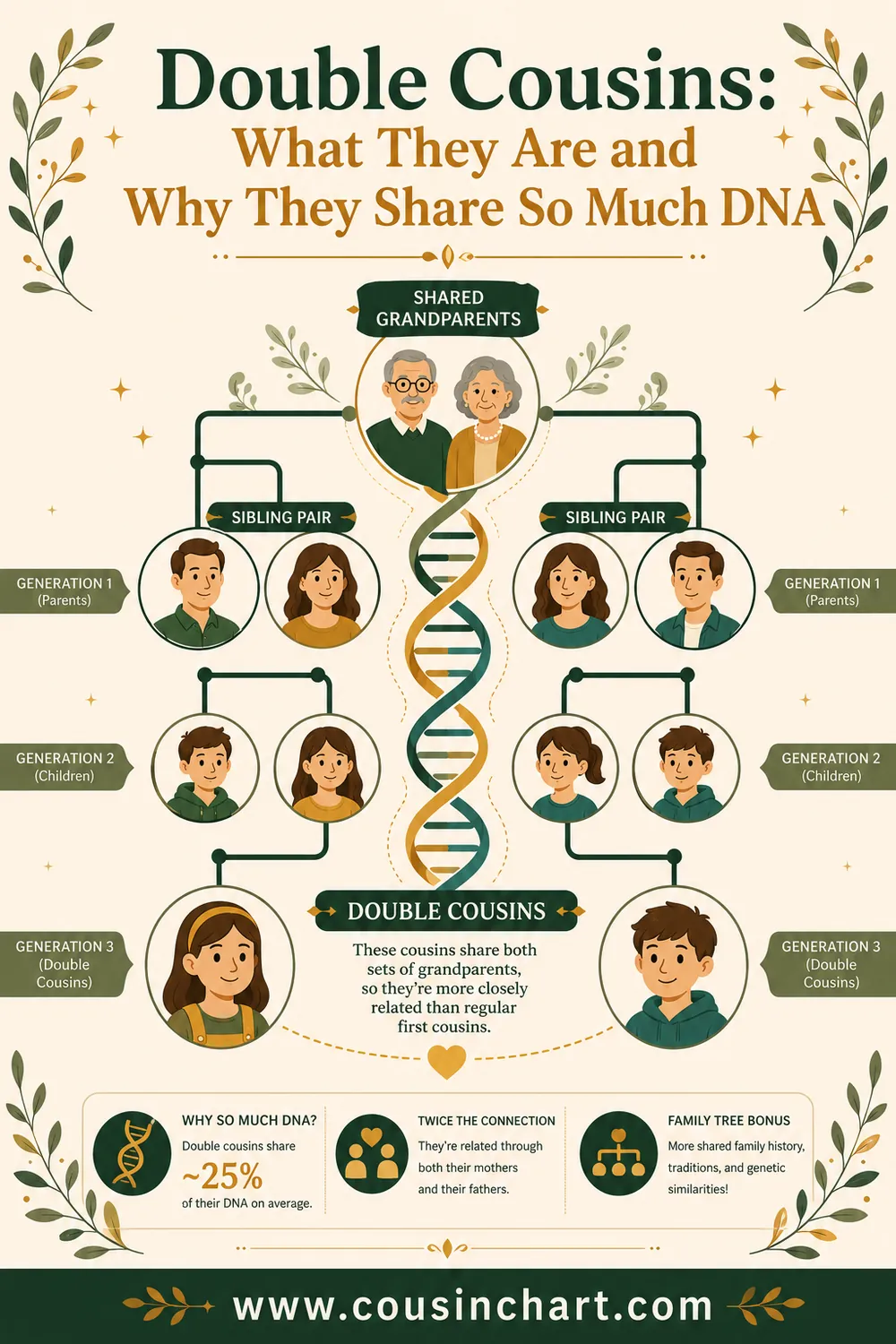
- Double cousins. If two siblings from one family married two siblings from another, the resulting double cousins share both sets of grandparents. Their cousins on "either side" are your relatives too — the two sets collapse into one big one.
- Endogamous and small communities. In towns, villages, and communities where families intermarried for generations, your cousin's paternal cousins often turn out to be your fifth-or-so cousins through some older link. DNA testing surfaces these loops constantly.
- A shared in-law becomes a shared blood line later. If your cousin's paternal cousin marries into your side of the family, no blood is created between you — but your children and their children can end up related through both routes. Family trees braid faster than you'd think.
None of these change the core rule; they just remind you that "no relation" means "no relation through this path" — real families sometimes have more than one path.
Quick Reference: Every "Cousin's Cousin" Scenario
Here's the whole thing on one screen. Find the row that matches your situation:
| Whose cousin are they? | Which side? | What they are to you | Related by blood? |
|---|---|---|---|
| Your first cousin's cousin | Through the parent you share | Your first cousin too (same grandparents) | Yes |
| Your first cousin's cousin | Through your cousin's other parent | No relation to you | No |
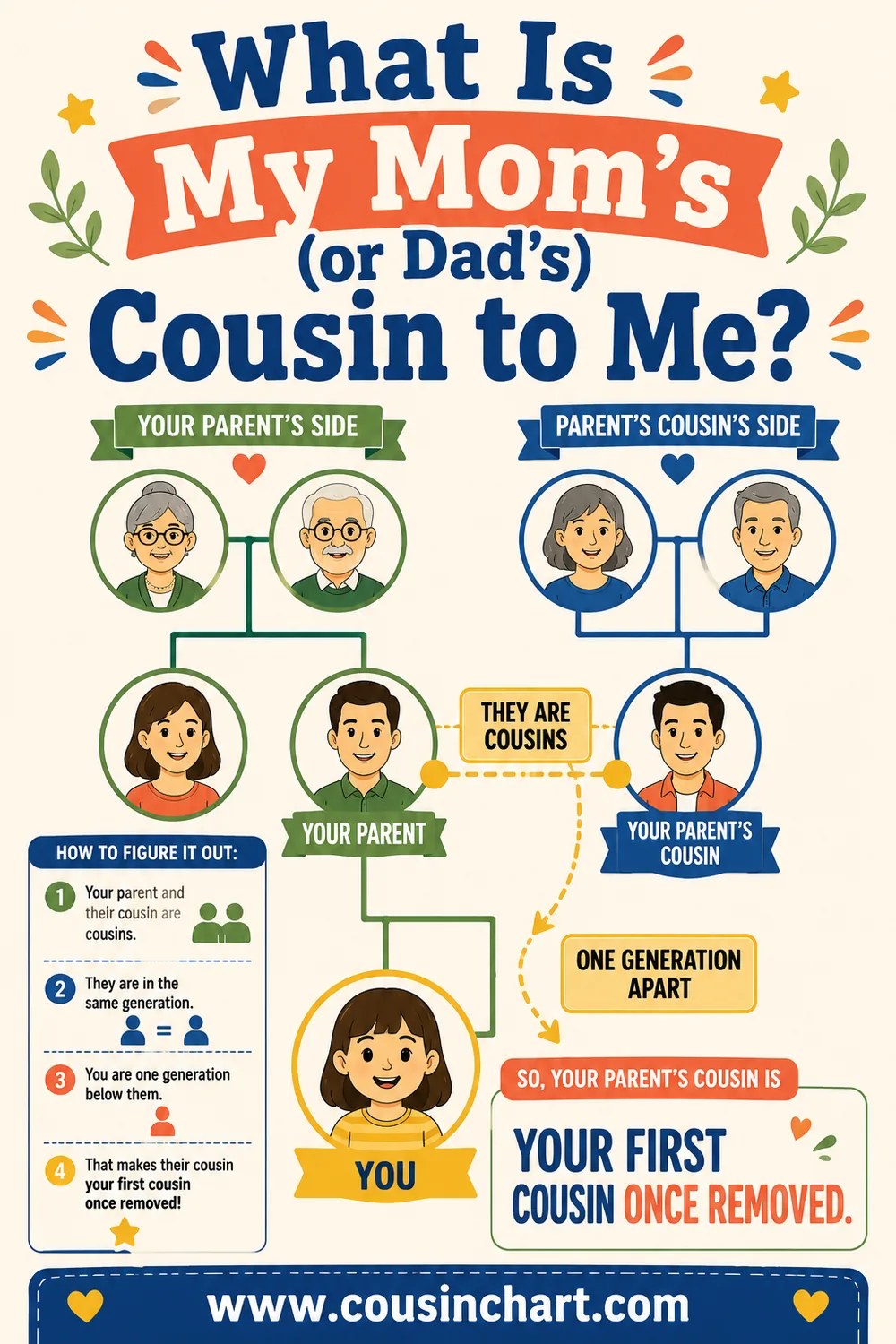
| Your first cousin's child | — | Your first cousin once removed | Yes |
| Your second cousin's cousin | Through the shared great-grandparent | Your second cousin | Yes |
| Your second cousin's cousin | Through the unshared side | No relation | No |
| Your cousin's cousin (both sides related) | Families intermarried | Often a double cousin or two relationships at once | Yes |
The pattern is simple once you see it: the answer depends entirely on which parent the two cousins connect through. Share that parent's line with them, and they're your cousin too. Don't, and they're a stranger who happens to know your family.
Does a Cousin's Cousin Share Your DNA?
- Same-side cousin's cousin: yes — they're your first cousin, sharing about 12.5% of your DNA (roughly 850 cM on average).
- Other-side cousin's cousin: 0%, barring the intermarriage cases above. They will simply never appear in your DNA match list, even though your mutual cousin matches you both strongly.
This produces a classic DNA-test moment: two people who both match Jake at first-cousin level but don't match each other at all. Nothing is wrong with the test — they're just Set A and Set B, meeting in the middle at Jake. Triangulation like this is actually a powerful research tool: which matches you don't share sorts a mystery match onto the correct side of a family fast.
Can You Date Your Cousin's Cousin?
This is quietly one of the most-asked versions of the question, so let's answer it properly. If they're an other-side cousin's cousin, yes — there's no genealogical issue at all. You share no ancestor and no DNA; the connection between you is purely social. Legally you're as unrelated as any two people who met at a coffee shop, and no jurisdiction anywhere restricts marriage between people who merely share a mutual cousin. Genetically, your children would carry no elevated risk, because there's no common bloodline to double up.
It feels more complicated than it is, for two reasons:
- Shared gatherings. You've possibly known each other since childhood birthday parties, and the families overlap socially. That can make it feel "like family" — but feeling like family and being kin are different facts, and only one of them shows up on a chart.
- The mutual cousin's position. Jake now has a cousin on each arm at Thanksgiving. That's a seating-chart situation, not a genealogy one.
Two genuine caveats. First, run the ten-second test honestly — make sure they really are from the other side and not a same-side cousin you'd lost track of. When in doubt, compare grandparents by name, or take DNA tests: an other-side cousin's cousin will show zero match. Second, in endogamous communities where the "other side" often loops back, that zero-match check is worth actually doing rather than assuming.
And if the relationship works out? Your mutual cousin Jake becomes your cousin-in-law's cousin and your cousin — one of the rare people who can attend the wedding from both sides of the aisle without changing seats.
For comparison's sake: even marrying an actual cousin is legal in many places (rules vary widely by country and U.S. state), so a cousin's cousin — who isn't kin at all — was never going to be the problem. The only chart consequence is a pleasant one: two previously unconnected family trees now share a branch, and every future genealogist in both families gets a slightly more interesting diagram.
FAQ
Is my cousin's cousin my second cousin?
No. Second cousins share great-grandparents with you. A cousin's cousin is either your first cousin as well (same-side) or no relation (other-side) — never automatically a second cousin.
What do I call my cousin's cousin from their other side?
There's no genealogical term, because there's no relationship — you share no ancestor. Socially, "my cousin's cousin" works fine, and many families just say "cousin" for anyone in the extended orbit.
Can my cousin's cousin and I share DNA?
Only if they're on your shared side (then they're your first cousin, ~12.5%) or if your families intermarried somewhere else in the tree. An other-side cousin's cousin from a fully separate family shares 0%.
My cousin's cousin and I have the same last name. Related?
Possibly — same surname plus same community is a hint worth checking, since it may mean the "other side" loops back to your family a few generations up. Build both trees back three or four generations and compare, or test DNA.
Are my children related to my cousin's other-side cousins?
No — if you share no ancestor with someone, your children don't either. The zero carries down. (Exception: if your side and that side intermarry later, new links form for the new generation.)
Should my cousin's other-side cousins go on my family tree?
Not on yours, no — a tree records descent, and no line of descent connects you. They belong on your cousin's tree, hanging from their other parent. Genealogy software handles this naturally: enter your cousin's other parent and that side stays visible but unconnected to your ancestor lines.
What is my cousin's cousin's child to me, on our shared side?
Your first cousin's child from that set — in other words, your first cousin once removed. Same-side cousin's cousins follow all the normal cousin rules, removals included.
One Question Settles It
"Cousin's cousin" sounds like a riddle, but it's a fork with two clean prongs: through your shared grandparents, they're your cousin; through the other side, they're a friendly stranger. Ask the one question — do we descend from the same couple? — and you're done. And for the family gatherings where the chains grow longer ("my cousin's cousin's daughter married my mom's cousin — so what's the baby to me?"), skip the napkin math. The free family relationship calculator traces any path, tells you if blood flows along it, and names exactly what you are to each other. Free, instant, and immune to party-trick riddles.