What Is My Mom's (or Dad's) Cousin to Me?
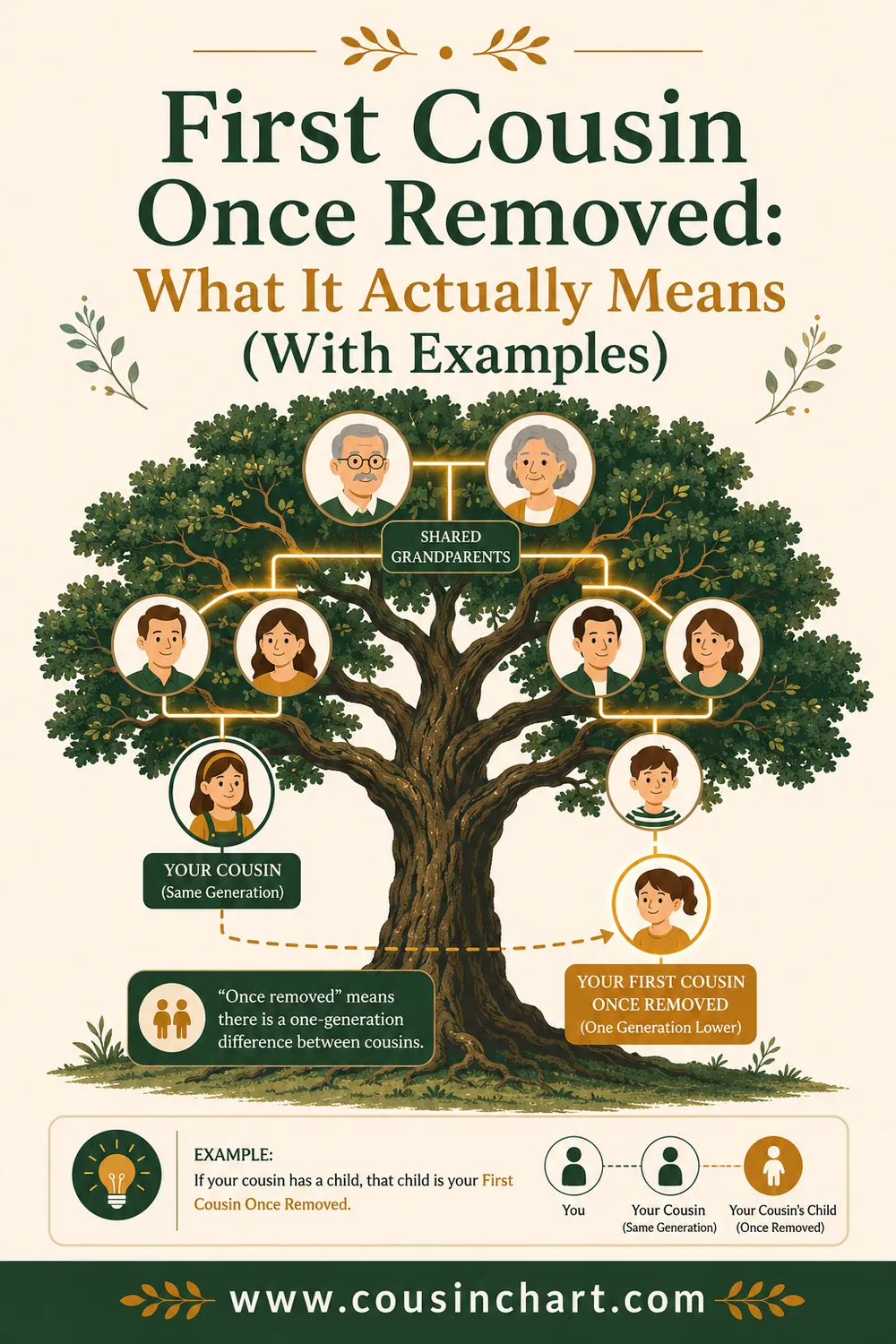
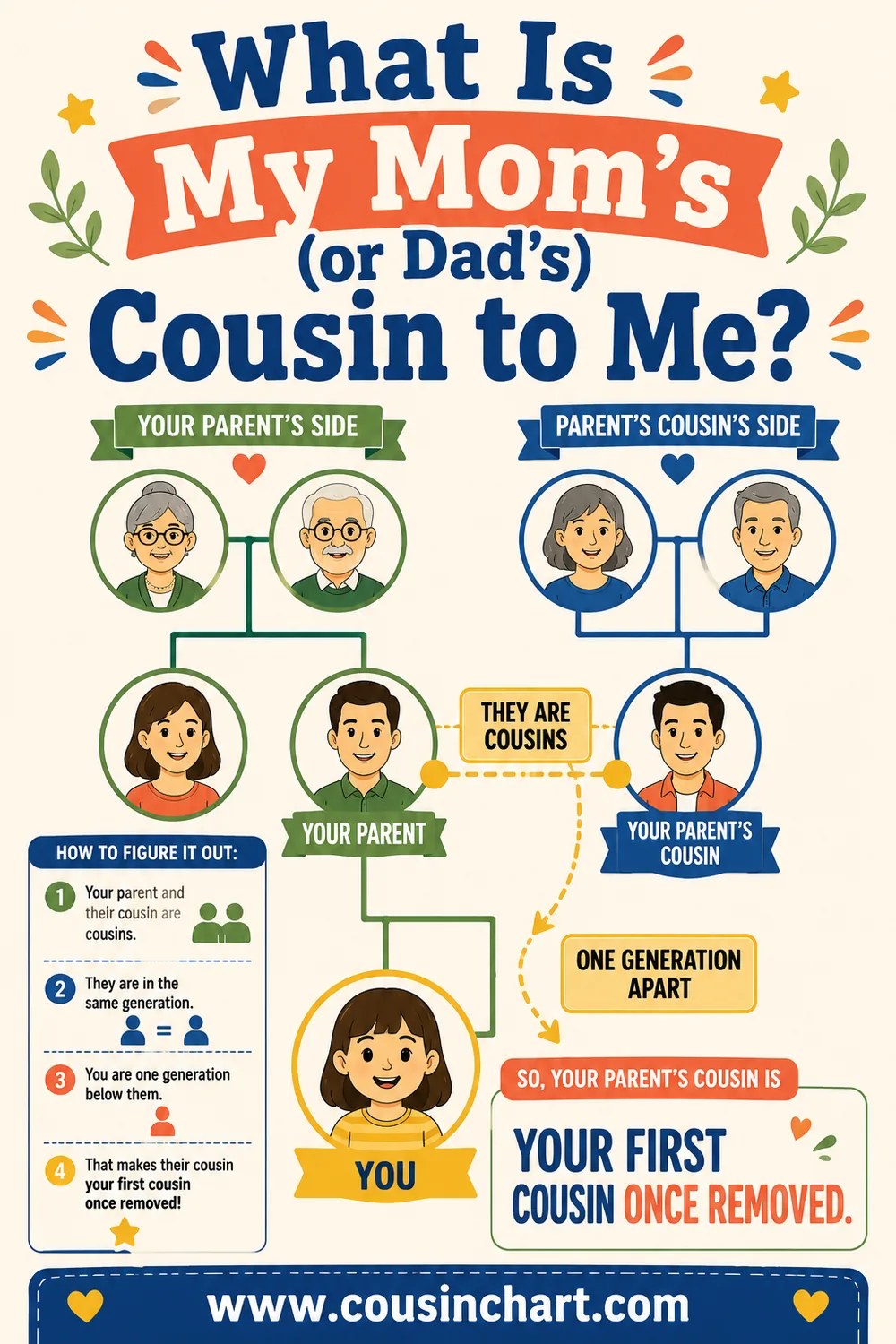
Your mom's first cousin — or your dad's — is your first cousin once removed. Not your second cousin, and not technically your aunt or uncle. The cousin relationship stays "first" because it's anchored at your parent's generation; the "once removed" records that you sit one generation below it.
That's the answer. The rest of this guide makes it stick: why "second cousin" is the wrong (but understandable) guess, where your actual second cousins come from, how much DNA you share with a parent's cousin, and what to call them at dinner. For any relative you can't place, the free family relationship calculator names the connection in seconds.
Relationship quick-check. Tap a phrase to see the correct term:
The answer will appear here.
Why It's "First Cousin Once Removed"
Two measurements generate every cousin term, and this relationship is the cleanest possible demo:
- The cousin number comes from the person closer to the shared ancestor. Your mom and her cousin share grandparents, which makes them plain first cousins. That "first" is locked in — it doesn't change when you enter the picture.
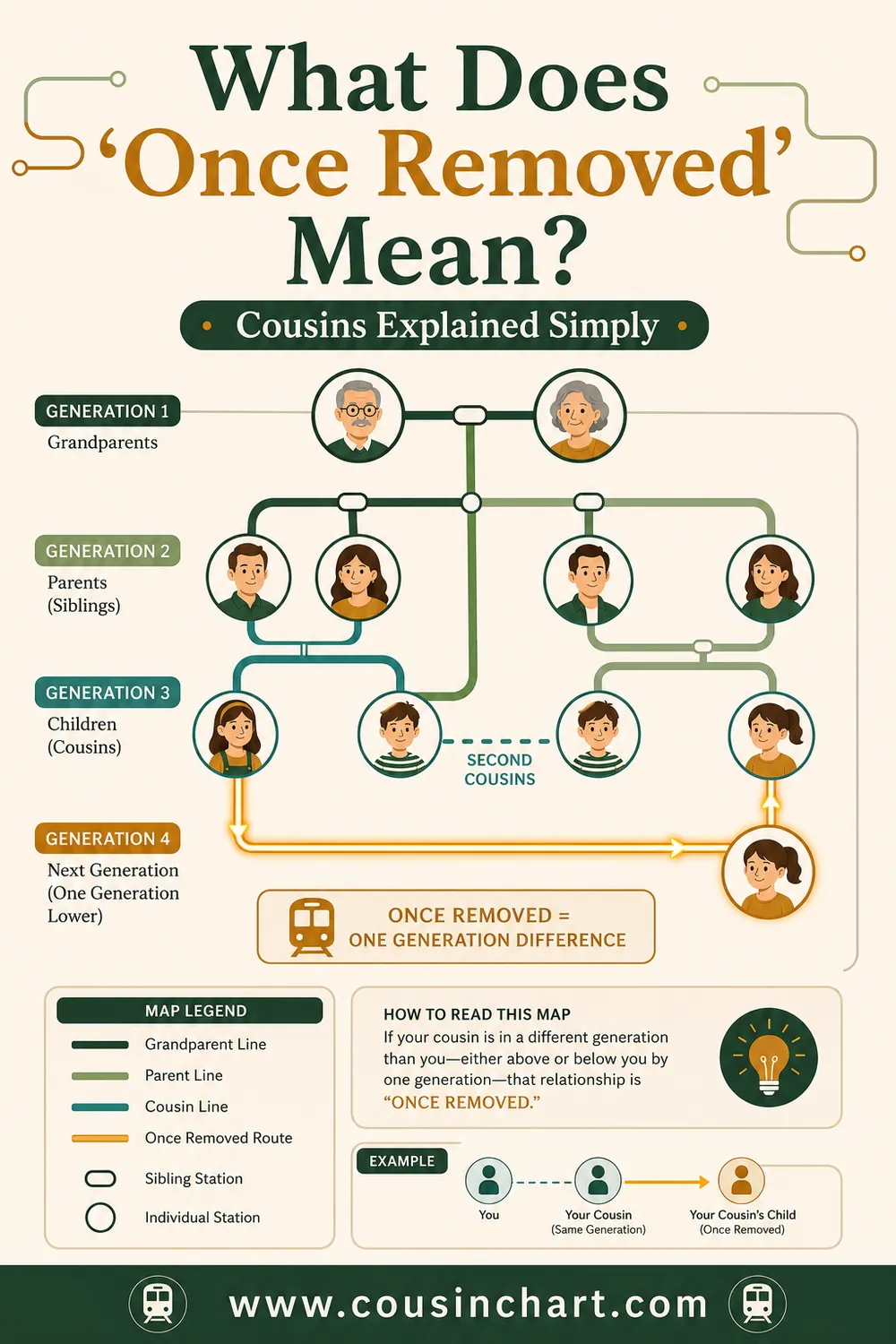
- "Removed" counts the generation gap. Your mom's cousin is your mom's generation; you're one below. One generation of difference = once removed.
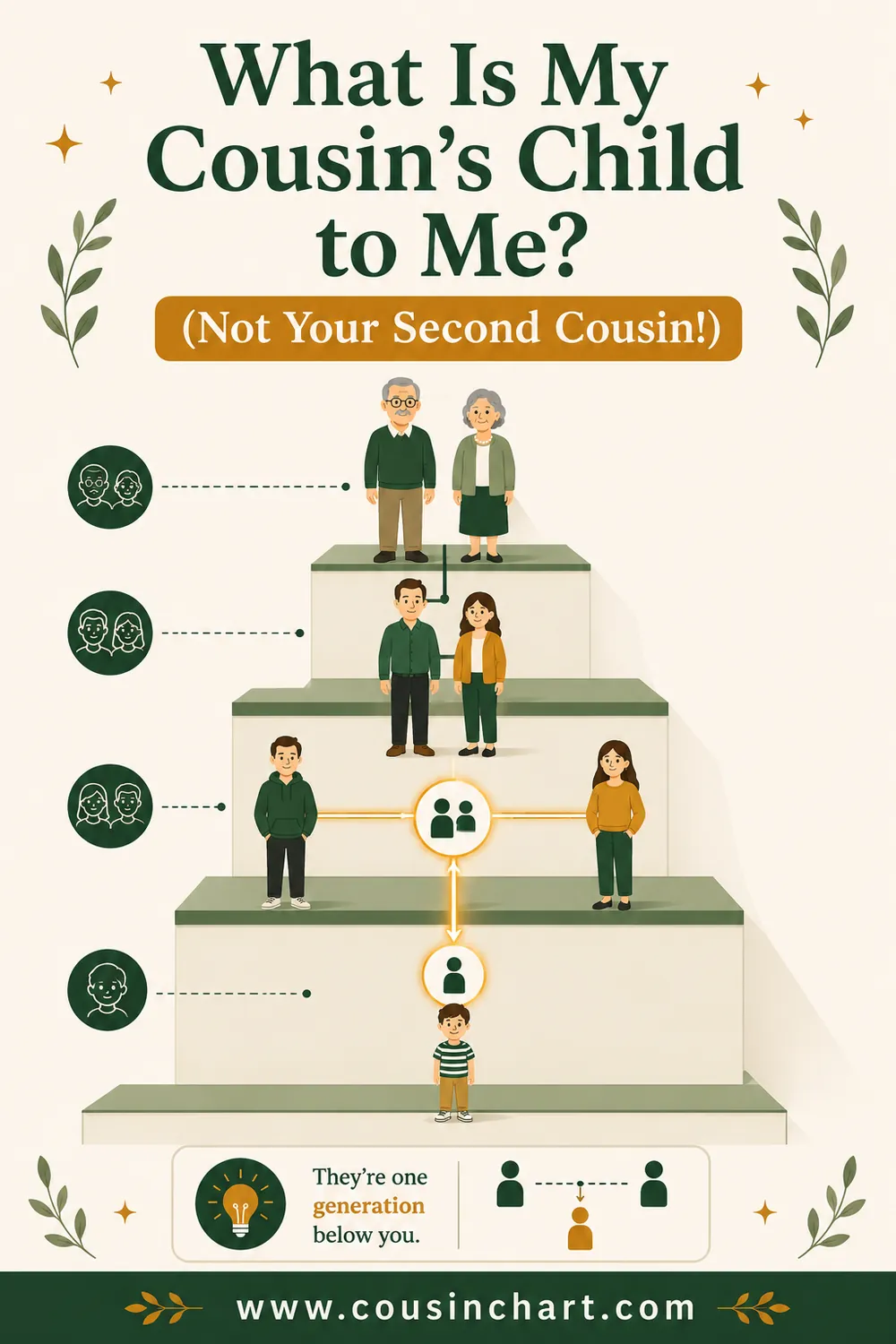
Put together: first cousin, once removed. The same logic, run in the opposite direction, explains why your cousin's child is also your first cousin once removed — that mirror-image case has its own article at what is my cousin's child to me, and the counting system behind "removed" is fully unpacked in what does once removed mean.
Useful symmetry to notice: you are also your mom's cousin's first cousin once removed. The label reads the same from both ends; only the direction of the generation gap differs.
Why "Second Cousin" Is the Classic Wrong Guess
The intuition goes: "my mom's first cousin, so one more step makes them my second cousin." It feels like the number should count steps away from you — but it actually counts how far back the shared ancestors are.
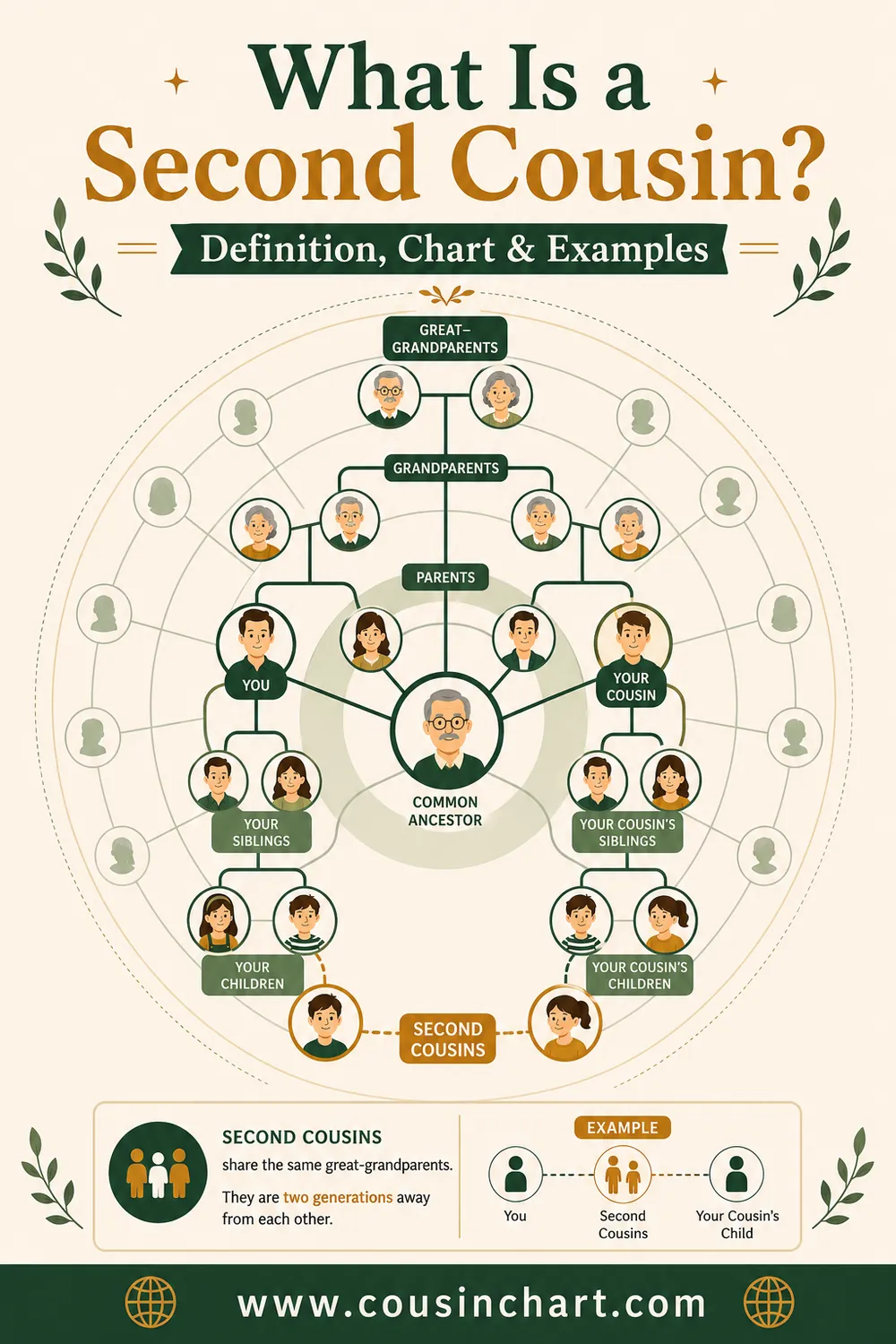
Second cousins share great-grandparents and sit in the same generation. Your mom's cousin fails the second test: they're a generation above you. The person who passes both tests is your mom's cousin's child — same generation as you, shared great-grandparents. Your second cousins are the children of your parents' first cousins. Full explainer at what is a second cousin.
| Your mom's first cousin | Your second cousin | |
|---|---|---|
| Who they are | Your parent's cousin | Your parent's cousin's child |
| Generation | One above you | Same as you |
| Shared ancestors | Your great-grandparents = their grandparents | Same great-grandparents, same distance |
| Avg. shared DNA | ~6.25% (~425 cM) | ~3.125% (~230 cM) |
| Official term | First cousin once removed | Second cousin |
The Whole Branch, Mapped From One Person
Once you've placed your mom's cousin, their entire line falls into order. Say your mom's first cousin is named Elena:
- Elena → your first cousin once removed (~6.25% shared DNA)
- Elena's children → your second cousins (~3.125%)
- Elena's grandchildren → your second cousins once removed (~1.5%)
- **Elena's children's children and your children** → third cousins to each other (~0.78%)
- Elena's husband → your cousin by marriage (0% shared DNA, full potluck privileges)
Notice the drumbeat: each generation down the branch either adds a removal or bumps the cousin number, and the DNA halves every step. This is exactly the pattern a cousin chart visualizes — and if reading charts isn't your idea of fun, the calculator tap-through gets you the same answer without one.
Is My Mom's Cousin My Aunt or Uncle?
Genealogically, no — aunts and uncles are siblings of your parents (plus their spouses). A parent's cousin is on the cousin grid, not the aunt/uncle ladder.
Socially? Call them whatever your family calls them. In huge swaths of the world — Southern US families, Filipino, Latino, South Asian, African American families, and plenty more — any warm adult of your parent's generation is "Auntie" or "Uncle," and the custom does real work: it signals respect and closeness that "first cousin once removed" never will. Use the precise term for family trees, DNA puzzles, and legal paperwork; use "Uncle Ray" for actual life. Both are correct in their own arena.
The DNA Between You
A parent's first cousin shares about 6.25% of your DNA on average — roughly 425 centimorgans, with a realistic range of about 215–650 cM. That's:
- Half of what they share with your mom (~12.5%), because your mom's DNA reached you through one more meiotic shuffle.
- The same average as a half-first-cousin or a first cousin twice removed — which is why DNA companies label matches with ranges ("1st–2nd cousin") rather than exact terms. The centimorgans narrow the possibilities; the paper trail picks the winner.
Practical upshot: if a ~425 cM match appears in your results and your mom recognizes the name as her cousin, the mystery is solved — that's a textbook first cousin once removed signature.
When Getting This Right Actually Matters
Most of the time "Mom's cousin Elena" works fine. But a handful of situations reward knowing the precise term:
- Sorting a DNA match list. Testing companies group matches into bands like "1st–2nd cousin," and a parent's cousin lands squarely in that ambiguous zone. Knowing that ~425 cM plus a one-generation age gap spells "first cousin once removed" lets you place a mystery match in minutes instead of weeks — and it's often the key that identifies which grandparent couple a whole cluster of matches hangs from.
- Building a family tree that computes. Genealogy software calculates relationships from the parent-child links you enter. If you record Elena as an "aunt" because that's what you grew up calling her, every downstream relationship on that branch comes out wrong. Enter the biology; keep the nickname for conversation.
- Wedding invitations and obituaries. Formal documents tend to sort people by actual kinship — "cousins of the bride," "survived by nieces and nephews." A parent's cousin belongs with the cousins, not the aunts and uncles, and funeral programs in particular get quietly fact-checked by every genealogist in the room.
- Medical family history. A doctor asking about relatives with a condition is mapping genetic distance. A parent's first cousin is a ~6.25% relative — meaningful for strongly hereditary conditions, and a different data point than an aunt (~25%). Saying "my aunt had it" when Elena is really a first cousin once removed overstates the risk fourfold.
- Cousin-marriage law. A first cousin once removed is a closer legal relation than a second cousin. In most places second-cousin marriage is universally legal while first-cousin-once-removed rules vary by jurisdiction — one more reason the two terms shouldn't be swapped.
None of this requires memorizing charts. It requires exactly one fact — parent's cousin = cousin number stays, add one removal — plus a calculator for everything else.
FAQ
Is my mom's cousin my second cousin?
No — your mom's first cousin is your first cousin once removed. Your second cousins are your mom's cousin's children: they're in your generation and share your great-grandparents.
What do I call my dad's cousin?
Genealogically, your first cousin once removed — identical rule on either side of the family. Socially, many families say "uncle" or "aunt" for a parent's cousin, which is warm and perfectly fine outside the family tree file.
What is my mom's cousin's child to me?
Your second cousin. You're in the same generation and share great-grandparents. Their kids, in turn, are your second cousins once removed.
How much DNA do I share with my mom's cousin?
About 6.25% on average — roughly 425 centimorgans, ranging from about 215 to 650 cM. Your mom shares about twice that with them, since she's a full generation closer.
Am I my mom's cousin's first cousin once removed too?
Yes. The relationship is symmetric — the same term describes both directions. You're the "removed downward" version; they're the "removed upward" version of the identical connection.
Is my mom's cousin related to my dad?
Not by blood (unless your parents happen to be related themselves). Your mom's cousin connects to you entirely through your mother's side, so your dad and Elena are simply relatives by marriage — connected through the couple, with no kinship term of their own beyond "my wife's cousin."
What about my mom's second cousin — what are they to me?
Your second cousin once removed. The pattern generalizes: take your parent's cousin relationship and add one removal. (Your grandparent's cousin adds two.)
Settle It at the Table
The rule fits in a toast: a parent's cousin keeps the cousin number and hands you one removal. Mom's first cousin → your first cousin once removed; their kids → your second cousins; everyone's DNA halves along the way. And when a relative three seats down claims otherwise — someone always does — you don't need to argue. Open the free family relationship calculator, tap "my mom → her cousin," and pass the phone around. Exact term, little diagram, argument over before dessert.