What Is a Half Second Cousin? Chart, Shared Ancestor and DNA
A half second cousin is someone who shares just one great-grandparent with you, instead of a great-grandparent couple. Your grandparent and their grandparent were half-siblings: same mother or same father, but not both. Because of that single shared ancestor, half second cousins share about half as much DNA as full second cousins. In the Shared cM Project, the average is 120 centimorgans, with a range from 10 to 325.
That's the quick answer. The rest of this guide shows exactly where a half second cousin sits on the family tree, which great-grandparent you share, how to tell a half second cousin from look-alike relationships on a DNA match list, and what their family members are to you. If "removed" cousins trip you up too, our main guide to the first cousin once removed explains how generations shift cousin names, and you'll see below why that relationship and this one often get confused.
Quick check. Tap a question for the short answer:
What is a half second cousin?
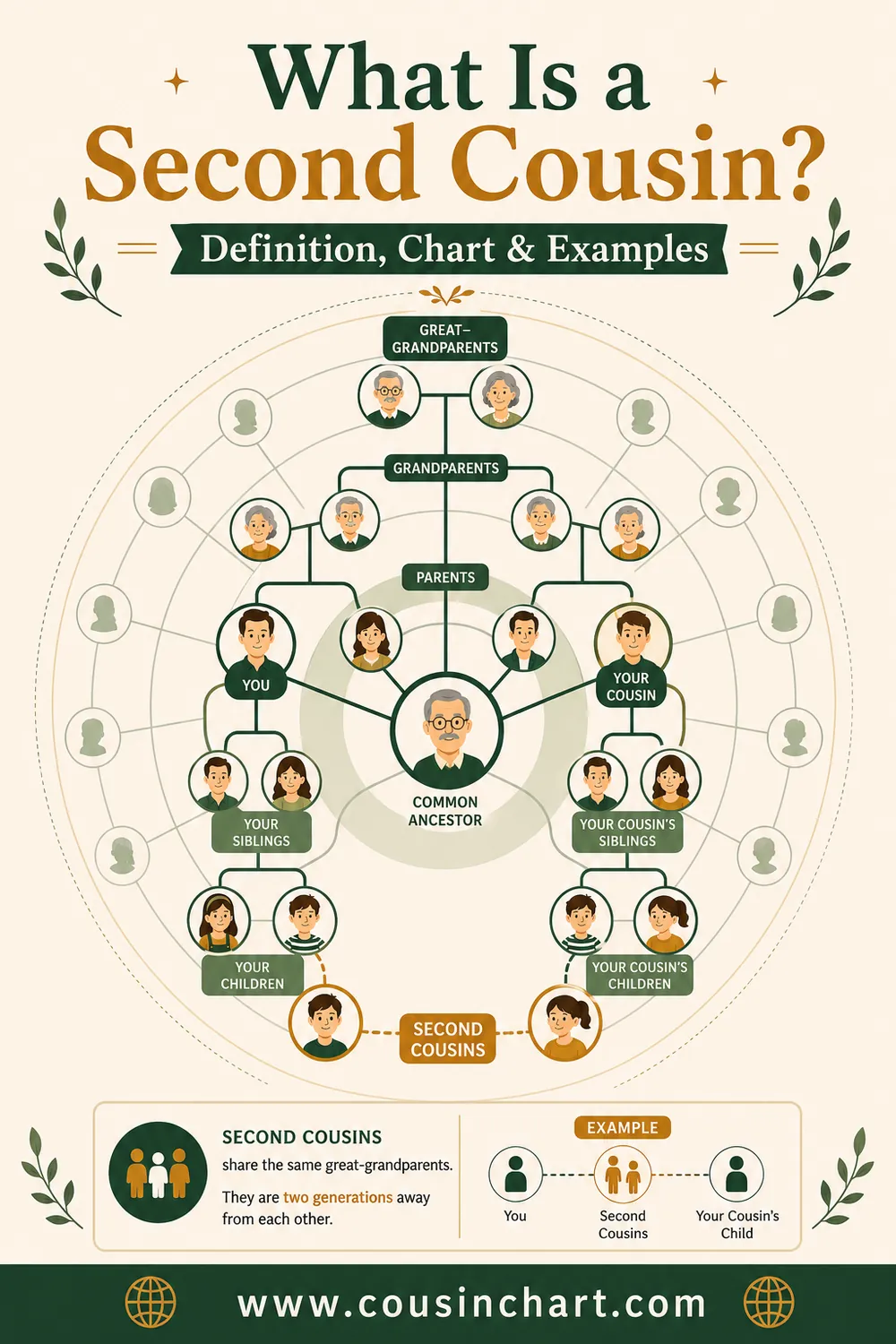
Start with ordinary second cousins. The American Heritage Dictionary defines a second cousin as "a child of a first cousin of one's parent." In other words, your parent and their parent are first cousins, and the two of you share a set of great-grandparents: usually a married couple.
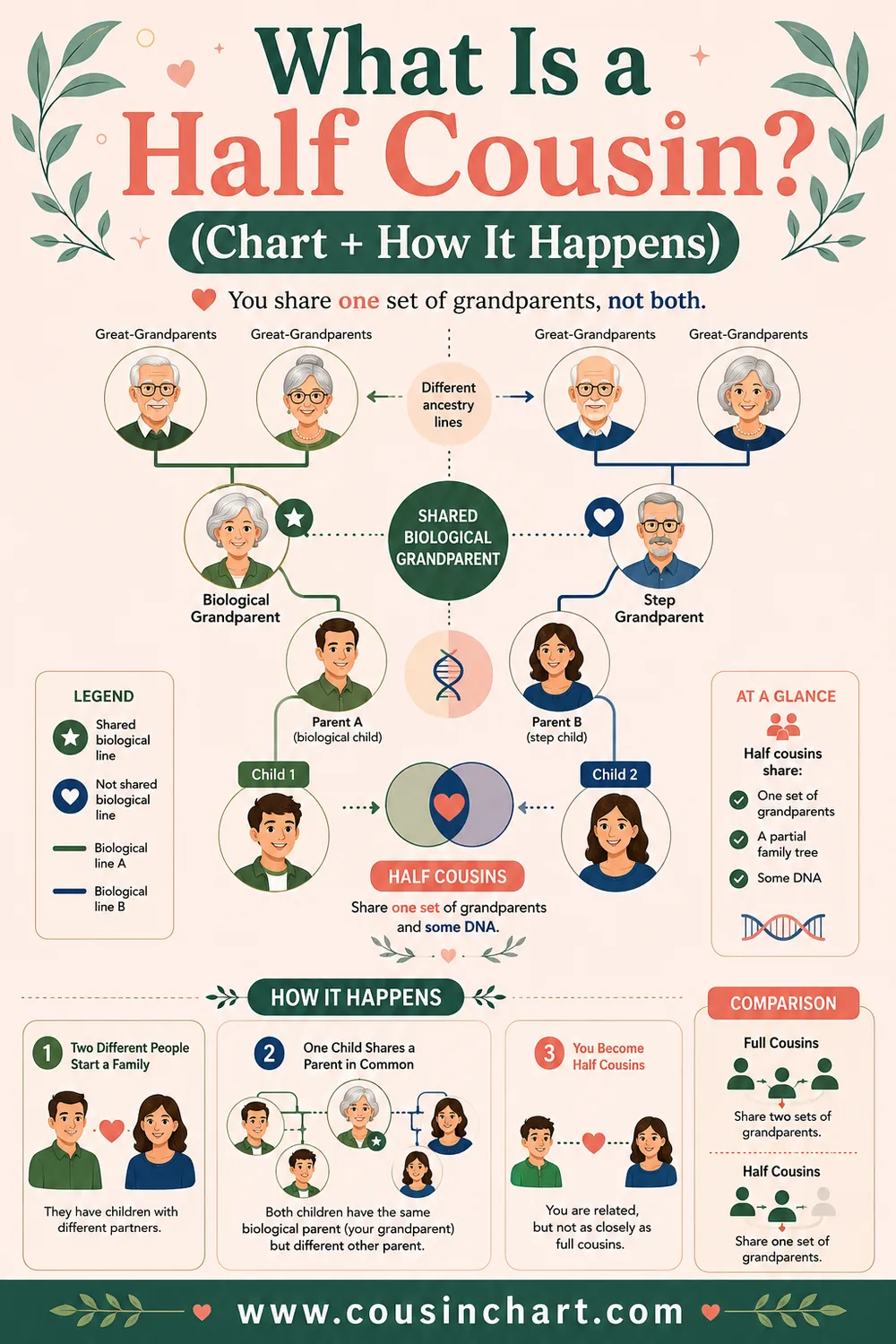
A half second cousin is the same thing with one ancestor missing. Your parent and their parent are half first cousins, and the two of you share only one great-grandparent. Everything traces back to a single person who had children with two different partners.
Here's the chain, from the top down:
- One great-grandparent has children with two different partners.
- Those children are half-siblings. One of them is your grandparent. The other is your half great-aunt or half great-uncle.
- Their children are half first cousins. One is your parent. The other is your parent's half first cousin.
- Their children are half second cousins. That's you and the other person.
In everyday life, half second cousins simply call each other "cousin." The "half" matters mostly when you're building a family tree, reading DNA results, or trying to figure out which ancestor connects you.
Which great-grandparent do you share?
You have eight great-grandparents: four on your mom's side and four on your dad's. A full second cousin shares two of them, a couple. A half second cousin shares exactly one.
The shared one is the person who had children with two partners. To find them, ask:
- Which of my grandparents had a half-sibling? The shared great-grandparent is the parent that your grandparent and that half-sibling had in common.
- Was it a mother or a father? If the half-siblings share a mother, your shared ancestor is a great-grandmother. If they share a father, it's a great-grandfather.
Your other seven great-grandparents aren't related to your half second cousin, and their other seven aren't related to you. That includes the "other" partner on each side. Your great-grandparent who had a child with the shared ancestor is in your tree but not theirs, and vice versa.
Half second cousin chart
Here's a side-by-side chart of the two branches. The names are illustrative. Great-grandpa Henry married Alice, and they had a son, Robert. After Alice died, Henry married Clara, and they had a daughter, Margaret.
| Generation | Your branch | Their branch | Relationship between the two |
|---|---|---|---|
| Great-grandparents | Henry + Alice | Henry + Clara | Henry is the one shared ancestor |
| Grandparents | Robert | Margaret | Half-siblings |
| Parents | Robert's daughter, Ellen | Margaret's son, David | Half first cousins |
| You | You (Ellen's child) | Jamie (David's child) | Half second cousins |
| Next generation | Your child | Jamie's child | Half third cousins |
Read across any row and you can name the relationship. Read down either column and you see one family line. The whole pattern rests on that single shared ancestor at the top. If you'd like to see all eight of your great-grandparents laid out at once, our great-grandparents chart gives you a blank to fill in.
Reading the chart diagonally
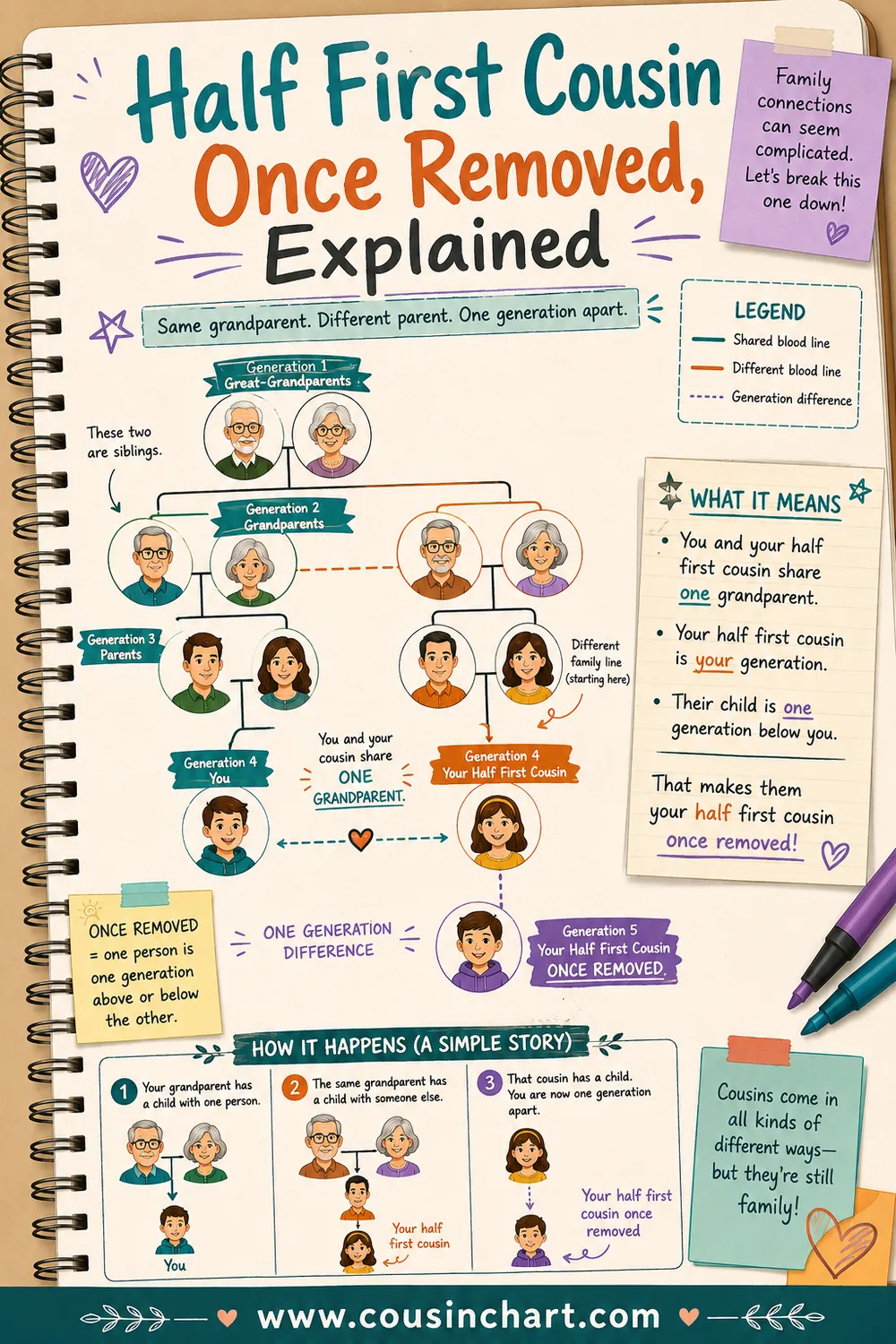
Diagonal steps give you "removed" relationships. From you, go up one row on the other branch and you reach David, your parent's half first cousin. That makes David your half first cousin once removed. Go down one row on the other branch and you reach Jamie's child, your half second cousin once removed.
How half second cousins happen
Every half second cousin relationship starts with one ancestor who had children with more than one partner. In older family trees, the most common reason is a death followed by remarriage. Before modern medicine, many people lost a spouse young and married again, sometimes more than once. Children from each marriage became half-siblings, and their great-grandchildren became half second cousins.
Other common reasons include:
- Divorce and remarriage. More common in recent generations.
- A child born outside a marriage. These often come to light through DNA testing, decades later.
- An unknown or misattributed parent. Someone believed to be a full sibling turns out to be a half-sibling, which turns the whole line below them into "half" relationships.
Why half lines hide in old trees
Half relationships three generations back are easy to miss. A great-grandparent's first spouse may have died before anyone now living was born. Family stories tend to smooth over the details, and children from two marriages often grew up in the same house, so everyone simply called each other brother and sister. Census records may list them together under one surname with no hint that they had different mothers or fathers.
That's why it pays to check dates closely. A gap in births, a mother's age that doesn't fit, or a marriage record dated after some of the children were born can all signal that a household held half-siblings. If you find one, every line descending from those children becomes a "half" line, and your second cousins on that branch may really be half second cousins.
That last case explains a lot of DNA surprises. If you match a supposed full second cousin at only around 100 cM, the half second cousin explanation is one of the first to consider. We'll look at why in the DNA section.
How much DNA do half second cousins share?
First, a quick refresher on where shared DNA comes from. Humans have 23 pairs of chromosomes, and, as the National Human Genome Research Institute explains, one copy of each chromosome is inherited from the mother and the other from the father. Each parent passes down a shuffled half of their own pairs. Over generations, an ancestor's DNA gets cut into smaller and smaller pieces, and different descendants end up with different pieces.
Consumer DNA tests look for those shared pieces. According to MedlinePlus, from the National Library of Medicine, autosomal DNA testing looks at large numbers of genetic markers across the non-sex chromosomes, and people who are related tend to share more of those variations. When two testers share long matching stretches, the company counts them up and reports the total.
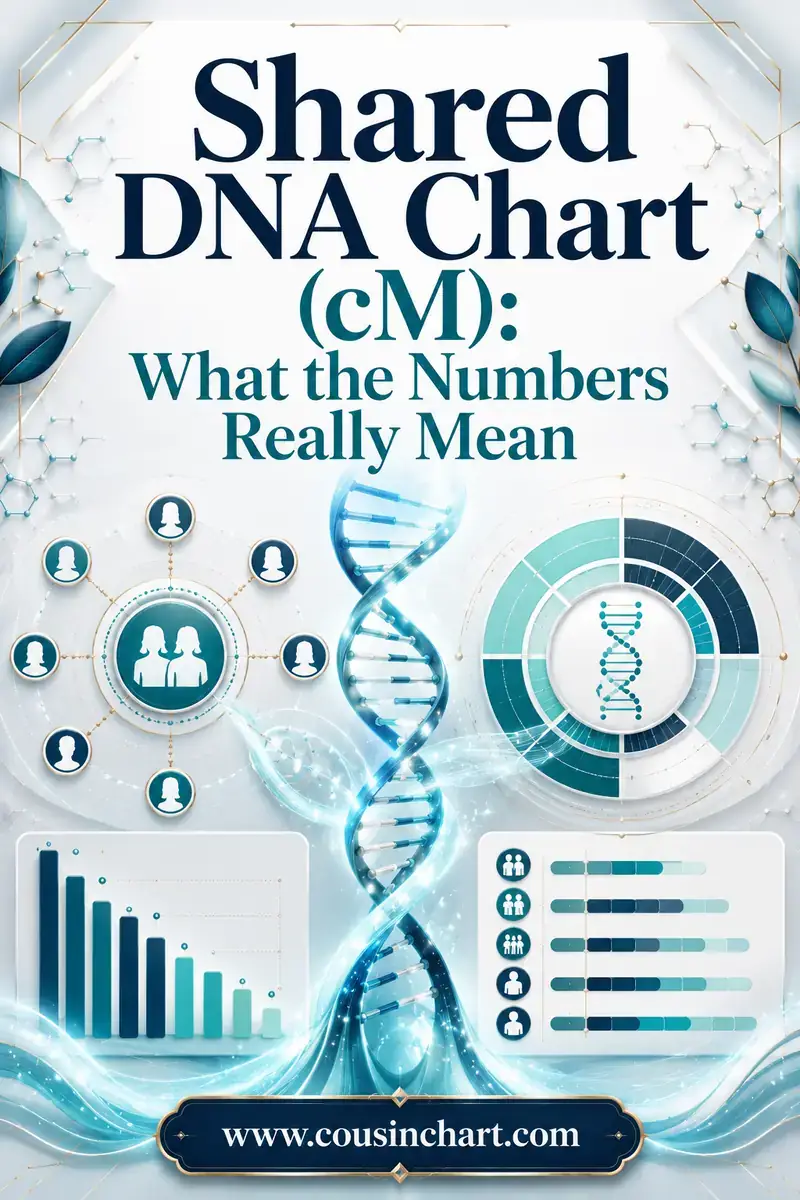
Half second cousins share, on average, about half as much DNA as full second cousins. The best public data comes from the Shared cM Project, Version 4.0, which genetic genealogist Blaine Bettinger compiled from about 60,000 submitted DNA results. DNA companies measure shared DNA in centimorgans (cM), a unit that roughly tracks the length of shared stretches of DNA.
| Relationship | Submissions | Average cM | Range in the project |
|---|---|---|---|
| Full second cousin | 4,172 | 229 | 41 to 592 |
| Half second cousin | 512 | 120 | 10 to 325 |
| Half second cousin once removed | 474 | 66 | 0 to 190 |
| Third cousin | 4,775 | 73 | 0 to 234 |
| Half third cousin | 302 | 48 | 0 to 168 |
The ranges above are after the project removed the top and bottom 0.5% of submissions for each relationship, to strip out obvious errors. You can explore the same data in the interactive Shared cM Project tool at DNA Painter, which lists half second cousins at an average of 120 cM with a range of 10 to 325.
Checking the arithmetic
Why roughly half? Count the steps. DNA passes from parent to child in a process called meiosis, and each step passes on about half. From Henry down to you is three steps (Henry to Robert, Robert to Ellen, Ellen to you). From Henry down to Jamie is another three. That's six steps in total.
- Half second cousins share one ancestor across six steps: 1/2 multiplied by itself six times, which is 1/64, or about 1.56%.
- Full second cousins share two ancestors across the same six steps: 2 × 1/64 = 1/32, or about 3.13%.
The Shared cM Project's "expected" column uses a genome total of 6,800 cM. (It gives 1,700 cM as the expected value for half-siblings, who share 25%, and 1,700 ÷ 0.25 = 6,800.) Applying that:
- Half second cousins: 6,800 ÷ 64 = 106.25 cM expected. The project lists 106 expected and 120 observed.
- Full second cousins: 6,800 ÷ 32 = 212.5 cM expected. The project lists 213 expected and 229 observed.
- Ratio of the observed averages: 120 ÷ 229 = 0.52, so half second cousins share about 52% as much as full second cousins in this data.
Observed averages run a little above the expected values for both. One likely reason, which the project itself flags, is that some families have more than one connection (through endogamy or pedigree collapse), which pushes shared DNA up.
Why the range is so wide
A range of 10 to 325 cM is huge. It happens because DNA doesn't pass down in neat halves. Population geneticist Graham Coop explains how much of your genome you inherit from a particular ancestor: on average it's 1/2 for a parent, 1/4 for a grandparent and 1/8 for a great-grandparent, but because DNA comes down in large chunks, the real share swings around those averages. Your share of Henry's DNA and Jamie's share are each random, and then the overlap between your two random pieces is random again. Multiply those swings together and you get a wide spread.
The project data shows the same spread for great-grandparents themselves: a great-grandchild shares an average of 887 cM with a great-grandparent, with a range of 485 to 1,486.
Can half second cousins share no DNA at all?
It's possible in theory, but it's rare at this distance. In the Shared cM Project, the lowest half second cousin value kept after trimming was 10 cM, so every one of the remaining submissions shared at least some DNA. The project notes that it set the minimum to 0 cM only for relationships more distant than half second cousin, which tells you this is roughly the point where zero-match cases start to show up in the data.
For comparison, Graham Coop's analysis of how many DNA blocks you share with a cousin estimates that roughly 1 in 100 pairs of full third cousins share no blocks from their shared ancestors, and about 25% of full fourth cousins share none. Half second cousins are a closer relationship than third cousins, with twice the expected sharing (1/64 compared with 1/128), so a true zero is even less likely for them.
So if a known half second cousin doesn't appear on your match list at all, check the paper trail before blaming chance. Possible explanations include a misattributed parent somewhere in the line, a testing error, or simply that the other person tested at a company you haven't checked.
Relationships that look the same in DNA
Here's the tricky part for DNA testers. A match around 120 cM fits several relationships, and the half second cousin is just one of them. The Shared cM Project groups relationships by how many steps of inheritance separate the two people, and half second cousins sit in a group with three others that have the same expected sharing.
| Relationship (same meiosis grouping) | Average cM | Range | Shared ancestor(s) |
|---|---|---|---|
| Half second cousin | 120 | 10 to 325 | One great-grandparent |
| Second cousin once removed | 122 | 14 to 353 | A great-grandparent couple (yours or your parent's) |
| Half first cousin twice removed | 125 | 16 to 269 | One ancestor, two generations apart |
| First cousin three times removed | 117 | 25 to 238 | An ancestor couple, three generations apart |
All four have the same expected value in the project, 106 cM, and their averages fall within 8 cM of each other. That means total shared DNA can't tell them apart. The most common real-world confusion is between a half second cousin and a second cousin once removed, since both tend to be closer in age than a first cousin three times removed would be.
How to tell them apart
- Ages. A second cousin once removed is usually a generation older or younger than you. A half second cousin is usually in your generation.
- Shared matches. Look at who you both match. A full second cousin's relatives will include descendants of both great-grandparents in a couple. A half second cousin will share matches with the descendants of only one of them.
- The paper trail. A marriage record, a death record for a first spouse, or a census showing children with different mothers can confirm a half line.
- Testing another relative. If your parent tests, the match should roughly double for them. That shifts the comparison up a generation, where the gap between half and full relationships is wider in cM terms.
A worked DNA example, step by step
Here's how a real-looking case might unfold. The people and numbers are illustrative, chosen to sit inside the Shared cM Project ranges.
The setup. You've always been told that your grandpa Robert and his sister Margaret were full siblings. Margaret's grandchild, Jamie, takes a DNA test, and the two of you match at 104 cM. For full second cousins, the project's average is 229 cM. Your match is well under that, though still inside the full second cousin range of 41 to 592 cM.
Step 1: Don't jump to conclusions. A single 104 cM match fits full second cousins, half second cousins, second cousins once removed and several others. One number alone can't decide it.
Step 2: Test a generation up. Your mom, Ellen, agrees to test. She and Jamie's dad, David, would be first cousins if Robert and Margaret were full siblings, and half first cousins if they were half-siblings. Say Ellen and David share 430 cM. The project's average for full first cousins is 866 cM (range 396 to 1,397). For half first cousins it's 449 cM (range 156 to 979). 430 cM sits right beside the half first cousin average and close to the bottom edge of the full first cousin range.
Step 3: Line up the evidence. Two independent matches both come in near the "half" averages. That's much stronger than one low match, because random variation rarely pushes two separate comparisons low in the same direction.
Step 4: Check shared matches. You look at people you and Jamie both match. They all trace back to Henry's parents and siblings. None trace back to Alice's family. That points to Henry as the only shared ancestor.
Step 5: Find the record. A search turns up Alice's death record and Henry's second marriage to Clara two years later, with Margaret born after that. The paper trail now agrees with the DNA: Robert and Margaret were half-siblings, and you and Jamie are half second cousins.
This is the usual pattern. DNA raises the question, a second tester sharpens it, shared matches point to the right ancestor, and records confirm it.
Using shared matches to find the one shared great-grandparent
If you know someone is your half second cousin but not which great-grandparent you share, shared matches can point the way. Here's the idea, using the illustrative Henry family.
- Your match list includes relatives of Alice. Alice is your great-grandmother but not Jamie's. People descended from Alice's parents or siblings will match you but not Jamie.
- Jamie's match list includes relatives of Clara. Clara is Jamie's great-grandmother but not yours. Her relatives match Jamie but not you.
- Henry's relatives match you both. Anyone descended from Henry's parents, siblings or cousins can show up as a shared match between you and Jamie.
So the shared matches you and Jamie have in common will mostly point to Henry's side. If those shared matches carry surnames and places from one great-grandparent's family, that's very likely your shared ancestor. Our guide to third cousins uses a similar approach for more distant matches, where the same reasoning applies one generation further back.
Half second cousin once removed, and other neighbors
The search question that comes up most after "what is a half second cousin" is about the relationship one step over: "What grandparents would you share with a half 2nd cousin once removed, or a 3rd cousin?" Here are the answers side by side.
- Half second cousin: one shared great-grandparent. Same generation as you.
- Half second cousin once removed (older): your parent's half second cousin. You share one of your second-great-grandparents, which is one of their great-grandparents.
- Half second cousin once removed (younger): your half second cousin's child. You share one of your great-grandparents, which is one of their second-great-grandparents.
- Third cousin: a shared couple of second-great-grandparents. Same generation as you.
- Half third cousin: one shared second-great-grandparent.
DNA-wise, the Shared cM Project puts a half second cousin once removed at an average of 66 cM (range 0 to 190), close to a third cousin at 73 cM (range 0 to 234). Again, those two can't be told apart by total cM alone. Our shared cM chart lists all of these relationships in one place, if you want to compare a match against several options at once.
Their family, mapped to you
Once you know someone is your half second cousin, you can work out what everyone in their family is to you. The rule is simple: take the full-cousin name, then add "half," because the whole branch traces back to one shared ancestor.
| Your half second cousin's... | Is your... |
|---|---|
| Full sibling | Half second cousin |
| Parent (on the shared side) | Half first cousin once removed |
| Grandparent (on the shared side) | Half great-aunt or half great-uncle |
| Great-grandparent (the shared one) | Great-grandparent |
| Great-grandparent (the other partner) | Not related to you |
| Child | Half second cousin once removed |
| Grandchild | Half second cousin twice removed |
| Parent (on their other side) | Not related to you |
How much DNA you'd expect with each of them
The same Shared cM Project data gives a rough idea of what to expect from each member of a half second cousin's family, if they test:
- Half great-aunt or half great-uncle (their grandparent): average 431 cM, range 184 to 668.
- Half first cousin once removed (their parent): average 224 cM, range 62 to 469.
- Half second cousin (them and their full siblings): average 120 cM, range 10 to 325.
- Half second cousin once removed (their child): average 66 cM, range 0 to 190.
- Half second cousin twice removed (their grandchild): average 48 cM, range 0 to 144.
Notice the pattern: each step down the line roughly halves the average, from 431 to 224 to 120 to 66. That's the "half per generation" rule showing up in real data, give or take some noise. It's also why testing the oldest living person in a branch gives you the clearest signal.
A half-sibling of your half second cousin is a special case. If the half-sibling shares the parent on your shared side, they're your half second cousin too. If they share only the other parent, they're not related to you.
How to show a half second cousin on a family tree
Half relationships are easy to draw once you know the trick: give the shared ancestor two separate marriage lines. Here's how to do it on paper or in a genealogy program.
- Draw the shared great-grandparent once. Put Henry in the center of the top row. Don't duplicate him, or the tree will look like two different people.
- Add both partners beside him. Put Alice on one side and Clara on the other, each joined to Henry by a separate marriage or partnership line. If you know the order, number them: first marriage, second marriage.
- Drop each child from the correct couple. Robert's line comes down from Henry and Alice. Margaret's line comes down from Henry and Clara. The two children are now visibly half-siblings.
- Carry each branch down. Add Ellen under Robert and David under Margaret, then you under Ellen and Jamie under David.
- Add a note. A short note, such as "half-siblings: same father, different mothers," saves a future reader from having to work it out.
Most genealogy software handles this automatically when you attach a person to more than one spouse. Once it's drawn correctly, the software's relationship calculator will label you and Jamie as half second cousins on its own.
How to write it
In notes and spreadsheets, genealogists often shorten cousin relationships. The Shared cM Project writes "C" for cousin and "R" for removed, so a half second cousin appears as "Half 2C" and a half second cousin once removed as "Half 2C1R." You'll also see "H2C" in some notes. Any of these is fine, as long as you're consistent.
Is a half second cousin a "real" cousin?
Yes. A half second cousin is a blood relative, with a real shared ancestor and real shared DNA. The "half" describes how the connection is built, not how much the person counts. Most families never use the word "half" out loud at all.
It's also worth remembering that closeness in a family has little to do with fractions. Plenty of half second cousins grew up in the same town, went to the same reunions and never knew their great-grandparents were from two different marriages. Learning about the "half" doesn't change any of that history. It just adds an accurate detail to the family story, and often a new set of ancestors to research on each side: the partner who's yours alone, and the partner who's theirs alone.
Where the word does matter is in records and research. Genealogists like to note it because it tells future researchers that only one ancestor connects the two lines. It also matters for DNA, since a half relationship shares about half as much DNA as the full version. And in some legal settings, such as inheritance between distant relatives, laws treat half-blood and whole-blood relatives differently in a few places, so laws vary by place.
Common mix-ups
- Mixing up "half" and "step." A half second cousin shares a great-grandparent with you. A step-relative is connected only by marriage and shares no ancestor. If your grandparent's stepsibling had grandchildren, those people are your step-relatives, not your half second cousins.
- Calling a cousin's child your second cousin. Your first cousin's child is your first cousin once removed. The American Heritage Dictionary even lists "a child of one's first cousin" as a second sense of "second cousin," which shows how common the loose usage is, but genealogists keep the two separate.
- Assuming you share a couple. With a half second cousin, only one great-grandparent is shared. Searching both spouses' families for the link will only lead you astray on one side.
- Reading 120 cM as a sure thing. Several relationships average around 120 cM. Ages, shared matches and records have to settle it.
- Forgetting the "half" in the next generation. Your child and your half second cousin's child are half third cousins. Once a line is half, it stays half all the way down.
Try it yourself
Here are a few puzzles to test your understanding. The families are illustrative.
- Puzzle: Your grandma and Jake's grandpa share a father but have different mothers. What are you and Jake? Answer: Half second cousins, sharing one great-grandfather.
- Puzzle: Your mom and Lena's dad are half first cousins. What is Lena to you? Answer: Your half second cousin, since your parents are half first cousins.
- Puzzle: You share 115 cM with Priya, who's about your age. Your trees show no link yet. Is she a half second cousin? Answer: Possibly. A half second cousin is one fit, but so is a second cousin once removed or a half first cousin twice removed. Check shared matches and ages before deciding.
- Puzzle: Your great-grandmother Ada had a son, Leon, with her first husband, and a daughter, Vera, with her second. Leon is your grandfather. Vera's granddaughter is Nell. What is Nell to you, and who is your shared ancestor? Answer: Nell is your half second cousin. Ada is the only ancestor you share. Neither of Ada's husbands is related to both of you.
- Puzzle: Your dad matches Nell at 210 cM. Does that fit? Answer: Yes. Your dad is Nell's half first cousin once removed, and the project's average for that relationship is 224 cM, with a range of 62 to 469.
- Puzzle: Your half second cousin's mother is related to you how? Answer: If she's on the shared side, she's your half first cousin once removed. If she married into that branch, she's not related to you.
Wrap-up: one shared great-grandparent
A half second cousin is your parent's half first cousin's child: someone who shares one great-grandparent with you instead of a couple. You'll share around 120 cM on average, roughly half of what full second cousins share, and a range wide enough that DNA alone can't confirm the relationship. Draw the line from the shared ancestor down both branches, and the name falls into place. For the bigger picture of how cousins shift across generations, our guide to the first cousin once removed is the natural next read. To name any relationship in seconds, try the free calculator on our homepage: you pick how two people connect, and it names the relationship, such as "first cousin once removed."
Frequently Asked Questions
What is a half second cousin in simple terms?
A half second cousin is someone who shares one great-grandparent with you instead of a great-grandparent couple. Your grandparent and their grandparent were half-siblings, meaning they had the same mother or the same father but not both. That makes your parents half first cousins, and you half second cousins. In everyday life you'd just call each other cousin. The half matters mainly for family trees and for reading DNA results.
How much DNA do half second cousins share?
In the Shared cM Project, Version 4.0, half second cousins share an average of 120 centimorgans, with a range of 10 to 325 cM across 512 submissions. That's about half of what full second cousins share, which averages 229 cM. The expected value, assuming perfect halving at each generation, is 1/64 of the genome, or about 106 cM using the project's 6,800 cM genome total. Real results vary widely because DNA is inherited in large random chunks.
Which great-grandparent do I share with a half second cousin?
You share the one great-grandparent who had children with two different partners. Look for the grandparent of yours who had a half-sibling. If your grandparent and that half-sibling had the same mother, your shared ancestor is a great-grandmother. If they had the same father, it's a great-grandfather. Your other seven great-grandparents, including the partner who had your grandparent, aren't related to your half second cousin.
What is the difference between a half second cousin and a second cousin once removed?
A half second cousin is in your generation and shares one great-grandparent with you. A second cousin once removed is a generation older or younger and shares a great-grandparent couple with you or your parent. In DNA they look almost identical: the Shared cM Project averages are 120 cM for half second cousins and 122 cM for second cousins once removed. Ages, shared matches and family records are what tell them apart.
What grandparents do you share with a half second cousin once removed?
You share one ancestor, never a couple. If the person is your parent's half second cousin, you share one of your second-great-grandparents, who is their great-grandparent. If the person is your half second cousin's child, you share one of your great-grandparents, who is their second-great-grandparent. The Shared cM Project gives this relationship an average of 66 cM, with a range of 0 to 190 cM.
Is a half second cousin closer than a third cousin?
Yes. A half second cousin shares one great-grandparent with you, while a third cousin shares a couple of second-great-grandparents. In expected DNA, half second cousins share about 1/64 of the genome and third cousins about 1/128. The Shared cM Project averages agree: 120 cM for half second cousins compared with 73 cM for third cousins. A half second cousin is genetically closer to a second cousin once removed.
What is my half second cousin's child to me?
Your half second cousin's child is your half second cousin once removed. Removed means one generation apart, and half means the connection runs through a single shared ancestor. Your own child and your half second cousin's child are half third cousins to each other. Once a line is half, it stays half for every generation below it, because the only shared ancestor at the top is still that one great-grandparent.
What do I call a half second cousin in person?
Just cousin, or their first name. Hardly anyone says half second cousin out loud at a family gathering, and there's no need to. The full term is useful in writing, such as in a family tree, a genealogy note or a conversation about DNA results, because it tells the reader that only one great-grandparent connects you. In notes, many genealogists shorten it to Half 2C, the same style the Shared cM Project uses for its relationship tables.
Is a half second cousin the same as a step second cousin?
No. A half second cousin shares a real ancestor with you, one great-grandparent, and normally shares some DNA with you. A step-relative is connected only through a marriage and shares no ancestor at all. For example, if your grandfather's stepsister had grandchildren, they're connected to your family through a remarriage, not through blood, so they aren't your half second cousins. Families may still call them cousins, which is a matter of custom.
Can half second cousins not share any DNA?
It's possible but rare. In the Shared cM Project, the lowest half second cousin result kept after trimming outliers was 10 cM, and the project starts showing a minimum of 0 cM only for relationships more distant than half second cousin. Population geneticist Graham Coop estimates that only about 1 in 100 pairs of full third cousins share no DNA blocks, and half second cousins are a closer relationship than that. A zero result is worth double-checking.
Sources
We checked every source below while writing this guide. Last reviewed October 30, 2026, by Joan Ramos.
- second cousin (The American Heritage Dictionary of the English Language, Fifth Edition) (HarperCollins / American Heritage Dictionary)
- The Shared cM Project, Version 4.0 (March 2020) (Blaine T. Bettinger, The Genetic Genealogist)
- The Shared cM Project 4.0 tool v4 (DNA Painter)
- Chromosomes Fact Sheet (National Human Genome Research Institute)
- What is genetic ancestry testing? (MedlinePlus Genetics, U.S. National Library of Medicine)
- How much of your genome do you inherit from a particular ancestor? (Graham Coop, gcbias (Coop Lab blog))
- How many genomic blocks do you share with a cousin? (Graham Coop, gcbias (Coop Lab blog))