Second Cousin Once Removed, Explained (With Chart)
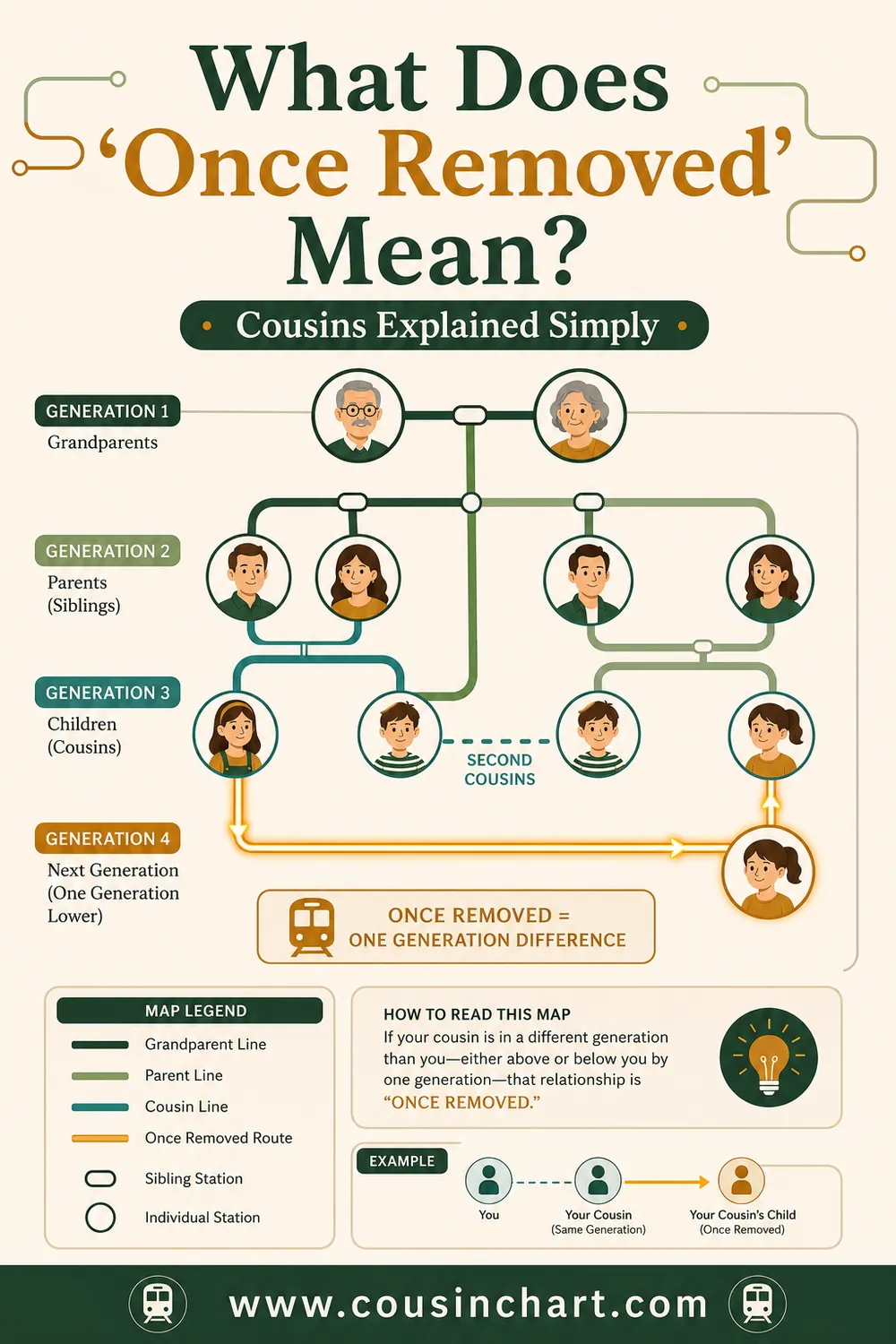
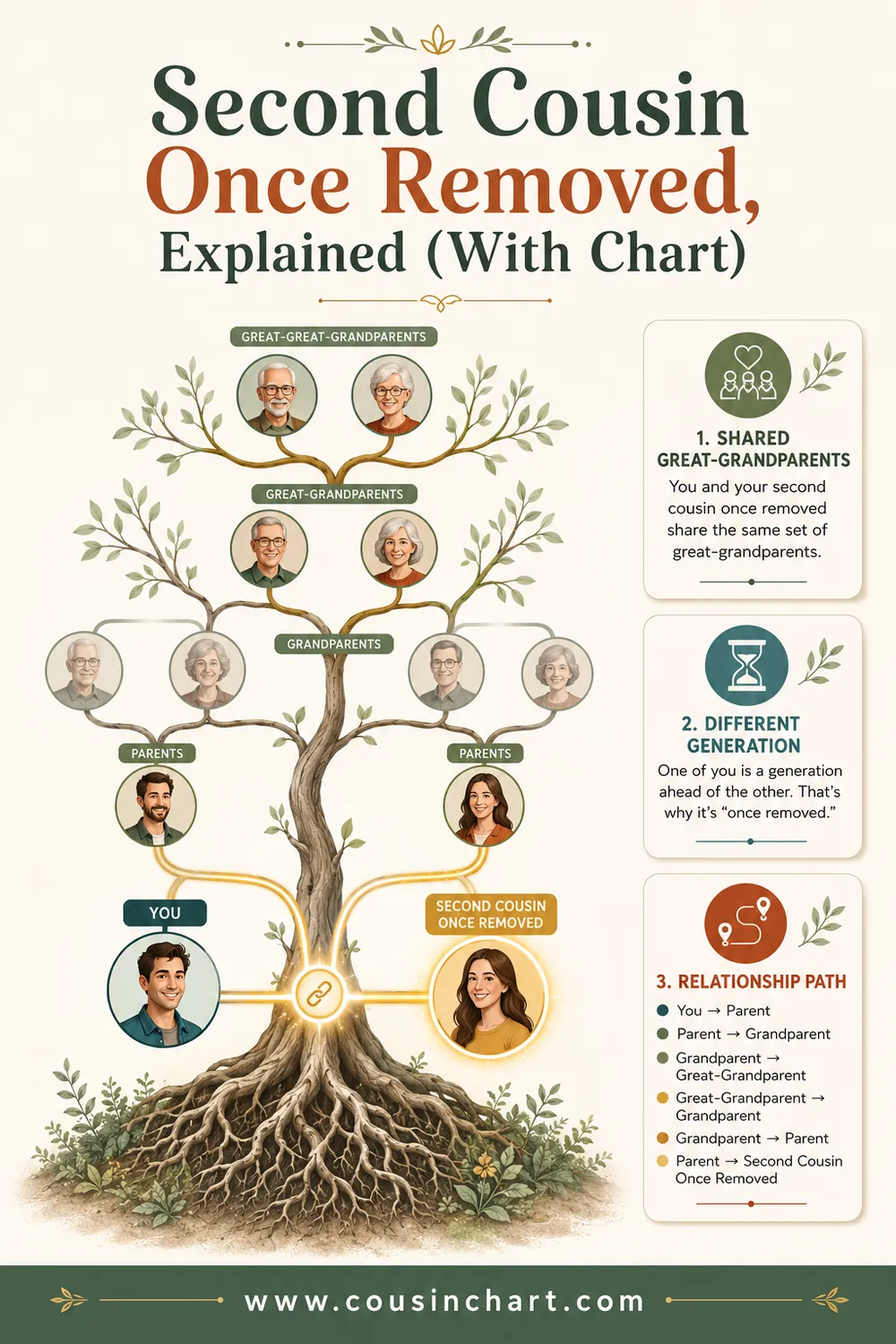
A second cousin once removed is either your second cousin's child or your parent's second cousin. The "second cousin" part tells you how close the family line is, and "once removed" means the two of you sit one generation apart on the family tree.
Both of those people get the exact same label, which is why the term trips so many people up. This guide walks through both directions, shows you the chart, covers how much DNA you share, and gives you a foolproof way to work it out at a reunion. If you'd rather not do any counting at all, the free relationship calculator on our homepage names the relationship for you in seconds.
Relationship quick-check. Tap a phrase to see the correct term:
The answer will appear here.
The Two People This Term Covers
"Second cousin once removed" describes two completely different people, one older than you and one younger:
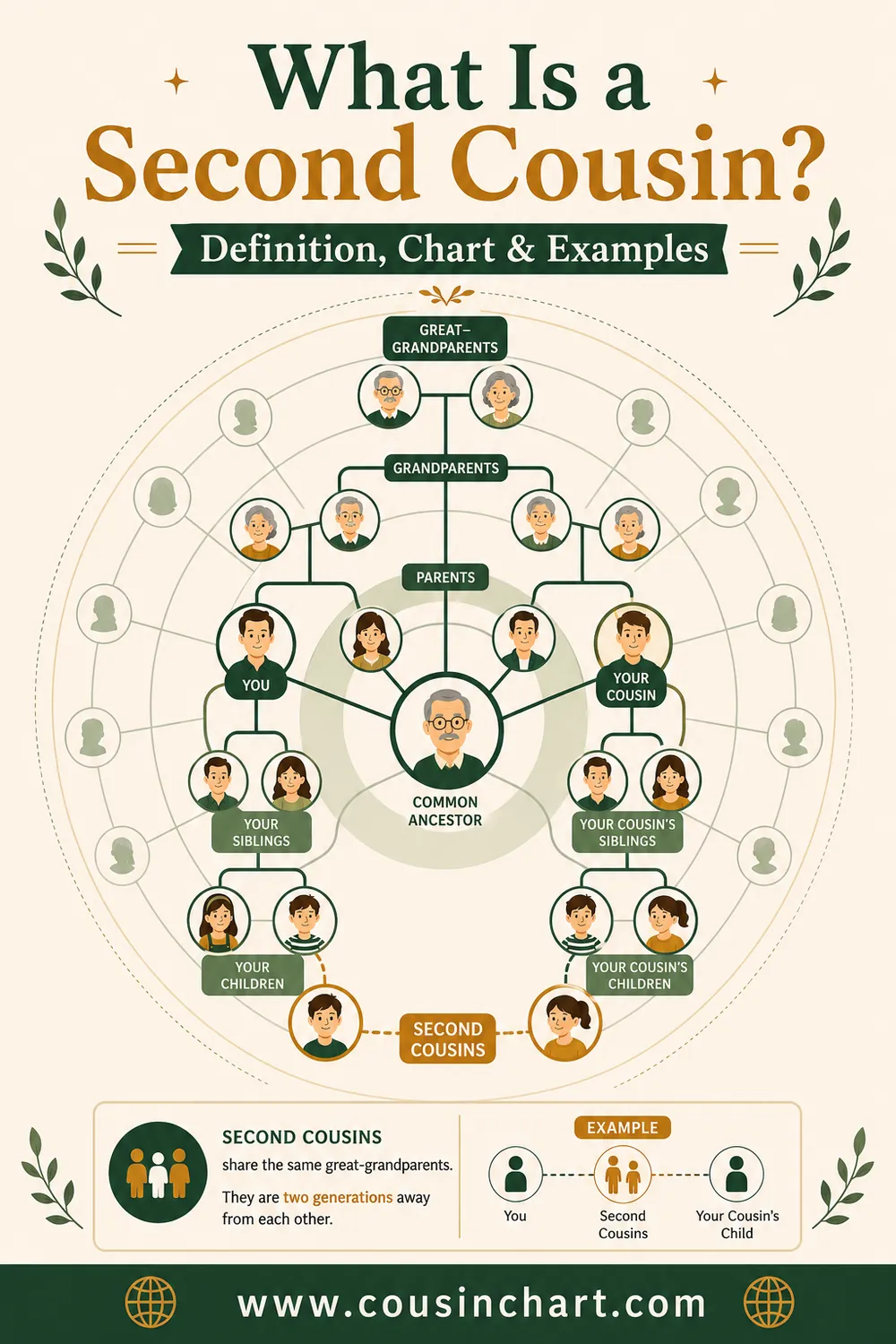
- One generation down: your second cousin's child. You and your second cousin share great-grandparents; their child is one generation below that shared line.
- One generation up: your parent's second cousin. Your parent and this person share great-grandparents, and you sit one step below your parent.
The label works in both directions. If Rosa is your dad's second cousin, then you are Rosa's second cousin once removed too. English doesn't bother with separate words for "removed upward" and "removed downward" — everyone relies on context, a chart, or a quick calculator check.
If you want the deeper logic behind the "removed" system, our guide to what once removed means covers it from the ground up.
How the Counting Works
Every cousin relationship is built from two numbers:
- The cousin degree (first, second, third...) — how far back the shared ancestor is. Count the generations from the person closer to the common ancestor, then subtract one. Second cousins are each three generations below shared great-grandparents: 3 − 1 = 2.
- The removal (once, twice...) — the generation gap between the two of you. Same generation = no removal. One apart = once removed.
Take your second cousin's daughter. You are three generations below the shared great-grandparents; she is four. The smaller number, three, sets the degree: 3 − 1 = 2, a second cousin. The gap between three and four is one: once removed.
That's the whole system. It never changes, no matter how tangled the family gets.
Second Cousin Once Removed: The Chart
Here's where the relationship sits among its neighbors. Find the person you're wondering about in the left column:
| Who they are | What they are to you | Shared ancestor |
|---|---|---|
| Your parent's first cousin | First cousin once removed | Your great-grandparents |
| Your first cousin's child | First cousin once removed | Your grandparents |
| Your second cousin | Second cousin | Your great-grandparents |
| Your parent's second cousin | Second cousin once removed | Your great-great-grandparents |
| Your second cousin's child | Second cousin once removed | Your great-grandparents |
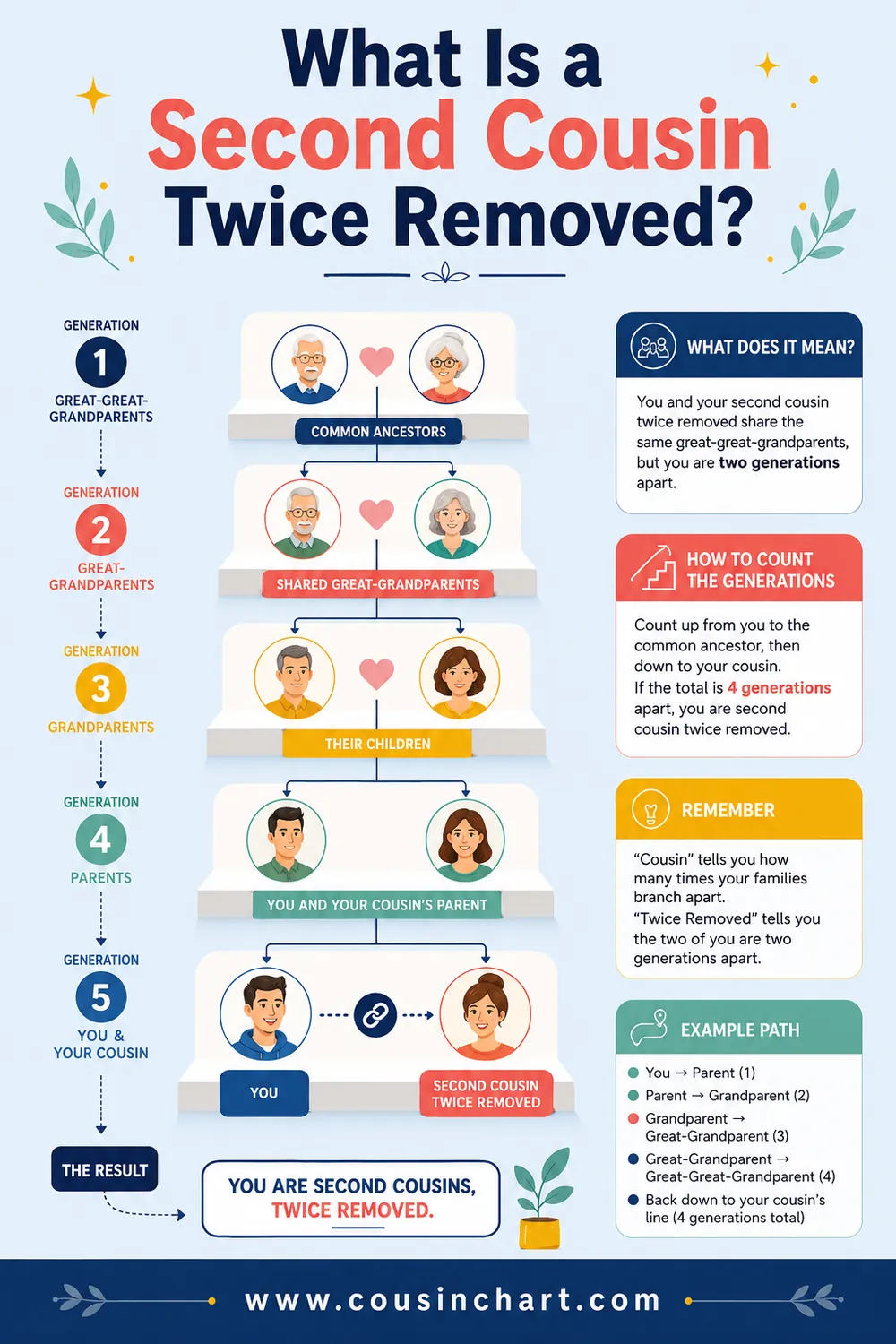
| Your grandparent's second cousin | Second cousin twice removed | Your 3×great-grandparents |
| Your second cousin's grandchild | Second cousin twice removed | Your great-grandparents |
| Your third cousin | Third cousin | Your great-great-grandparents |
Notice something useful: the two versions of "second cousin once removed" connect through different shared ancestors. Going up (your parent's second cousin), the common ancestors are your great-great-grandparents. Going down (your second cousin's child), they're your great-grandparents. The label is the same because the degree-and-removal math comes out the same.
A Real Family Example
Abstract rules stick better with names, so meet the Rivera family.
Elena and Marco are second cousins — their grandmothers were sisters, so they share great-grandparents. They see each other at every big family barbecue.
Marco has a son, Diego. What is Diego to Elena? Elena stays where she is on the tree; Diego is one generation below Marco. Same cousin line, one-generation gap: Diego is Elena's second cousin once removed.
Now flip it around from Diego's point of view. Elena is his father's second cousin. Same two people, same relationship, same term — Diego and Elena are second cousins once removed to each other.
When Diego eventually has kids, they'll be Elena's second cousins twice removed, and Diego's kids and Elena's kids will be third cousins to each other. Each new generation on both sides bumps the degree up by one; a generation on only one side bumps the removal.
How Much DNA Do Second Cousins Once Removed Share?
On average, second cousins once removed share about 1.5% of their DNA — roughly 100–125 centimorgans (cM) on testing sites like AncestryDNA or 23andMe. That's half of what full second cousins share (about 3%).
Two things worth knowing:
- The range is wide. Real-world results run from close to zero up to around 300 cM, because DNA inheritance is random. A low number doesn't mean the paper trail is wrong.
- The label overlaps with other relationships. A DNA match at ~120 cM could be a second cousin once removed, a half second cousin, or a first cousin three times removed. Testing companies list several possibilities for a reason — the cM value alone can't pick between them.
That's exactly why genealogists pair DNA results with a proper relationship chart, or just run both people through a relationship calculator to see which paths fit the paper records.
Is a Second Cousin Once Removed "Really" Family?
Genealogically, absolutely — you share great-great-grandparents (or great-grandparents, in the downward direction), which usually means the connection is only three or four generations old. In many families that's someone you actually know: the older cousin who shows up at weddings, or the kid your second cousin brings to Thanksgiving.
Socially, most people just say "cousin" and move on, and that's fine. The precise term matters in three situations:
- Genealogy research, where degree and removal determine which ancestor line to search.
- DNA matches, where the label predicts expected shared DNA.
- Inheritance and legal questions, where some jurisdictions define kinship by exact degree.
For everyday conversation, "my cousin Diego" works perfectly.
The Classic Mix-Ups (And How to Dodge Them)
Three relationships get confused with second cousin once removed constantly:
- Third cousin. Your second cousin's child is not your third cousin. Third cousins require a new generation on both sides — your child and your second cousin's child would be third cousins. One-sided steps change the removal, not the degree.
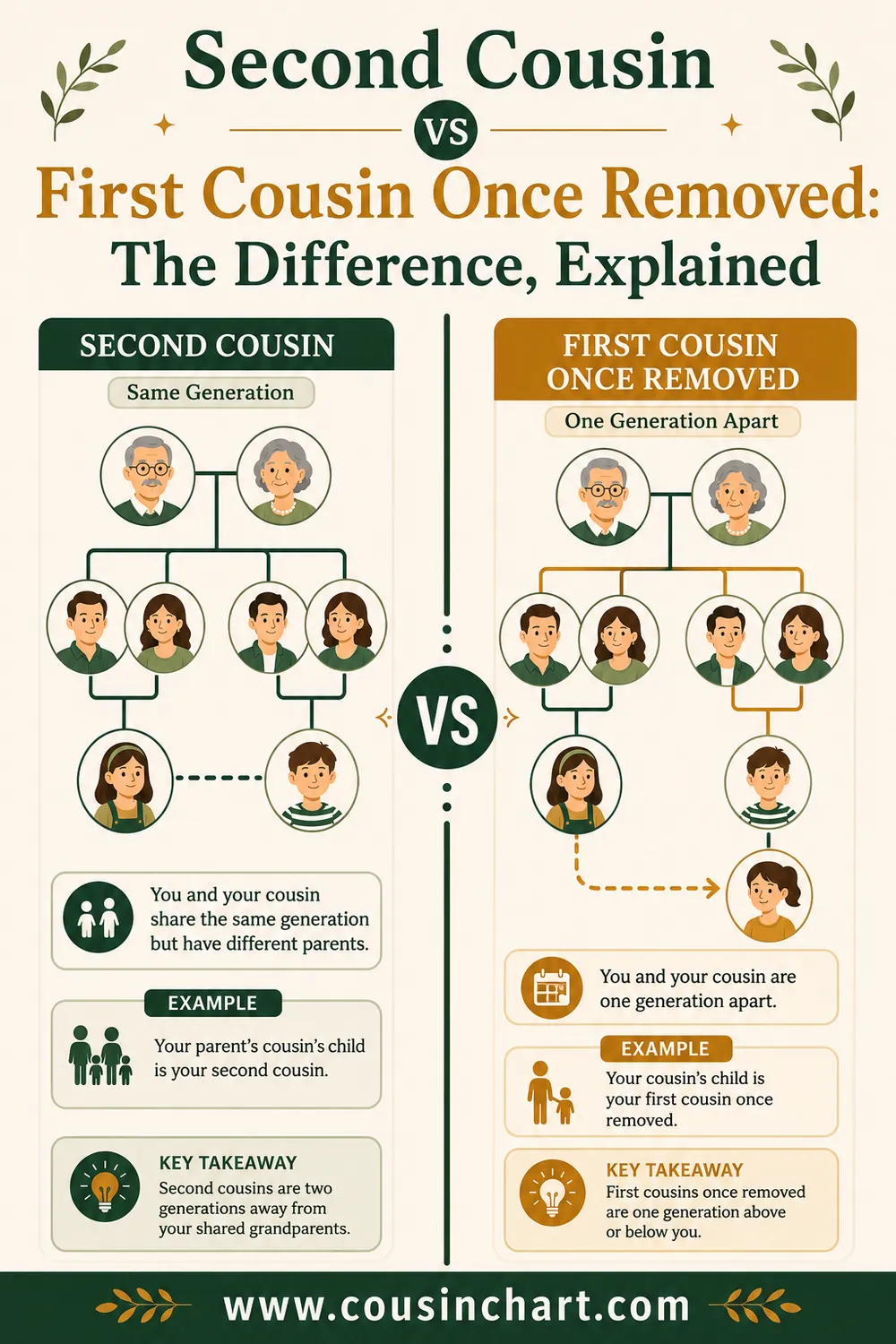
- Second cousin. Your parent's first cousin's child is your second cousin (same generation, shared great-grandparents) — no removal involved. Compare that with your parent's second cousin, who is your second cousin once removed.
- First cousin once removed. Same "once removed," different degree. Your parent's first cousin is your first cousin once removed; your parent's second cousin is your second cousin once removed. Our second cousin vs first cousin once removed comparison untangles that pair in detail.
A quick self-test: if you can name which ancestor two people share, you can always rebuild the term. Shared great-grandparents with no generation gap? Second cousins. Add a one-generation gap? Once removed.
How to Work It Out Fast
At a family gathering, use this three-question shortcut:
- Find the shared ancestor couple. Ask the older relatives — they usually know exactly whose grandmother was whose sister.
- Count generations down to each person. Grandparents = 2, great-grandparents = 3, great-great-grandparents = 4.
- Smaller count minus one = the cousin degree. The difference between counts = the removal.
Or skip all three steps: open the free family relationship calculator, click through "my parent's second cousin" or "my second cousin's child," and read the answer. It also shows the reverse relationship and the expected DNA share, which makes it handy for checking DNA-match lists too.
FAQ
What is a second cousin once removed in simple terms?
It's your second cousin's child, or your parent's second cousin. "Second cousin" describes the family line; "once removed" means you're one generation apart.
Is my second cousin's child my third cousin?
No. Your second cousin's child is your second cousin once removed. Third cousins only happen when both sides step down a generation — your children and your second cousin's children will be third cousins.
What do I call my parent's second cousin?
Formally, your second cousin once removed. Informally, most families just say "cousin" — and the relationship works both ways, so you're their second cousin once removed too.
How much DNA do second cousins once removed share?
About 1.5% on average, or roughly 100–125 cM, though real results range from near zero to about 300 cM. It's half the average for full second cousins.
Can second cousins once removed marry?
In the United States, marriage restrictions focus on closer relationships — no state bars second cousins or second cousins once removed. Laws vary by state and country, so check the current law where you live.
Is "second cousin once removed" the same relationship in both directions?
Yes. If she's your second cousin once removed, you're hers. The term is symmetric even though one of you is a generation older.
The Short Version
A second cousin once removed is your second cousin's child or your parent's second cousin — same cousin line, one generation apart. Count generations to the shared ancestor for the degree, count the gap for the removal, and the term builds itself.
And when a relative asks "so what are we, exactly?" at the next reunion, pull out the free cousin calculator and settle it in ten seconds flat.