What Is a Second Cousin Twice Removed?
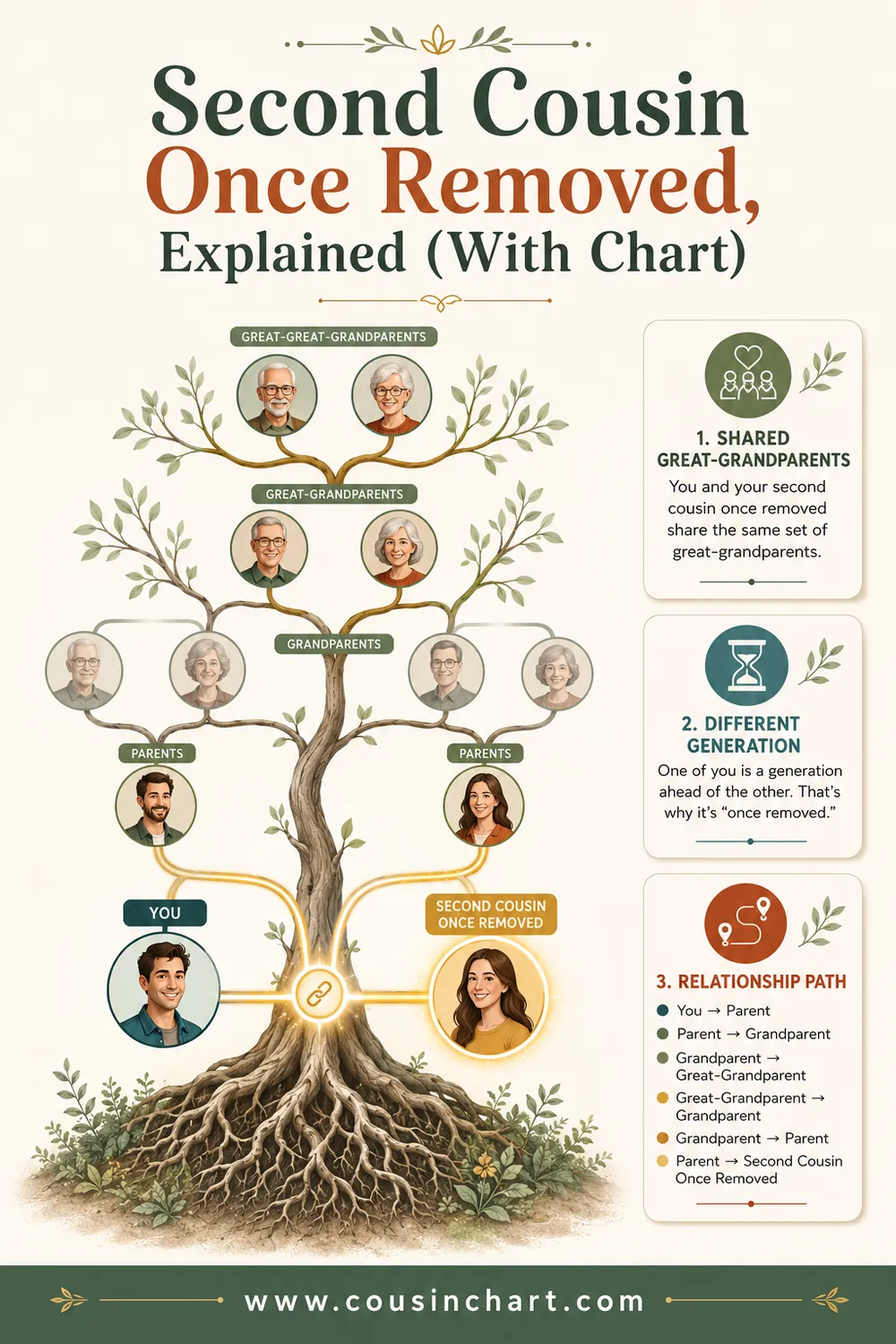
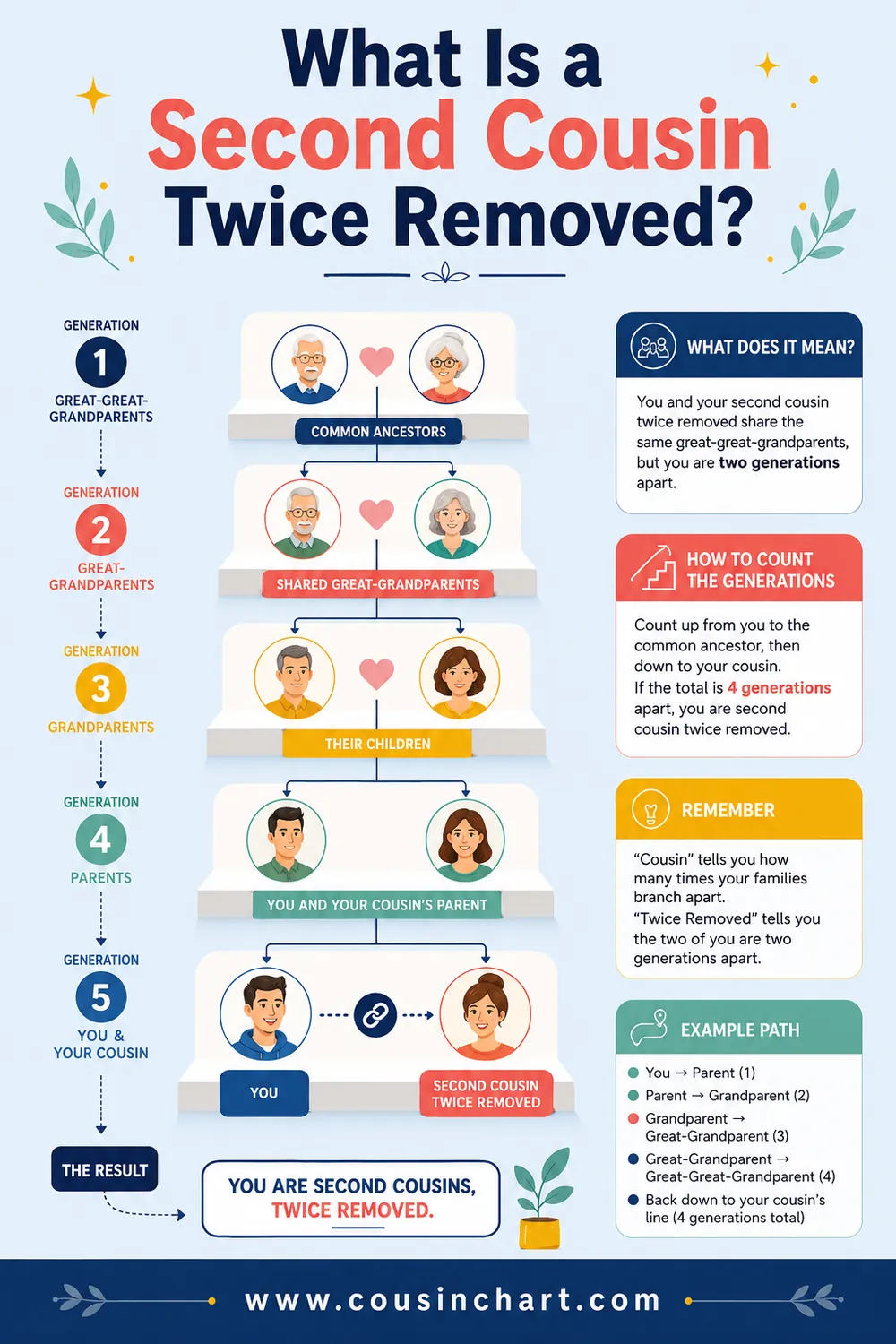
A second cousin twice removed is either your second cousin's grandchild or your grandparent's second cousin. "Second cousin" names the family line, and "twice removed" means the two of you are two generations apart on the family tree.
It sounds like a made-up relationship from a sitcom, but the term is precise, the math behind it is simple, and by the end of this page you'll be able to work it out for any pair of relatives. Or let the free relationship calculator on our homepage do it for you — pick the two people, get the term instantly.
Relationship quick-check. Tap a phrase to see the correct term:
The answer will appear here.
The Two People Who Get This Label
Like every "removed" relationship, second cousin twice removed points at two different people — one two generations older than you, one two generations younger:
- Two generations up: your grandparent's second cousin. Your grandparent and this person share great-grandparents, which makes those ancestors your 3×great-grandparents.
- Two generations down: your second cousin's grandchild. You and your second cousin share great-grandparents, and their grandchild sits two rows below you.
The relationship is symmetric. If Walter is your grandmother's second cousin, you are Walter's second cousin twice removed, and he is yours. There's no separate word for which one of you is older — context handles that, or people add "ascending" and "descending" in formal genealogy writing.
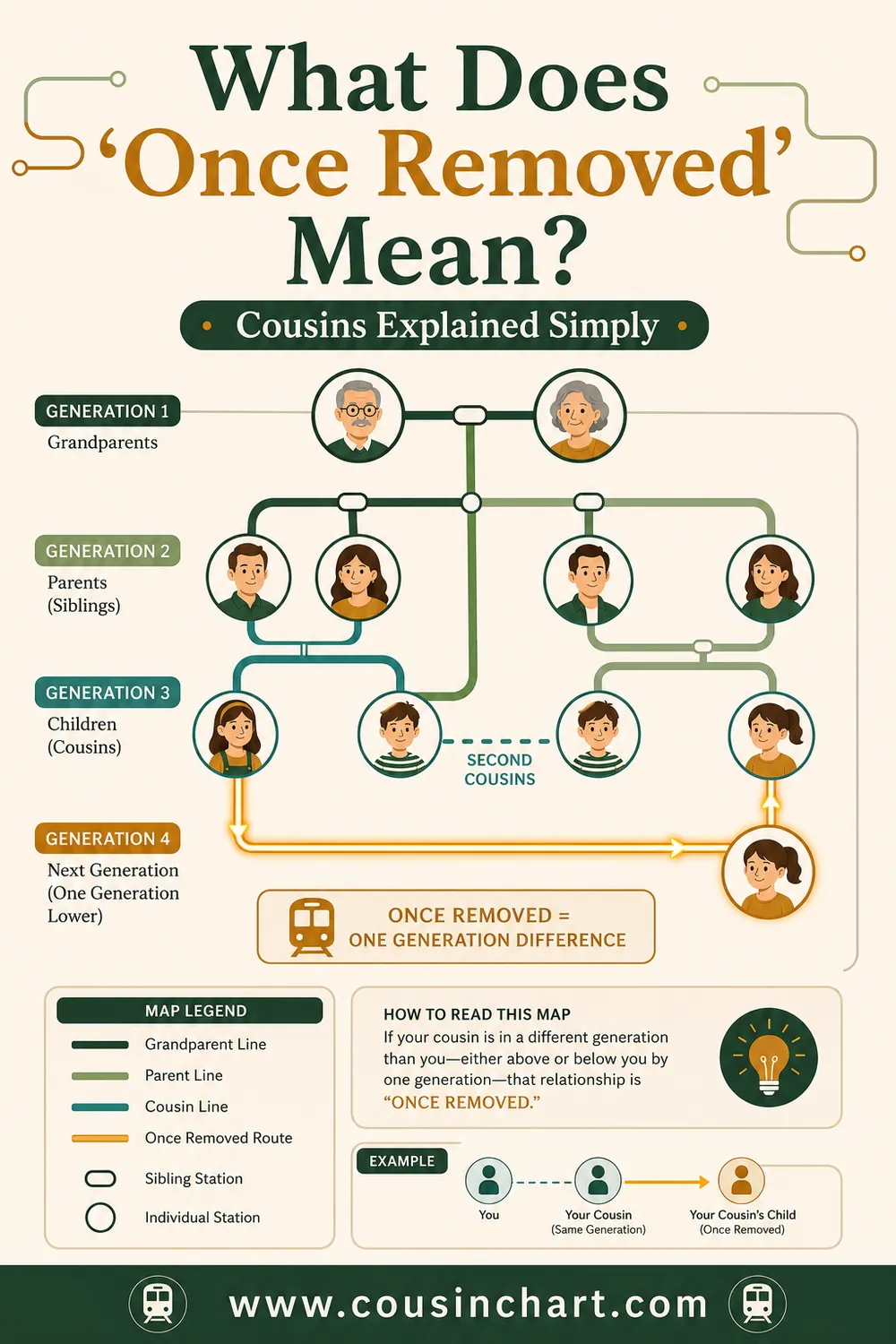
New to the "removed" idea entirely? Start with our plain-English guide to what once removed means, then come back — this page will feel easy.
The Two-Number System Behind the Term
Every cousin label is just two measurements:
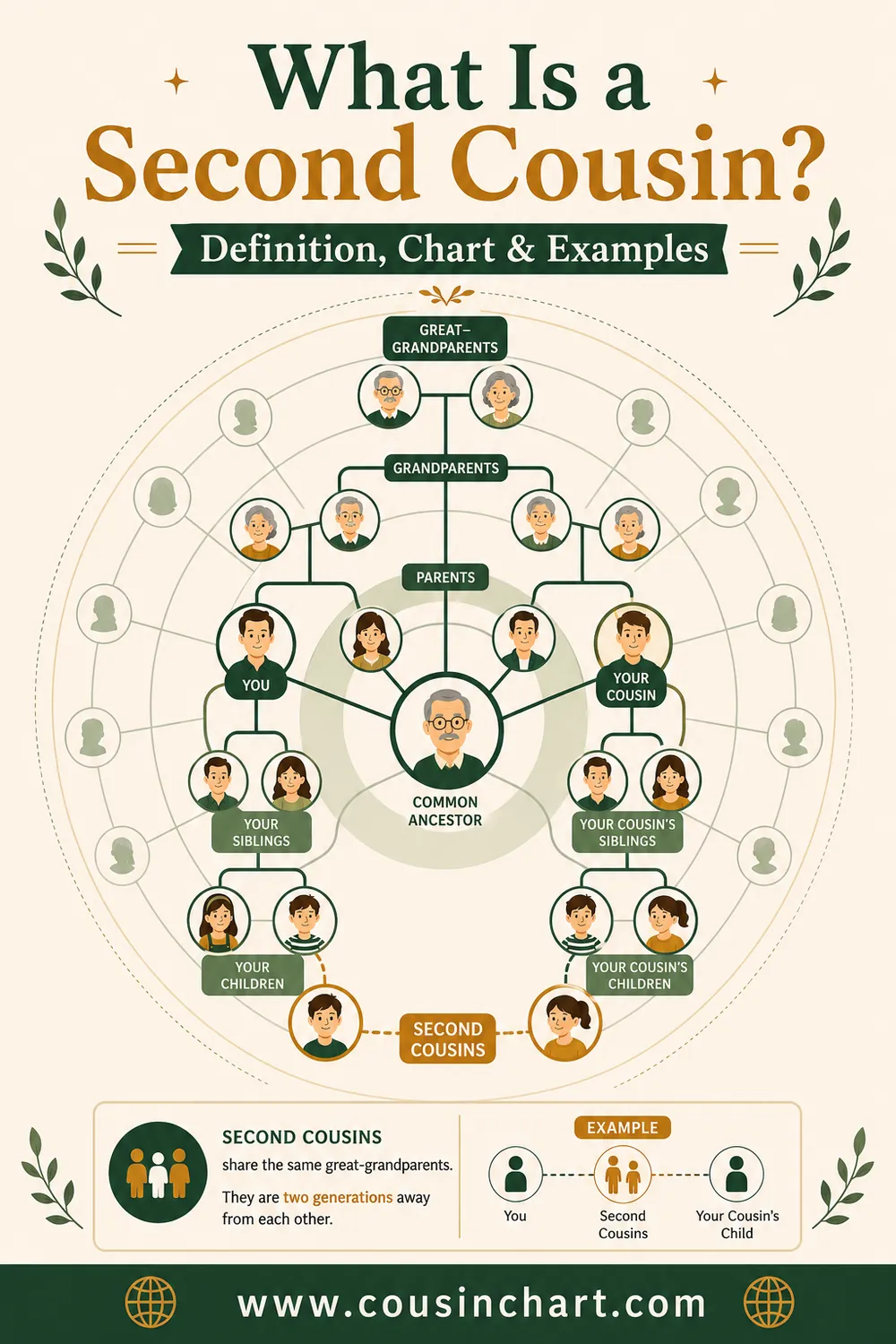
- Degree — how far back the shared ancestors sit. Count generations from the person closer to the common ancestor and subtract one. Second cousins are each three generations below shared great-grandparents (3 − 1 = 2).
- Removal — the generation gap between the two people. Two rows apart = twice removed.
Check it against your grandparent's second cousin. That person is three generations below the shared ancestors; you are five. Smaller number: three, so the degree is second (3 − 1 = 2). Difference: 5 − 3 = 2, so twice removed. The system spits out the right answer every time — which is exactly how the cousin calculator works under the hood.
Chart: Where Second Cousin Twice Removed Sits
| Who they are | What they are to you | Generation gap |
|---|---|---|
| Your second cousin | Second cousin | 0 |
| Your second cousin's child | Second cousin once removed | 1 |
| Your second cousin's grandchild | Second cousin twice removed | 2 |
| Your second cousin's great-grandchild | Second cousin three times removed | 3 |
| Your parent's second cousin | Second cousin once removed | 1 |
| Your grandparent's second cousin | Second cousin twice removed | 2 |
| Your great-grandparent's second cousin | Second cousin three times removed | 3 |
Two patterns worth noticing:
- Moving down your second cousin's line changes only the removal. The degree stays "second" forever.
- Moving up your own ancestor line does the same thing in reverse. Grandparent's second cousin, great-grandparent's second cousin — the degree never budges, the removal just climbs.
A Real-World Example
Say your great-grandmother, Ruth, had a sister named Ida. Ruth's granddaughter is your mother; Ida's granddaughter is a woman named Carol. Your mother and Carol share great-grandparents (Ruth and Ida's parents), so they're second cousins.
Now the generations spread out:
- Carol is your mother's second cousin, which makes Carol your second cousin once removed.
- Carol's granddaughter, Mia, is two generations below Carol. To your mother, Mia is a second cousin twice removed — her second cousin's grandchild.
- And from the other direction it's the same term: to Mia, your mother is her grandmother's second cousin. Second cousin twice removed, both ways.
This is the situation where the term actually comes up in real life: an older relative at a reunion and a young kid, four-plus rows apart on the tree, and someone asks "okay, but what are they to each other?"
How Much DNA Do You Share?
Second cousins twice removed share about 0.8% of their DNA on average — roughly 70–75 centimorgans (cM). Here's how that fits the neighboring relationships:
| Relationship | Average shared DNA | Approx. cM |
|---|---|---|
| Second cousin | ~3.1% | ~230 |
| Second cousin once removed | ~1.5% | ~120 |
| Second cousin twice removed | ~0.8% | ~71 |
| Third cousin | ~0.8% | ~73 |
| Third cousin once removed | ~0.4% | ~35 |
Spot the interesting one: a second cousin twice removed shares almost exactly the same DNA as a third cousin. On a DNA match list, the two are indistinguishable by numbers alone — you need the paper trail (or the family stories) to tell which one your match actually is.
Also remember the ranges are wide. Some second cousins twice removed share 200+ cM, and a few share nothing detectable at all. DNA inheritance is a shuffle, not a photocopier.
Is Someone Two Generations Away Still "Family"?
By any genealogical standard, yes. Your grandparent's second cousin descends from your 3×great-grandparents — the same couple whose name you'd chase in census records. In tight-knit families, this is a real person you've met: the elderly cousin your grandma still exchanges holiday cards with.
Practically, the exact term matters when you're:
- Building a family tree and need each person on the correct row.
- Interpreting a DNA match in the 50–150 cM zone.
- Researching records, since the shared-ancestor generation tells you which decade and surname to search.
In conversation? "My cousin Walter" is fine. Nobody says the full phrase at dinner, and that's okay.
Quick Ways to Avoid the Common Mix-Ups
- It's not a fourth cousin. Distance in generations doesn't raise the cousin degree. Only distance in the shared ancestor does. Your second cousin's grandchild is second cousin twice removed, not a third or fourth cousin.
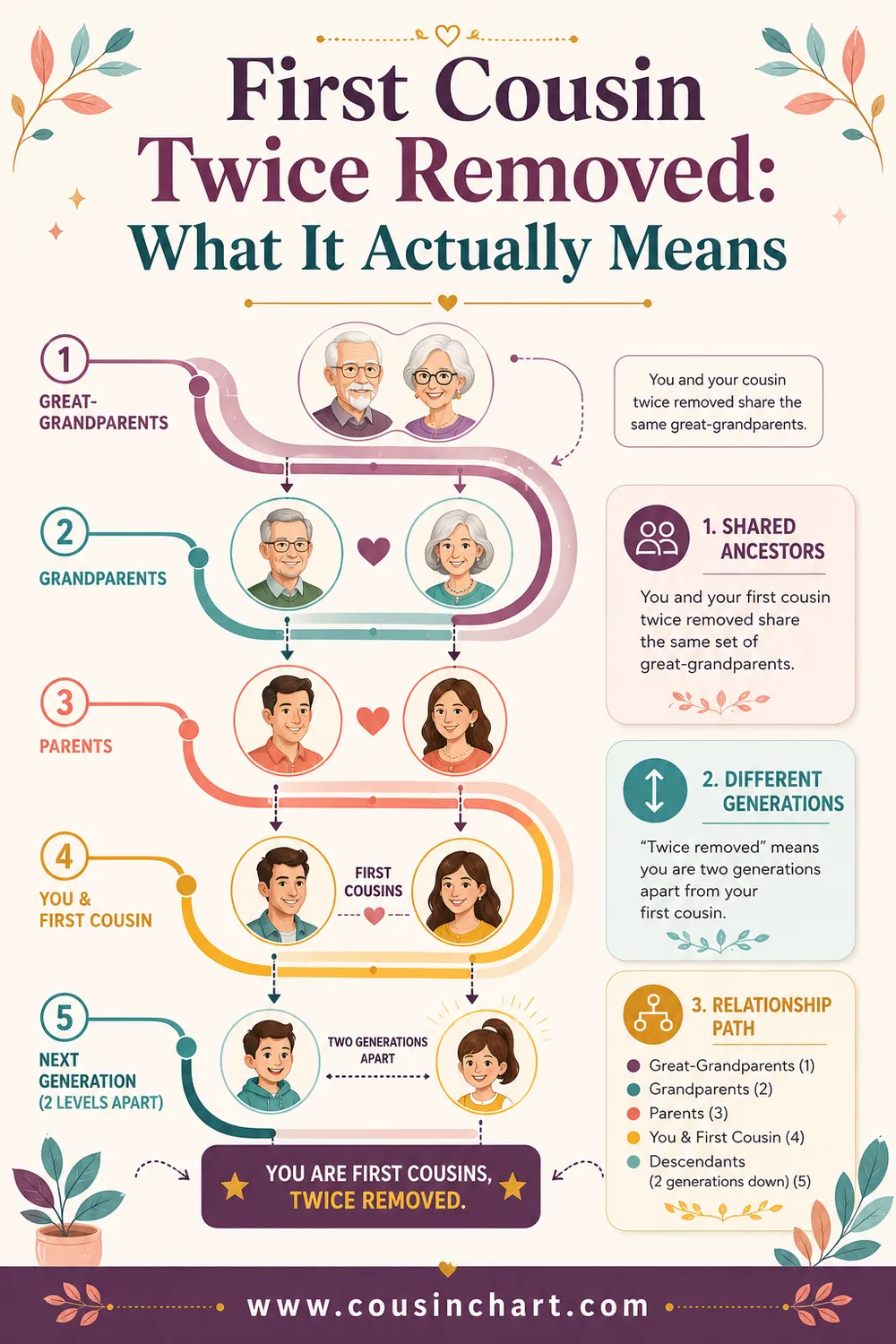
- It's not the same as a first cousin twice removed. Same removal, different line. Your grandparent's first cousin is your first cousin twice removed; your grandparent's second cousin is your second cousin twice removed.
- Removal counts the gap, not the total distance. People two generations apart are twice removed whether the cousin line is first, second, or fifth.
If you'd rather never memorize any of this, keep the free family relationship calculator bookmarked — it handles degrees and removals for any pair, in both directions.
Every "Twice Removed" Cousin, Side by Side
"Twice removed" isn't one relationship — it's a whole family of them. The removal (two generations apart) stays fixed, while the cousin line changes who the shared ancestors are and how much DNA you're likely to share:
| Relationship | Who they are (going up) | Shared ancestors | Avg DNA |
|---|---|---|---|
| First cousin twice removed | Your grandparent's first cousin | Your 2×great-grandparents | ~3.1% (~229 cM) |
| Second cousin twice removed | Your grandparent's second cousin | Your 3×great-grandparents | ~0.8% (~71 cM) |
| Third cousin twice removed | Your grandparent's third cousin | Your 4×great-grandparents | ~0.2% (~18 cM) |
Notice the rhythm: each step up in degree pushes the shared couple one generation deeper into the past and cuts the expected DNA to roughly a quarter. That's why the degree matters so much more than the removal when you're sizing up a DNA match — and why "which cousin was Grandpa's?" is the question worth answering first.
How to Work It Out on the Spot
No chart handy? Three steps sort out any pair at a reunion:
- Find the shared couple. Ask up both lines until the two branches meet — say, "our great-great-grandparents were the Hollands."
- Count each person's steps down from that couple. Take the smaller number and subtract one: that's the degree. Three steps down = second cousin.
- Subtract the two counts. The difference is the removal. Three steps versus five steps = twice removed.
So when teenage Mia and great-uncle Roy both trace back to the Hollands — Mia in five steps, Roy in three — Roy's smaller count makes the degree second, and the two-step gap makes it twice removed. Done before the potato salad runs out.
FAQ
What is a second cousin twice removed in plain English?
Your second cousin's grandchild, or your grandparent's second cousin. The "twice removed" part just means you're two generations apart.
Is my second cousin's grandchild my fourth cousin?
No. Generations on one side only change the removal, not the degree. Your second cousin's grandchild is your second cousin twice removed. Fourth cousins share 3×great-grandparents and sit on the same generation.
How much DNA does a second cousin twice removed share?
About 0.8% on average — roughly 71 cM — which is nearly identical to a third cousin. DNA alone can't tell those two relationships apart.
What is my grandma's second cousin to me?
Your second cousin twice removed. Your grandma and her second cousin share great-grandparents; you sit two generations below your grandma.
What is my grandparent's second cousin's child to me?
Surprisingly, your third cousin once removed. That child and your parent are children of second cousins, which makes them third cousins — and you sit one generation below your parent. It's a good example of why counting to the shared ancestor beats guessing.
Do people actually use this term?
Genealogists and DNA-testing sites use it constantly, because it's precise. Around the dinner table, "cousin" covers it — but it's satisfying to know the real answer when someone asks.
Wrap-Up
Second cousin twice removed = second-cousin line + two-generation gap. That's your second cousin's grandchild looking down the tree, or your grandparent's second cousin looking up it. Same term both ways, about 0.8% shared DNA, and 100% legitimate family.
Got a trickier pair to untangle? The free cousin calculator sorts out any relationship — cousins, removals, in-laws, greats — in about ten seconds.