Nephew by Marriage: Is My Spouse's Niece or Nephew Mine Too?
Yes, your husband's or wife's nephew is your nephew too. The precise term is nephew by marriage: the son of your spouse's brother or sister. (A daughter is a niece by marriage.) You don't share any DNA with him, but dictionaries, most families and even some laws treat him as your nephew. The American Heritage Dictionary builds it right into the definition: a nephew is "a son of one's brother or sister or of the brother or sister of one's spouse."
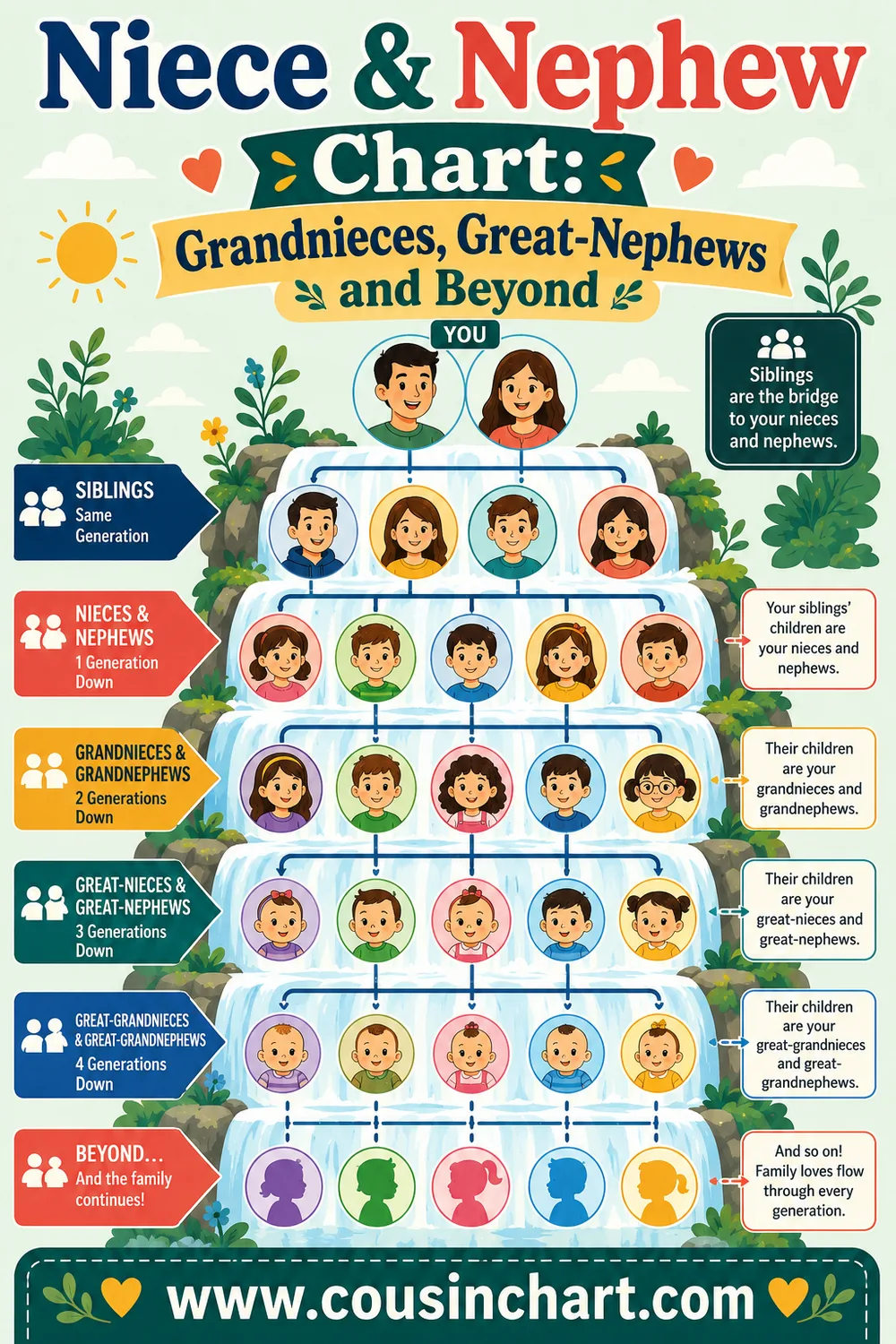
So if you've wondered "is my wife's sister's son my nephew?" or "what is my husband's brother's son to me?", the answer is the same: he's your nephew, by marriage. The harder questions come later. What changes if you divorce? What if your spouse dies? Does the law see him as your relative? Does "nephew by marriage" ever mean someone else? This guide answers all of it, with tables and real rules. For the full ladder of nieces, nephews, grandnieces and more, see our niece and nephew relationship chart, which this article builds on.
Quick check. Tap a question for the short answer:
What is a nephew by marriage?
A nephew by marriage is a nephew you gain through your own marriage rather than through your own parents. Your blood nephews are your siblings' sons. When you marry, your spouse's siblings' sons join that list.
Here's an illustrative family to make it concrete. The names are made up.
- You marry Daniel.
- Daniel has a sister, Kara, and a brother, Owen.
- Kara has a son, Eli. Owen has a daughter, Ruby.
Before the wedding, Eli and Ruby were Daniel's nephew and niece, and not related to you at all. After the wedding, Eli is your nephew by marriage and Ruby is your niece by marriage. They'll most likely call you Aunt or Uncle plus your first name, and you'll most likely just call them your nephew and niece.
The niece version works exactly the same way. The American Heritage Dictionary defines a niece as "the daughter of one's brother or sister or of the brother or sister of one's spouse." Everything in this article applies to nieces by marriage, too.
"By marriage" is a description, not a downgrade
In daily life, almost nobody says "nephew by marriage" out loud. It's a description you use when you need to explain how you're connected, like on a family tree or in a conversation about genealogy. At a family dinner, he's simply your nephew. The words "by marriage" just tell you which door he came through.
Every "spouse's nephew" case at a glance
The searches people make on this topic come in many shapes: wife's sister's son, husband's brother's son, and so on. Here's the full list, plus a few look-alikes that aren't quite the same.
| The person | What he is to you | Shared DNA with you? |
|---|---|---|
| Your wife's sister's son | Nephew by marriage | No |
| Your wife's brother's son | Nephew by marriage | No |
| Your husband's sister's son | Nephew by marriage | No |
| Your husband's brother's son | Nephew by marriage | No |
| Your spouse's half-sibling's son | Nephew by marriage (your spouse's half-nephew) | No |
| Your spouse's stepsibling's son | Your spouse's step-nephew; nephew by custom only | No |
| Your spouse's sibling's stepson | Your spouse's step-nephew; nephew by custom only | No |
| Your spouse's nephew's son | Great-nephew (grandnephew) by marriage | No |
| Your spouse's cousin's son | Not a nephew; your spouse's first cousin once removed | No |
| Your own sibling's son | Nephew by blood | Yes |
| Your sibling's stepson | Step-nephew | No |
| Your niece's husband | Nephew-in-law (sometimes also called nephew by marriage) | No |
The top four rows are the heart of it. If the person is your spouse's sibling's son, he's your nephew by marriage, full stop. The lower rows are where words get slippery, so let's walk through them.
A three-question test
If you're not sure whether someone is your nephew by marriage, run through these three questions in order. They work for nieces, too.
- Is he the son of a sibling? If he's your own brother's or sister's son, he's your nephew by blood, and you can stop here. If he's your spouse's brother's or sister's son, go to question 2. If he's a cousin's son or anyone else, he isn't a nephew of either kind.
- Is the sibling your spouse's full or half sibling? Either way, he's your nephew by marriage. A half-sibling's son is your spouse's half-nephew, but the "half" doesn't change anything for you, since you don't share DNA with either. If the sibling is only your spouse's stepsibling, he's a step-nephew by marriage, and the title is a family choice.
- Are you and your spouse still married? If yes, he's your nephew by marriage in every everyday sense. If you've divorced or your spouse has died, the family tie is whatever you and he make of it, and the legal tie depends on the rule (see the sections on divorce and death below).
That's really all there is to it. The rest of this article is about the exceptions and the edge cases that make families scratch their heads.
The two meanings of "nephew by marriage"
Here's a wrinkle many guides skip. "Nephew by marriage" gets used for two different people, depending on whose marriage you mean.
- Your spouse's sibling's son. The link is your marriage. This is the main meaning, and the one this article is about.
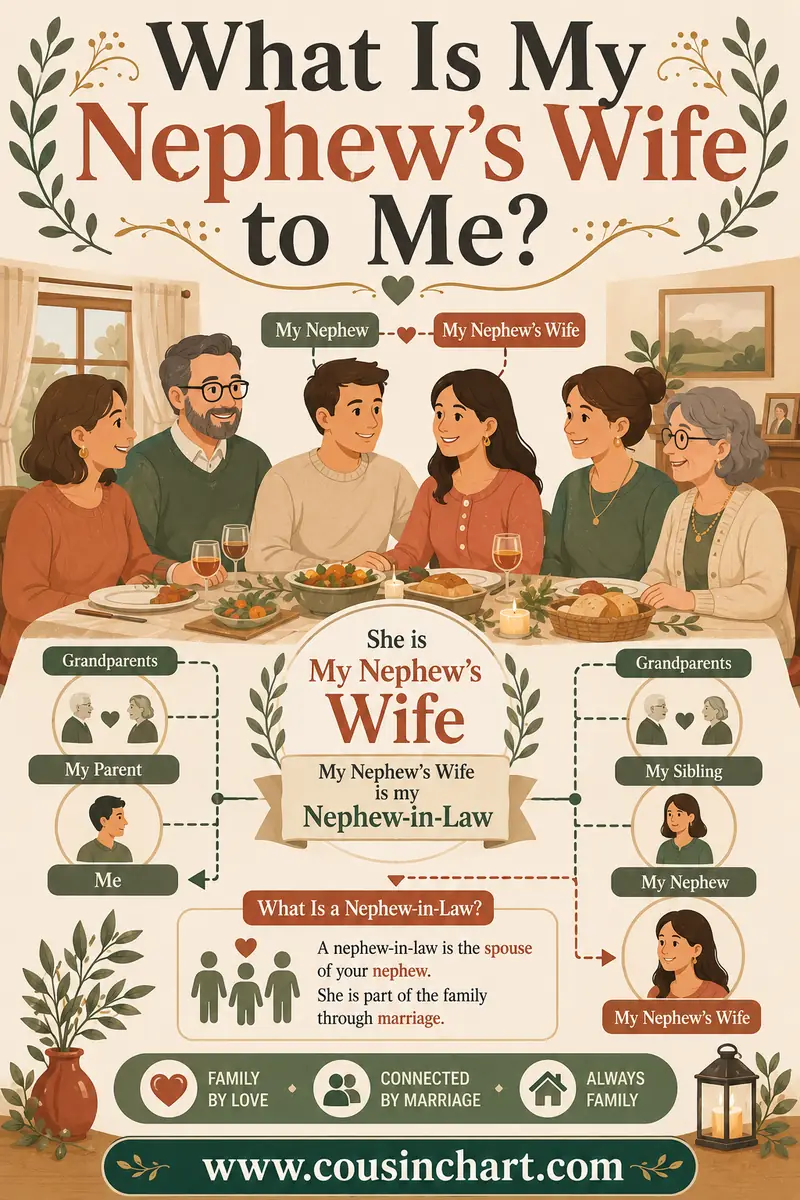
- Your niece's husband. The link is your niece's marriage. He's more precisely called your nephew-in-law, but some families call him a nephew by marriage, too.
Both are nephews who joined through a wedding, so you'll hear the phrase used either way. If you need to be exact, say "my husband's nephew" or "my niece's husband." Our guide to what your nephew's wife is to you covers that second direction in depth, including what the in-law spouse calls you.
Where the word "nephew" comes from
The word itself is old. The American Heritage Dictionary traces "nephew" to Middle English neveu, from Old French, and ultimately from Latin nepōs. "Niece" comes down the same road, from Old French and Latin neptis. The dictionary definitions that include a spouse's siblings' children reflect how English speakers use the words today: once you marry, your spouse's nieces and nephews are counted as yours.
Why English blurs them
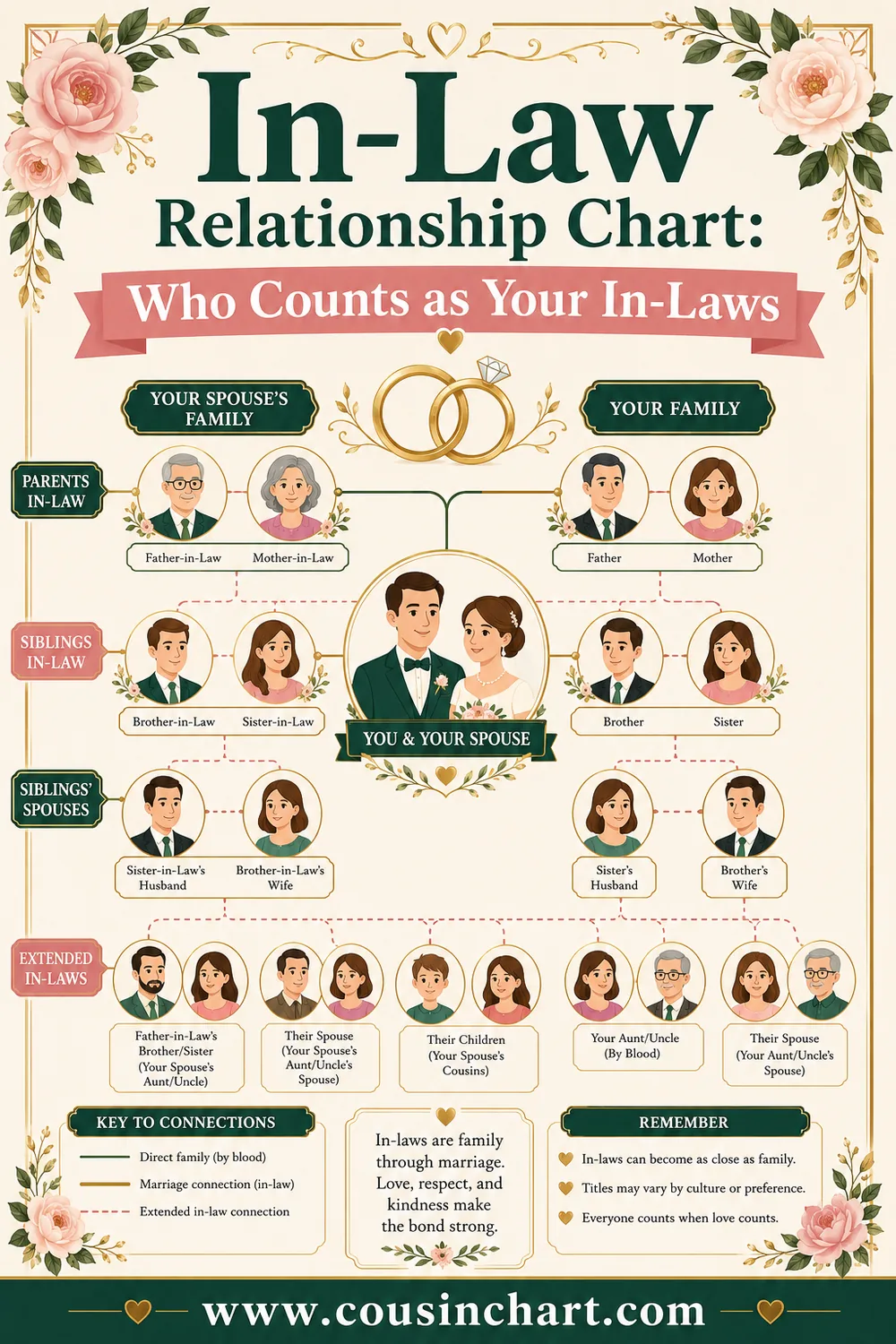
English uses "in-law" and "by marriage" loosely. "Brother-in-law" covers both your spouse's brother and your sister's husband. "Nephew by marriage" works the same way: it describes any nephew whose link runs through a marriage, without saying which marriage. Our in-law relationship chart lays out the whole in-law vocabulary side by side, if you want to see where each word starts and stops.
Half, step and great: the less common cases
Your spouse's half-sibling's son
If your wife has a half-brother, his son is your wife's half-nephew. They share about half as much DNA as a full nephew would. (Our guide to your half-sibling's child has the numbers.) To you, he's a nephew by marriage just like any other. You don't share DNA with either kind, so the "half" doesn't change anything for you.
Your spouse's step-nephew
Your spouse's stepsibling's son, or your spouse's sibling's stepson, is a step-nephew to your spouse. To you, he's a step-nephew by marriage, which is two links away from you. No dictionary definition or standard legal list includes him, so whether he's "your nephew" is purely a family choice. Lots of families say yes. For the rest of the step titles, see our step-family relationship chart.
Your spouse's grandnephew
When your nephew by marriage has a child, that child is your great-nephew (or grandnephew) by marriage. The "by marriage" carries down the line, but the names follow the normal niece and nephew ladder. Your spouse's nephew's son is a grandnephew to your spouse and a grandnephew by marriage to you.
Your spouse's cousin's son
This one trips people up. Your spouse's first cousin's son is not a nephew. He's your spouse's first cousin once removed. Cousins' children are never nieces or nephews, whether by blood or by marriage. If it helps, the general rule is that "nephew" only comes from a sibling's line.
When he's your nephew twice over
Sometimes a nephew by marriage turns out to be a blood nephew as well. The classic case is two brothers who marry two sisters. Say you and your brother Ian married sisters, Amy and Beth. Amy and Ian's son, Leo, is your nephew by blood, because he's your brother's son. He's also your wife's sister's son, which makes him your nephew by marriage too. In families like this, Leo shares DNA with you through your brother, at the normal nephew level, and your children are his double first cousins, sharing all four grandparents.
Unmarried partners
If you're in a long-term relationship but not married, your partner's sibling's son isn't technically your nephew by marriage. In practice, many families use the same titles anyway. Legal and tax definitions usually require a marriage, so the difference shows up only on paper.
What he calls you, and where your kids fit
Your nephew by marriage will usually call you Aunt or Uncle, the same as his blood aunts and uncles. Some families add a first name ("Uncle Mike"), some don't. You're his aunt or uncle by marriage, the mirror image of his relationship to you.
Your children and your nephew by marriage
Here's a fact that surprises people. You and your nephew by marriage share no DNA, but your children with your spouse are his blood relatives. Your kids and Eli share a set of grandparents: your spouse's parents. That makes them first cousins.
If you have children from an earlier relationship, they're not related to Eli by blood. They're connected only because their parent married into Eli's family. Many families call them step-cousins, or simply cousins.
Your siblings and your nephew by marriage
Your own brothers and sisters aren't related to your spouse's nephew either. To them, he's their sibling's spouse's nephew. If the families are close, he may still call them by friendly titles, but there's no family link on paper. The same goes for your own blood nieces and nephews: they and your nephew by marriage are each your nephews, yet they aren't related to each other. Your children with your spouse are the one link between them, since your kids are first cousins to both groups, one on each side.
Your parents and your nephew by marriage
Your own parents have no relationship to your spouse's nephew. He's their child's spouse's nephew. There's no common English name for that, and most people just use first names.
His family, mapped to you
Once you know your spouse's nephew is your nephew by marriage, you can work out the rest of his family the same way. Here's the illustrative family again: you married Daniel, Daniel's sister Kara married Greg, and their son is Eli.
| Eli's... | Who that is | What they are to you |
|---|---|---|
| Mother | Kara, your husband's sister | Your sister-in-law |
| Father | Greg, Kara's husband | Your husband's brother-in-law; informally your co-brother-in-law |
| Grandparents on Kara's side | Your husband's parents | Your parents-in-law |
| Grandparents on Greg's side | Greg's parents | Not related to you |
| Sister | Kara and Greg's daughter | Your niece by marriage |
| Half-brother on Greg's side | Greg's son from an earlier relationship | Not related to you; Kara's stepson |
| Wife | Whoever Eli marries | Your niece-in-law by marriage, a step further out |
| Children | Eli's kids | Your great-nephews and great-nieces by marriage |
| First cousins on Kara's side | Your children with Daniel, and Daniel's other siblings' kids | Your children, nephews and nieces by marriage |
Greg's place in that table has a name in some families. Two people who married a pair of siblings are sometimes called co-brothers-in-law or co-sisters-in-law. Our guide to co-siblings-in-law explains the term and where it's used.
The pattern is the same as with blood relatives: anyone connected to Eli through your spouse's family has a name in your family, too. Anyone connected through Eli's other parent's family belongs to that side, and isn't related to you.
Does a nephew by marriage share DNA with you?
No. A nephew by marriage descends from your spouse's parents, not yours, so you have no common ancestor and no expected shared DNA. A DNA test won't list him as a match unless your two families happen to be related some other way.
For comparison, here's what the Shared cM Project, Version 4.0, which genetic genealogist Blaine Bettinger compiled from about 60,000 submitted results, shows for each kind of nephew. Shared DNA is measured in centimorgans (cM), a unit that roughly tracks the length of matching stretches.
| Kind of nephew | Average shared cM with you | Range in the project |
|---|---|---|
| Nephew by blood (your full sibling's son) | 1,741 | 1,201 to 2,282 |
| Half-nephew (your half-sibling's son) | 871 | 492 to 1,315 |
| Great-nephew by blood | 850 | 330 to 1,467 |
| Nephew by marriage (your spouse's sibling's son) | 0 expected | No shared ancestor |
| Your child and your nephew by marriage (first cousins) | 866 | 396 to 1,397 |
The math behind those averages is straightforward. The project's "expected" figures assume perfect halving, with 1,700 cM listed as the expected value for half-siblings, who share 25%. That implies a genome total of 1,700 ÷ 0.25 = 6,800 cM. A blood nephew also shares about 25%, so 6,800 × 0.25 = 1,700 cM expected, close to the observed 1,741. A half-nephew shares about 12.5%, so 6,800 × 0.125 = 850 cM expected, close to the observed 871. A nephew by marriage shares 0%, so 6,800 × 0 = 0.
That last row of the table is the fun one. Your nephew by marriage shares nothing with you, yet he shares roughly as much with your child as a half-nephew would share with you. One family dinner table, three very different DNA stories.
Is a nephew by marriage a relative in the eyes of the law?
Often, yes, but it depends on the rule and the place. Lawyers call relationships created by marriage affinity, as opposed to consanguinity, which means relationships by blood. Different laws draw the affinity line in different places. Here are three real examples from the US. Laws vary by place, so treat these as illustrations, not advice for your situation.
Texas: a third-degree relative by affinity
Texas spells out affinity clearly in its nepotism law. Under Texas Government Code Section 573.024, two people are related by affinity if they're married to each other, or if "the spouse of one of the individuals is related by consanguinity to the other individual." Your spouse is related by blood to their nephew, so you're related to him by affinity.
The next section, Section 573.025, says the degree of an affinity relationship matches the degree of the underlying blood relationship. A nephew is a third-degree blood relative, as the University of Texas System's nepotism rule lists when it sorts relatives by degree. So under Texas law, your spouse's nephew is your relative in the third degree by affinity.
Whether that degree matters depends on the rule. The UT System's own nepotism rule, which builds on these sections, covers blood relatives through the third degree but relatives by affinity only through the second degree. Its affinity lists stop at in-laws such as your spouse's siblings, grandparents and grandchildren. So under that rule, your own nephew is covered, but a nephew by marriage, at the third degree of affinity, falls just outside it. It's a neat example of how "is he my relative?" can have a different answer depending on which rule is asking.
Federal hiring rules
The federal anti-nepotism law, 5 U.S.C. § 3110, stops public officials from hiring or promoting relatives in their agencies. Its definition of "relative" lists "nephew" and "niece," along with in-laws such as brother-in-law and sister-in-law, step-relatives and half-siblings. The list doesn't separately name a spouse's nephew, so if this ever matters to you, it's a question for the agency's ethics office.
Federal taxes
The IRS uses its own list for who can be a "qualifying relative" without living with you. Publication 501 includes "a son or daughter of your brother or sister," along with your in-laws. It also says: "If you file a joint return, the person can be related to either you or your spouse." So on a joint return, your spouse's nephew can count as a relative for this test, because he's your spouse's nephew. There are many other conditions, so check the current publication or a tax professional before relying on it.
What changes after divorce
This is the part people wonder about most. There are really three answers: what your family does, what the law says, and what the paperwork says.
In the family
There's no rule. Some people stay close to their former spouse's nieces and nephews for life, especially if they helped raise them or if there are shared children in the picture. Others drift apart naturally. A common middle ground is "my ex's nephew," which is accurate and kind. If your nephew by marriage still calls you Aunt or Uncle, there's no reason to correct him.
If you and your ex had children together, the tie never fully goes away. Your kids and your ex's nephew are still first cousins, by blood, and divorce can't change that. You'll likely see each other at birthdays and graduations for years.
In the law
Texas gives a clear example of how a law can handle it. Section 573.024(b) says that ending a marriage by divorce or death "ends relationships by affinity created by that marriage," unless "a child of that marriage is living." In that case, the marriage "is considered to continue as long as a child of that marriage lives." So in Texas, for nepotism purposes, your nephew by marriage stops being your relative by affinity after a divorce, unless you and your ex have a living child together. (A separate subsection limits that "child of the marriage" rule for school board members and officers to the time before the youngest child turns 21.)
Other states and other laws handle this differently, and many don't address it at all.
On tax forms
Publication 501 says that relationships on its list "that were established by marriage aren't ended by death or divorce." That covers the in-laws on the list, such as a brother-in-law or sister-in-law. A spouse's nephew gets onto the list a different way, through the joint-return rule, and after a divorce you're no longer filing jointly with that spouse. This is exactly the kind of detail to confirm with a tax professional.
What changes after your spouse dies
Losing a spouse doesn't erase the family you married into. Most widows and widowers keep calling their late spouse's nieces and nephews just that, and many stay close for the rest of their lives. Nieces and nephews by marriage often become an important link to the family after a death.
Legally, death works much like divorce in the Texas affinity rule above: the death of a spouse ends affinity relationships created by that marriage, unless a child of the marriage is living. Again, that's one state's rule for one purpose.
Inheritance
If someone dies without a will, state law decides who inherits. Nephews and nieces by blood often appear in those lists, while nephews by marriage usually don't. A few states have special rules for property that came from a late spouse. In California, for example, Probate Code Section 6402.5 covers cases where a person's spouse died not more than 15 years before them and there's no surviving spouse or descendant. In that case, the part of the estate that came from the late spouse can pass to the late spouse's family, starting with the late spouse's own descendants. Rules like this are technical and vary a lot from state to state.
If you want a nephew by marriage to inherit from you, the dependable way is to say so in a will or other estate plan. If you're dealing with an estate right now, talk to a licensed estate attorney in your state. They can tell you exactly how the local rules apply.
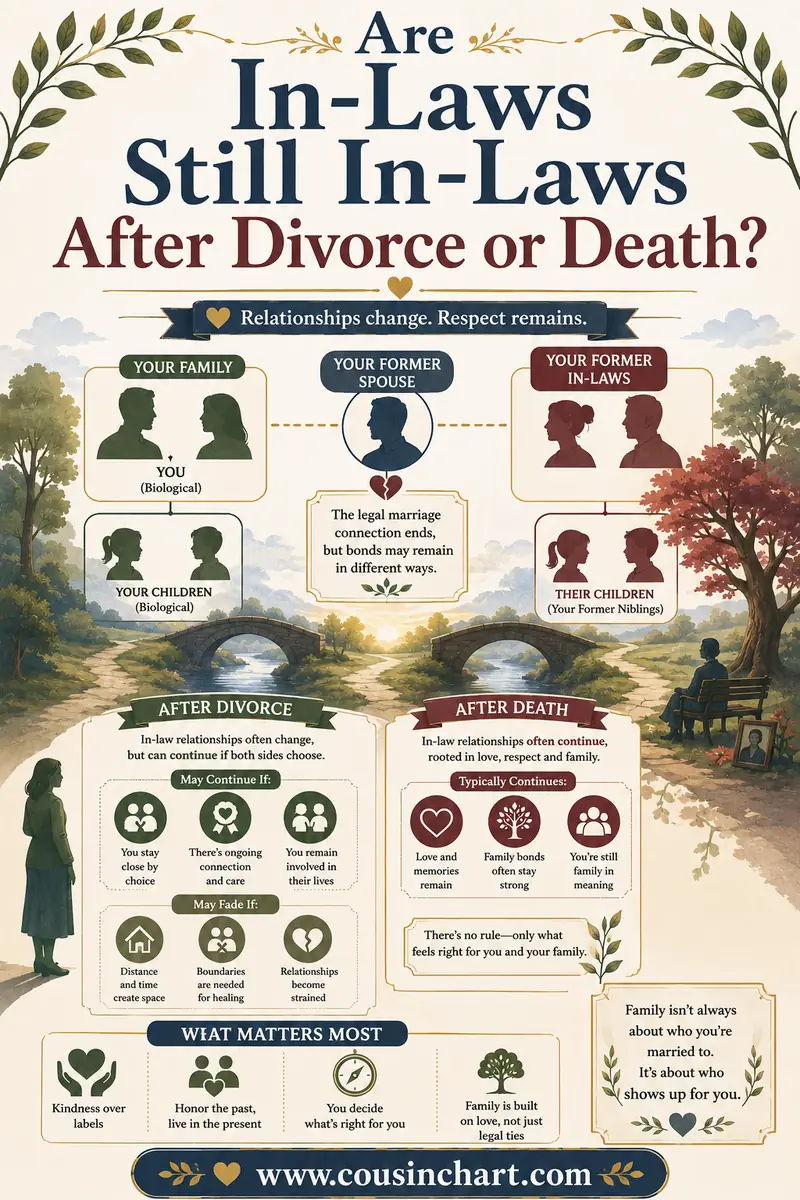
For a broader look at how all in-law ties hold up over time, see our guide to in-laws after divorce or death.
How to show a nephew by marriage on a family tree
On a family tree, a nephew by marriage is easy to place once you remember that he hangs off your spouse's branch, not yours. Here's a simple way to draw it.
- Draw yourself and your spouse side by side, joined by a marriage line.
- Put your spouse's parents above your spouse, and your parents above you. The two sets of parents aren't connected to each other.
- Add your spouse's siblings beside your spouse, all coming down from your spouse's parents.
- Add each sibling's spouse and children. Your nephew by marriage drops down from your spouse's sibling. His line never touches your parents.
- Add your own children under you and your spouse. Now you can see your kids and your nephew by marriage side by side, both descending from your spouse's parents. That's why they're first cousins.
Most genealogy programs will label your spouse's nephew as your "nephew" or "nephew (by marriage)" automatically, as long as the marriage is entered. If you share your tree publicly, it's worth making sure no blood line is drawn from your own parents to your spouse's family by mistake. That kind of error can send future researchers looking for a connection that doesn't exist.
Being a good aunt or uncle by marriage
Titles are only part of the story. If you married into a family with nieces and nephews, you're stepping into a role the kids may not have chosen, so a little patience goes a long way. Here are a few ideas families find helpful.
- Follow their lead on names. Young kids usually start calling you Aunt or Uncle right away if their parents use it. Teens and adults may prefer first names at first. Either is fine.
- Coordinate with your spouse and their sibling. Your spouse's sibling is the parent here. Ask before big gifts, outings or anything that touches family rules.
- Show up for the small things. School plays, sports games and birthday calls build a relationship faster than grand gestures.
- Bring your own kids in. If you have children with your spouse, they're first cousins to your nephew by marriage, and that bond often becomes the strongest link between the families.
- Don't keep score with blood aunts and uncles. Nephews and nieces have room for plenty of adults in their lives. You're adding to their family, not competing for a spot.
A collective word helps, too. If you have nieces and nephews by marriage of several genders, the informal word "nibling" covers all of them at once.
Common mix-ups
- "He's not really my nephew." He is, by the dictionary definition and in most families. He's just not your blood relative.
- Calling him your nephew-in-law. That term usually means your niece's husband. Your spouse's nephew is a nephew by marriage. Some people use the terms loosely, but they point to different people.
- Calling your spouse's cousin's son a nephew. He's your spouse's first cousin once removed. Nephews come only from siblings.
- Expecting a DNA match. You won't share DNA with a nephew by marriage unless your families are linked some other way.
- Assuming divorce erases everything. Family ties are a personal choice, and if you have children with your ex, your kids and the nephew remain first cousins.
- Assuming the law always counts him. Some laws include relatives by affinity and some don't. Each law has its own list.
For the bigger picture of where blood ties end and marriage ties begin, our guide to blood relatives vs. relatives by marriage walks through the same logic for every kind of relative.
Try it yourself
Here are a few quick puzzles. The families are illustrative.
- Puzzle: Your wife's sister's son is Theo. What is he to you? Answer: Your nephew by marriage.
- Puzzle: Your husband's brother has a stepson, Nico, from his wife's first marriage. What is Nico to you? Answer: Your husband's step-nephew. To you he's a step-nephew by marriage, and your nephew only if your family uses the title.
- Puzzle: You and your husband have a daughter, Mae. What is Mae to your husband's sister's son? Answer: His first cousin. They share your husband's parents as grandparents.
- Puzzle: Your niece, Lena, marries Sam. What is Sam to you? Answer: Your nephew-in-law. Some families also say nephew by marriage.
- Puzzle: You divorce, and you and your ex have no children. Is your ex's nephew still your nephew? Answer: In daily life, that's up to the two of you. Under the Texas affinity rule, the legal tie ends with the divorce because no child of the marriage is living.
Wrap-up: yes, he's your nephew
Your spouse's sibling's son is your nephew by marriage, and in everyday life he's simply your nephew. You won't share DNA with him, but your children with your spouse will, as his first cousins. Divorce and death can loosen the legal tie in some places, while the family tie is up to the people in it. For the complete ladder of nieces, nephews and grand-niblings, keep our niece and nephew relationship chart handy. And when a question gets tangled, the free calculator on our homepage can sort it out: you pick how two people connect, and it names the relationship.
Frequently Asked Questions
Is my wife's sister's son my nephew?
Yes. Your wife's sister's son is your nephew by marriage. The American Heritage Dictionary defines a nephew as a son of one's brother or sister or of the brother or sister of one's spouse, so he fits the standard definition. You don't share DNA with him, because your connection runs through your wife rather than through your own parents. In everyday life, most families simply call him your nephew and you his uncle, with no need to add by marriage.
What is my husband's brother's son to me?
He's your nephew by marriage. Your husband's brother's son is your husband's nephew by blood, and when you married your husband, he became your nephew too. He'll usually call you Aunt, perhaps with your first name. If you and your husband have children, your kids and his nephew are first cousins, because they share your husband's parents as grandparents. You and the nephew share no ancestors, so a DNA test won't link you.
Is my husband's niece my niece?
Yes. Your husband's niece, the daughter of his brother or sister, is your niece by marriage. Dictionaries define a niece as the daughter of one's sibling or of one's spouse's sibling, so she's your niece in the standard sense. You won't share DNA, but she's part of your family through your marriage. Most people simply say my niece, and save niece by marriage for times when they need to explain exactly how they're connected.
What's the difference between a nephew by marriage and a nephew-in-law?
A nephew by marriage usually means your spouse's sibling's son, a nephew you gained through your own marriage. A nephew-in-law usually means your niece's husband, a man who joined your family by marrying your niece. People sometimes use the two terms loosely, and you'll hear nephew by marriage used for a niece's husband too. If you need to be precise, say my wife's nephew or my niece's husband, which leaves no room for confusion.
Is my nephew by marriage still my nephew after a divorce?
In the family, that's up to you and him. Many people stay close to a former spouse's nieces and nephews, especially when there are shared children, since your children and the nephew remain first cousins by blood. Legally, some rules end the tie. Texas, for example, says a divorce ends relationships by affinity created by the marriage unless a child of that marriage is living. Laws vary by place, so check the rule that applies to your situation.
Is my late husband's nephew still my nephew?
Most people say yes. The death of a spouse doesn't end the family relationships you built, and many widows and widowers stay close to their late spouse's nieces and nephews for life. Some legal rules treat death like divorce. In Texas, the death of a spouse ends relationships by affinity created by the marriage unless a child of the marriage is living. That rule matters for things like nepotism limits, not for what you call each other.
Do I share DNA with my nephew by marriage?
No. Your nephew by marriage descends from your spouse's parents, not from yours, so the two of you have no common ancestor. The expected shared DNA is zero. By comparison, the Shared cM Project lists an average of 1,741 centimorgans for a nephew by blood and 871 for a half-nephew. If you ever do match a nephew by marriage on a DNA test, it means your two families are connected some other, usually distant, way.
Can a nephew by marriage inherit from me?
Yes, if you leave him something in a will or other estate plan. Without a will, state law decides who inherits, and nephews by marriage usually aren't on those lists, although a few states have special rules for property that came from a spouse who died earlier. If you want a nephew by marriage to inherit, put it in writing. For any real estate question, talk to a licensed estate attorney in your state, since the rules vary.
Is my fiancée's nephew my nephew before the wedding?
Not technically. The by marriage part starts with the marriage, so until then he's your fiancée's nephew. In practice, many families start using Aunt and Uncle as soon as an engagement is announced, or even earlier for long-term partners, and there's nothing wrong with that. The difference matters mainly on paper, since legal and tax definitions of relatives by affinity usually depend on an actual marriage rather than an engagement or a relationship.
What does my nephew by marriage call me?
Usually Aunt or Uncle, often with your first name, exactly as he'd address his blood aunts and uncles. You're his aunt or uncle by marriage, the mirror image of his relationship to you. Some families use first names only, and that's fine too. If you joined the family when he was already an adult, it's common to settle on first names. The best approach is to follow whatever the rest of the family does.
Sources
We checked every source below while writing this guide. Last reviewed October 30, 2026, by Joan Ramos.
- nephew (The American Heritage Dictionary of the English Language, Fifth Edition) (HarperCollins / American Heritage Dictionary)
- niece (The American Heritage Dictionary of the English Language, Fifth Edition) (HarperCollins / American Heritage Dictionary)
- The Shared cM Project, Version 4.0 (March 2020) (Blaine T. Bettinger, The Genetic Genealogist)
- Texas Government Code Section 573.024, Determination of Affinity (Texas Legislature, via Texas.Public.Law)
- Texas Government Code Section 573.025, Computation of Degree of Affinity (Texas Legislature, via Texas.Public.Law)
- Rule 30106: Nepotism (The University of Texas System Board of Regents)
- 5 U.S. Code § 3110, Employment of relatives; restrictions (Legal Information Institute, Cornell Law School)
- Publication 501 (2025), Dependents, Standard Deduction, and Filing Information (Internal Revenue Service)
- California Probate Code Section 6402.5 (California Legislative Information)