Why Is My Cousin Younger Than My Child? How Once Removed Works
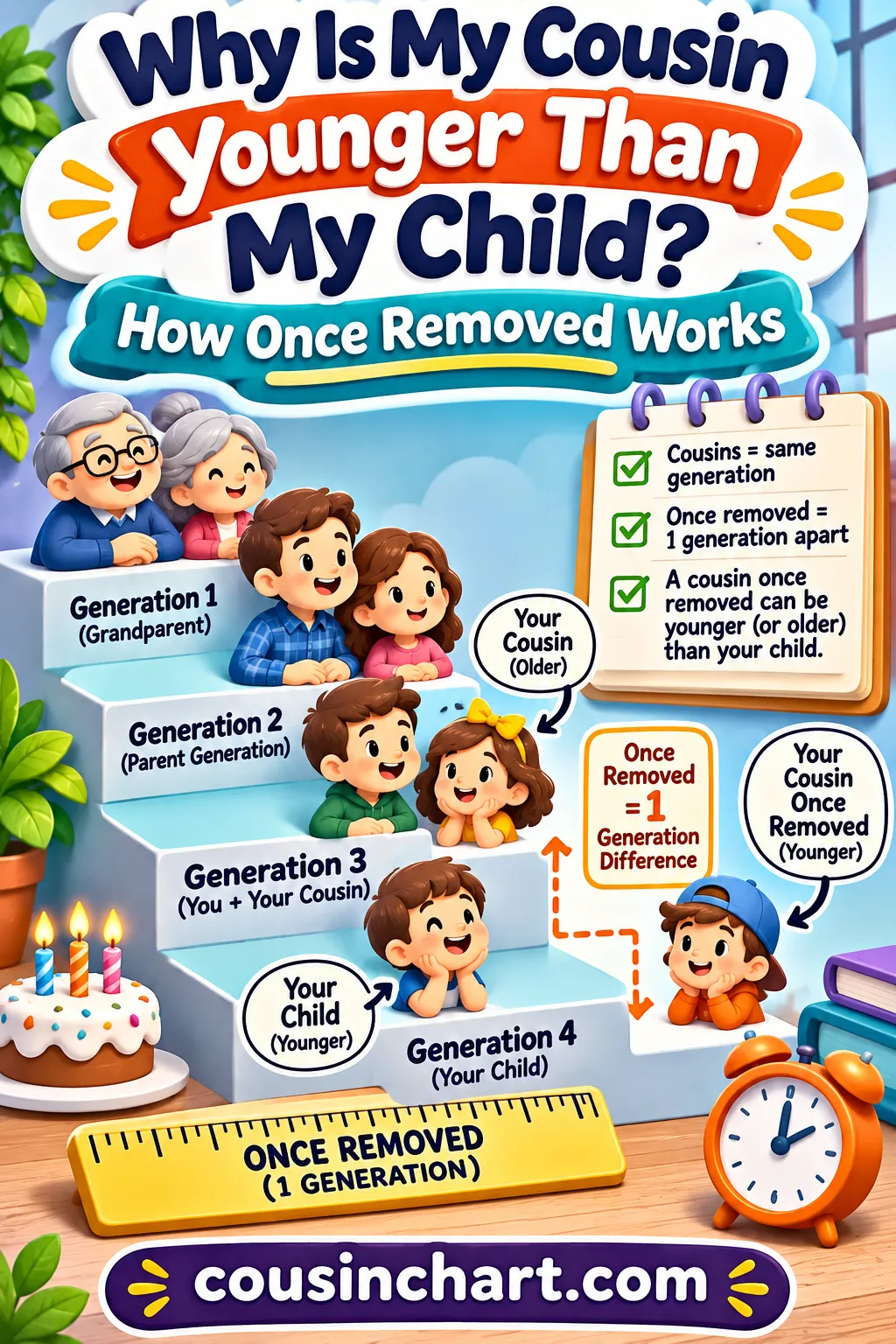
Your cousin can be younger than your child because family labels follow generations, not birthdays. Your first cousin is your aunt or uncle's child, and if they were born late, they can easily arrive after your own kids. To your child, that young cousin of yours is a first cousin once removed, and you can confirm it in seconds with the free Cousin Chart relationship calculator.
It feels backward the first time you see it. Your daughter is eight, your cousin is five, and someone at Thanksgiving asks who's whose cousin. The answer is simple once you stop thinking in years and start counting steps down the family tree.
▶ Work it out in the free calculator
Ages vs. Generations: The Rule That Explains It
Every relationship name in a family is built from one thing: how many generations each person sits below the closest ancestor they share. Age never goes into the math.
Think of a family tree like floors in a building.
- Your grandparents are on the top floor.
- Your parent and your aunts and uncles are one floor down.
- You and your first cousins are two floors down.
- Your kids and your cousins' kids are three floors down.
People on the same floor can be born decades apart. Your mom might be 20 years older than her youngest brother. If that brother had kids in his forties, his children land on your floor, the first cousin floor, even though they're young enough to be your kids.
That's all "cousin younger than my kid" really means. Your cousin is on your floor. Your child is one floor down. The person on the higher floor just happens to be younger.
The floors at a glance
| Floor (generations below your grandparents) | Who lives there | Can be born... |
|---|---|---|
| 0 | Your grandparents | Earliest, as a rule |
| 1 | Your parent, aunts, uncles | Across 20 years or more in big families |
| 2 | You, your siblings, your first cousins | Across 30 years or more |
| 3 | Your kids, your nieces and nephews, your cousins' kids | Overlapping with floor 2 |
| 4 | Your grandkids, your cousins' grandkids | Overlapping with floor 3 |
That last column is the whole story. Each floor's birth years spread out as you go down, and before long, two floors overlap. Someone on floor 2 can be born after someone on floor 3.
Why it happens so often
Big age gaps between cousins are normal in many families. A few common reasons:
- Large families. When your grandparents had kids across 15 or 20 years, the oldest and youngest siblings are almost a generation apart themselves.
- Late children. An aunt or uncle who started a family later than your parent did.
- Second families. A grandparent who remarried and had more children, which also brings in half-aunts and half-uncles.
- Young parents. If you had kids early and your aunt had kids late, the overlap gets even bigger.
None of these change the labels. They just make the labels feel funny.
Second families stretch the gap even further
When a grandparent has children with two different partners, the age range among their kids can get very wide. Say your grandfather had your dad in his twenties, then remarried and had a daughter in his fifties. That daughter is your half-aunt. She might be close to your age, or even younger than you.
Her children are your half first cousins. They're still on your floor of the family tree, 2 generations below your grandfather, just like you. But they could easily be born after your own kids.
To your child, a half first cousin of yours is a half first cousin once removed. The removal works exactly the same way. The only change is that the shared ancestor at the top is one grandparent instead of a couple, so the label picks up a "half" and the expected shared DNA drops to roughly half of a full first cousin once removed.
Families like this often have the most confusing reunion photos. A 6-year-old half-aunt, a 9-year-old nephew and a 4-year-old cousin can all be running around the same backyard. Count the floors, and it sorts itself out. The page on what a half-aunt is covers that side of the family in more detail.
What Your Cousin Is to Your Child
Your first cousin is your child's first cousin once removed. Here's the math.
You and your cousin share your grandparents. Call them Grandma and Grandpa Reyes.
- Grandma and Grandpa Reyes → your mom → you. That's 2 generations down to you.
- Grandma and Grandpa Reyes → your uncle → your cousin. That's 2 generations down to your cousin.
- Grandma and Grandpa Reyes → your mom → you → your child. That's 3 generations down to your child.
Your cousin is 2 down. Your child is 3 down. The smaller number tells you the cousin level: 2 means first cousin. The difference tells you the removal: 3 minus 2 is 1, so once removed.
The word "removed" just means you're on different floors. It doesn't mean less related, and it doesn't care who's older. The explainer on what once removed means has more pictures if you want them.
The label goes both ways
Your cousin is your child's first cousin once removed, and your child is your cousin's first cousin once removed too. The label is the same in both directions. That surprises people, since we're used to "aunt" and "niece" being different words. Cousin labels don't flip.
Who is everyone to your child?
Here's a quick reference for the relatives people ask about most, all seen from your child's seat.
| Relative | Shared ancestor | Counts (your child / them) | To your child, they're... |
|---|---|---|---|
| Your first cousin | Your grandparents | 3 / 2 | First cousin once removed |
| Your cousin's child | Your grandparents | 3 / 3 | Second cousin |
| Your cousin's grandchild | Your grandparents | 3 / 4 | Second cousin once removed |
| Your aunt or uncle | Your grandparents | 3 / 1 | Great-aunt or great-uncle |
| Your parent's first cousin | Your great-grandparents | 4 / 2 | First cousin twice removed |
| Your second cousin | Your great-grandparents | 4 / 3 | Second cousin once removed |
| Your second cousin's child | Your great-grandparents | 4 / 4 | Third cousin |
Your aunt or uncle is a good one to notice. If your youngest uncle is only a few years older than your kids, he's still their great-uncle, two floors up.
A Worked Example: The Reyes Family
Let's lay out a real-looking family with ages so you can see the floors and the years side by side.
- Grandma and Grandpa Reyes had their first child, Elena, when they were young, and their last child, Marco, 18 years later.
- Elena's son is Daniel, now 38.
- Daniel's daughter is Sofia, now 10.
- Marco had his son Leo when he was 38. Leo is 7.
So who's who?
| Person | Generations below Grandma and Grandpa Reyes | Age | Daniel is their… | Sofia is their… |
|---|---|---|---|---|
| Elena | 1 | 63 | Son | Granddaughter |
| Marco | 1 | 45 | Nephew | Great-niece |
| Daniel | 2 | 38 | (himself) | Daughter |
| Leo | 2 | 7 | First cousin | First cousin once removed |
| Sofia | 3 | 10 | Father | (herself) |
Leo is 7 and Sofia is 10, but Leo sits a floor above Sofia. He's her first cousin once removed. If they're playing together at a reunion, they'll probably just call each other cousins, and that's fine.
What about Marco, the young uncle?
Marco is only 7 years older than Daniel. He's still Daniel's uncle, because he's 1 generation below the grandparents and Daniel is 2. It's the same idea in a different spot on the tree. An uncle can be close in age to you, and an aunt can even be younger than you.
Worked Example 2: The Aunt Who's Younger Than You
The Okafor family shows the same rule one floor higher.
- Grandma Okafor had her first child, Grace, at 19. Grace had her son, Chris, at 20.
- Grandma Okafor had her last child, Ada, at 41. That was two years after Chris was born.
- Today, Chris is 30 and Ada is 28.
Ada is Chris's aunt, even though she's two years younger. She's Grace's sister, 1 floor below Grandma. Chris is 2 floors below. One and two is an aunt and nephew line, so the label is aunt, no matter the birth years.
Now the next generation:
- Chris has a son, Jayden, who's 6.
- Ada has a daughter, Zoe, who's 2.
Zoe is 2 floors below Grandma Okafor, the same as Chris. So Zoe is Chris's first cousin, at 2 years old. To Jayden, who's 3 floors down, Zoe is a first cousin once removed, four years younger than him.
Calculator settings for this one:
- Chris to Ada: generations down to you 2, to the other person 1, sex female. Result: aunt.
- Chris to Zoe: 2 and 2. Result: first cousin.
- Jayden to Zoe: 3 and 2. Result: first cousin once removed.
In daily life, the Okafors call Ada "Ada" and Zoe "Zoe," and everyone gets along fine. The labels only come out when someone at church asks how a toddler can be Chris's cousin.
Worked Example 3: A Half-Uncle and His Kids
In the Brennan family, Grandpa Brennan had three kids with his first wife, then a son, Liam, with his second wife when he was 55.
- Grandpa's first son, Pat, has a daughter, Erin, now 35.
- Erin has two kids, ages 9 and 6.
- Liam is 24, and he just had a baby, Rory.
Here's how it lands:
- Liam to Erin: Liam shares only his father with Pat, so he's Pat's half-brother. That makes him Erin's half-uncle, 11 years younger than her.
- Rory to Erin: Rory is 2 down from Grandpa Brennan, and so is Erin. They share only Grandpa, so Rory is Erin's half first cousin, a newborn.
- Rory to Erin's kids: They're 3 down, and Rory is 2 down. Rory is their half first cousin once removed, younger than both of them.
Calculator settings: set Grandpa Brennan as the relative you both come from, generations down to you 3 (for Erin's child), to the other person 2 (Rory), and switch on the half relationship. The result is half first cousin once removed.
The Next Generation: Your Kids and Your Cousin's Kids
Fast-forward a few years. Leo grows up and has a child of his own. What's that child to Sofia?
- Sofia is 3 generations down from Grandma and Grandpa Reyes.
- Leo's child is also 3 generations down.
Three and three makes them second cousins. No removal, because they're on the same floor, even if Sofia is 25 years older.
And Leo's child to Daniel? Daniel is 2 down and the baby is 3 down. Smaller number 2 means first cousin, difference 1 means once removed. So Daniel and Leo's baby are first cousins once removed, the same relationship Sofia has with Leo.
Here's the full picture.
| Pair | Generations (each) | Relationship | Typical shared DNA |
|---|---|---|---|
| You and your cousin | 2 and 2 | First cousins | ~866 cM average |
| Your child and your cousin | 3 and 2 | First cousins once removed | About half of first cousins |
| Your child and your cousin's child | 3 and 3 | Second cousins | ~229 cM average |
| You and your cousin's child | 2 and 3 | First cousins once removed | About half of first cousins |
| Your grandchild and your cousin | 4 and 2 | First cousins twice removed | Less again, wide range |
| Your grandchild and your cousin's grandchild | 4 and 4 | Third cousins | ~73 cM average |
These DNA numbers are averages. Real shared amounts vary, and the ranges for different relationships overlap.
The pattern stays tidy no matter how far you go. Same floor means plain cousins. Different floors means removed. The first cousin once removed page shows more examples of this exact pairing.
Second cousin or first cousin once removed?
These two labels get swapped more than any others, and age gaps make it worse. If your 7-year-old cousin is close in age to your 10-year-old, people assume they're "the same kind of cousin" and call them second cousins. They're not. Your cousin is on your floor, and your child is one floor down, so it's once removed. Second cousins are on the same floor, like your child and your cousin's child. The page on second cousin vs. first cousin once removed lays the two side by side.
Other Age Puzzles That Follow the Same Rule
Once you see that generations decide the label, a lot of odd family moments make sense.
An aunt who's younger than you. If your grandmother had a baby after you were born, that baby is your aunt or uncle. She's one floor above you no matter what year she arrived.
A niece older than you. If your much older half-sibling had kids before you were born, those kids are your nieces and nephews, even if they're older than you.
A great-uncle your own age. It happens in very large families. He's the brother of a grandparent, so he's one floor above your parents.
Cousins in different school grades. First cousins are often 10 or 15 years apart. That doesn't make them "removed." Only a generation difference does.
A grandchild older than your youngest child. If your oldest child became a parent before you had your last baby, your grandchild is older than your youngest child. Your youngest is still that grandchild's aunt or uncle.
A second cousin old enough to be your grandparent. In families where one line had children young for several generations and another had them late, two people on the same floor can be 50 years apart. Same floor, plain second cousins.
If you'd like a broader look at how generations stack up, the guide to family generations explained walks through it from the top.
How to Check It With the Calculator
The relationship calculator is built around the same floor-counting idea. You choose the relative you both come from, then count how many generations down each person is. Here's exactly how to set it.
Your cousin and your child
- Think of your grandparents as the relatives you both come from.
- Set the generations down on the "you" side to 3, for your child.
- Set generations down to the other person, your cousin: 2.
- Leave half off, unless your parent and your cousin's parent are half-siblings.
- Result: first cousin once removed.
Your child and your cousin's child
- Your grandparents are still the shared relatives.
- Set 3 generations down for your child.
- Set 3 generations down for your cousin's child.
- Result: second cousin.
A quicker route for one of these
The quick-pick buttons cover some of the common age-gap questions. "My cousin's child" gives you the first cousin once removed answer straight away, because that's the same relationship your child has with your cousin, just viewed from the other end.
If your aunt or uncle is a half-sibling of your parent
Turn on the half relationship option. Your cousin then becomes your half first cousin, and to your child they're a half first cousin once removed. The structure stays the same; the "half" just rides along.
You'll see the relationship name with a small chart showing both paths. You can copy the result, download the chart, or print it, which is handy when a relative at a reunion doesn't believe you.
All the settings in one table
| Question | Generations down to you | To the other person | Options | Result |
|---|---|---|---|---|
| My cousin, to my child | 3 (your child) | 2 | none | First cousin once removed |
| My child and my cousin's child | 3 | 3 | none | Second cousin |
| My young aunt, to me | 2 | 1 | Sex: female | Aunt |
| My young aunt, to my child | 3 | 1 | Sex: female | Great-aunt |
| My half-aunt's kid, to my child | 3 | 2 | Half on | Half first cousin once removed |
| My cousin's grandchild, to my child | 3 | 4 | none | Second cousin once removed |
When you're entering it for your child, remember that "you" in the calculator is the person you're asking about, so set the count for your child, not yourself.
How to Explain It to Kids
Kids love this puzzle once it clicks. A simple way to put it:
- "Your cousin Leo is Daddy's cousin. That means he's a generation above you, like Daddy."
- "He's younger than you, but in the family tree he's up a step."
- "When you and Leo's kids grow up, they'll be your second cousins, because you'll be on the same step."
Drawing it on paper helps. Put the grandparents at the top, then draw steps going down. Most kids get it in about two minutes, which is faster than a lot of adults. The guide on how to explain cousins to kids has more ideas like this.
Scripts by age
Ages 3 to 5: Keep it simple. "Leo is your cousin. He's part of our family, and he comes to Grandma's house too." There's no need for "removed" at this age.
Ages 6 to 9: Use the stairs. "Grandma is at the top. Daddy and Leo are on the next step down together. You're on the step below Daddy. Leo is on a higher step, even though he's littler."
Ages 10 and up: Give them the real rule and let them try it. "Count steps from Grandma to you, then from Grandma to Leo. Three and two. When the numbers don't match, we say removed. One step apart is once removed." Then ask them to work out what Leo's future kids will be to them.
What kids actually call each other
In real life, children usually call any relative near their age "cousin," and grown-ups rarely correct them. The exact label matters most for family trees, DNA matches and medical history. Day to day, use whatever feels natural for your family.
What to Call Each Other Day to Day
The tree label and the everyday name don't have to match. Families handle age-gap relatives in a few common ways.
| Situation | Formal label | What families often say |
|---|---|---|
| Your young cousin, to your child | First cousin once removed | Cousin, or just their name |
| A young aunt or uncle, to you | Aunt or uncle | Their first name |
| A young great-aunt, to your child | Great-aunt | Aunt plus first name, or just the name |
| An older first cousin once removed | First cousin once removed | Aunt or Uncle, as a sign of respect |
| Your kids and your cousin's kids | Second cousins | Cousins |
None of these is wrong. Many families give an older relative an "Aunt" or "Uncle" title out of respect, and drop it for a younger one who'd feel silly being called "Aunt Zoe" at age two. Pick what fits, and keep the formal label for the family tree.
When an adult asks at a party
Someone always asks. A short answer usually does it:
- "She's my cousin. My uncle had her late, so she's younger than my kids."
- "Technically he's my daughter's first cousin once removed. They just call each other cousins."
- "Yes, she's my aunt. Grandma had her after I was born."
If they want more, draw the floors on a napkin, or pull up the calculator and show them the chart.
Where the Exact Label Matters
Most days, "cousin" is plenty. A few situations call for the precise name, and age gaps are exactly where people get it wrong.
Family trees. If you're building a tree, each person goes on their true generation row. Put your young cousin on your row, not your child's, or every relationship below them will come out wrong.
DNA results. If your child takes a DNA test and matches your young cousin, the match list may suggest a range of possible relationships. Knowing that the real link is first cousin once removed helps you read the result. On average, that relationship shares about 433 cM, compared with about 229 cM for second cousins. Ranges vary and overlap, so use the tree and the DNA together.
Reunion name tags and place cards. A tag that says "Leo, Daniel's cousin" helps everyone. One that says "Leo, Sofia's cousin" is close enough for kids but can confuse the grown-ups doing the family tree.
Family stories and records. When someone writes down the family history, the generations matter. "Leo was born the same year as his first cousin once removed, Sofia's little brother" is clear. "Leo and Sofia's brother were cousins the same age" leaves future readers guessing.
Worked Example 4: Reading a DNA Match With an Age Gap
Maria is 41. Her daughter, Lucia, is 16 and took a DNA test for a school project. One of Lucia's top matches is Mateo, 12. Lucia has no idea who he is.
Maria recognizes the name. Mateo is the son of her uncle Tony, who started a family late. So Mateo is Maria's first cousin, even though he's four years younger than her daughter.
Here's how Maria checks it:
- Shared ancestors: Maria's grandparents, Tony's parents.
- Counts: Lucia is 3 down. Mateo is 2 down.
- Calculator: generations down to you 3, to the other person 2, sex male. Result: first cousin once removed.
- DNA check: the amount Lucia shares with Mateo sits in the range you'd expect for a first cousin once removed. It's higher than you'd expect for a second cousin, which is what Lucia guessed from his age.
Lucia's mistake is a common one. She assumed a kid younger than her had to be on her floor or below. The DNA pointed one floor up, and the tree confirmed it.
Edge Cases: Step, Adopted and Double Cousins
Step-relatives. If your stepmother's young nephew comes to family events, he's your step-cousin, not a blood cousin. To your child, he's a step-relative too. In the calculator, set the relation type to step to see the step label. The floors still help you place him, but there's no shared ancestor by blood.
Adopted relatives. An adopted child sits on the same floor a birth child would. If your aunt adopted a little boy last year, he's your first cousin and your child's first cousin once removed, just like a birth child of hers would be. The one difference is DNA: an adoptee won't share DNA with their adoptive relatives.
Double cousins. If two siblings in your family married two siblings in another, their children are double first cousins. The floor rule works the same way. A double first cousin of yours is your child's double first cousin once removed, linked through two couples instead of one.
Your spouse's young cousin. Your spouse's first cousin is your cousin-in-law. To your child, they're a first cousin once removed by blood, on your spouse's side. Same floors, same label, just counted through the other parent.
How to Draw a Floor Chart for Your Family
If the age gaps in your family keep confusing people, a simple floor chart clears it up. It takes about ten minutes.
- Pick the top couple. Usually the grandparents everyone shares. Write their names at the top of a sheet.
- Draw horizontal lines for each floor. Label them 1, 2, 3 and 4.
- Place each person on their floor. Children of the top couple on floor 1. Their kids on floor 2. And so on. Ignore ages completely while you do this.
- Add birth years under each name. Now the age gaps show up, but they don't move anyone off their floor.
- Connect parents and children with lines. This shows each branch running down the page.
- Shade the surprising pairs. Circle anyone who's younger than someone on the floor below. Those are the people your relatives will ask about.
Bring it to the next gathering. Kids will find themselves, then their cousins, then the young aunt nobody could explain.
Common Mix-Ups With "Removed"
- Thinking removed means age. It means generations. A first cousin once removed can be older, younger or the same age as you.
- Thinking removed means "your cousin's kid only." It goes both ways. Your parent's cousin is also your first cousin once removed.
- Calling your cousin's kid your second cousin. Second cousins are on the same floor, 3 and 3 from a shared couple. Your cousin's child is 2 and 3 from your grandparents, so they're once removed instead.
- Thinking second cousin is closer than first cousin once removed. A first cousin once removed usually shares more DNA with you on average than a second cousin does.
- Counting from the wrong person. When you check the relationship between your child and your cousin, the counts start at your grandparents, not at your parents. Your parents aren't your cousin's ancestors.
- Dropping the half. If your cousin comes from a grandparent's second marriage, the link to your child is half first cousin once removed. The removal is the same; just remember the "half" when you write it in a tree.
- Assuming a younger relative must be lower on the tree. It's the most natural guess and the most common error. Always count the floors before you assign a label.
A quick checklist before you label an age-gap relative
Run through these five checks whenever a relative's age doesn't match what you'd expect from their label.
- Who is the closest couple, or person, you both come from? Write their names down first.
- How many floors down is each of you? Count parent to child, one step at a time, starting at 1 for the couple's children.
- Is either count 1? Then it's an aunt, uncle, niece or nephew line, not cousins.
- Do you share a couple or only one person? If only one, add "half."
- Did you look at birth years at any point in steps 1 to 4? If you did, start over. Ages only come in after the label is settled.
That last check sounds like a joke, but it's the one that catches most mistakes. The moment you think "she can't be my aunt, she's younger than me," you've let the birthday back into the math. Count the floors, trust the counts, then enjoy the surprise.
Next time someone at a family party asks how a 7-year-old can be your cousin, open the free relationship calculator, enter the generations, and show them the chart.
▶ Work it out in the free calculator
Frequently Asked Questions
How can my cousin be younger than my child?
Your cousin is your aunt or uncle's child, so they're in your generation no matter when they were born. If your aunt or uncle had kids much later than your parent had you, your cousin can arrive after your own children. Age doesn't change the label.
What is my cousin to my son or daughter?
Your first cousin is your child's first cousin once removed. Your cousin is 2 generations below your shared grandparents and your child is 3, and that one-generation difference is the "once removed."
Are my kids and my cousin's kids second cousins?
Yes. Both sets of children are 3 generations below the grandparents you and your cousin share. Same generation, one level further out than you and your cousin, so they're second cousins.
Can someone be my aunt if she's younger than me?
Yes. If she's your parent's sister or half-sister, she's your aunt, even if she was born after you. Big gaps between the oldest and youngest siblings make this fairly common.
Does once removed mean my cousin is less related?
It means you're in different generations. A first cousin once removed usually shares less DNA than a first cousin but more than a second cousin, on average. The label is about position on the tree, not closeness.
What's my cousin's grandchild to my grandchild?
They're third cousins, as long as they're both 4 generations below your shared grandparents. Because they're on the same level, there's no "removed" in the name.
What is my young aunt to my child?
She's your child's great-aunt. Your aunt is 1 generation below your grandparents and your child is 3, so it's an aunt line two steps apart, even if she's only a few years older than your child.
Should my kids call my young cousin "Aunt" or "Uncle"?
That's a family choice, not a rule. The tree label is first cousin once removed, but many families use "Aunt" or "Uncle" for an older relative in that spot out of respect. For a cousin who's younger than your kids, first names usually feel more natural.
What is my half-cousin to my child?
Your half first cousin is your child's half first cousin once removed. The counts are the same as with a full cousin, 3 and 2 from the shared grandparent, and the "half" carries over because you share only one grandparent, not a couple.